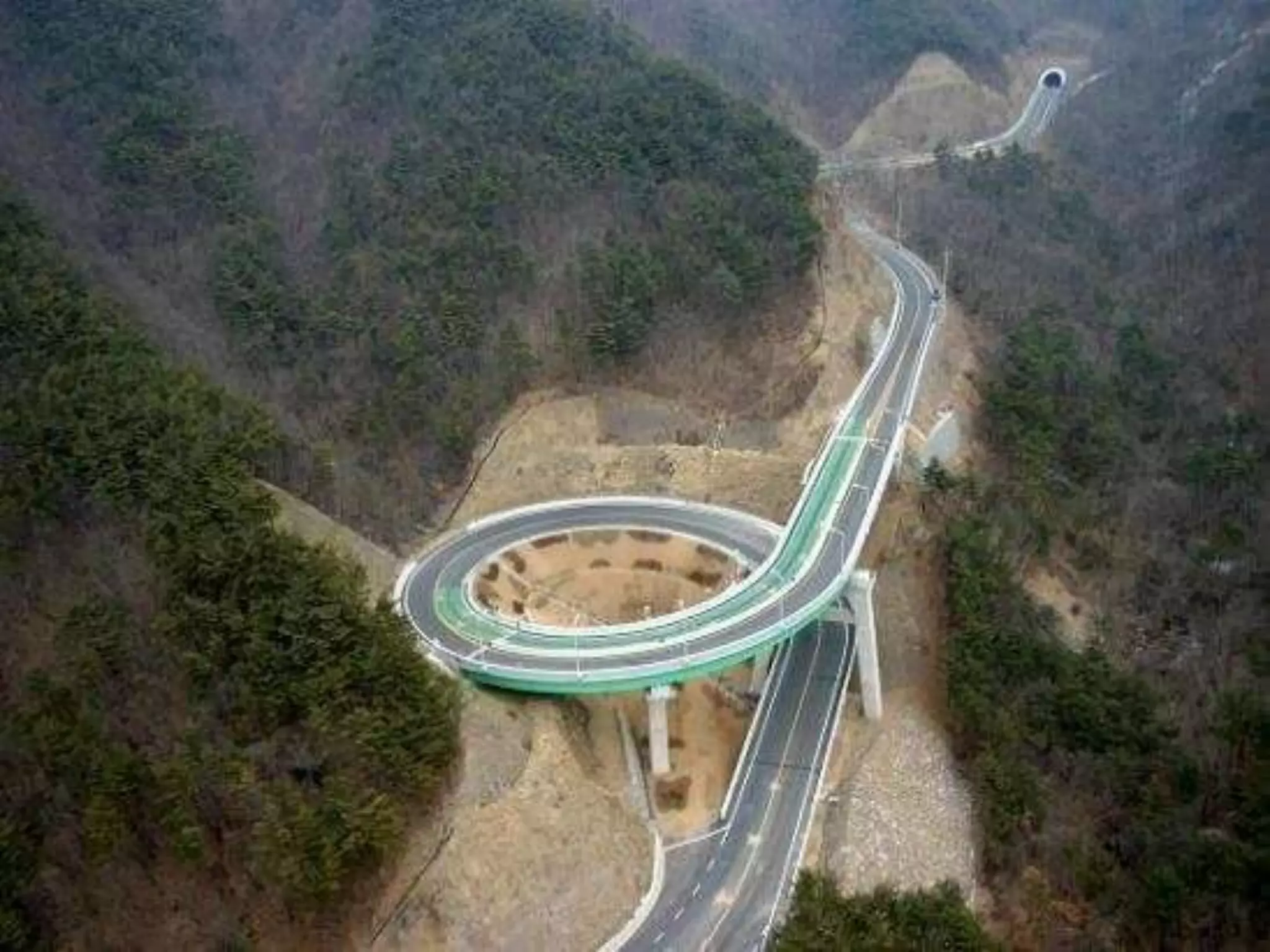
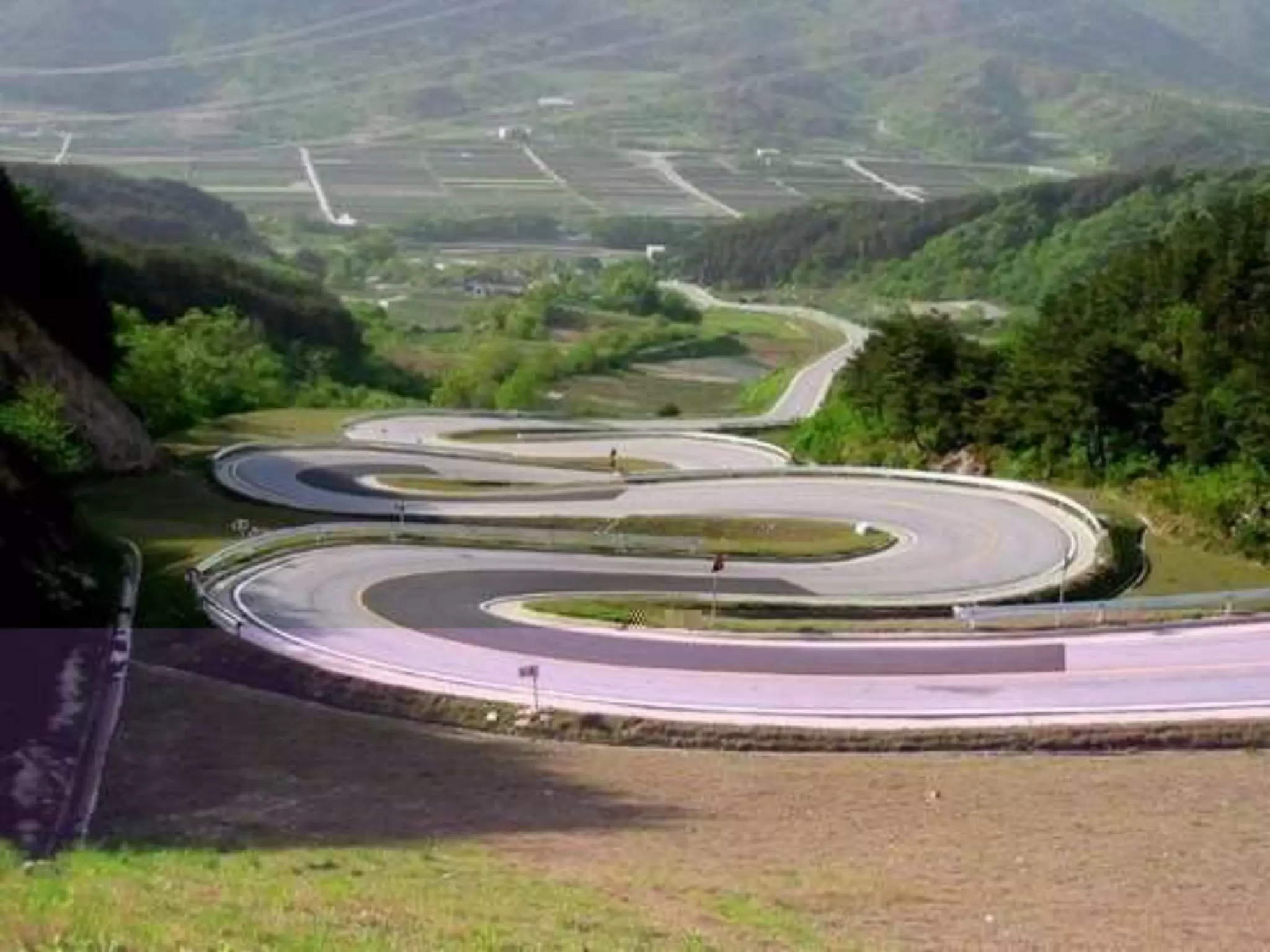
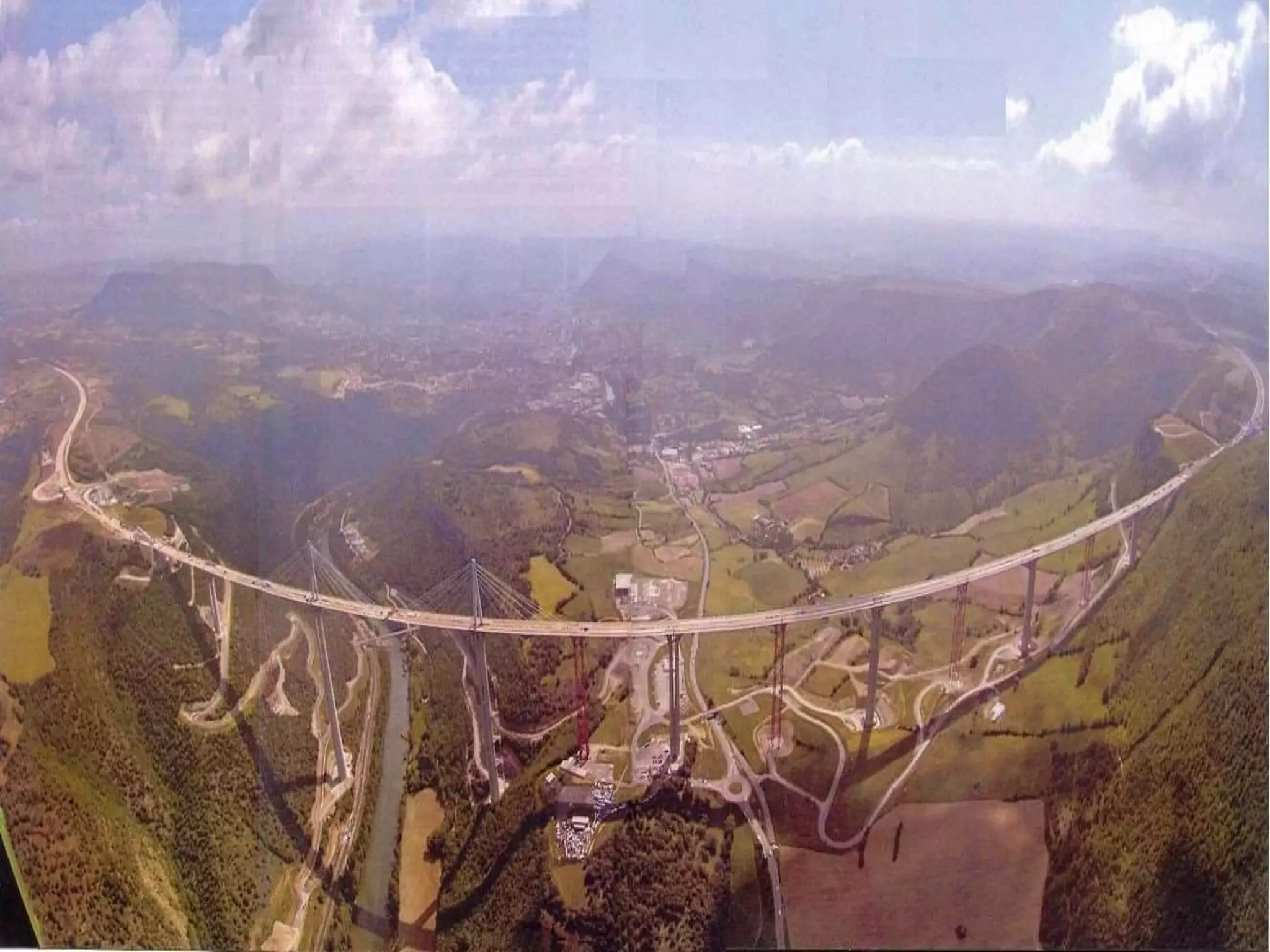
A bridge is a structure that permits us to cross over an obstacle.
Suppose we lay a plank across a brook. If we have a bridge. If the plank is thin in
relation to
its length , it will sag. In fact, if it is too long, it will collapse. This shows that we
must consider the
weight of a bridge itself---the “dead load”.
If we stand at the middle of the plank, it sags even more. So, we
must provide for the weight of whatever our bridge is designed to
carry--- the “live load”.
Also, when you walk across the plank, it bounces under you,
illustrating the effect of a “moving live load”.
Finally, there is a “wind load”. A strong wind pushes against the
sides, lifts the deck, shakes the whole structure. Certainly the force of
the wind is something to keep in mind.
Bridges help us to connect to each other and the world.
There are four main types of physical bridges. They are arch, beam,
suspension and cable-stayed.
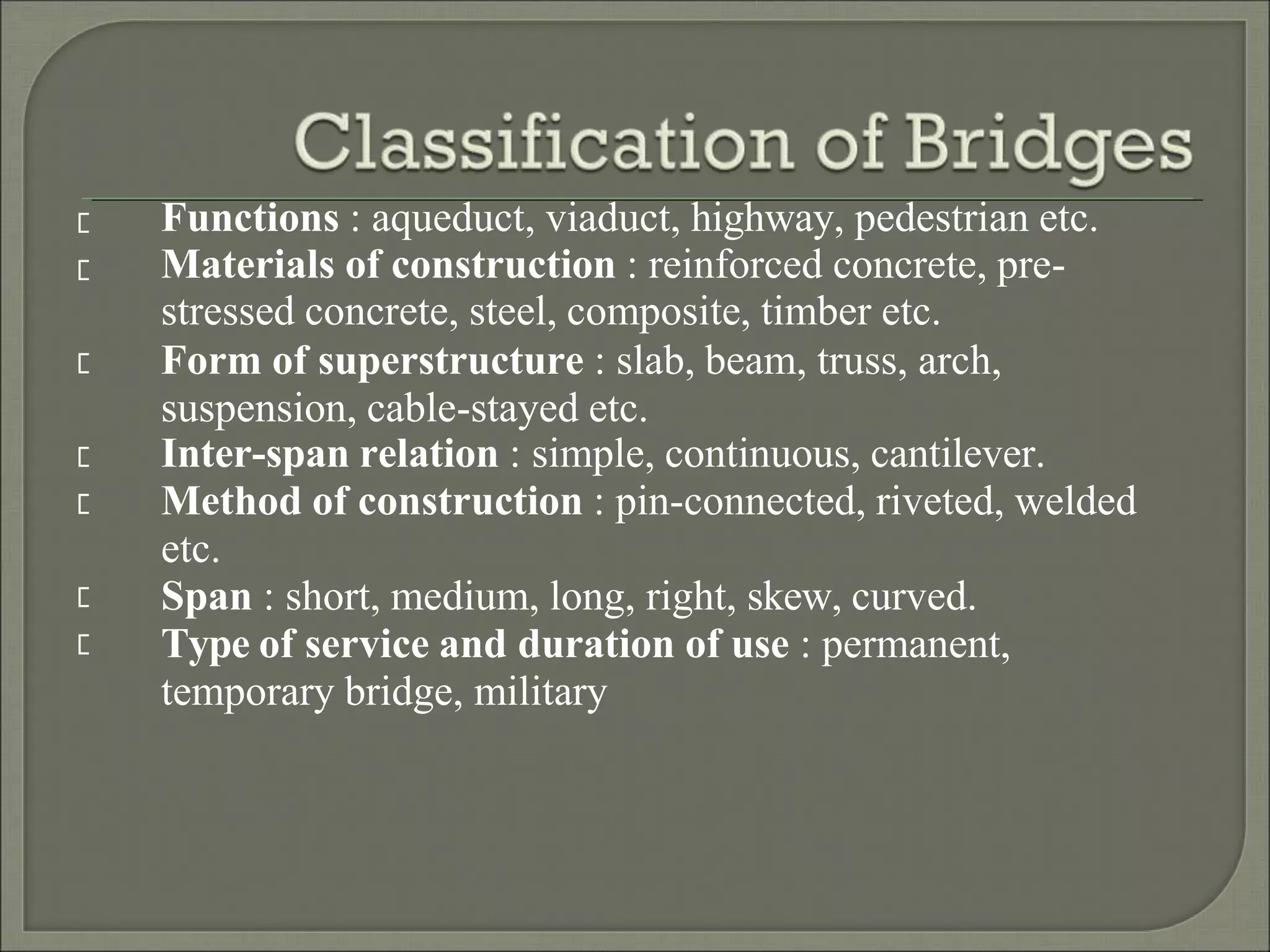
Functions : aqueduct, viaduct, highway, pedestrian etc.
Materials of construction : reinforced concrete, pre-
stressed concrete, steel, composite, timber etc.
Form of superstructure : slab, beam, truss, arch,
suspension, cable-stayed etc.
Inter-span relation : simple, continuous, cantilever.
Method of construction : pin-connected, riveted, welded
etc.
Span : short, medium, long, right, skew, curved.
Type of service and duration of use : permanent,
temporary bridge, military
SUSPENSION BRIDGE
COMPARISION
Advantages over other bridge
types
Longer main spans
Less material may be required than other
bridge types, even at spans they can achieve,
leading to a reduced construction cost
Except for installation of the initial temporary
cables, little or no access from below is required
during construction, for example allowing a
waterway to remain open while the bridge is built
above
A suspension bridge can be made out of
simple materials such as wood and common
wire rope.
May be better to withstand earthquake
movements than heavier and more rigid bridges
Disadvantages over other bridge
types
Considerable stiffness may be
required to prevent the bridge deck
vibrating under high winds
The relatively low deck stiffness
compared to other (non-suspension)
types of bridges makes it more
difficult to carry heavy rail traffic
where high concentrated live loads
occur
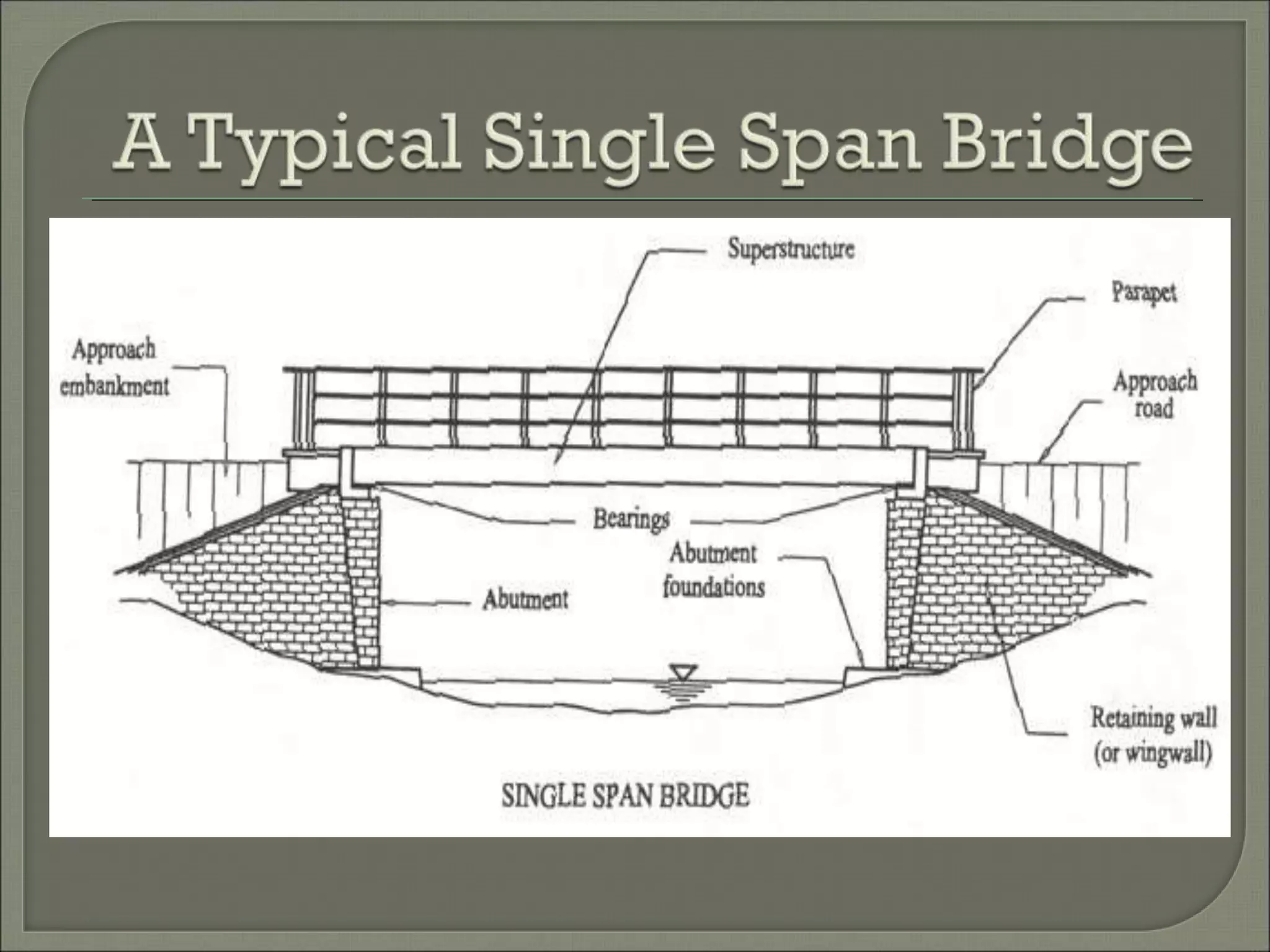
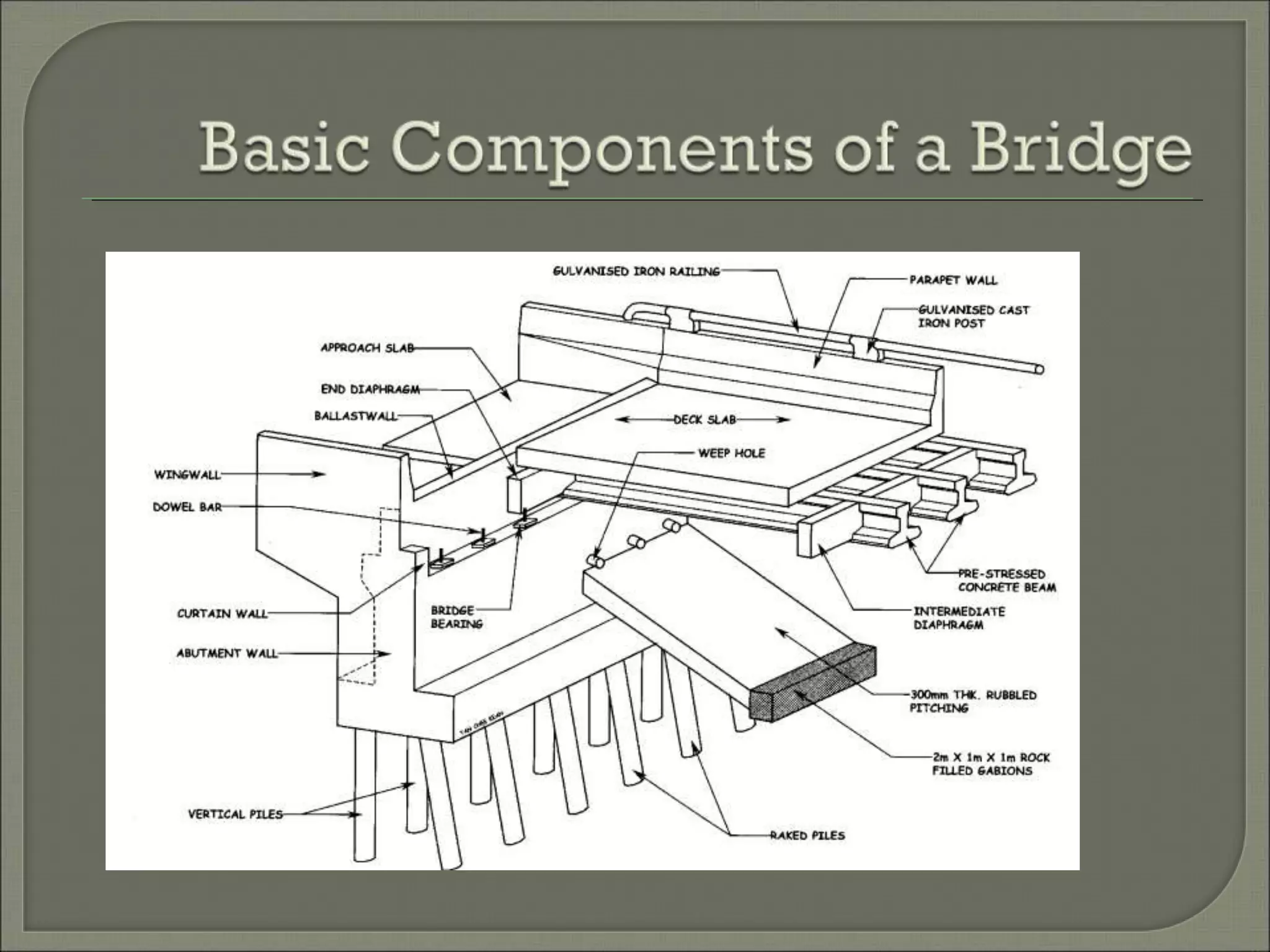
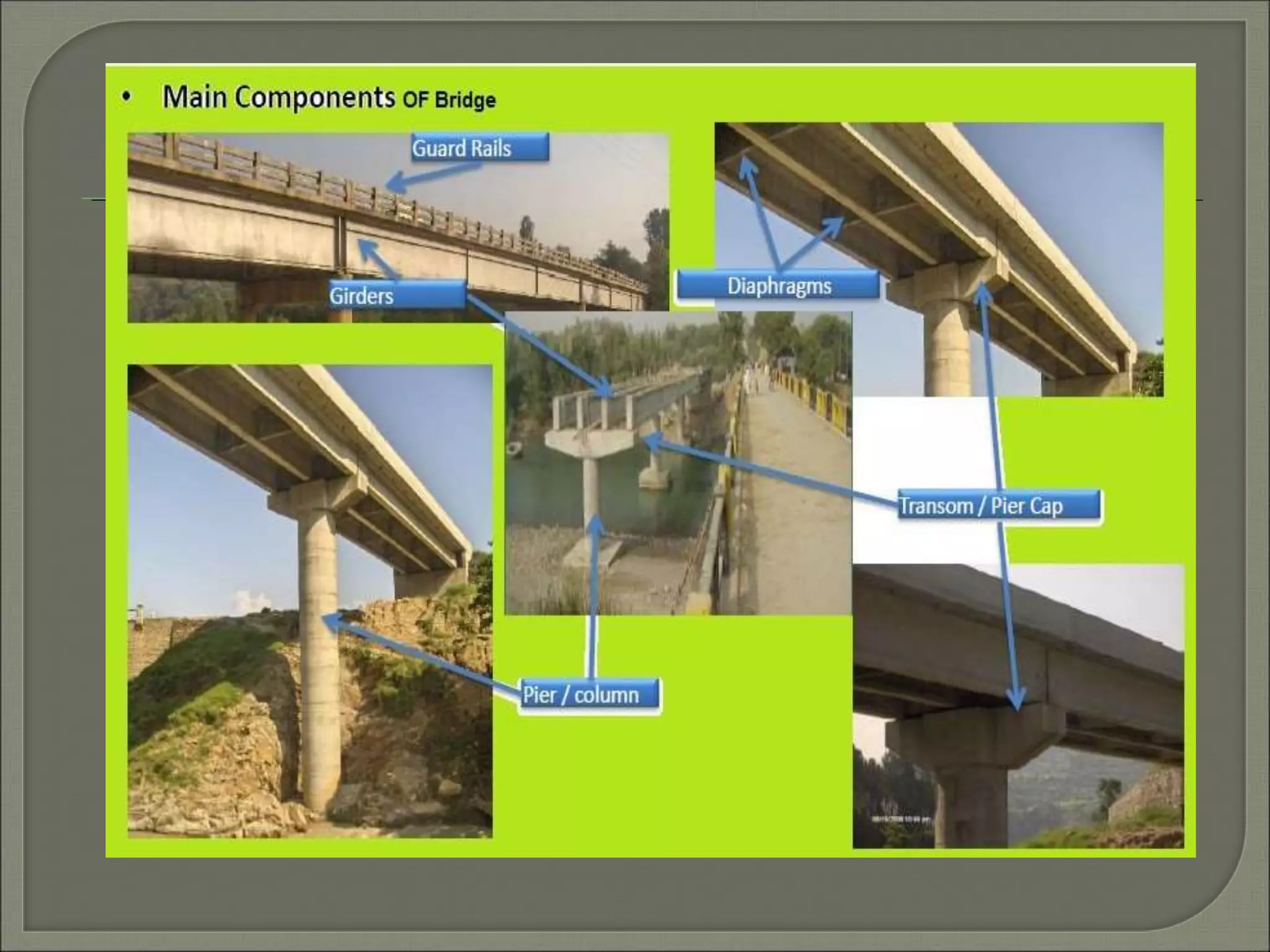
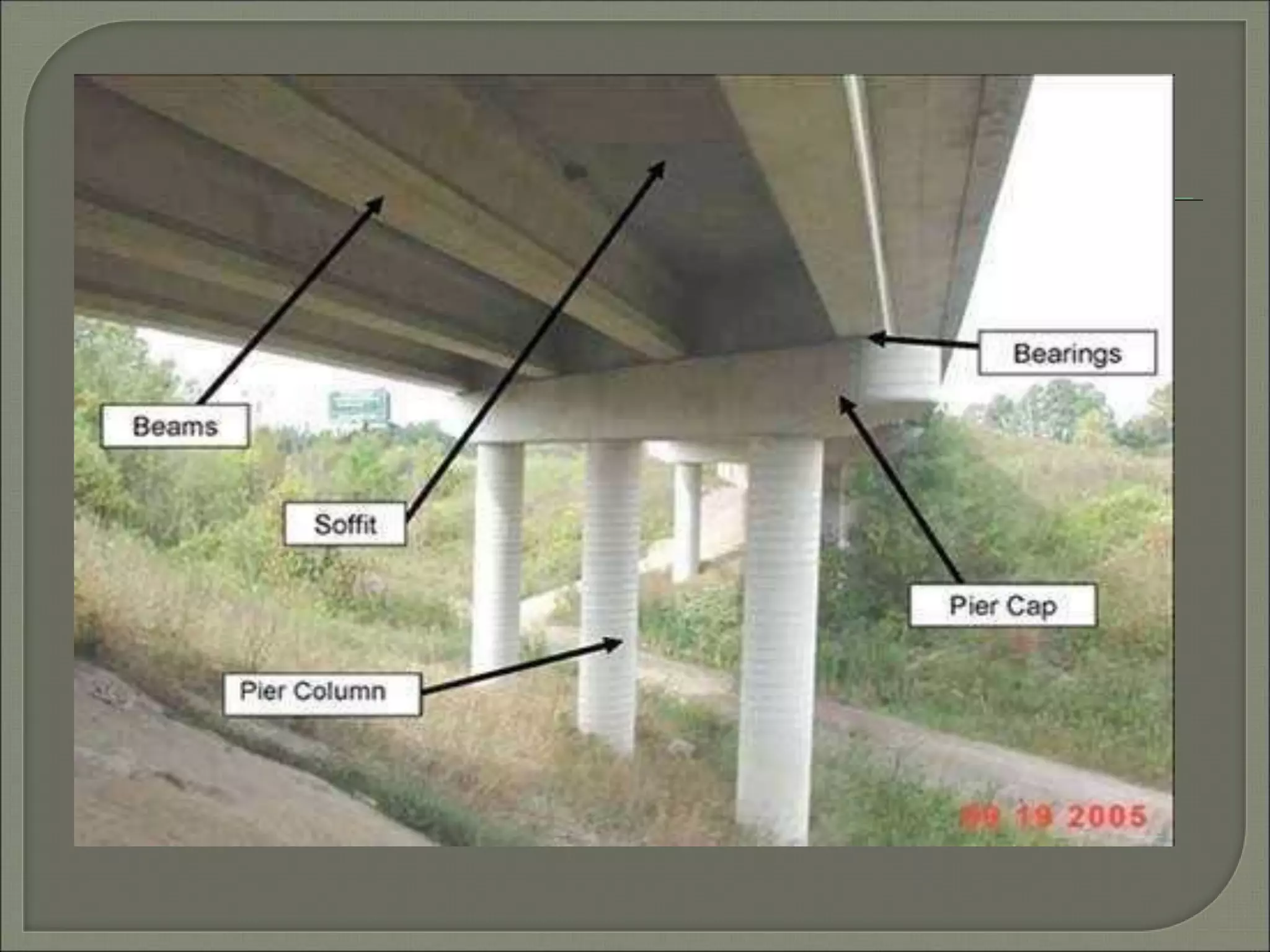
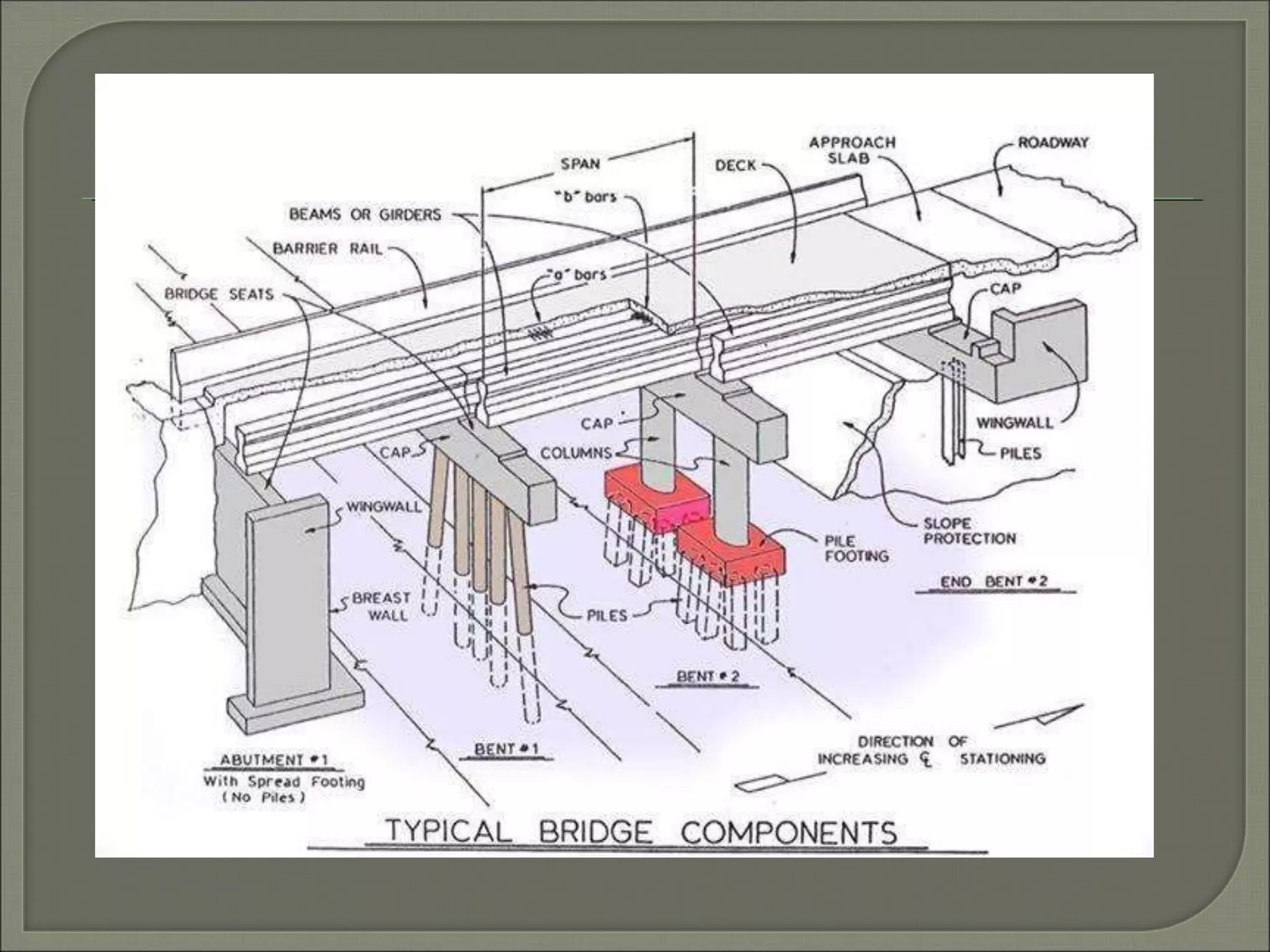
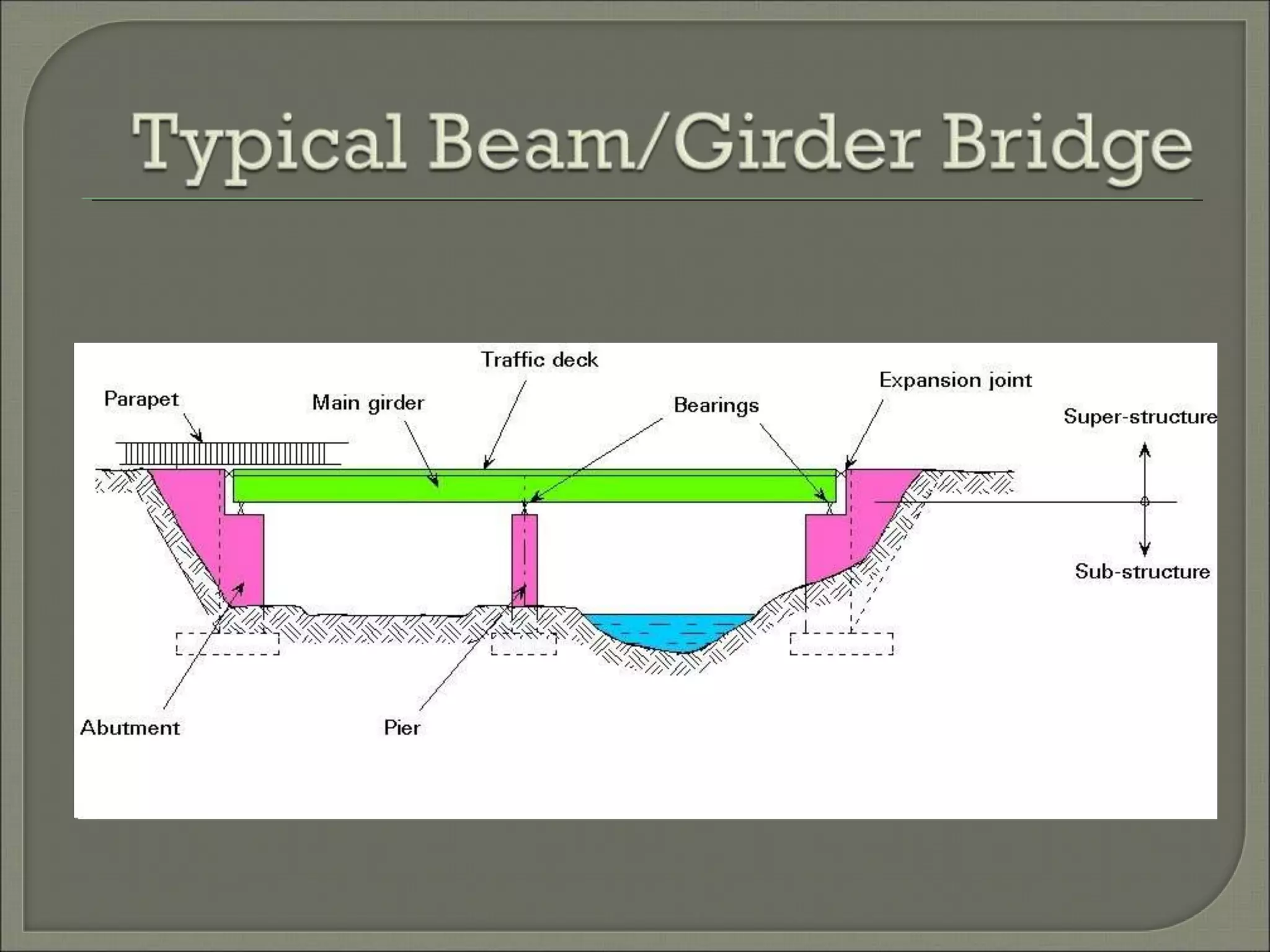
The two basic parts are:
Substructure - includes the piers, the abutments and the
foundations.
Superstructure - consists of the deck structure itself, which
support the direct loads due to traffic and all the other
permanent and variable leads to which the structure is
subjected.
The connection between the substructure and the
superstructure is usually made through bearings. However,
rigid connections between the piers (and sometimes the
abutments) may be adopted, particularly in frame bridges
with tall (flexible) piers.
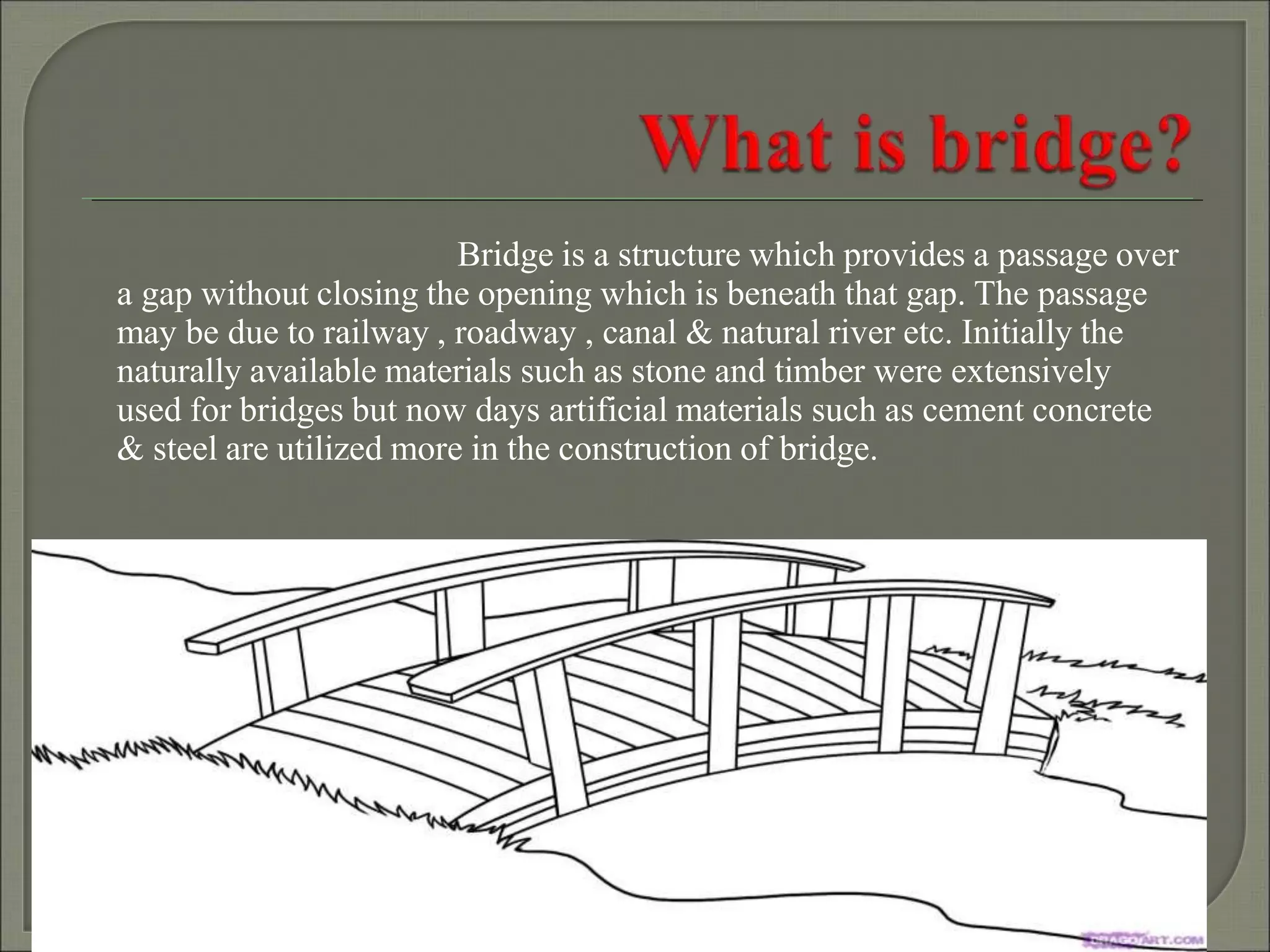
Bridge is a structure which provides a passage over
a gap without closing the opening which is beneath that gap. The passage
may be due to railway , roadway , canal & natural river etc. Initially the
naturally available materials such as stone and timber were extensively
used for bridges but now days artificial materials such as cement concrete
& steel are utilized more in the construction of bridge.
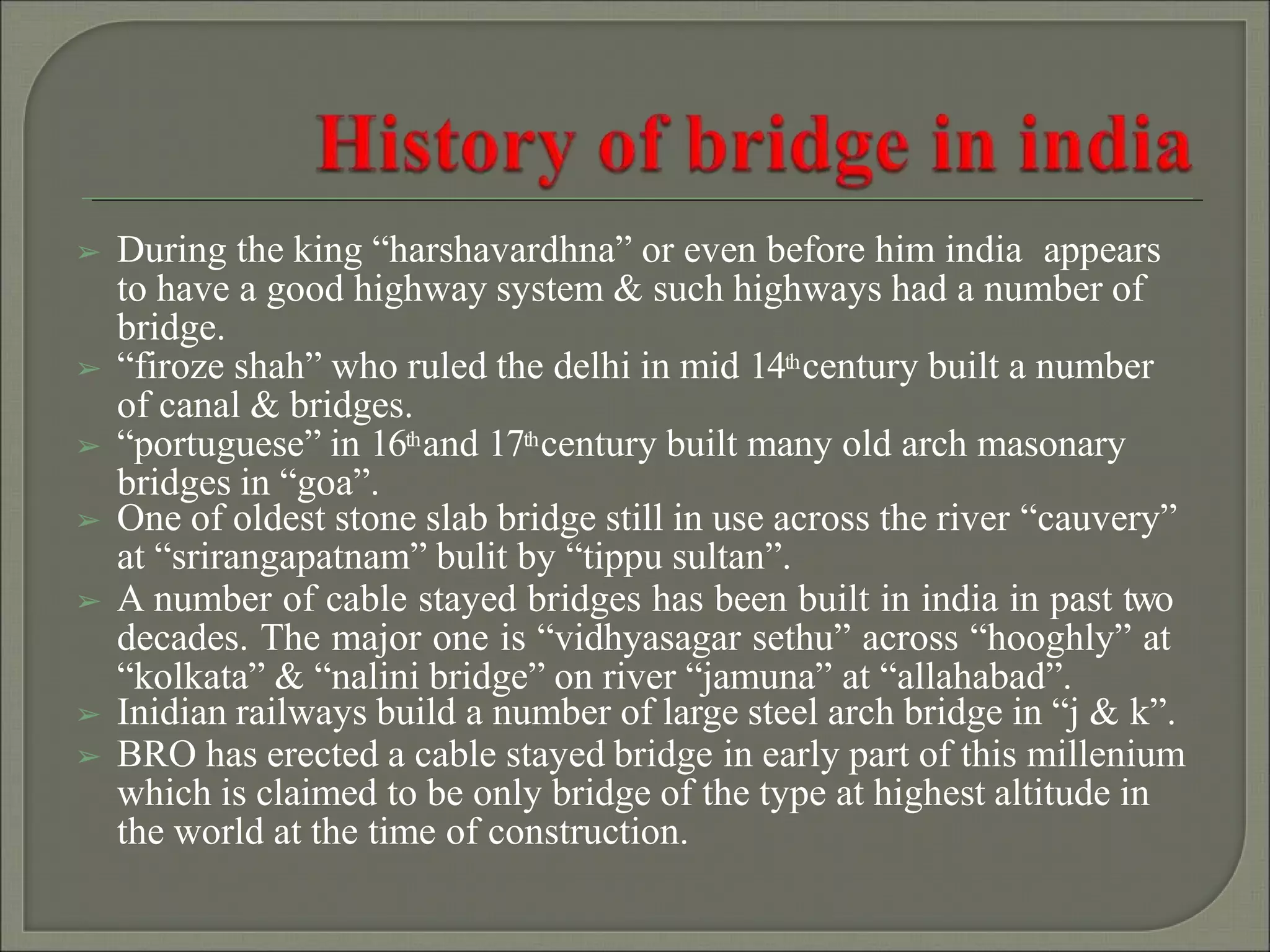
➢ During the king “harshavardhna” or even before him india appears
to have a good highway system & such highways had a number of
bridge.
➢ “firoze shah” who ruled the delhi in mid 14thcentury built a number
of canal & bridges.
➢ “portuguese” in 16thand 17thcentury built many old arch masonary
bridges in “goa”.
➢ One of oldest stone slab bridge still in use across the river “cauvery”
at “srirangapatnam” bulit by “tippu sultan”.
➢ A number of cable stayed bridges has been built in india in past two
decades. The major one is “vidhyasagar sethu” across “hooghly” at
“kolkata” & “nalini bridge” on river “jamuna” at “allahabad”.
➢ Inidian railways build a number of large steel arch bridge in “j & k”.
➢ BRO has erected a cable stayed bridge in early part of this millenium
which is claimed to be only bridge of the type at highest altitude in
the world at the time of construction.
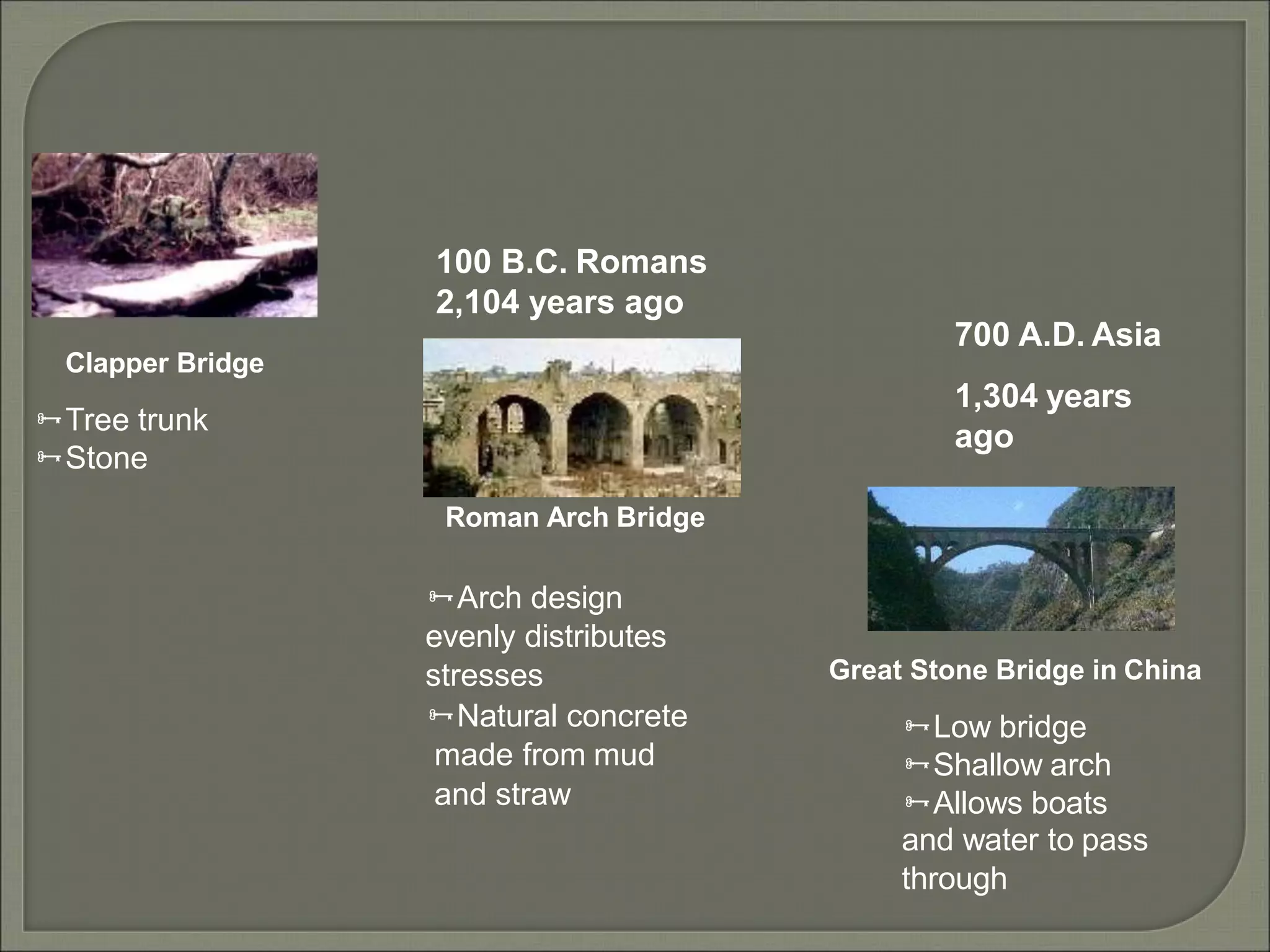
700 A.D. Asia
1,304 years
ago
100 B.C. Romans
2,104 years ago
Clapper Bridge
Tree trunk
Stone
Arch design
evenly distributes
stresses
Natural concrete
made from mud
and straw
Roman Arch Bridge
Great Stone Bridge in China
Low bridge
Shallow arch
Allows boats
and water to pass
through
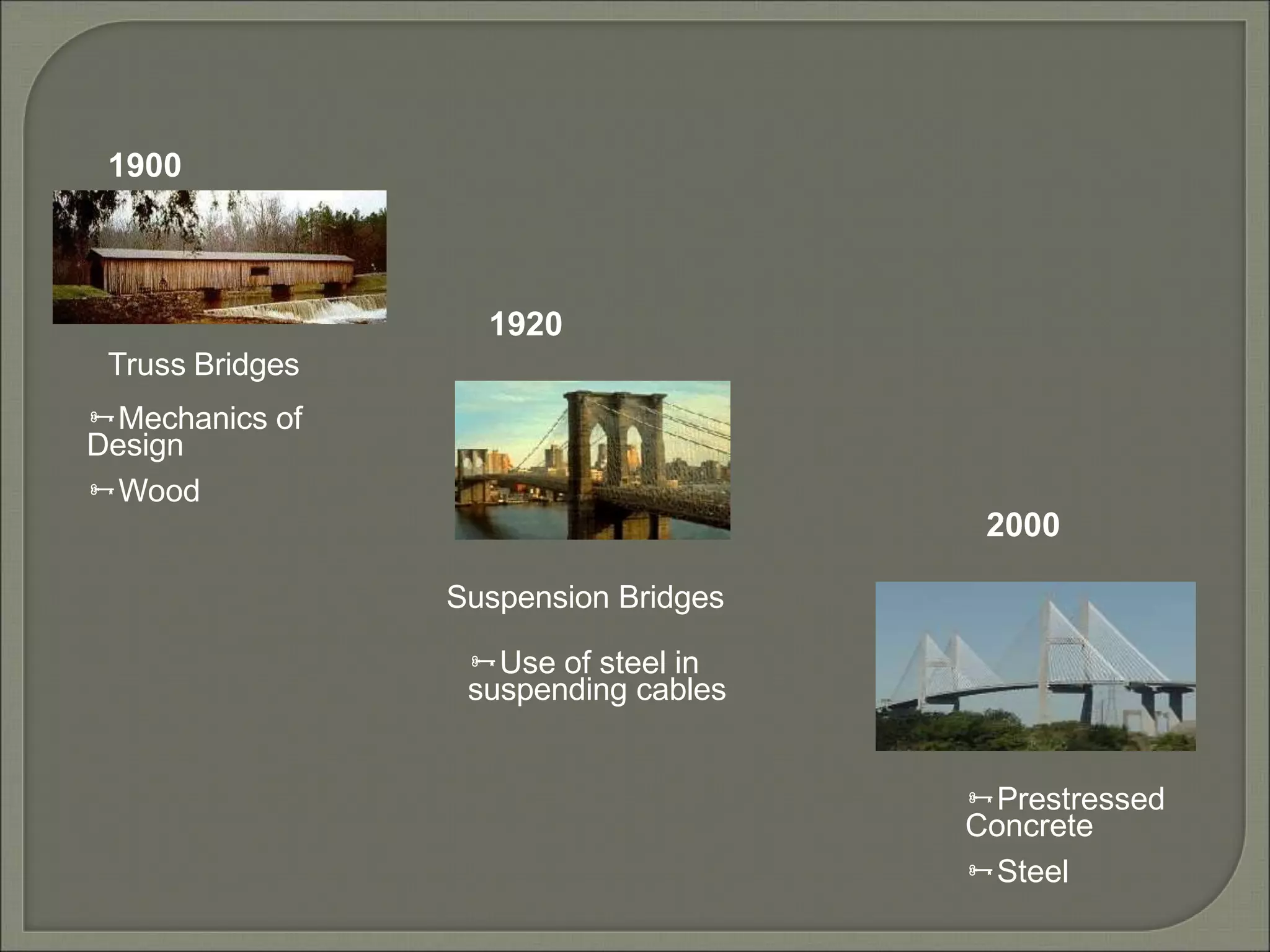
Truss Bridges
Mechanics of
Design
Wood
Suspension Bridges
Use of steel in
suspending cables
1900
1920
Prestressed
Concrete
Steel
2000
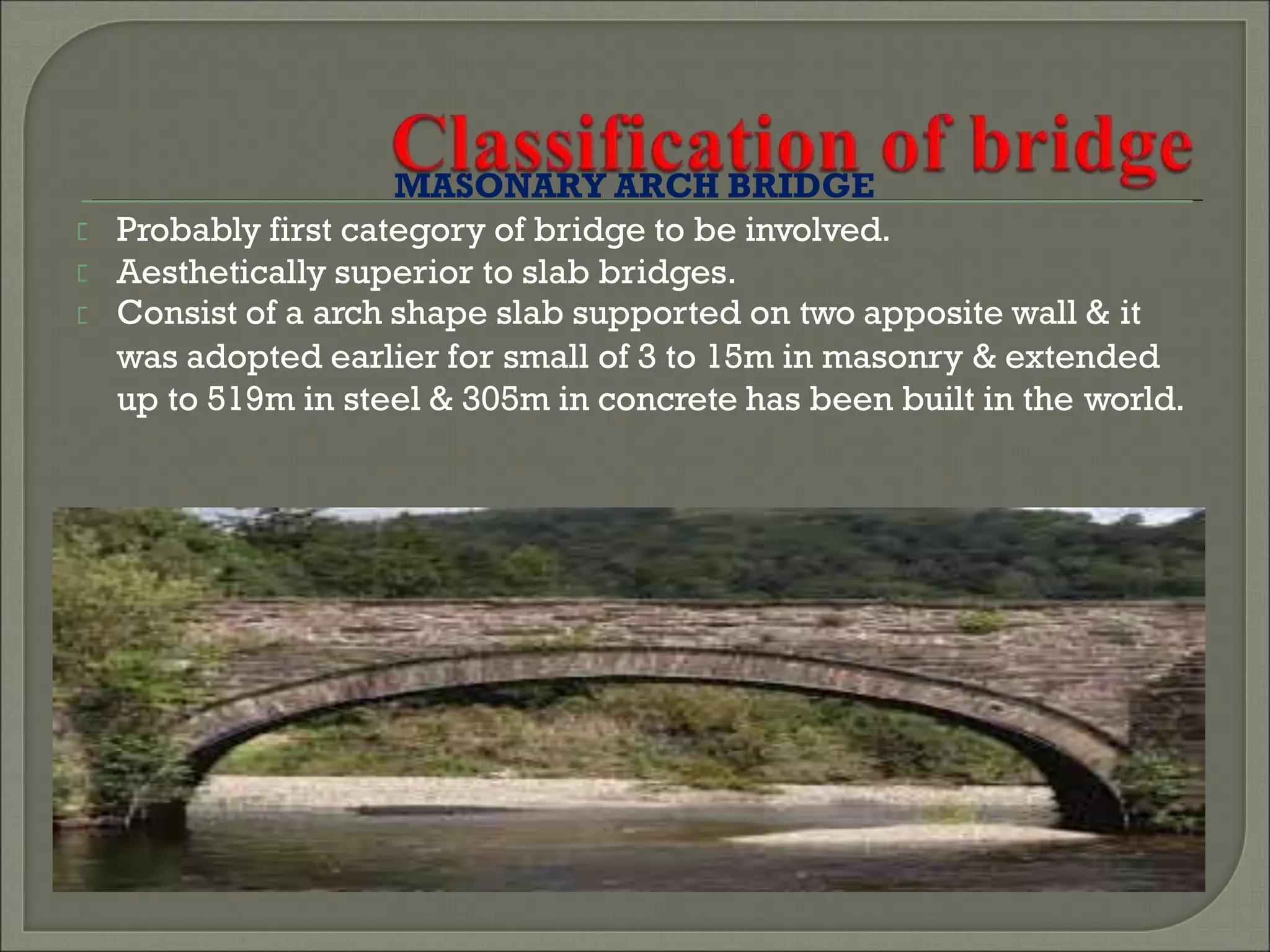
MASONARY ARCH BRIDGE
Probably first category of bridge to be involved.
Aesthetically superior to slab bridges.
Consist of a arch shape slab supported on two apposite wall & it
was adopted earlier for small of 3 to 15m in masonry & extended
up to 519m in steel & 305m in concrete has been built in the world.
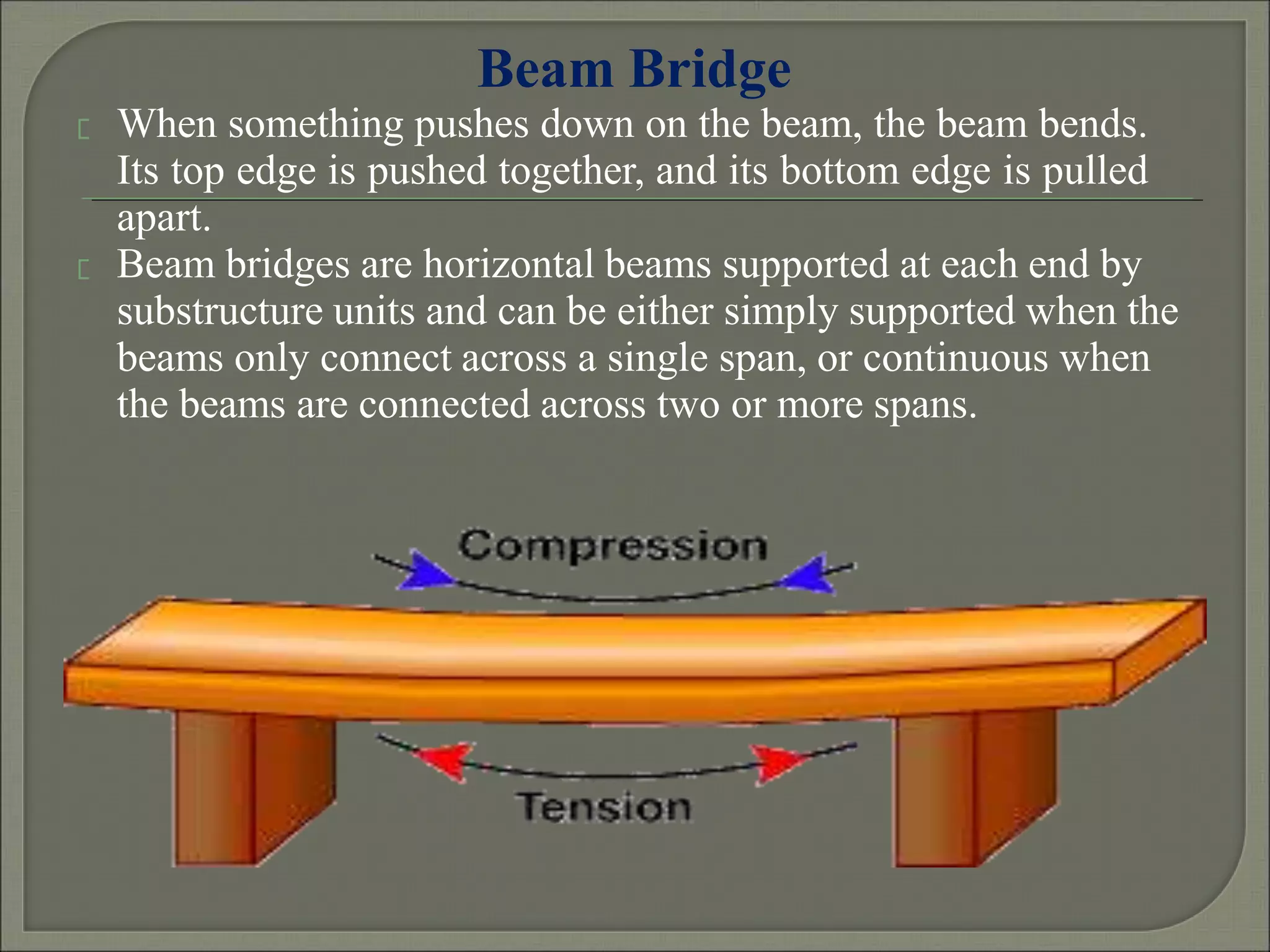
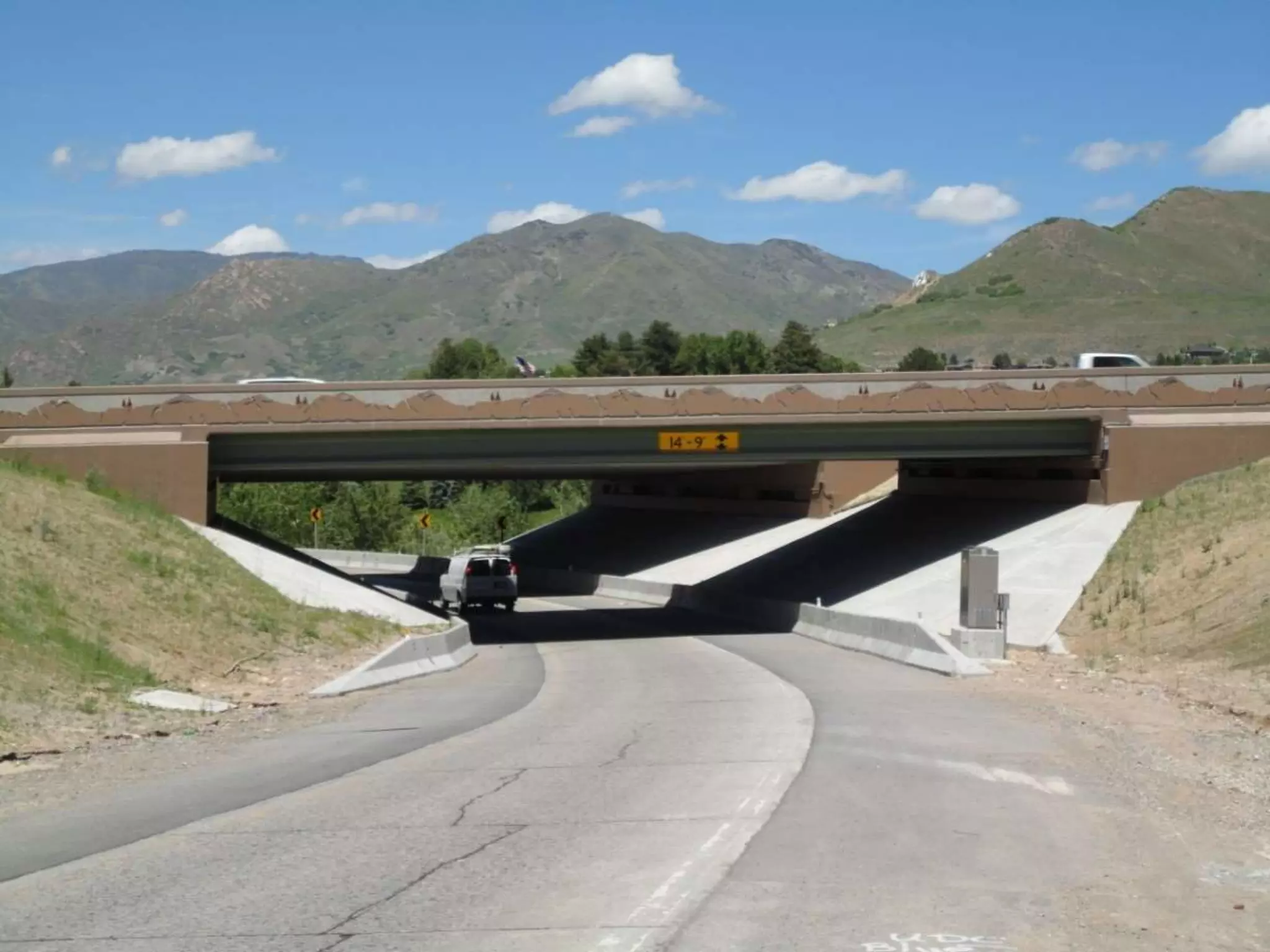
Beam Bridge
When something pushes down on the beam, the beam bends.
Its top edge is pushed together, and its bottom edge is pulled
apart.
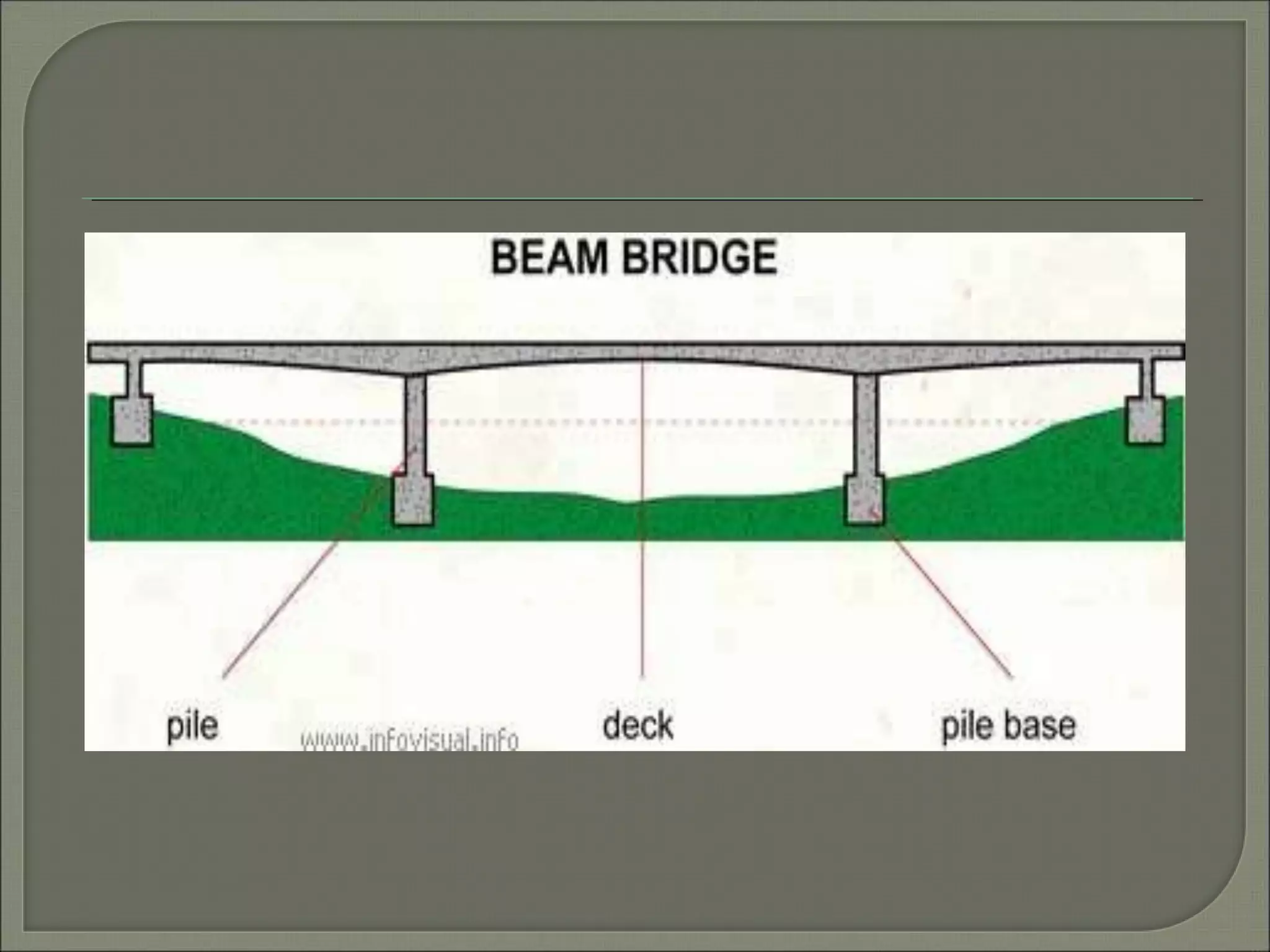
Beam bridges are horizontal beams supported at each end by
substructure units and can be either simply supported when the
beams only connect across a single span, or continuous when
the beams are connected across two or more spans.
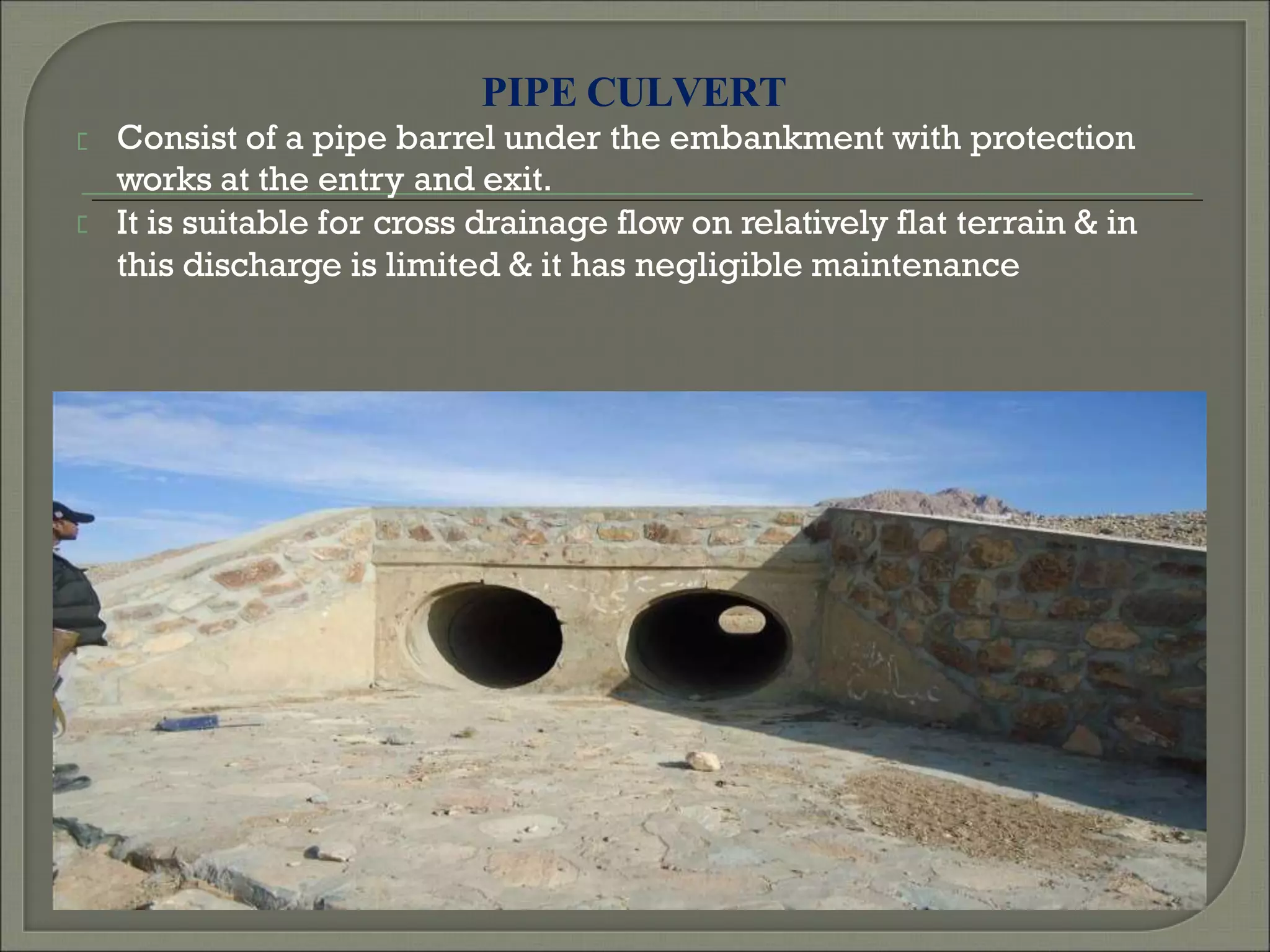
PIPE CULVERT
Consist of a pipe barrel under the embankment with protection
works at the entry and exit.
It is suitable for cross drainage flow on relatively flat terrain & in
this discharge is limited & it has negligible maintenance
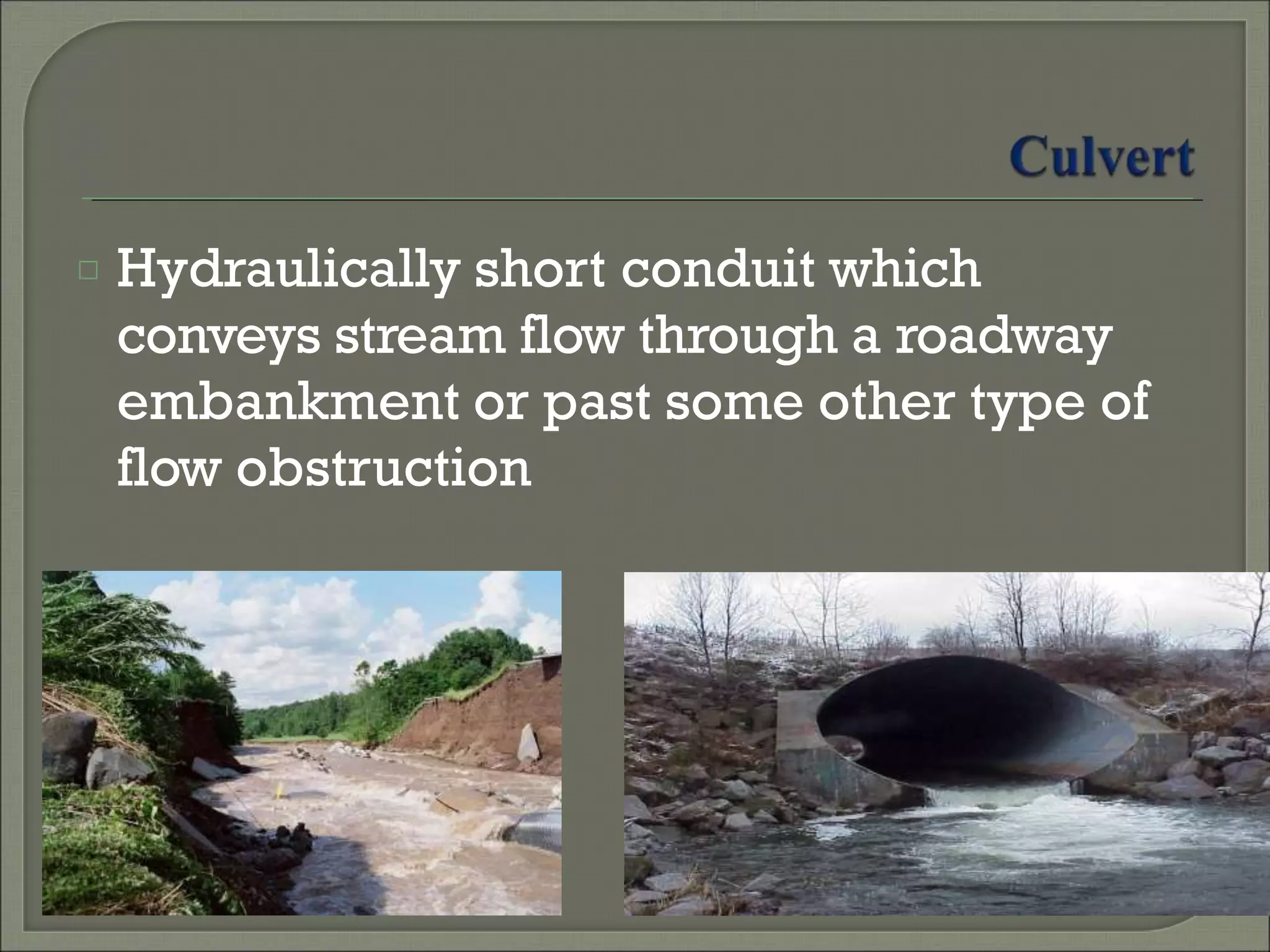
□ Hydraulically short conduit which
conveys stream flow through a roadway
embankment or past some other type of
flow obstruction
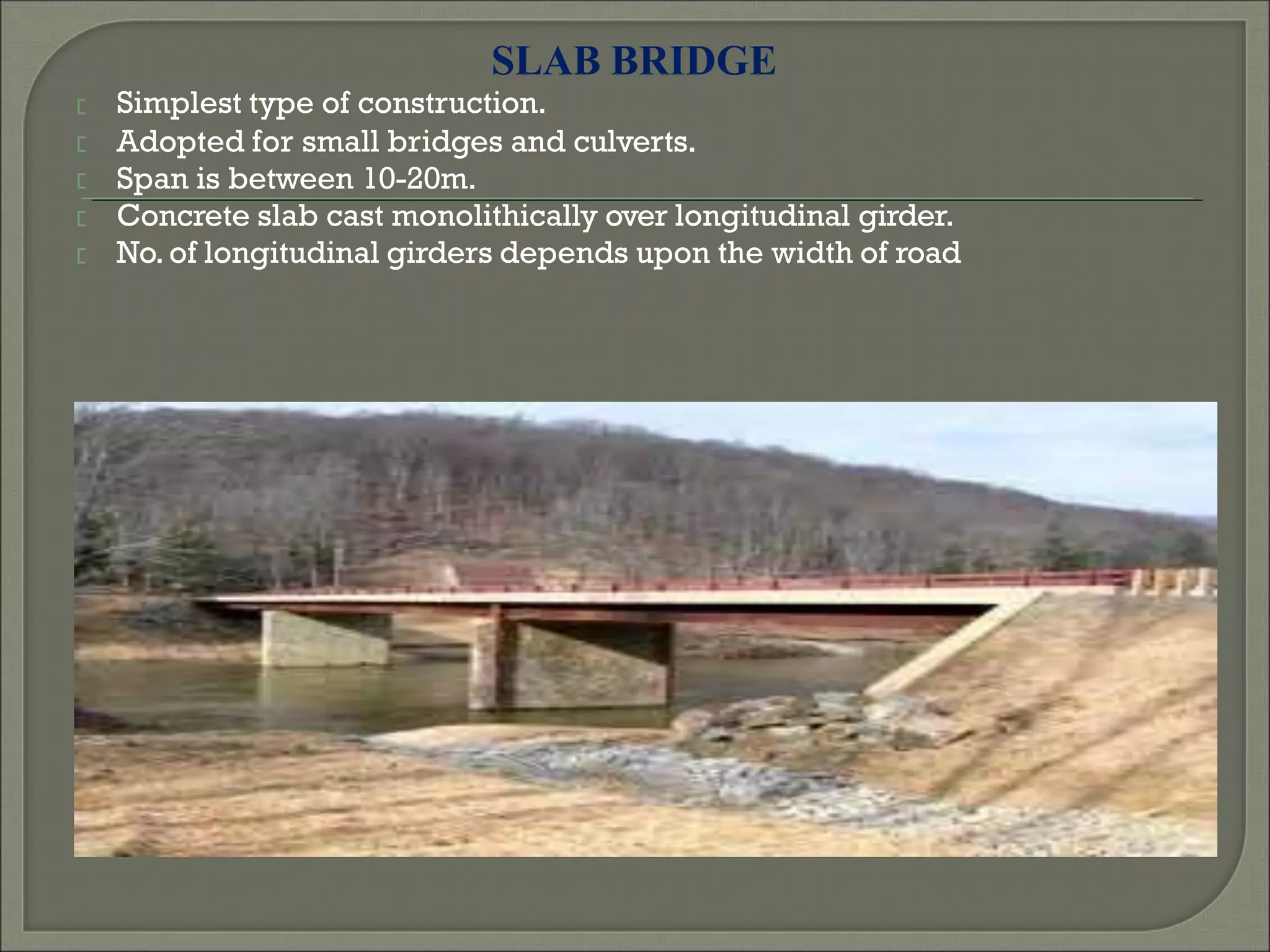
SLAB BRIDGE
Simplest type of construction.
Adopted for small bridges and culverts.
Span is between 10-20m.
Concrete slab cast monolithically over longitudinal girder.
No.of longitudinal girders depends upon the width of road
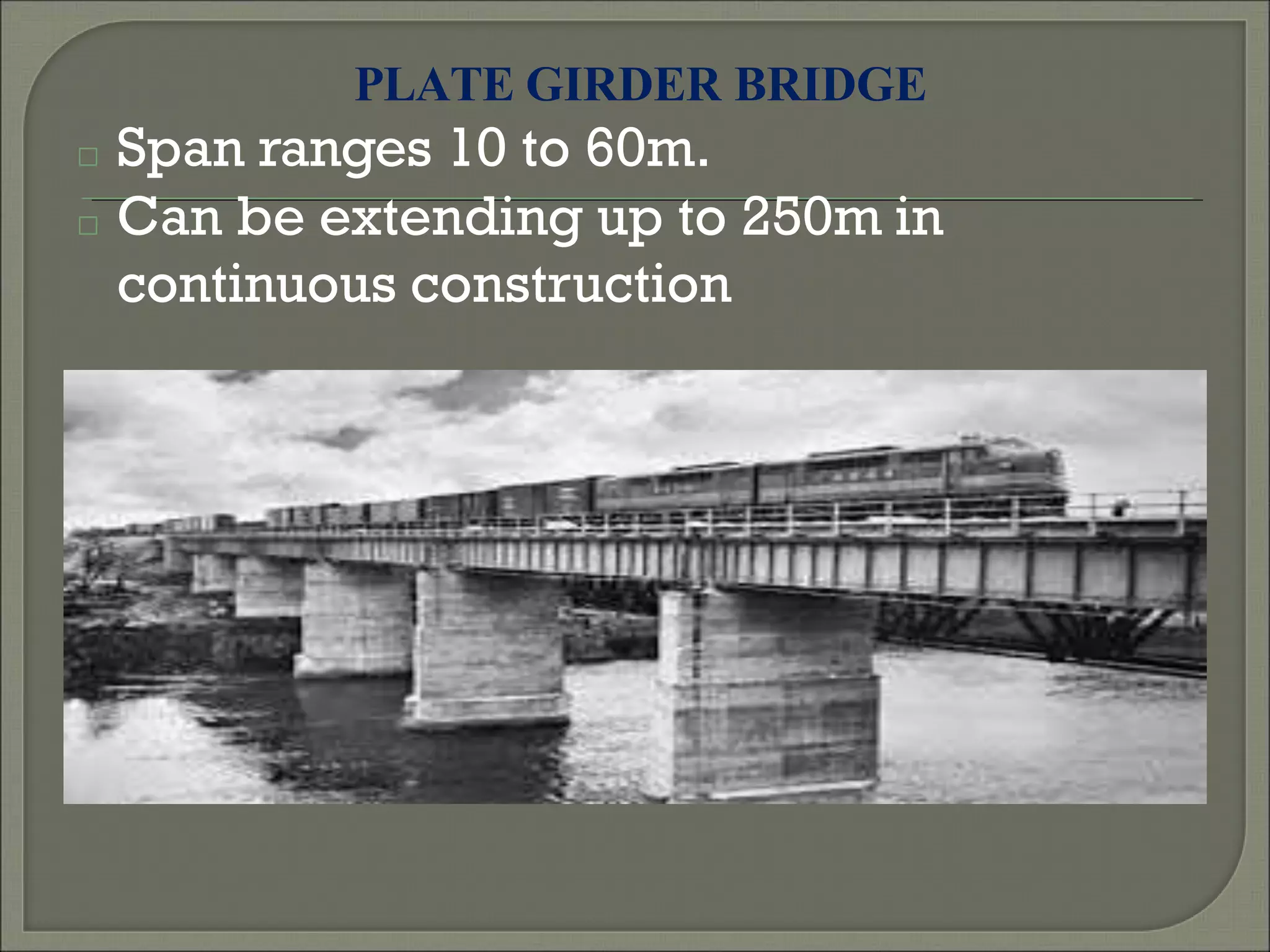
PLATE GIRDER BRIDGE
□ Span ranges 10 to 60m.
□ Can be extending up to 250m in
continuous construction
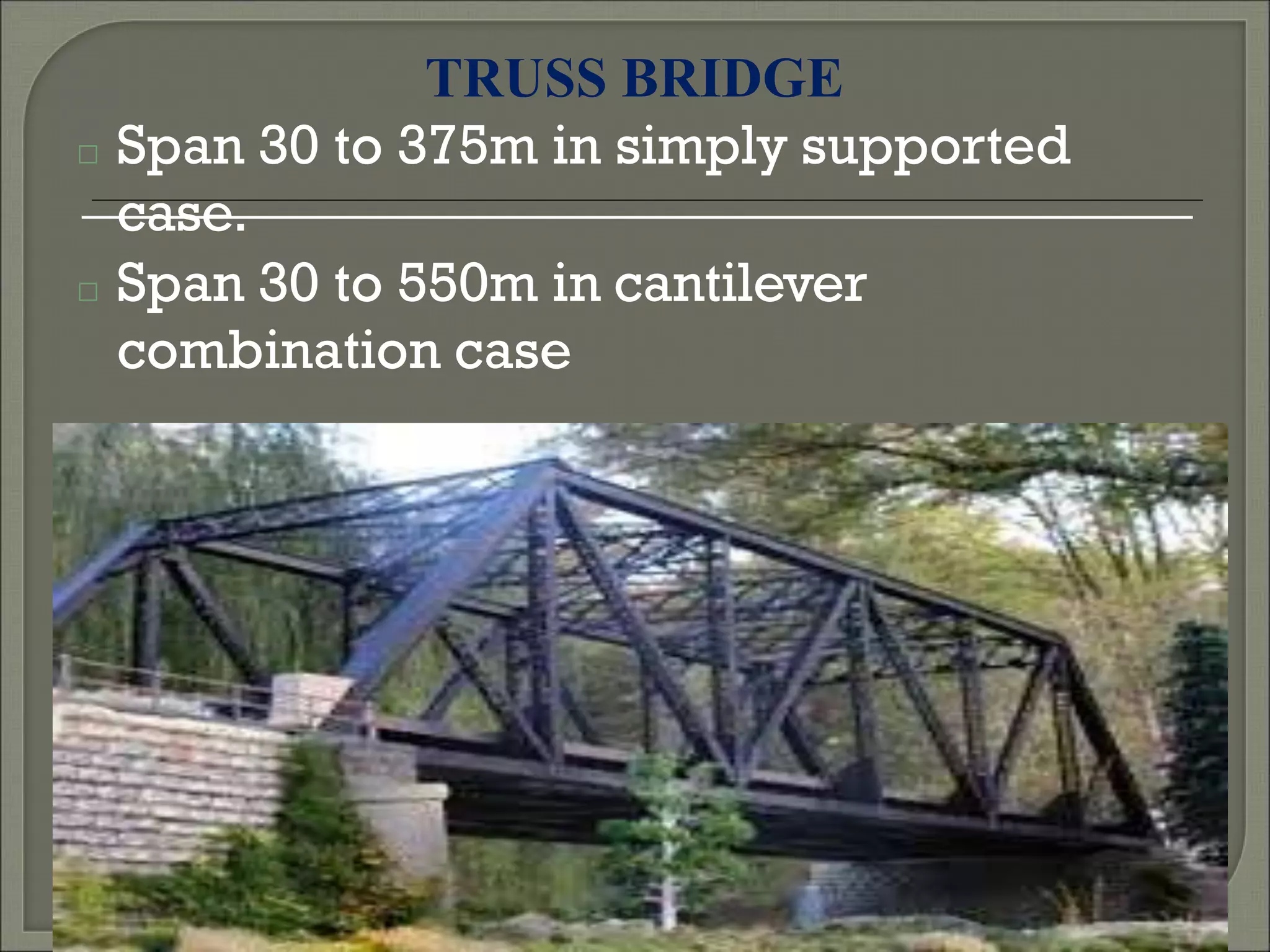
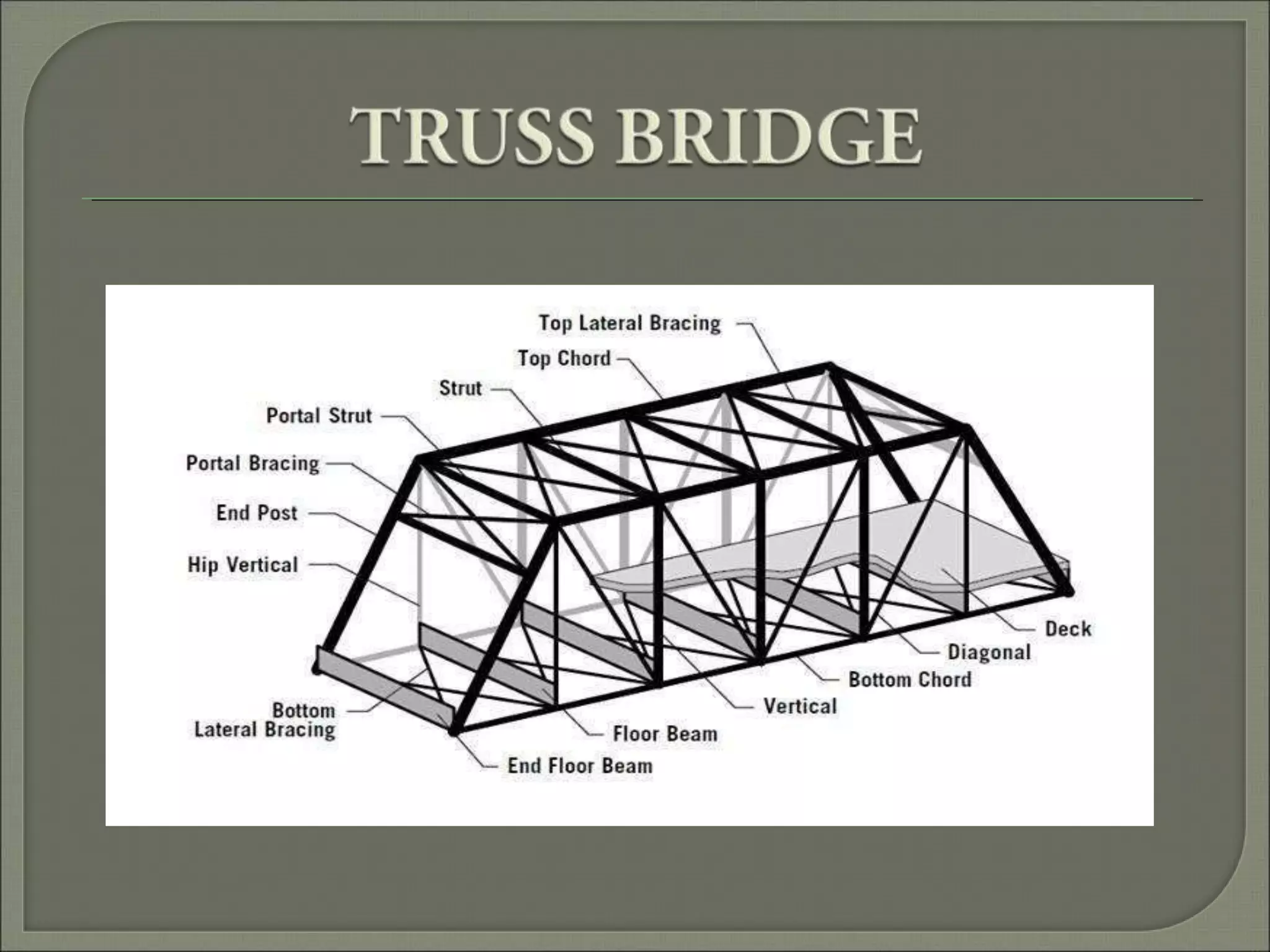
TRUSS BRIDGE
□ Span 30 to 375m in simply supported
case.
□ Span 30 to 550m in cantilever
combination case
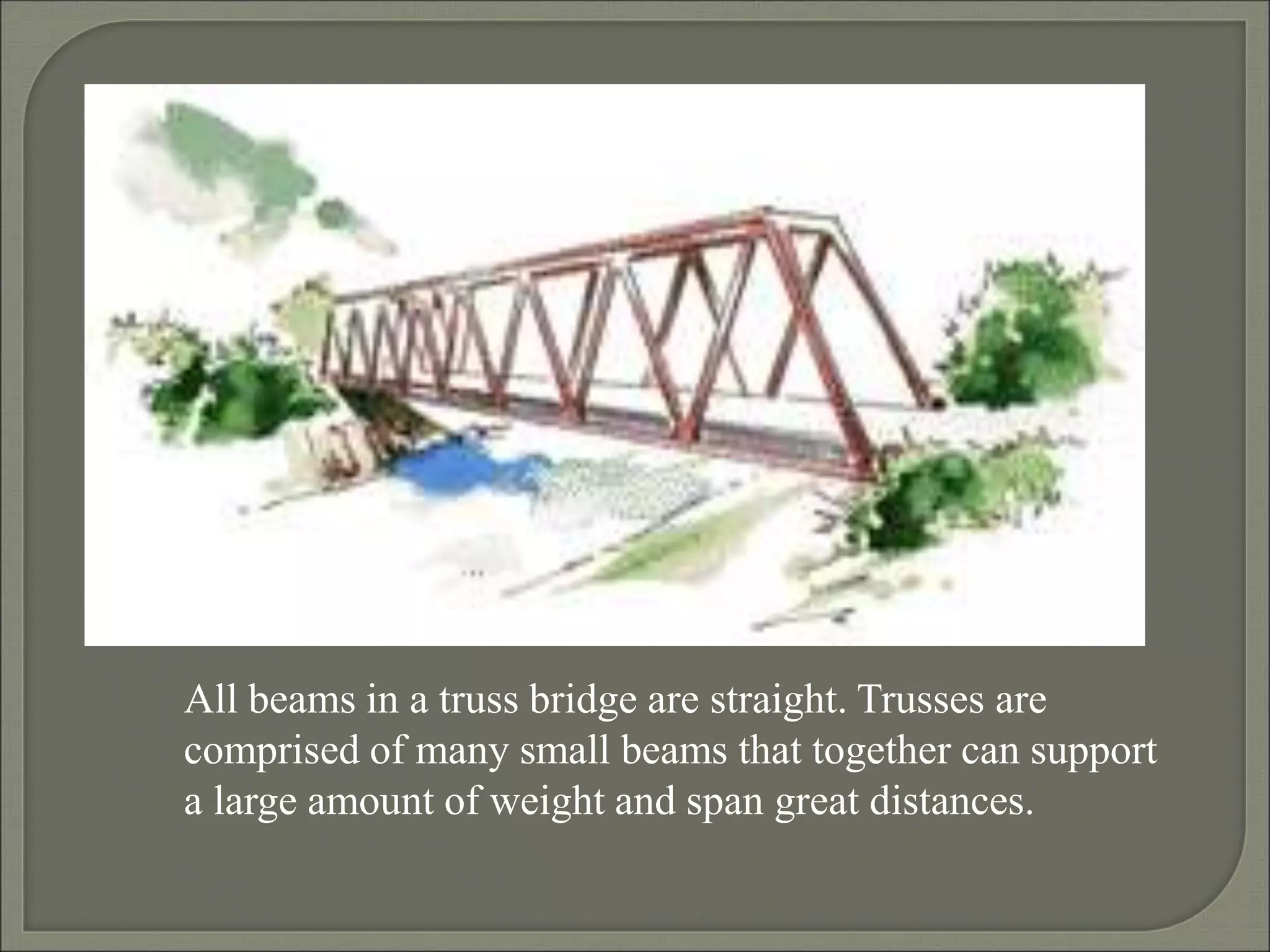
All beams in a truss bridge are straight. Trusses are
comprised of many small beams that together can support
a large amount of weight and span great distances.
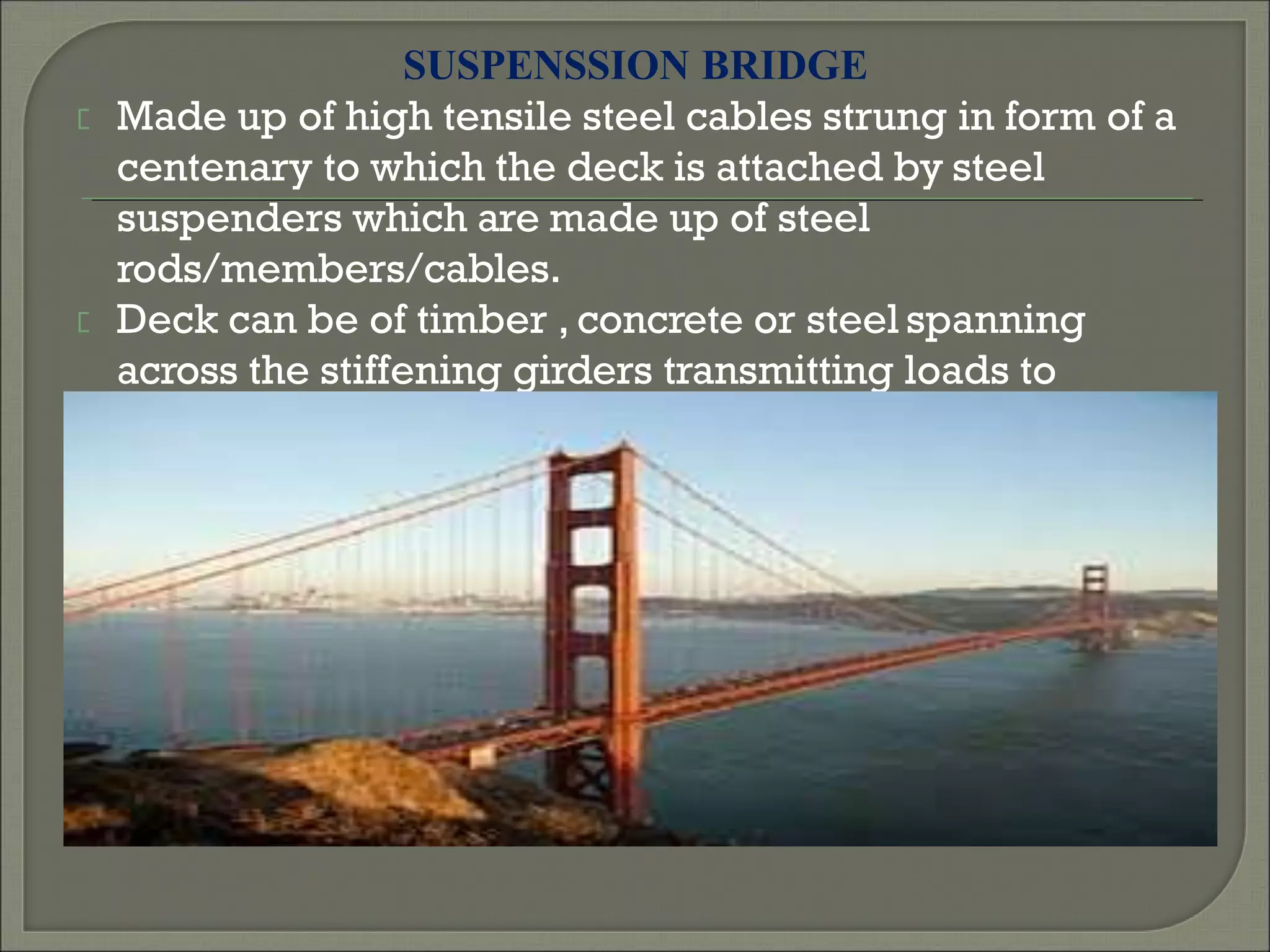
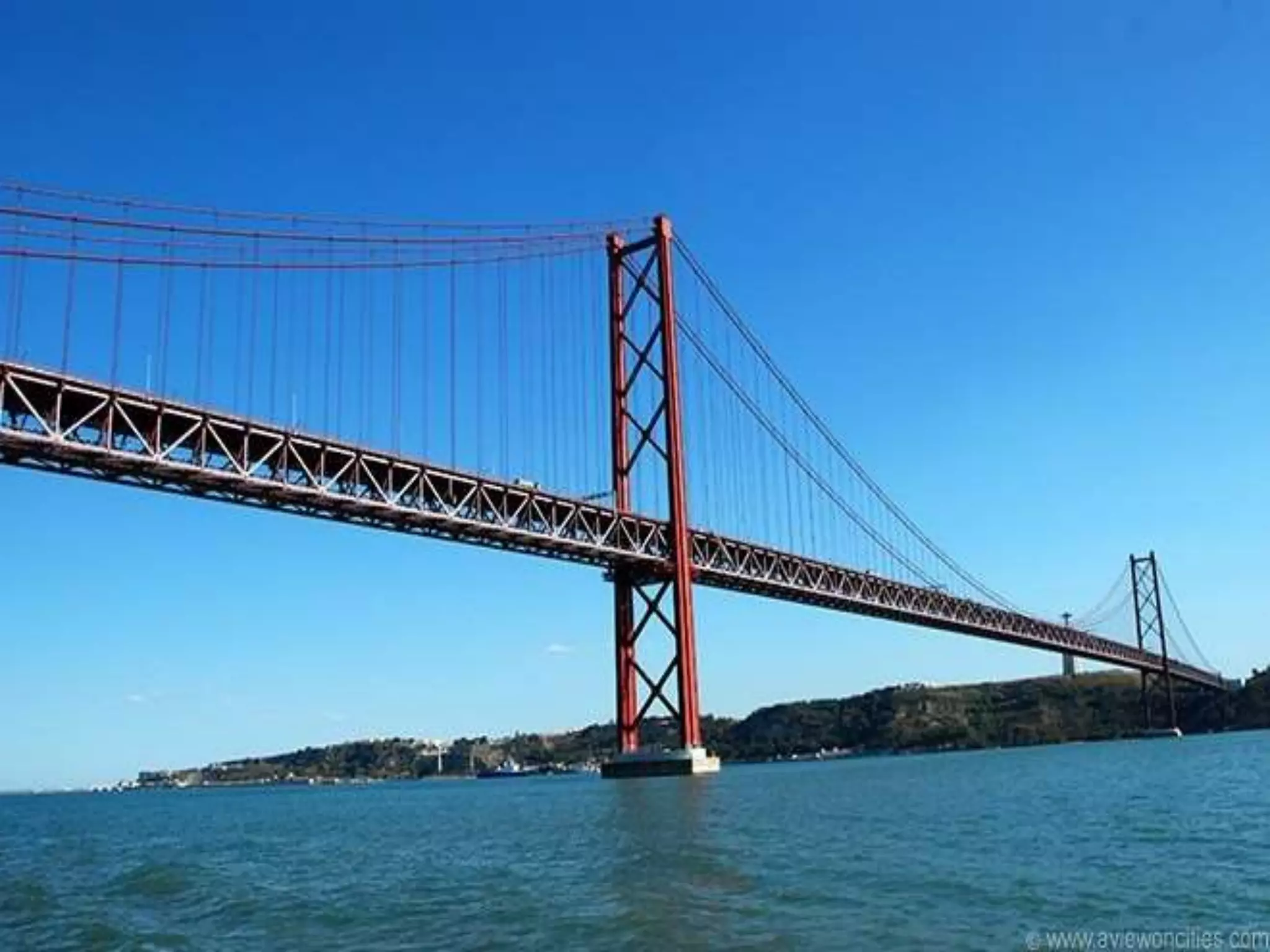
SUSPENSSION BRIDGE
Made up of high tensile steel cables strung in form of a
centenary to which the deck is attached by steel
suspenders which are made up of steel
rods/members/cables.
Deck can be of timber , concrete or steel spanning
across the stiffening girders transmitting loads to
suspenders.
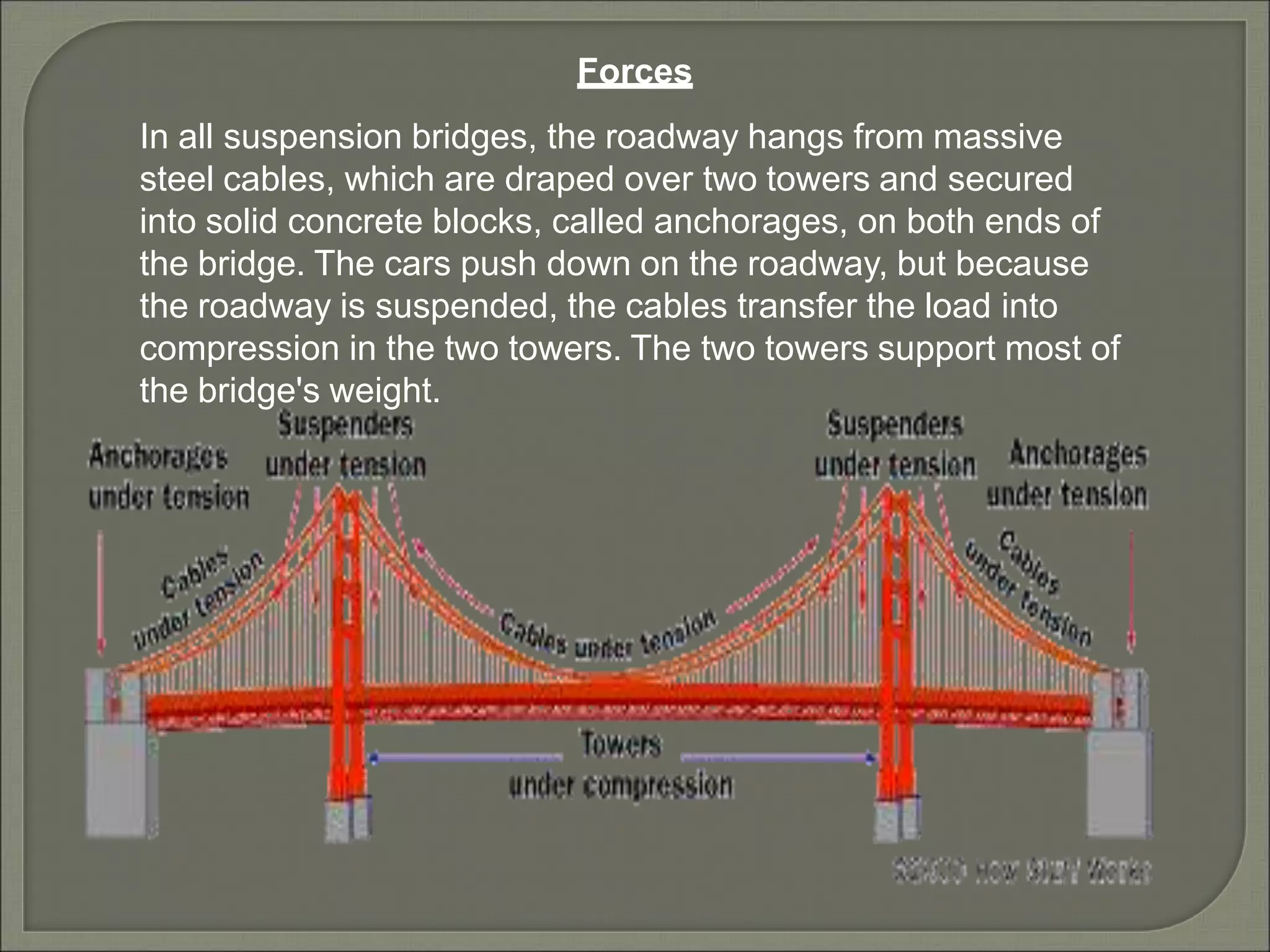
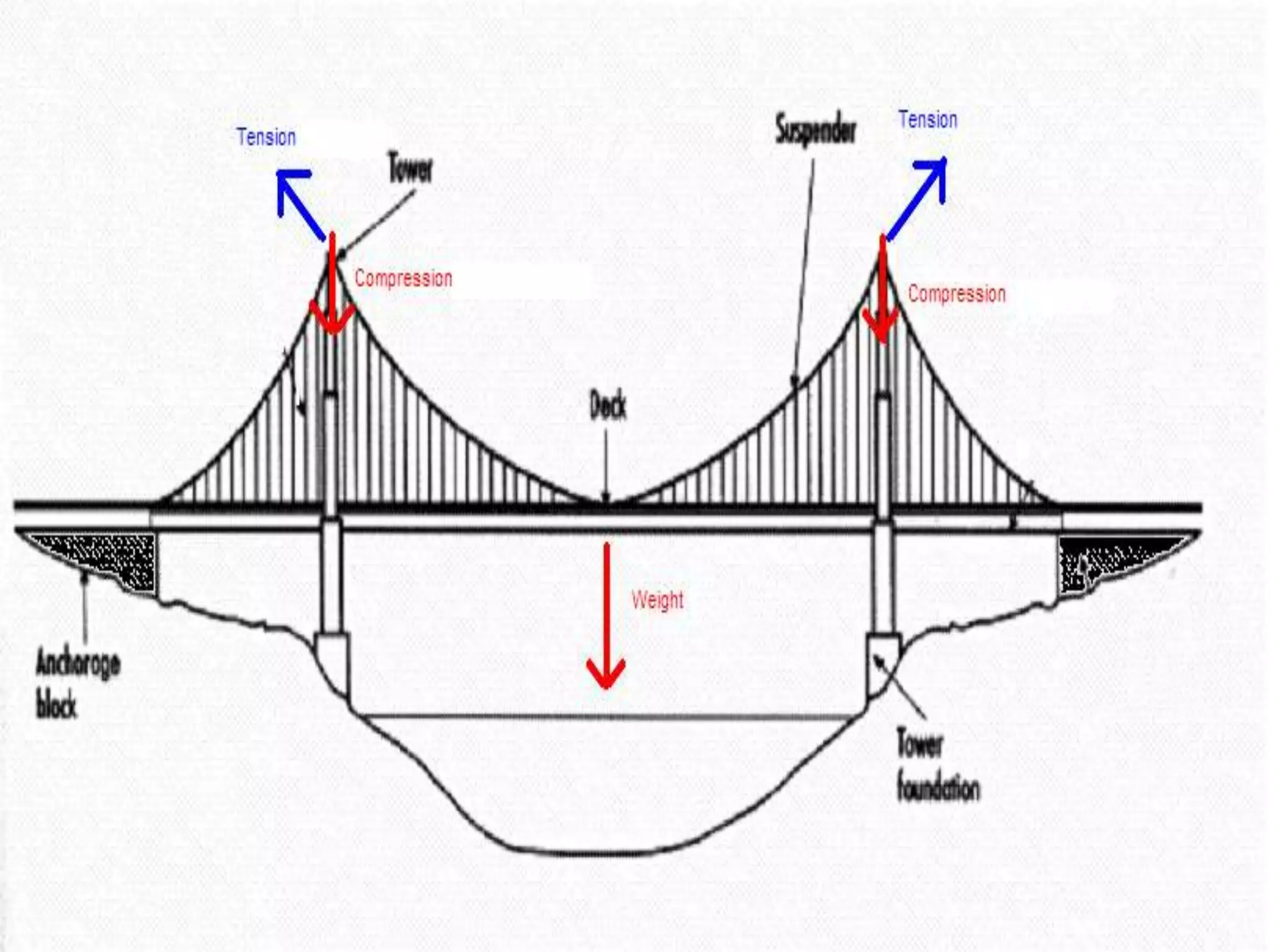
Forces
In all suspension bridges, the roadway hangs from massive
steel cables, which are draped over two towers and secured
into solid concrete blocks, called anchorages, on both ends of
the bridge. The cars push down on the roadway, but because
the roadway is suspended, the cables transfer the load into
compression in the two towers. The two towers support most of
the bridge's weight.
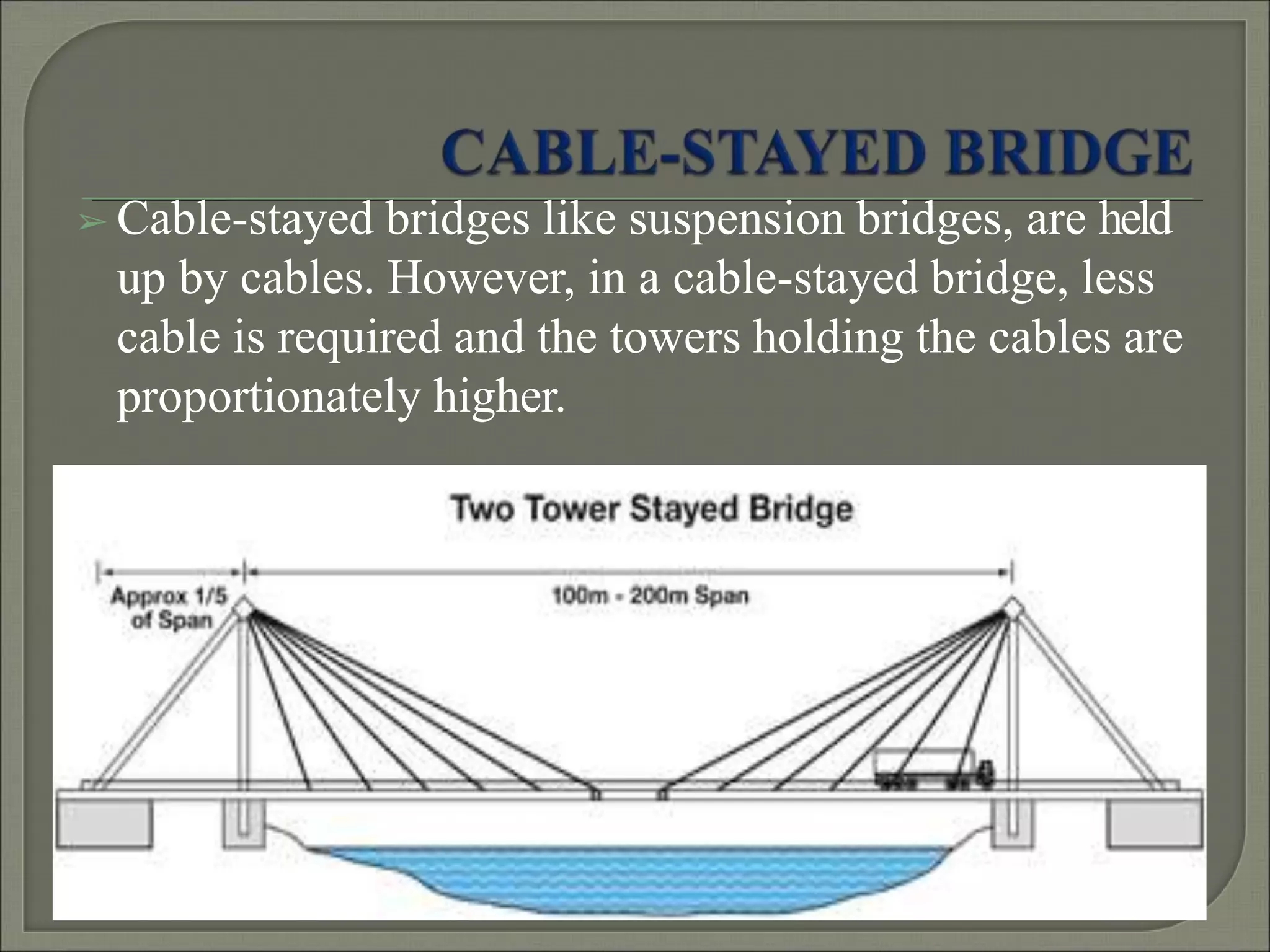
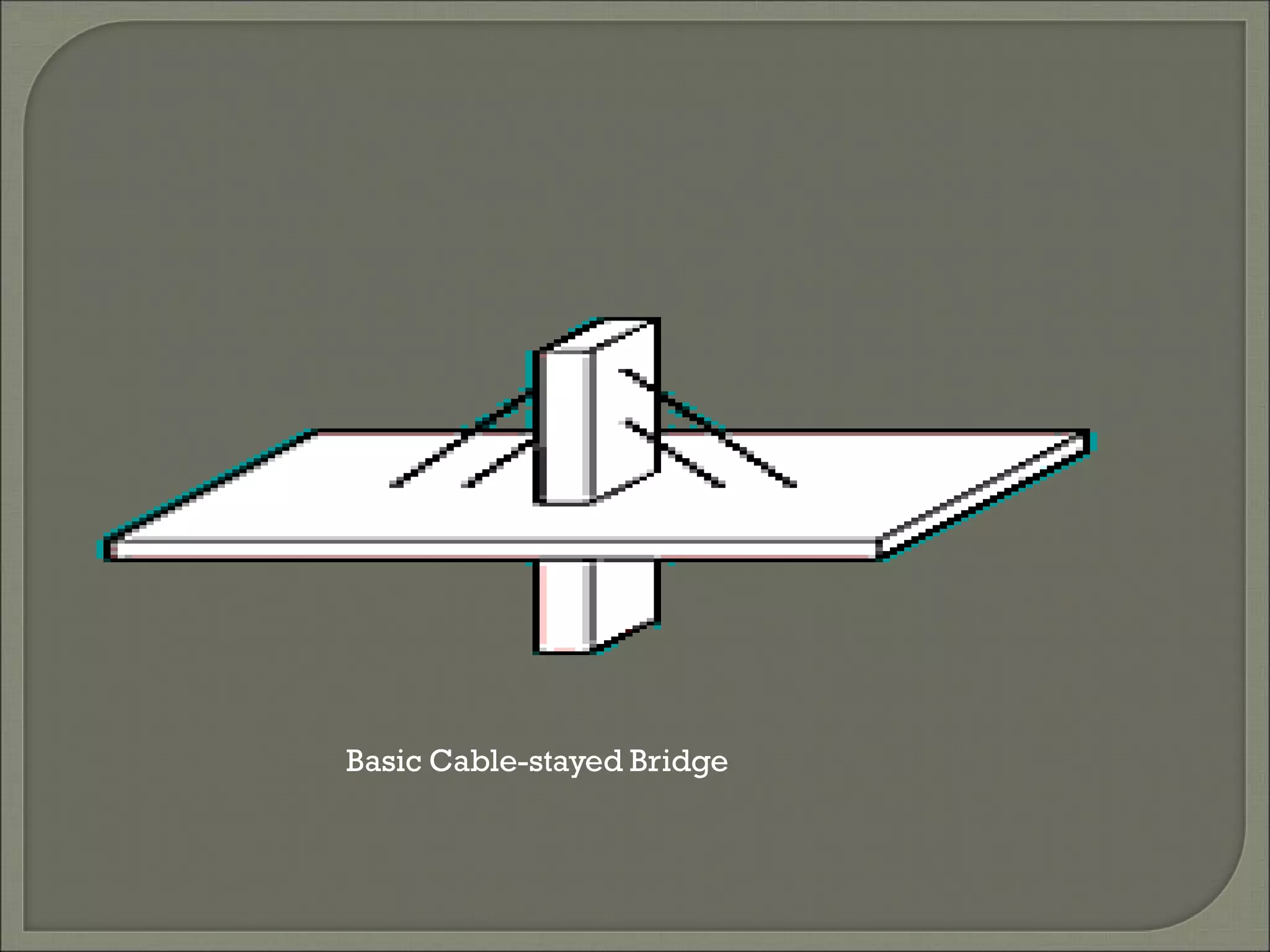
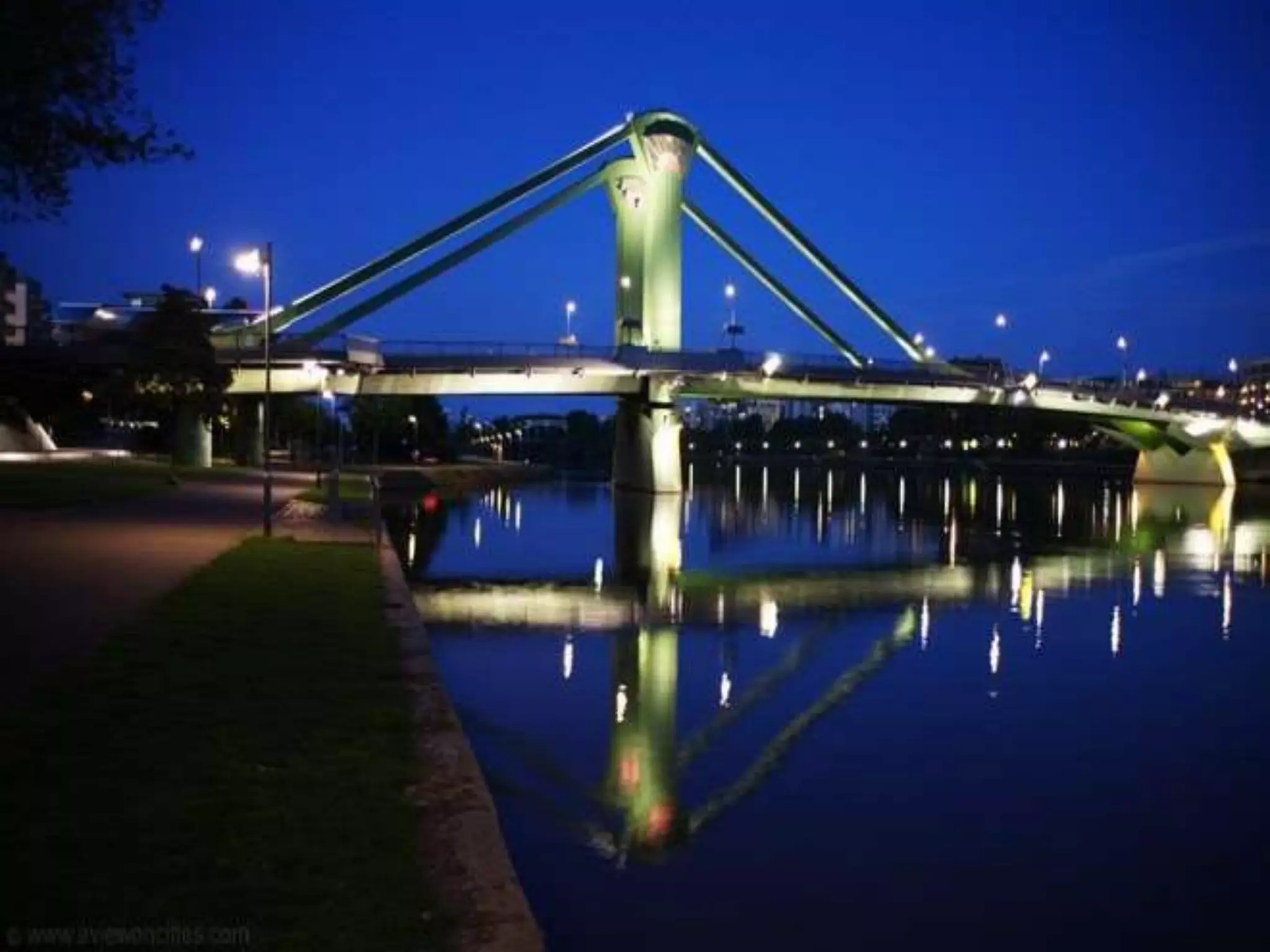
➢ Cable-stayed bridges like suspension bridges, are held
up by cables. However, in a cable-stayed bridge, less
cable is required and the towers holding the cables are
proportionately higher.
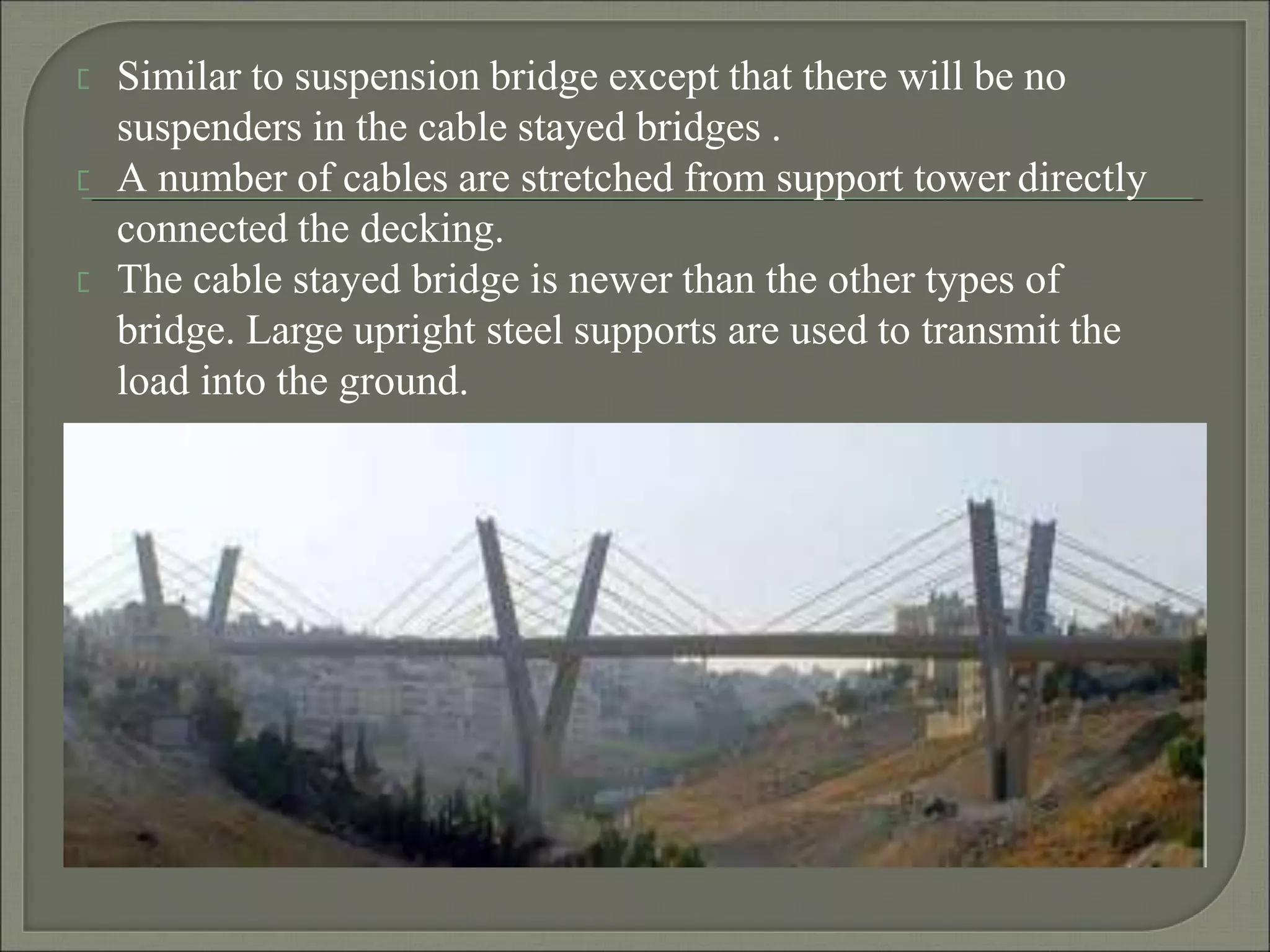
Similar to suspension bridge except that there will be no
suspenders in the cable stayed bridges .
A number of cables are stretched from support tower directly
connected the decking.
The cable stayed bridge is newer than the other types of
bridge. Large upright steel supports are used to transmit the
load into the ground.
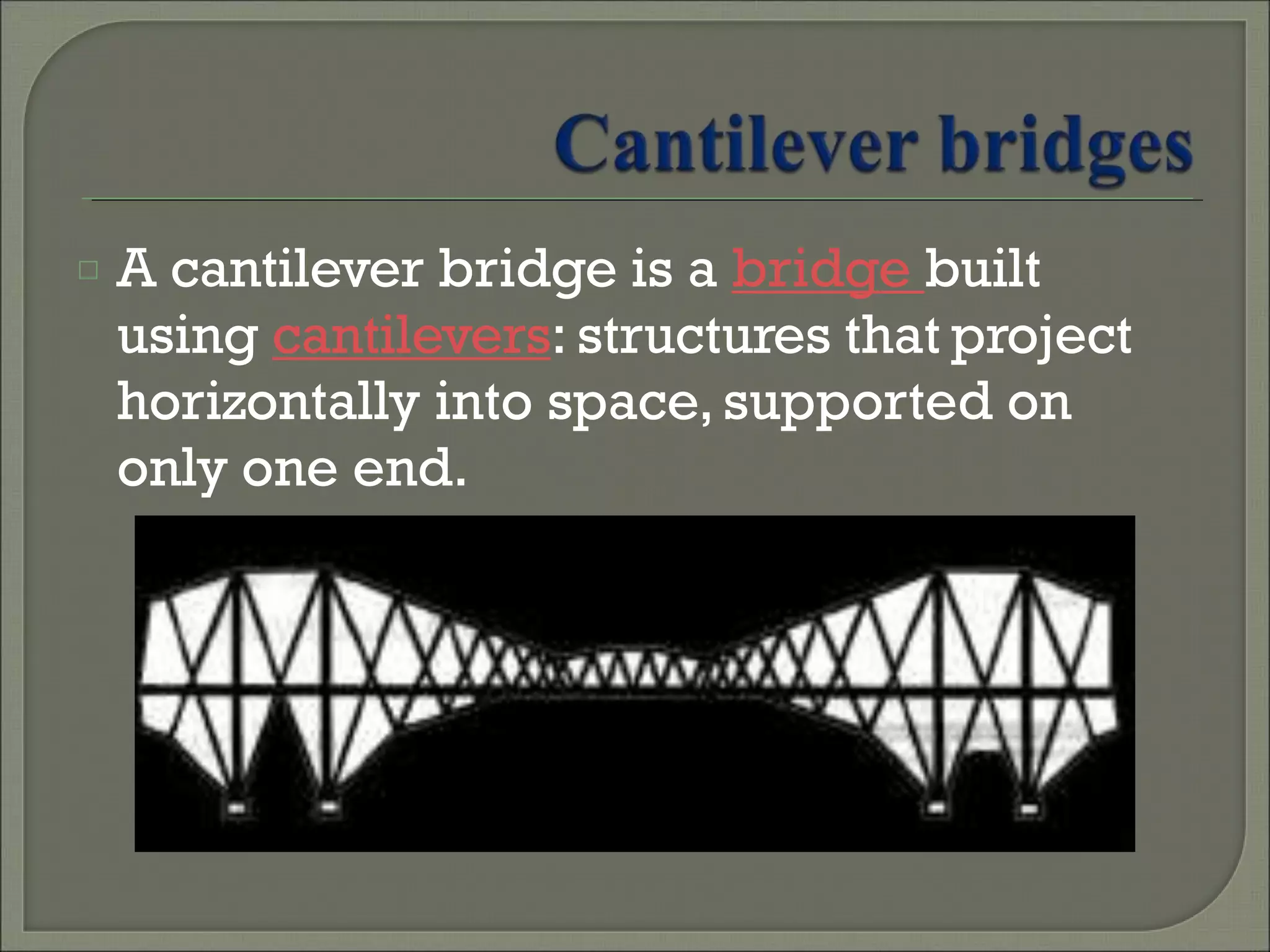
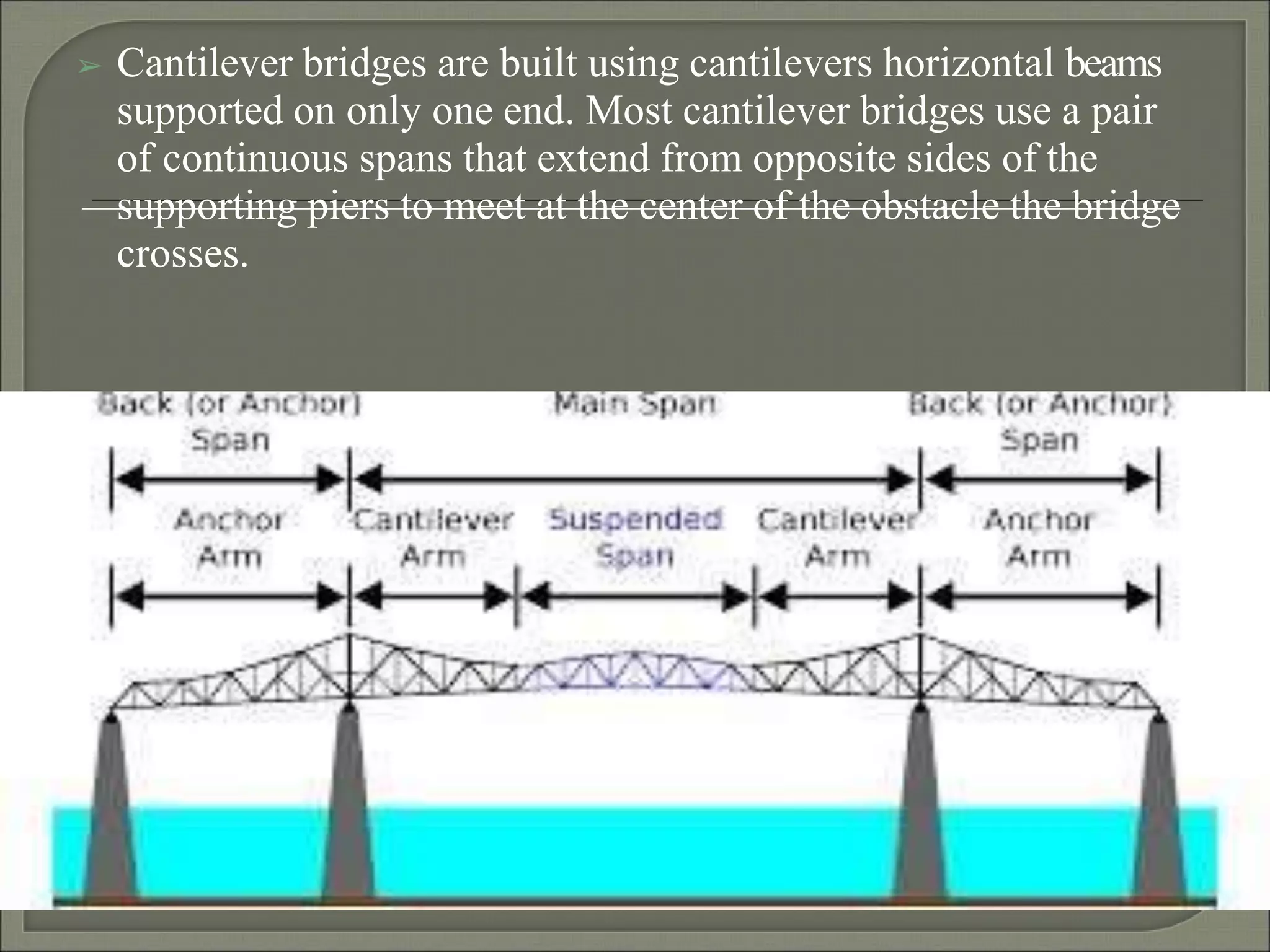
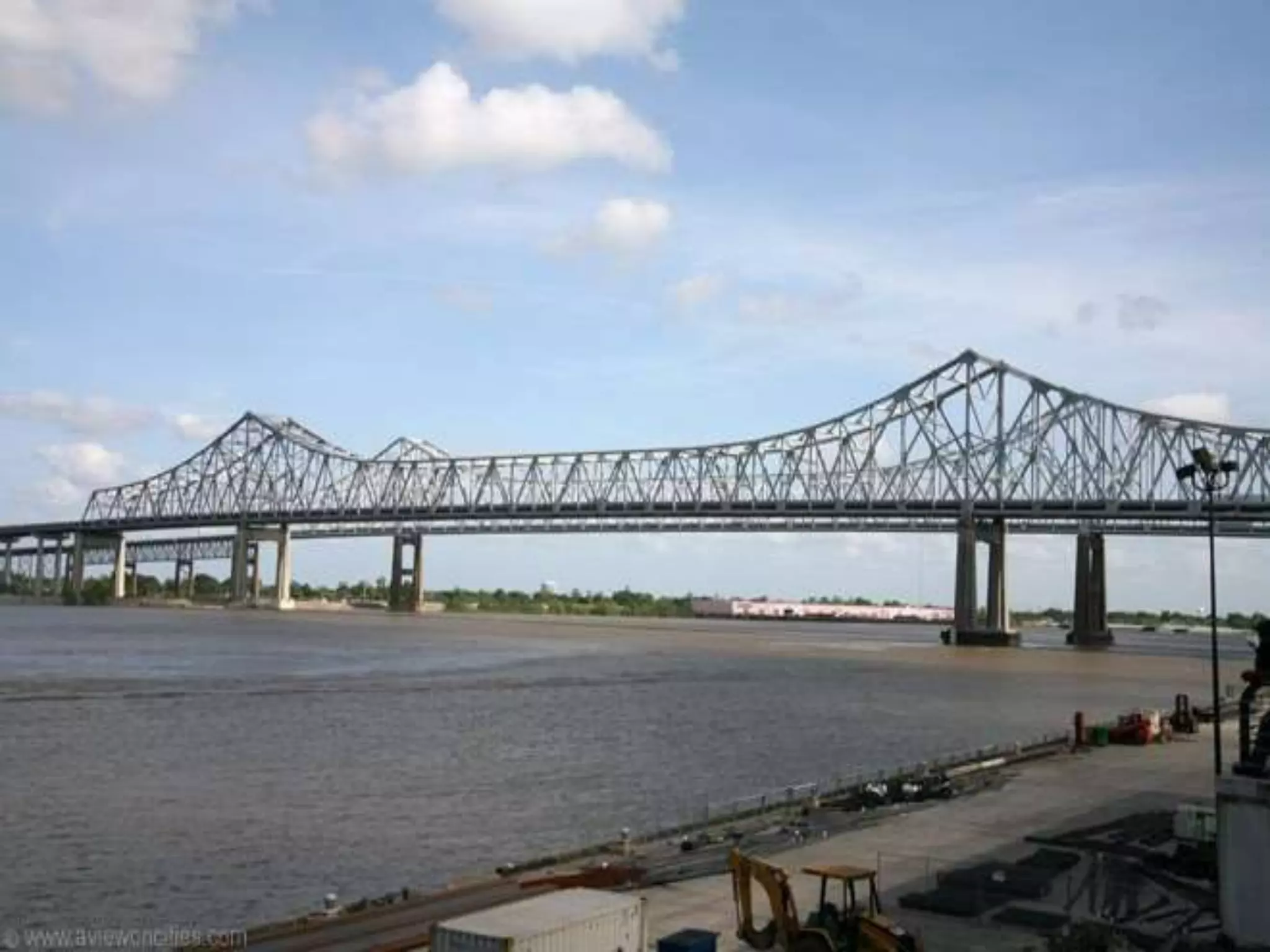
□ A cantilever bridge is a bridge built
using cantilevers: structures that project
horizontally into space, supported on
only one end.
➢ Cantilever bridges are built using cantilevers horizontal beams
supported on only one end. Most cantilever bridges use a pair
of continuous spans that extend from opposite sides of the
supporting piers to meet at the center of the obstacle the bridge
crosses.
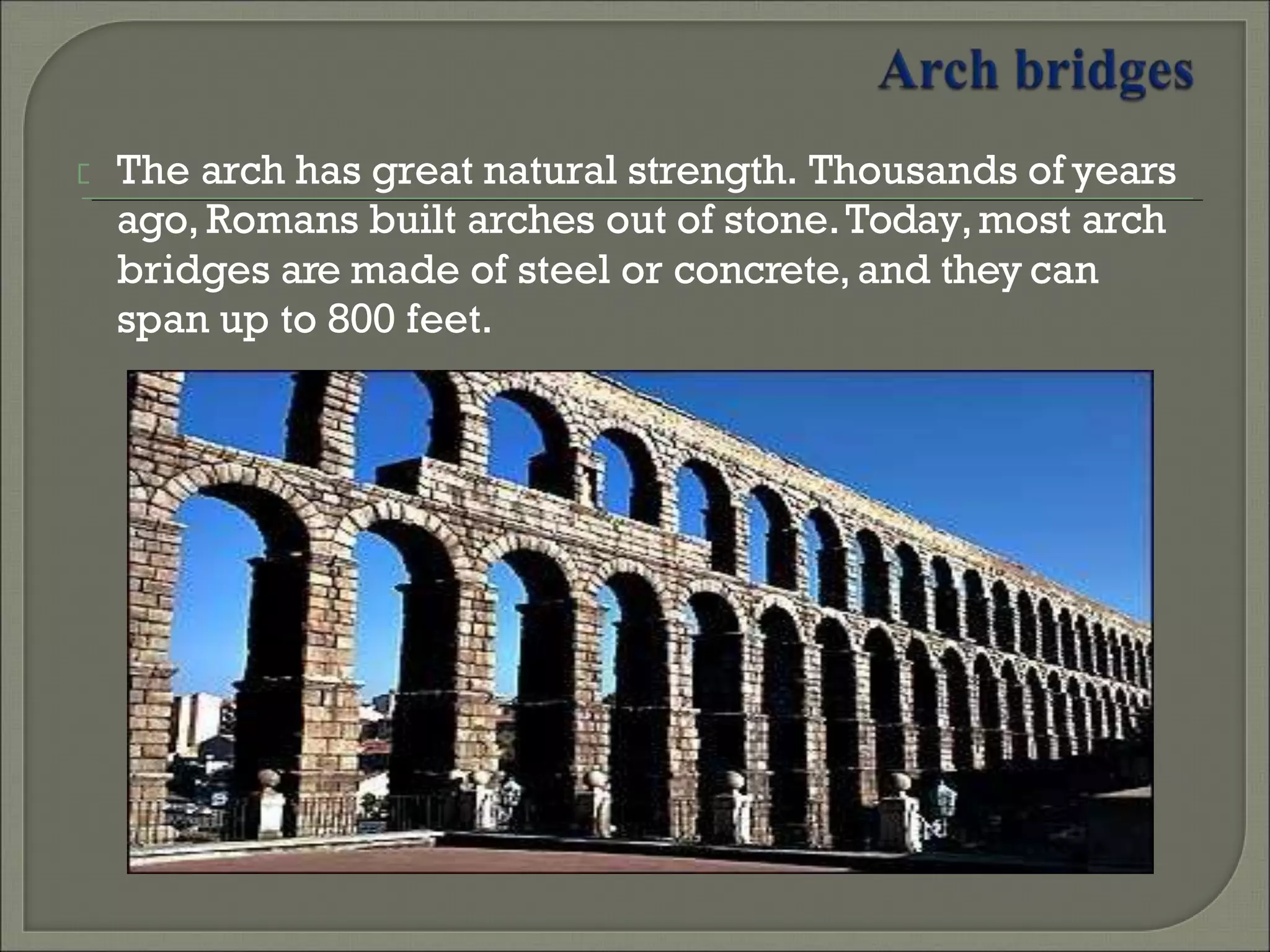
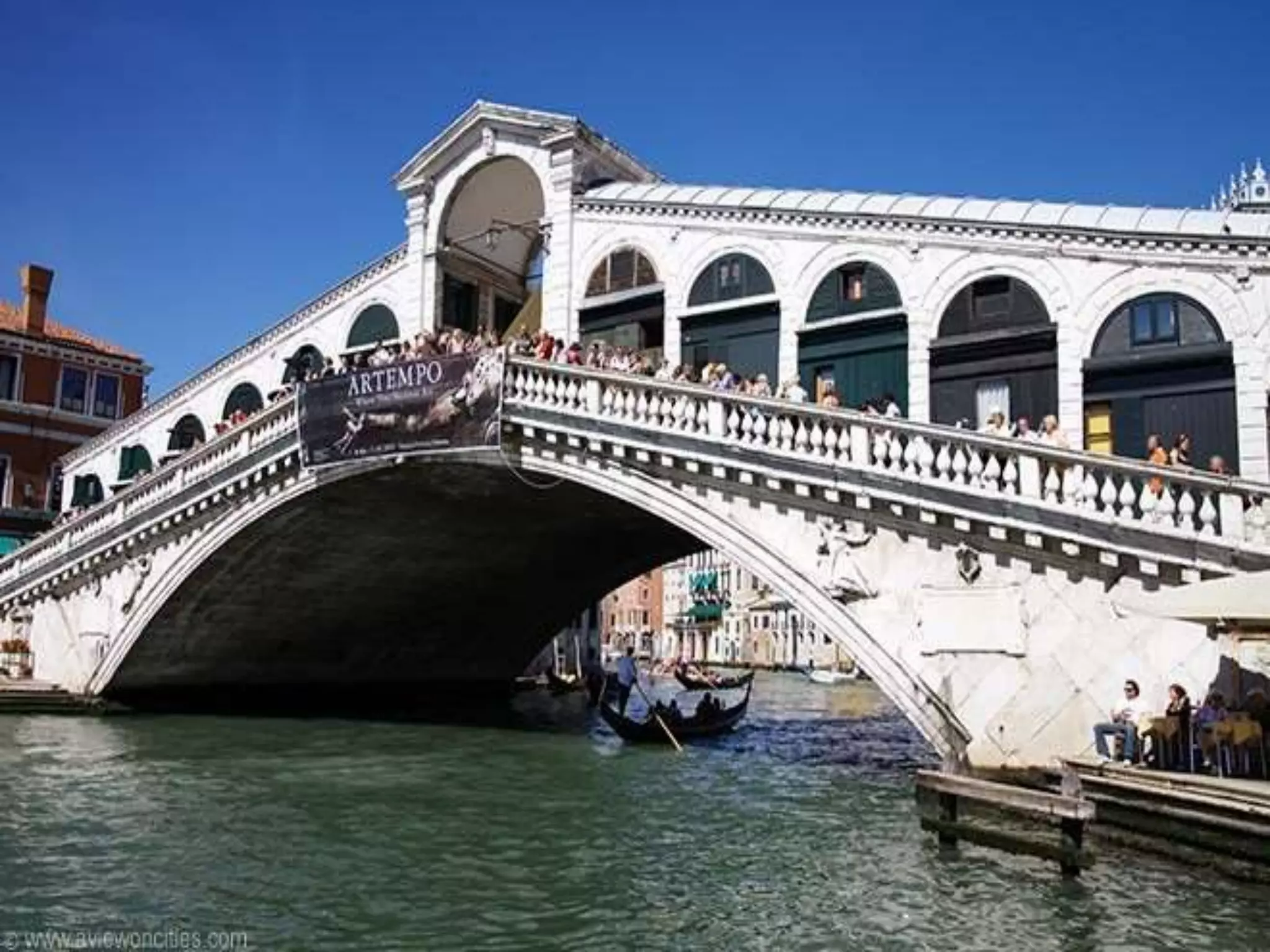
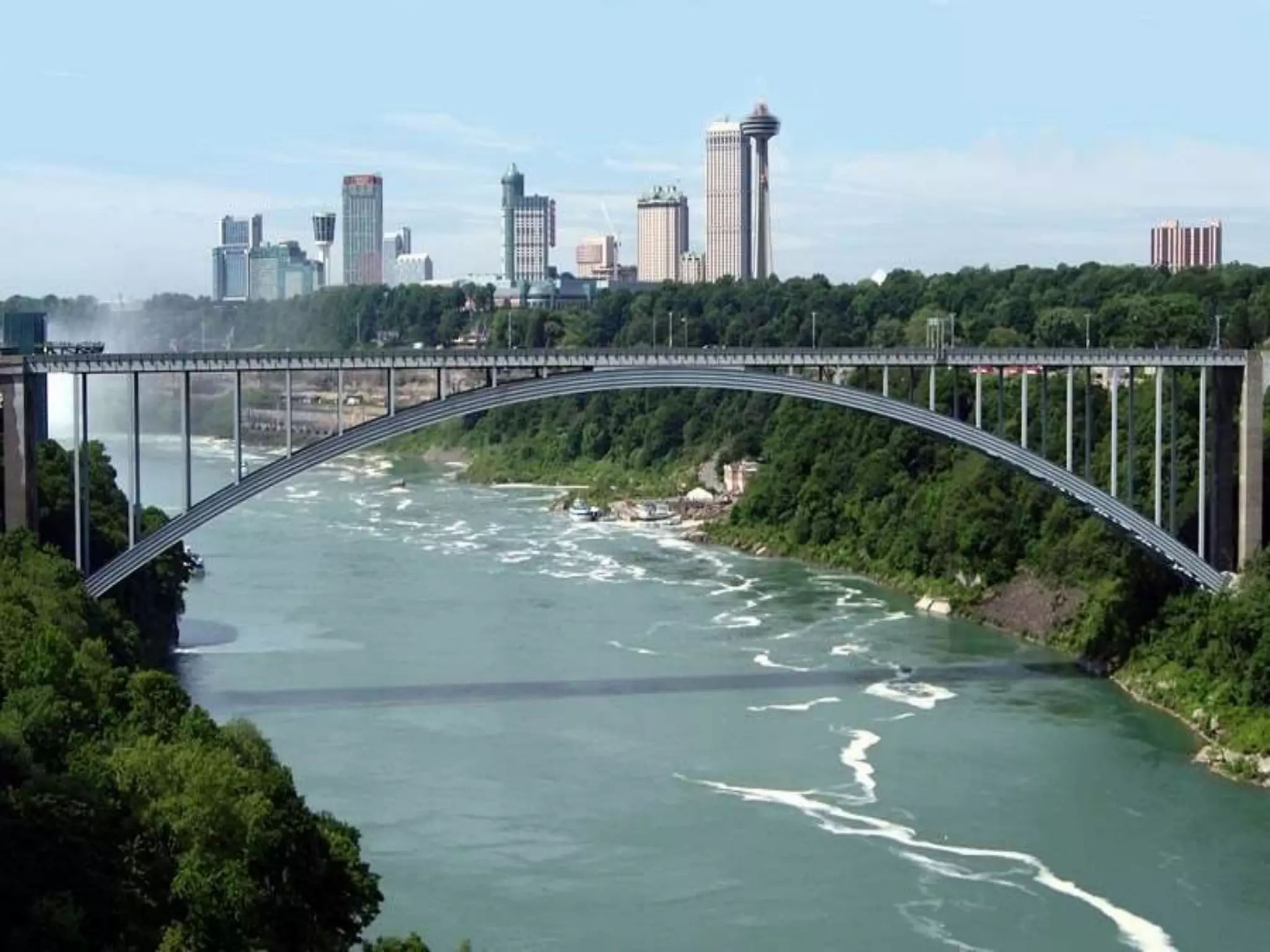
The arch has great natural strength. Thousands of years
ago, Romans built arches out of stone.Today,most arch
bridges are made of steel or concrete,and they can
span up to 800 feet.
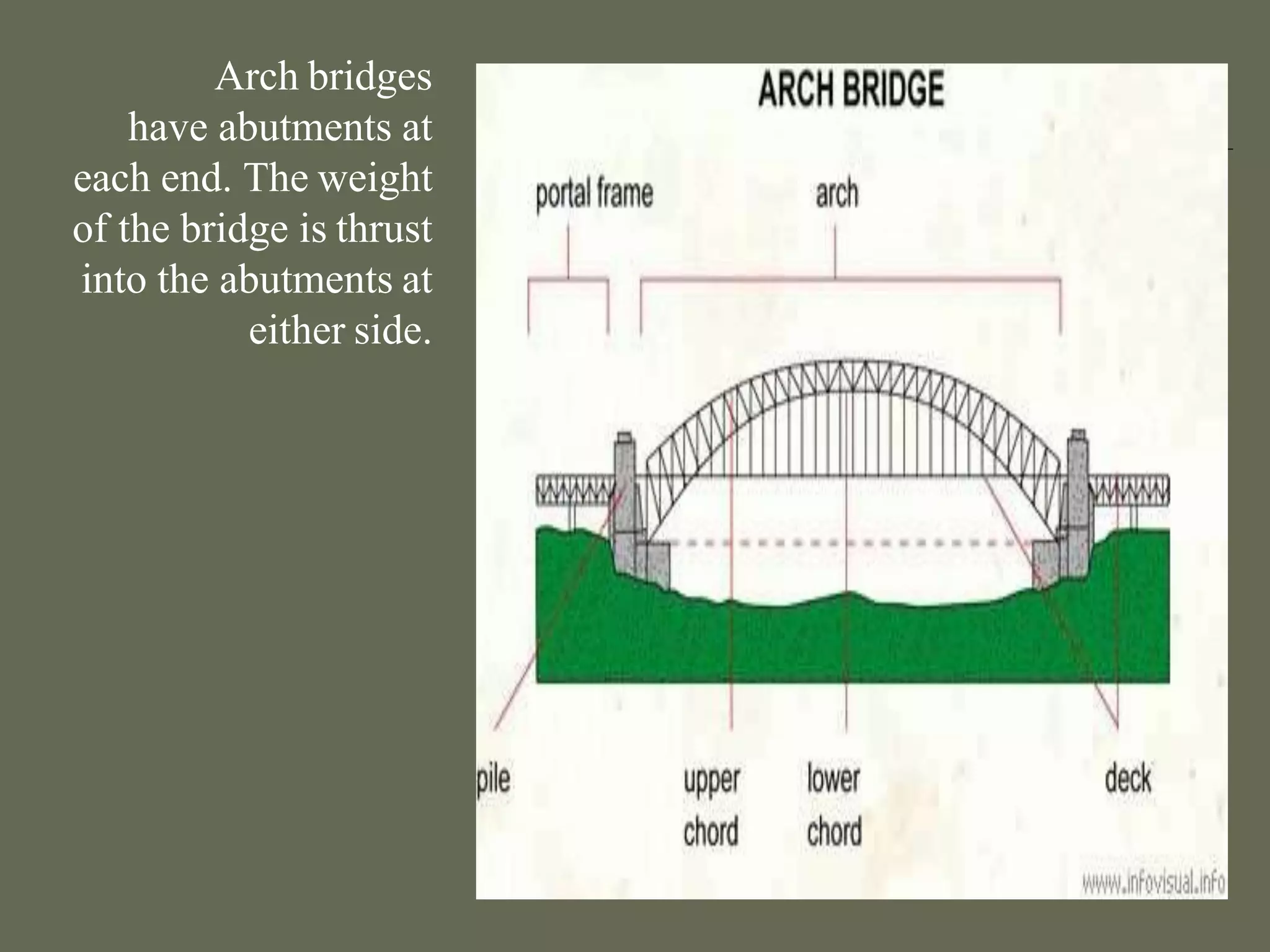
Arch bridges
have abutments at
each end. The weight
of the bridge is thrust
into the abutments at
either side.
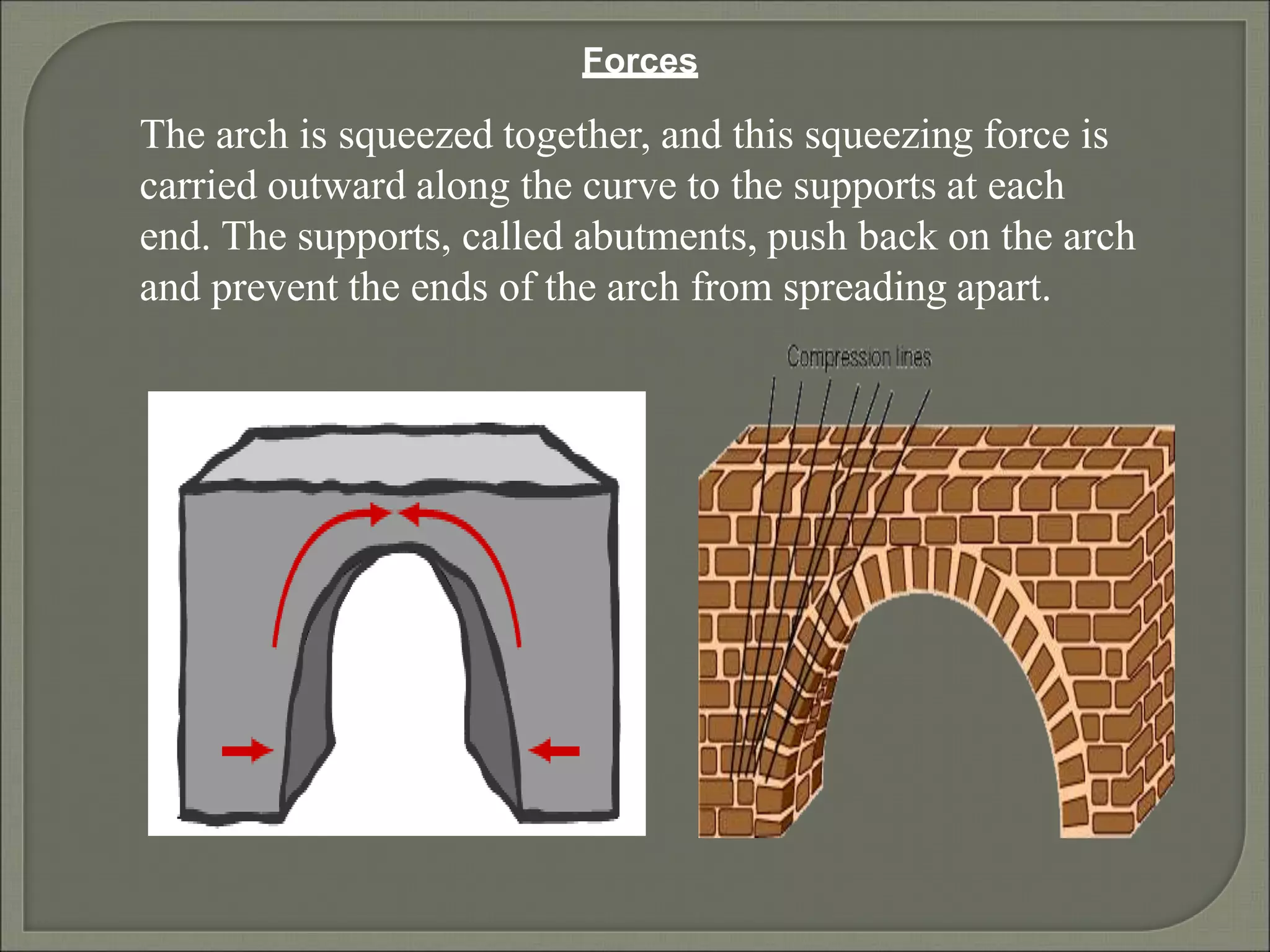
Forces
The arch is squeezed together, and this squeezing force is
carried outward along the curve to the supports at each
end. The supports, called abutments, push back on the arch
and prevent the ends of the arch from spreading apart.
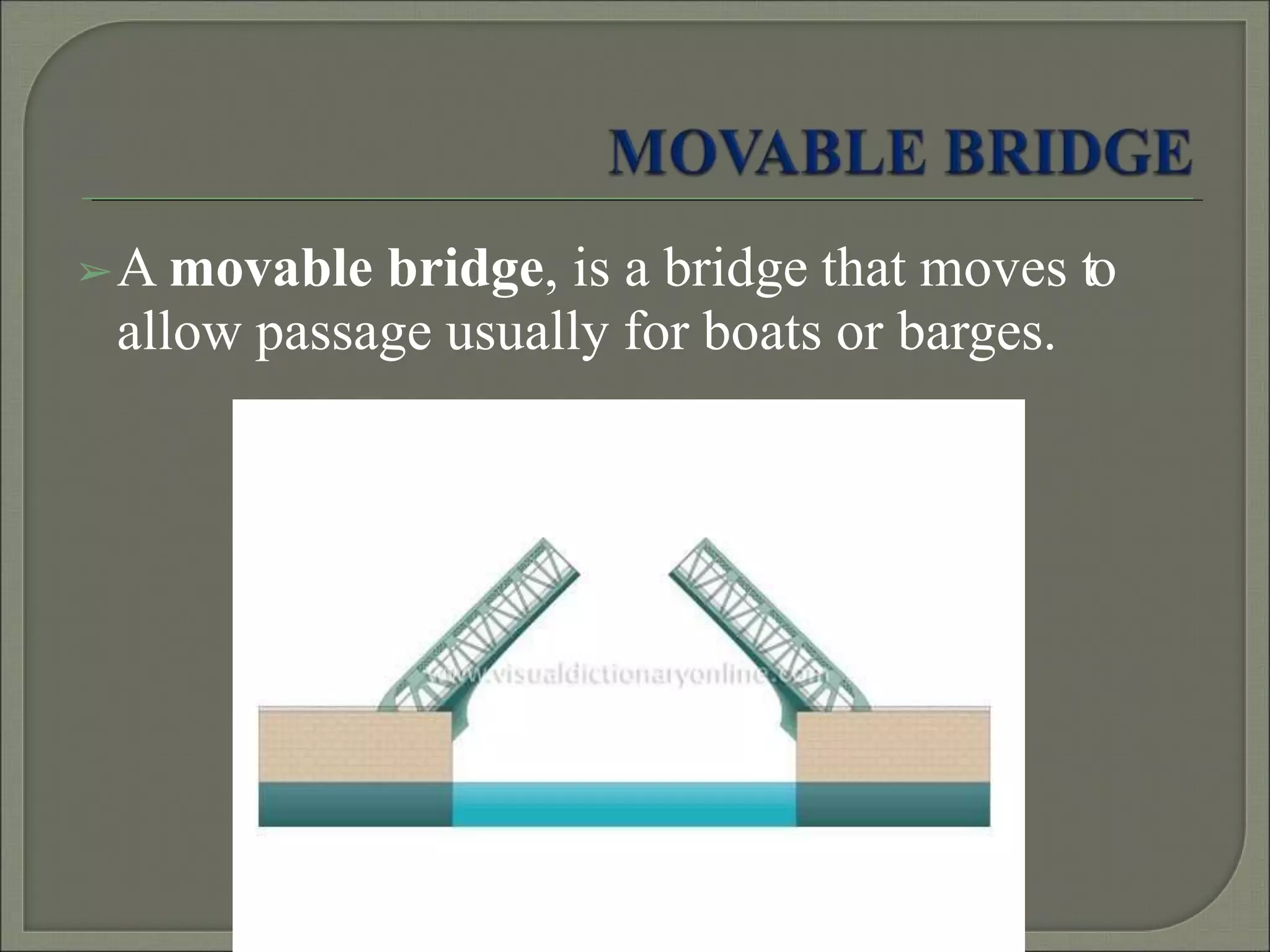
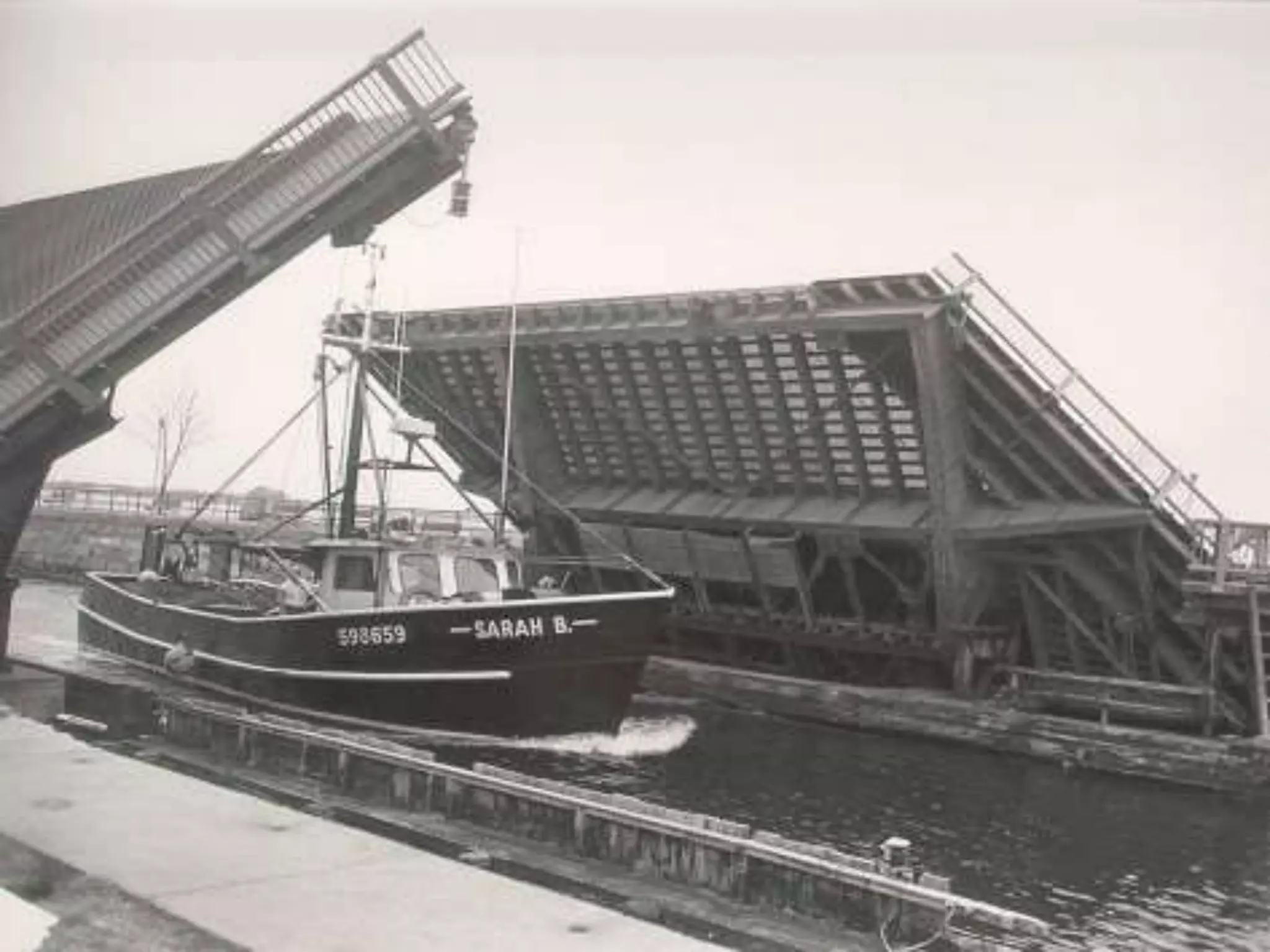
➢A movable bridge, is a bridge that moves to
allow passage usually for boats or barges.
Based upon type of structural arrangement
➢I-girder bridge
➢Plate girder bridge
➢truss girder bridge
➢Suspension bridge
Based upon structural action or nature of
superstructure action
➢Simply supported span bridge
➢Continuous span bridge
➢Cantilever bridge
➢Arch bridge
➢Rigid frame bridge
Based upon type of connections
➢Riveted bridge
➢Welded bridge
➢Bolted bridge
➢Pinned bridge
Based upon floor action
➢Deck type bridge
➢Through type bridge
➢Semi –through type bridge or pony
bridge
➢Double deck bridge-used in rail cum
road bridge
Based upon movement of structural parts of
the bridge
➢Fixed(permanent) bridge
➢Movable bridge: Can opened either
horizontally or vertically so as allow the
river or channel traffic to pass
Based upon purpose of bridge
➢Road bridge
➢Railway bridge
➢Pedestrian bridge
Based upon loading
➢IRC class AA loading bridge
➢IRC class A loading bridge
➢IRC class B bridge
.
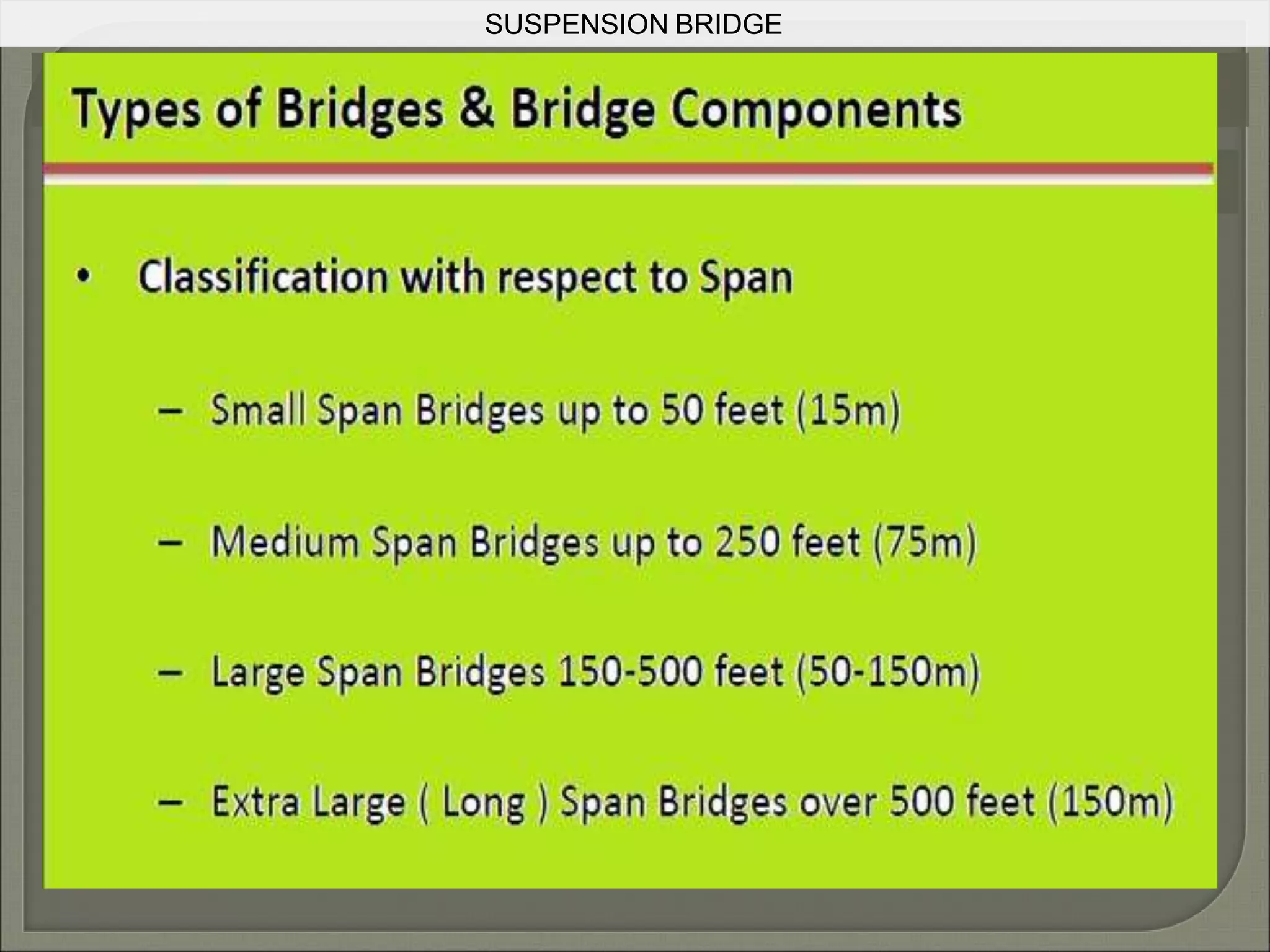
Base upon span length
➢Culvert – up to span length 6m
➢Minor bridge – up to span length 6 to
30m.
➢Major bridge – up to span length over
30m
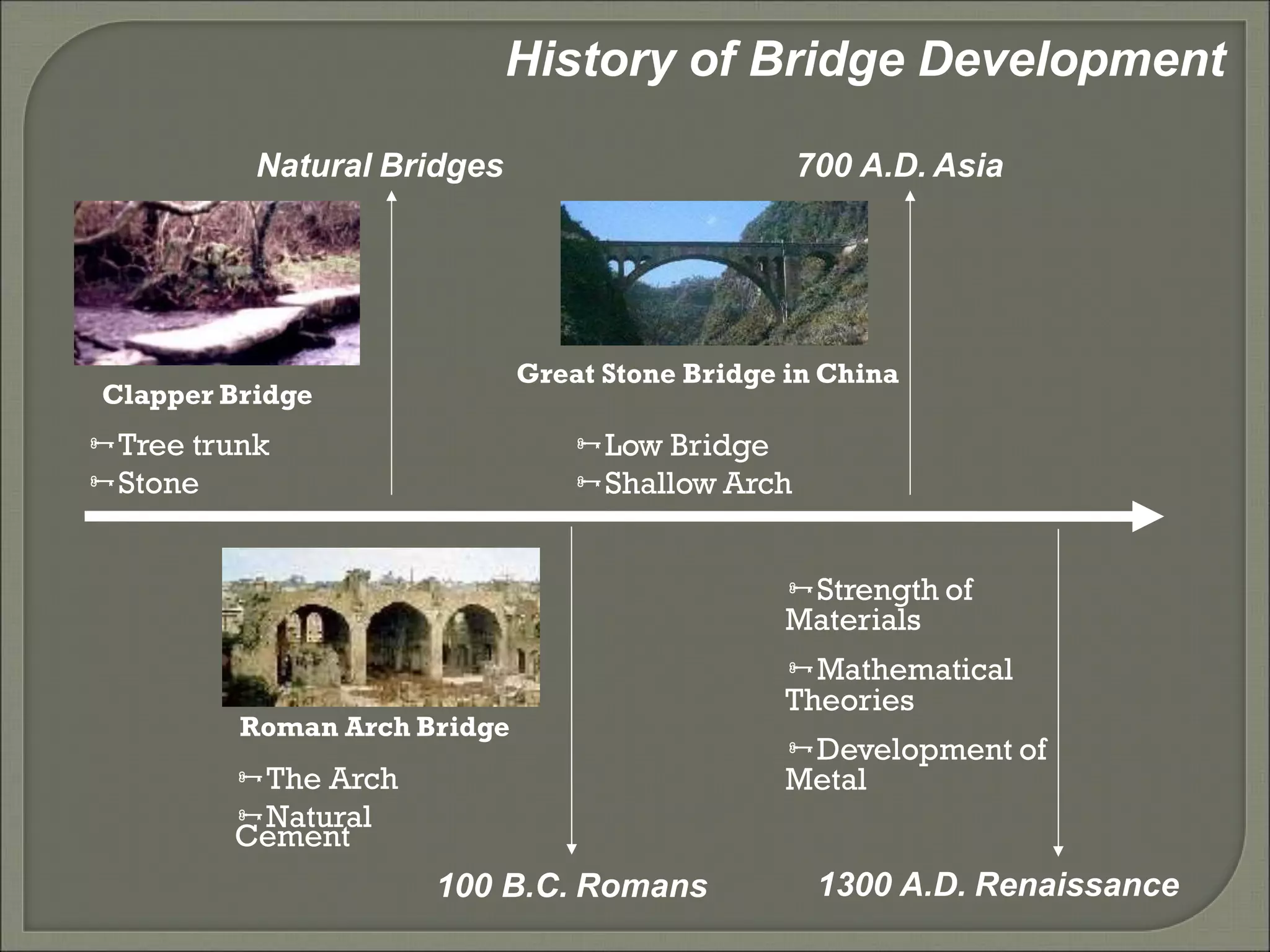
700 A.D. Asia
100 B.C. Romans
Natural Bridges
Clapper Bridge
Tree trunk
Stone
Natural
Cement
Roman Arch Bridge
The Arch
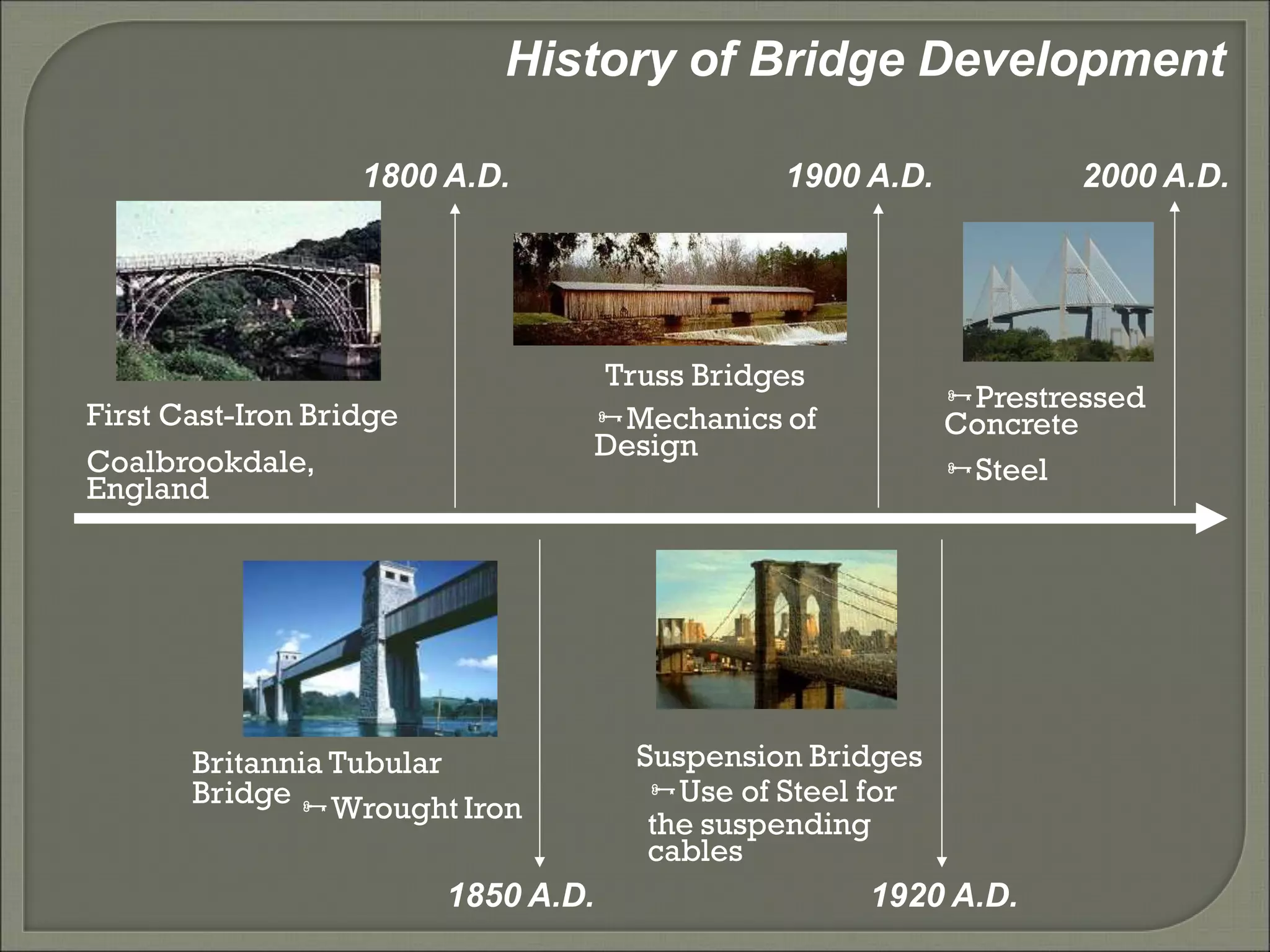
History of Bridge Development
Great Stone Bridge in China
Low Bridge
Shallow Arch
1300 A.D. Renaissance
Strength of
Materials
Mathematical
Theories
Development of
Metal
First Cast-Iron Bridge
Coalbrookdale,
England
1800 A.D.
History of Bridge Development
1850 A.D.
Britannia Tubular
Bridge Wrought Iron
Truss Bridges
Mechanics of
Design
Suspension Bridges
Use of Steel for
the suspending
cables
1900 A.D.
1920 A.D.
Prestressed
Concrete
Steel
2000 A.D.
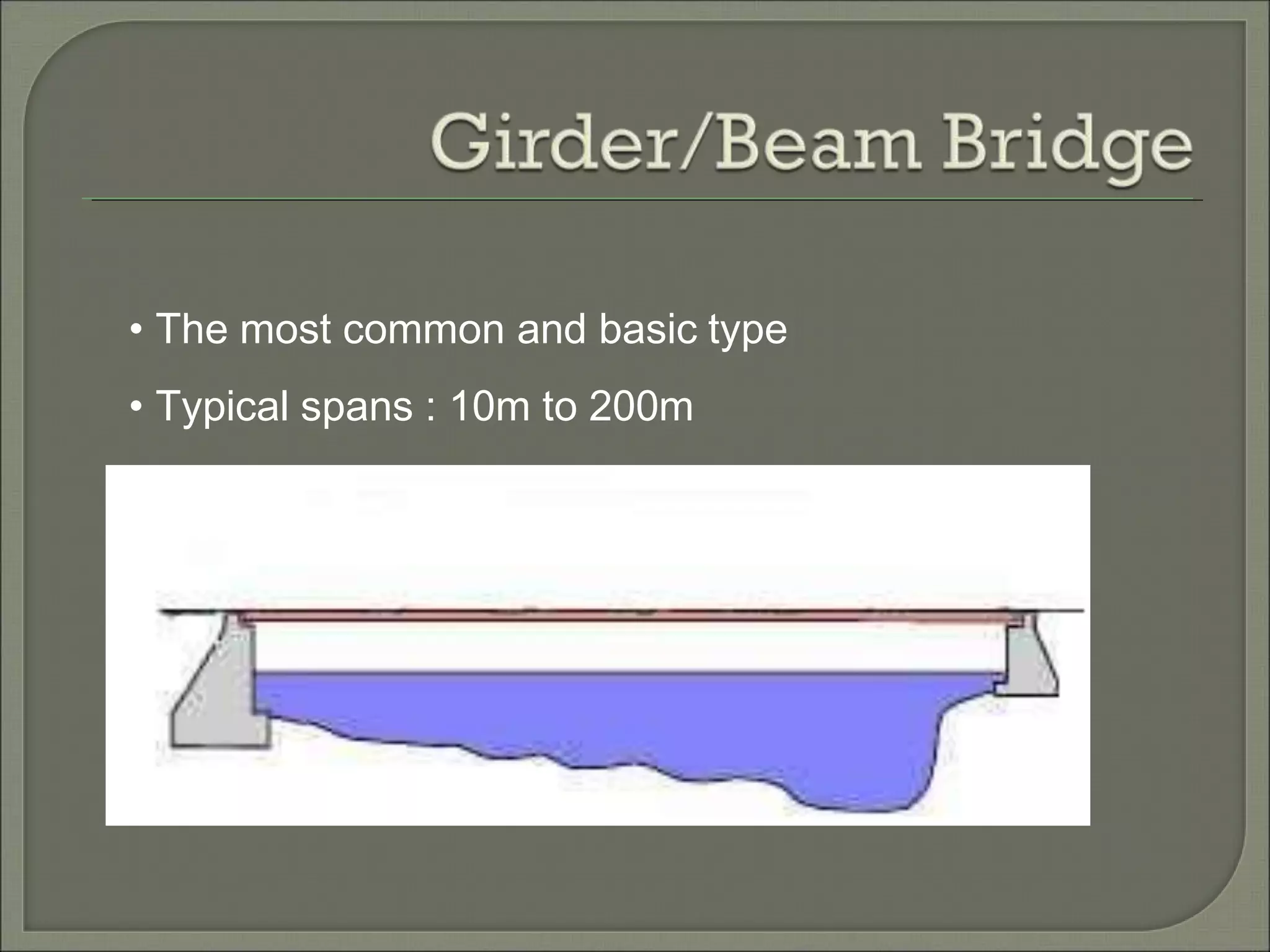
• The most common and basic type
• Typical spans : 10m to 200m
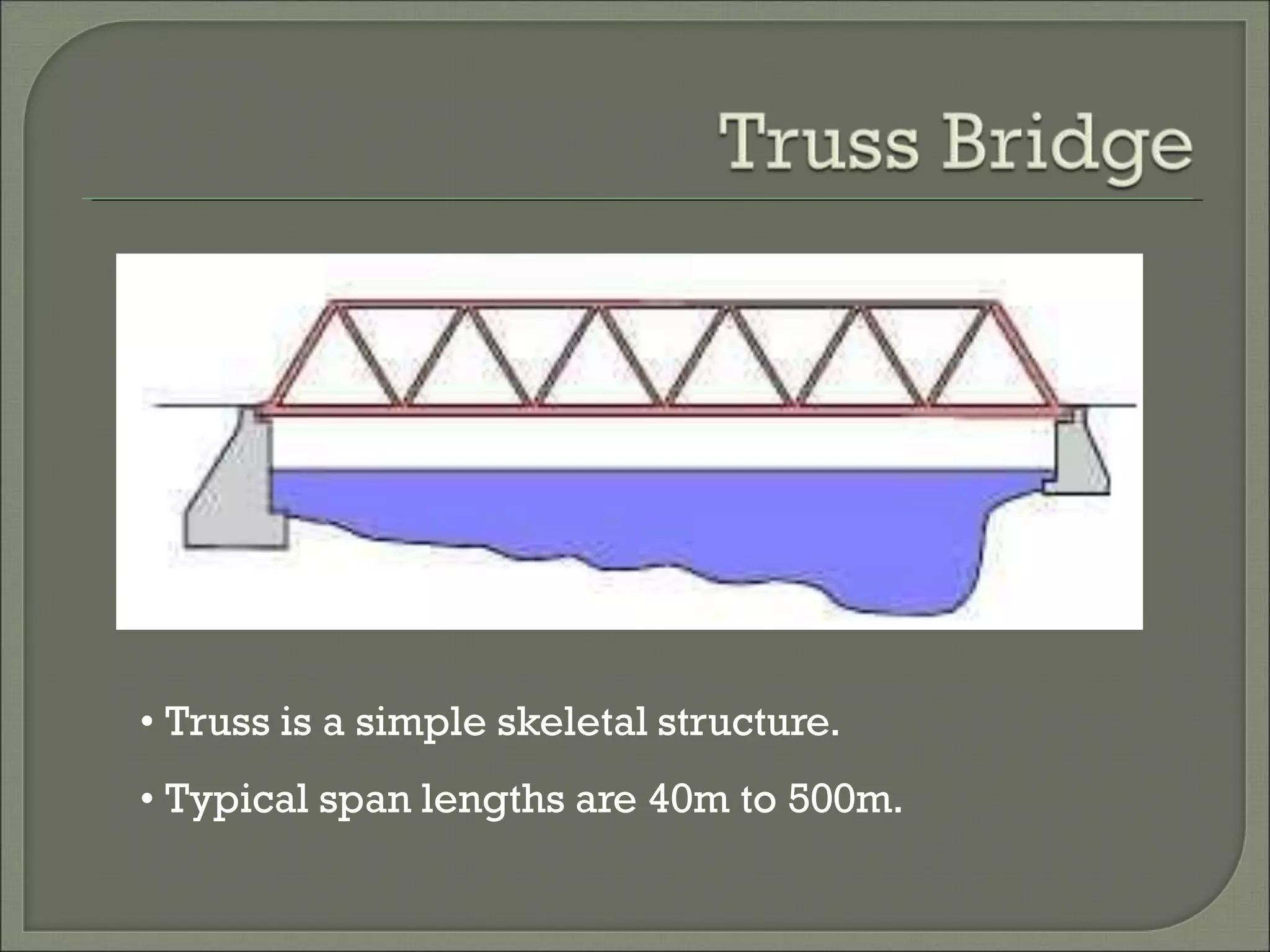
• Truss is a simple skeletal structure.
• Typical span lengths are 40m to 500m.
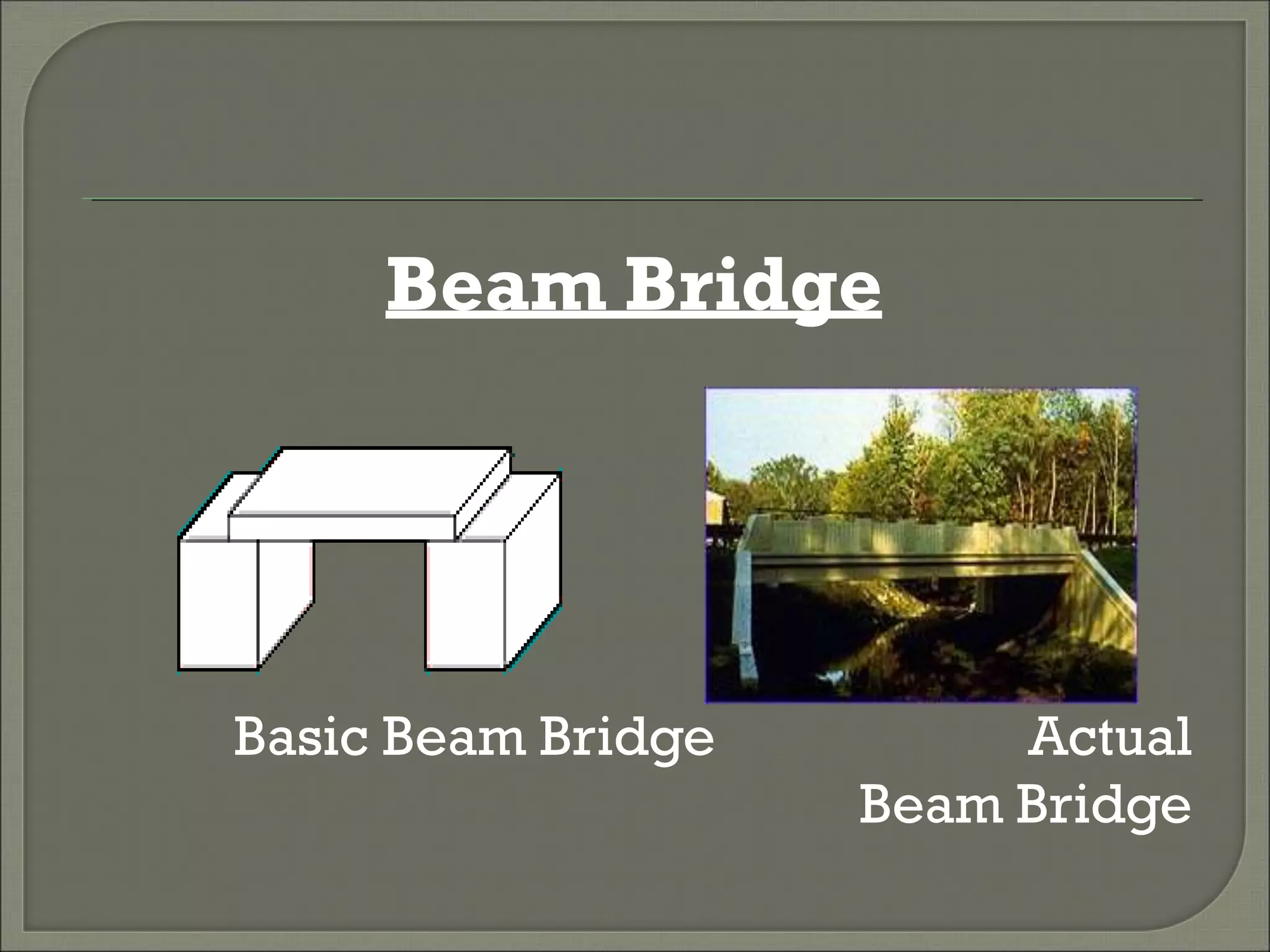
Beam Bridge
Basic Beam Bridge Actual
Beam Bridge
➢ A beam or "girder" bridge is the simplest and most
inexpensive kind of bridge.
➢ In its most basic form, a beam bridge consists of a
horizontal beam that is supported at each end by
piers.The weight of the beam pushes straight
down on the piers.
➢ The beam itself must be strong so that it doesn't
bend under its own weight and the added weight
of crossing traffic.
➢ When a load pushes down on the beam, the beam's
top edge is pushed together (compression) while
the bottom edge is stretched (tension).
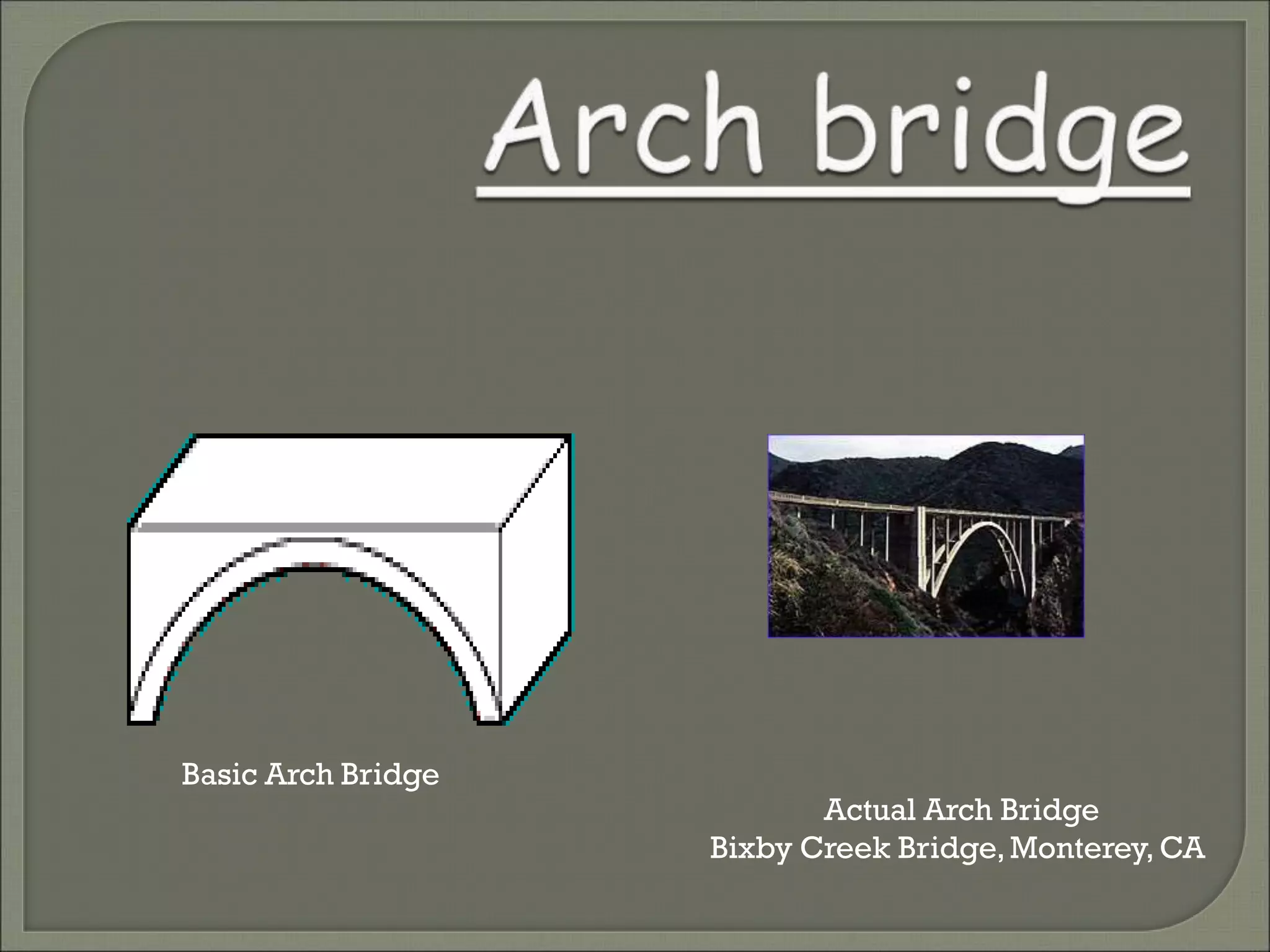
Basic Arch Bridge
Actual Arch Bridge
Bixby Creek Bridge,Monterey, CA
➢Arch bridges are one of the oldest types
of bridges and have great natural
strength.
➢Instead of pushing straight down, the
weight of an arch bridge is carried
outward along the curve of the arch to the
supports at each end.
➢These supports, called the abutments,
carry the load and keep the ends of the
bridge from spreading out.
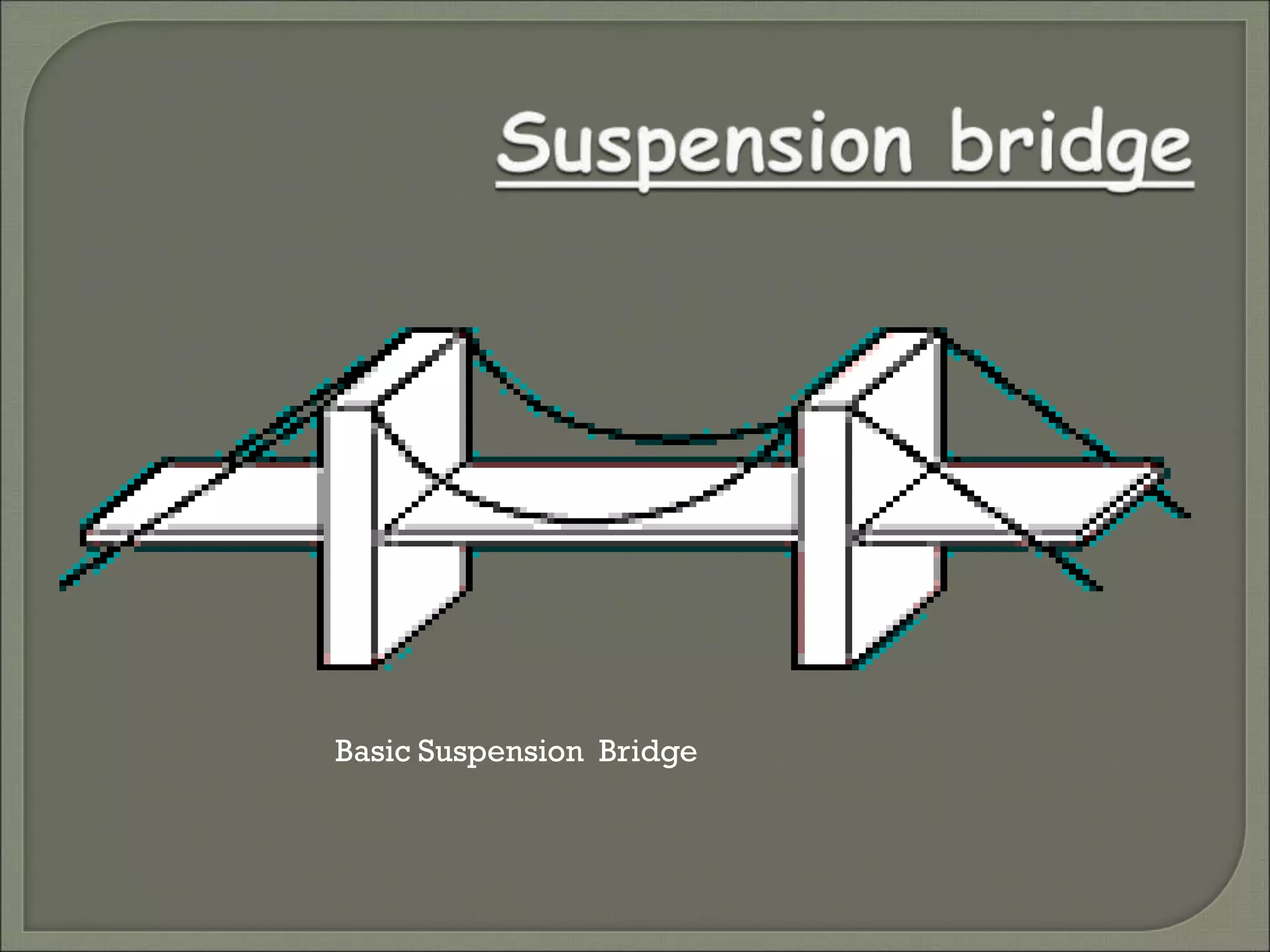
Basic Suspension Bridge
➢ Aesthetic, light, and strong,suspension bridges
can span distances from 2,000 to 7,000 feet --
far longer than any other kind of bridge.
➢ They also tend to be the most expensive to
build.
➢ True to its name, a suspension bridge suspends
the roadway from huge main cables, which
extend from one end of the bridge to the other.
➢ These cables rest on top of high towers and are
secured at each end by anchorages.
The towers enable the main cables
to be draped over long distances.
Most of the weight of the bridge is
carried by the cables to the
anchorages, which are imbedded in
either solid rock or massive concrete
blocks.
Inside the anchorages, thecables
are spread over a large area to
evenly distribute the load and to
prevent the cables from breaking
free.
Basic Cable-stayed Bridge
➢ Cable-stayed bridges may look similar to
suspensions bridges -- both have roadways that
hang from cables and both have towers.
➢ Two bridges support the load of the roadway in
very different ways.
➢ The difference lies in how the cables are
connected to the towers. In suspension bridges,the
cables ride freely across the towers, transmitting
the load to the anchorages at either end.
➢ In cable-stayeded bridges, the cables are attached
to the towers, which alone bear the load.
The cables can be attached to the
roadway in a variety of ways.
In a radial pattern, cablesextend
from several points on the road to
a single point at the top of the
tower.
In a parallel pattern, cables are
attached at different heights along
the tower,running parallel to one
other.
Introductiontobridges 150423001518-conversion-gate02

Introductiontobridges 150423001518-conversion-gate02

  • 2.
    A bridge isa structure that permits us to cross over an obstacle. Suppose we lay a plank across a brook. If we have a bridge. If the plank is thin in relation to its length , it will sag. In fact, if it is too long, it will collapse. This shows that we must consider the weight of a bridge itself---the “dead load”. If we stand at the middle of the plank, it sags even more. So, we must provide for the weight of whatever our bridge is designed to carry--- the “live load”. Also, when you walk across the plank, it bounces under you, illustrating the effect of a “moving live load”. Finally, there is a “wind load”. A strong wind pushes against the sides, lifts the deck, shakes the whole structure. Certainly the force of the wind is something to keep in mind. Bridges help us to connect to each other and the world. There are four main types of physical bridges. They are arch, beam, suspension and cable-stayed.
  • 3.
    Functions : aqueduct,viaduct, highway, pedestrian etc. Materials of construction : reinforced concrete, pre- stressed concrete, steel, composite, timber etc. Form of superstructure : slab, beam, truss, arch, suspension, cable-stayed etc. Inter-span relation : simple, continuous, cantilever. Method of construction : pin-connected, riveted, welded etc. Span : short, medium, long, right, skew, curved. Type of service and duration of use : permanent, temporary bridge, military
  • 4.
    SUSPENSION BRIDGE COMPARISION Advantages overother bridge types Longer main spans Less material may be required than other bridge types, even at spans they can achieve, leading to a reduced construction cost Except for installation of the initial temporary cables, little or no access from below is required during construction, for example allowing a waterway to remain open while the bridge is built above A suspension bridge can be made out of simple materials such as wood and common wire rope. May be better to withstand earthquake movements than heavier and more rigid bridges Disadvantages over other bridge types Considerable stiffness may be required to prevent the bridge deck vibrating under high winds The relatively low deck stiffness compared to other (non-suspension) types of bridges makes it more difficult to carry heavy rail traffic where high concentrated live loads occur
  • 5.
    The two basicparts are: Substructure - includes the piers, the abutments and the foundations. Superstructure - consists of the deck structure itself, which support the direct loads due to traffic and all the other permanent and variable leads to which the structure is subjected. The connection between the substructure and the superstructure is usually made through bearings. However, rigid connections between the piers (and sometimes the abutments) may be adopted, particularly in frame bridges with tall (flexible) piers.
  • 6.
    Bridge is astructure which provides a passage over a gap without closing the opening which is beneath that gap. The passage may be due to railway , roadway , canal & natural river etc. Initially the naturally available materials such as stone and timber were extensively used for bridges but now days artificial materials such as cement concrete & steel are utilized more in the construction of bridge.
  • 7.
    ➢ During theking “harshavardhna” or even before him india appears to have a good highway system & such highways had a number of bridge. ➢ “firoze shah” who ruled the delhi in mid 14thcentury built a number of canal & bridges. ➢ “portuguese” in 16thand 17thcentury built many old arch masonary bridges in “goa”. ➢ One of oldest stone slab bridge still in use across the river “cauvery” at “srirangapatnam” bulit by “tippu sultan”. ➢ A number of cable stayed bridges has been built in india in past two decades. The major one is “vidhyasagar sethu” across “hooghly” at “kolkata” & “nalini bridge” on river “jamuna” at “allahabad”. ➢ Inidian railways build a number of large steel arch bridge in “j & k”. ➢ BRO has erected a cable stayed bridge in early part of this millenium which is claimed to be only bridge of the type at highest altitude in the world at the time of construction.
  • 8.
    700 A.D. Asia 1,304years ago 100 B.C. Romans 2,104 years ago Clapper Bridge Tree trunk Stone Arch design evenly distributes stresses Natural concrete made from mud and straw Roman Arch Bridge Great Stone Bridge in China Low bridge Shallow arch Allows boats and water to pass through
  • 9.
    Truss Bridges Mechanics of Design Wood SuspensionBridges Use of steel in suspending cables 1900 1920 Prestressed Concrete Steel 2000
  • 10.
    MASONARY ARCH BRIDGE Probablyfirst category of bridge to be involved. Aesthetically superior to slab bridges. Consist of a arch shape slab supported on two apposite wall & it was adopted earlier for small of 3 to 15m in masonry & extended up to 519m in steel & 305m in concrete has been built in the world.
  • 11.
    Beam Bridge When somethingpushes down on the beam, the beam bends. Its top edge is pushed together, and its bottom edge is pulled apart. Beam bridges are horizontal beams supported at each end by substructure units and can be either simply supported when the beams only connect across a single span, or continuous when the beams are connected across two or more spans.
  • 13.
    PIPE CULVERT Consist ofa pipe barrel under the embankment with protection works at the entry and exit. It is suitable for cross drainage flow on relatively flat terrain & in this discharge is limited & it has negligible maintenance
  • 14.
    □ Hydraulically shortconduit which conveys stream flow through a roadway embankment or past some other type of flow obstruction
  • 15.
    SLAB BRIDGE Simplest typeof construction. Adopted for small bridges and culverts. Span is between 10-20m. Concrete slab cast monolithically over longitudinal girder. No.of longitudinal girders depends upon the width of road
  • 16.
    PLATE GIRDER BRIDGE □Span ranges 10 to 60m. □ Can be extending up to 250m in continuous construction
  • 17.
    TRUSS BRIDGE □ Span30 to 375m in simply supported case. □ Span 30 to 550m in cantilever combination case
  • 18.
    All beams ina truss bridge are straight. Trusses are comprised of many small beams that together can support a large amount of weight and span great distances.
  • 19.
    SUSPENSSION BRIDGE Made upof high tensile steel cables strung in form of a centenary to which the deck is attached by steel suspenders which are made up of steel rods/members/cables. Deck can be of timber , concrete or steel spanning across the stiffening girders transmitting loads to suspenders.
  • 20.
    Forces In all suspensionbridges, the roadway hangs from massive steel cables, which are draped over two towers and secured into solid concrete blocks, called anchorages, on both ends of the bridge. The cars push down on the roadway, but because the roadway is suspended, the cables transfer the load into compression in the two towers. The two towers support most of the bridge's weight.
  • 22.
    ➢ Cable-stayed bridgeslike suspension bridges, are held up by cables. However, in a cable-stayed bridge, less cable is required and the towers holding the cables are proportionately higher.
  • 23.
    Similar to suspensionbridge except that there will be no suspenders in the cable stayed bridges . A number of cables are stretched from support tower directly connected the decking. The cable stayed bridge is newer than the other types of bridge. Large upright steel supports are used to transmit the load into the ground.
  • 24.
    □ A cantileverbridge is a bridge built using cantilevers: structures that project horizontally into space, supported on only one end.
  • 25.
    ➢ Cantilever bridgesare built using cantilevers horizontal beams supported on only one end. Most cantilever bridges use a pair of continuous spans that extend from opposite sides of the supporting piers to meet at the center of the obstacle the bridge crosses.
  • 26.
    The arch hasgreat natural strength. Thousands of years ago, Romans built arches out of stone.Today,most arch bridges are made of steel or concrete,and they can span up to 800 feet.
  • 27.
    Arch bridges have abutmentsat each end. The weight of the bridge is thrust into the abutments at either side.
  • 28.
    Forces The arch issqueezed together, and this squeezing force is carried outward along the curve to the supports at each end. The supports, called abutments, push back on the arch and prevent the ends of the arch from spreading apart.
  • 29.
    ➢A movable bridge,is a bridge that moves to allow passage usually for boats or barges.
  • 31.
    Based upon typeof structural arrangement ➢I-girder bridge ➢Plate girder bridge ➢truss girder bridge ➢Suspension bridge
  • 32.
    Based upon structuralaction or nature of superstructure action ➢Simply supported span bridge ➢Continuous span bridge ➢Cantilever bridge ➢Arch bridge ➢Rigid frame bridge
  • 33.
    Based upon typeof connections ➢Riveted bridge ➢Welded bridge ➢Bolted bridge ➢Pinned bridge
  • 34.
    Based upon flooraction ➢Deck type bridge ➢Through type bridge ➢Semi –through type bridge or pony bridge ➢Double deck bridge-used in rail cum road bridge
  • 35.
    Based upon movementof structural parts of the bridge ➢Fixed(permanent) bridge ➢Movable bridge: Can opened either horizontally or vertically so as allow the river or channel traffic to pass
  • 36.
    Based upon purposeof bridge ➢Road bridge ➢Railway bridge ➢Pedestrian bridge
  • 37.
    Based upon loading ➢IRCclass AA loading bridge ➢IRC class A loading bridge ➢IRC class B bridge .
  • 38.
    Base upon spanlength ➢Culvert – up to span length 6m ➢Minor bridge – up to span length 6 to 30m. ➢Major bridge – up to span length over 30m
  • 39.
    700 A.D. Asia 100B.C. Romans Natural Bridges Clapper Bridge Tree trunk Stone Natural Cement Roman Arch Bridge The Arch History of Bridge Development Great Stone Bridge in China Low Bridge Shallow Arch 1300 A.D. Renaissance Strength of Materials Mathematical Theories Development of Metal
  • 40.
    First Cast-Iron Bridge Coalbrookdale, England 1800A.D. History of Bridge Development 1850 A.D. Britannia Tubular Bridge Wrought Iron Truss Bridges Mechanics of Design Suspension Bridges Use of Steel for the suspending cables 1900 A.D. 1920 A.D. Prestressed Concrete Steel 2000 A.D.
  • 49.
    • The mostcommon and basic type • Typical spans : 10m to 200m
  • 50.
    • Truss isa simple skeletal structure. • Typical span lengths are 40m to 500m.
  • 51.
    Beam Bridge Basic BeamBridge Actual Beam Bridge
  • 53.
    ➢ A beamor "girder" bridge is the simplest and most inexpensive kind of bridge. ➢ In its most basic form, a beam bridge consists of a horizontal beam that is supported at each end by piers.The weight of the beam pushes straight down on the piers. ➢ The beam itself must be strong so that it doesn't bend under its own weight and the added weight of crossing traffic. ➢ When a load pushes down on the beam, the beam's top edge is pushed together (compression) while the bottom edge is stretched (tension).
  • 54.
    Basic Arch Bridge ActualArch Bridge Bixby Creek Bridge,Monterey, CA
  • 57.
    ➢Arch bridges areone of the oldest types of bridges and have great natural strength. ➢Instead of pushing straight down, the weight of an arch bridge is carried outward along the curve of the arch to the supports at each end. ➢These supports, called the abutments, carry the load and keep the ends of the bridge from spreading out.
  • 58.
  • 61.
    ➢ Aesthetic, light,and strong,suspension bridges can span distances from 2,000 to 7,000 feet -- far longer than any other kind of bridge. ➢ They also tend to be the most expensive to build. ➢ True to its name, a suspension bridge suspends the roadway from huge main cables, which extend from one end of the bridge to the other. ➢ These cables rest on top of high towers and are secured at each end by anchorages.
  • 62.
    The towers enablethe main cables to be draped over long distances. Most of the weight of the bridge is carried by the cables to the anchorages, which are imbedded in either solid rock or massive concrete blocks. Inside the anchorages, thecables are spread over a large area to evenly distribute the load and to prevent the cables from breaking free.
  • 63.
  • 66.
    ➢ Cable-stayed bridgesmay look similar to suspensions bridges -- both have roadways that hang from cables and both have towers. ➢ Two bridges support the load of the roadway in very different ways. ➢ The difference lies in how the cables are connected to the towers. In suspension bridges,the cables ride freely across the towers, transmitting the load to the anchorages at either end. ➢ In cable-stayeded bridges, the cables are attached to the towers, which alone bear the load.
  • 67.
    The cables canbe attached to the roadway in a variety of ways. In a radial pattern, cablesextend from several points on the road to a single point at the top of the tower. In a parallel pattern, cables are attached at different heights along the tower,running parallel to one other.