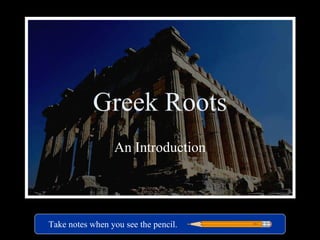
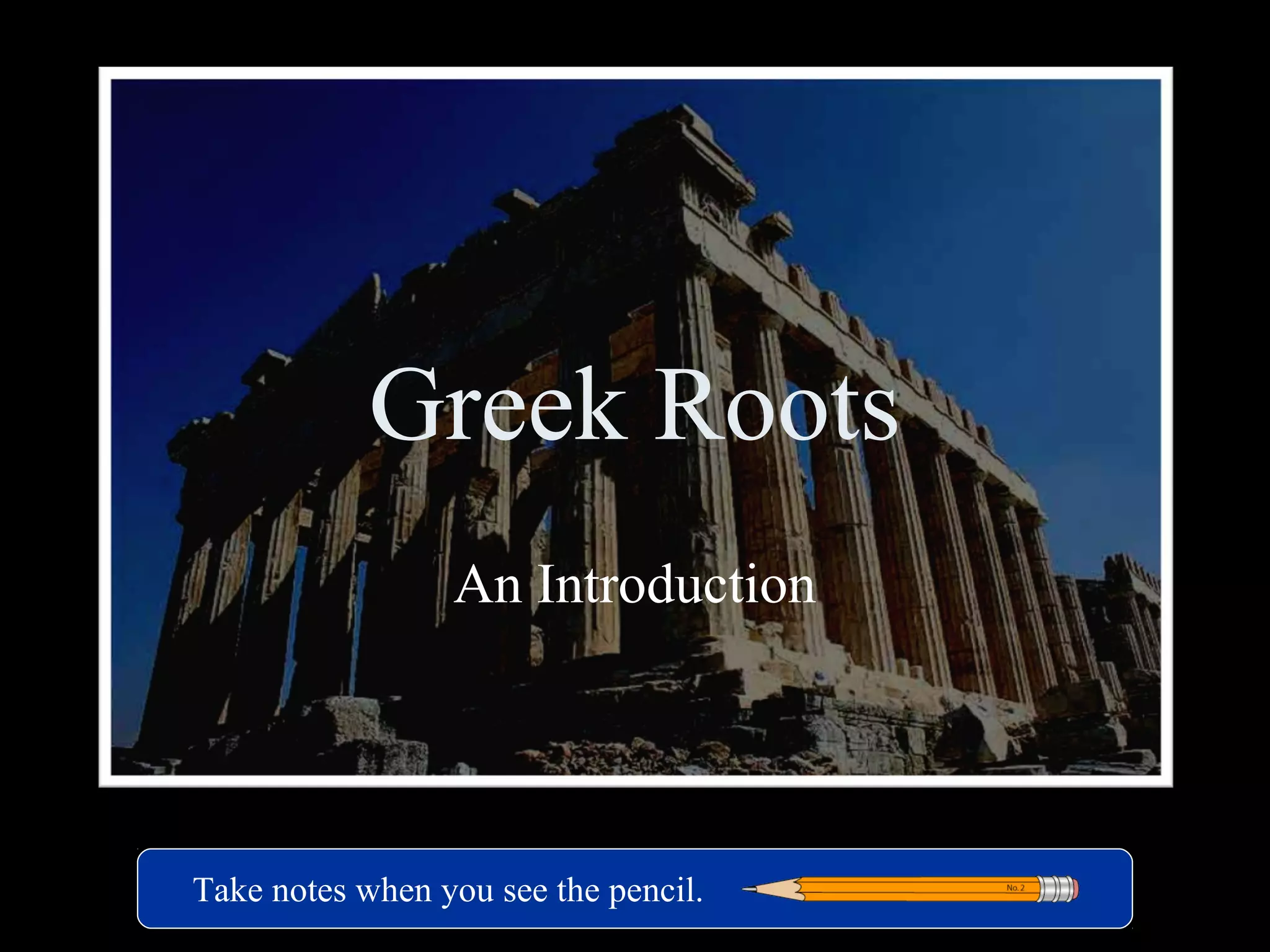
Greek Roots
                 An Introduction


Take notes when you see the pencil.
Greek Roots
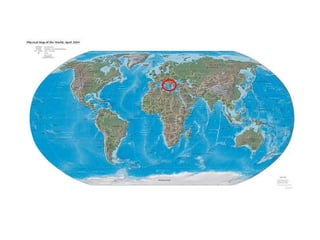
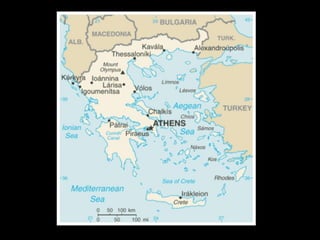
• Greece is a country in the
  Mediterranean region.
• The Greek civilization is thousands
  of years old.
• Many of the words in modern
  languages come from Greek words.
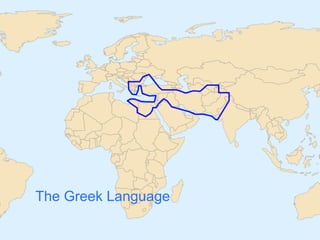
The Greek Language
Greek Roots

• Greek roots are word
  parts that have meaning.
• For example...
photo = light
graph = write
photograph
picture written
   with light
bio = life
ology = the study of
biology = the study
  of living things
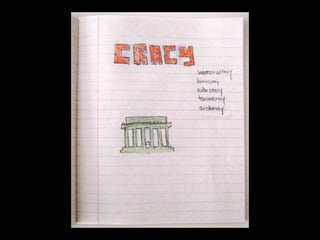
cracy = type of
  government
democracy
bureaucracy
  autocracy
technocracy
 aristocracy
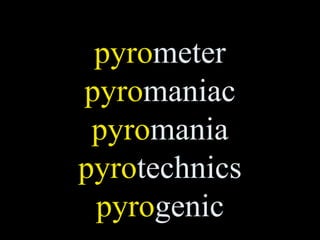
pyro = fire
pyrometer
pyromaniac
 pyromania
pyrotechnics
 pyrogenic
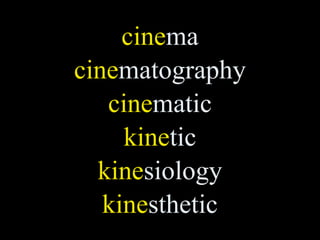
cine/kine = motion
cinema
cinematography
   cinematic
     kinetic
  kinesiology
   kinesthetic
hyper = over
hyperspace
  hyperactive
 hypercritical
hypersensitive
 hyperactivity
path/pathos = feeling
empathy
 sympathy
   apathy
  apathetic
psychopathic
mania = madness
pyromania
bibliomania
   maniac
kleptomania
megalomania
theo = god
monotheism
polytheism
 atheism
 theology
   theist
gon = figure having
      angles
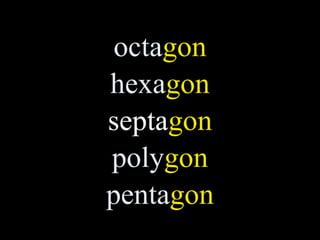
octagon
hexagon
septagon
polygon
pentagon
penta= five
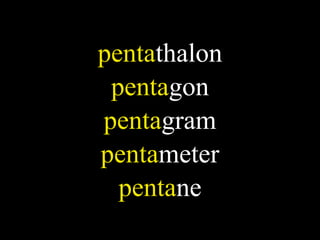
pentathalon
 pentagon
pentagram
pentameter
  pentane
GREEK ROOTS
• If you know the meaning of 42
  Greek roots, you will know the
  meaning of thousands of English
  words.
Greek Roots Art Book Project
• Create one hand-drawn, color art image for
  each Greek root.
• Find five words that contain that root.
• Combine them into one page.
• DUE Friday, Sept. 21
Materials
1. Composition Book or 21 pieces of paper,
   folded in half.
2. Pencil
3. Colored pencils or crayons or markers.
4. Handout: The 42 Most Common Greek
   Roots
Greek Roots Art Book
           Guidelines
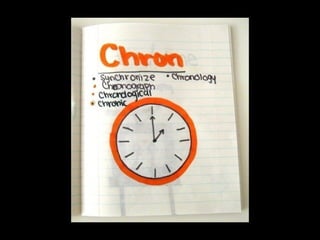
1. The root: big.
2. A picture that represents the
   meaning of the root.
3. Five words that use the root.

anti
   antibacterial
   antibiotic
   antisocial
   antibodies
Introductionto greekrootspowerpointpresentationlecture

Introductionto greekrootspowerpointpresentationlecture

Editor's Notes

  • #4 This image is in the public domain because it contains materials that originally came from the United States Central Intelligence Agency's World Factbook.
  • #5 This image is in the public domain because it contains materials that originally came from the United States Central Intelligence Agency's World Factbook.
  • #6 The Greek language was spoken in the geographical area that represents, more or less, the cradle of Western civilization. This map shows the approximate area of the Ancient Greece, and the area in which the Greek language was spoken in one form or another. Ancient Greece is the civilization belonging to the period of Greek history lasting from the Archaic period of the 8th to 6th centuries BC to the end of antiquity and beginning of the Early Middle Ages with the rise of the Byzantine era following Justinian I.[1] At the center of this time period is Classical Greece, which flourished during the 5th to 4th centuries BC, at first under Athenian leadership successfully repelling the military threat of Persian invasion. The Athenian Golden Age ends with the defeat of Athens at the hands of Sparta in the Peloponnesian War in 404 BC. Following the conquests of Alexander the Great, Hellenistic civilization flourished from Central Asia to the western end of the Mediterranean Sea. Source: http://en.wikipedia.org/wiki/Ancient_Greece Requires an internet connection.
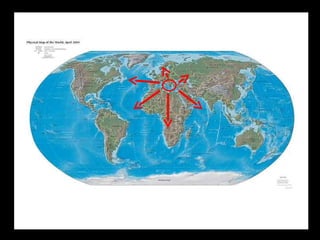
  • #7 The Greek language seeded languages that spread the world over. This image is in the public domain because it contains materials that originally came from the United States Central Intelligence Agency's World Factbook.