Introduction
to
Scientific models
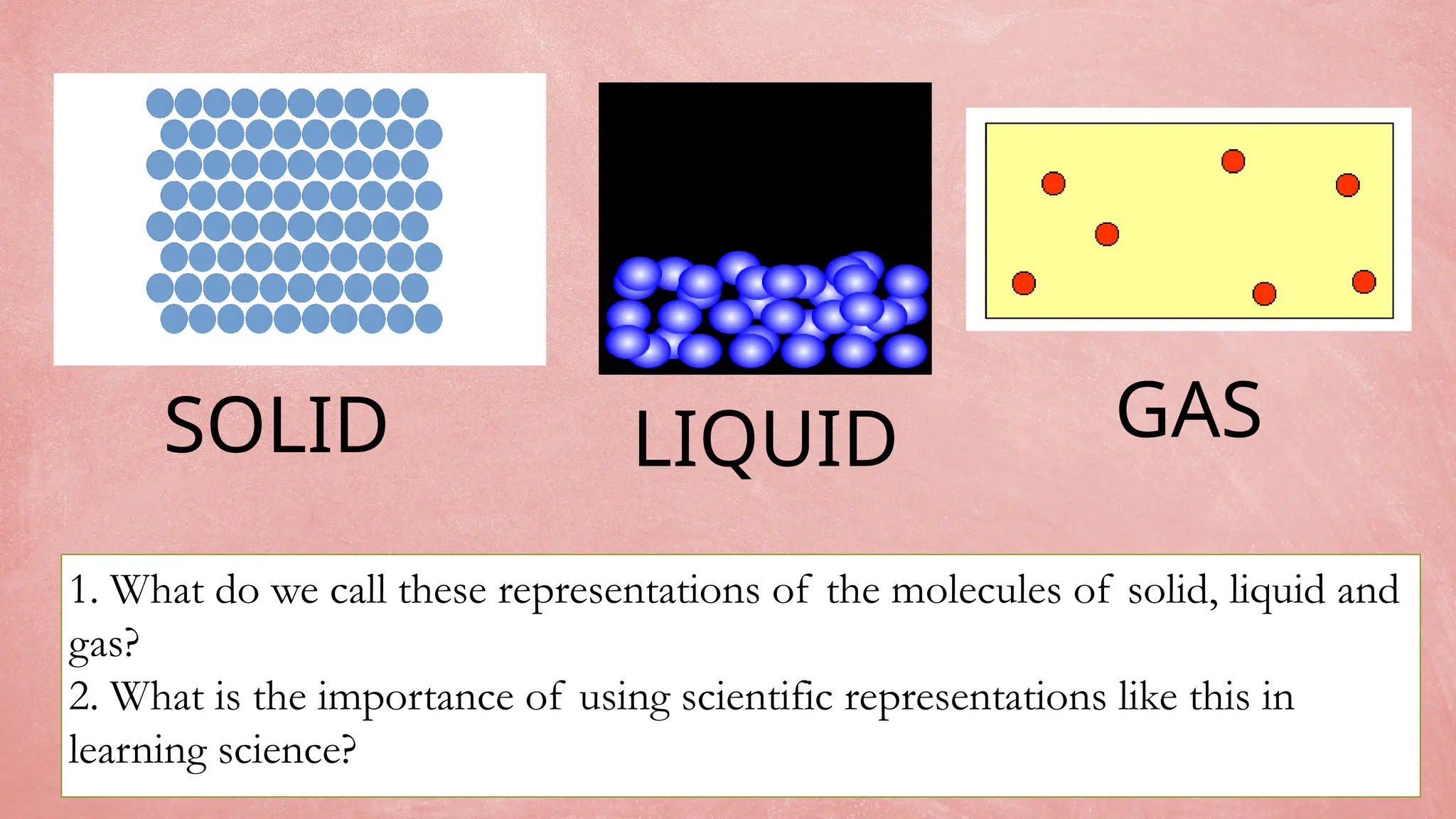
SOLID LIQUID GAS
1. What do we call these representations of the molecules of solid, liquid and
gas?
2. What is the importance of using scientific representations like this in
learning science?
• How can we visualize things that
cannot be seen by the eye?
• How can we visualize things that is
too big, and complex be examined in
actuality?
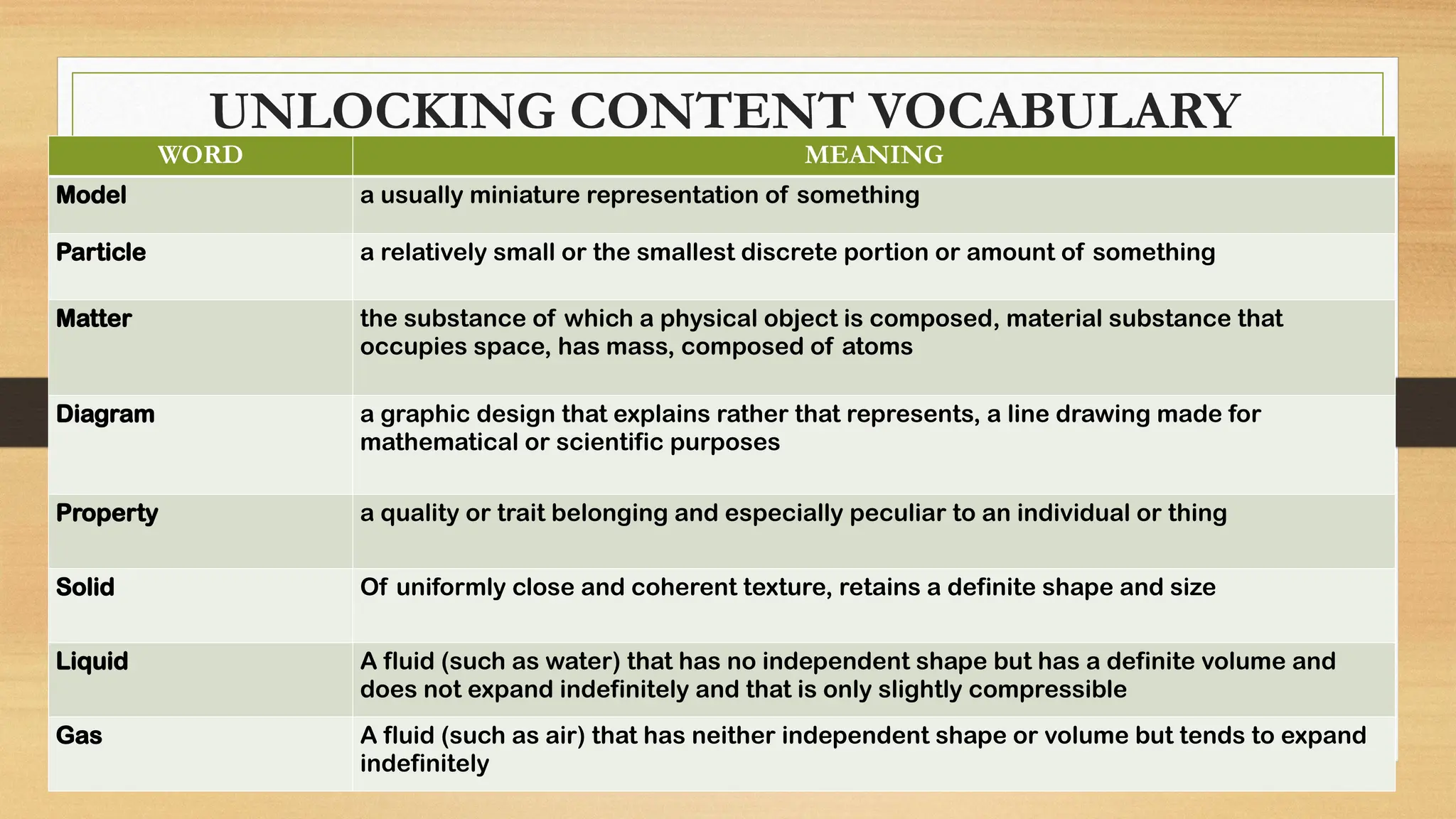
UNLOCKING CONTENT VOCABULARY
WORD MEANING
Model a usually miniature representation of something
Particle a relatively small or the smallest discrete portion or amount of something
Matter the substance of which a physical object is composed, material substance that
occupies space, has mass, composed of atoms
Diagram a graphic design that explains rather that represents, a line drawing made for
mathematical or scientific purposes
Property a quality or trait belonging and especially peculiar to an individual or thing
Solid Of uniformly close and coherent texture, retains a definite shape and size
Liquid A fluid (such as water) that has no independent shape but has a definite volume and
does not expand indefinitely and that is only slightly compressible
Gas A fluid (such as air) that has neither independent shape or volume but tends to expand
indefinitely
UNLOCKING CONTENT VOCABULARY
WORD MEANING
Melting The process in which solid substances are converted into liquids by adding
heat.
Freezing Is a phase transition in which a liquid turns into a solid when its temperature
is lowered below its freezing point.
Evaporation Is when a liquid turns into a gas
Condensation Is when a gas turns into a liquid
Sublimation Conversion of a substance from solid to the gaseous state without its
becoming liquid
Deposition Is the laying down of sediment carried by wind, flowing water, the sea or ice
Energy The capacity to do work
Temperature The degree or intensity of heat present in a substance or object
Think-pair-share
• What do you think a scientific model is?
• Can you give an example of a scientific model
you have encountered before?
• Why do you think scientists use models to
understand phenomena?
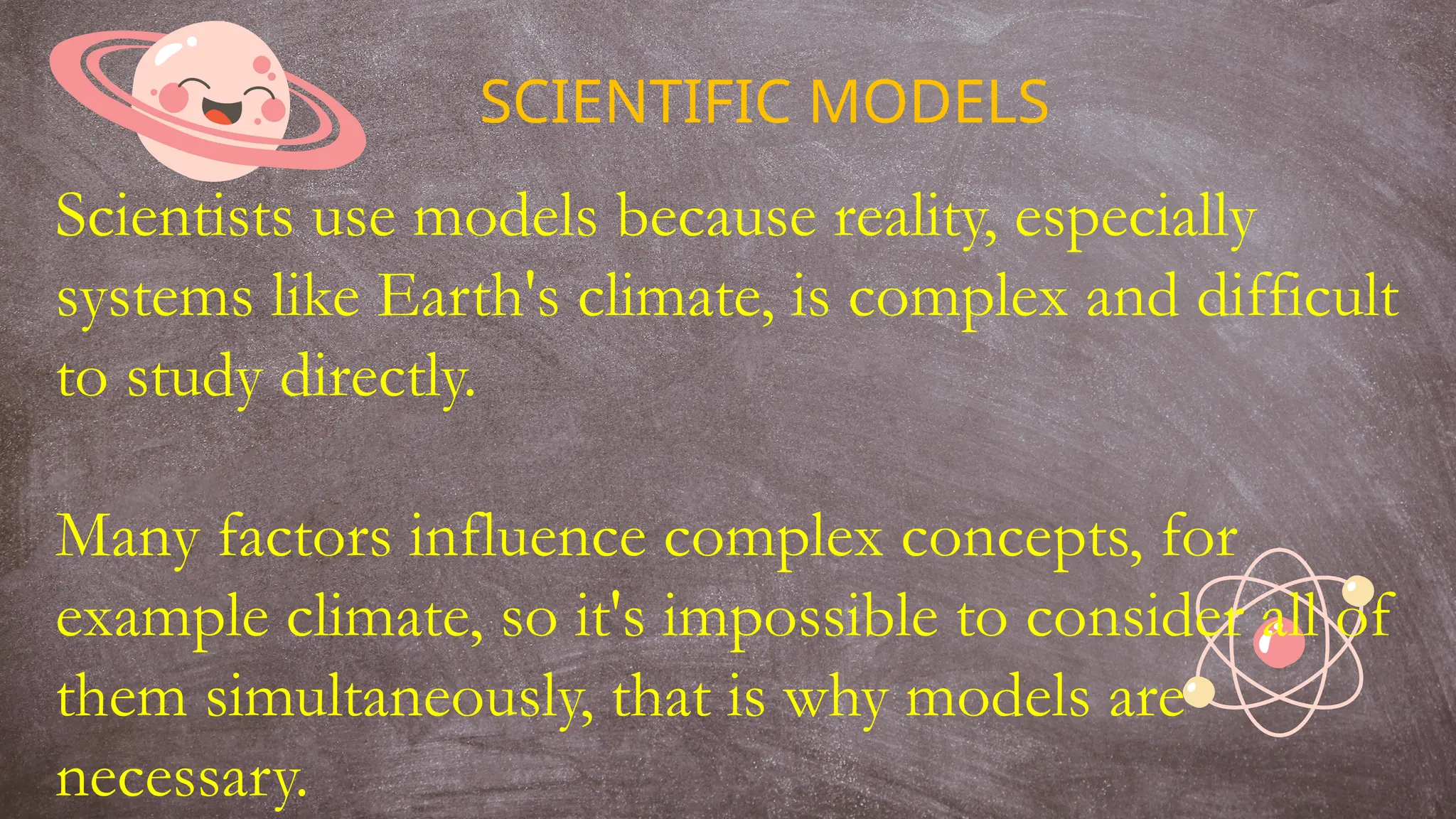
SCIENTIFIC MODELS
Scientists use models because reality, especially
systems like Earth's climate, is complex and difficult
to study directly.
Many factors influence complex concepts, for
example climate, so it's impossible to consider all of
them simultaneously, that is why models are
necessary.
Models are useful tools that help scientists understand complex
systems by allowing them to analyze and make predictions.
There are different types of models: physical models, conceptual
models, and mathematical models.
MISSION
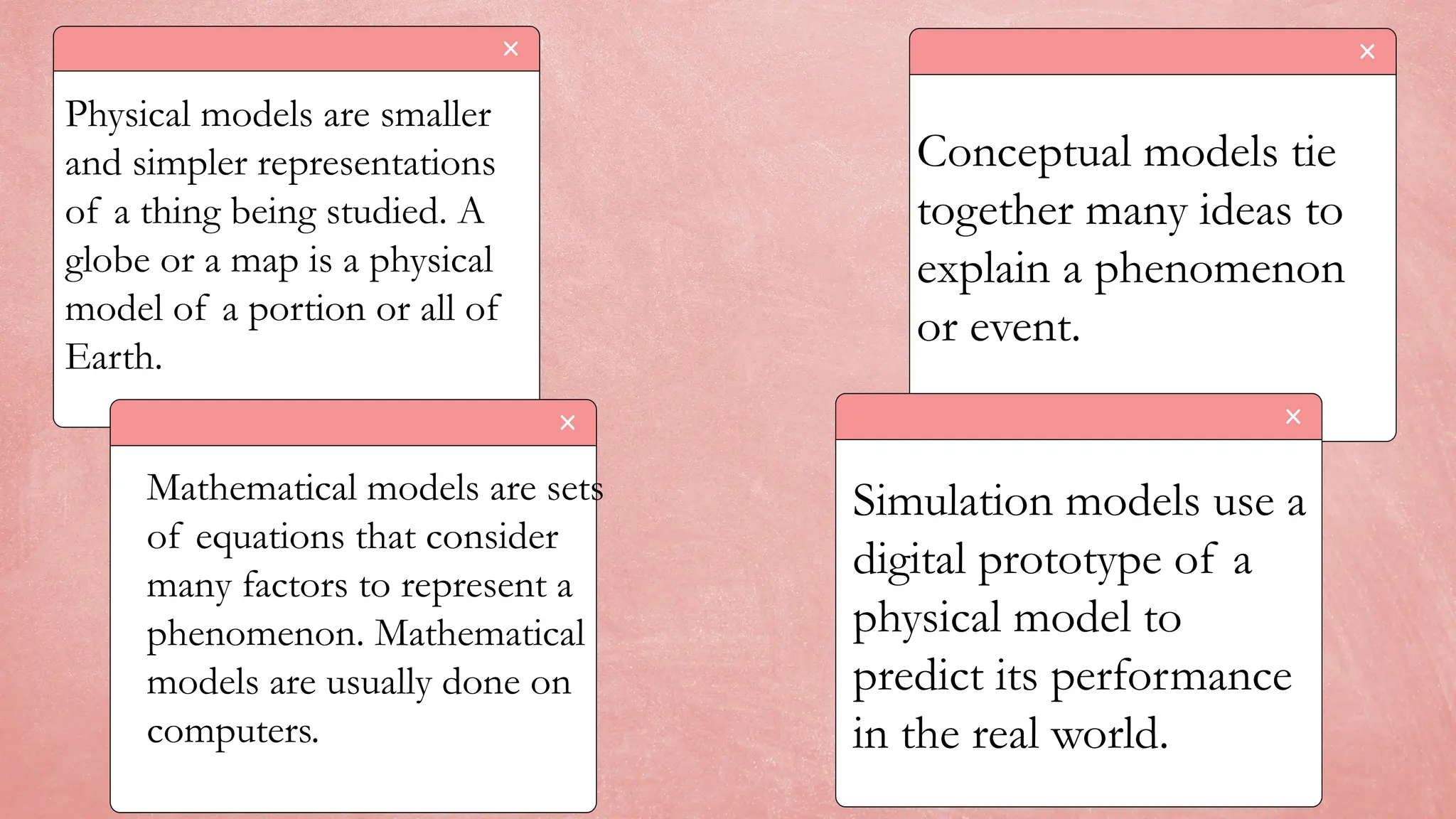
Physical models are smaller
and simpler representations
of a thing being studied. A
globe or a map is a physical
model of a portion or all of
Earth.
Conceptual models tie
together many ideas to
explain a phenomenon
or event.
Mathematical models are sets
of equations that consider
many factors to represent a
phenomenon. Mathematical
models are usually done on
computers.
Simulation models use a
digital prototype of a
physical model to
predict its performance
in the real world.
Many models are created on computers because
they can handle enormous amounts of data..
Models can be used to test ideas by simulating
specific parts of a system, making it easier for
scientists to understand how certain factors affect
each other.
Models can also be used to make predictions about
the future, with the best ones considering multiple
factors.
To assess the accuracy of a model, scientists often use past
data to see if the model can accurately predict the present.
Despite their usefulness, models have limitations because they
are simpler than real systems and may not predict real-world
behavior with absolute accuracy. However, careful
construction and sufficient computing power can improve a
model's accuracy.
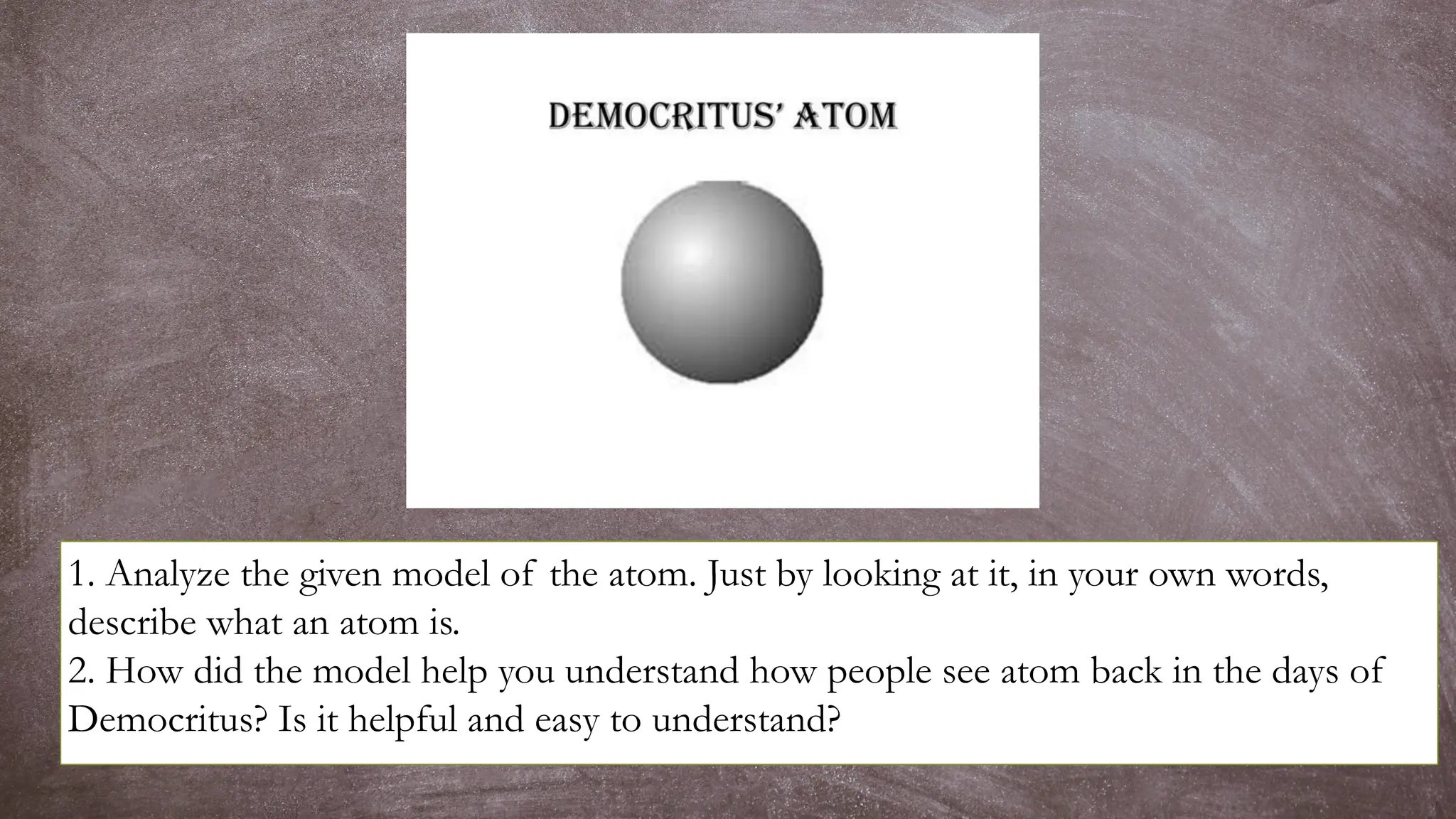
1. Analyze the given model of the atom. Just by looking at it, in your own words,
describe what an atom is.
2. How did the model help you understand how people see atom back in the days of
Democritus? Is it helpful and easy to understand?
Take Home Activity
Thank you very
much!

Introduction-to-scientific-models-W1-Day1.pptx

  • 1.
  • 2.
    SOLID LIQUID GAS 1.What do we call these representations of the molecules of solid, liquid and gas? 2. What is the importance of using scientific representations like this in learning science?
  • 3.
    • How canwe visualize things that cannot be seen by the eye? • How can we visualize things that is too big, and complex be examined in actuality?
  • 4.
    UNLOCKING CONTENT VOCABULARY WORDMEANING Model a usually miniature representation of something Particle a relatively small or the smallest discrete portion or amount of something Matter the substance of which a physical object is composed, material substance that occupies space, has mass, composed of atoms Diagram a graphic design that explains rather that represents, a line drawing made for mathematical or scientific purposes Property a quality or trait belonging and especially peculiar to an individual or thing Solid Of uniformly close and coherent texture, retains a definite shape and size Liquid A fluid (such as water) that has no independent shape but has a definite volume and does not expand indefinitely and that is only slightly compressible Gas A fluid (such as air) that has neither independent shape or volume but tends to expand indefinitely
  • 5.
    UNLOCKING CONTENT VOCABULARY WORDMEANING Melting The process in which solid substances are converted into liquids by adding heat. Freezing Is a phase transition in which a liquid turns into a solid when its temperature is lowered below its freezing point. Evaporation Is when a liquid turns into a gas Condensation Is when a gas turns into a liquid Sublimation Conversion of a substance from solid to the gaseous state without its becoming liquid Deposition Is the laying down of sediment carried by wind, flowing water, the sea or ice Energy The capacity to do work Temperature The degree or intensity of heat present in a substance or object
  • 6.
    Think-pair-share • What doyou think a scientific model is? • Can you give an example of a scientific model you have encountered before? • Why do you think scientists use models to understand phenomena?
  • 7.
    SCIENTIFIC MODELS Scientists usemodels because reality, especially systems like Earth's climate, is complex and difficult to study directly. Many factors influence complex concepts, for example climate, so it's impossible to consider all of them simultaneously, that is why models are necessary.
  • 8.
    Models are usefultools that help scientists understand complex systems by allowing them to analyze and make predictions. There are different types of models: physical models, conceptual models, and mathematical models.
  • 9.
    MISSION Physical models aresmaller and simpler representations of a thing being studied. A globe or a map is a physical model of a portion or all of Earth. Conceptual models tie together many ideas to explain a phenomenon or event. Mathematical models are sets of equations that consider many factors to represent a phenomenon. Mathematical models are usually done on computers. Simulation models use a digital prototype of a physical model to predict its performance in the real world.
  • 10.
    Many models arecreated on computers because they can handle enormous amounts of data.. Models can be used to test ideas by simulating specific parts of a system, making it easier for scientists to understand how certain factors affect each other. Models can also be used to make predictions about the future, with the best ones considering multiple factors.
  • 11.
    To assess theaccuracy of a model, scientists often use past data to see if the model can accurately predict the present. Despite their usefulness, models have limitations because they are simpler than real systems and may not predict real-world behavior with absolute accuracy. However, careful construction and sufficient computing power can improve a model's accuracy.
  • 12.
    1. Analyze thegiven model of the atom. Just by looking at it, in your own words, describe what an atom is. 2. How did the model help you understand how people see atom back in the days of Democritus? Is it helpful and easy to understand?
  • 13.
  • 17.

Editor's Notes

  • #2 There are many types of scientific models not just conceptual models for solid, liquid and gas. You will get to know them in the next activity/part of the lesson.”
  • #3 -too small or too big or too complex materials cannot always be seen and examined face to face or in actual. -representations or models are needed to further study things like that.