Quantum Cryptography (IV)
• Introduction
• Classical Cryptography: Symmetrical (Secret-Key) and Asymmetrical (Public-Key)
Cryptosystem
• RSA protocol
• Quantum Key Distribution: Comments on No Cloning theorem
• Polarized light and BB84 protocol
• The Ekert Protocol-Eavesdropping
• Real-World Implementation: Polarization Encoding and Polarization Entanglement.
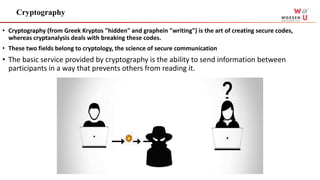
• Cryptography (from Greek Kryptos "hidden" and graphein "writing") is the art of creating secure codes,
whereas cryptanalysis deals with breaking these codes.
• These two fields belong to cryptology, the science of secure communication
• The basic service provided by cryptography is the ability to send information between
participants in a way that prevents others from reading it.
Cryptography
There is a set of rules that belongs to quantum physics which cannot be fully understood by everyday physics.
For example:
• The no-cloning theorem states that one cannot create a copy of an unknown quantum state.
• One cannot measure a system without perturbing it.
• The uncertainty principle states that one cannot simultaneously measure complementary variables (such as the position and
momentum of a particle) with arbitrarily high precision.
The examples have one thing in common: They conclude what cannot be done. This leads to a negative viewpoint of quantum
mechanics.
However, after closer inspection, it turns out that these properties have their positive sides.
Quantum cryptography is the best example of these "drawbacks" that can be turned
into useful applications. But what exactly is quantum cryptography?
Introduction
• Cryptography can be divided into two methods of encryption, known as transposition and
substitution
• In transposition, the order of letters in a plaintext, which is the technical term for the message
before being encrypted into a ciphertext, is rearranged by a certain permutation.
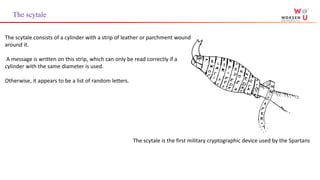
• A famous example of this method is called scytale, which represents the first-ever military
cryptographic device.
• It was used by Spartans military commanders around the fifth century BC.
• In transposition each letter is rearranged in a different order, but its identity is left unchanged.
• In contrast to that, in substitution each letter changes its identity but keeps its position.
Types of encryption
The scytale is the first military cryptographic device used by the Spartans
The scytale consists of a cylinder with a strip of leather or parchment wound
around it.
A message is written on this strip, which can only be read correctly if a
cylinder with the same diameter is used.
Otherwise, it appears to be a list of random letters.
The scytale
• Where security engineering meets mathematics…
There are five primary functions of cryptography:
1.Privacy/confidentiality: Ensuring that no one can read the message except the intended receiver.
2.Authentication: The process of proving one's identity.
3.Integrity: Assuring the receiver that the received message has not been altered in any way from the original.
4.Non-repudiation: A mechanism to prove that the sender really sent this message.
5.Key exchange: The method by which crypto keys are shared between sender and receiver.
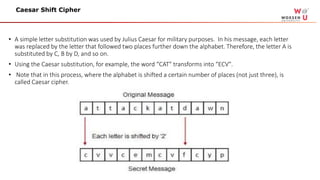
• A simple letter substitution was used by Julius Caesar for military purposes. In his message, each letter
was replaced by the letter that followed two places further down the alphabet. Therefore, the letter A is
substituted by C, B by D, and so on.
• Using the Caesar substitution, for example, the word “CAT" transforms into “ECV".
• Note that in this process, where the alphabet is shifted a certain number of places (not just three), is
called Caesar cipher.
Caesar Shift Cipher
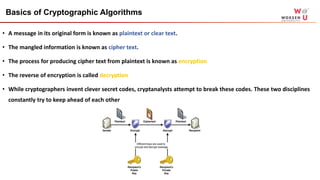
• A message in its original form is known as plaintext or clear text.
• The mangled information is known as cipher text.
• The process for producing cipher text from plaintext is known as encryption
• The reverse of encryption is called decryption
• While cryptographers invent clever secret codes, cryptanalysts attempt to break these codes. These two disciplines
constantly try to keep ahead of each other
Basics of Cryptographic Algorithms
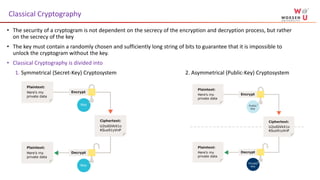
• The security of a cryptogram is not dependent on the secrecy of the encryption and decryption process, but rather
on the secrecy of the key
• The key must contain a randomly chosen and sufficiently long string of bits to guarantee that it is impossible to
unlock the cryptogram without the key.
• Classical Cryptography is divided into
1. Symmetrical (Secret-Key) Cryptosystem 2. Asymmetrical (Public-Key) Cryptosystem
Classical Cryptography
Symmetrical (Secret-Key) Cryptosystem
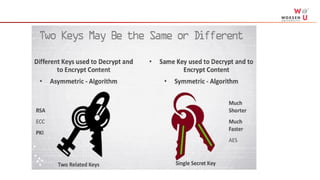
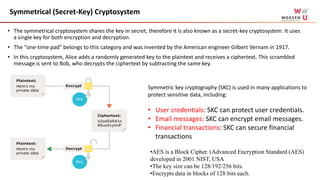
• The symmetrical cryptosystem shares the key in secret, therefore it is also known as a secret-key cryptosystem. It uses
a single key for both encryption and decryption.
• The "one-time pad" belongs to this category and was invented by the American engineer Gilbert Vernam in 1917.
• In this cryptosystem, Alice adds a randomly generated key to the plaintext and receives a ciphertext. This scrambled
message is sent to Bob, who decrypts the ciphertext by subtracting the same key.
Symmetric key cryptography (SKC) is used in many applications to
protect sensitive data, including:
• User credentials: SKC can protect user credentials.
• Email messages: SKC can encrypt email messages.
• Financial transactions: SKC can secure financial
transactions
•AES is a Block Cipher. (Advanced Encryption Standard (AES)
developed in 2001 NIST, USA
•The key size can be 128/192/256 bits.
•Encrypts data in blocks of 128 bits each.
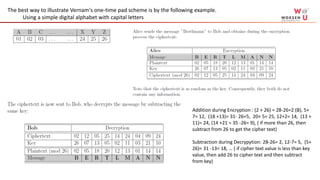
The best way to illustrate Vernam's one-time pad scheme is by the following example.
Using a simple digital alphabet with capital letters
Addition during Encryption : (2 + 26) = 28-26=2 (B), 5+
7= 12, (18 +13)= 31- 26=5, 20+ 5= 25, 12+2= 14, (13 +
11)= 24, (14 +21 = 35 -26= 9), ( if more than 26, then
subtract from 26 to get the cipher text)
Subtraction during Decrypytion: 28-26= 2, 12-7= 5, (5+
26)= 31 -13= 18, … ( if cipher text value is less than key
value, then add 26 to cipher text and then subtract
from key)
Asymmetrical (Public-Key) Cryptosystem
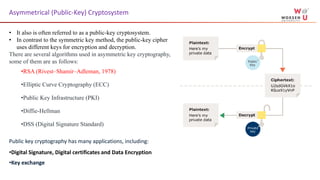
• It also is often referred to as a public-key cryptosystem.
• In contrast to the symmetric key method, the public-key cipher
uses different keys for encryption and decryption.
There are several algorithms used in asymmetric key cryptography,
some of them are as follows:
•RSA (Rivest–Shamir–Adleman, 1978)
•Elliptic Curve Cryptography (ECC)
•Public Key Infrastructure (PKI)
•Diffie-Hellman
•DSS (Digital Signature Standard)
Public key cryptography has many applications, including:
•Digital Signature, Digital certificates and Data Encryption
•Key exchange
RSA algorithm is an asymmetric cryptography algorithm. Asymmetric means that it works on two different keys i.e. Public
Key and Private Key. As the name describes the Public Key is given to everyone and the Private key is kept private.
The Public Key is used for encryption and is known to everyone, while the Private Key is used for decryption and must be
kept secret by the receiver. RSA Algorithm is named after Ron Rivest, Adi Shamir and Leonard Adleman, who published the
algorithm in 1977.
An example of asymmetric cryptography:
1.A client (for example browser) sends its public key to the server and requests some data.
2.The server encrypts the data using the client’s public key and sends the encrypted data.
3.The client receives this data and decrypts it using private key.
Since this is asymmetric, nobody else except the browser can decrypt the data even if a third party has the public key of the
browser.
RSA algorithm
RSA algorithm
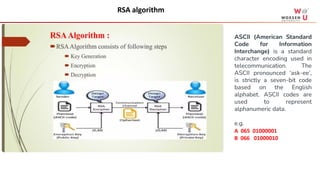
ASCII (American Standard
Code for Information
Interchange) is a standard
character encoding used in
telecommunication. The
ASCII pronounced ‘ask-ee’,
is strictly a seven-bit code
based on the English
alphabet. ASCII codes are
used to represent
alphanumeric data.
e.g.
A 065 01000001
B 066 01000010
17
RSA (Rivest, Shamir, Adleman) Protocol
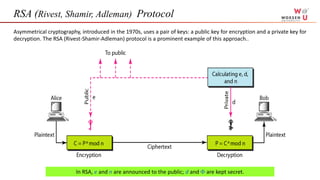
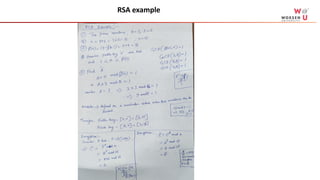
In RSA, e and n are announced to the public; d and  are kept secret.
Asymmetrical cryptography, introduced in the 1970s, uses a pair of keys: a public key for encryption and a private key for
decryption. The RSA (Rivest-Shamir-Adleman) protocol is a prominent example of this approach..
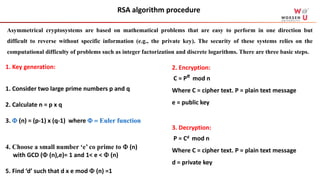
2. Encryption:
C = Pe mod n
Where C = cipher text. P = plain text message
e = public key
3. Decryption:
P = Cd mod n
Where C = cipher text. P = plain text message
d = private key
1. Key generation:
1. Consider two large prime numbers p and q
2. Calculate n = p x q
3.  (n) = (p-1) x (q-1) where  = Euler function
4. Choose a small number ‘e’ co prime to  (n)
with GCD ( (n),e)= 1 and 1< e <  (n)
5. Find ‘d’ such that d x e mod  (n) =1
RSA algorithm procedure
Asymmetrical cryptosystems are based on mathematical problems that are easy to perform in one direction but
difficult to reverse without specific information (e.g., the private key). The security of these systems relies on the
computational difficulty of problems such as integer factorization and discrete logarithms. There are three basic steps.
RSA example
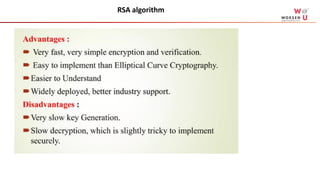
RSA algorithm
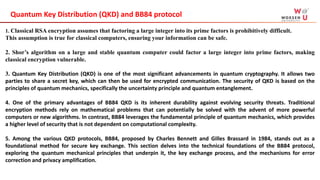
Quantum Key Distribution (QKD) and BB84 protocol
1. Classical RSA encryption assumes that factoring a large integer into its prime factors is prohibitively difficult.
This assumption is true for classical computers, ensuring your information can be safe.
2. Shor’s algorithm on a large and stable quantum computer could factor a large integer into prime factors, making
classical encryption vulnerable.
3. Quantum Key Distribution (QKD) is one of the most significant advancements in quantum cryptography. It allows two
parties to share a secret key, which can then be used for encrypted communication. The security of QKD is based on the
principles of quantum mechanics, specifically the uncertainty principle and quantum entanglement.
4. One of the primary advantages of BB84 QKD is its inherent durability against evolving security threats. Traditional
encryption methods rely on mathematical problems that can potentially be solved with the advent of more powerful
computers or new algorithms. In contrast, BB84 leverages the fundamental principle of quantum mechanics, which provides
a higher level of security that is not dependent on computational complexity.
5. Among the various QKD protocols, BB84, proposed by Charles Bennett and Gilles Brassard in 1984, stands out as a
foundational method for secure key exchange. This section delves into the technical foundations of the BB84 protocol,
exploring the quantum mechanical principles that underpin it, the key exchange process, and the mechanisms for error
correction and privacy amplification.
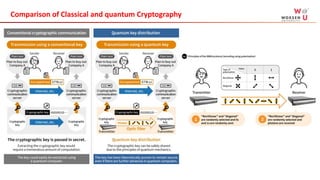
Comparison of Classical and quantum Cryptography
The BB84 protocol: Theory
Traditional encryption methods like RSA protocol rely on mathematical problems that can potentially be solved with the advent
of more powerful computers or new algorithms. In contrast, BB84 leverages the fundamental principle of quantum mechanics,
which provides a higher level of security that is not dependent on computational complexity.
Heisenberg Uncertainty Principle:
The security of BB84 is rooted in the Heisenberg Uncertainty Principle, which talks about it is impossible to simultaneously
measure both the position and momentum of a quantum particle with arbitrary precision. This principle ensures that any
eavesdropping attempt on a quantum channel will introduce detectable disturbances. Mathematically, if an eavesdropper
tries to measure the quantum states used in BB84, it will inevitably alter these states, introducing errors that can be
detected by the legitimate parties.
Δx ・Δp ≥ ħ/2
where Δx and Δp are the uncertainties in position and momentum, respectively, and ħ is the reduced Planck constant
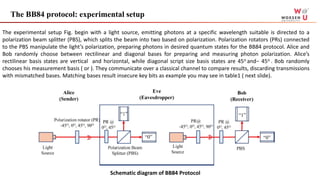
The BB84 protocol: experimental setup
Schematic diagram of BB84 Protocol
The experimental setup Fig. begin with a light source, emitting photons at a specific wavelength suitable is directed to a
polarization beam splitter (PBS), which splits the beam into two based on polarization. Polarization rotators (PRs) connected
to the PBS manipulate the light’s polarization, preparing photons in desired quantum states for the BB84 protocol. Alice and
Bob randomly choose between rectilinear and diagonal bases for preparing and measuring photon polarization. Alice’s
rectilinear basis states are vertical and horizontal, while diagonal script size basis states are 45o and− 45o . Bob randomly
chooses his measurement basis ( or ). They communicate over a classical channel to compare results, discarding transmissions
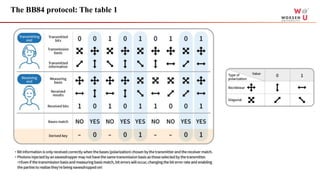
with mismatched bases. Matching bases result insecure key bits as example you may see in table1 ( next slide).
The BB84 protocol: The table 1
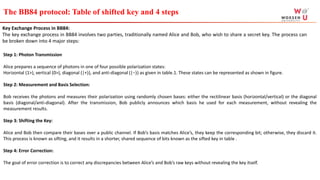
The BB84 protocol: Table of shifted key and 4 steps
Key Exchange Process in BB84:
The key exchange process in BB84 involves two parties, traditionally named Alice and Bob, who wish to share a secret key. The process can
be broken down into 4 major steps:
Step 1: Photon Transmission
Alice prepares a sequence of photons in one of four possible polarization states:
Horizontal (1>), vertical (0>), diagonal (|+⟩), and anti-diagonal (|−⟩) as given in table.1. These states can be represented as shown in figure.
Step 2: Measurement and Basis Selection:
Bob receives the photons and measures their polarization using randomly chosen bases: either the rectilinear basis (horizontal/vertical) or the diagonal
basis (diagonal/anti-diagonal). After the transmission, Bob publicly announces which basis he used for each measurement, without revealing the
measurement results.
Step 3: Shifting the Key:
Alice and Bob then compare their bases over a public channel. If Bob’s basis matches Alice’s, they keep the corresponding bit; otherwise, they discard it.
This process is known as sifting, and it results in a shorter, shared sequence of bits known as the sifted key in table .
Step 4: Error Correction:
The goal of error correction is to correct any discrepancies between Alice’s and Bob’s raw keys without revealing the key itself.
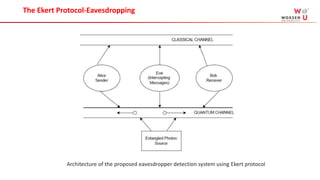
Architecture of the proposed eavesdropper detection system using Ekert protocol
The Ekert Protocol-Eavesdropping
The Ekert protocol, proposed by Artur Ekert in 1991, is a quantum key distribution (QKD)protocol that uses the phenomenon of quantum
entanglement to ensure secure communication. Unlike the BB84 protocol, which relies on the uncertainty principle, the Ekert protocol uses
the violation of Bell’s inequalities to detect eavesdropping.
The Ekert protocol involves three parties: Alice, Bob, and an entangled photon source. The basic steps of the protocol are as follows:
1. An entangled photon source produces pairs of entangled photons and sends one photon from each pair to Alice and the other to Bob.
2. Alice and Bob each choose a measurement basis randomly from a predefined set of bases.
3. Alice and Bob measure their respective photons in their chosen bases and record the results.
4. After a sufficient number of measurements, Alice and Bob publicly announce their measurement bases (but not the results) and discard
the measurements where their bases do not match.
5. Using the remaining results, Alice and Bob compute the correlation coefficients and test for the violation of Bell’s inequalities.
6. If Bell’s inequalities are violated, they can be sure that their shared key is secure. They then use classical communication to further process
their raw key into a secure final key.
Measurement and Correlation:
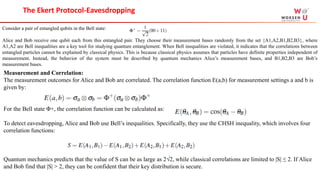
The measurement outcomes for Alice and Bob are correlated. The correlation function E(a,b) for measurement settings a and b is
given by:
For the Bell state Φ+, the correlation function can be calculated as:
To detect eavesdropping, Alice and Bob use Bell’s inequalities. Specifically, they use the CHSH inequality, which involves four
correlation functions:
Quantum mechanics predicts that the value of S can be as large as 2√2, while classical correlations are limited to |S| ≤ 2. If Alice
and Bob find that |S| > 2, they can be confident that their key distribution is secure.
The Ekert Protocol-Eavesdropping
Consider a pair of entangled qubits in the Bell state:
Alice and Bob receive one qubit each from this entangled pair. They choose their measurement bases randomly from the set {A1,A2,B1,B2,B3}, where
A1,A2 are Bell inequalities are a key tool for studying quantum entanglement. When Bell inequalities are violated, it indicates that the correlations between
entangled particles cannot be explained by classical physics. This is because classical physics assumes that particles have definite properties independent of
measurement. Instead, the behavior of the system must be described by quantum mechanics Alice’s measurement bases, and B1,B2,B3 are Bob’s
measurement bases.
Eavesdropping and Security:
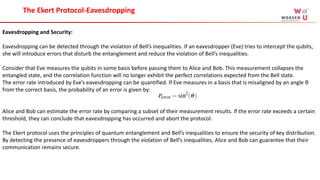
Eavesdropping can be detected through the violation of Bell’s inequalities. If an eavesdropper (Eve) tries to intercept the qubits,
she will introduce errors that disturb the entanglement and reduce the violation of Bell’s inequalities.
Consider that Eve measures the qubits in some basis before passing them to Alice and Bob. This measurement collapses the
entangled state, and the correlation function will no longer exhibit the perfect correlations expected from the Bell state.
The error rate introduced by Eve’s eavesdropping can be quantified. If Eve measures in a basis that is misaligned by an angle θ
from the correct basis, the probability of an error is given by:
Alice and Bob can estimate the error rate by comparing a subset of their measurement results. If the error rate exceeds a certain
threshold, they can conclude that eavesdropping has occurred and abort the protocol.
The Ekert protocol uses the principles of quantum entanglement and Bell’s inequalities to ensure the security of key distribution.
By detecting the presence of eavesdroppers through the violation of Bell’s inequalities, Alice and Bob can guarantee that their
communication remains secure.
The Ekert Protocol-Eavesdropping
Real-World Implementation: Polarization Encoding and Polarization Entanglement.
Polarisation Encoding:
The first demonstration of quantum key distribution in 1989 used polarized photons and free space propagation over a distance
of 30 cm. Despite the small scale of the experiment, it had a strong impact.
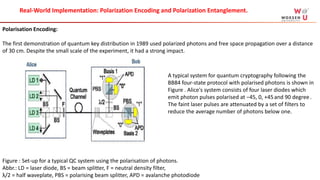
Figure : Set-up for a typical QC system using the polarisation of photons.
Abbr.: LD = laser diode, BS = beam splitter, F = neutral density filter,
λ/2 = half waveplate, PBS = polarising beam splitter, APD = avalanche photodiode
A typical system for quantum cryptography following the
BB84 four-state protocol with polarised photons is shown in
Figure . Alice's system consists of four laser diodes which
emit photon pulses polarised at −45, 0, +45and 90 degree.
The faint laser pulses are attenuated by a set of filters to
reduce the average number of photons below one.
Polarisation Entanglement
An elegant alternative to the previously discussed method is quantum cryptography based on entangled photon pairs. An
advantage of using photon pairs is that false detection can be easily revealed, since a detected photon implies the presence of
another photon of the pair. This is beneficial because currently available single photon detectors have a high dark count rate,
which is the average rate of falsely registered photons.
In this quantum cryptography system, a two photons source emits pairs of entangled photons towards Alice and Bob. Each
photon is analysed with a polarization beam splitter. The orientation of the beam splitter can be changed rapidly with
respect to a common reference.
A significant advantage of polarisation entanglement is that analysers are simple and efficient. Nevertheless, the difficulty to
keep the polarisation stable over distances of a few kilometres in optical fibres remains. However, these experiments
play an interesting role in free space quantum cryptography
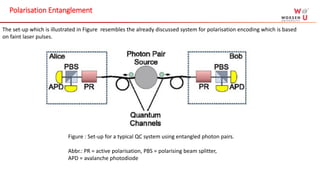
The set-up which is illustrated in Figure resembles the already discussed system for polarisation encoding which is based
on faint laser pulses.
Figure : Set-up for a typical QC system using entangled photon pairs.
Abbr.: PR = active polarisation, PBS = polarising beam splitter,
APD = avalanche photodiode
Polarisation Entanglement

Introduction to Quantum Computing and Cryptography Final

  • 1.
    Quantum Cryptography (IV) •Introduction • Classical Cryptography: Symmetrical (Secret-Key) and Asymmetrical (Public-Key) Cryptosystem • RSA protocol • Quantum Key Distribution: Comments on No Cloning theorem • Polarized light and BB84 protocol • The Ekert Protocol-Eavesdropping • Real-World Implementation: Polarization Encoding and Polarization Entanglement.
  • 2.
    • Cryptography (fromGreek Kryptos "hidden" and graphein "writing") is the art of creating secure codes, whereas cryptanalysis deals with breaking these codes. • These two fields belong to cryptology, the science of secure communication • The basic service provided by cryptography is the ability to send information between participants in a way that prevents others from reading it. Cryptography
  • 3.
    There is aset of rules that belongs to quantum physics which cannot be fully understood by everyday physics. For example: • The no-cloning theorem states that one cannot create a copy of an unknown quantum state. • One cannot measure a system without perturbing it. • The uncertainty principle states that one cannot simultaneously measure complementary variables (such as the position and momentum of a particle) with arbitrarily high precision. The examples have one thing in common: They conclude what cannot be done. This leads to a negative viewpoint of quantum mechanics. However, after closer inspection, it turns out that these properties have their positive sides. Quantum cryptography is the best example of these "drawbacks" that can be turned into useful applications. But what exactly is quantum cryptography? Introduction
  • 4.
    • Cryptography canbe divided into two methods of encryption, known as transposition and substitution • In transposition, the order of letters in a plaintext, which is the technical term for the message before being encrypted into a ciphertext, is rearranged by a certain permutation. • A famous example of this method is called scytale, which represents the first-ever military cryptographic device. • It was used by Spartans military commanders around the fifth century BC. • In transposition each letter is rearranged in a different order, but its identity is left unchanged. • In contrast to that, in substitution each letter changes its identity but keeps its position. Types of encryption
  • 5.
    The scytale isthe first military cryptographic device used by the Spartans The scytale consists of a cylinder with a strip of leather or parchment wound around it. A message is written on this strip, which can only be read correctly if a cylinder with the same diameter is used. Otherwise, it appears to be a list of random letters. The scytale
  • 6.
    • Where securityengineering meets mathematics… There are five primary functions of cryptography: 1.Privacy/confidentiality: Ensuring that no one can read the message except the intended receiver. 2.Authentication: The process of proving one's identity. 3.Integrity: Assuring the receiver that the received message has not been altered in any way from the original. 4.Non-repudiation: A mechanism to prove that the sender really sent this message. 5.Key exchange: The method by which crypto keys are shared between sender and receiver.
  • 7.
    • A simpleletter substitution was used by Julius Caesar for military purposes. In his message, each letter was replaced by the letter that followed two places further down the alphabet. Therefore, the letter A is substituted by C, B by D, and so on. • Using the Caesar substitution, for example, the word “CAT" transforms into “ECV". • Note that in this process, where the alphabet is shifted a certain number of places (not just three), is called Caesar cipher. Caesar Shift Cipher
  • 8.
    • A messagein its original form is known as plaintext or clear text. • The mangled information is known as cipher text. • The process for producing cipher text from plaintext is known as encryption • The reverse of encryption is called decryption • While cryptographers invent clever secret codes, cryptanalysts attempt to break these codes. These two disciplines constantly try to keep ahead of each other Basics of Cryptographic Algorithms
  • 10.
    • The securityof a cryptogram is not dependent on the secrecy of the encryption and decryption process, but rather on the secrecy of the key • The key must contain a randomly chosen and sufficiently long string of bits to guarantee that it is impossible to unlock the cryptogram without the key. • Classical Cryptography is divided into 1. Symmetrical (Secret-Key) Cryptosystem 2. Asymmetrical (Public-Key) Cryptosystem Classical Cryptography
  • 12.
    Symmetrical (Secret-Key) Cryptosystem •The symmetrical cryptosystem shares the key in secret, therefore it is also known as a secret-key cryptosystem. It uses a single key for both encryption and decryption. • The "one-time pad" belongs to this category and was invented by the American engineer Gilbert Vernam in 1917. • In this cryptosystem, Alice adds a randomly generated key to the plaintext and receives a ciphertext. This scrambled message is sent to Bob, who decrypts the ciphertext by subtracting the same key. Symmetric key cryptography (SKC) is used in many applications to protect sensitive data, including: • User credentials: SKC can protect user credentials. • Email messages: SKC can encrypt email messages. • Financial transactions: SKC can secure financial transactions •AES is a Block Cipher. (Advanced Encryption Standard (AES) developed in 2001 NIST, USA •The key size can be 128/192/256 bits. •Encrypts data in blocks of 128 bits each.
  • 13.
    The best wayto illustrate Vernam's one-time pad scheme is by the following example. Using a simple digital alphabet with capital letters Addition during Encryption : (2 + 26) = 28-26=2 (B), 5+ 7= 12, (18 +13)= 31- 26=5, 20+ 5= 25, 12+2= 14, (13 + 11)= 24, (14 +21 = 35 -26= 9), ( if more than 26, then subtract from 26 to get the cipher text) Subtraction during Decrypytion: 28-26= 2, 12-7= 5, (5+ 26)= 31 -13= 18, … ( if cipher text value is less than key value, then add 26 to cipher text and then subtract from key)
  • 14.
    Asymmetrical (Public-Key) Cryptosystem •It also is often referred to as a public-key cryptosystem. • In contrast to the symmetric key method, the public-key cipher uses different keys for encryption and decryption. There are several algorithms used in asymmetric key cryptography, some of them are as follows: •RSA (Rivest–Shamir–Adleman, 1978) •Elliptic Curve Cryptography (ECC) •Public Key Infrastructure (PKI) •Diffie-Hellman •DSS (Digital Signature Standard) Public key cryptography has many applications, including: •Digital Signature, Digital certificates and Data Encryption •Key exchange
  • 15.
    RSA algorithm isan asymmetric cryptography algorithm. Asymmetric means that it works on two different keys i.e. Public Key and Private Key. As the name describes the Public Key is given to everyone and the Private key is kept private. The Public Key is used for encryption and is known to everyone, while the Private Key is used for decryption and must be kept secret by the receiver. RSA Algorithm is named after Ron Rivest, Adi Shamir and Leonard Adleman, who published the algorithm in 1977. An example of asymmetric cryptography: 1.A client (for example browser) sends its public key to the server and requests some data. 2.The server encrypts the data using the client’s public key and sends the encrypted data. 3.The client receives this data and decrypts it using private key. Since this is asymmetric, nobody else except the browser can decrypt the data even if a third party has the public key of the browser. RSA algorithm
  • 16.
    RSA algorithm ASCII (AmericanStandard Code for Information Interchange) is a standard character encoding used in telecommunication. The ASCII pronounced ‘ask-ee’, is strictly a seven-bit code based on the English alphabet. ASCII codes are used to represent alphanumeric data. e.g. A 065 01000001 B 066 01000010
  • 17.
    17 RSA (Rivest, Shamir,Adleman) Protocol In RSA, e and n are announced to the public; d and  are kept secret. Asymmetrical cryptography, introduced in the 1970s, uses a pair of keys: a public key for encryption and a private key for decryption. The RSA (Rivest-Shamir-Adleman) protocol is a prominent example of this approach..
  • 18.
    2. Encryption: C =Pe mod n Where C = cipher text. P = plain text message e = public key 3. Decryption: P = Cd mod n Where C = cipher text. P = plain text message d = private key 1. Key generation: 1. Consider two large prime numbers p and q 2. Calculate n = p x q 3.  (n) = (p-1) x (q-1) where  = Euler function 4. Choose a small number ‘e’ co prime to  (n) with GCD ( (n),e)= 1 and 1< e <  (n) 5. Find ‘d’ such that d x e mod  (n) =1 RSA algorithm procedure Asymmetrical cryptosystems are based on mathematical problems that are easy to perform in one direction but difficult to reverse without specific information (e.g., the private key). The security of these systems relies on the computational difficulty of problems such as integer factorization and discrete logarithms. There are three basic steps.
  • 19.
  • 20.
  • 21.
    Quantum Key Distribution(QKD) and BB84 protocol 1. Classical RSA encryption assumes that factoring a large integer into its prime factors is prohibitively difficult. This assumption is true for classical computers, ensuring your information can be safe. 2. Shor’s algorithm on a large and stable quantum computer could factor a large integer into prime factors, making classical encryption vulnerable. 3. Quantum Key Distribution (QKD) is one of the most significant advancements in quantum cryptography. It allows two parties to share a secret key, which can then be used for encrypted communication. The security of QKD is based on the principles of quantum mechanics, specifically the uncertainty principle and quantum entanglement. 4. One of the primary advantages of BB84 QKD is its inherent durability against evolving security threats. Traditional encryption methods rely on mathematical problems that can potentially be solved with the advent of more powerful computers or new algorithms. In contrast, BB84 leverages the fundamental principle of quantum mechanics, which provides a higher level of security that is not dependent on computational complexity. 5. Among the various QKD protocols, BB84, proposed by Charles Bennett and Gilles Brassard in 1984, stands out as a foundational method for secure key exchange. This section delves into the technical foundations of the BB84 protocol, exploring the quantum mechanical principles that underpin it, the key exchange process, and the mechanisms for error correction and privacy amplification.
  • 22.
    Comparison of Classicaland quantum Cryptography
  • 23.
    The BB84 protocol:Theory Traditional encryption methods like RSA protocol rely on mathematical problems that can potentially be solved with the advent of more powerful computers or new algorithms. In contrast, BB84 leverages the fundamental principle of quantum mechanics, which provides a higher level of security that is not dependent on computational complexity. Heisenberg Uncertainty Principle: The security of BB84 is rooted in the Heisenberg Uncertainty Principle, which talks about it is impossible to simultaneously measure both the position and momentum of a quantum particle with arbitrary precision. This principle ensures that any eavesdropping attempt on a quantum channel will introduce detectable disturbances. Mathematically, if an eavesdropper tries to measure the quantum states used in BB84, it will inevitably alter these states, introducing errors that can be detected by the legitimate parties. Δx ・Δp ≥ ħ/2 where Δx and Δp are the uncertainties in position and momentum, respectively, and ħ is the reduced Planck constant
  • 24.
    The BB84 protocol:experimental setup Schematic diagram of BB84 Protocol The experimental setup Fig. begin with a light source, emitting photons at a specific wavelength suitable is directed to a polarization beam splitter (PBS), which splits the beam into two based on polarization. Polarization rotators (PRs) connected to the PBS manipulate the light’s polarization, preparing photons in desired quantum states for the BB84 protocol. Alice and Bob randomly choose between rectilinear and diagonal bases for preparing and measuring photon polarization. Alice’s rectilinear basis states are vertical and horizontal, while diagonal script size basis states are 45o and− 45o . Bob randomly chooses his measurement basis ( or ). They communicate over a classical channel to compare results, discarding transmissions with mismatched bases. Matching bases result insecure key bits as example you may see in table1 ( next slide).
  • 25.
    The BB84 protocol:The table 1
  • 26.
    The BB84 protocol:Table of shifted key and 4 steps Key Exchange Process in BB84: The key exchange process in BB84 involves two parties, traditionally named Alice and Bob, who wish to share a secret key. The process can be broken down into 4 major steps: Step 1: Photon Transmission Alice prepares a sequence of photons in one of four possible polarization states: Horizontal (1>), vertical (0>), diagonal (|+⟩), and anti-diagonal (|−⟩) as given in table.1. These states can be represented as shown in figure. Step 2: Measurement and Basis Selection: Bob receives the photons and measures their polarization using randomly chosen bases: either the rectilinear basis (horizontal/vertical) or the diagonal basis (diagonal/anti-diagonal). After the transmission, Bob publicly announces which basis he used for each measurement, without revealing the measurement results. Step 3: Shifting the Key: Alice and Bob then compare their bases over a public channel. If Bob’s basis matches Alice’s, they keep the corresponding bit; otherwise, they discard it. This process is known as sifting, and it results in a shorter, shared sequence of bits known as the sifted key in table . Step 4: Error Correction: The goal of error correction is to correct any discrepancies between Alice’s and Bob’s raw keys without revealing the key itself.
  • 27.
    Architecture of theproposed eavesdropper detection system using Ekert protocol The Ekert Protocol-Eavesdropping
  • 28.
    The Ekert Protocol-Eavesdropping TheEkert protocol, proposed by Artur Ekert in 1991, is a quantum key distribution (QKD)protocol that uses the phenomenon of quantum entanglement to ensure secure communication. Unlike the BB84 protocol, which relies on the uncertainty principle, the Ekert protocol uses the violation of Bell’s inequalities to detect eavesdropping. The Ekert protocol involves three parties: Alice, Bob, and an entangled photon source. The basic steps of the protocol are as follows: 1. An entangled photon source produces pairs of entangled photons and sends one photon from each pair to Alice and the other to Bob. 2. Alice and Bob each choose a measurement basis randomly from a predefined set of bases. 3. Alice and Bob measure their respective photons in their chosen bases and record the results. 4. After a sufficient number of measurements, Alice and Bob publicly announce their measurement bases (but not the results) and discard the measurements where their bases do not match. 5. Using the remaining results, Alice and Bob compute the correlation coefficients and test for the violation of Bell’s inequalities. 6. If Bell’s inequalities are violated, they can be sure that their shared key is secure. They then use classical communication to further process their raw key into a secure final key.
  • 29.
    Measurement and Correlation: Themeasurement outcomes for Alice and Bob are correlated. The correlation function E(a,b) for measurement settings a and b is given by: For the Bell state Φ+, the correlation function can be calculated as: To detect eavesdropping, Alice and Bob use Bell’s inequalities. Specifically, they use the CHSH inequality, which involves four correlation functions: Quantum mechanics predicts that the value of S can be as large as 2√2, while classical correlations are limited to |S| ≤ 2. If Alice and Bob find that |S| > 2, they can be confident that their key distribution is secure. The Ekert Protocol-Eavesdropping Consider a pair of entangled qubits in the Bell state: Alice and Bob receive one qubit each from this entangled pair. They choose their measurement bases randomly from the set {A1,A2,B1,B2,B3}, where A1,A2 are Bell inequalities are a key tool for studying quantum entanglement. When Bell inequalities are violated, it indicates that the correlations between entangled particles cannot be explained by classical physics. This is because classical physics assumes that particles have definite properties independent of measurement. Instead, the behavior of the system must be described by quantum mechanics Alice’s measurement bases, and B1,B2,B3 are Bob’s measurement bases.
  • 30.
    Eavesdropping and Security: Eavesdroppingcan be detected through the violation of Bell’s inequalities. If an eavesdropper (Eve) tries to intercept the qubits, she will introduce errors that disturb the entanglement and reduce the violation of Bell’s inequalities. Consider that Eve measures the qubits in some basis before passing them to Alice and Bob. This measurement collapses the entangled state, and the correlation function will no longer exhibit the perfect correlations expected from the Bell state. The error rate introduced by Eve’s eavesdropping can be quantified. If Eve measures in a basis that is misaligned by an angle θ from the correct basis, the probability of an error is given by: Alice and Bob can estimate the error rate by comparing a subset of their measurement results. If the error rate exceeds a certain threshold, they can conclude that eavesdropping has occurred and abort the protocol. The Ekert protocol uses the principles of quantum entanglement and Bell’s inequalities to ensure the security of key distribution. By detecting the presence of eavesdroppers through the violation of Bell’s inequalities, Alice and Bob can guarantee that their communication remains secure. The Ekert Protocol-Eavesdropping
  • 31.
    Real-World Implementation: PolarizationEncoding and Polarization Entanglement. Polarisation Encoding: The first demonstration of quantum key distribution in 1989 used polarized photons and free space propagation over a distance of 30 cm. Despite the small scale of the experiment, it had a strong impact. Figure : Set-up for a typical QC system using the polarisation of photons. Abbr.: LD = laser diode, BS = beam splitter, F = neutral density filter, λ/2 = half waveplate, PBS = polarising beam splitter, APD = avalanche photodiode A typical system for quantum cryptography following the BB84 four-state protocol with polarised photons is shown in Figure . Alice's system consists of four laser diodes which emit photon pulses polarised at −45, 0, +45and 90 degree. The faint laser pulses are attenuated by a set of filters to reduce the average number of photons below one.
  • 32.
    Polarisation Entanglement An elegantalternative to the previously discussed method is quantum cryptography based on entangled photon pairs. An advantage of using photon pairs is that false detection can be easily revealed, since a detected photon implies the presence of another photon of the pair. This is beneficial because currently available single photon detectors have a high dark count rate, which is the average rate of falsely registered photons. In this quantum cryptography system, a two photons source emits pairs of entangled photons towards Alice and Bob. Each photon is analysed with a polarization beam splitter. The orientation of the beam splitter can be changed rapidly with respect to a common reference. A significant advantage of polarisation entanglement is that analysers are simple and efficient. Nevertheless, the difficulty to keep the polarisation stable over distances of a few kilometres in optical fibres remains. However, these experiments play an interesting role in free space quantum cryptography
  • 33.
    The set-up whichis illustrated in Figure resembles the already discussed system for polarisation encoding which is based on faint laser pulses. Figure : Set-up for a typical QC system using entangled photon pairs. Abbr.: PR = active polarisation, PBS = polarising beam splitter, APD = avalanche photodiode Polarisation Entanglement