Near Real Time
Agenda
• What’s Near Real Time Computing
• Streaming Processing VS Batch Job
• Business Scenarios and Use Cases
• Architecture and Technology
• NRT Solution: Storm, Spark Streaming
Near Real Time = Velocity
0.5 sec to 60 Sec
Fast, Non-Stop, immediate analytics
Cannot be done in Batch job
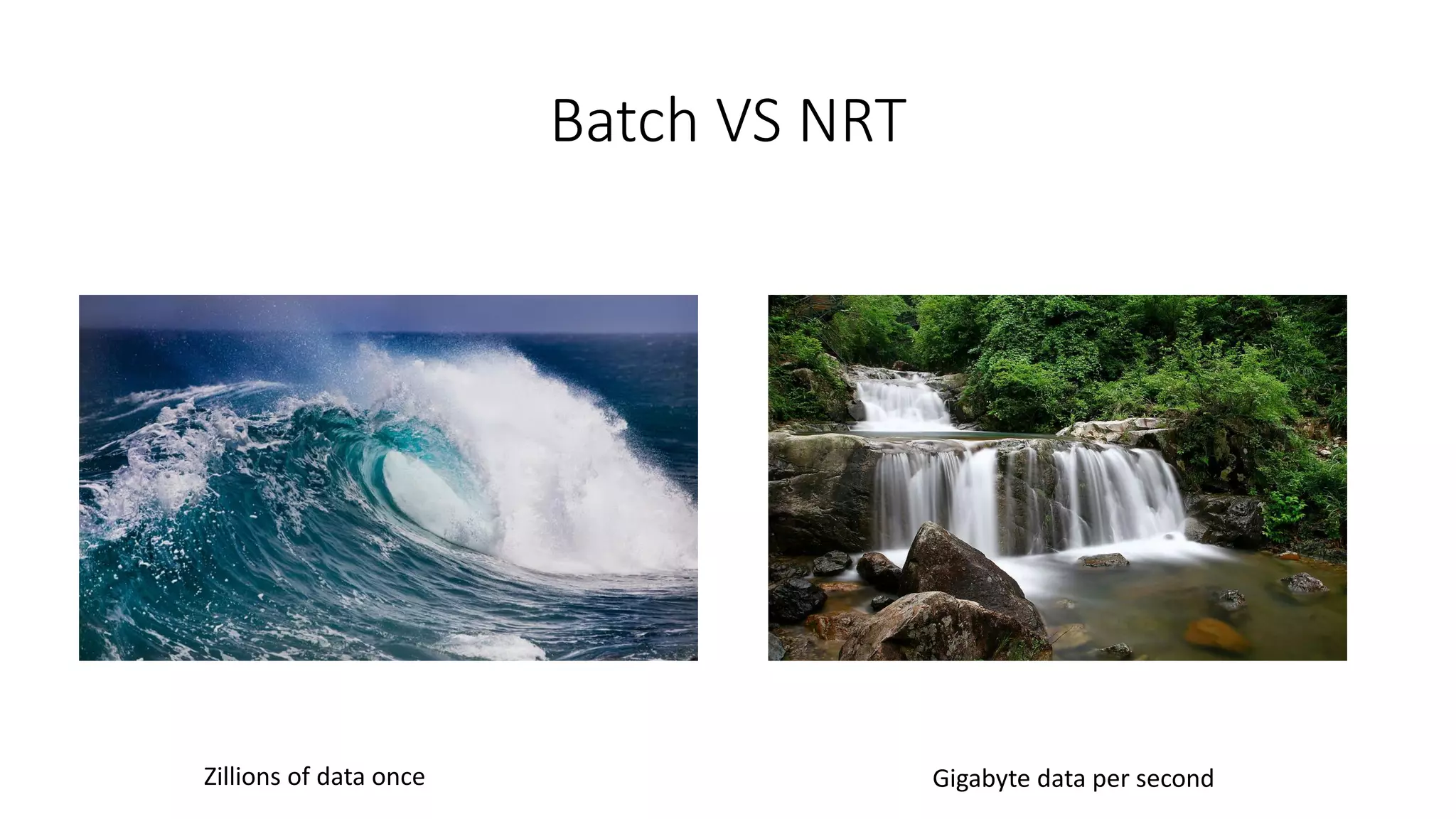
Batch VS NRT
Zillions of data once Gigabyte data per second
Batch VS NRT
Completed in longer time 7*24 Non-Stop availability
Batch VS NRT
Make future Plan & Decisions Immediate Decision & Action
Batch
Analytics
• Is when you have plenty of time for
analysis
• Is when you explore patterns and
models in historic data
• Is when you plan and forecast the
future instead of (re)acting
immediately
Technology
• Query previously stored data
• Store the data in HDFS/Cosmos and
Process with Hadoop/Scope
• Generally rely on disks/storage
NRT
Analytics
• Is when you don’t have time
• Is when you analyze data as it comes
• Is when you already have a fixed
model, and data flying in fits it 100%
• Is when you (re)act immediately
Technology
• Process events in streaming
• Store only for checkpoint reasons
• Mostly in memory and hit disk rarely
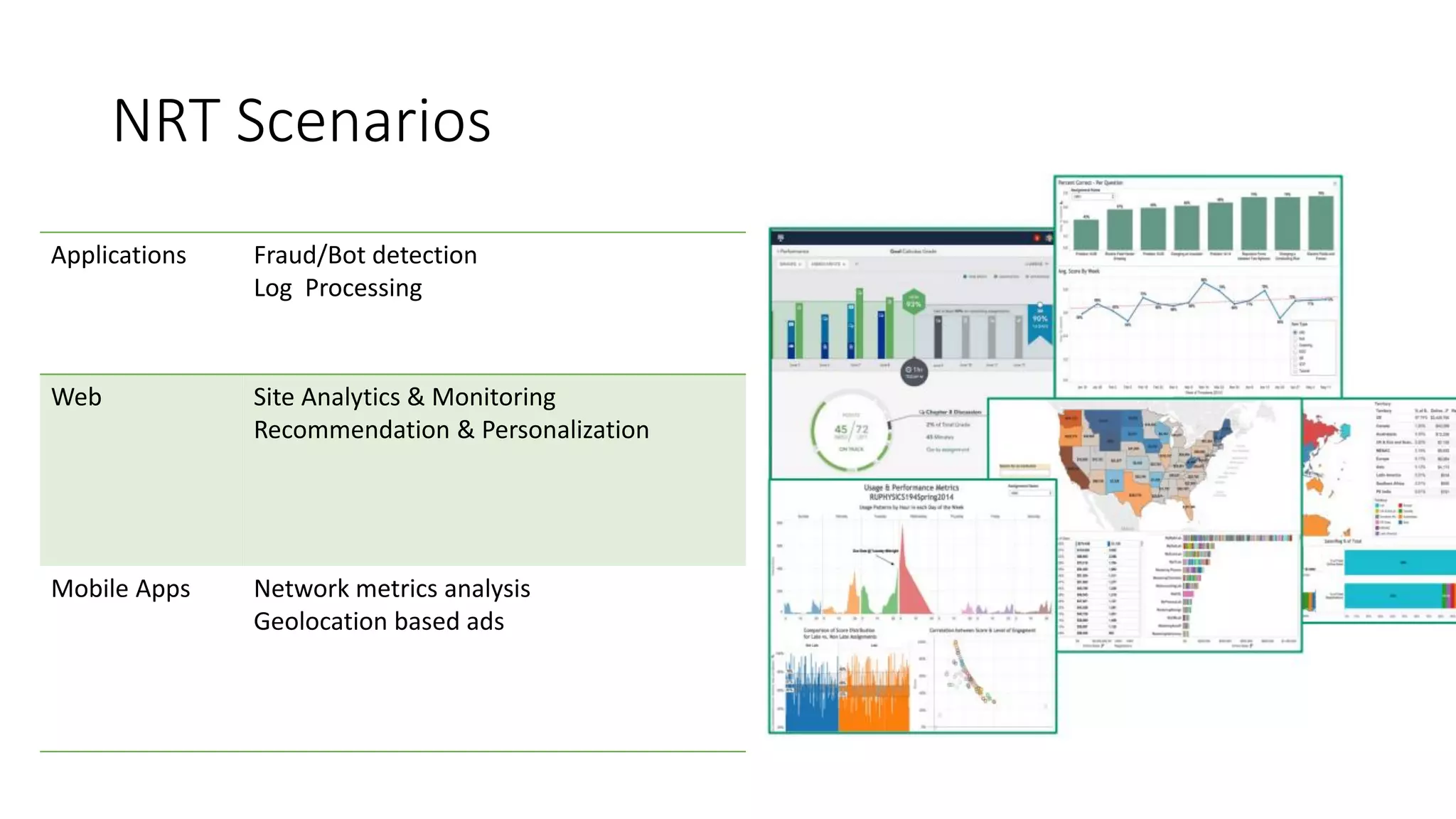
NRT Scenarios
Applications Fraud/Bot detection
Log Processing
Web Site Analytics & Monitoring
Recommendation & Personalization
Mobile Apps Network metrics analysis
Geolocation based ads
NRT Computing Model
• Event Processing/Mini Batch Processing
o Cooking, enrichment, and transfer
• Time Window based Counter/Aggregation
o Real Time Metrics/Monitoring
o Active User, Usage statistics
• Buffer data for processing
o Multi-Chunk Streaming
o Sessionization
• State based updating
o User info tracking/updating
o New user detection
• Interact with Historic/external data
o Fraud/Bot Detection, ML Prediction
o Streaming SQL
Architecture & Technology
Storm, Spark Streaming
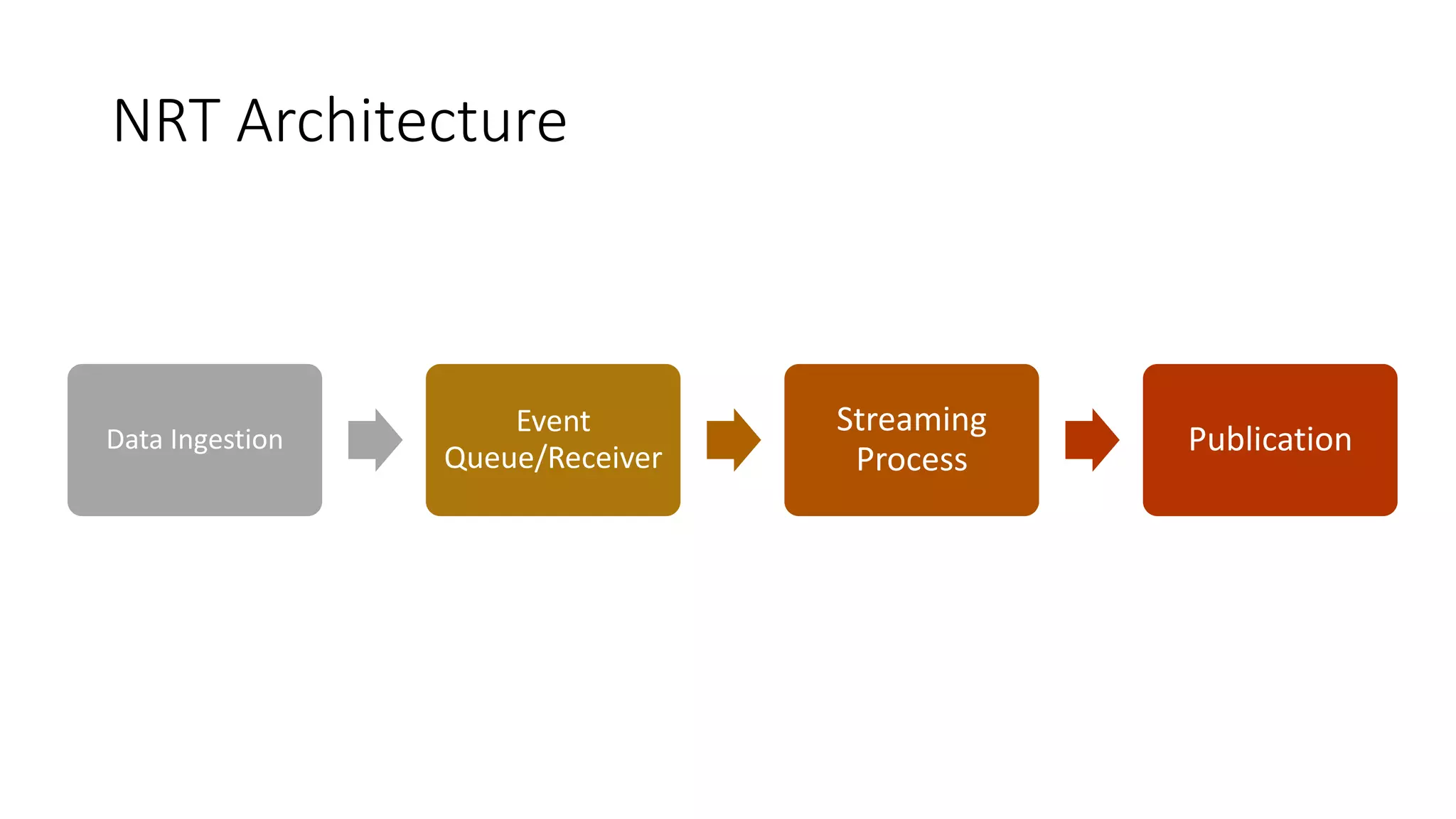
NRT Architecture
Data Ingestion
Event
Queue/Receiver
Streaming
Process
Publication
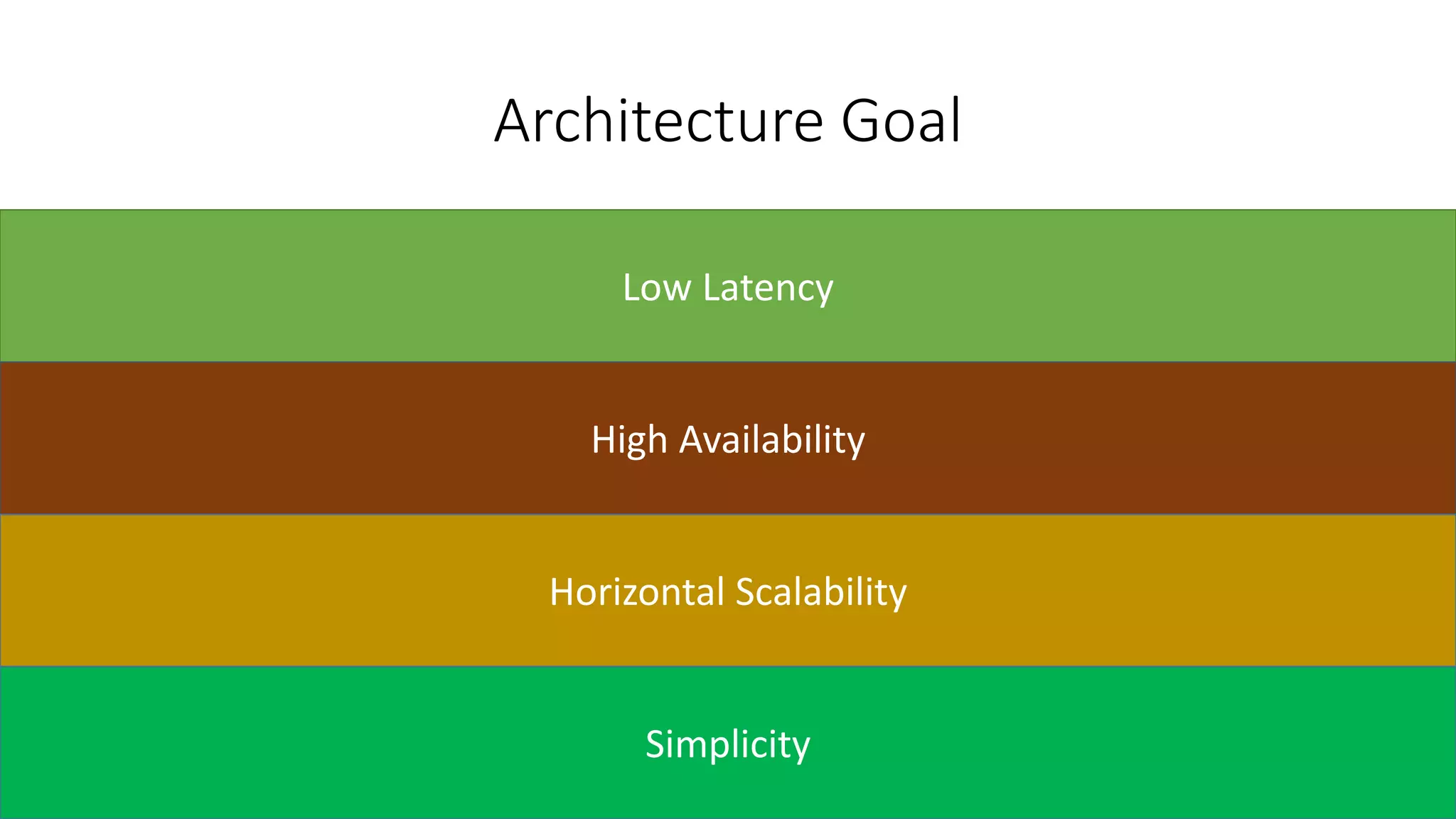
Architecture Goal
Low Latency
High Availability
Horizontal Scalability
Simplicity
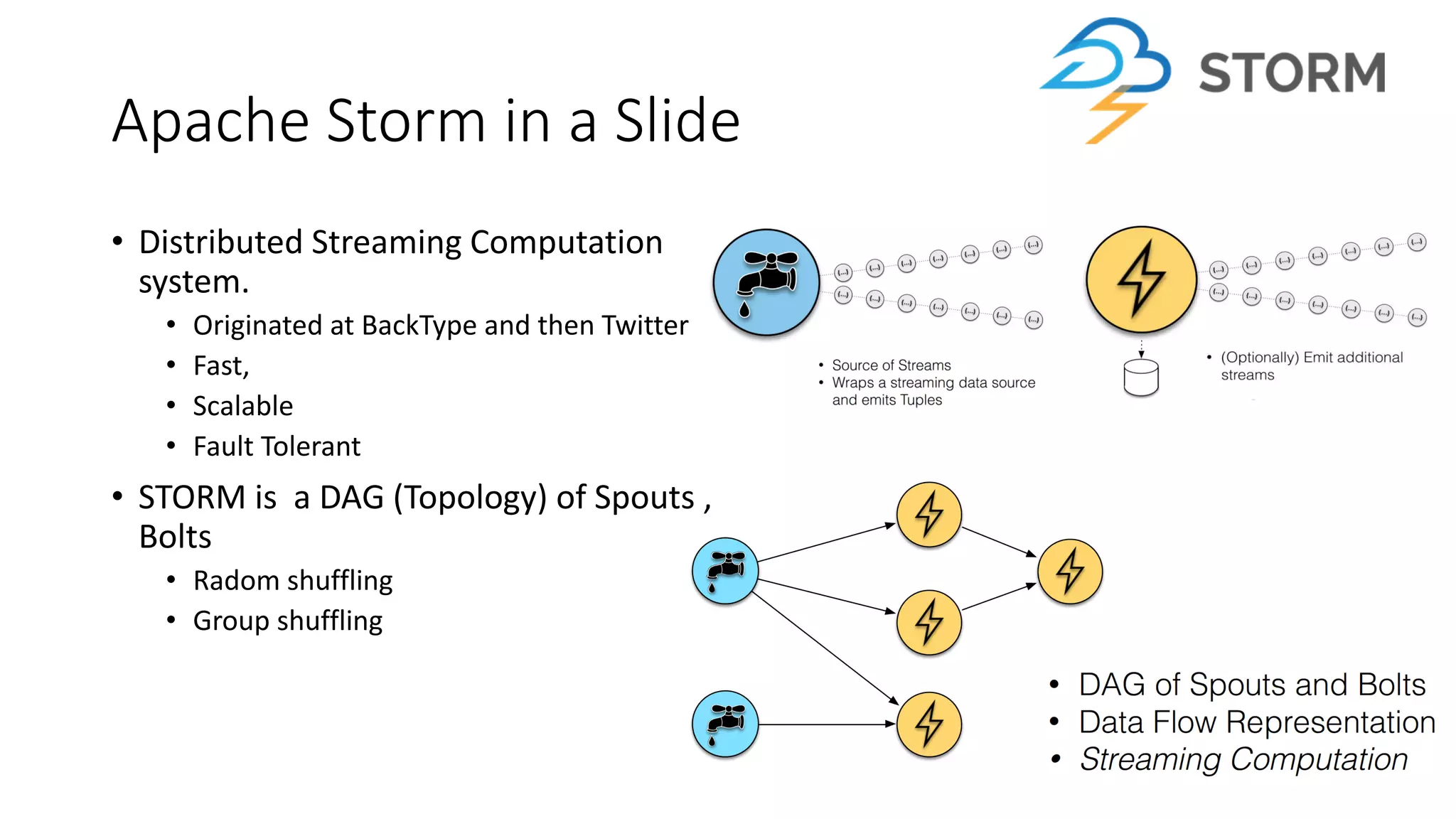
Apache Storm in a Slide
• Distributed Streaming Computation
system.
• Originated at BackType and then Twitter
• Fast,
• Scalable
• Fault Tolerant
• STORM is a DAG (Topology) of Spouts ,
Bolts
• Radom shuffling
• Group shuffling
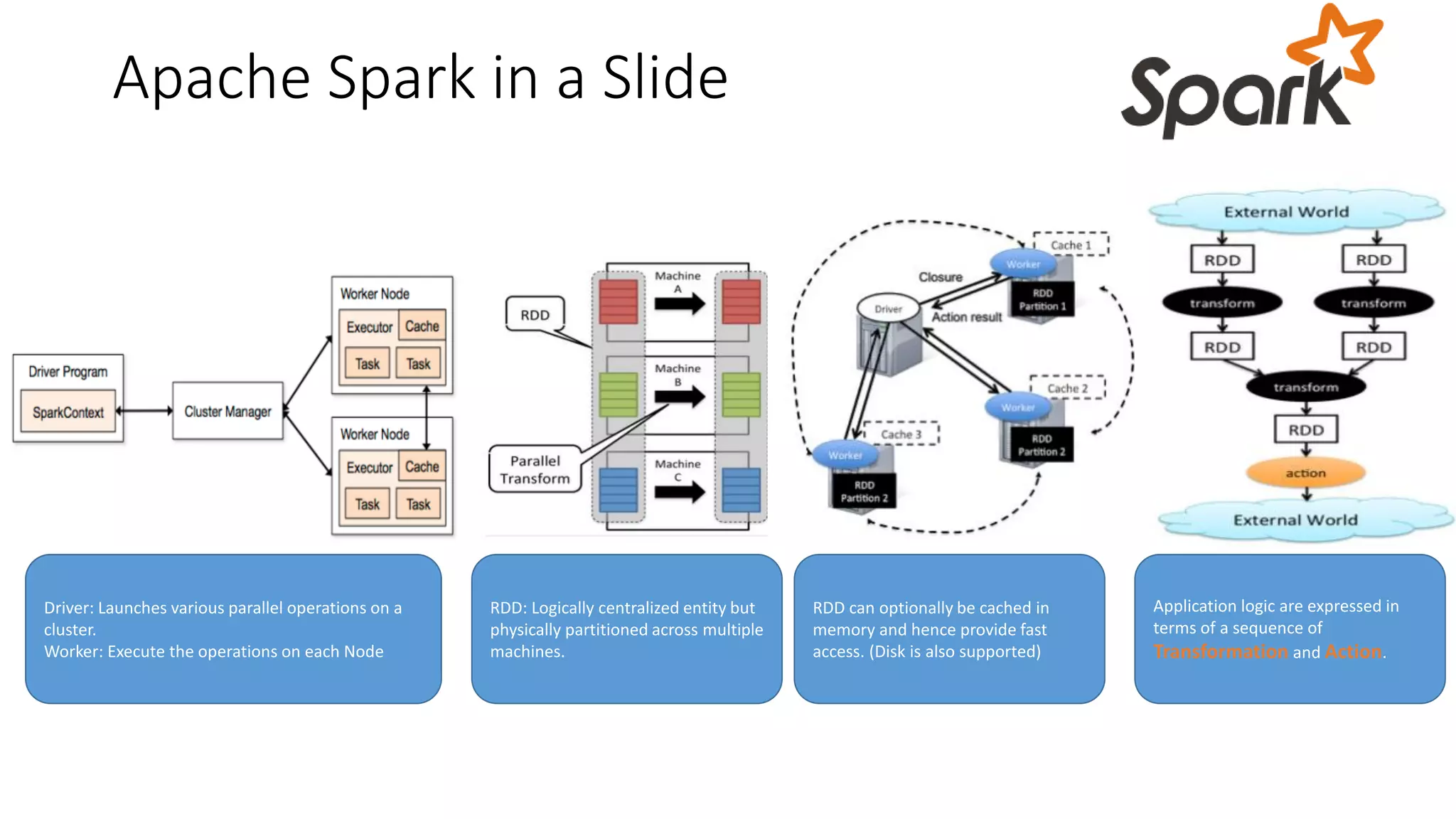
Apache Spark in a Slide
Driver: Launches various parallel operations on a
cluster.
Worker: Execute the operations on each Node
RDD: Logically centralized entity but
physically partitioned across multiple
machines.
RDD can optionally be cached in
memory and hence provide fast
access. (Disk is also supported)
Application logic are expressed in
terms of a sequence of
Transformation and Action.
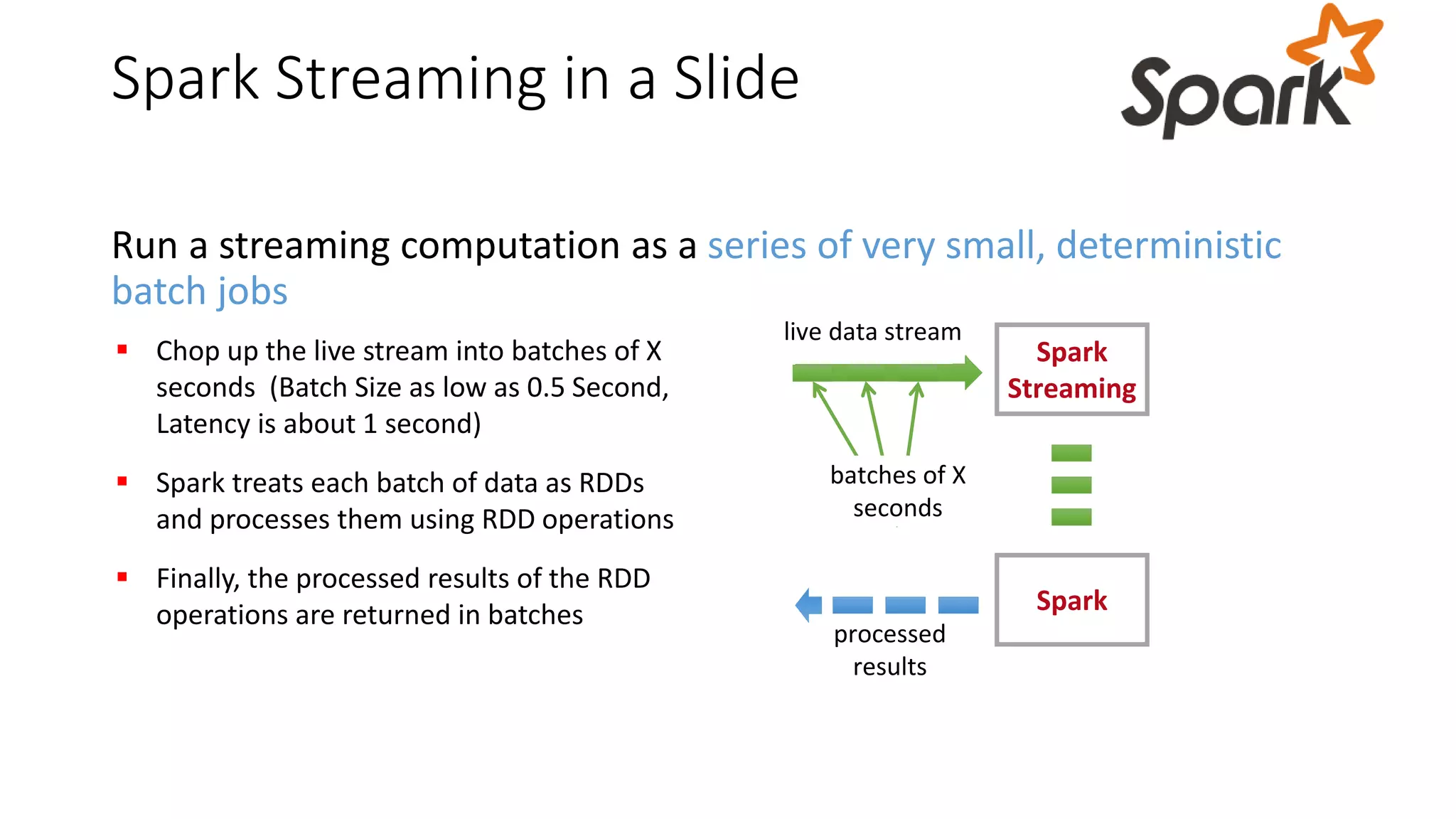
Spark Streaming in a Slide
Run a streaming computation as a series of very small, deterministic
batch jobs
Spark
Spark
Streaming
batches of X
seconds
live data stream
processed
results
 Chop up the live stream into batches of X
seconds (Batch Size as low as 0.5 Second,
Latency is about 1 second)
 Spark treats each batch of data as RDDs
and processes them using RDD operations
 Finally, the processed results of the RDD
operations are returned in batches
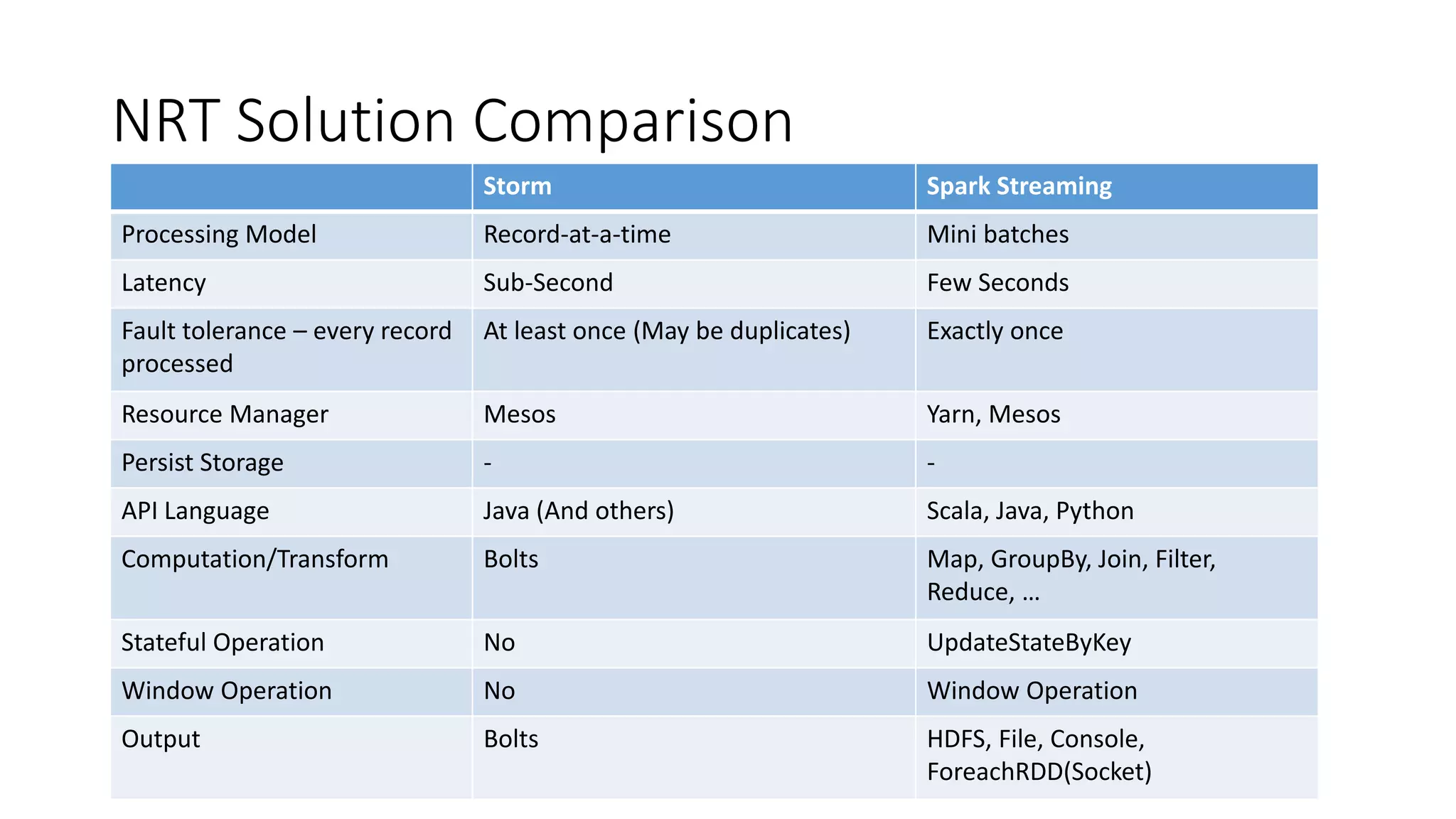
NRT Solution Comparison
Storm Spark Streaming
Processing Model Record-at-a-time Mini batches
Latency Sub-Second Few Seconds
Fault tolerance – every record
processed
At least once (May be duplicates) Exactly once
Resource Manager Mesos Yarn, Mesos
Persist Storage - -
API Language Java (And others) Scala, Java, Python
Computation/Transform Bolts Map, GroupBy, Join, Filter,
Reduce, …
Stateful Operation No UpdateStateByKey
Window Operation No Window Operation
Output Bolts HDFS, File, Console,
ForeachRDD(Socket)
QA
• Spark Streaming
• Storm
• Google – MillWheel
• Spark on Azure HDInsight
• Apache Storm vs Spark Streaming

Introduction to near real time computing

  • 1.
  • 2.
    Agenda • What’s NearReal Time Computing • Streaming Processing VS Batch Job • Business Scenarios and Use Cases • Architecture and Technology • NRT Solution: Storm, Spark Streaming
  • 3.
    Near Real Time= Velocity 0.5 sec to 60 Sec Fast, Non-Stop, immediate analytics Cannot be done in Batch job
  • 4.
    Batch VS NRT Zillionsof data once Gigabyte data per second
  • 5.
    Batch VS NRT Completedin longer time 7*24 Non-Stop availability
  • 6.
    Batch VS NRT Makefuture Plan & Decisions Immediate Decision & Action
  • 7.
    Batch Analytics • Is whenyou have plenty of time for analysis • Is when you explore patterns and models in historic data • Is when you plan and forecast the future instead of (re)acting immediately Technology • Query previously stored data • Store the data in HDFS/Cosmos and Process with Hadoop/Scope • Generally rely on disks/storage
  • 8.
    NRT Analytics • Is whenyou don’t have time • Is when you analyze data as it comes • Is when you already have a fixed model, and data flying in fits it 100% • Is when you (re)act immediately Technology • Process events in streaming • Store only for checkpoint reasons • Mostly in memory and hit disk rarely
  • 9.
    NRT Scenarios Applications Fraud/Botdetection Log Processing Web Site Analytics & Monitoring Recommendation & Personalization Mobile Apps Network metrics analysis Geolocation based ads
  • 10.
    NRT Computing Model •Event Processing/Mini Batch Processing o Cooking, enrichment, and transfer • Time Window based Counter/Aggregation o Real Time Metrics/Monitoring o Active User, Usage statistics • Buffer data for processing o Multi-Chunk Streaming o Sessionization • State based updating o User info tracking/updating o New user detection • Interact with Historic/external data o Fraud/Bot Detection, ML Prediction o Streaming SQL
  • 11.
  • 12.
  • 13.
    Architecture Goal Low Latency HighAvailability Horizontal Scalability Simplicity
  • 14.
    Apache Storm ina Slide • Distributed Streaming Computation system. • Originated at BackType and then Twitter • Fast, • Scalable • Fault Tolerant • STORM is a DAG (Topology) of Spouts , Bolts • Radom shuffling • Group shuffling
  • 15.
    Apache Spark ina Slide Driver: Launches various parallel operations on a cluster. Worker: Execute the operations on each Node RDD: Logically centralized entity but physically partitioned across multiple machines. RDD can optionally be cached in memory and hence provide fast access. (Disk is also supported) Application logic are expressed in terms of a sequence of Transformation and Action.
  • 16.
    Spark Streaming ina Slide Run a streaming computation as a series of very small, deterministic batch jobs Spark Spark Streaming batches of X seconds live data stream processed results  Chop up the live stream into batches of X seconds (Batch Size as low as 0.5 Second, Latency is about 1 second)  Spark treats each batch of data as RDDs and processes them using RDD operations  Finally, the processed results of the RDD operations are returned in batches
  • 17.
    NRT Solution Comparison StormSpark Streaming Processing Model Record-at-a-time Mini batches Latency Sub-Second Few Seconds Fault tolerance – every record processed At least once (May be duplicates) Exactly once Resource Manager Mesos Yarn, Mesos Persist Storage - - API Language Java (And others) Scala, Java, Python Computation/Transform Bolts Map, GroupBy, Join, Filter, Reduce, … Stateful Operation No UpdateStateByKey Window Operation No Window Operation Output Bolts HDFS, File, Console, ForeachRDD(Socket)
  • 18.
    QA • Spark Streaming •Storm • Google – MillWheel • Spark on Azure HDInsight • Apache Storm vs Spark Streaming