INTRODUCTION TO
INFORMATION SYSTEMS
SECURITY
Subject: Information Assurance and Security 2
Subtitle: Understanding the Basics of Information Security
Instructor: Lester R. Ladera, MIT, DM
Institution: Ramon Magsaysay Memorial Colleges-Marbel, Inc.
OBJECTIVES OF THE TOPIC
 Understand the fundamental concepts of information systems security.
 Learn the significance of confidentiality, integrity, and availability (CIA) in security.
 Explore how information security impacts individuals and organizations.
LEARNING OUTCOMES (TLOS)
 Discuss various knowledge areas in computing.
 Explain the role of information systems security in daily
life and businesses.
 Analyze the CIA triad’s significance in securing IT
infrastructure.
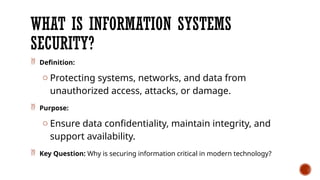
WHAT IS INFORMATION SYSTEMS
SECURITY?
 Definition:
o Protecting systems, networks, and data from
unauthorized access, attacks, or damage.
 Purpose:
o Ensure data confidentiality, maintain integrity, and
support availability.
 Key Question: Why is securing information critical in modern technology?
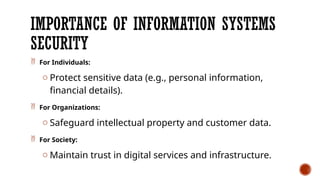
IMPORTANCE OF INFORMATION SYSTEMS
SECURITY
 For Individuals:
o Protect sensitive data (e.g., personal information,
financial details).
 For Organizations:
o Safeguard intellectual property and customer data.
 For Society:
o Maintain trust in digital services and infrastructure.
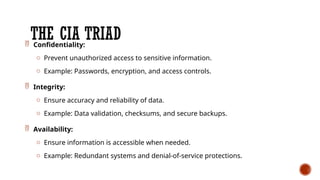
THE CIA TRIAD
 Confidentiality:
o Prevent unauthorized access to sensitive information.
o Example: Passwords, encryption, and access controls.
 Integrity:
o Ensure accuracy and reliability of data.
o Example: Data validation, checksums, and secure backups.
 Availability:
o Ensure information is accessible when needed.
o Example: Redundant systems and denial-of-service protections.
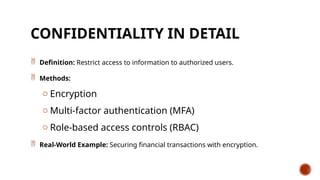
CONFIDENTIALITY IN DETAIL
 Definition: Restrict access to information to authorized users.
 Methods:
o Encryption
o Multi-factor authentication (MFA)
o Role-based access controls (RBAC)
 Real-World Example: Securing financial transactions with encryption.
INTEGRITY IN DETAIL
 Definition: Protect data from unauthorized changes.
 Methods:
o Digital signatures
o Hash functions
o Change logs and audit trails
 Real-World Example: Ensuring medical records remain
unaltered.
AVAILABILITY IN DETAIL
 Definition: Ensure reliable access to information and systems.
 Methods:
o Redundancy
o Load balancing
o Disaster recovery plans (DRPs)
 Real-World Example: E-commerce websites staying online during peak sales.
DISCUSSING KNOWLEDGE AREAS IN
COMPUTING
 Core Areas:
o Software development
o Networking
o Data management
o Cybersecurity
 Why It Matters: Security concerns intersect with every
aspect of computing.
INFORMATION SYSTEMS SECURITY
AND ITS EFFECTS
 On Businesses:
o Reduces financial losses from breaches.
o Ensures compliance with legal regulations.
 On People:
o Builds trust in digital interactions.
o Protects privacy and personal freedoms.
REAL-LIFE BREACH EXAMPLES
 Case Study 1: Data breach at a major financial institution.
o Cause: Weak password policies.
o Effect: Financial loss and reputation damage.
 Case Study 2: Ransomware attack on a hospital.
o Cause: Unpatched software.
o Effect: Service disruption and ransom payment.
THREATS TO INFORMATION
SECURITY
 External Threats:
o Hacking
o Phishing
o Malware
 Internal Threats:
o Insider threats
o Misconfigurations
HOW TO MITIGATE THREATS
 Implement strong security policies.
 Use advanced tools like firewalls and intrusion detection
systems.
 Conduct regular employee training on cybersecurity.
THE ROLE OF POLICIES IN SECURITY
 Definition: Guidelines to ensure consistent
security practices.
 Components:
o Acceptable use policies
o Incident response plans
o Compliance guidelines
SECURITY FRAMEWORKS
 Examples:
o ISO 27001: International standard for information
security management.
o NIST Cybersecurity Framework: U.S.-based framework
for reducing cyber risks.
 Why Use Frameworks? Standardizes practices and
simplifies compliance.
IMPORTANCE OF AWARENESS
 For Individuals:
o Stay vigilant against phishing and scams.
 For Organizations:
o Foster a culture of security.
o Regular awareness campaigns.
CLASSROOM DISCUSSION ACTIVITY
 Scenario:
o You are the IT security officer at a company. Identify
threats and propose solutions for the following:
A phishing email.
Unauthorized access to a secure file.
Objective: Encourage critical thinking and application of
the CIA triad.
SUMMARY
 Key Points:
o CIA Triad is fundamental to information security.
o Information security protects individuals, businesses,
and society.
o Effective policies and frameworks reduce risks.
 Takeaway: Secure information systems are a shared
responsibility.
Q&A AND NEXT STEPS
 Questions: Open the floor to clarify concepts and
address doubts.
 Next Session: Evolution of Internet of Things (IoT) and
its impact on security.
THANKYOU!
LET ME KNOW IF
YOU'D LIKE
FURTHER
ENHANCEMENTS OR
DETAILS ADDED!

Introduction to Information Systems Security

  • 1.
    INTRODUCTION TO INFORMATION SYSTEMS SECURITY Subject:Information Assurance and Security 2 Subtitle: Understanding the Basics of Information Security Instructor: Lester R. Ladera, MIT, DM Institution: Ramon Magsaysay Memorial Colleges-Marbel, Inc.
  • 2.
    OBJECTIVES OF THETOPIC  Understand the fundamental concepts of information systems security.  Learn the significance of confidentiality, integrity, and availability (CIA) in security.  Explore how information security impacts individuals and organizations.
  • 3.
    LEARNING OUTCOMES (TLOS) Discuss various knowledge areas in computing.  Explain the role of information systems security in daily life and businesses.  Analyze the CIA triad’s significance in securing IT infrastructure.
  • 4.
    WHAT IS INFORMATIONSYSTEMS SECURITY?  Definition: o Protecting systems, networks, and data from unauthorized access, attacks, or damage.  Purpose: o Ensure data confidentiality, maintain integrity, and support availability.  Key Question: Why is securing information critical in modern technology?
  • 5.
    IMPORTANCE OF INFORMATIONSYSTEMS SECURITY  For Individuals: o Protect sensitive data (e.g., personal information, financial details).  For Organizations: o Safeguard intellectual property and customer data.  For Society: o Maintain trust in digital services and infrastructure.
  • 6.
    THE CIA TRIAD Confidentiality: o Prevent unauthorized access to sensitive information. o Example: Passwords, encryption, and access controls.  Integrity: o Ensure accuracy and reliability of data. o Example: Data validation, checksums, and secure backups.  Availability: o Ensure information is accessible when needed. o Example: Redundant systems and denial-of-service protections.
  • 7.
    CONFIDENTIALITY IN DETAIL Definition: Restrict access to information to authorized users.  Methods: o Encryption o Multi-factor authentication (MFA) o Role-based access controls (RBAC)  Real-World Example: Securing financial transactions with encryption.
  • 8.
    INTEGRITY IN DETAIL Definition: Protect data from unauthorized changes.  Methods: o Digital signatures o Hash functions o Change logs and audit trails  Real-World Example: Ensuring medical records remain unaltered.
  • 9.
    AVAILABILITY IN DETAIL Definition: Ensure reliable access to information and systems.  Methods: o Redundancy o Load balancing o Disaster recovery plans (DRPs)  Real-World Example: E-commerce websites staying online during peak sales.
  • 10.
    DISCUSSING KNOWLEDGE AREASIN COMPUTING  Core Areas: o Software development o Networking o Data management o Cybersecurity  Why It Matters: Security concerns intersect with every aspect of computing.
  • 11.
    INFORMATION SYSTEMS SECURITY ANDITS EFFECTS  On Businesses: o Reduces financial losses from breaches. o Ensures compliance with legal regulations.  On People: o Builds trust in digital interactions. o Protects privacy and personal freedoms.
  • 12.
    REAL-LIFE BREACH EXAMPLES Case Study 1: Data breach at a major financial institution. o Cause: Weak password policies. o Effect: Financial loss and reputation damage.  Case Study 2: Ransomware attack on a hospital. o Cause: Unpatched software. o Effect: Service disruption and ransom payment.
  • 13.
    THREATS TO INFORMATION SECURITY External Threats: o Hacking o Phishing o Malware  Internal Threats: o Insider threats o Misconfigurations
  • 14.
    HOW TO MITIGATETHREATS  Implement strong security policies.  Use advanced tools like firewalls and intrusion detection systems.  Conduct regular employee training on cybersecurity.
  • 15.
    THE ROLE OFPOLICIES IN SECURITY  Definition: Guidelines to ensure consistent security practices.  Components: o Acceptable use policies o Incident response plans o Compliance guidelines
  • 16.
    SECURITY FRAMEWORKS  Examples: oISO 27001: International standard for information security management. o NIST Cybersecurity Framework: U.S.-based framework for reducing cyber risks.  Why Use Frameworks? Standardizes practices and simplifies compliance.
  • 17.
    IMPORTANCE OF AWARENESS For Individuals: o Stay vigilant against phishing and scams.  For Organizations: o Foster a culture of security. o Regular awareness campaigns.
  • 18.
    CLASSROOM DISCUSSION ACTIVITY Scenario: o You are the IT security officer at a company. Identify threats and propose solutions for the following: A phishing email. Unauthorized access to a secure file. Objective: Encourage critical thinking and application of the CIA triad.
  • 19.
    SUMMARY  Key Points: oCIA Triad is fundamental to information security. o Information security protects individuals, businesses, and society. o Effective policies and frameworks reduce risks.  Takeaway: Secure information systems are a shared responsibility.
  • 20.
    Q&A AND NEXTSTEPS  Questions: Open the floor to clarify concepts and address doubts.  Next Session: Evolution of Internet of Things (IoT) and its impact on security.
  • 21.
    THANKYOU! LET ME KNOWIF YOU'D LIKE FURTHER ENHANCEMENTS OR DETAILS ADDED!