A Query Language for your API
GraphQL
Bhargav Anadkat
Twitter @bhargavlalo
WHAT TO EXPECT AHEAD...
❏ Introduction
❏ Start with Example
❏ REST Limitations
❏ Why choose GraphQL over
REST?
❏ What is GraphQL?
❏ Who uses GraphQL?
❏ Language Supported
❏ Install & Configure in NodeJs
❏ Install & Configure in .Net/C#
❏ Install & Configure in PHP
❏ Understanding Tools
❏ Types & Schema
❏ Scalar Type
❏ Object Type
❏ Query Type
❏ Mutation Type
❏ Input Type
❏ Enum Type
❏ Syntax & Language
❏ Fields
❏ Arguments
❏ Aliases
❏ Fragments
❏ Resolver
❏ Introspection
❏ Live Example
❏ PHP Sample
❏ Shopify
❏ Movies
❏ Further reading
❏ Questions
Let’s start with an Example
You have an API for music albums and songs:
Album:
{
“id” : 321
“artist”: “David Bowie”,
“name”: “Aladdin Sane”,
“releaseYear”: 1973,
“songIDs”:
[111,112,113,114,....],
…
}
Song:
{
“id” : 116
“artist”: “David Bowie”,
“name”: “Time”,
“album” : “Aladdin Sane”,
“duration”: “5:15”,
“trackNumber”: 6,
...
}
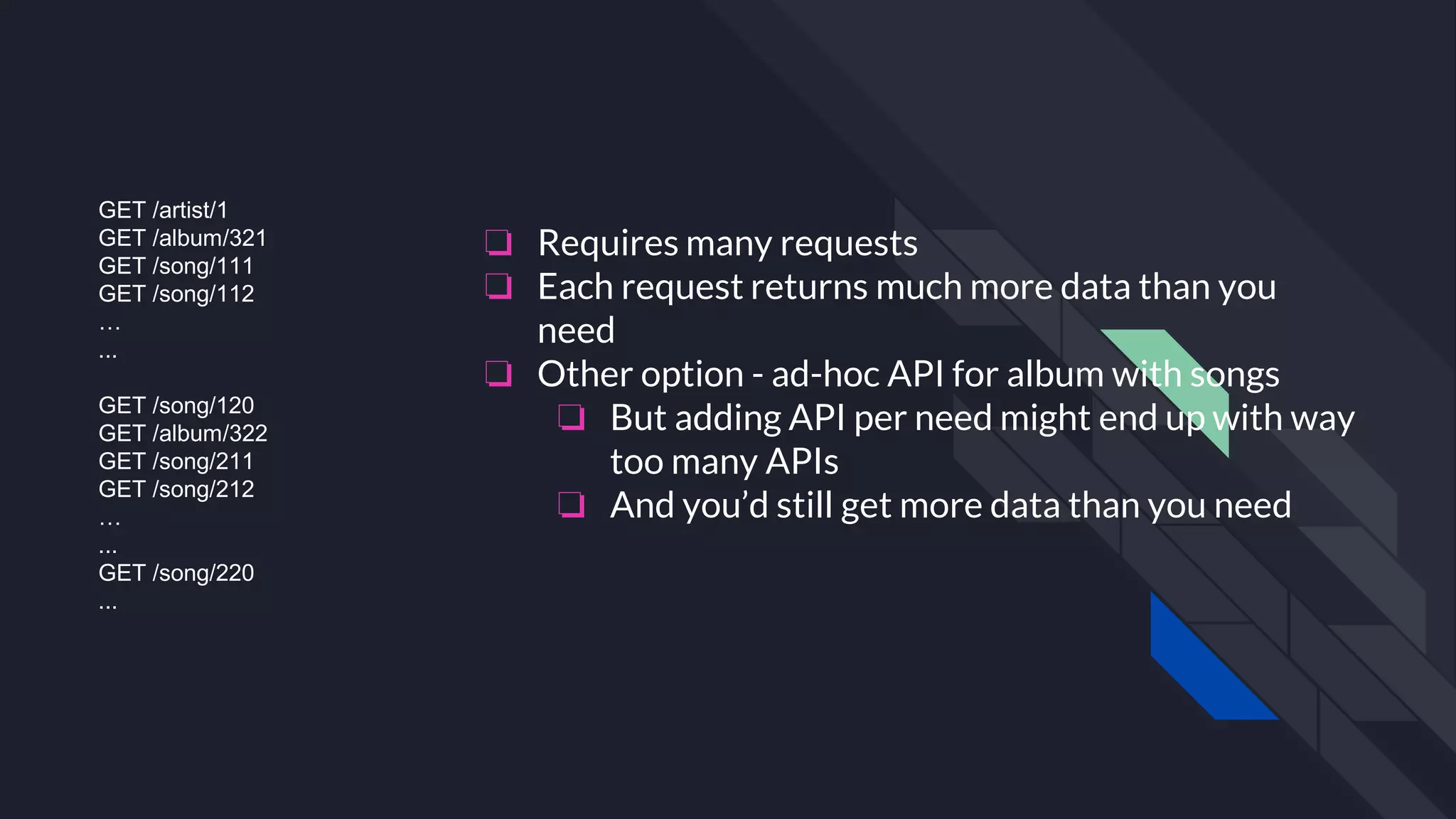
And now you want to get all of an artist’s albums with their songs lists
GET /artist/1
GET /album/321
GET /song/111
GET /song/112
…
...
GET /song/120
GET /album/322
GET /song/211
GET /song/212
…
...
GET /song/220
...
❏ Requires many requests
❏ Each request returns much more data than you
need
❏ Other option - ad-hoc API for album with songs
❏ But adding API per need might end up with way
too many APIs
❏ And you’d still get more data than you need
REST Limitations
❏ Resource-centric: many endpoints
❏ The endpoints are often organized the way they’re
stored in DB, not the way they’re retrieved by clients
❏ Large and fixed responses
❏ Getting a complete response requires multiple requests
❏ We would like to get on a single request
❏ ALL the data that we need, from several resources
❏ ONLY the data that we need -no large responses
with redundant fields
Why choose GraphQL over REST?
❏ Single endpoint -easier to scale
❏ Tailored responses -client gets only what he wants
❏ Fewer round trips -can return several related resources
together
❏ Backwards compatibility -the client decides the
response structure, knows exactly what to expect
❏ Introspective -GraphQL has a native and highly
extensible schema and type system
GraphQL is a modern query language for the API.
It allows the front-end developer, to write queries that have the exact data shape they want.
GraphQL is developed by Facebook.
GraphQL was developed internally by Facebook in 2012
It's open source version publicly released in 2015 and current stable version released in
June 2018
GraphQL official website is https://graphql.org/
GraphQL official git repository is https://github.com/graphql/graphql-spec
What is GraphQL?
Who’s using GraphQL
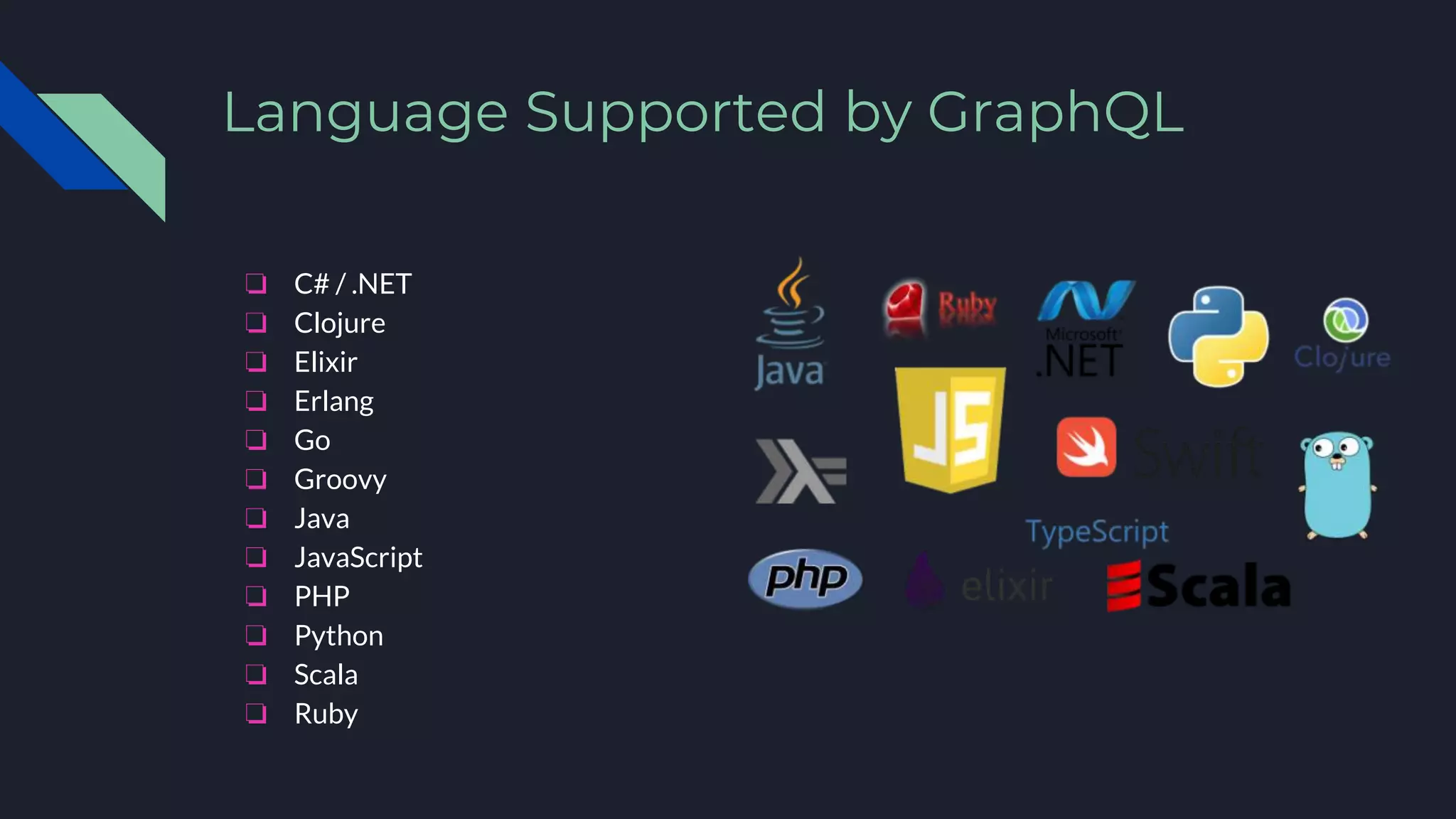
Language Supported by GraphQL
❏ C# / .NET
❏ Clojure
❏ Elixir
❏ Erlang
❏ Go
❏ Groovy
❏ Java
❏ JavaScript
❏ PHP
❏ Python
❏ Scala
❏ Ruby
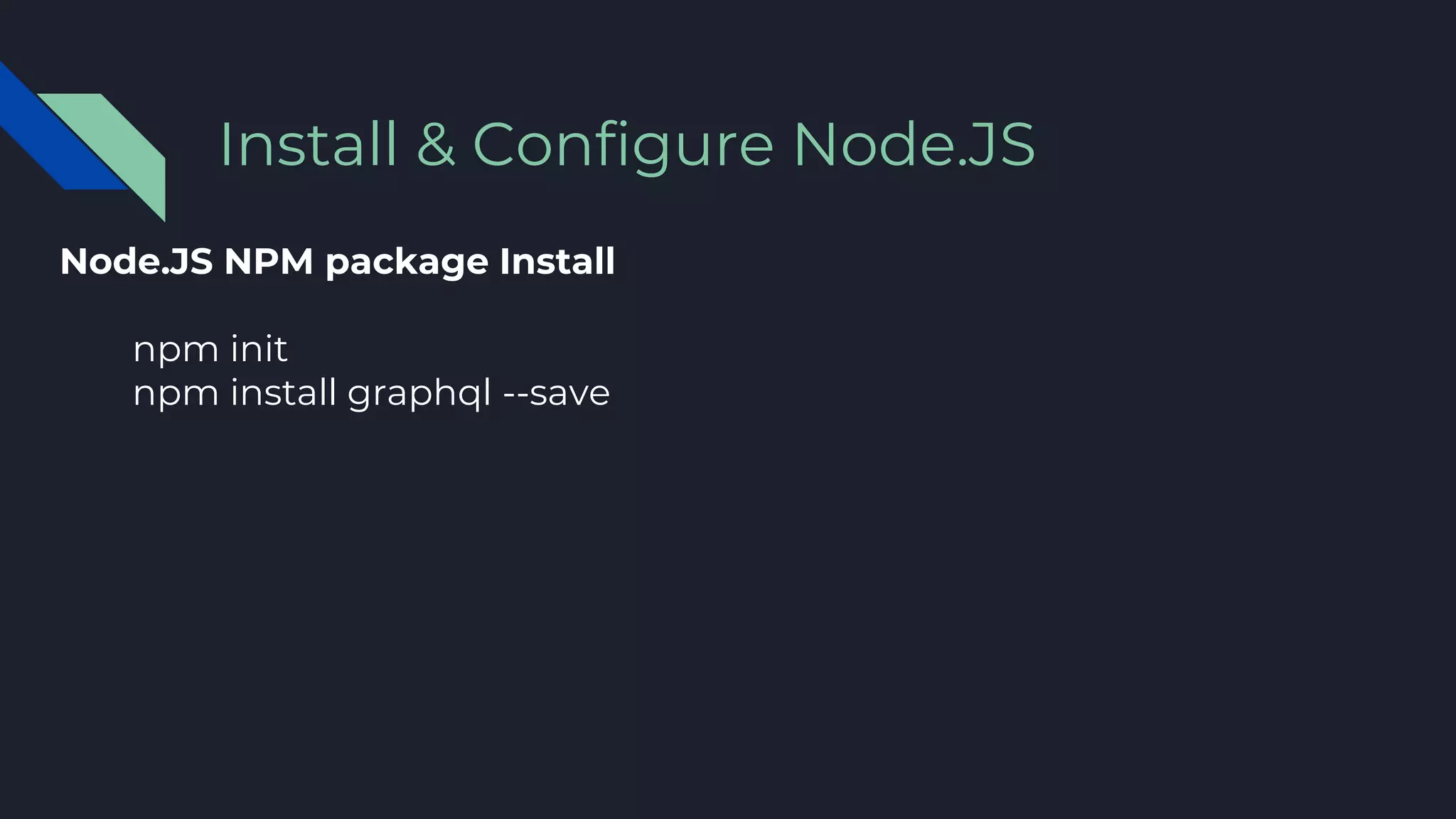
Node.JS NPM package Install
npm init
npm install graphql --save
Install & Configure Node.JS
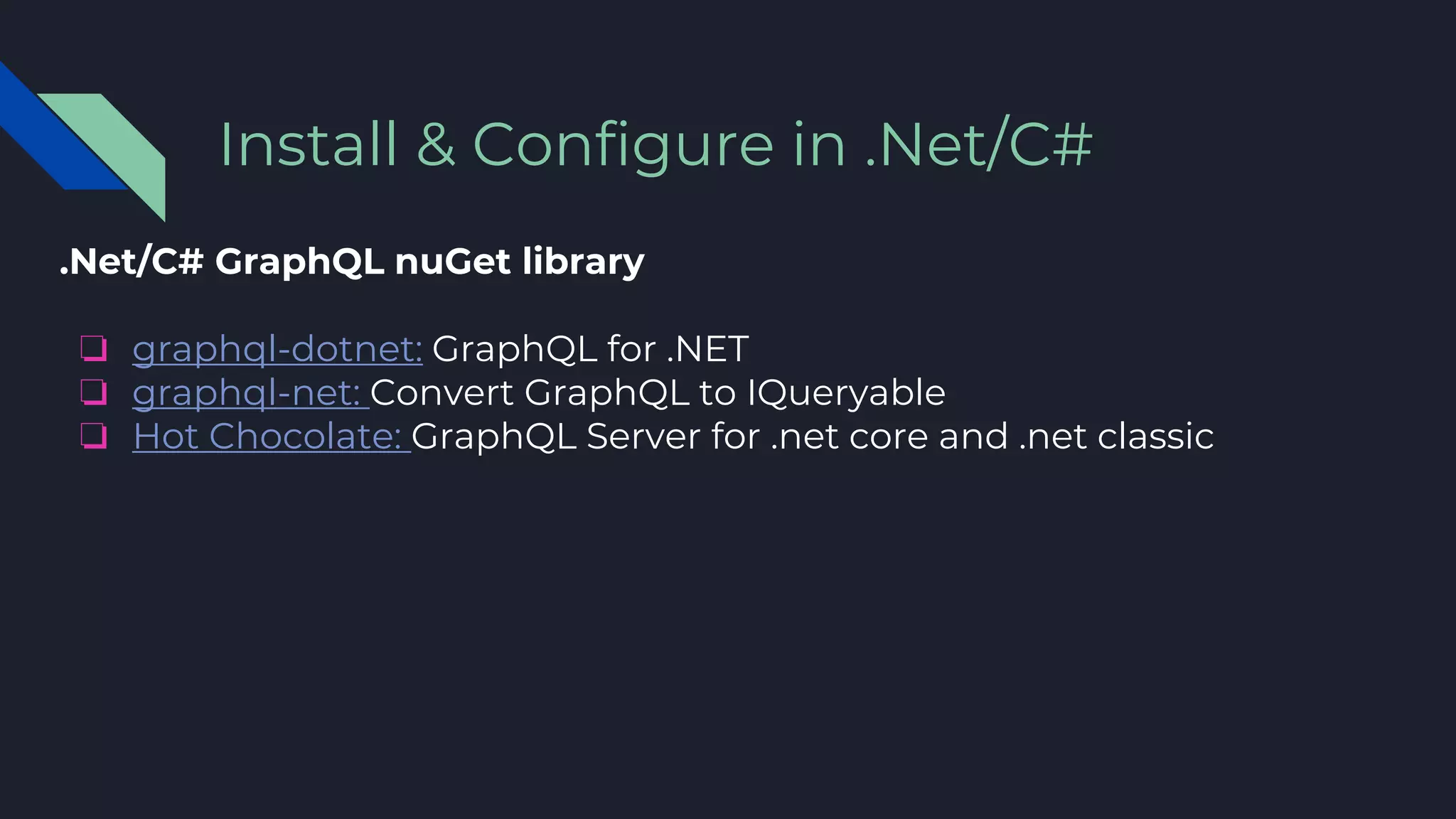
.Net/C# GraphQL nuGet library
❏ graphql-dotnet: GraphQL for .NET
❏ graphql-net: Convert GraphQL to IQueryable
❏ Hot Chocolate: GraphQL Server for .net core and .net classic
Install & Configure in .Net/C#
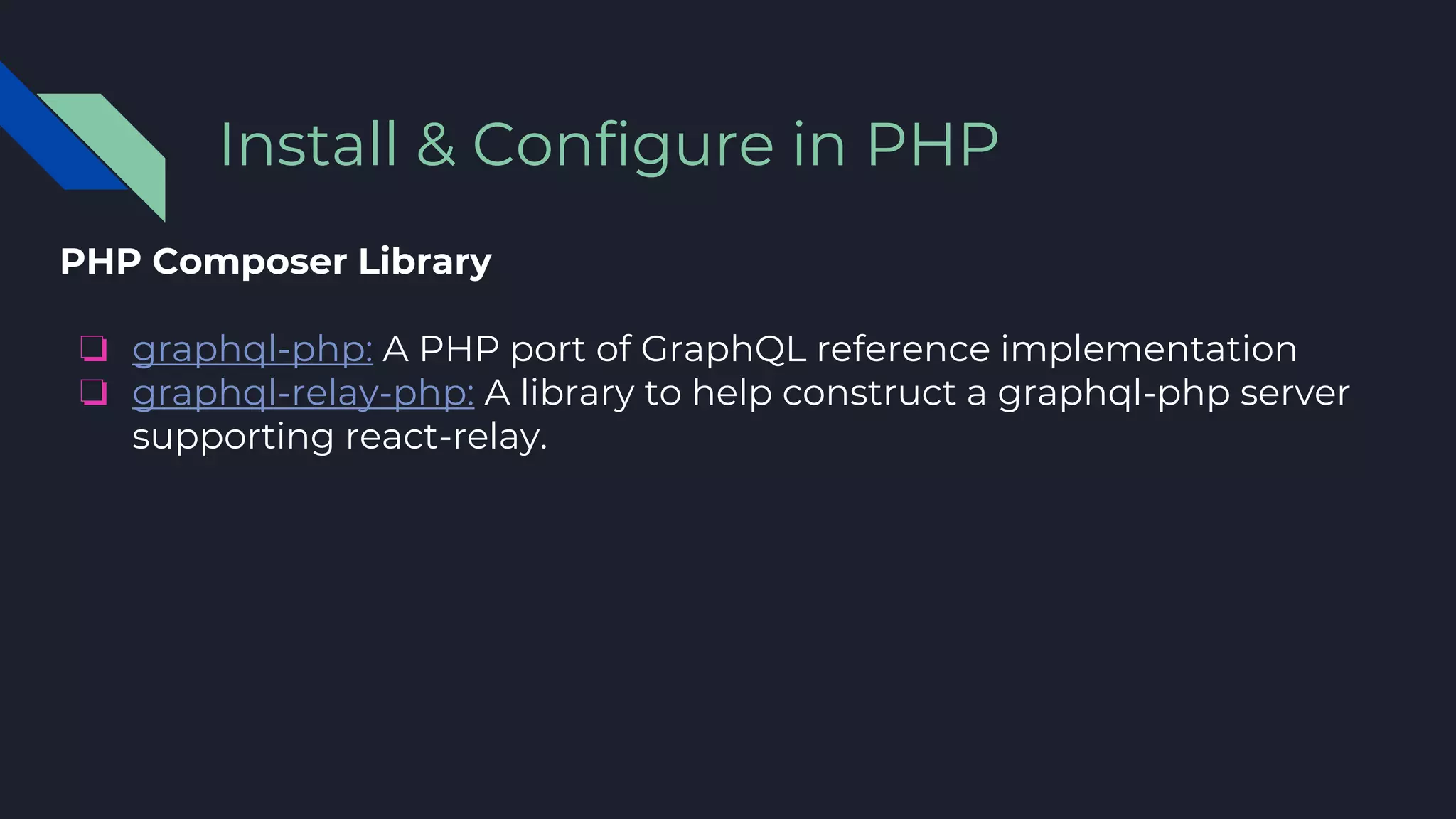
PHP Composer Library
❏ graphql-php: A PHP port of GraphQL reference implementation
❏ graphql-relay-php: A library to help construct a graphql-php server
supporting react-relay.
Install & Configure in PHP
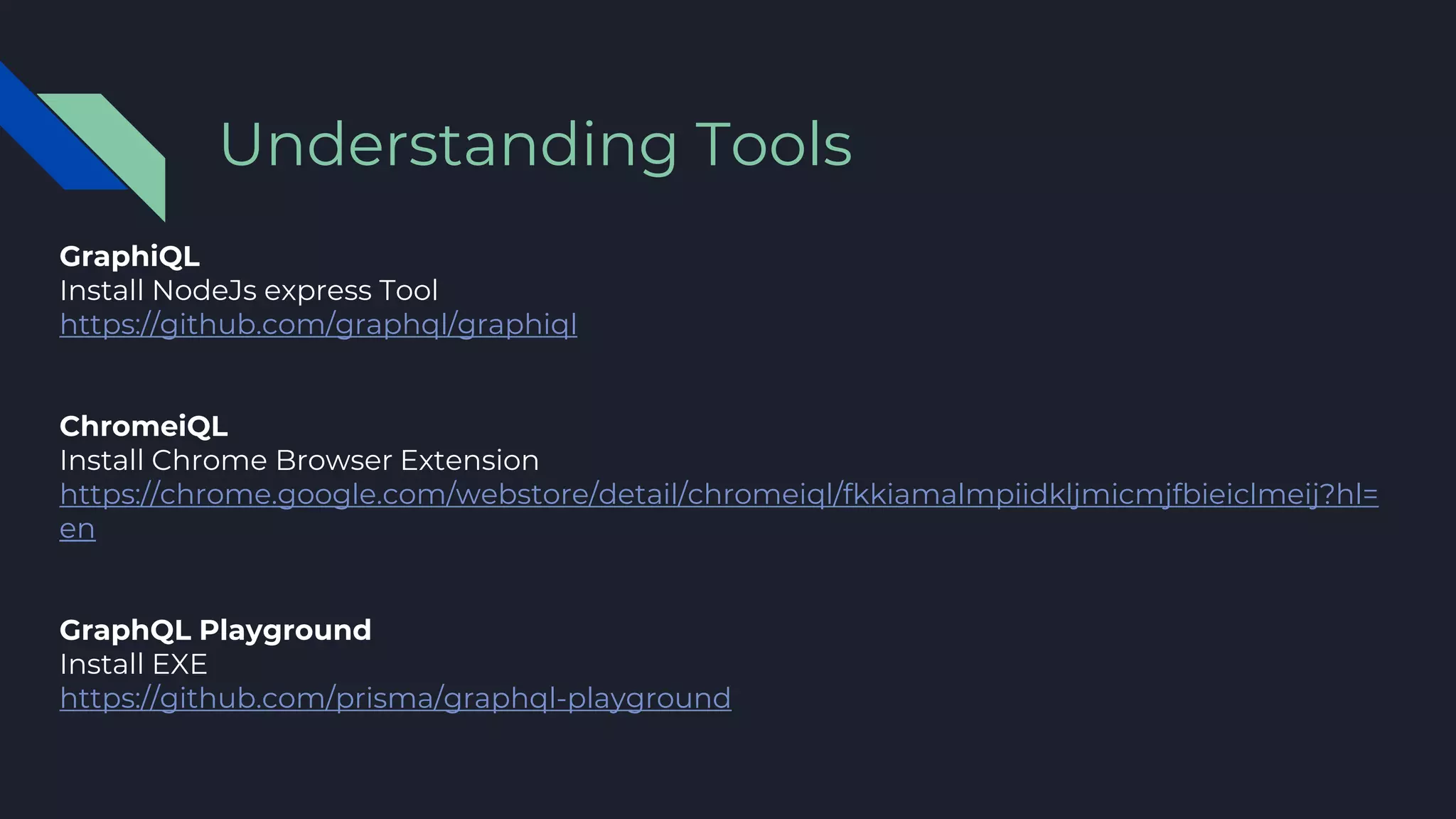
GraphiQL
Install NodeJs express Tool
https://github.com/graphql/graphiql
ChromeiQL
Install Chrome Browser Extension
https://chrome.google.com/webstore/detail/chromeiql/fkkiamalmpiidkljmicmjfbieiclmeij?hl=
en
GraphQL Playground
Install EXE
https://github.com/prisma/graphql-playground
Understanding Tools
Schema
A GraphQL schema is at the center of any
GraphQL server implementation and
describes the functionality available to the
clients which connect to it.
Type
GraphQL is a strongly typed language.
Type System defines various data types that
can be used in a GraphQL application.
The type system helps to define the
schema, which is a contract between client
and server.
Types & Schema
List of Types
❏ Scalar Type
❏ Object Type
❏ Query Type
❏ Mutation Type
❏ Interface Type
❏ Union Type
❏ Enum Type
❏ Input Type
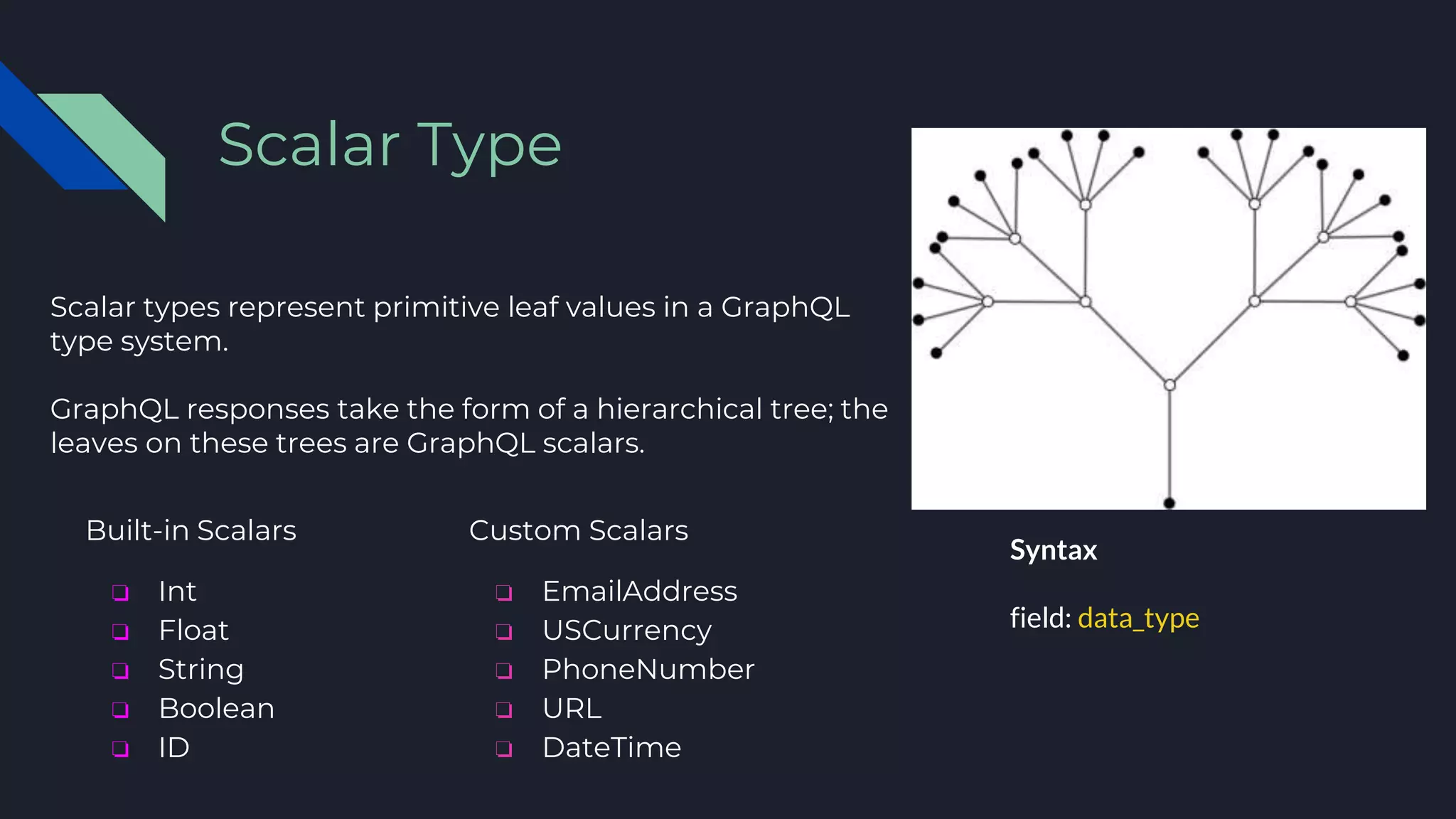
Scalar types represent primitive leaf values in a GraphQL
type system.
GraphQL responses take the form of a hierarchical tree; the
leaves on these trees are GraphQL scalars.
Scalar Type
Custom Scalars
❏ EmailAddress
❏ USCurrency
❏ PhoneNumber
❏ URL
❏ DateTime
Built‐in Scalars
❏ Int
❏ Float
❏ String
❏ Boolean
❏ ID
Syntax
field: data_type
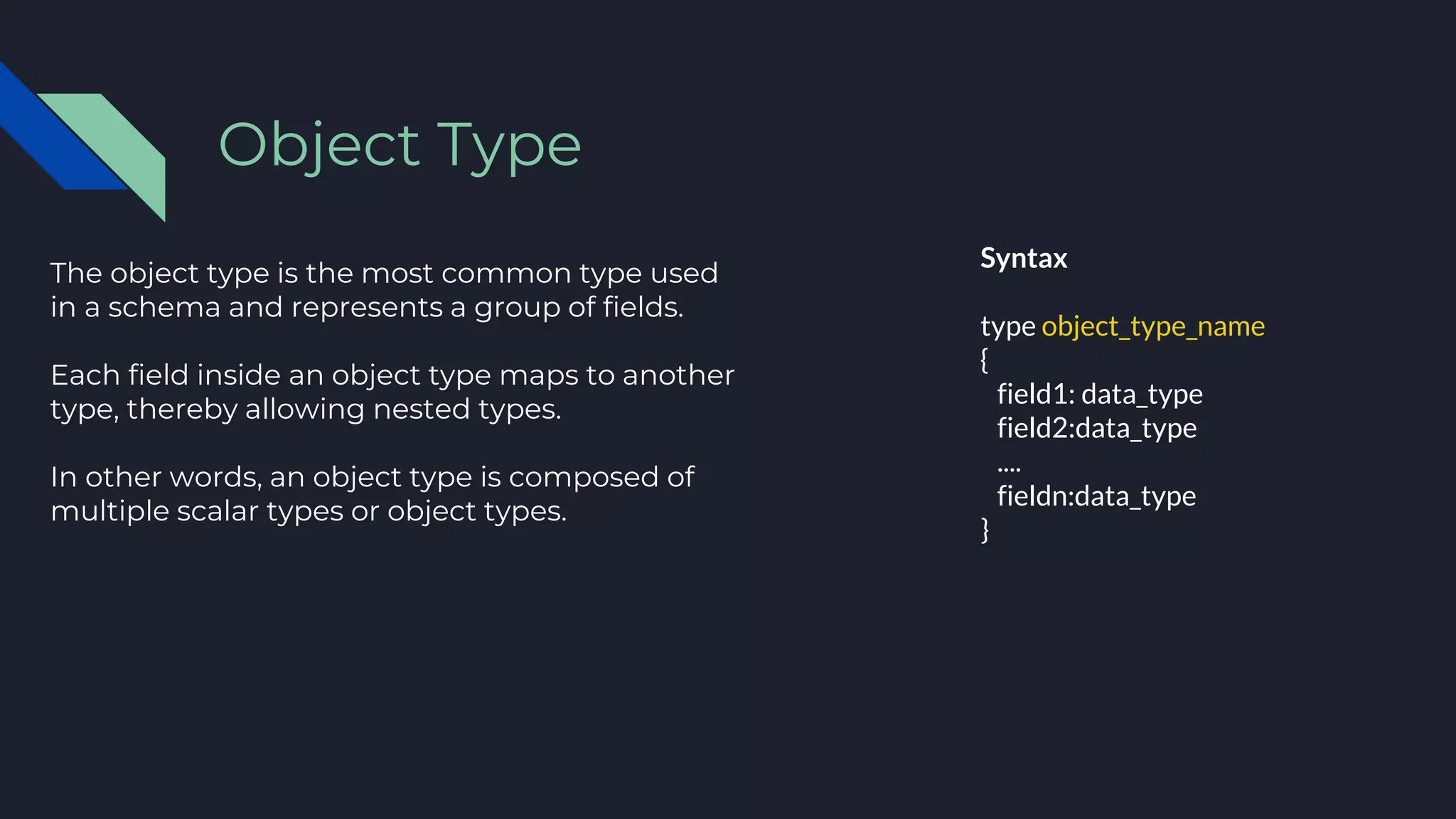
The object type is the most common type used
in a schema and represents a group of fields.
Each field inside an object type maps to another
type, thereby allowing nested types.
In other words, an object type is composed of
multiple scalar types or object types.
Object Type
Syntax
type object_type_name
{
field1: data_type
field2:data_type
....
fieldn:data_type
}
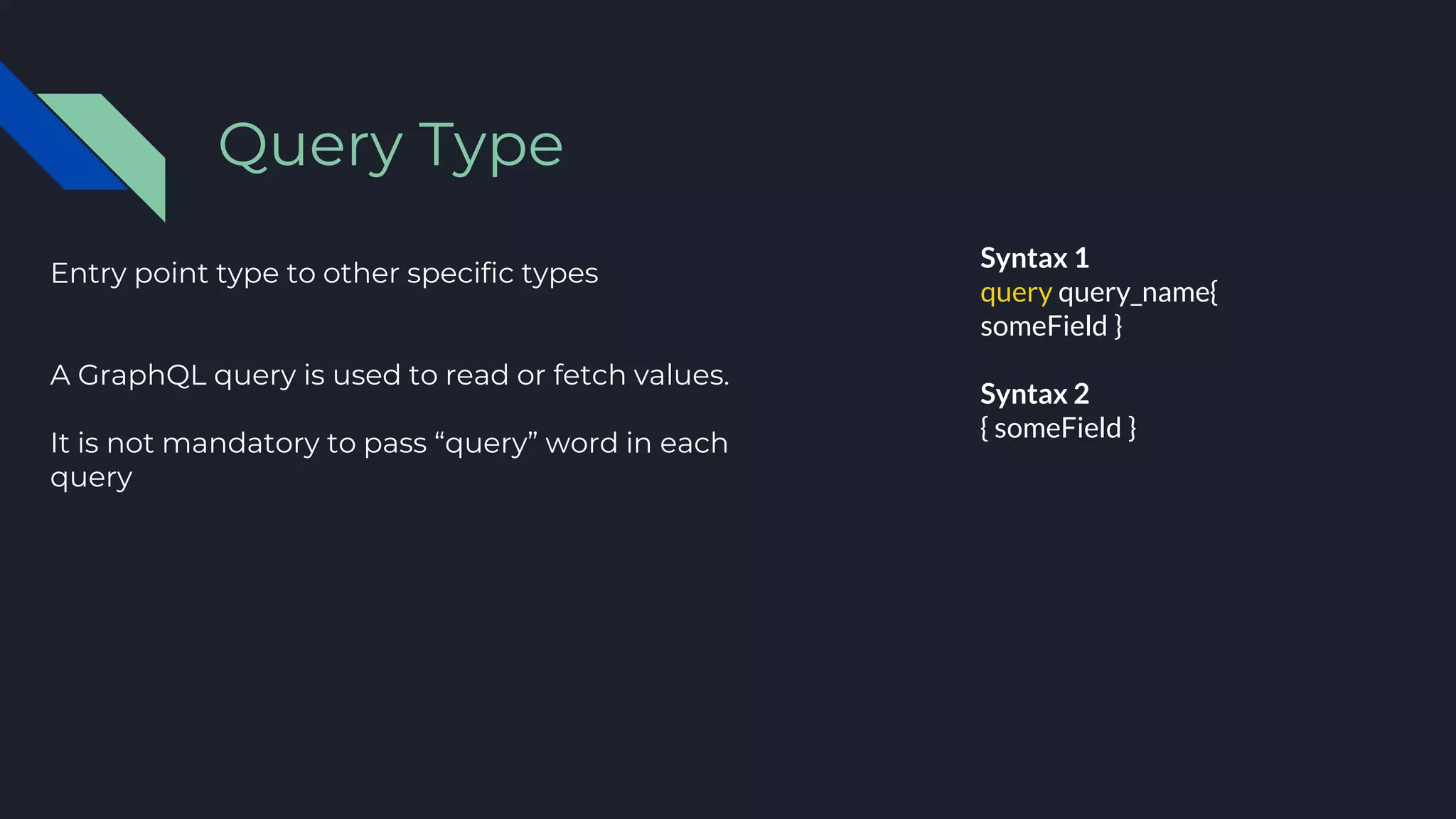
Entry point type to other specific types
A GraphQL query is used to read or fetch values.
It is not mandatory to pass “query” word in each
query
Query Type
Syntax 1
query query_name{
someField }
Syntax 2
{ someField }
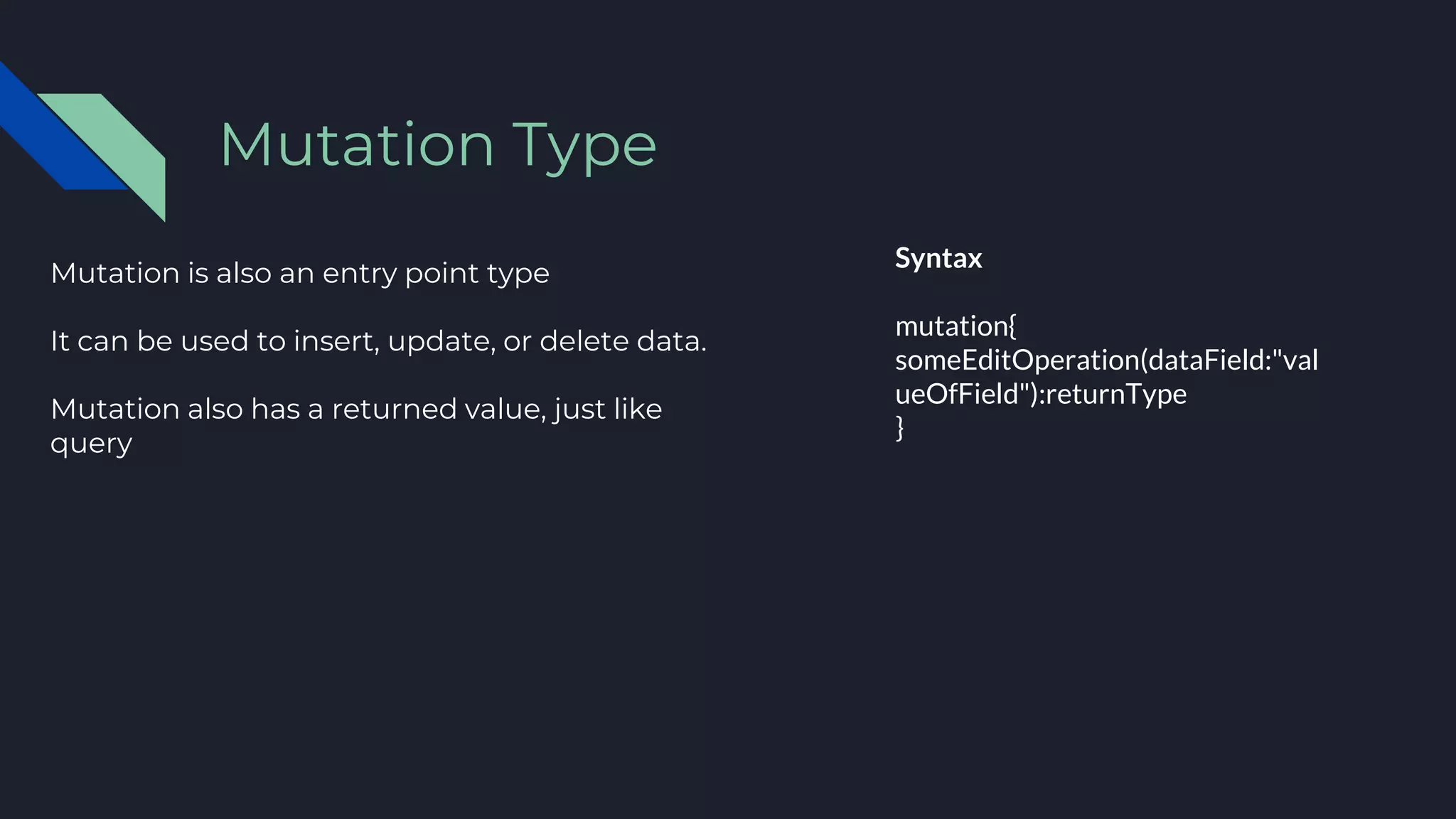
Mutation is also an entry point type
It can be used to insert, update, or delete data.
Mutation also has a returned value, just like
query
Mutation Type
Syntax
mutation{
someEditOperation(dataField:"val
ueOfField"):returnType
}
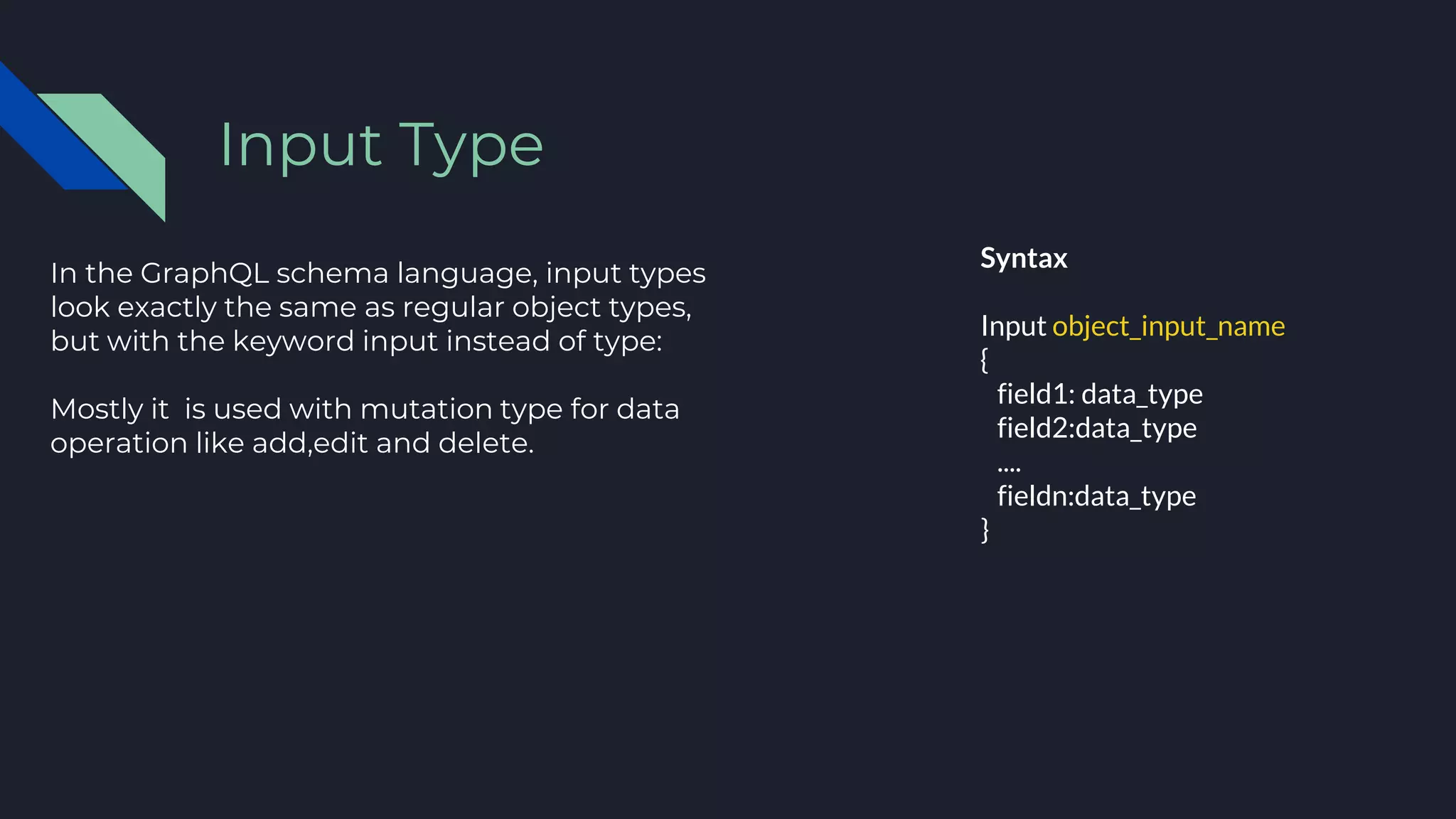
In the GraphQL schema language, input types
look exactly the same as regular object types,
but with the keyword input instead of type:
Mostly it is used with mutation type for data
operation like add,edit and delete.
Input Type
Syntax
Input object_input_name
{
field1: data_type
field2:data_type
....
fieldn:data_type
}
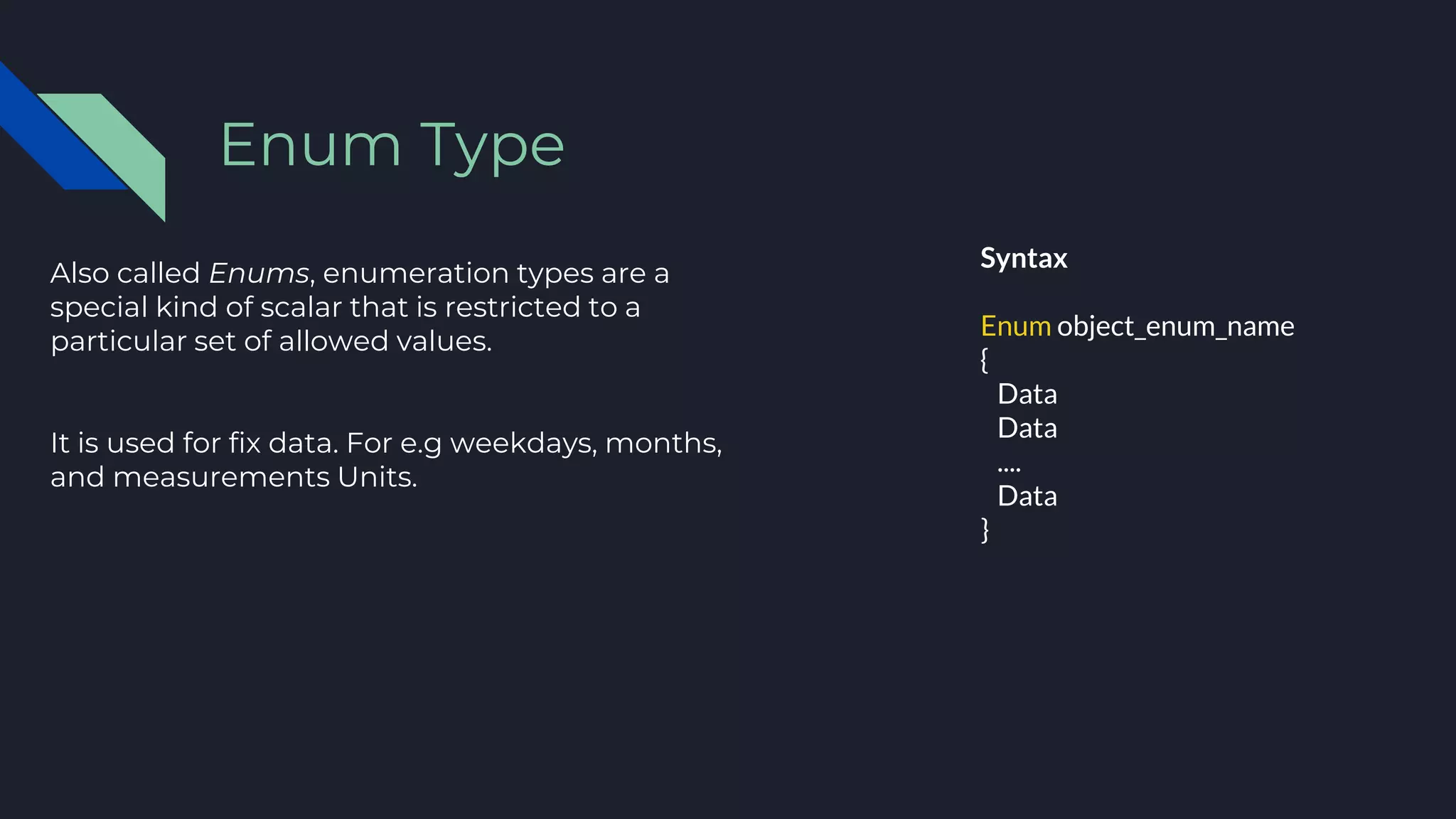
Also called Enums, enumeration types are a
special kind of scalar that is restricted to a
particular set of allowed values.
It is used for fix data. For e.g weekdays, months,
and measurements Units.
Enum Type
Syntax
Enum object_enum_name
{
Data
Data
....
Data
}
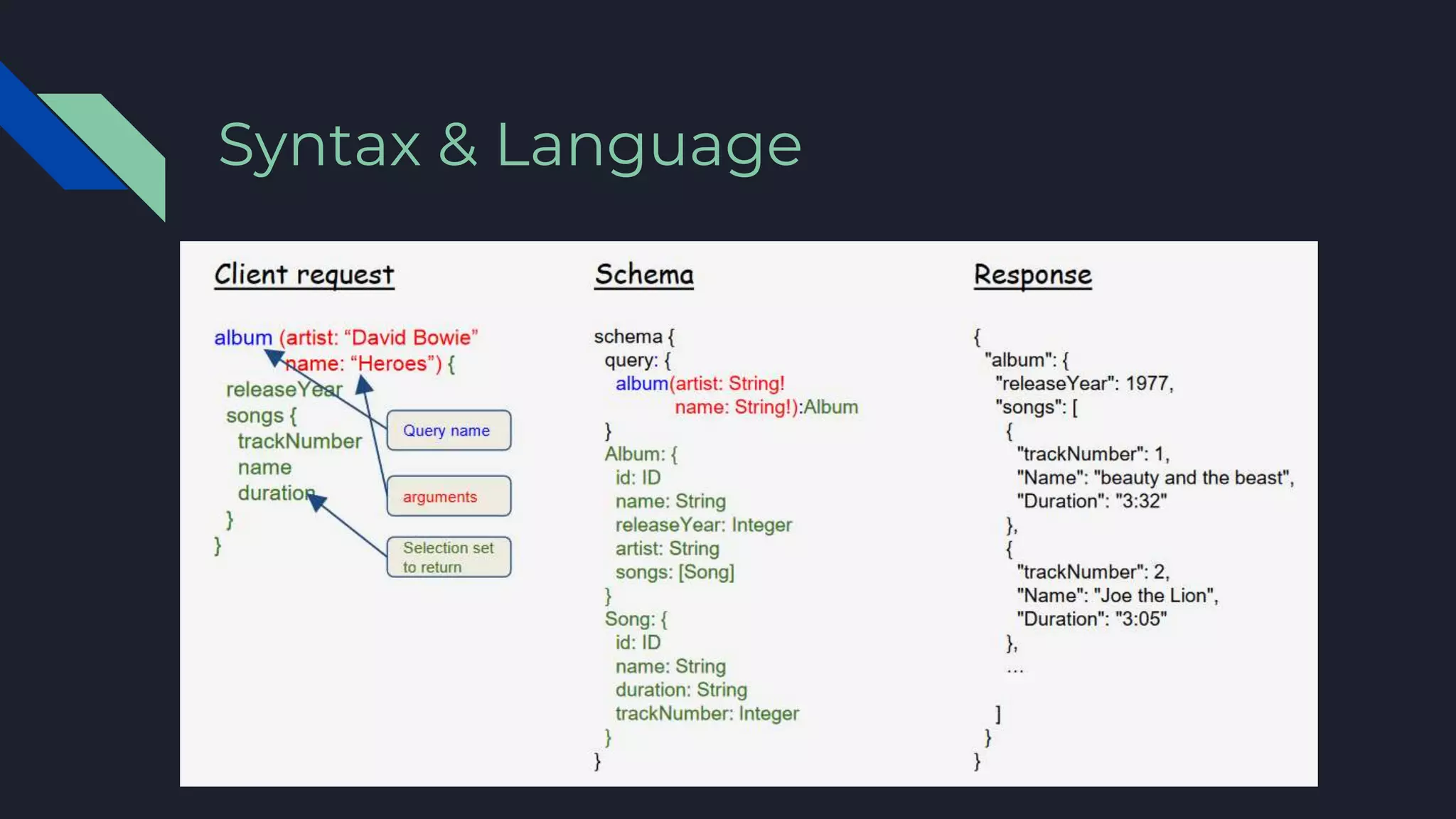
Syntax & Language
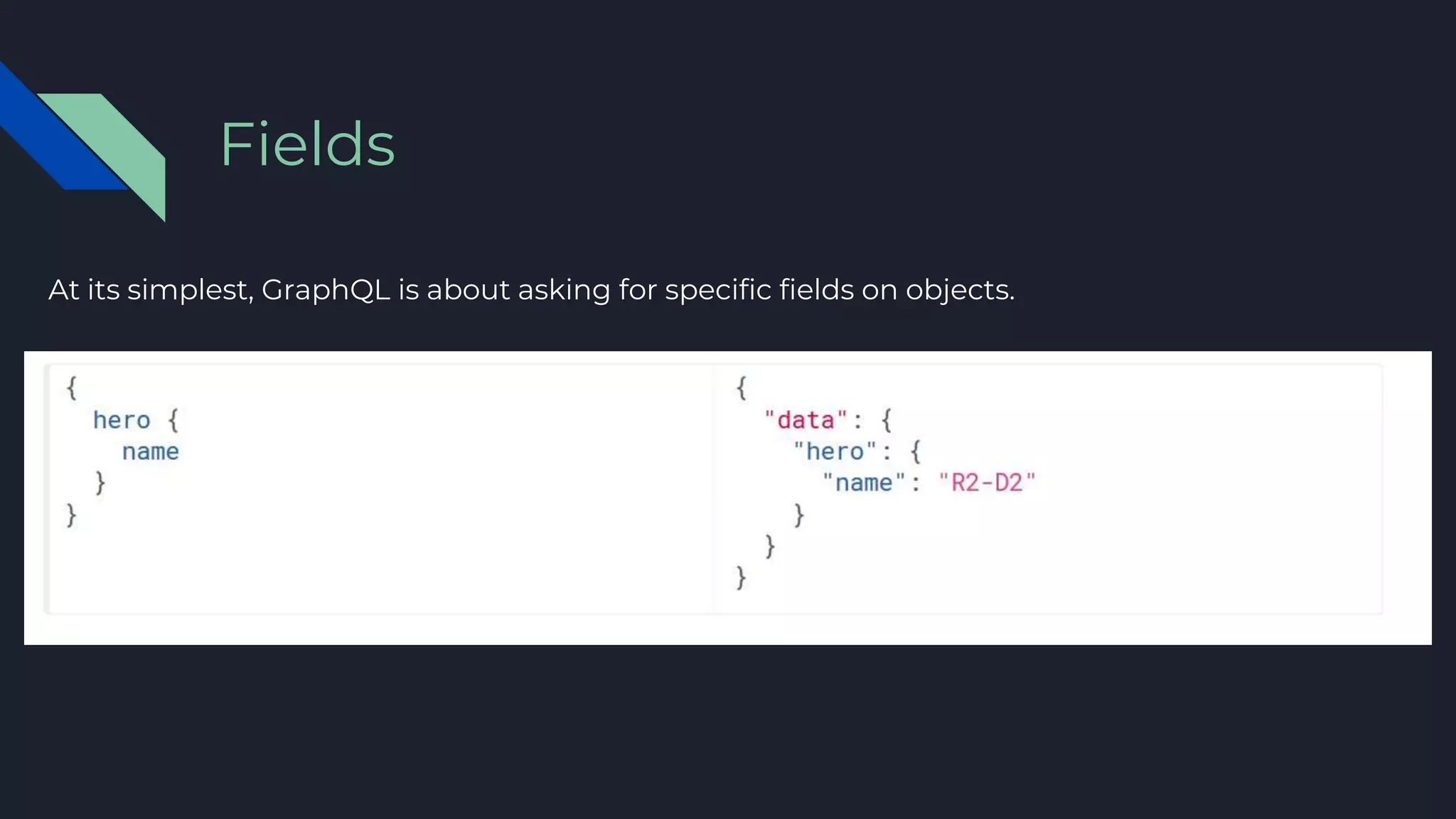
At its simplest, GraphQL is about asking for specific fields on objects.
Fields
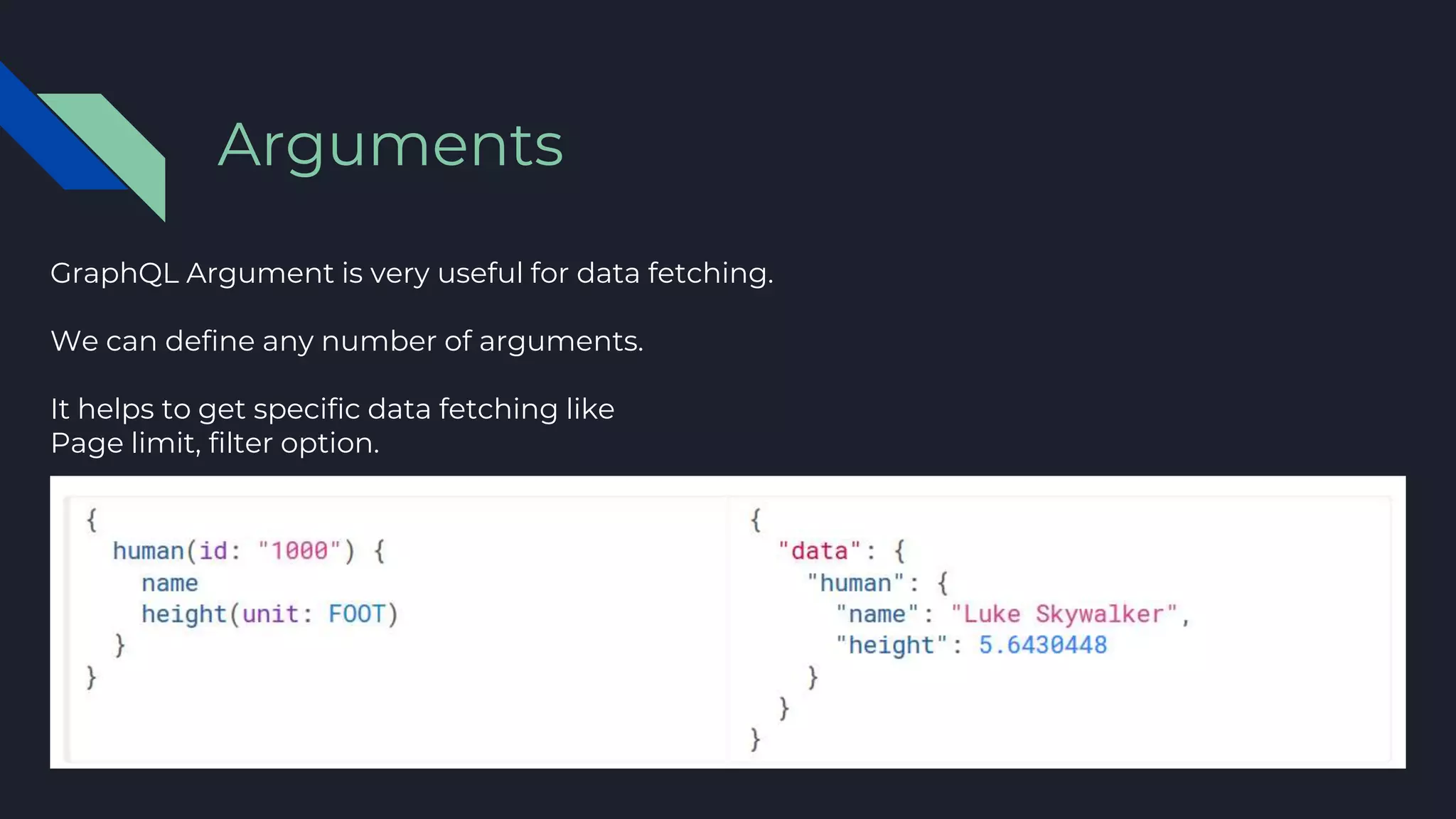
GraphQL Argument is very useful for data fetching.
We can define any number of arguments.
It helps to get specific data fetching like
Page limit, filter option.
Arguments
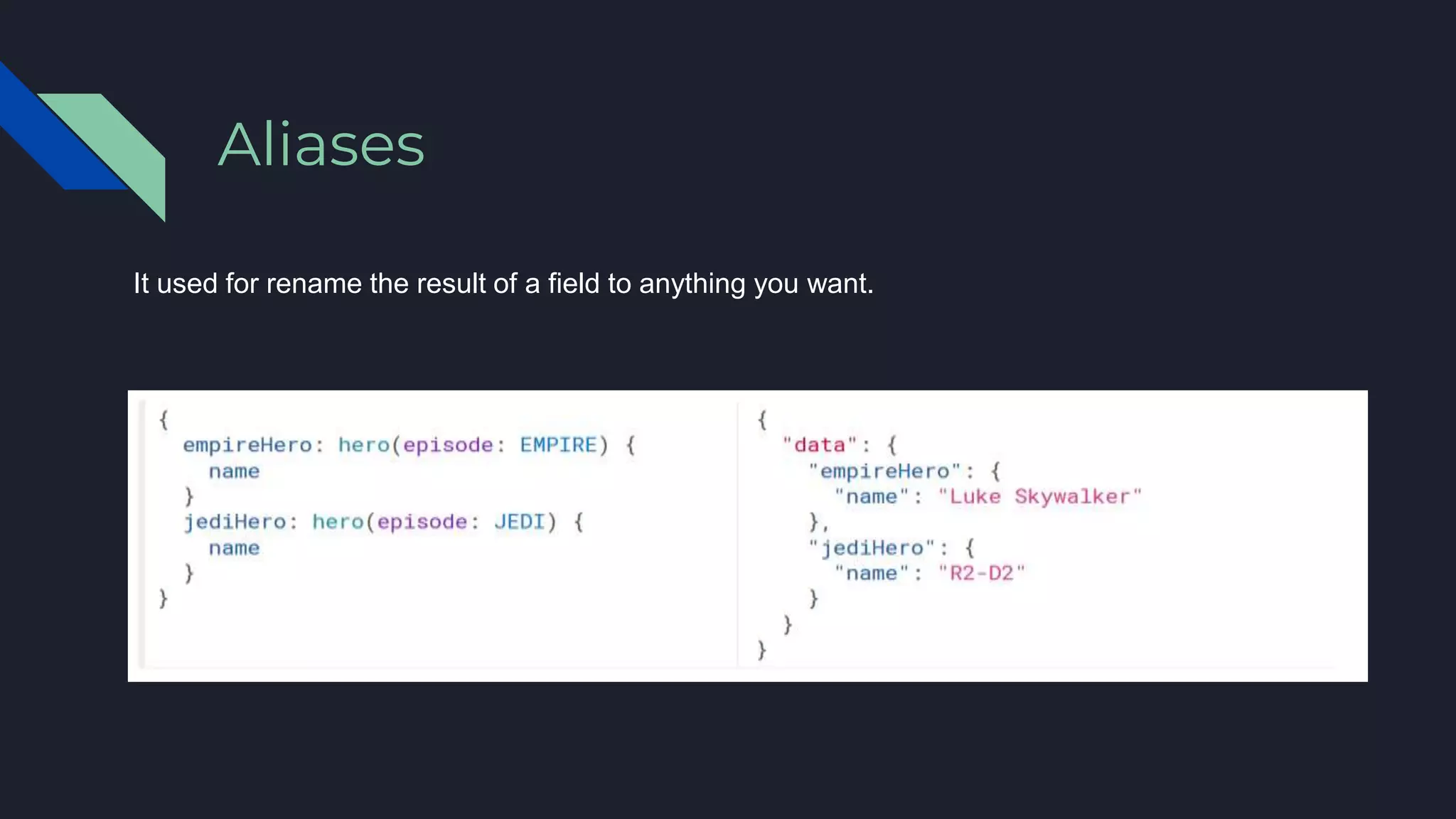
Aliases
It used for rename the result of a field to anything you want.
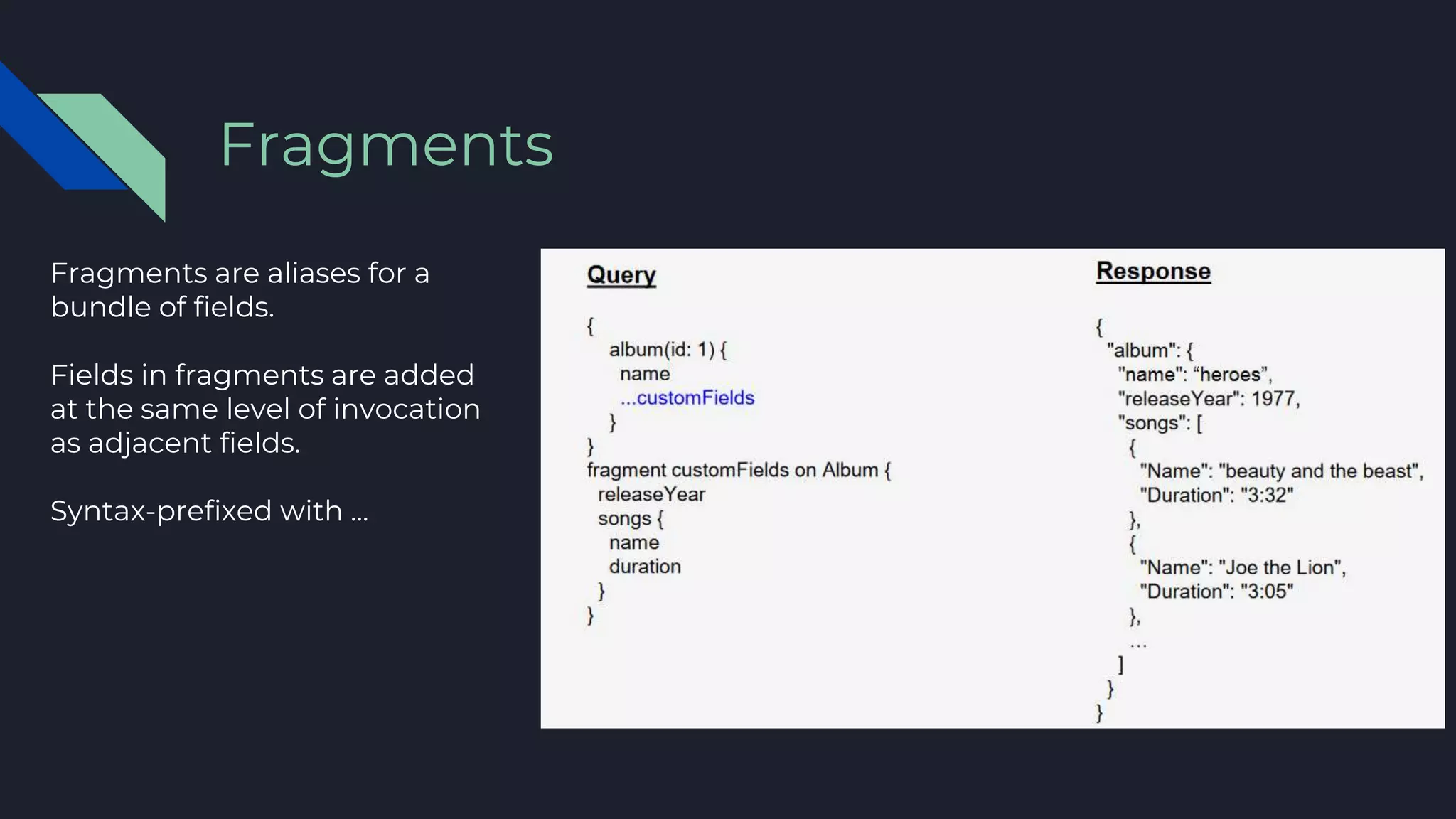
Fragments are aliases for a
bundle of fields.
Fields in fragments are added
at the same level of invocation
as adjacent fields.
Syntax-prefixed with ...
Fragments
Each object in the schema should be provided with a resolver.
The resolver is a piece of code that does the actual work -fetches the
results from the storage layer.
GraphQL server will take care of combining the objects and returning
only the selection set fields.
Resolver
GraphQL APIs are required to be self-documenting.
According to the specification, every GraphQL API needs to respond to queries about its own
structure.
This system is called introspection, and an introspection query starts with the __schema field
present on every GraphQL API that hasn’t intentionally disabled it.
Introspection
❏ PHP Sample Example
❏ Shopify
❏ Movies
Live Example
Further Reading
❏ https://github.com/chentsulin/awesome-graphql github repo
with many links to tutorials, libraries in various languages,
blogs, videos and more
❏ http://graphql.org/learn
❏ https://www.graphqlhub.com - playground on various public
GraphQL API. good place to learn the syntax
❏ https://www.howtographql.com/ - How to GraphQL
Question?
Thanks!
Try GraphQL,
You'll like it.

Introduction to GraphQL

  • 1.
    A Query Languagefor your API GraphQL Bhargav Anadkat Twitter @bhargavlalo
  • 2.
    WHAT TO EXPECTAHEAD... ❏ Introduction ❏ Start with Example ❏ REST Limitations ❏ Why choose GraphQL over REST? ❏ What is GraphQL? ❏ Who uses GraphQL? ❏ Language Supported ❏ Install & Configure in NodeJs ❏ Install & Configure in .Net/C# ❏ Install & Configure in PHP ❏ Understanding Tools ❏ Types & Schema ❏ Scalar Type ❏ Object Type ❏ Query Type ❏ Mutation Type ❏ Input Type ❏ Enum Type ❏ Syntax & Language ❏ Fields ❏ Arguments ❏ Aliases ❏ Fragments ❏ Resolver ❏ Introspection ❏ Live Example ❏ PHP Sample ❏ Shopify ❏ Movies ❏ Further reading ❏ Questions
  • 3.
    Let’s start withan Example You have an API for music albums and songs: Album: { “id” : 321 “artist”: “David Bowie”, “name”: “Aladdin Sane”, “releaseYear”: 1973, “songIDs”: [111,112,113,114,....], … } Song: { “id” : 116 “artist”: “David Bowie”, “name”: “Time”, “album” : “Aladdin Sane”, “duration”: “5:15”, “trackNumber”: 6, ... } And now you want to get all of an artist’s albums with their songs lists
  • 4.
    GET /artist/1 GET /album/321 GET/song/111 GET /song/112 … ... GET /song/120 GET /album/322 GET /song/211 GET /song/212 … ... GET /song/220 ... ❏ Requires many requests ❏ Each request returns much more data than you need ❏ Other option - ad-hoc API for album with songs ❏ But adding API per need might end up with way too many APIs ❏ And you’d still get more data than you need
  • 5.
    REST Limitations ❏ Resource-centric:many endpoints ❏ The endpoints are often organized the way they’re stored in DB, not the way they’re retrieved by clients ❏ Large and fixed responses ❏ Getting a complete response requires multiple requests ❏ We would like to get on a single request ❏ ALL the data that we need, from several resources ❏ ONLY the data that we need -no large responses with redundant fields
  • 6.
    Why choose GraphQLover REST? ❏ Single endpoint -easier to scale ❏ Tailored responses -client gets only what he wants ❏ Fewer round trips -can return several related resources together ❏ Backwards compatibility -the client decides the response structure, knows exactly what to expect ❏ Introspective -GraphQL has a native and highly extensible schema and type system
  • 7.
    GraphQL is amodern query language for the API. It allows the front-end developer, to write queries that have the exact data shape they want. GraphQL is developed by Facebook. GraphQL was developed internally by Facebook in 2012 It's open source version publicly released in 2015 and current stable version released in June 2018 GraphQL official website is https://graphql.org/ GraphQL official git repository is https://github.com/graphql/graphql-spec What is GraphQL?
  • 8.
  • 9.
    Language Supported byGraphQL ❏ C# / .NET ❏ Clojure ❏ Elixir ❏ Erlang ❏ Go ❏ Groovy ❏ Java ❏ JavaScript ❏ PHP ❏ Python ❏ Scala ❏ Ruby
  • 10.
    Node.JS NPM packageInstall npm init npm install graphql --save Install & Configure Node.JS
  • 11.
    .Net/C# GraphQL nuGetlibrary ❏ graphql-dotnet: GraphQL for .NET ❏ graphql-net: Convert GraphQL to IQueryable ❏ Hot Chocolate: GraphQL Server for .net core and .net classic Install & Configure in .Net/C#
  • 12.
    PHP Composer Library ❏graphql-php: A PHP port of GraphQL reference implementation ❏ graphql-relay-php: A library to help construct a graphql-php server supporting react-relay. Install & Configure in PHP
  • 13.
    GraphiQL Install NodeJs expressTool https://github.com/graphql/graphiql ChromeiQL Install Chrome Browser Extension https://chrome.google.com/webstore/detail/chromeiql/fkkiamalmpiidkljmicmjfbieiclmeij?hl= en GraphQL Playground Install EXE https://github.com/prisma/graphql-playground Understanding Tools
  • 14.
    Schema A GraphQL schemais at the center of any GraphQL server implementation and describes the functionality available to the clients which connect to it. Type GraphQL is a strongly typed language. Type System defines various data types that can be used in a GraphQL application. The type system helps to define the schema, which is a contract between client and server. Types & Schema List of Types ❏ Scalar Type ❏ Object Type ❏ Query Type ❏ Mutation Type ❏ Interface Type ❏ Union Type ❏ Enum Type ❏ Input Type
  • 15.
    Scalar types representprimitive leaf values in a GraphQL type system. GraphQL responses take the form of a hierarchical tree; the leaves on these trees are GraphQL scalars. Scalar Type Custom Scalars ❏ EmailAddress ❏ USCurrency ❏ PhoneNumber ❏ URL ❏ DateTime Built‐in Scalars ❏ Int ❏ Float ❏ String ❏ Boolean ❏ ID Syntax field: data_type
  • 16.
    The object typeis the most common type used in a schema and represents a group of fields. Each field inside an object type maps to another type, thereby allowing nested types. In other words, an object type is composed of multiple scalar types or object types. Object Type Syntax type object_type_name { field1: data_type field2:data_type .... fieldn:data_type }
  • 17.
    Entry point typeto other specific types A GraphQL query is used to read or fetch values. It is not mandatory to pass “query” word in each query Query Type Syntax 1 query query_name{ someField } Syntax 2 { someField }
  • 18.
    Mutation is alsoan entry point type It can be used to insert, update, or delete data. Mutation also has a returned value, just like query Mutation Type Syntax mutation{ someEditOperation(dataField:"val ueOfField"):returnType }
  • 19.
    In the GraphQLschema language, input types look exactly the same as regular object types, but with the keyword input instead of type: Mostly it is used with mutation type for data operation like add,edit and delete. Input Type Syntax Input object_input_name { field1: data_type field2:data_type .... fieldn:data_type }
  • 20.
    Also called Enums,enumeration types are a special kind of scalar that is restricted to a particular set of allowed values. It is used for fix data. For e.g weekdays, months, and measurements Units. Enum Type Syntax Enum object_enum_name { Data Data .... Data }
  • 21.
  • 22.
    At its simplest,GraphQL is about asking for specific fields on objects. Fields
  • 23.
    GraphQL Argument isvery useful for data fetching. We can define any number of arguments. It helps to get specific data fetching like Page limit, filter option. Arguments
  • 24.
    Aliases It used forrename the result of a field to anything you want.
  • 25.
    Fragments are aliasesfor a bundle of fields. Fields in fragments are added at the same level of invocation as adjacent fields. Syntax-prefixed with ... Fragments
  • 26.
    Each object inthe schema should be provided with a resolver. The resolver is a piece of code that does the actual work -fetches the results from the storage layer. GraphQL server will take care of combining the objects and returning only the selection set fields. Resolver
  • 27.
    GraphQL APIs arerequired to be self-documenting. According to the specification, every GraphQL API needs to respond to queries about its own structure. This system is called introspection, and an introspection query starts with the __schema field present on every GraphQL API that hasn’t intentionally disabled it. Introspection
  • 28.
    ❏ PHP SampleExample ❏ Shopify ❏ Movies Live Example
  • 29.
    Further Reading ❏ https://github.com/chentsulin/awesome-graphqlgithub repo with many links to tutorials, libraries in various languages, blogs, videos and more ❏ http://graphql.org/learn ❏ https://www.graphqlhub.com - playground on various public GraphQL API. good place to learn the syntax ❏ https://www.howtographql.com/ - How to GraphQL
  • 30.
  • 31.