AER 101 Introduction to Aeronautics Instructor : Prof. Dr. Galal Bahgat Salem Textbook : John D. Anderson, Jr, Introduction to Flight , 4 th  Edition , 2000 . Term Work : 25 +25 = 50 Marks Final Exam:  50 +50 = 100 Marks
AER 101 A Introduction to Aeronautics ( 2 + 1 ) History of Flight Nature of Aerodynamic Forces Airplane components and Configurations Scope of Aeronautical Engineering Fluid Properties and Characteristics Atmosphere Basic Aerodynamics : Kinematics, Continuity and Bernoulli’s Equations, Boundary Layer Concept, Skin Friction, Pressure Drag, Flow Separation, Streamlining
AER 101B Introduction to Aeronautics ( 2 + 1 ) Geometric and Aerodynamic Characteristics of Airfoils Dimensional Analysis and Aerodynamic Force Coefficients Elements of Airplane Performance: Drag-Speed Curve, Cruising Flight Performance, Climbing Performance, Gliding Performance Elements of Propulsion: Propellers, Piston Engines, Reaction Principle, Jet Engines, Rocket Motors Elements of Airplane Stability and Control
Chapter 1 History Of Flight What is Flight ? ■  Flight is a motion in air free from ground topography ■  It is a high-speed motion through a low-resistance ( low density ) medium which is air N.B.  Compare flight in air, having a density of 1.225 Kg/m 3 , with shipping in water of density 1000 Kg/m 3
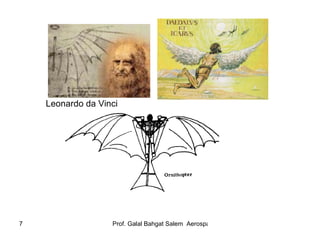
Short History of Flight 1.  Imitating Birds People attempting to fly by using artificial wings strapped to their arms and-or legs The flapping of wings generate lift The Greek myth of Daedalus and his son Icarus imprisoned on the island of Crete in the Mediterranean Sea illustrates man’s flight The idea of strapping a pair of wings to arms fell out of favor It was replaced by concept of wings flapped up and down by various mechanical devices,
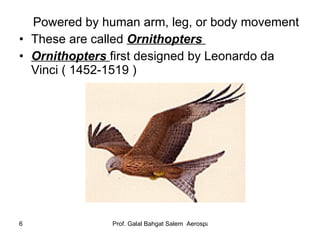
Powered by human arm, leg, or body movement These are called  Ornithopters  Ornithopters  first designed by Leonardo da Vinci ( 1452-1519 )
Leonardo da Vinci
Why Don’t Ornithopters Work?  G. A. Borelli (1680 ) realized the fact that ( power/weight) ratio of a man is much less than that of bird Hence man will never be able to fly like a bird, by his own power only 2. Lighter-than-Air Balloons[Unpowered Flight] ●  Firstly hot air balloons discovered by the Montgolfier Brothers in France (1783)
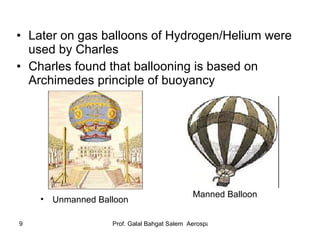
Later on gas balloons of Hydrogen/Helium were used by Charles Charles found that ballooning is based on Archimedes principle of buoyancy Unmanned Balloon Manned Balloon
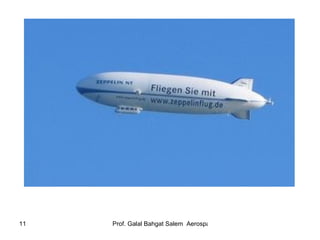
3. Lighter-than-Air Dirigibles (Airships)[Powered] ● Firstly invented by Count von Zeppelin in Germany (1900) ● They are more rigid (the first airframe) than balloons, controlled and directed (using stabilizing surfaces) and propeller droved  ● Large bags of gas inside the rigid airframe ● Count von Zeppelin (1929), flew around the world in 21 days ● Hydrogen fired in “Hindenburg” dirigible in 1937
 
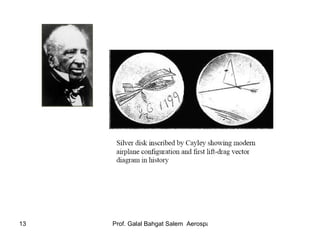
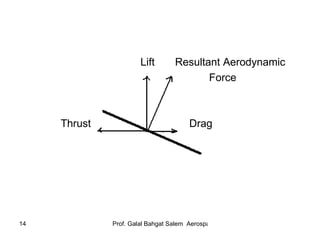
4.Sir George Cayley (1799)   ● First pioneered the concept for the modern airplane configuration in 1799 - Fixed wings, tail, fuselage - Separate mechanism for propulsion “ separation of lift and propulsion” ●   Recognized that the function of thrust was to overcome aerodynamic drag  ● Drew the first lift-drag vector diagram in the history N.B.  Before   this time flapping wings were supposed to provide both lift and propulsion
 
Lift Resultant Aerodynamic Force Drag Thrust
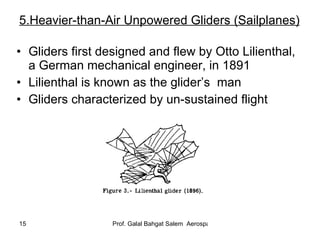
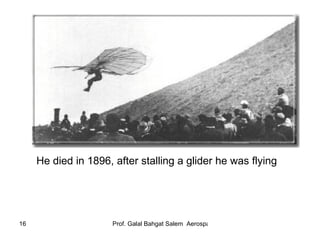
5.Heavier-than-Air Unpowered Gliders (Sailplanes) Gliders first designed and flew by Otto Lilienthal, a German mechanical engineer, in 1891 Lilienthal is known as the glider’s   man Gliders characterized by un-sustained flight
He died in 1896, after stalling a glider he was flying
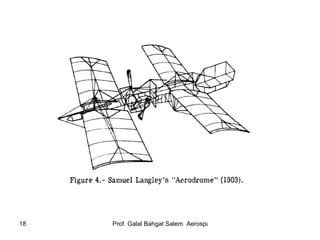
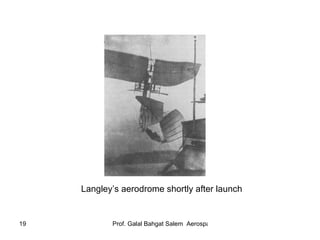
6.Heavier-than-Air Powered Airplanes Samuel P. Langley   was contracted to build a flying machine for the U.S. government Began a series of aerodynamic experiments in 1887 Successful in flying several small scale, unmanned, powered aircraft, which he called  aerodromes These were the first steam-powered, heavier-than-air   machines to successfully fly Langley’s attempt to build a manned aerodrome failed Lunched and crashed on Oct. 7 and December 8, 1903
 
Langley’s aerodrome shortly after launch
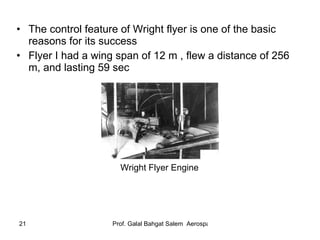
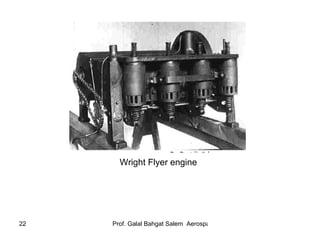
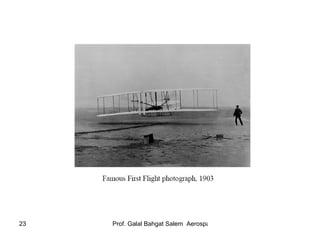
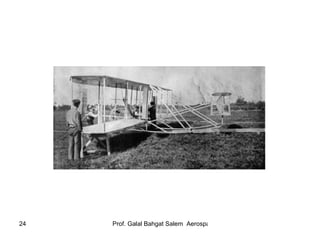
The Wright Brothers   Wright brothers (Orville&Wilbur) were the inventors of the first practical manned flight on 17 Dec.,1903 (Flyer I ) It was a strut-and-wire biplane configuration Propulsion was achieved by a four-cylinder in-line engine designed and built by Orville Wright It produced close to 12 hp and weighed 140 Ibs It drove two propellers via a bicycle-like chain loop
The control feature of Wright flyer is one of the basic reasons for its success Flyer I had a wing span of 12 m , flew a distance of 256 m, and lasting 59 sec Wright Flyer Engine
Wright Flyer engine


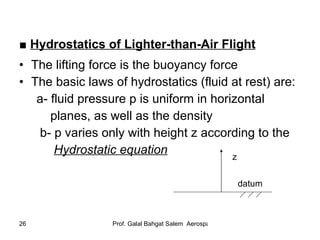
■  Hydrostatics of Lighter-than-Air Flight   The lifting force is the buoyancy force The basic laws of hydrostatics (fluid at rest) are: a- fluid pressure p is uniform in horizontal  planes, as well as the density b- p varies only with height z according to the  Hydrostatic equation   z datum
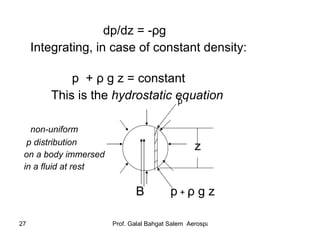
dp/dz = - ρ g Integrating, in case of constant density:  p  +  ρ  g z = constant This is the  hydrostatic equation   non-uniform p distribution on a body immersed in a fluid at rest p p  +  ρ  g z  z  B
The resultant fluid-pressure force is called the buoyancy force B, acting vertically upward, and equals to the weight of the displaced fluid B =  ρ  g V where  ρ   density of fluid g  acceleration of gravity V  volume of immersed body N.B. The basis of Heavier-than-air Flight will discussed later
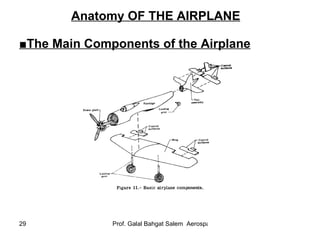
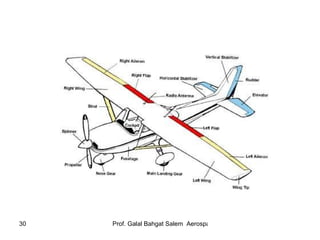
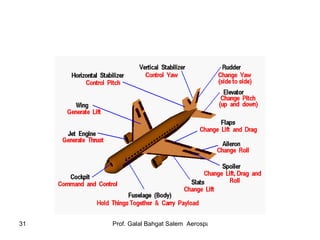
Anatomy OF THE AIRPLANE ■The Main Components of the Airplane
 
 
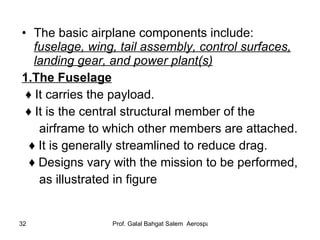
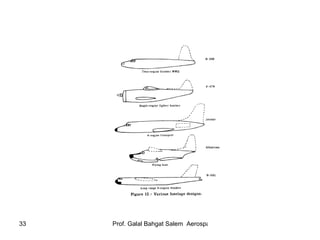
The basic airplane components include:  fuselage, wing, tail assembly, control surfaces, landing gear, and power plant(s) 1.The Fuselage   ♦  It carries the payload.  ♦  It is the central structural member of the  airframe to which other members are attached.  ♦  It is generally streamlined to reduce drag.  ♦  Designs vary with the mission to be performed,  as illustrated in figure
 
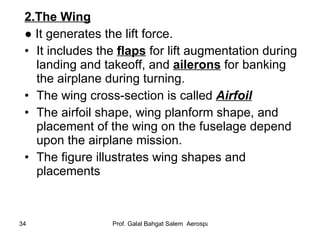
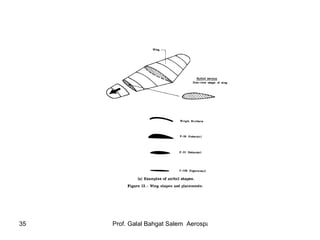
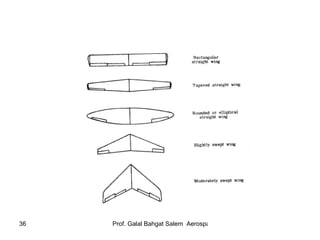
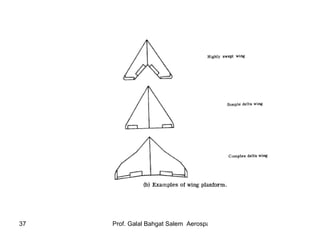
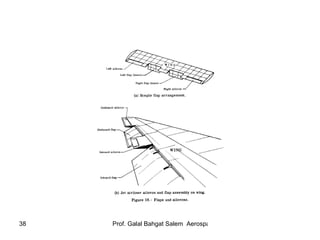
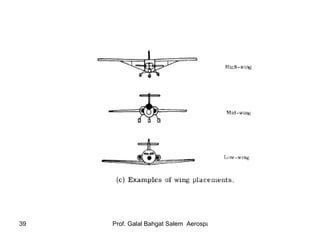
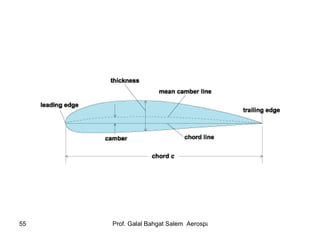
2.The Wing   ●  It generates the lift force.  It includes the  flaps  for lift augmentation during landing and takeoff, and  ailerons  for banking the airplane during turning. The wing cross-section is called  Airfoil The airfoil shape, wing planform shape, and placement of the wing on the fuselage depend upon the airplane mission. The figure illustrates wing shapes and placements


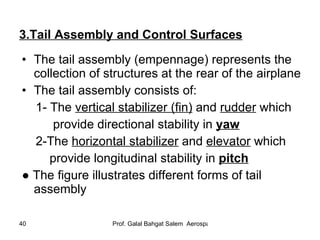
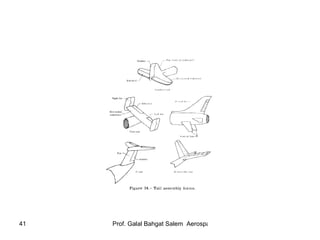
3.Tail Assembly and Control Surfaces The tail assembly (empennage) represents the collection of structures at the rear of the airplane The tail assembly consists of: 1- The  vertical stabilizer (fin)  and  rudder  which  provide directional stability in  yaw 2-The  horizontal stabilizer  and  elevator  which  provide longitudinal stability in  pitch ●  The figure illustrates different forms of tail assembly
 
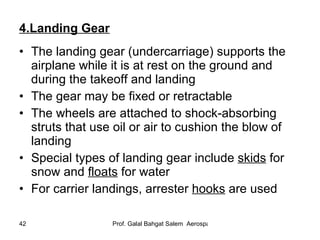
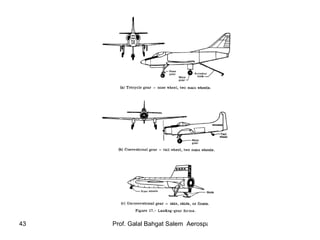
4.Landing Gear The landing gear (undercarriage) supports the airplane while it is at rest on the ground and during the takeoff and landing The gear may be fixed or retractable The wheels are attached to shock-absorbing struts that use oil or air to cushion the blow of landing Special types of landing gear include  skids  for snow and  floats  for water For carrier landings, arrester  hooks  are used
 
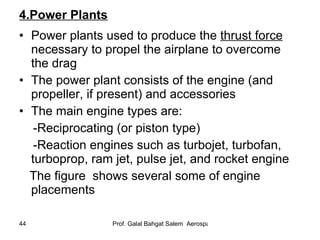
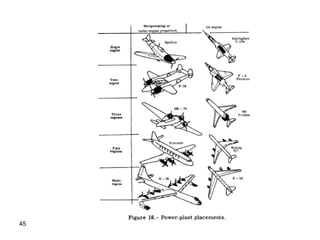
4.Power Plants Power plants used to produce the  thrust force  necessary to propel the airplane to overcome the drag The power plant consists of the engine (and propeller, if present) and accessories The main engine types are: -Reciprocating (or piston type) -Reaction engines such as turbojet, turbofan, turboprop, ram jet, pulse jet, and rocket engine The figure  shows several some of engine placements
 
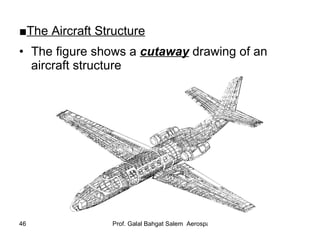
■ The Aircraft Structure The figure shows a  cutaway  drawing of an aircraft structure
Basic Elements of Aircraft Structure ■ The   wing
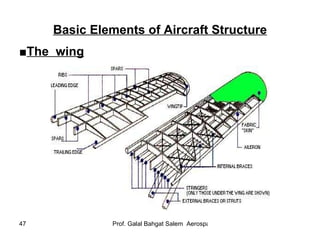
Wing   structure  basically same in all aircraft types  Modern aircrafts have all metal and composite material wings but many older had wood and fabric wings The wing is a framework composed of  spars ,  ribs  and (possibly)  stringers  (see figure) Spars are the main members of the wing. They extended lengthwise of the wing (crosswise of fuselage) Most wing structures have two spars, the front spar and the rear spar
Front spar near the leading edge, while the rear spar at about two-thirds the distance to the trailing edge The ribs are the parts of the wing which support the covering and provide the airfoil shape A skin covers the wing framework
■ The  Fuselage
 
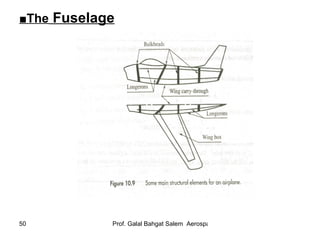
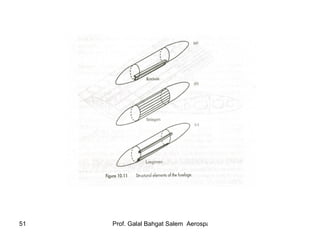
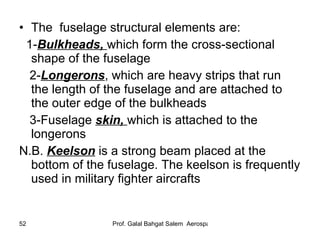
The   fuselage structural elements are:  1- Bulkheads,  which form the cross-sectional   shape of the fuselage 2- Longerons , which are heavy strips that run the length of the fuselage and are attached to the outer edge of the bulkheads 3-Fuselage  skin,  which is attached to the longerons N.B.  Keelson  is a strong beam placed at the bottom of the fuselage. The keelson is frequently used in military fighter aircrafts
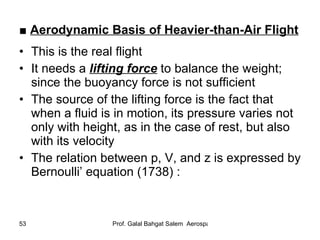
■  Aerodynamic Basis of Heavier-than-Air Flight This is the real flight It needs a  lifting force  to balance the weight; since the buoyancy force is not sufficient The source of the   lifting force is the fact that when a fluid is in motion, its pressure varies not only with height, as in the case of rest, but also with its velocity The relation between p, V, and z is expressed by Bernoulli’ equation (1738) :
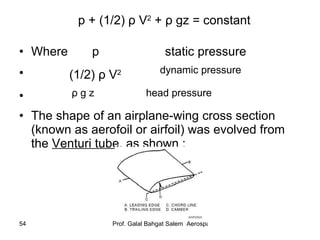
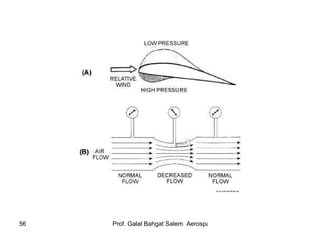
p + (1/2)  ρ  V 2  +  ρ  gz = constant Where  p  static pressure (1/2)  ρ  V 2  dynamic pressure ρ  g z  head pressure   The shape of an airplane-wing cross section (known as aerofoil or airfoil) was evolved from the  Venturi tube , as shown :


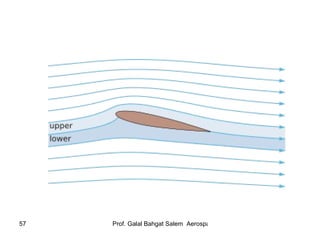
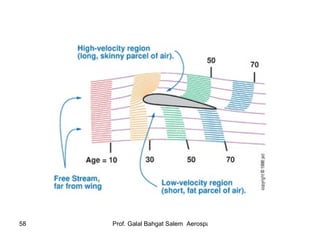
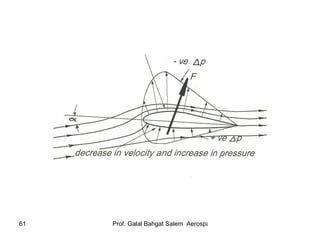
When a fluid flows over a body (or a surface), or when a body is forced to move through a fluid, the fluid velocity relative to the body surface may be  increased  or  decreased  (depending on surface shape and altitude) And consequently the fluid pressure p may  decrease  or  increase  according to  Bernoulli’s equation  The resultant will be a  net fluid force F  acting on the body which is completely different than the  Buoyancy force  (and may be many times greater than it)
 
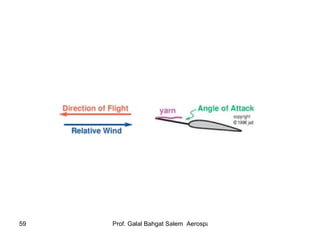
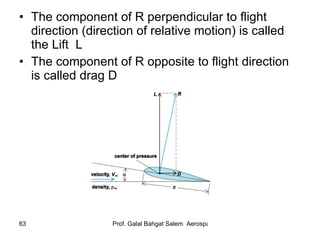
How does an Airplane fly? The key to the  generation of lift  is the specially-designed  streamlined body , called the  wing , and characterized by a special cross-section, called  airfoil When the wing is propelled through air at a suitable angle of attack, and with a relatively-high speed, the air flowing around its surface is accelerated and/or decelerated according to Bernoulli’s equation  The integration of the air-pressure distribution over the surface of the wing results in a resultant aerodynamic force F
The component of R perpendicular to flight direction (direction of relative motion) is called the Lift  L The component of R opposite to flight direction is called drag D
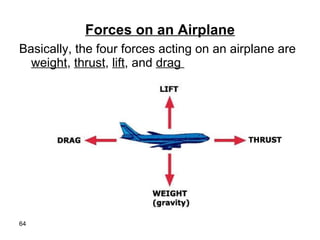
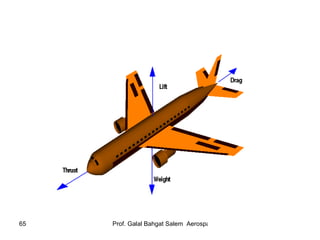
Forces on an Airplane Basically, the four forces acting on an airplane are  weight ,  thrust ,  lift , and  drag
 
Weight : The weight includes the airplane itself, the payload, and the fuel. Since the fuel is consumed as the airplane flies, the weight decreases.  Weight acts in a direction towards the center of the Earth. Thrust : The driving force of whatever propulsive system is used, engine driven propeller, jet engine, rocket engine, and so forth, is the thrust. It may be taken to act along the longitudinal axis of the airplane. Lift : This force is generated by the flow of air around the airplane, the major portion resulting from the wing. It represents the component of the resultant aerodynamic force normal to the flight direction.
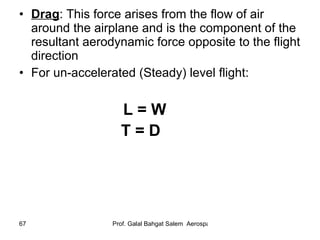
Drag : This force arises from the flow of air around the airplane and is the component of the resultant aerodynamic force opposite to the flight direction  For un-accelerated (Steady) level flight: L = W T = D
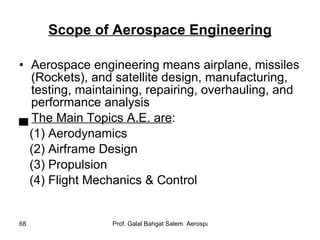
Scope of Aerospace Engineering Aerospace engineering means airplane, missiles (Rockets), and satellite design, manufacturing, testing, maintaining, repairing, overhauling, and performance analysis ▄  The Main Topics A.E. are : (1) Aerodynamics (2) Airframe Design (3) Propulsion (4) Flight Mechanics & Control
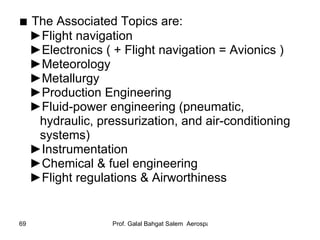
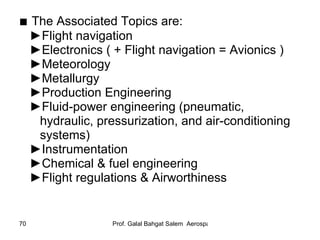
■  The Associated Topics are: ► Flight navigation ► Electronics ( + Flight navigation = Avionics ) ► Meteorology ► Metallurgy ► Production Engineering ► Fluid-power engineering (pneumatic,  hydraulic, pressurization, and air-conditioning  systems) ► Instrumentation ► Chemical & fuel engineering ► Flight regulations & Airworthiness
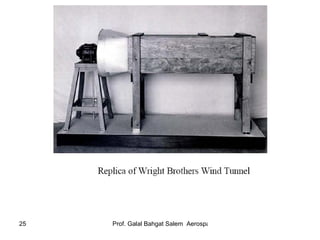
Aerodynamics ● Aerodynamic design of the flight vehicle/space vehicle for: ► Maximum lift production ► Minimum drag ► Max. available space for structure and payload ● Determination of the aerodynamic forces on the designed configuration at the different flight conditions (speed, attitude, and a altitude)  ●  Wind-tunnel testing ● Flight testing
Propulsion ● Power-plant design & construction for: ► Max. thrust/weight of engine ► Max. thrust/drag of engine ► Min. specific fuel consumption (sfc) ► Good performance at different altitudes and speeds of flight ● Power-plant manufacturing ● Power-plant testing
Airframe Design ● Structural analysis ● Airframe design & construction for: sufficient strength and with less weight ● Airframe manufacturing techniques ● Airframe testing techniques
Flight Mechanics & Control ● Stabilizing and control surfaces design ● Control surfaces operation and performance ● Aircraft stability analysis ● Maneuverability considerations ● Airplane systems and instrumentation

Introduction to flight 1

  • 1.
    AER 101 Introductionto Aeronautics Instructor : Prof. Dr. Galal Bahgat Salem Textbook : John D. Anderson, Jr, Introduction to Flight , 4 th Edition , 2000 . Term Work : 25 +25 = 50 Marks Final Exam: 50 +50 = 100 Marks
  • 2.
    AER 101 AIntroduction to Aeronautics ( 2 + 1 ) History of Flight Nature of Aerodynamic Forces Airplane components and Configurations Scope of Aeronautical Engineering Fluid Properties and Characteristics Atmosphere Basic Aerodynamics : Kinematics, Continuity and Bernoulli’s Equations, Boundary Layer Concept, Skin Friction, Pressure Drag, Flow Separation, Streamlining
  • 3.
    AER 101B Introductionto Aeronautics ( 2 + 1 ) Geometric and Aerodynamic Characteristics of Airfoils Dimensional Analysis and Aerodynamic Force Coefficients Elements of Airplane Performance: Drag-Speed Curve, Cruising Flight Performance, Climbing Performance, Gliding Performance Elements of Propulsion: Propellers, Piston Engines, Reaction Principle, Jet Engines, Rocket Motors Elements of Airplane Stability and Control
  • 4.
    Chapter 1 HistoryOf Flight What is Flight ? ■ Flight is a motion in air free from ground topography ■ It is a high-speed motion through a low-resistance ( low density ) medium which is air N.B. Compare flight in air, having a density of 1.225 Kg/m 3 , with shipping in water of density 1000 Kg/m 3
  • 5.
    Short History ofFlight 1. Imitating Birds People attempting to fly by using artificial wings strapped to their arms and-or legs The flapping of wings generate lift The Greek myth of Daedalus and his son Icarus imprisoned on the island of Crete in the Mediterranean Sea illustrates man’s flight The idea of strapping a pair of wings to arms fell out of favor It was replaced by concept of wings flapped up and down by various mechanical devices,
  • 6.
    Powered by humanarm, leg, or body movement These are called Ornithopters Ornithopters first designed by Leonardo da Vinci ( 1452-1519 )
  • 7.
  • 8.
    Why Don’t OrnithoptersWork? G. A. Borelli (1680 ) realized the fact that ( power/weight) ratio of a man is much less than that of bird Hence man will never be able to fly like a bird, by his own power only 2. Lighter-than-Air Balloons[Unpowered Flight] ● Firstly hot air balloons discovered by the Montgolfier Brothers in France (1783)
  • 9.
    Later on gasballoons of Hydrogen/Helium were used by Charles Charles found that ballooning is based on Archimedes principle of buoyancy Unmanned Balloon Manned Balloon
  • 10.
    3. Lighter-than-Air Dirigibles(Airships)[Powered] ● Firstly invented by Count von Zeppelin in Germany (1900) ● They are more rigid (the first airframe) than balloons, controlled and directed (using stabilizing surfaces) and propeller droved ● Large bags of gas inside the rigid airframe ● Count von Zeppelin (1929), flew around the world in 21 days ● Hydrogen fired in “Hindenburg” dirigible in 1937
  • 11.
  • 12.
    4.Sir George Cayley(1799) ● First pioneered the concept for the modern airplane configuration in 1799 - Fixed wings, tail, fuselage - Separate mechanism for propulsion “ separation of lift and propulsion” ● Recognized that the function of thrust was to overcome aerodynamic drag ● Drew the first lift-drag vector diagram in the history N.B. Before this time flapping wings were supposed to provide both lift and propulsion
  • 13.
  • 14.
    Lift Resultant AerodynamicForce Drag Thrust
  • 15.
    5.Heavier-than-Air Unpowered Gliders(Sailplanes) Gliders first designed and flew by Otto Lilienthal, a German mechanical engineer, in 1891 Lilienthal is known as the glider’s man Gliders characterized by un-sustained flight
  • 16.
    He died in1896, after stalling a glider he was flying
  • 17.
    6.Heavier-than-Air Powered AirplanesSamuel P. Langley was contracted to build a flying machine for the U.S. government Began a series of aerodynamic experiments in 1887 Successful in flying several small scale, unmanned, powered aircraft, which he called aerodromes These were the first steam-powered, heavier-than-air machines to successfully fly Langley’s attempt to build a manned aerodrome failed Lunched and crashed on Oct. 7 and December 8, 1903
  • 18.
  • 19.
  • 20.
    The Wright Brothers Wright brothers (Orville&Wilbur) were the inventors of the first practical manned flight on 17 Dec.,1903 (Flyer I ) It was a strut-and-wire biplane configuration Propulsion was achieved by a four-cylinder in-line engine designed and built by Orville Wright It produced close to 12 hp and weighed 140 Ibs It drove two propellers via a bicycle-like chain loop
  • 21.
    The control featureof Wright flyer is one of the basic reasons for its success Flyer I had a wing span of 12 m , flew a distance of 256 m, and lasting 59 sec Wright Flyer Engine
  • 22.
  • 23.
  • 24.
  • 25.
  • 26.
    ■ Hydrostaticsof Lighter-than-Air Flight The lifting force is the buoyancy force The basic laws of hydrostatics (fluid at rest) are: a- fluid pressure p is uniform in horizontal planes, as well as the density b- p varies only with height z according to the Hydrostatic equation z datum
  • 27.
    dp/dz = -ρ g Integrating, in case of constant density: p + ρ g z = constant This is the hydrostatic equation non-uniform p distribution on a body immersed in a fluid at rest p p + ρ g z z B
  • 28.
    The resultant fluid-pressureforce is called the buoyancy force B, acting vertically upward, and equals to the weight of the displaced fluid B = ρ g V where ρ density of fluid g acceleration of gravity V volume of immersed body N.B. The basis of Heavier-than-air Flight will discussed later
  • 29.
    Anatomy OF THEAIRPLANE ■The Main Components of the Airplane
  • 30.
  • 31.
  • 32.
    The basic airplanecomponents include: fuselage, wing, tail assembly, control surfaces, landing gear, and power plant(s) 1.The Fuselage ♦ It carries the payload. ♦ It is the central structural member of the airframe to which other members are attached. ♦ It is generally streamlined to reduce drag. ♦ Designs vary with the mission to be performed, as illustrated in figure
  • 33.
  • 34.
    2.The Wing ● It generates the lift force. It includes the flaps for lift augmentation during landing and takeoff, and ailerons for banking the airplane during turning. The wing cross-section is called Airfoil The airfoil shape, wing planform shape, and placement of the wing on the fuselage depend upon the airplane mission. The figure illustrates wing shapes and placements
  • 35.
  • 36.
  • 37.
  • 38.
  • 39.
  • 40.
    3.Tail Assembly andControl Surfaces The tail assembly (empennage) represents the collection of structures at the rear of the airplane The tail assembly consists of: 1- The vertical stabilizer (fin) and rudder which provide directional stability in yaw 2-The horizontal stabilizer and elevator which provide longitudinal stability in pitch ● The figure illustrates different forms of tail assembly
  • 41.
  • 42.
    4.Landing Gear Thelanding gear (undercarriage) supports the airplane while it is at rest on the ground and during the takeoff and landing The gear may be fixed or retractable The wheels are attached to shock-absorbing struts that use oil or air to cushion the blow of landing Special types of landing gear include skids for snow and floats for water For carrier landings, arrester hooks are used
  • 43.
  • 44.
    4.Power Plants Powerplants used to produce the thrust force necessary to propel the airplane to overcome the drag The power plant consists of the engine (and propeller, if present) and accessories The main engine types are: -Reciprocating (or piston type) -Reaction engines such as turbojet, turbofan, turboprop, ram jet, pulse jet, and rocket engine The figure shows several some of engine placements
  • 45.
  • 46.
    ■ The AircraftStructure The figure shows a cutaway drawing of an aircraft structure
  • 47.
    Basic Elements ofAircraft Structure ■ The wing
  • 48.
    Wing structure basically same in all aircraft types Modern aircrafts have all metal and composite material wings but many older had wood and fabric wings The wing is a framework composed of spars , ribs and (possibly) stringers (see figure) Spars are the main members of the wing. They extended lengthwise of the wing (crosswise of fuselage) Most wing structures have two spars, the front spar and the rear spar
  • 49.
    Front spar nearthe leading edge, while the rear spar at about two-thirds the distance to the trailing edge The ribs are the parts of the wing which support the covering and provide the airfoil shape A skin covers the wing framework
  • 50.
    ■ The Fuselage
  • 51.
  • 52.
    The fuselage structural elements are: 1- Bulkheads, which form the cross-sectional shape of the fuselage 2- Longerons , which are heavy strips that run the length of the fuselage and are attached to the outer edge of the bulkheads 3-Fuselage skin, which is attached to the longerons N.B. Keelson is a strong beam placed at the bottom of the fuselage. The keelson is frequently used in military fighter aircrafts
  • 53.
    ■ AerodynamicBasis of Heavier-than-Air Flight This is the real flight It needs a lifting force to balance the weight; since the buoyancy force is not sufficient The source of the lifting force is the fact that when a fluid is in motion, its pressure varies not only with height, as in the case of rest, but also with its velocity The relation between p, V, and z is expressed by Bernoulli’ equation (1738) :
  • 54.
    p + (1/2) ρ V 2 + ρ gz = constant Where p static pressure (1/2) ρ V 2 dynamic pressure ρ g z head pressure The shape of an airplane-wing cross section (known as aerofoil or airfoil) was evolved from the Venturi tube , as shown :
  • 55.
  • 56.
  • 57.
  • 58.
  • 59.
  • 60.
    When a fluidflows over a body (or a surface), or when a body is forced to move through a fluid, the fluid velocity relative to the body surface may be increased or decreased (depending on surface shape and altitude) And consequently the fluid pressure p may decrease or increase according to Bernoulli’s equation The resultant will be a net fluid force F acting on the body which is completely different than the Buoyancy force (and may be many times greater than it)
  • 61.
  • 62.
    How does anAirplane fly? The key to the generation of lift is the specially-designed streamlined body , called the wing , and characterized by a special cross-section, called airfoil When the wing is propelled through air at a suitable angle of attack, and with a relatively-high speed, the air flowing around its surface is accelerated and/or decelerated according to Bernoulli’s equation The integration of the air-pressure distribution over the surface of the wing results in a resultant aerodynamic force F
  • 63.
    The component ofR perpendicular to flight direction (direction of relative motion) is called the Lift L The component of R opposite to flight direction is called drag D
  • 64.
    Forces on anAirplane Basically, the four forces acting on an airplane are weight , thrust , lift , and drag
  • 65.
  • 66.
    Weight : Theweight includes the airplane itself, the payload, and the fuel. Since the fuel is consumed as the airplane flies, the weight decreases. Weight acts in a direction towards the center of the Earth. Thrust : The driving force of whatever propulsive system is used, engine driven propeller, jet engine, rocket engine, and so forth, is the thrust. It may be taken to act along the longitudinal axis of the airplane. Lift : This force is generated by the flow of air around the airplane, the major portion resulting from the wing. It represents the component of the resultant aerodynamic force normal to the flight direction.
  • 67.
    Drag : Thisforce arises from the flow of air around the airplane and is the component of the resultant aerodynamic force opposite to the flight direction For un-accelerated (Steady) level flight: L = W T = D
  • 68.
    Scope of AerospaceEngineering Aerospace engineering means airplane, missiles (Rockets), and satellite design, manufacturing, testing, maintaining, repairing, overhauling, and performance analysis ▄ The Main Topics A.E. are : (1) Aerodynamics (2) Airframe Design (3) Propulsion (4) Flight Mechanics & Control
  • 69.
    ■ TheAssociated Topics are: ► Flight navigation ► Electronics ( + Flight navigation = Avionics ) ► Meteorology ► Metallurgy ► Production Engineering ► Fluid-power engineering (pneumatic, hydraulic, pressurization, and air-conditioning systems) ► Instrumentation ► Chemical & fuel engineering ► Flight regulations & Airworthiness
  • 70.
    ■ TheAssociated Topics are: ► Flight navigation ► Electronics ( + Flight navigation = Avionics ) ► Meteorology ► Metallurgy ► Production Engineering ► Fluid-power engineering (pneumatic, hydraulic, pressurization, and air-conditioning systems) ► Instrumentation ► Chemical & fuel engineering ► Flight regulations & Airworthiness
  • 71.
    Aerodynamics ● Aerodynamicdesign of the flight vehicle/space vehicle for: ► Maximum lift production ► Minimum drag ► Max. available space for structure and payload ● Determination of the aerodynamic forces on the designed configuration at the different flight conditions (speed, attitude, and a altitude) ● Wind-tunnel testing ● Flight testing
  • 72.
    Propulsion ● Power-plantdesign & construction for: ► Max. thrust/weight of engine ► Max. thrust/drag of engine ► Min. specific fuel consumption (sfc) ► Good performance at different altitudes and speeds of flight ● Power-plant manufacturing ● Power-plant testing
  • 73.
    Airframe Design ●Structural analysis ● Airframe design & construction for: sufficient strength and with less weight ● Airframe manufacturing techniques ● Airframe testing techniques
  • 74.
    Flight Mechanics &Control ● Stabilizing and control surfaces design ● Control surfaces operation and performance ● Aircraft stability analysis ● Maneuverability considerations ● Airplane systems and instrumentation