Introduction to
Exercise Testing
DR ANWAR HASAN SIDDIQUI
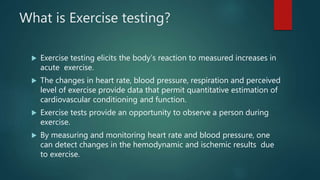
What is Exercise testing?
 Exercise testing elicits the body’s reaction to measured increases in
acute exercise.
 The changes in heart rate, blood pressure, respiration and perceived
level of exercise provide data that permit quantitative estimation of
cardiovascular conditioning and function.
 Exercise tests provide an opportunity to observe a person during
exercise.
 By measuring and monitoring heart rate and blood pressure, one
can detect changes in the hemodynamic and ischemic results due
to exercise.
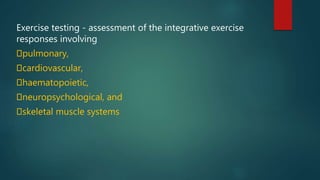
Exercise testing - assessment of the integrative exercise
responses involving
pulmonary,
cardiovascular,
haematopoietic,
neuropsychological, and
skeletal muscle systems
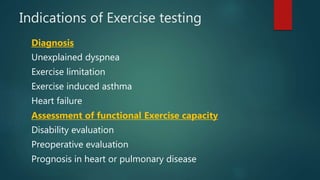
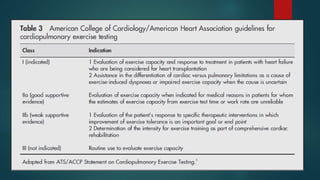
Indications of Exercise testing
Diagnosis
Unexplained dyspnea
Exercise limitation
Exercise induced asthma
Heart failure
Assessment of functional Exercise capacity
Disability evaluation
Preoperative evaluation
Prognosis in heart or pulmonary disease
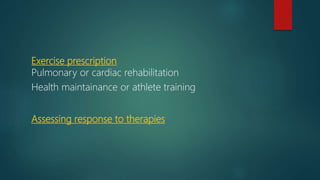
Exercise prescription
Pulmonary or cardiac rehabilitation
Health maintainance or athlete training
Assessing response to therapies
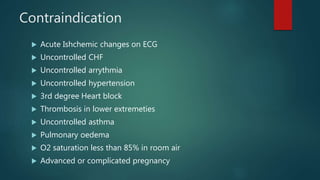
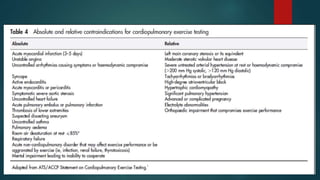
Contraindication
 Acute Ishchemic changes on ECG
 Uncontrolled CHF
 Uncontrolled arrythmia
 Uncontrolled hypertension
 3rd degree Heart block
 Thrombosis in lower extremeties
 Uncontrolled asthma
 Pulmonary oedema
 O2 saturation less than 85% in room air
 Advanced or complicated pregnancy
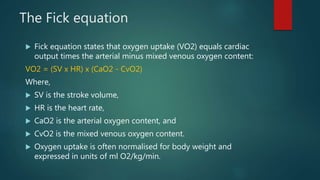
The Fick equation
 Fick equation states that oxygen uptake (VO2) equals cardiac
output times the arterial minus mixed venous oxygen content:
VO2 = (SV x HR) x (CaO2 - CvO2)
Where,
 SV is the stroke volume,
 HR is the heart rate,
 CaO2 is the arterial oxygen content, and
 CvO2 is the mixed venous oxygen content.
 Oxygen uptake is often normalised for body weight and
expressed in units of ml O2/kg/min.
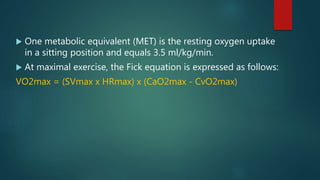
 One metabolic equivalent (MET) is the resting oxygen uptake
in a sitting position and equals 3.5 ml/kg/min.
 At maximal exercise, the Fick equation is expressed as follows:
VO2max = (SVmax x HRmax) x (CaO2max - CvO2max)
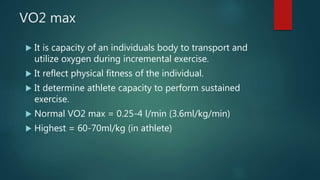
VO2 max
 It is capacity of an individuals body to transport and
utilize oxygen during incremental exercise.
 It reflect physical fitness of the individual.
 It determine athlete capacity to perform sustained
exercise.
 Normal VO2 max = 0.25-4 l/min (3.6ml/kg/min)
 Highest = 60-70ml/kg (in athlete)
Factor affecting VO2 max
 Genetic factors
 Age
 Gender
 Altitude
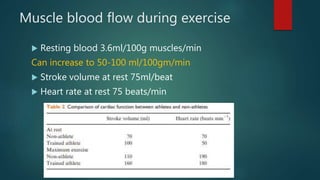
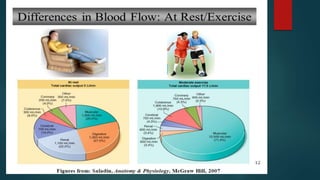
Muscle blood flow during exercise
 Resting blood 3.6ml/100g muscles/min
Can increase to 50-100 ml/100gm/min
 Stroke volume at rest 75ml/beat
 Heart rate at rest 75 beats/min
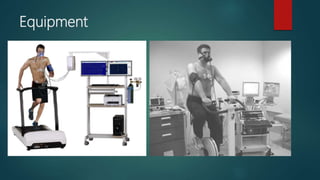
Equipment
Equipment for airflow and gas
measurement
Airflow or volume transducers
 Pneumotachograph
 Mass flow sensor
 Pitot tube flowmeter
 Turbine volume transducer
Gas Analyzer
 Mass spectrometer: measure O2, CO2, N2
 Separate analyzer for O2, CO2
Exercise Testing Protocols
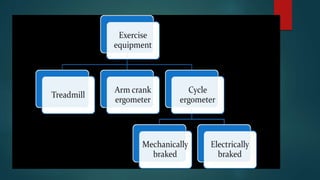
 Maximal incremental cycle ergometry protocols
 Maximal incremental treadmill protocols
 Constant work rate protocol
Maximal incremental cycle ergometry
protocols
IET protocol
 3 minutes of rest, then 3 minutes of unloaded pedalling then the
incremental phase of exercise every minute (5 to 25 W/minute) until the
patient reaches volitional exhaustion or the test is terminated by the
medical monitor
Ramp protocol
 increase the work rate continuously, usually every 1 to 2 seconds in a
ramplike fashion
Standardized exponential exercise protocol
 work rate is increased exponentially by 15% of the previous workload
every minute
Maximal incremental treadmill
protocols
Bruce protocol:
 the starting point (ie, stage 1) is 1.7 mph at a 10% grade (5
METs).
 Stage 2 is 2.5 mph at a 12% grade (7 METs).
 Stage 3 is 3.4 mph at a 14% grade (9 METs).
 This protocol includes 3-minute periods to allow achievement
of a steady state before workload is increased.
Modified Bruce protocol
 2 warm up stages, each lasting 3 minutes.
 The first is at 1.7 mph and a 0% grade,
 the second is at 1.7 mph and a 5% grade
Constant work rate protocol
 Treadmill or cycle ergometry exercise at levels
approximating the subject’s usual daily activities (e.g.,
up to 3.0 mph on a treadmill, or up to 50 W on a
cycle ergometer).
 This test should involve at least 6 minutes of
continuous exercise.
Introduction to exercise testing

Introduction to exercise testing

  • 1.
  • 2.
    What is Exercisetesting?  Exercise testing elicits the body’s reaction to measured increases in acute exercise.  The changes in heart rate, blood pressure, respiration and perceived level of exercise provide data that permit quantitative estimation of cardiovascular conditioning and function.  Exercise tests provide an opportunity to observe a person during exercise.  By measuring and monitoring heart rate and blood pressure, one can detect changes in the hemodynamic and ischemic results due to exercise.
  • 3.
    Exercise testing -assessment of the integrative exercise responses involving pulmonary, cardiovascular, haematopoietic, neuropsychological, and skeletal muscle systems
  • 4.
    Indications of Exercisetesting Diagnosis Unexplained dyspnea Exercise limitation Exercise induced asthma Heart failure Assessment of functional Exercise capacity Disability evaluation Preoperative evaluation Prognosis in heart or pulmonary disease
  • 5.
    Exercise prescription Pulmonary orcardiac rehabilitation Health maintainance or athlete training Assessing response to therapies
  • 7.
    Contraindication  Acute Ishchemicchanges on ECG  Uncontrolled CHF  Uncontrolled arrythmia  Uncontrolled hypertension  3rd degree Heart block  Thrombosis in lower extremeties  Uncontrolled asthma  Pulmonary oedema  O2 saturation less than 85% in room air  Advanced or complicated pregnancy
  • 10.
    The Fick equation Fick equation states that oxygen uptake (VO2) equals cardiac output times the arterial minus mixed venous oxygen content: VO2 = (SV x HR) x (CaO2 - CvO2) Where,  SV is the stroke volume,  HR is the heart rate,  CaO2 is the arterial oxygen content, and  CvO2 is the mixed venous oxygen content.  Oxygen uptake is often normalised for body weight and expressed in units of ml O2/kg/min.
  • 11.
     One metabolicequivalent (MET) is the resting oxygen uptake in a sitting position and equals 3.5 ml/kg/min.  At maximal exercise, the Fick equation is expressed as follows: VO2max = (SVmax x HRmax) x (CaO2max - CvO2max)
  • 12.
    VO2 max  Itis capacity of an individuals body to transport and utilize oxygen during incremental exercise.  It reflect physical fitness of the individual.  It determine athlete capacity to perform sustained exercise.  Normal VO2 max = 0.25-4 l/min (3.6ml/kg/min)  Highest = 60-70ml/kg (in athlete)
  • 13.
    Factor affecting VO2max  Genetic factors  Age  Gender  Altitude
  • 14.
    Muscle blood flowduring exercise  Resting blood 3.6ml/100g muscles/min Can increase to 50-100 ml/100gm/min  Stroke volume at rest 75ml/beat  Heart rate at rest 75 beats/min
  • 16.
  • 19.
    Equipment for airflowand gas measurement Airflow or volume transducers  Pneumotachograph  Mass flow sensor  Pitot tube flowmeter  Turbine volume transducer Gas Analyzer  Mass spectrometer: measure O2, CO2, N2  Separate analyzer for O2, CO2
  • 20.
    Exercise Testing Protocols Maximal incremental cycle ergometry protocols  Maximal incremental treadmill protocols  Constant work rate protocol
  • 21.
    Maximal incremental cycleergometry protocols IET protocol  3 minutes of rest, then 3 minutes of unloaded pedalling then the incremental phase of exercise every minute (5 to 25 W/minute) until the patient reaches volitional exhaustion or the test is terminated by the medical monitor Ramp protocol  increase the work rate continuously, usually every 1 to 2 seconds in a ramplike fashion Standardized exponential exercise protocol  work rate is increased exponentially by 15% of the previous workload every minute
  • 22.
    Maximal incremental treadmill protocols Bruceprotocol:  the starting point (ie, stage 1) is 1.7 mph at a 10% grade (5 METs).  Stage 2 is 2.5 mph at a 12% grade (7 METs).  Stage 3 is 3.4 mph at a 14% grade (9 METs).  This protocol includes 3-minute periods to allow achievement of a steady state before workload is increased. Modified Bruce protocol  2 warm up stages, each lasting 3 minutes.  The first is at 1.7 mph and a 0% grade,  the second is at 1.7 mph and a 5% grade
  • 23.
    Constant work rateprotocol  Treadmill or cycle ergometry exercise at levels approximating the subject’s usual daily activities (e.g., up to 3.0 mph on a treadmill, or up to 50 W on a cycle ergometer).  This test should involve at least 6 minutes of continuous exercise.