INTRODUCTION TO CONSTRUCTIVE
LEARNING &TEACHING THEORIES
• Constructivism is the theory that says learners
construct knowledge rather than just passively
take in information. As people experience the
world and reflect upon those experiences, they
build their own representations and incorporate
new information into their pre-existing
knowledge
• constructivism argues that you cannot directly
impart this information. Only an experience can
facilitate students to construct their own
knowledge. Therefore, the goal of teaching is to
design these experiences.
Consequences of constructivist theory
are that
• Students learn best when engaged in learning
experiences rather passively receiving
information.
• Learning is inherently a social process because it
is embedded within a social context as students
and teachers work together to build knowledge.
• Because knowledge cannot be directly imparted
to students, the goal of teaching is to provide
experiences that facilitate the construction of
knowledge
Examples of constructivist classroom activities
• Reciprocal teaching/learning
Allow pairs of students to teach each other.
• Inquiry-based learning (IBL)
Learners pose their own questions and seek
answers to their questions via research and direct
observation. They present their supporting
evidence to answer the questions. They draw
connections between their pre-existing
knowledge and the knowledge they’ve acquired
through the activity. Finally, they draw
conclusions, highlight remaining gaps in
knowledge and develop plans for future
investigations.
• Problem-based learning (PBL)
Learners acquire knowledge by devising a
solution to a problem. Activities provide
students with real-world problems that
require students to work together to devise a
solution. As the group works through the
challenging real-world problem, learners
acquire communication and collaboration
skills in addition to knowledge
• Cooperative learning
Students work together in small groups to
maximize their own and each other's learning.
Cooperative learning differs from typical group
work in that it requires interdependence
among group members to solve a problem or
complete an assignment.
OTHER TYPES OF LEARNING AND
TEACHING THEORIES
• PRAGETIAN AND VYGOTSKIAN LEARNING
EXPERIENCE
• BRUNNERS REFLECTIVE CLASS ROOM
TEACHING
• HUMANISTIC CONSTRUCTIVIST
PRAGETIAN & VYGOTSKIAN LEARNING
EXPERIENCE
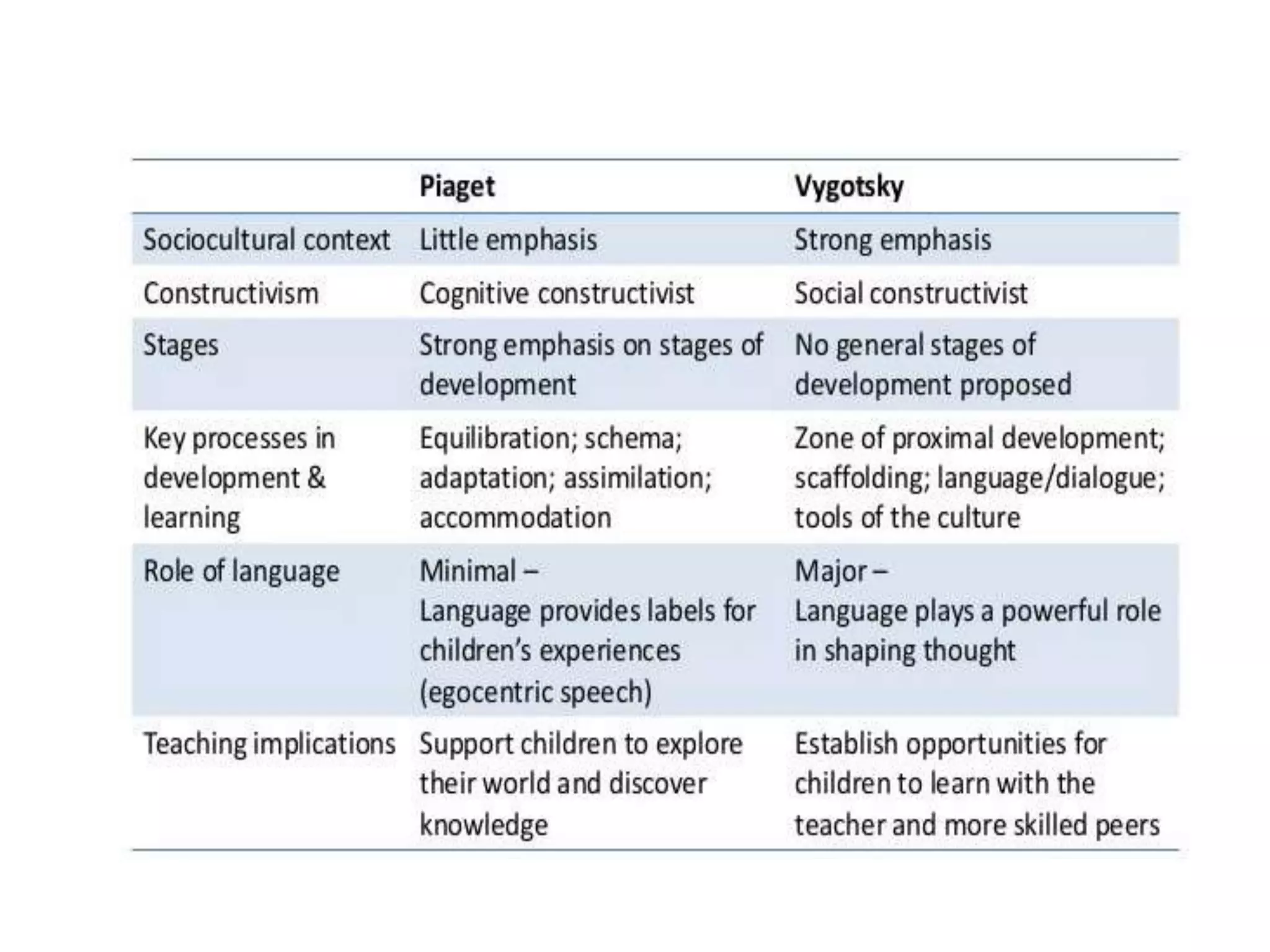
• Vygotsky's approach to child development is a
form of social constructivism, based on the
idea that cognitive functions are the products
of social interactions. Vygotsky emphasized
the collaborative nature of learning by the
construction of knowledge through social
negotiation.
• Vygotsky perceived the child as a social being
who is able to appropriate new patterns of
thinking when learning alongside more
advanced and competent
individuals (parents, teachers, older siblings
or peers). He called this concept, the Zone of
Proximal Development(ZPD)
Vygotsky believed that educators should help students learn within their ZPD so
that they can increase their skills and knowledge without becoming frustrated by
things that are currently too difficult for them to accomplish
According to this perspective teachers need to provide children,especially
young children, many opportunities to play. Through play, and imagination a
child's conceptual abilities are stretched. Vygotsky argued that play leads to
development
Vygotsky's social cultural theory asserts that learning is an essentially social
process in which the support of parents, caregivers, peers and the wider
society and culture plays a crucial role in the development of higher
psychological functions.
• He found that individual knowledge-based
tests are often an inaccurate way to measure a
young student's intelligence since children
need to interact with others who are more
intelligent than they currently are in order to
learn. He cited many examples of cultures
where young children are taught new skills
and knowledge passed down by older
generations.
• Vygotsky instead believed that the proper
way to test young students was to test their
ability to solve problems both independently and
with the help of an adult.
• Vygotsky scaffolding is a teaching method
that uses instructors and more advanced peers to
help students learn. The Vygotsky theory of
cognitive development states that students will
learn more when they receive guidance from
someone with more skills in the subject they're
learning than they would if they were tackling the
subject on their own.
PIAGETIAN LEARNING EXPERIENCE
• Piaget suggested the teacher's role
involved providing appropriate learning
experiences and materials that stimulate
students to advance their thinking. His theory
has influenced concepts of individual and
student-centred learning, formative
assessment, active learning, discovery
learning, and peer interaction.
• According to Piaget's Learning
Theory, learning is a process that only makes
sense in situations of change. Therefore,
learning is partly knowing how to adapt to
these changes. This theory explains the
dynamics of adaptation through the processes
of assimilation and accommodation.
• A Piaget influenced curricula, upholds the
belief that children need to explore, to
experiment, (and something close to my
heart), to question. It advocates that children
should be provided with opportunities to
discuss and debate with each other, with
teachers acting as guides and facilitators
Applying Piaget in the Classroom
• Use concrete props and visual aids whenever
possible.
• Make instructions relatively short, using
actions as well as words.
• Do not expect the students to consistently see
the world from someone else's point of view
BRUNNERS REFLECTIVE CLASSROOM
TEACHING
Bruner advocates that “a good teacher will
design lessons that help students discover the
relationship between bits of information. To do
this a teacher must give students the information
they need, but without organizing it for them.
Bruner believed that the most effective way to
develop a coding system is to discover it rather
than being told by the teacher. The concept of
discovery learning implies that students
construct their own knowledge for themselves
• He researched the cognitive development of
children and identified three stages of
representation namely
• The enactive stage
• The iconic stage,
• The symbolic representation stage.
• He believed that the intellectual development
of an individual should be the primary goal of
education instead of rote memorization.

INTRODUCTION TO CONSTRUCTIVE LEARNING &TEACHING THEORIES.pptx

  • 1.
  • 2.
    • Constructivism isthe theory that says learners construct knowledge rather than just passively take in information. As people experience the world and reflect upon those experiences, they build their own representations and incorporate new information into their pre-existing knowledge • constructivism argues that you cannot directly impart this information. Only an experience can facilitate students to construct their own knowledge. Therefore, the goal of teaching is to design these experiences.
  • 3.
    Consequences of constructivisttheory are that • Students learn best when engaged in learning experiences rather passively receiving information. • Learning is inherently a social process because it is embedded within a social context as students and teachers work together to build knowledge. • Because knowledge cannot be directly imparted to students, the goal of teaching is to provide experiences that facilitate the construction of knowledge
  • 4.
    Examples of constructivistclassroom activities • Reciprocal teaching/learning Allow pairs of students to teach each other.
  • 5.
    • Inquiry-based learning(IBL) Learners pose their own questions and seek answers to their questions via research and direct observation. They present their supporting evidence to answer the questions. They draw connections between their pre-existing knowledge and the knowledge they’ve acquired through the activity. Finally, they draw conclusions, highlight remaining gaps in knowledge and develop plans for future investigations.
  • 6.
    • Problem-based learning(PBL) Learners acquire knowledge by devising a solution to a problem. Activities provide students with real-world problems that require students to work together to devise a solution. As the group works through the challenging real-world problem, learners acquire communication and collaboration skills in addition to knowledge
  • 7.
    • Cooperative learning Studentswork together in small groups to maximize their own and each other's learning. Cooperative learning differs from typical group work in that it requires interdependence among group members to solve a problem or complete an assignment.
  • 8.
    OTHER TYPES OFLEARNING AND TEACHING THEORIES • PRAGETIAN AND VYGOTSKIAN LEARNING EXPERIENCE • BRUNNERS REFLECTIVE CLASS ROOM TEACHING • HUMANISTIC CONSTRUCTIVIST
  • 9.
    PRAGETIAN & VYGOTSKIANLEARNING EXPERIENCE • Vygotsky's approach to child development is a form of social constructivism, based on the idea that cognitive functions are the products of social interactions. Vygotsky emphasized the collaborative nature of learning by the construction of knowledge through social negotiation.
  • 10.
    • Vygotsky perceivedthe child as a social being who is able to appropriate new patterns of thinking when learning alongside more advanced and competent individuals (parents, teachers, older siblings or peers). He called this concept, the Zone of Proximal Development(ZPD)
  • 11.
    Vygotsky believed thateducators should help students learn within their ZPD so that they can increase their skills and knowledge without becoming frustrated by things that are currently too difficult for them to accomplish According to this perspective teachers need to provide children,especially young children, many opportunities to play. Through play, and imagination a child's conceptual abilities are stretched. Vygotsky argued that play leads to development Vygotsky's social cultural theory asserts that learning is an essentially social process in which the support of parents, caregivers, peers and the wider society and culture plays a crucial role in the development of higher psychological functions.
  • 12.
    • He foundthat individual knowledge-based tests are often an inaccurate way to measure a young student's intelligence since children need to interact with others who are more intelligent than they currently are in order to learn. He cited many examples of cultures where young children are taught new skills and knowledge passed down by older generations.
  • 13.
    • Vygotsky insteadbelieved that the proper way to test young students was to test their ability to solve problems both independently and with the help of an adult. • Vygotsky scaffolding is a teaching method that uses instructors and more advanced peers to help students learn. The Vygotsky theory of cognitive development states that students will learn more when they receive guidance from someone with more skills in the subject they're learning than they would if they were tackling the subject on their own.
  • 14.
    PIAGETIAN LEARNING EXPERIENCE •Piaget suggested the teacher's role involved providing appropriate learning experiences and materials that stimulate students to advance their thinking. His theory has influenced concepts of individual and student-centred learning, formative assessment, active learning, discovery learning, and peer interaction.
  • 15.
    • According toPiaget's Learning Theory, learning is a process that only makes sense in situations of change. Therefore, learning is partly knowing how to adapt to these changes. This theory explains the dynamics of adaptation through the processes of assimilation and accommodation.
  • 16.
    • A Piagetinfluenced curricula, upholds the belief that children need to explore, to experiment, (and something close to my heart), to question. It advocates that children should be provided with opportunities to discuss and debate with each other, with teachers acting as guides and facilitators
  • 17.
    Applying Piaget inthe Classroom • Use concrete props and visual aids whenever possible. • Make instructions relatively short, using actions as well as words. • Do not expect the students to consistently see the world from someone else's point of view
  • 19.
    BRUNNERS REFLECTIVE CLASSROOM TEACHING Bruneradvocates that “a good teacher will design lessons that help students discover the relationship between bits of information. To do this a teacher must give students the information they need, but without organizing it for them. Bruner believed that the most effective way to develop a coding system is to discover it rather than being told by the teacher. The concept of discovery learning implies that students construct their own knowledge for themselves
  • 20.
    • He researchedthe cognitive development of children and identified three stages of representation namely • The enactive stage • The iconic stage, • The symbolic representation stage. • He believed that the intellectual development of an individual should be the primary goal of education instead of rote memorization.