Cassandra
Replication & Consistency

  Benjamin Black, b@b3k.us
        2010-04-28
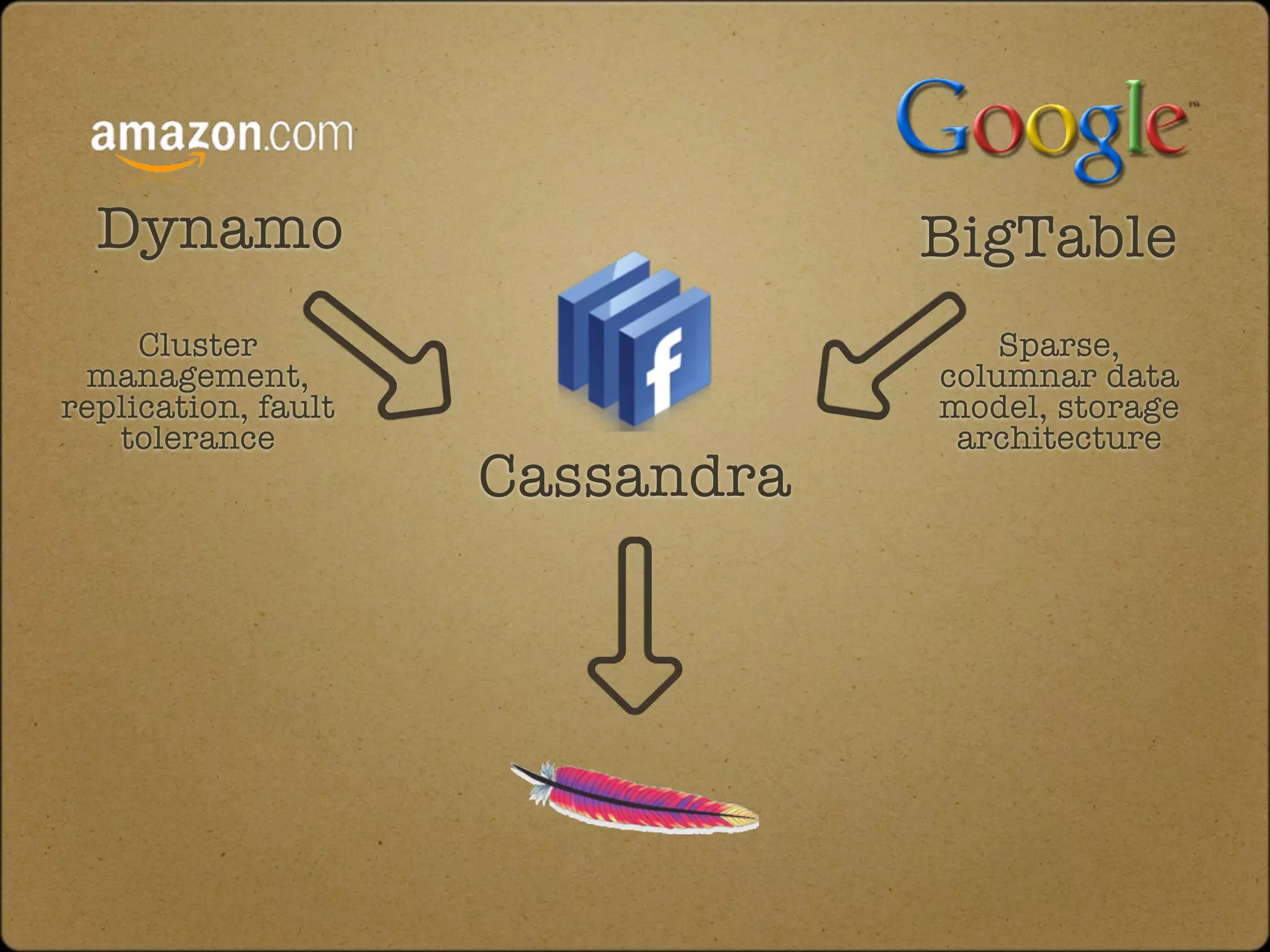
Dynamo                         BigTable
     Cluster                         Sparse,
 management,                     columnar data
replication, fault               model, storage
   tolerance                      architecture
                     Cassandra
Dynamo-like
 Features
Symmetric, P2P architecture
 No special nodes/SPOFs
Gossip-based cluster management
Distributed hash table for data
placement
 Pluggable partitioning
 Pluggable topology discovery
 Pluggable placement strategies
Tunable, eventual consistency
BigTable-like
  Features
Sparse, “columnar” data model
 Optional, 2-level maps called
 Super Column Families
SSTable disk storage
 Append-only commit log
 Memtable (buffer and sort)
 Immutable SSTable files
Hadoop integration
Topic(s) for Today

    Replication
         &
    Consistency
[1]
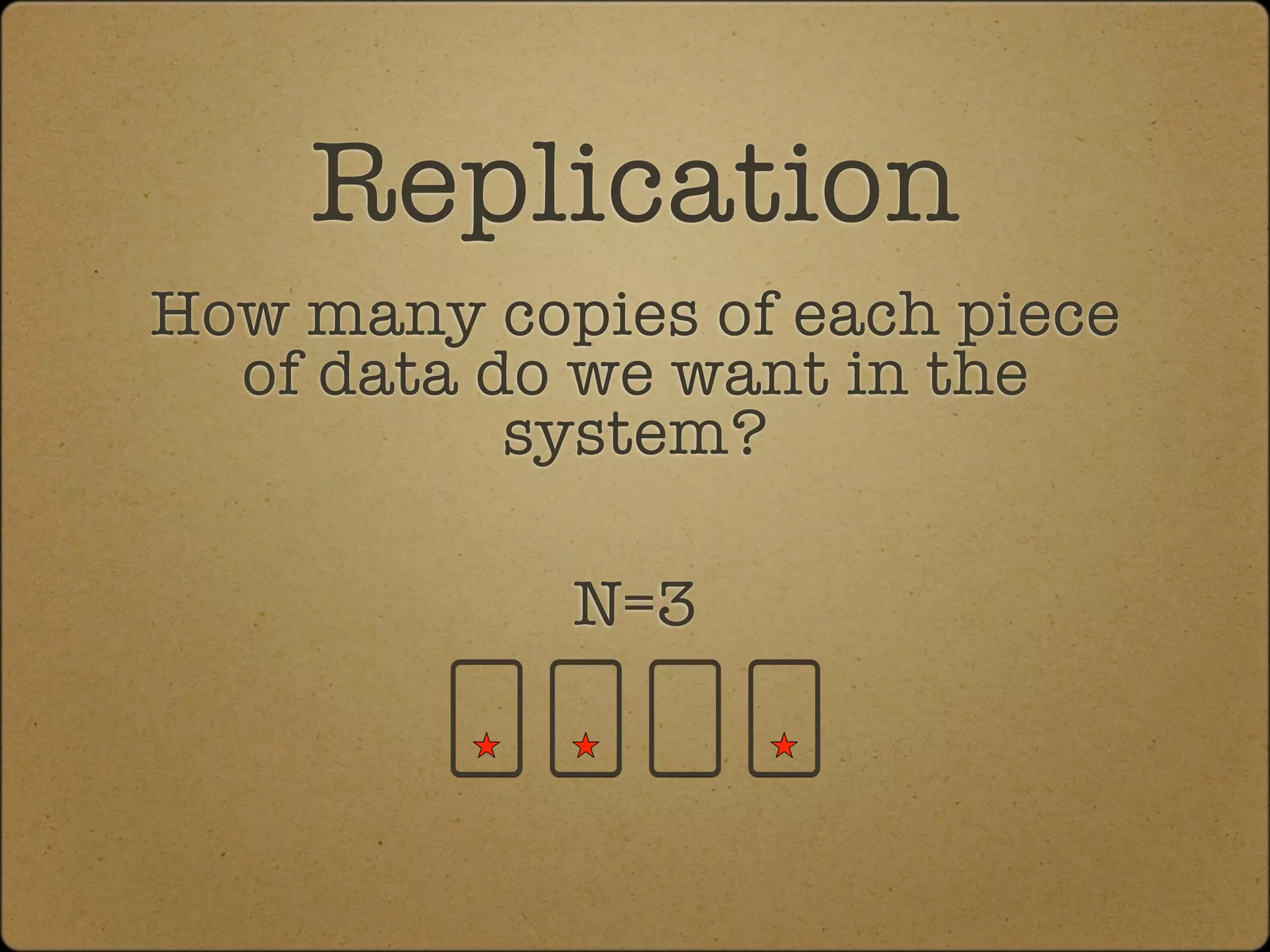
Replication
How many copies of each piece
  of data do we want in the
           system?

            N=3
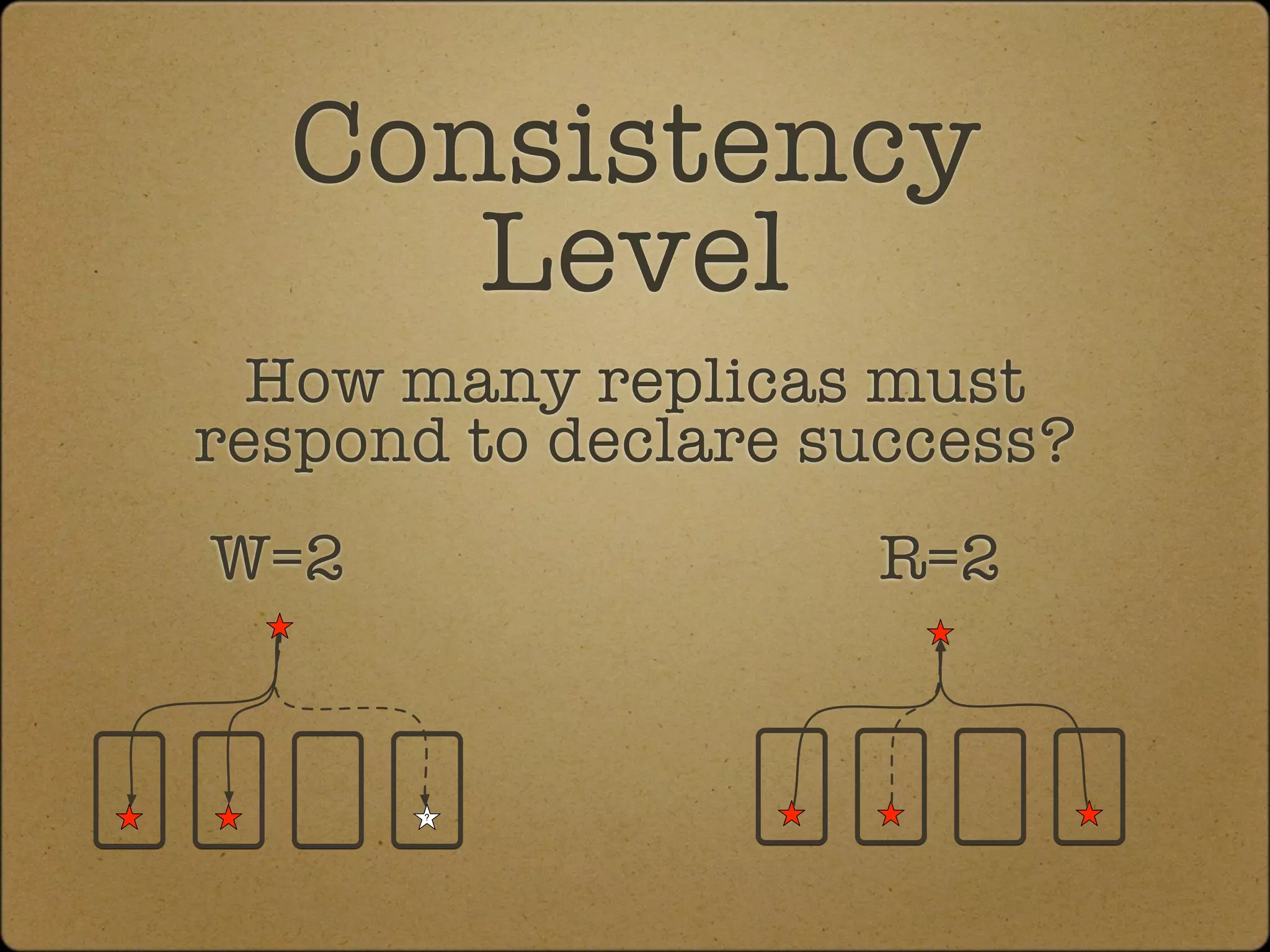
Consistency
     Level
  How many replicas must
respond to declare success?
W=2                 R=2


       ?
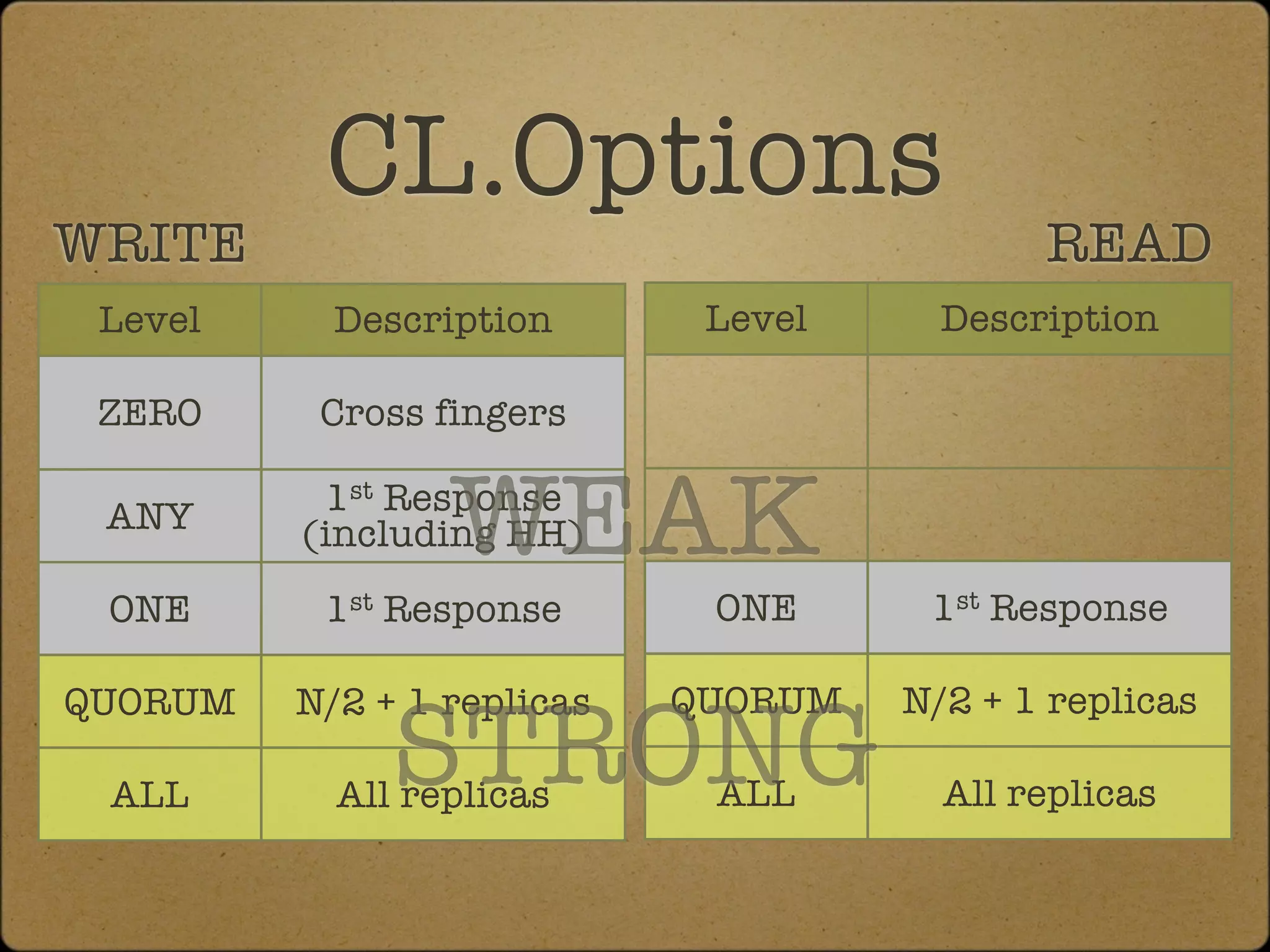
CL.Options
WRITE                                       READ
 Level     Description       Level     Description

 ZERO     Cross fingers

 ANY
                 WEAK
          1st Response
         (including HH)
 ONE      1st Response       ONE      1st Response


              STRONG
QUORUM   N/2 + 1 replicas   QUORUM   N/2 + 1 replicas

 ALL       All replicas      ALL       All replicas
A Side Note on
      CL
        Consistency
        Level is based
        on Replication
        Factor (N), not
        on the number
        of nodes in the
        system.
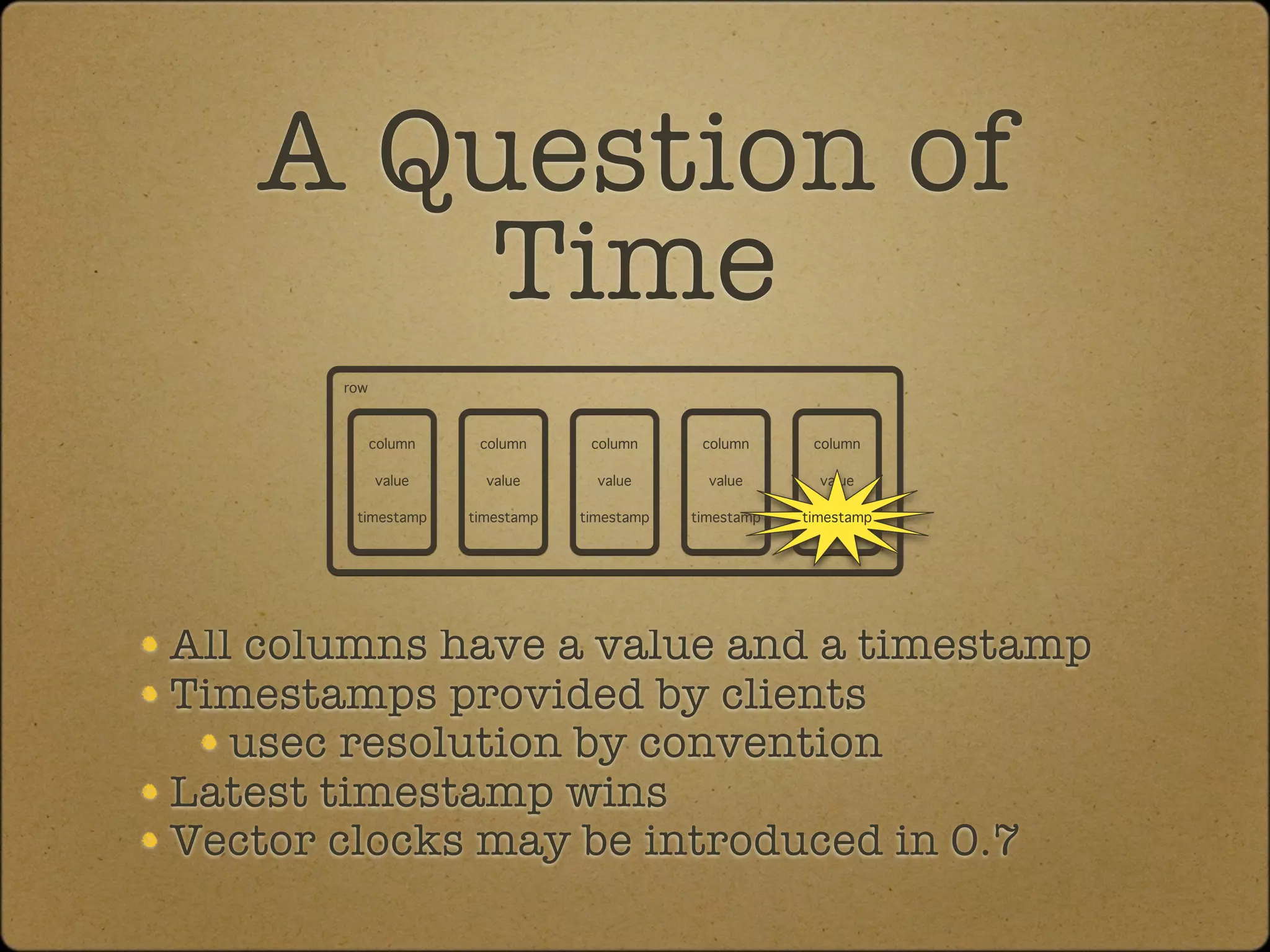
A Question of
       Time
       row


             column    column      column      column      column

             value      value       value       value       value

        timestamp     timestamp   timestamp   timestamp   timestamp


All columns have a value and a timestamp
Timestamps provided by clients
   usec resolution by convention
Latest timestamp wins
Vector clocks may be introduced in 0.7
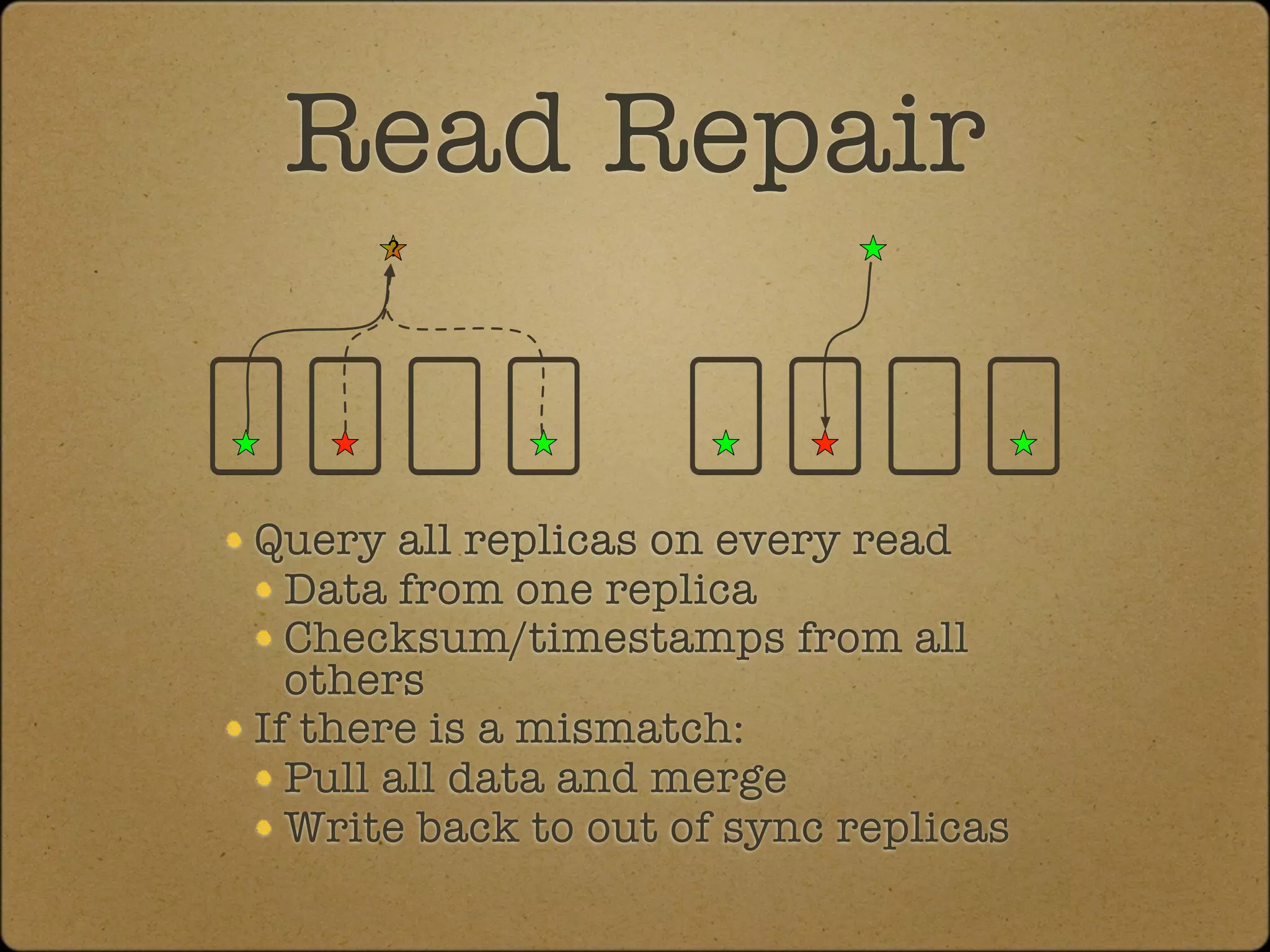
Read Repair
      ?


Query all replicas on every read
  Data from one replica
  Checksum/timestamps from all
  others
If there is a mismatch:
  Pull all data and merge
  Write back to out of sync replicas
Weak vs. Strong
Weak Consistency
(reads)Perform repair after
returning results

      Strong Consistency (reads)
    Perform repair before returning
                             results
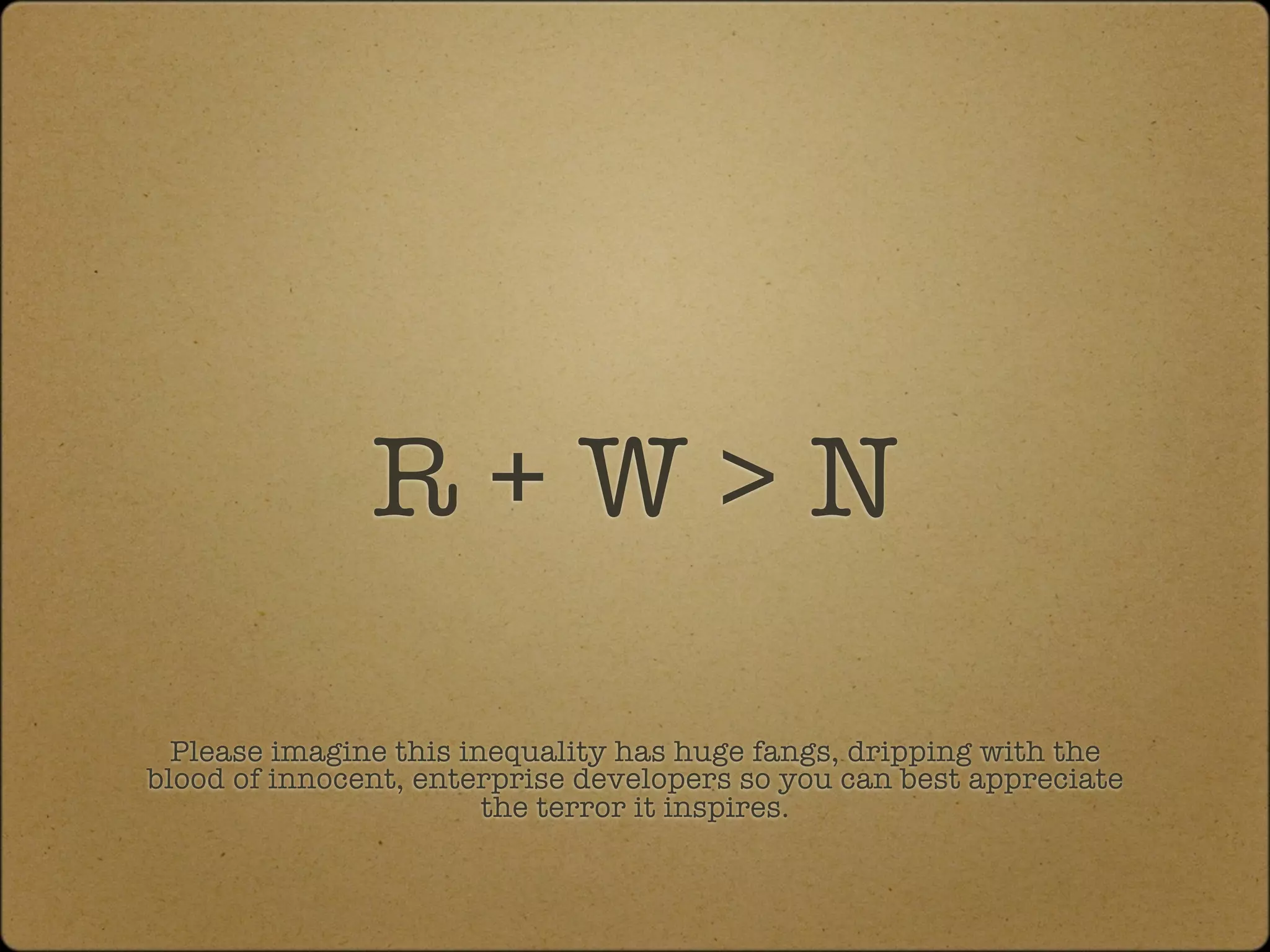
R+W>N

  Please imagine this inequality has huge fangs, dripping with the
blood of innocent, enterprise developers so you can best appreciate
                        the terror it inspires.
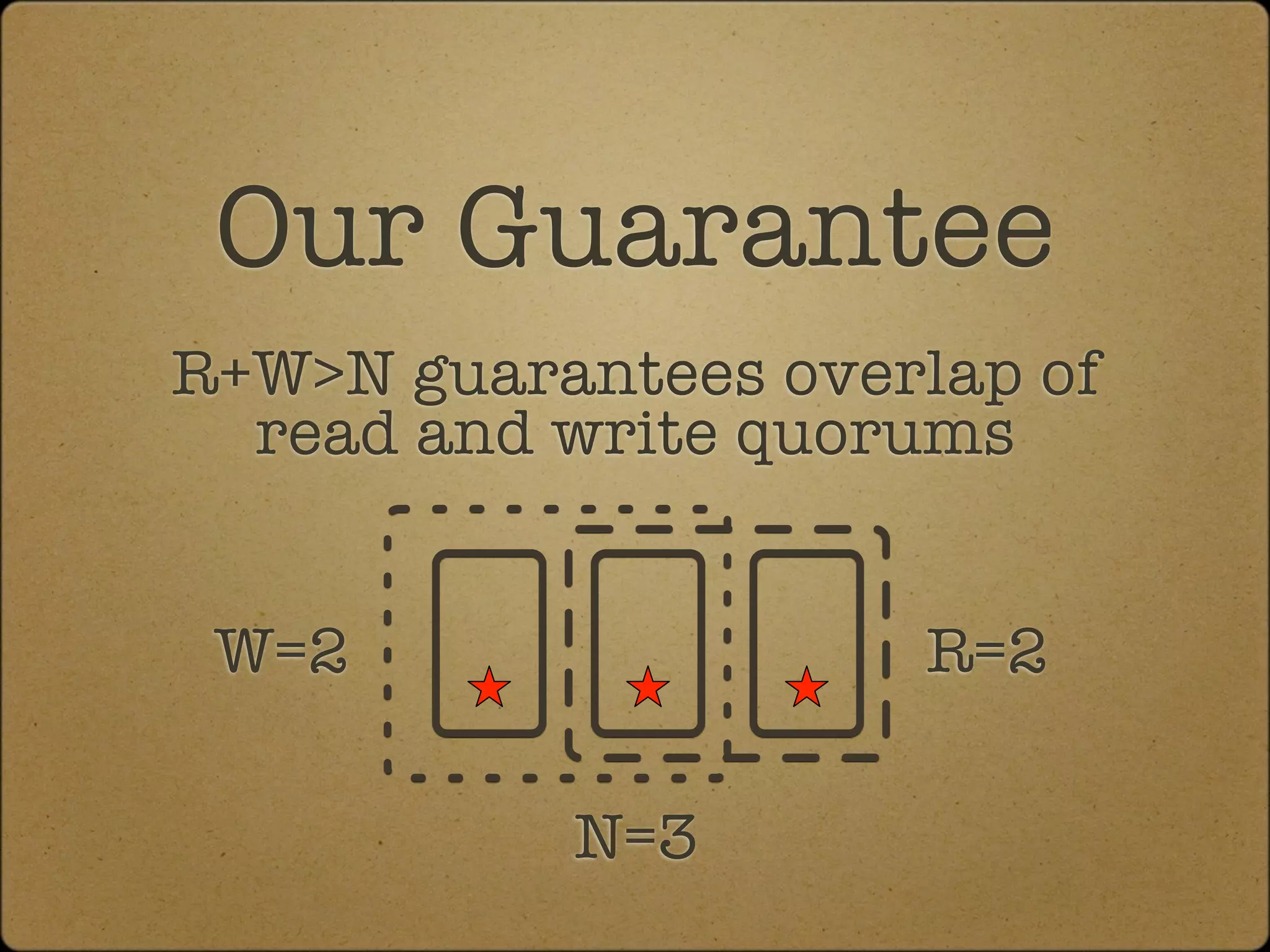
Our Guarantee
R+W>N guarantees overlap of
  read and write quorums


 W=2                 R=2

           N=3
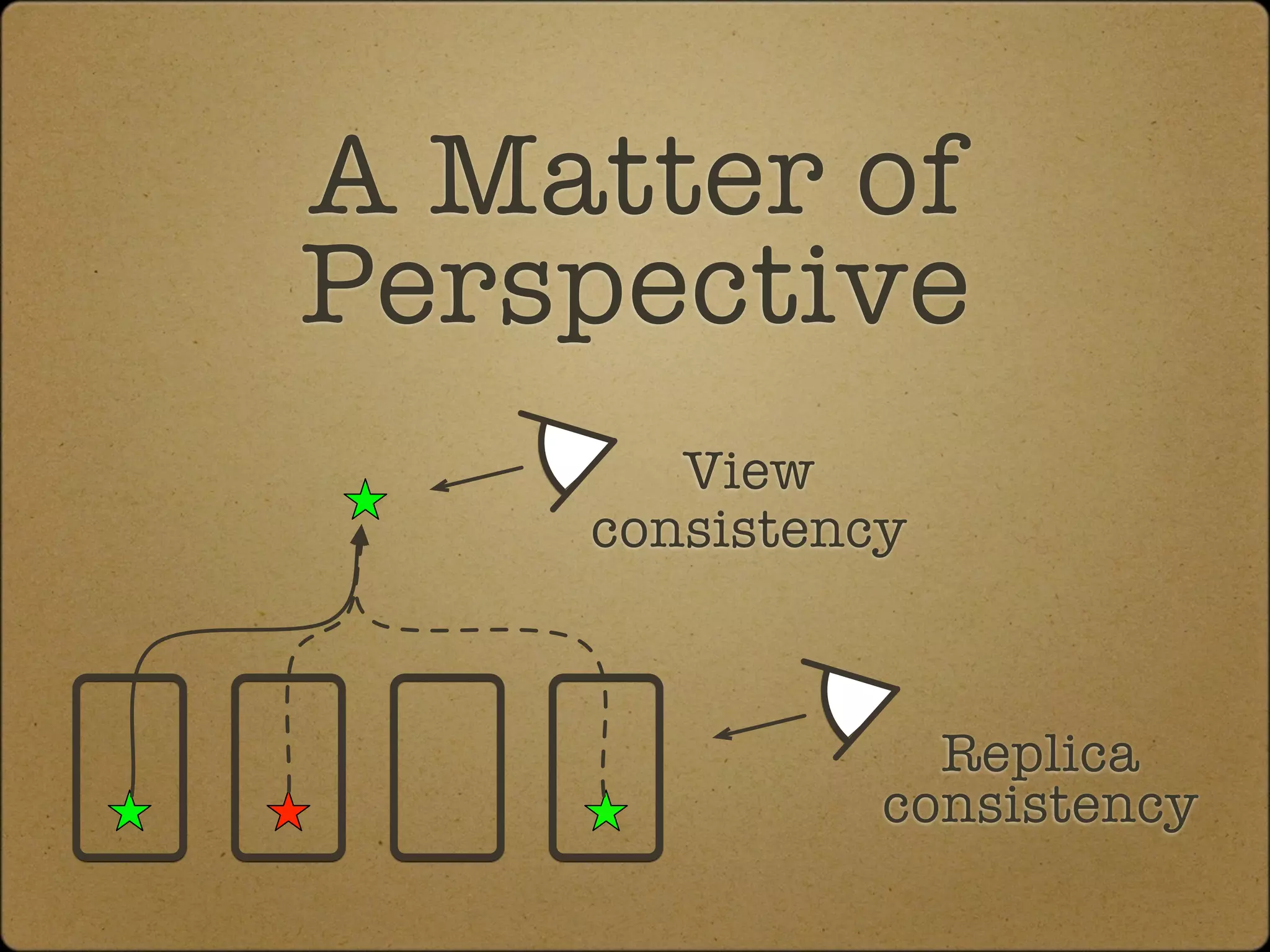
A Matter of
Perspective
       View
    consistency


                Replica
              consistency
[2]
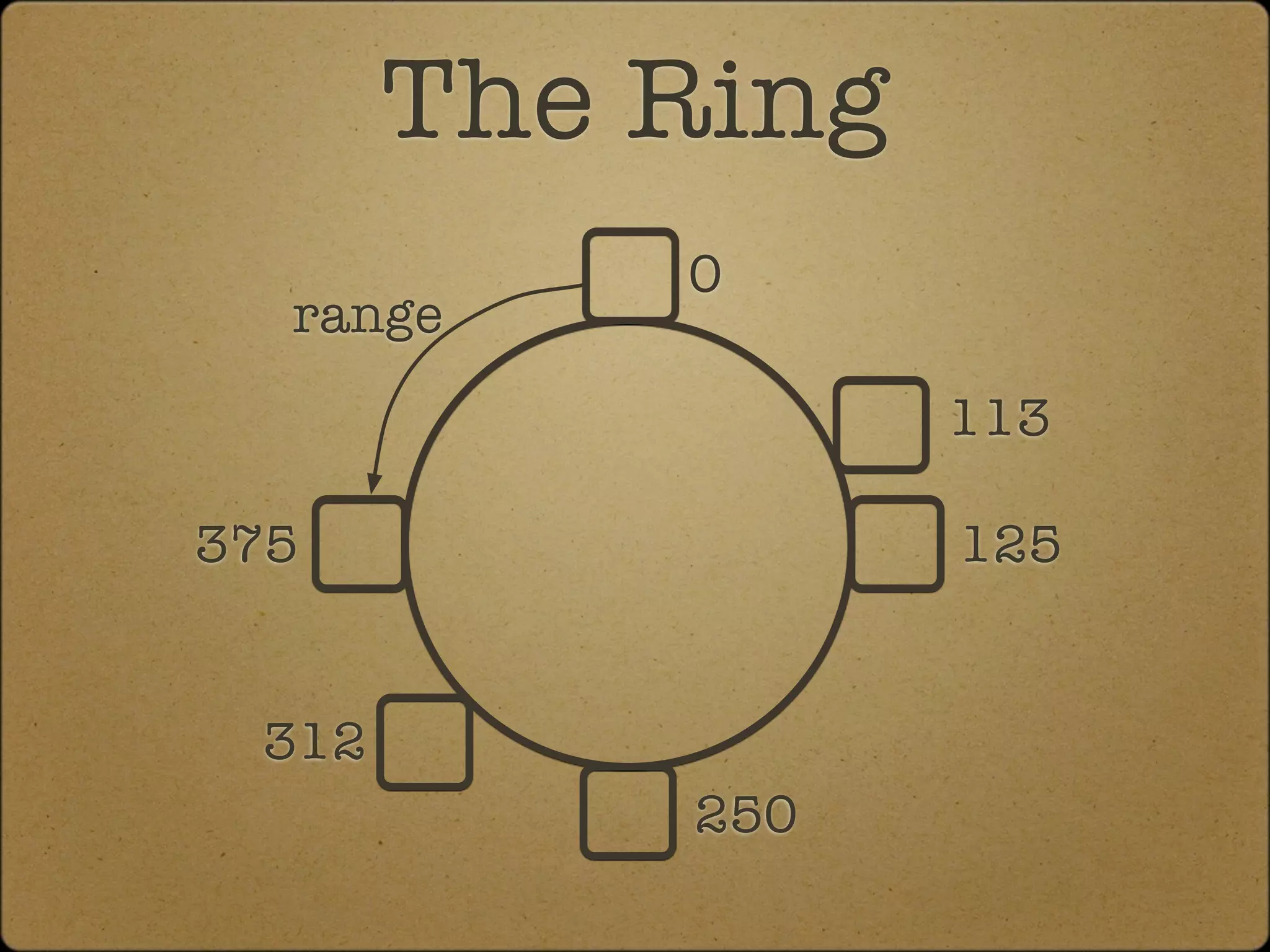
The Ring
           0
  range
                  113

375               125


 312
           250
Tokens
A TOKEN is a
partitioner-dependent
element on the ring
                  Each NODE has a
                  single, unique TOKEN

   Each NODE claims a RANGE of
   the ring from its TOKEN to the
   token of the previous node on
   the ring
Partitioning
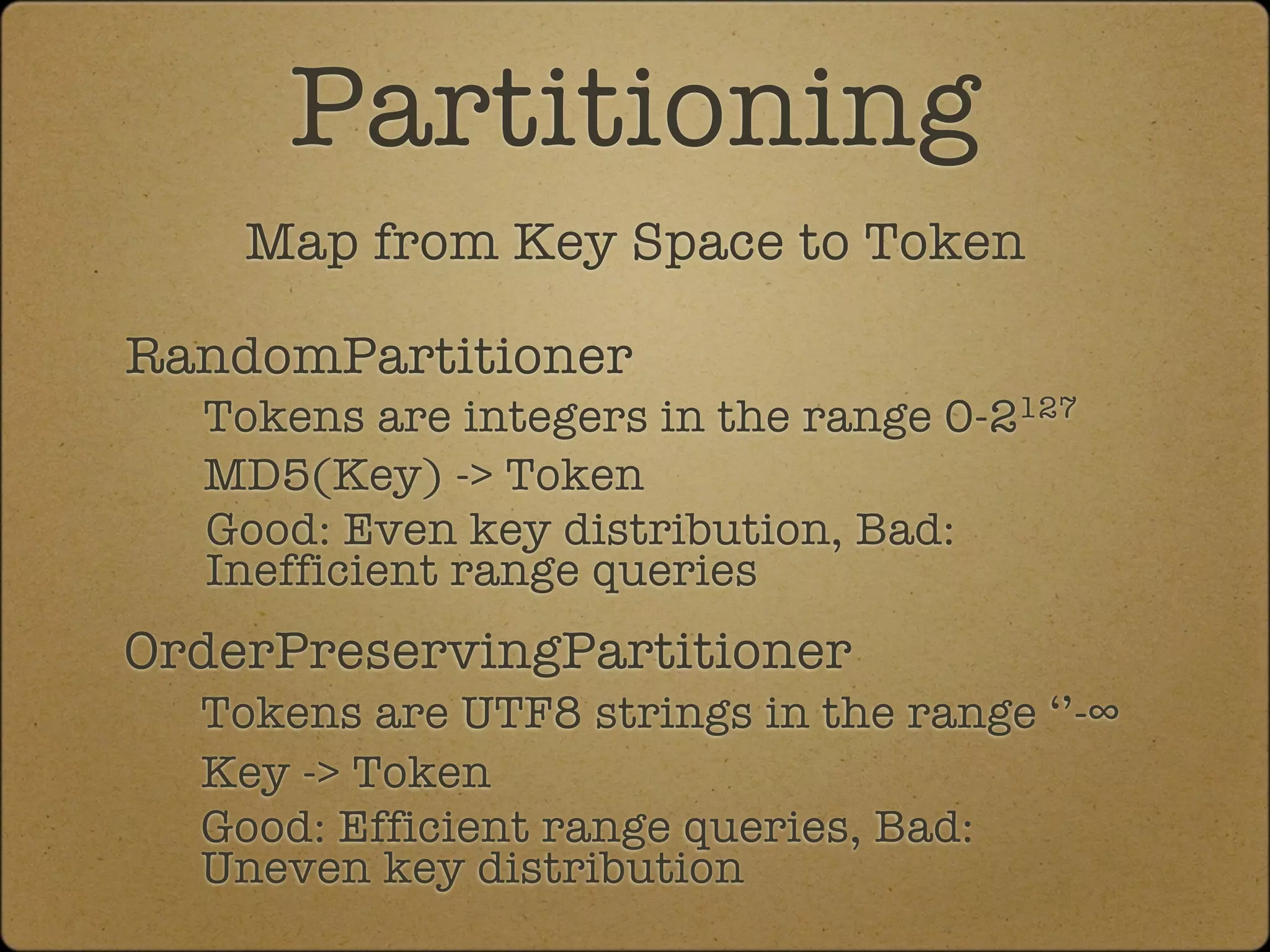
    Map from Key Space to Token

RandomPartitioner
  Tokens are integers in the range 0-2127
  MD5(Key) -> Token
  Good: Even key distribution, Bad:
  Inefficient range queries
OrderPreservingPartitioner
  Tokens are UTF8 strings in the range ‘’-∞
  Key -> Token
  Good: Efficient range queries, Bad:
  Uneven key distribution
Snitching
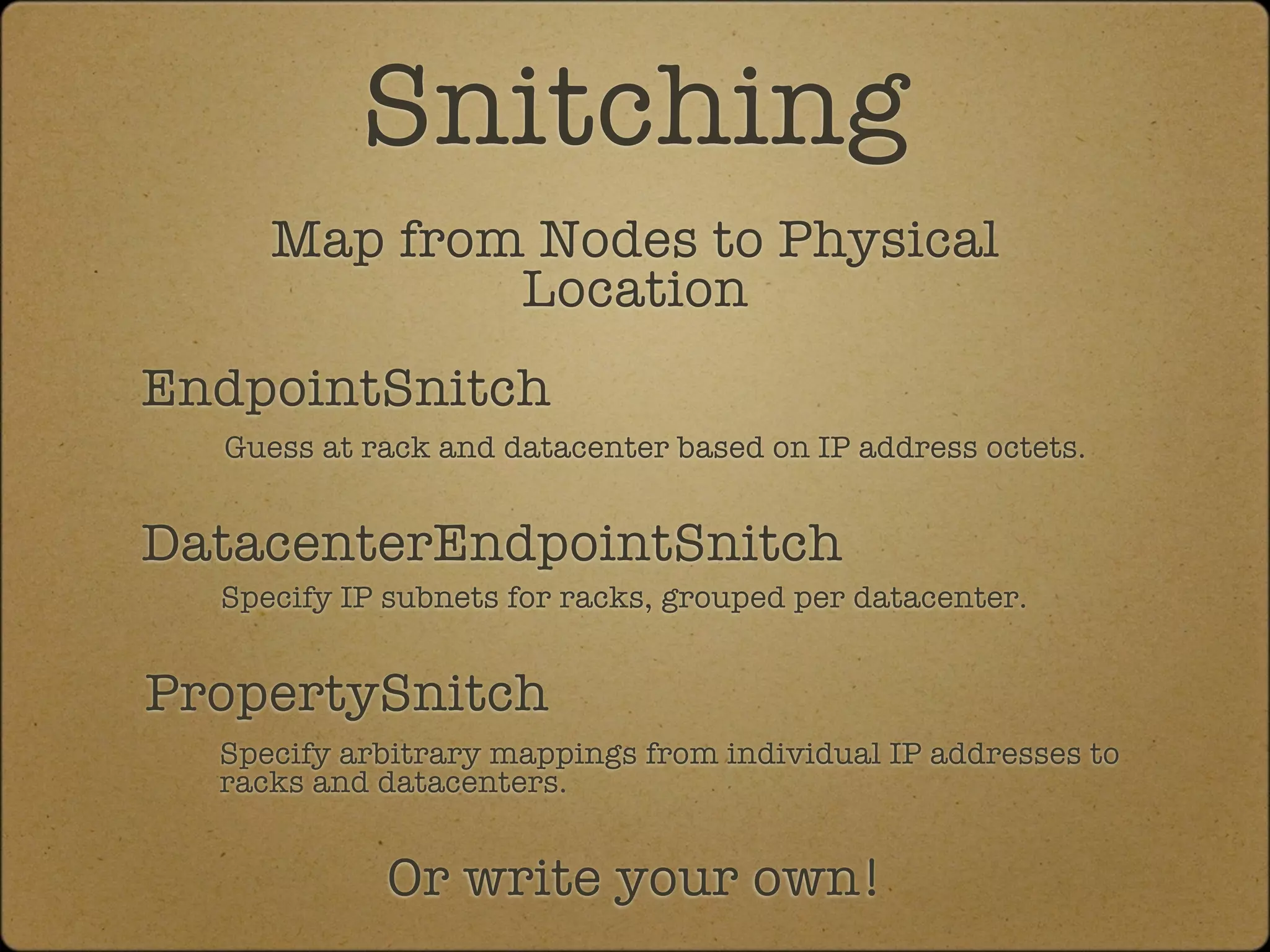
     Map from Nodes to Physical
             Location
EndpointSnitch
  Guess at rack and datacenter based on IP address octets.


DatacenterEndpointSnitch
  Specify IP subnets for racks, grouped per datacenter.


PropertySnitch
  Specify arbitrary mappings from individual IP addresses to
  racks and datacenters.


            Or write your own!
Placement
  Map from Token Space to Nodes


The first replica is always placed
on the node that claims the
range in which the token falls.

Strategies determine where the
rest of the replicas are placed.
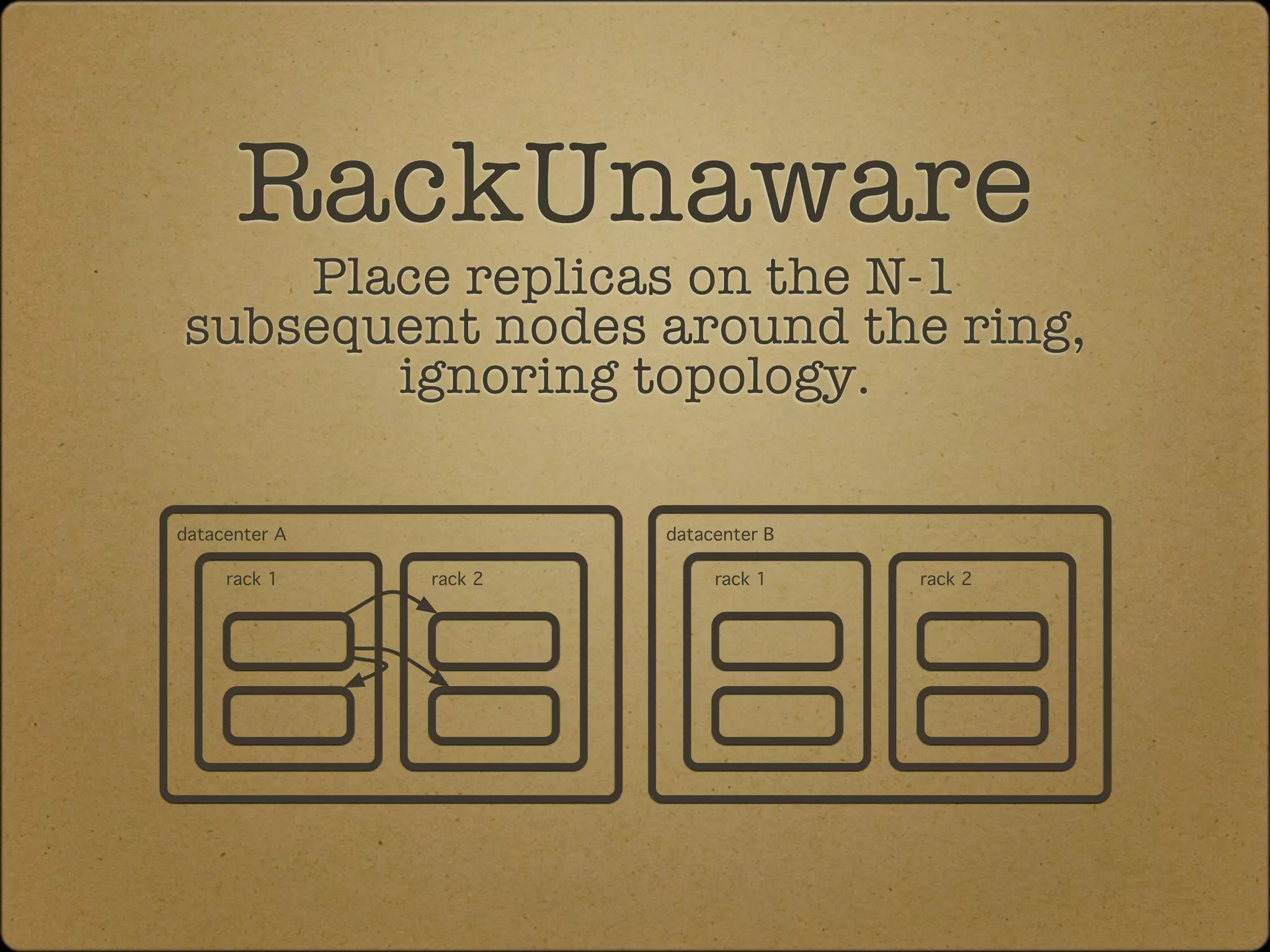
RackUnaware
    Place replicas on the N-1
subsequent nodes around the ring,
       ignoring topology.

datacenter A            datacenter B

     rack 1    rack 2        rack 1    rack 2
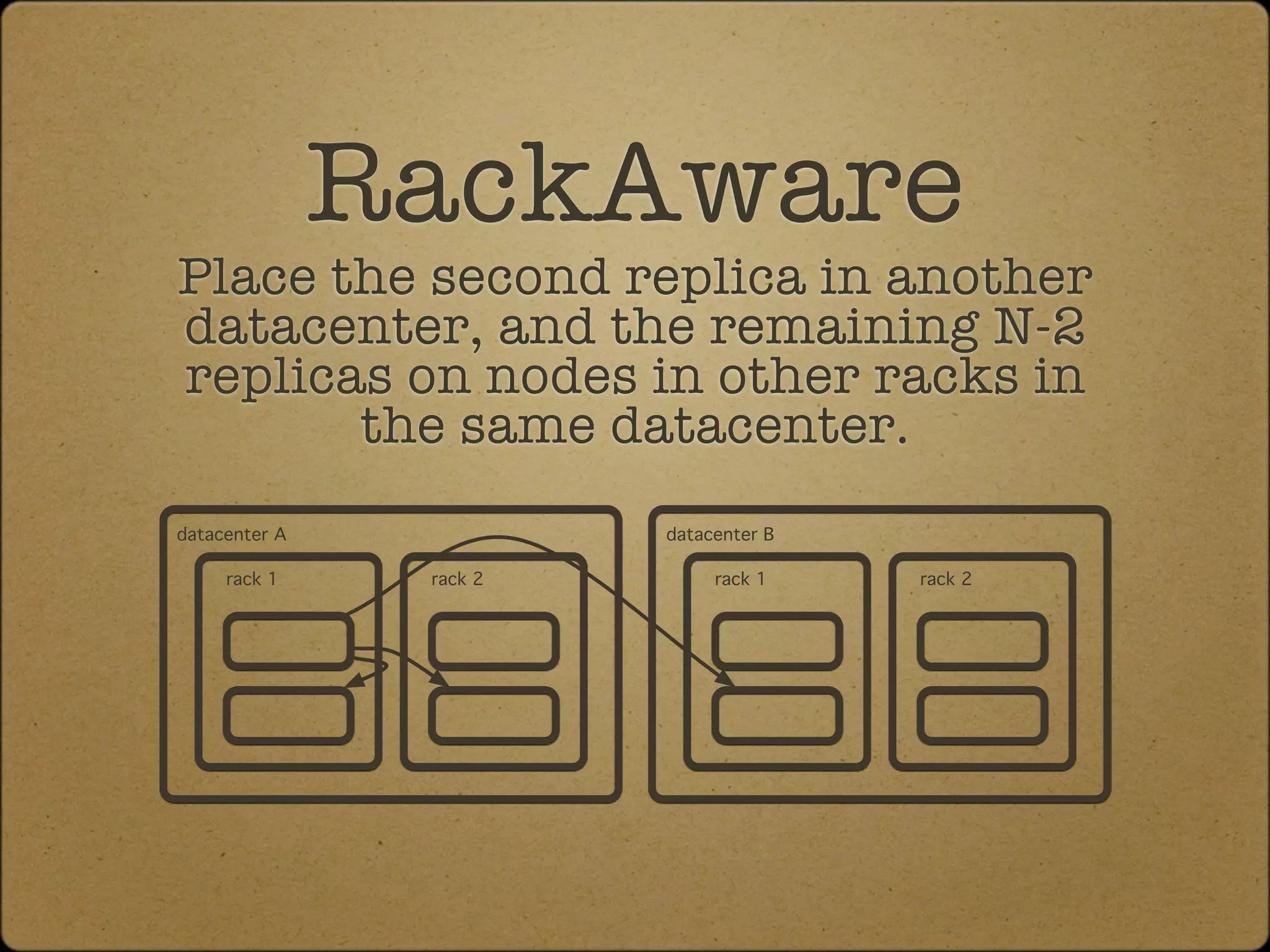
RackAware
Place the second replica in another
datacenter, and the remaining N-2
replicas on nodes in other racks in
       the same datacenter.
datacenter A             datacenter B

     rack 1     rack 2        rack 1    rack 2
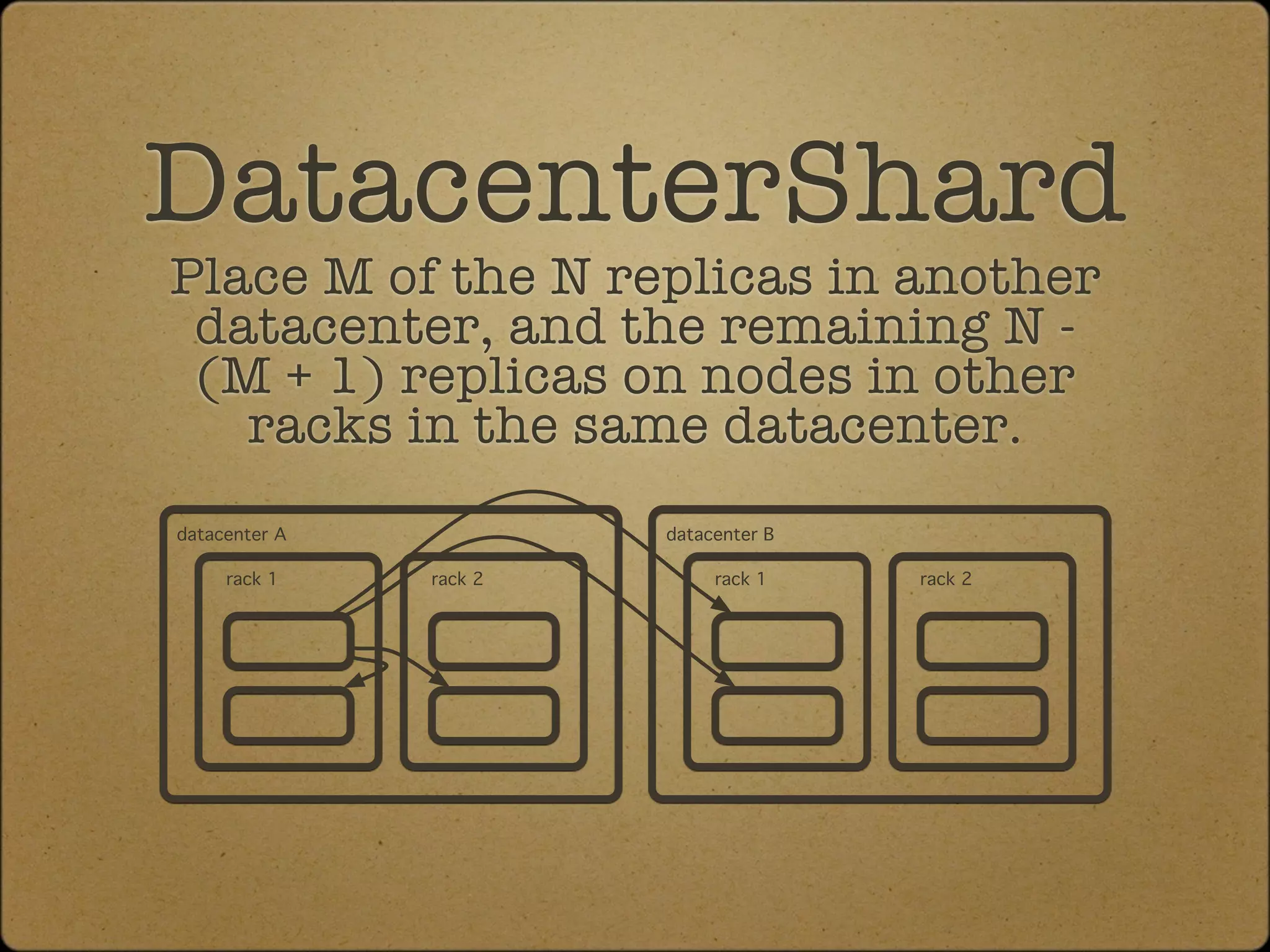
DatacenterShard
Place M of the N replicas in another
 datacenter, and the remaining N -
 (M + 1) replicas on nodes in other
   racks in the same datacenter.
datacenter A            datacenter B

     rack 1    rack 2        rack 1    rack 2
Or write your own!
[fin]
Cassandra
http://cassandra.apache.org
Amazon Dynamo
   http://www.allthingsdistributed.com/2007/10/amazons_dynamo.html


       Google BigTable
                http://labs.google.com/papers/bigtable.html


Facebook Cassandra
http://www.cs.cornell.edu/projects/ladis2009/papers/lakshman-ladis2009.pdf
Thank you!
 Questions?

Introduction to Cassandra: Replication and Consistency

  • 1.
    Cassandra Replication & Consistency Benjamin Black, b@b3k.us 2010-04-28
  • 2.
    Dynamo BigTable Cluster Sparse, management, columnar data replication, fault model, storage tolerance architecture Cassandra
  • 3.
    Dynamo-like Features Symmetric, P2Parchitecture No special nodes/SPOFs Gossip-based cluster management Distributed hash table for data placement Pluggable partitioning Pluggable topology discovery Pluggable placement strategies Tunable, eventual consistency
  • 4.
    BigTable-like Features Sparse,“columnar” data model Optional, 2-level maps called Super Column Families SSTable disk storage Append-only commit log Memtable (buffer and sort) Immutable SSTable files Hadoop integration
  • 5.
    Topic(s) for Today Replication & Consistency
  • 6.
  • 7.
    Replication How many copiesof each piece of data do we want in the system? N=3
  • 8.
    Consistency Level How many replicas must respond to declare success? W=2 R=2 ?
  • 9.
    CL.Options WRITE READ Level Description Level Description ZERO Cross fingers ANY WEAK 1st Response (including HH) ONE 1st Response ONE 1st Response STRONG QUORUM N/2 + 1 replicas QUORUM N/2 + 1 replicas ALL All replicas ALL All replicas
  • 10.
    A Side Noteon CL Consistency Level is based on Replication Factor (N), not on the number of nodes in the system.
  • 11.
    A Question of Time row column column column column column value value value value value timestamp timestamp timestamp timestamp timestamp All columns have a value and a timestamp Timestamps provided by clients usec resolution by convention Latest timestamp wins Vector clocks may be introduced in 0.7
  • 12.
    Read Repair ? Query all replicas on every read Data from one replica Checksum/timestamps from all others If there is a mismatch: Pull all data and merge Write back to out of sync replicas
  • 13.
    Weak vs. Strong WeakConsistency (reads)Perform repair after returning results Strong Consistency (reads) Perform repair before returning results
  • 14.
    R+W>N Pleaseimagine this inequality has huge fangs, dripping with the blood of innocent, enterprise developers so you can best appreciate the terror it inspires.
  • 15.
    Our Guarantee R+W>N guaranteesoverlap of read and write quorums W=2 R=2 N=3
  • 16.
    A Matter of Perspective View consistency Replica consistency
  • 17.
  • 18.
    The Ring 0 range 113 375 125 312 250
  • 19.
    Tokens A TOKEN isa partitioner-dependent element on the ring Each NODE has a single, unique TOKEN Each NODE claims a RANGE of the ring from its TOKEN to the token of the previous node on the ring
  • 20.
    Partitioning Map from Key Space to Token RandomPartitioner Tokens are integers in the range 0-2127 MD5(Key) -> Token Good: Even key distribution, Bad: Inefficient range queries OrderPreservingPartitioner Tokens are UTF8 strings in the range ‘’-∞ Key -> Token Good: Efficient range queries, Bad: Uneven key distribution
  • 21.
    Snitching Map from Nodes to Physical Location EndpointSnitch Guess at rack and datacenter based on IP address octets. DatacenterEndpointSnitch Specify IP subnets for racks, grouped per datacenter. PropertySnitch Specify arbitrary mappings from individual IP addresses to racks and datacenters. Or write your own!
  • 22.
    Placement Mapfrom Token Space to Nodes The first replica is always placed on the node that claims the range in which the token falls. Strategies determine where the rest of the replicas are placed.
  • 23.
    RackUnaware Place replicas on the N-1 subsequent nodes around the ring, ignoring topology. datacenter A datacenter B rack 1 rack 2 rack 1 rack 2
  • 24.
    RackAware Place the secondreplica in another datacenter, and the remaining N-2 replicas on nodes in other racks in the same datacenter. datacenter A datacenter B rack 1 rack 2 rack 1 rack 2
  • 25.
    DatacenterShard Place M ofthe N replicas in another datacenter, and the remaining N - (M + 1) replicas on nodes in other racks in the same datacenter. datacenter A datacenter B rack 1 rack 2 rack 1 rack 2
  • 26.
  • 27.
  • 28.
  • 29.
    Amazon Dynamo http://www.allthingsdistributed.com/2007/10/amazons_dynamo.html Google BigTable http://labs.google.com/papers/bigtable.html Facebook Cassandra http://www.cs.cornell.edu/projects/ladis2009/papers/lakshman-ladis2009.pdf
  • 30.