BUSINESS ANALYTICS
By
Prof. Suku Thomas Samuel
Department of Management
Introduction to Business Analytics
• Name of the course : Business Analytics
• Course code : BBA203B63
• Number of credits : 3
• Marks for the course : 75 marks
: 50 marks for ESE + 25 marks for CIA
Business Analytics: BBA203B63
Chapter name
Chapter No
Introduction to Business Analytics
1
Types of Business Analytics
2
Digital Data and Data Warehouse
3
Risk Return Measurement
4
Chapter 1
Introduction to Business Analytics
By
Prof. Suku Thomas Samuel
Department of Management
Key terminologies
Data is a sequence of characters or symbols that are stored and
processed for analysis purposes.
A database is an organized collection of structured information, or
data, typically stored electronically in a computer system.
A relational database is a type of database that stores and provides
access to data points that are related to one another. Relational
databases are based on the relational model, an intuitive,
straightforward way of representing data in tables.
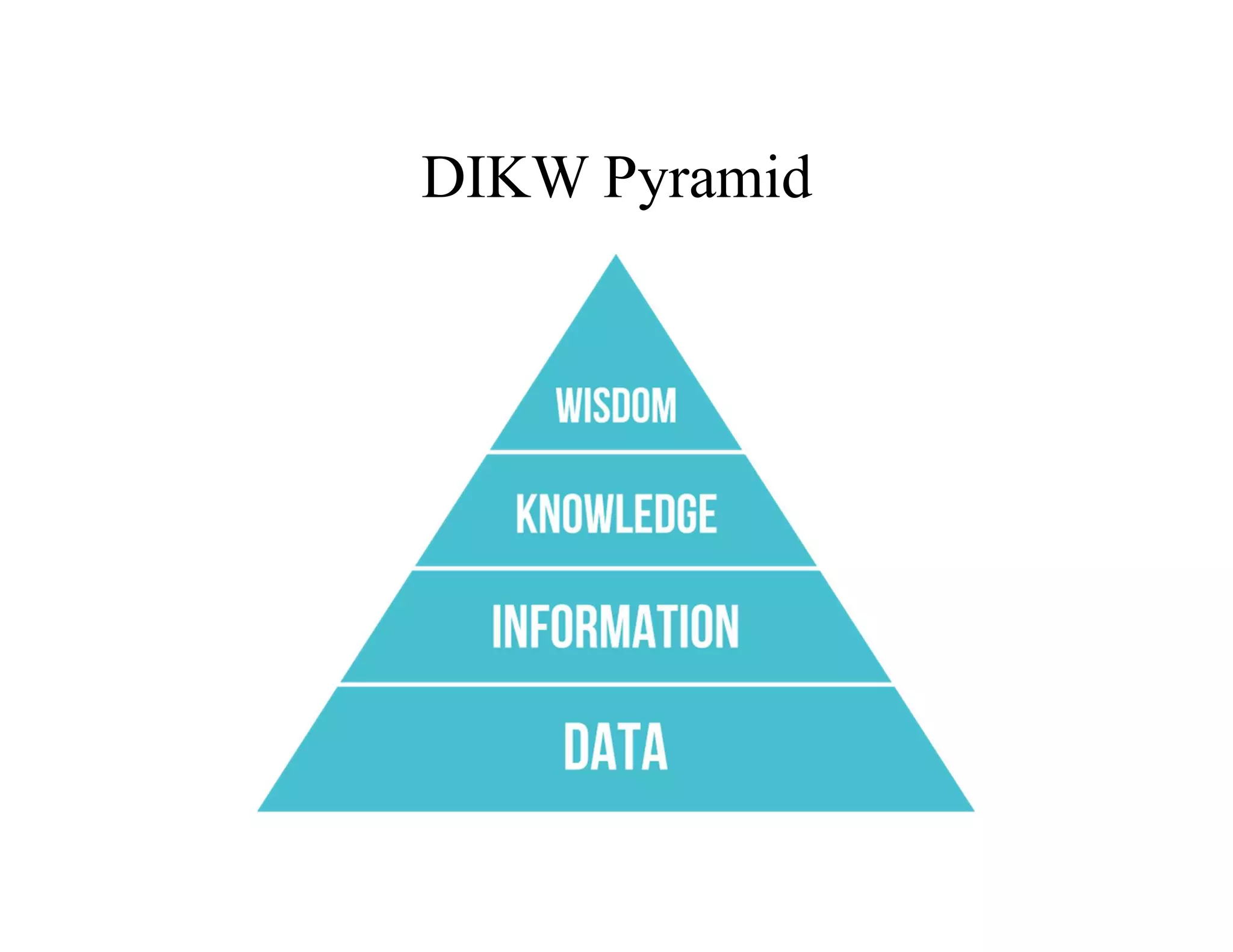
DIKW Pyramid
Business Analytics
What is Analytics?
Analytics is the process of discovering, interpreting, and
communicating significant patterns in data.
Applying analytics in context to business scenarios is called as
Business Analytics.
Business Analytics
• Business analytics (BA) refers to the skills, technologies, and
practices for continuous iterative exploration and investigation of
past business performance to gain insight and drive business
planning.
• Business analytics focuses on developing new insights and
understanding of business performance based on data and statistical
methods.
• Business analytics makes extensive use of analytical modeling and
numerical analysis, including explanatory and predictive modeling,
and fact-based management to drive decision making.
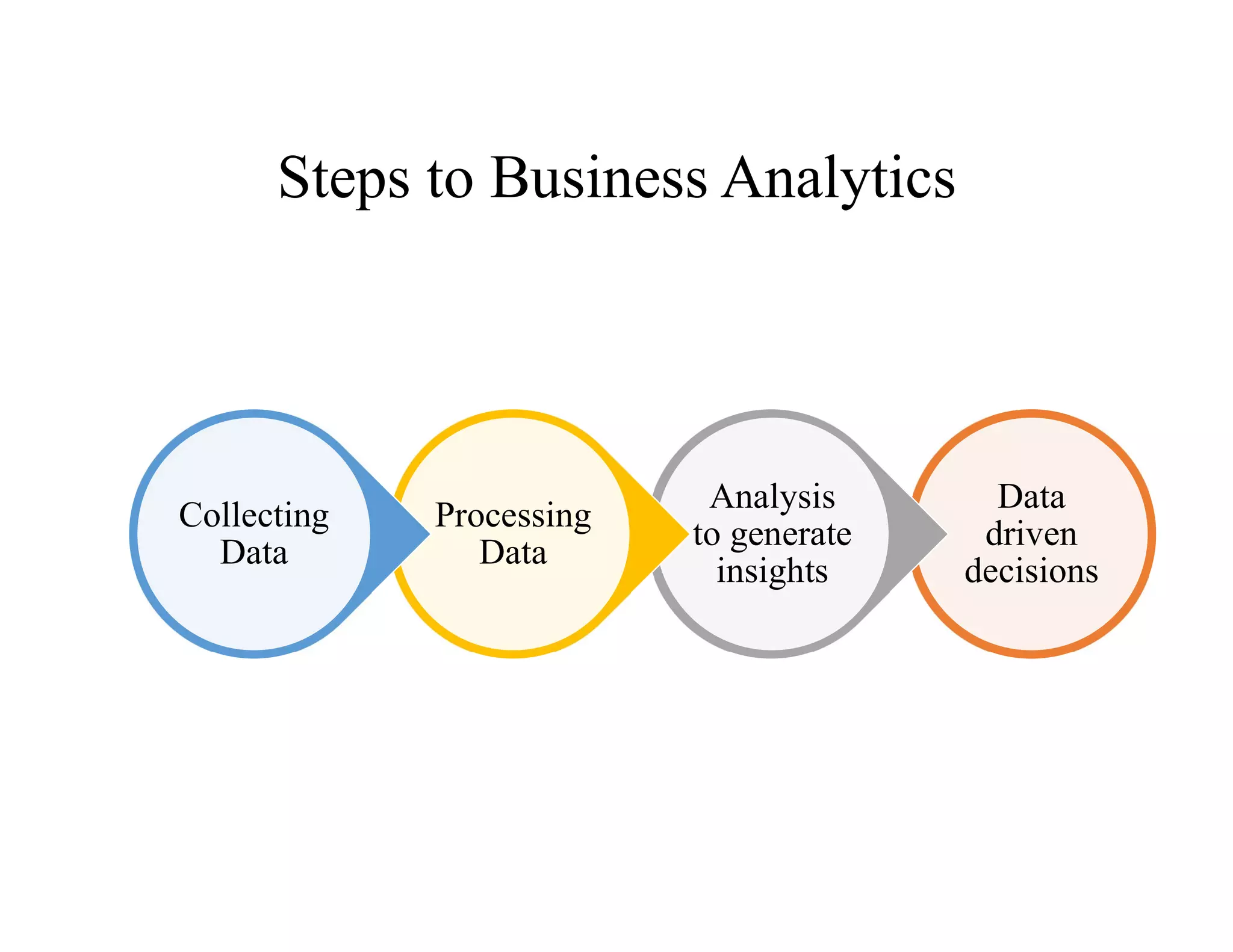
Steps to Business Analytics
Data
driven
decisions
Analysis
to generate
insights
Processing
Data
Collecting
Data
History of Business Analytics
• 1865 - Staying ahead
Mr. Richard Miller Devens described in his book - Cyclopaedia of
Commercial and Business Anecdotes, how Sir Henry Furnese, a
British banker of 16th century, was always one step ahead by
actively gathering information and acting on it before any of his
competitors.
• 1890 - Introduction of Scientific Management
It took over seven years for the U.S. Census Bureau to process the
collected information and complete a final report. Inventor Herman
Hollerith produced a “tabulating machine”. The tabulating machine
helped in processing data recorded on punch card and the census of
1890 was finished in 18 months.
History of Business Analytics
• Late 1800s - Introduction of Scientific Management
Frederick Taylor introduced the first-ever system of business
analytics in the USA. The approach was called scientific
management. The purpose of the system was to analyze the
production techniques and laborer's body movements to identify
greater efficiencies.
• Early 1900s - Transformation of the Manufacturing Industry
Henry Ford introduced the assembly line of production, and the
analysis transformed the manufacturing industry across the globe.
History of Business Analytics
• 1950s - First hard drive disk by IBM
Computers had a massive demand during World War II. Until then
punch cards or tapes were used to store information. In 1956, the
tech giant, IBM invented the first hard disk drive which allowed
users to save a vast amount of data with better flexibility.
• 1970’s – Relational databases
Relational databases were invented by Edgar F. Codd in the 1970s
and became quite popular in the 1980s. Relational databases
(RDBMs), in turn, allowed users to write in sequel (SQL) and
retrieve data from their database.
History of Business Analytics
• Late 1980s - Emergence of Business Intelligence
Business intelligence solutions emerged. However, there was a
considerable amount of data available but not a centralized place to
store it. Ralph Kimball and Bill Inmon proposed strategies to build
data warehouses (DW).
• Early 2000's - Relational Databases
Companies like SAP, Microsoft, SAS and IBM introduced various
solutions and software with relational databases.
• 2005: Big data!
In 2005, big data was coined by Roger Magoulasdescribing a large
amount of data, which seemed almost impossible to cope with using
the Business Intelligence tools available at the time
History of Business Analytics
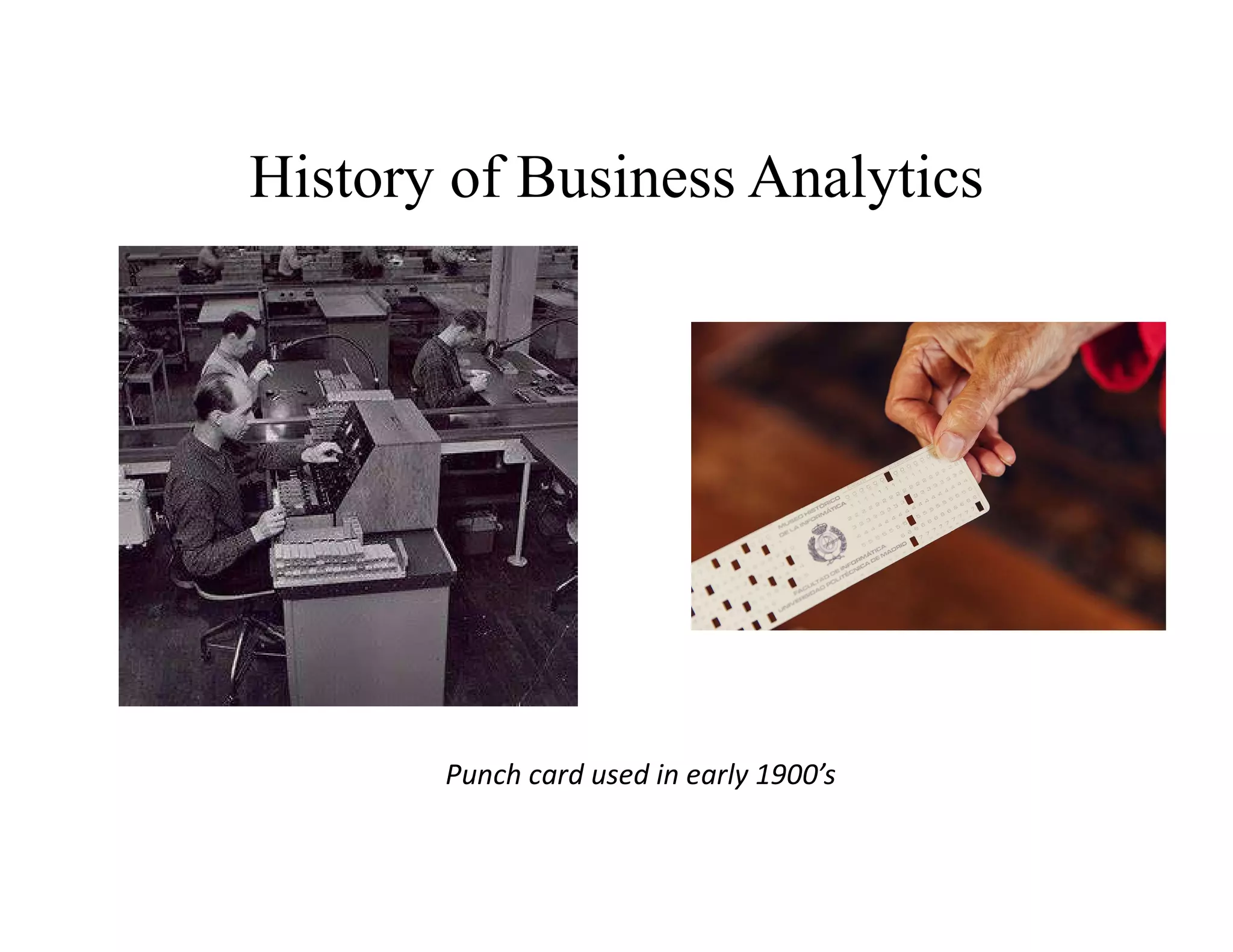
Punch card used in early 1900’s
History of Business Analytics
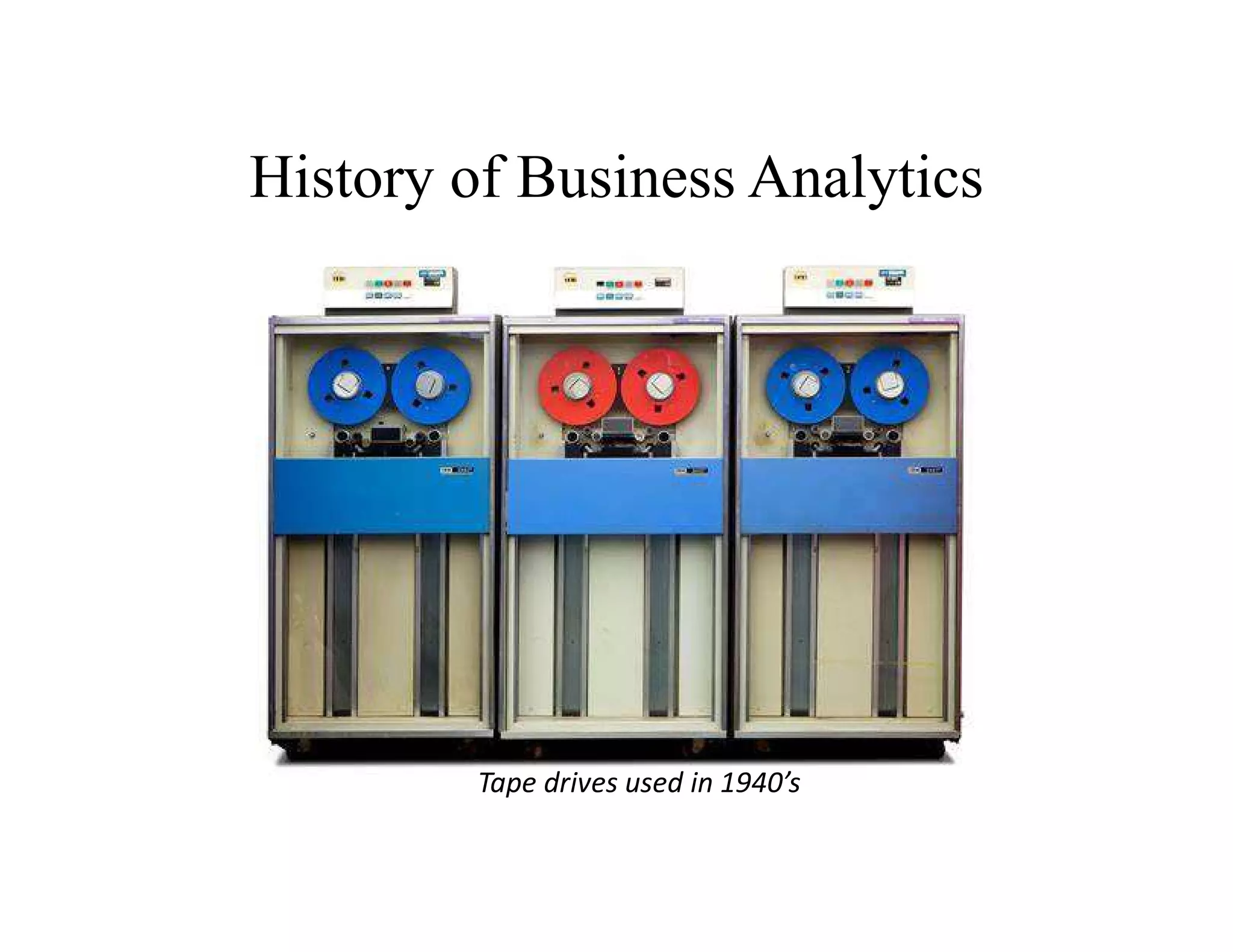
Tape drives used in 1940’s
History of Business Analytics
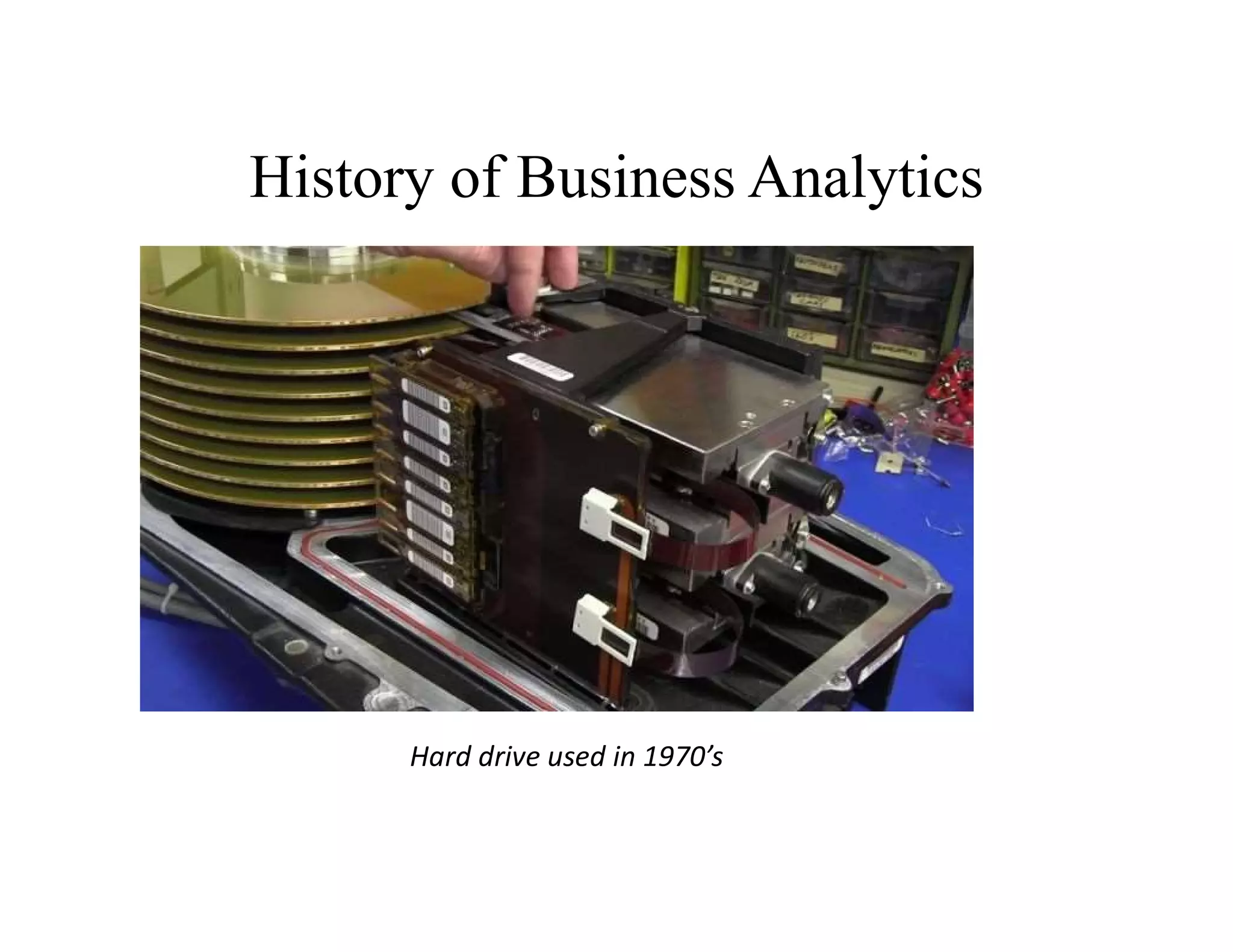
Hard drive used in 1970’s
History of Business Analytics
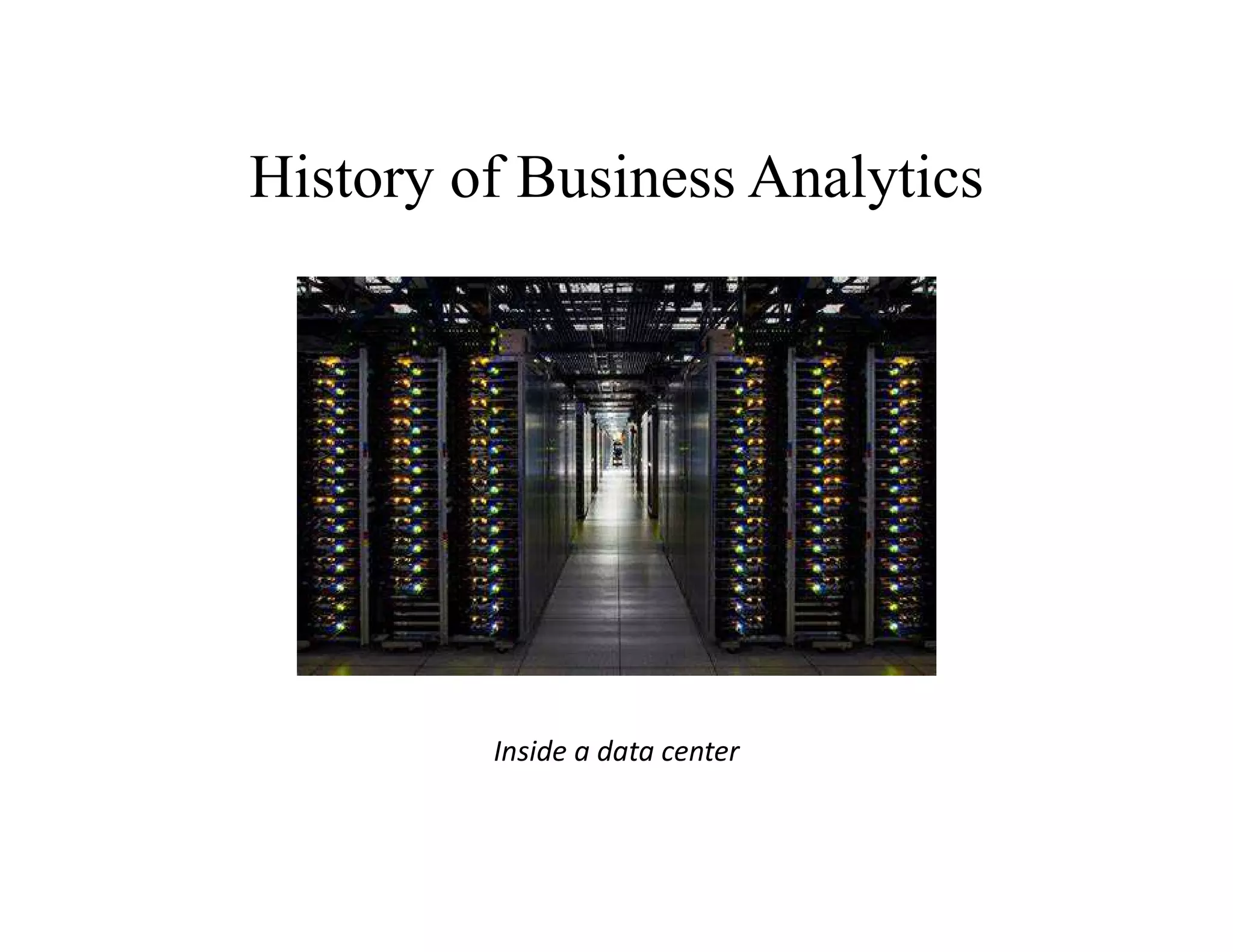
Inside a data center
Components of Business Analytics
The following are the core components of Business Analytics:
1. Data Storage
• Data needs to be stored for future use.
• Approach to storage can be file storage, object storage or block storage.
2. Data Visualization
• Representation of the date using visual aids.
• Makes the communication of outputs to the stakeholder easier.
3. Data Insights
• Outputs generated by processing data.
• Refers to the inferences/ conclusions drawn from data.
4. Data Security
• Monitoring and identifying malicious activities in the security networks.
• Identifying vulnerabilities in the system.
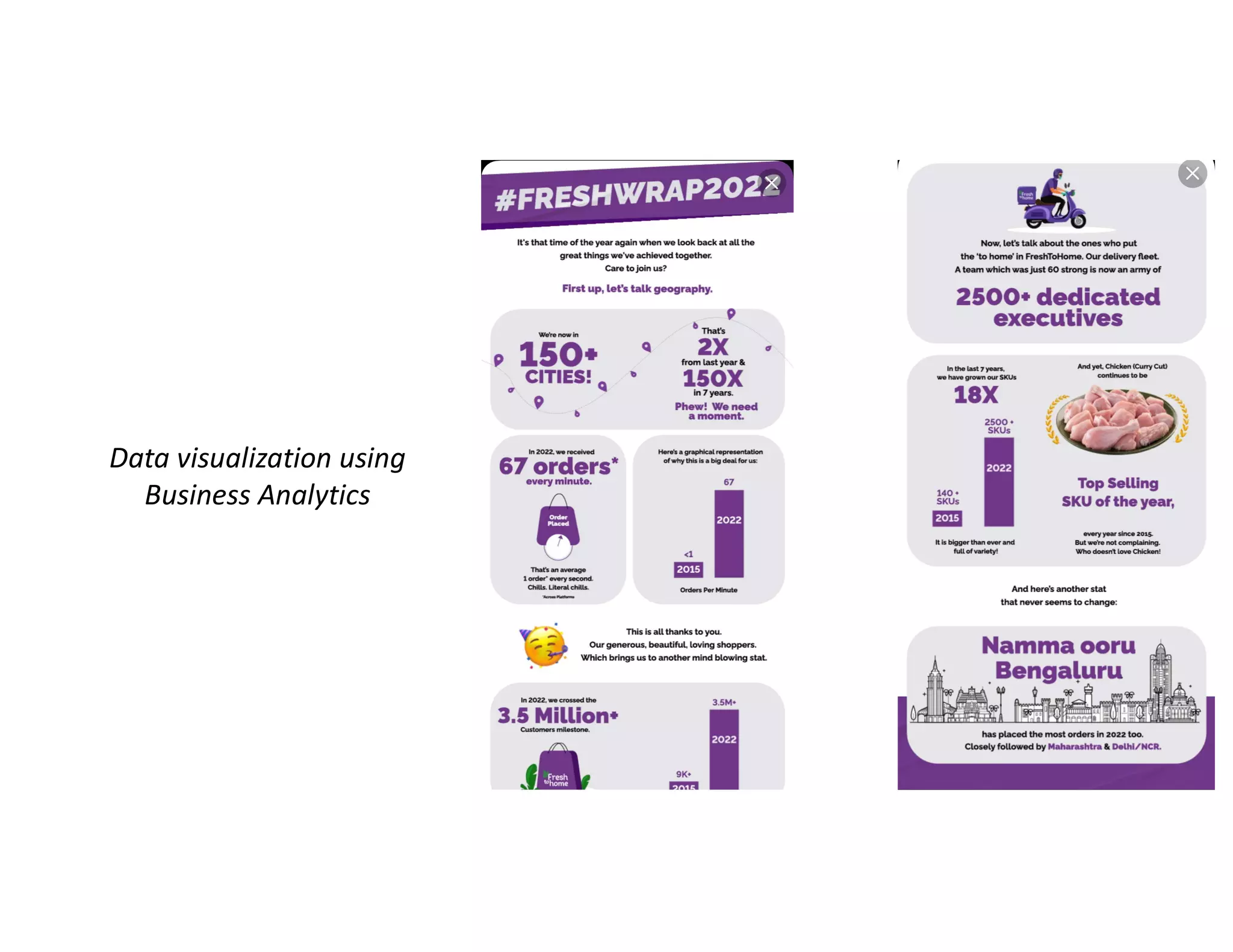
Data visualization using
Business Analytics
Benefits of Business Analytics
• Data-driven decisions
Quantifying root causes and clearly identifying trends creates a smarter
way to look at the future of an organization to take better decisions.
• Easy visualization
Business analytics software helps in taking bid data and turn it into
simple-yet-effective visualizations.
• Go augmented
Augmented analytics uses the ability to self-learn, adapt, and process
bulk quantities of data to automate processes and generate insights
without human bias.
• Modelling of what-if scenario
Creates models for users to look for trends and patterns that will affect
future outcomes.
Benefits of Business Analytics
• Budget specific decisions
Application of business analytics helps with better decisions with
increase in resource utilisation and minimising wastage.
• Increase efficiency
Business analytics helps to take real time decisions helping business to
increase and improve efficiency.
• Measure progress
Helps in measuring the performance of the business with real time data
analytics and attain goals.
Types of Business Analytics
There are four (five) types of Business Analytics models:
1. Descriptive Analytics
2. Diagnostics Analytics
3. Predictive Analytics
4. Prescriptive Analytics
5. Cognitive Analytics
Scope of Business Analytics
The scope of Business Analytics are as follows:
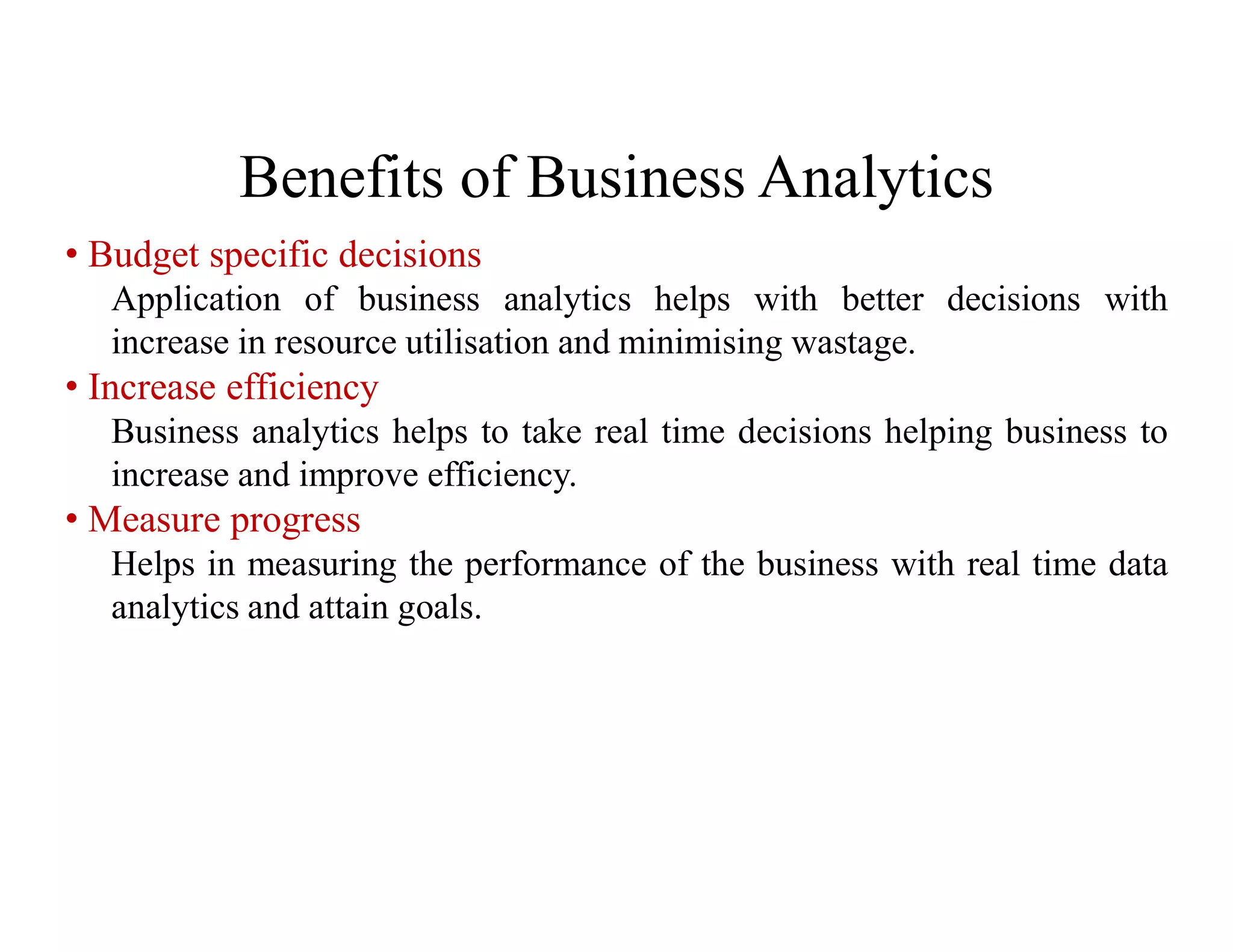
1. Client Relationship Management
• Organization can accurately monitor and quantify
customer service factors and consumer
gratification
• Make appropriate corrections and ensure client
retention.
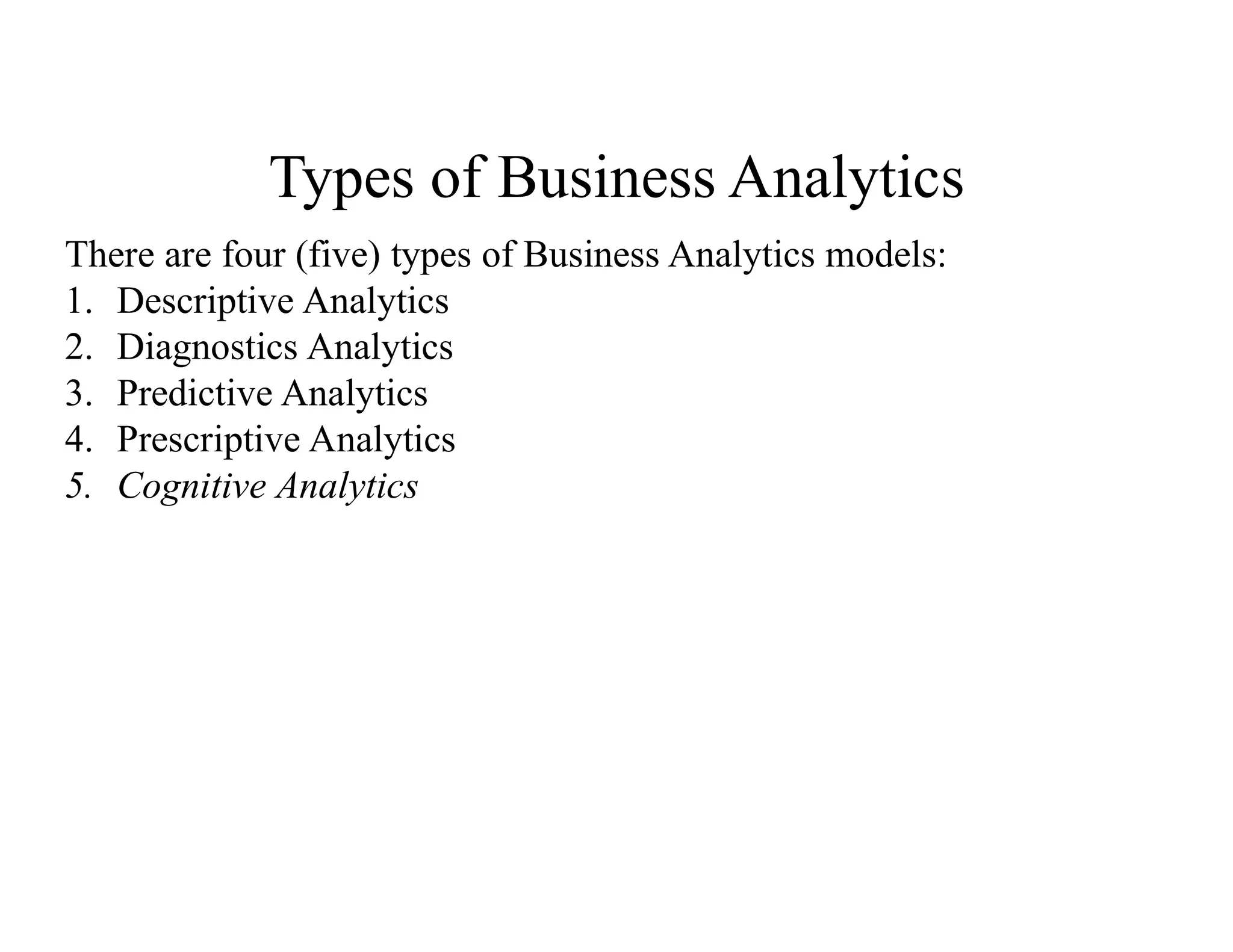
2. Inventory Management
• Efficiently manage the inventory for profit
maximization and growing customer delight.
• Help to reduce loss of revenue and minimise cost.
Scope of Business Analytics
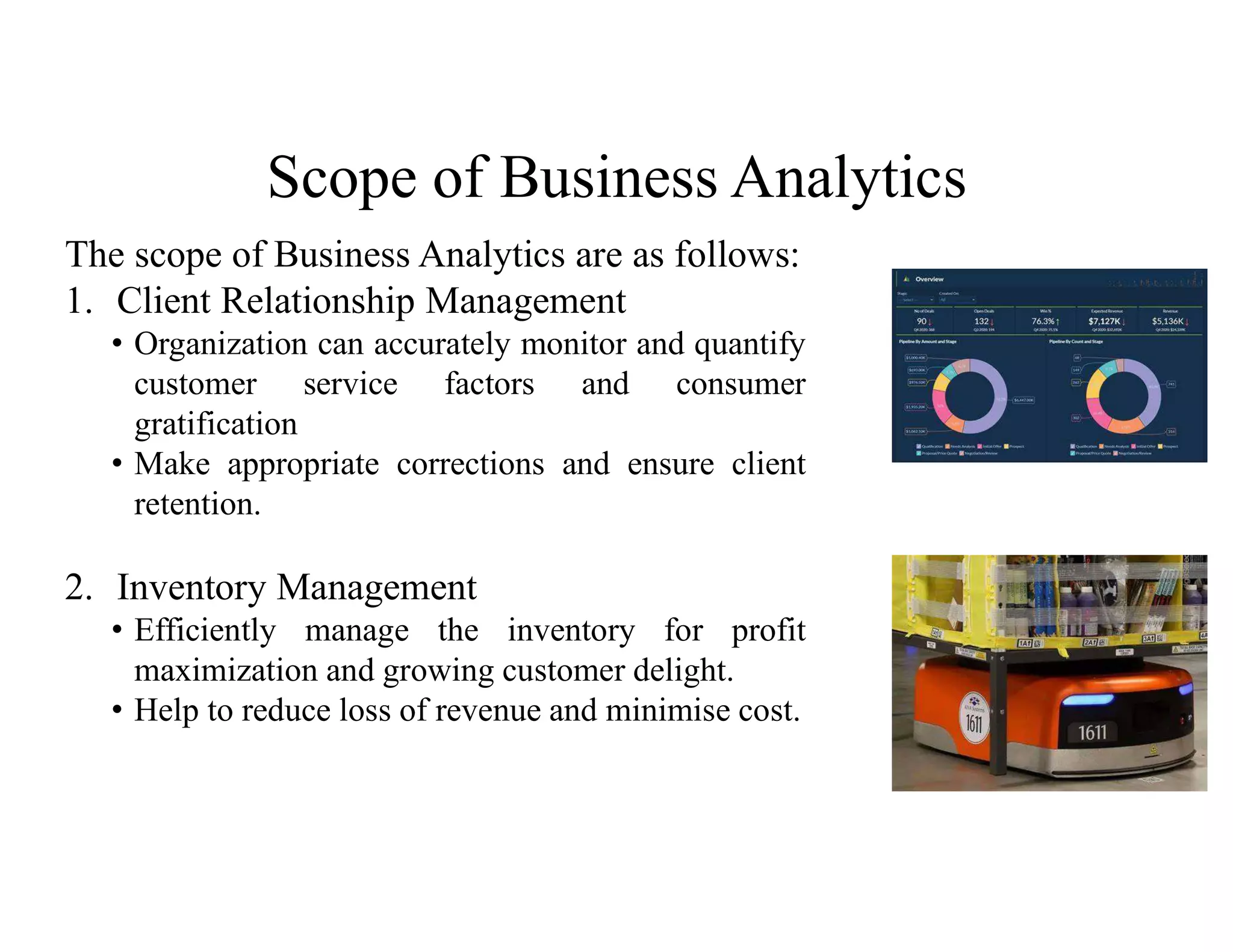
3. Market Analysis:
• Helps companies to predict customer
purchasing patterns for the future.
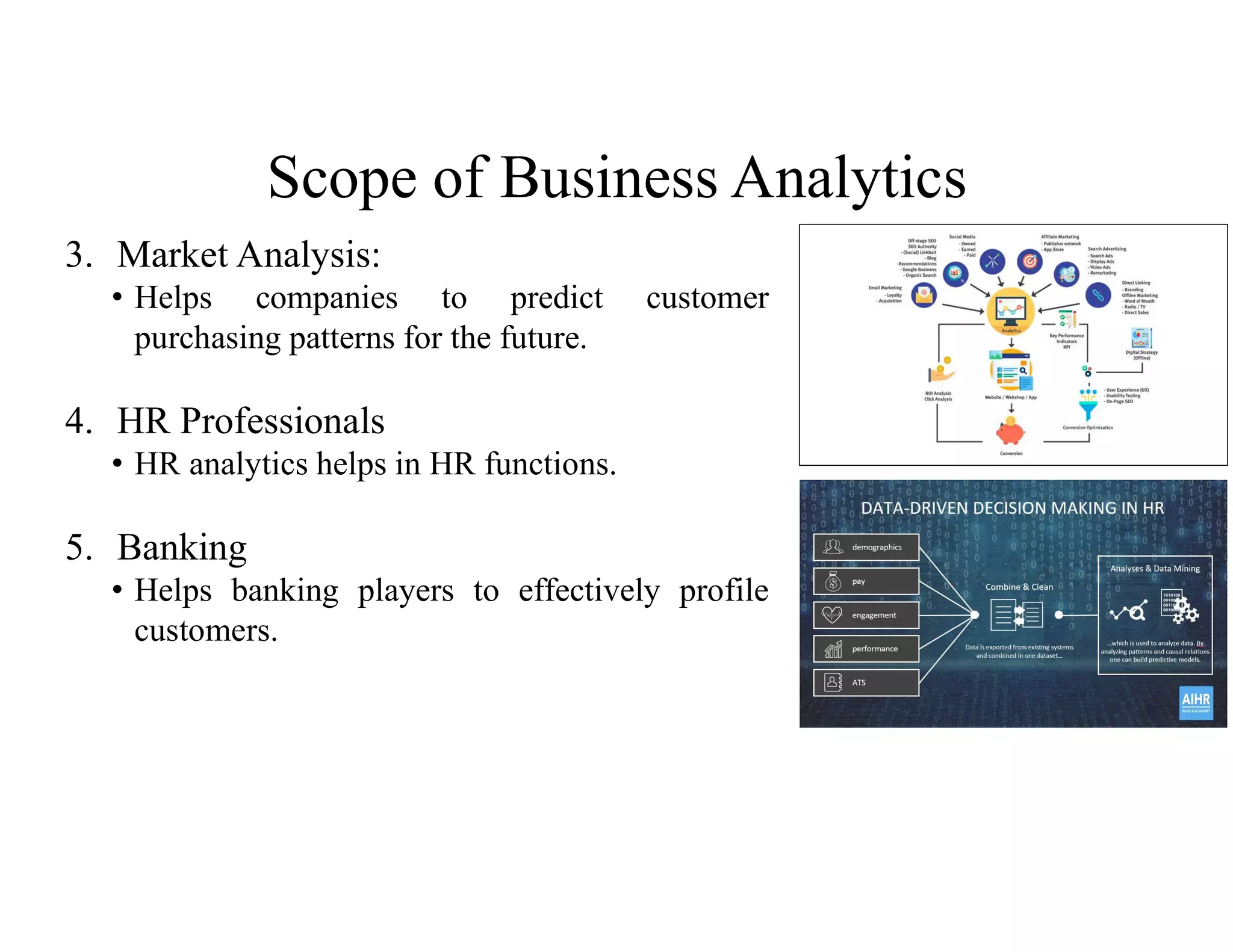
4. HR Professionals
• HR analytics helps in HR functions.
5. Banking
• Helps banking players to effectively profile
customers.
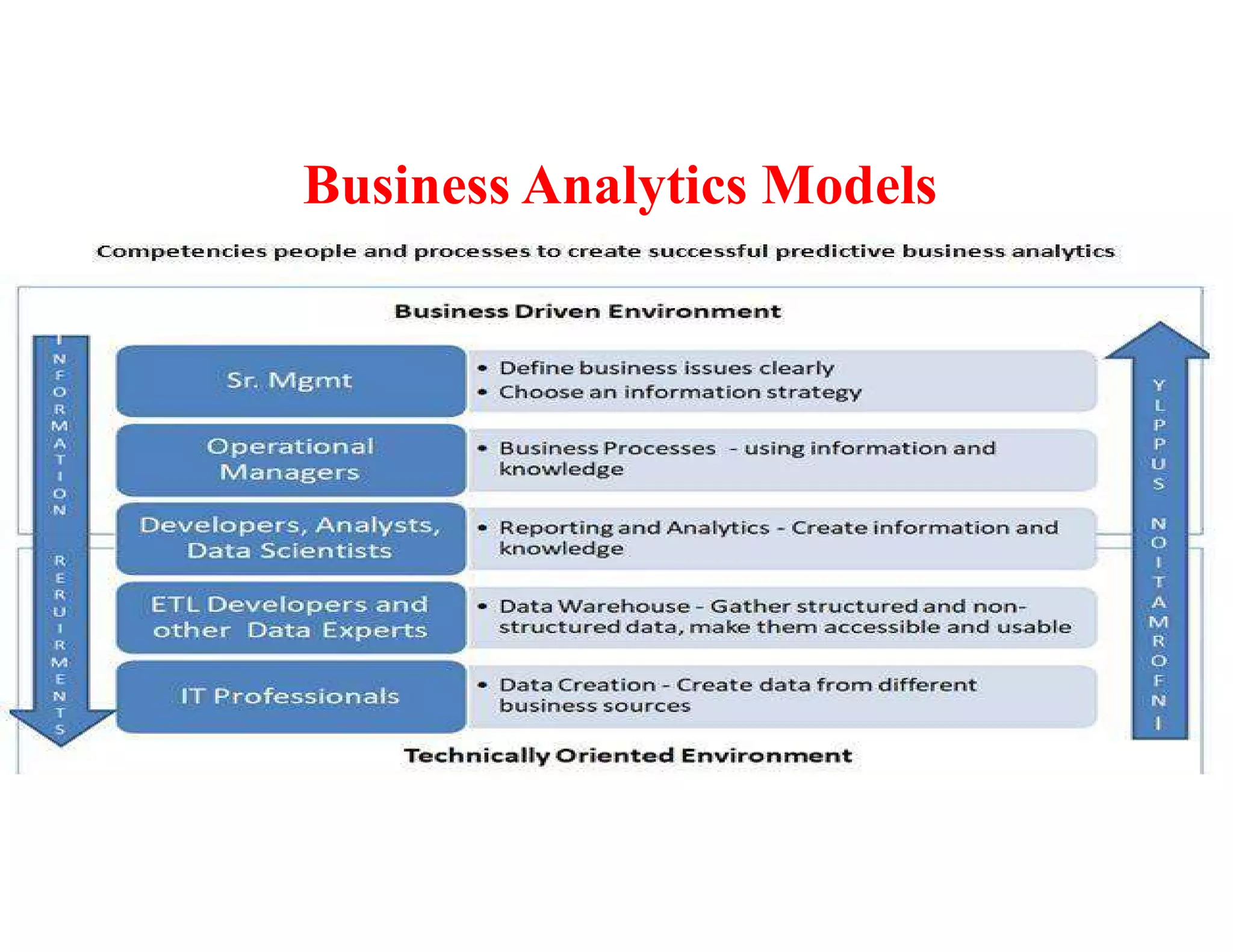
Business Analytics Models
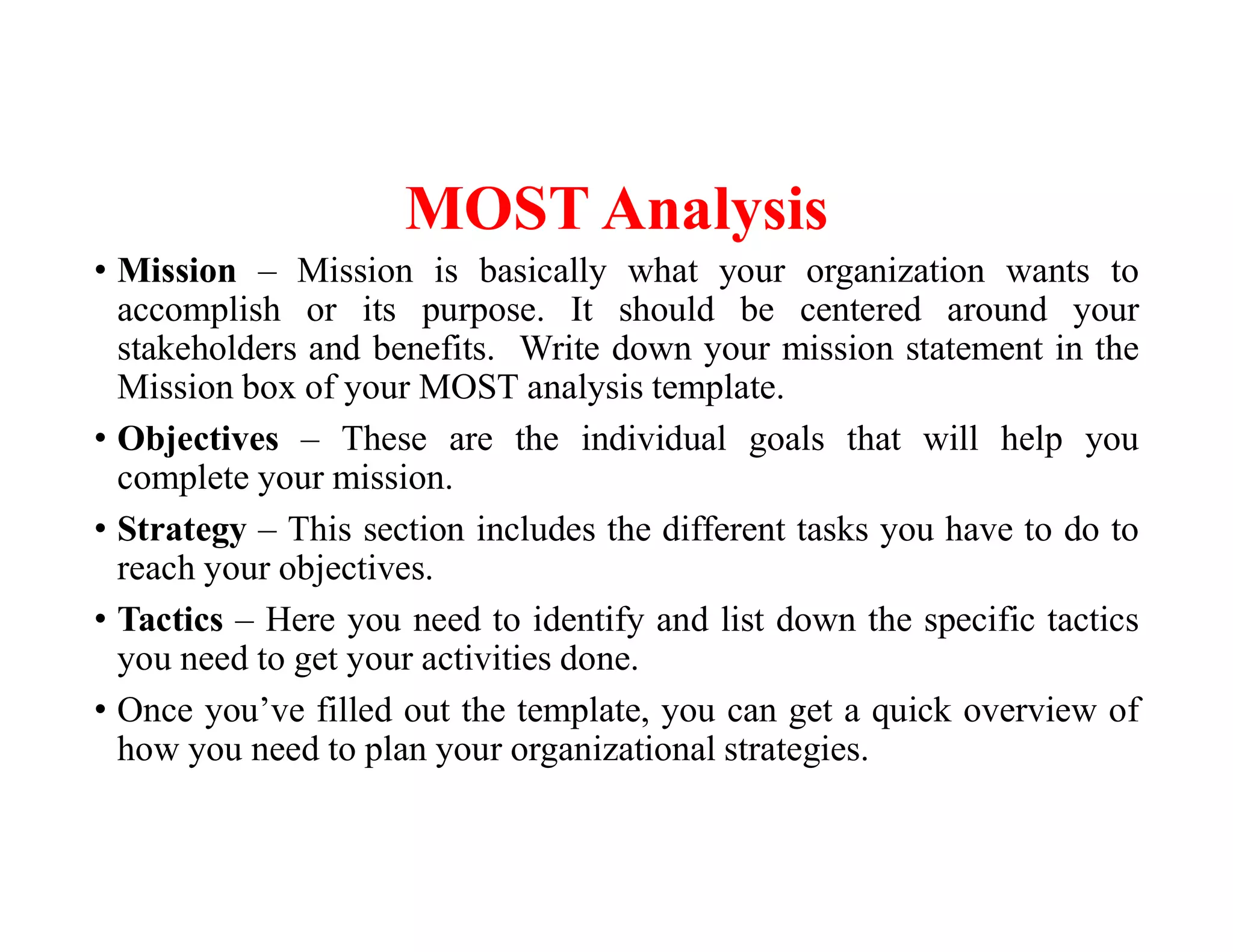
MOST Analysis
• Mission – Mission is basically what your organization wants to
accomplish or its purpose. It should be centered around your
stakeholders and benefits. Write down your mission statement in the
Mission box of your MOST analysis template.
• Objectives – These are the individual goals that will help you
complete your mission.
• Strategy – This section includes the different tasks you have to do to
reach your objectives.
• Tactics – Here you need to identify and list down the specific tactics
you need to get your activities done.
• Once you’ve filled out the template, you can get a quick overview of
how you need to plan your organizational strategies.
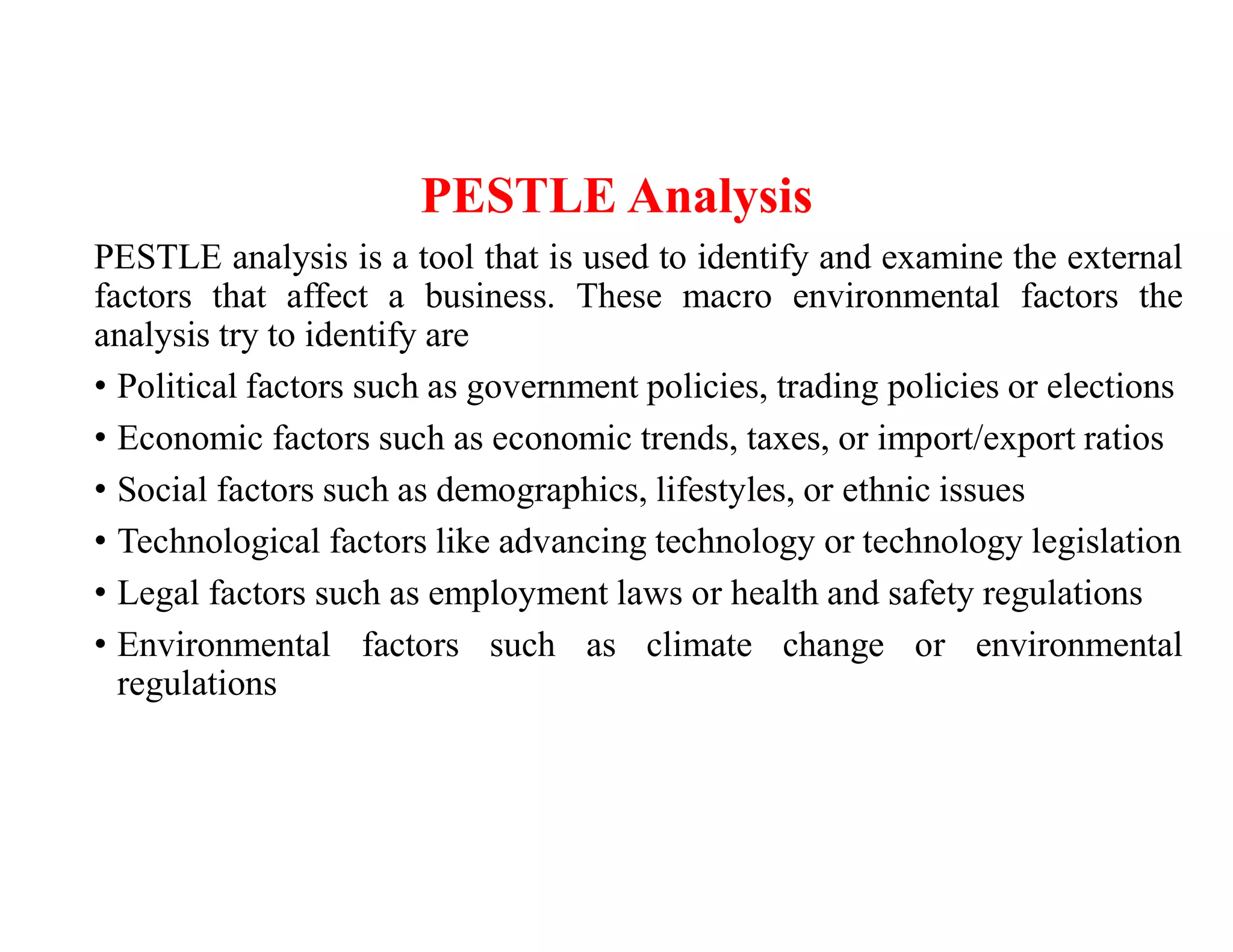
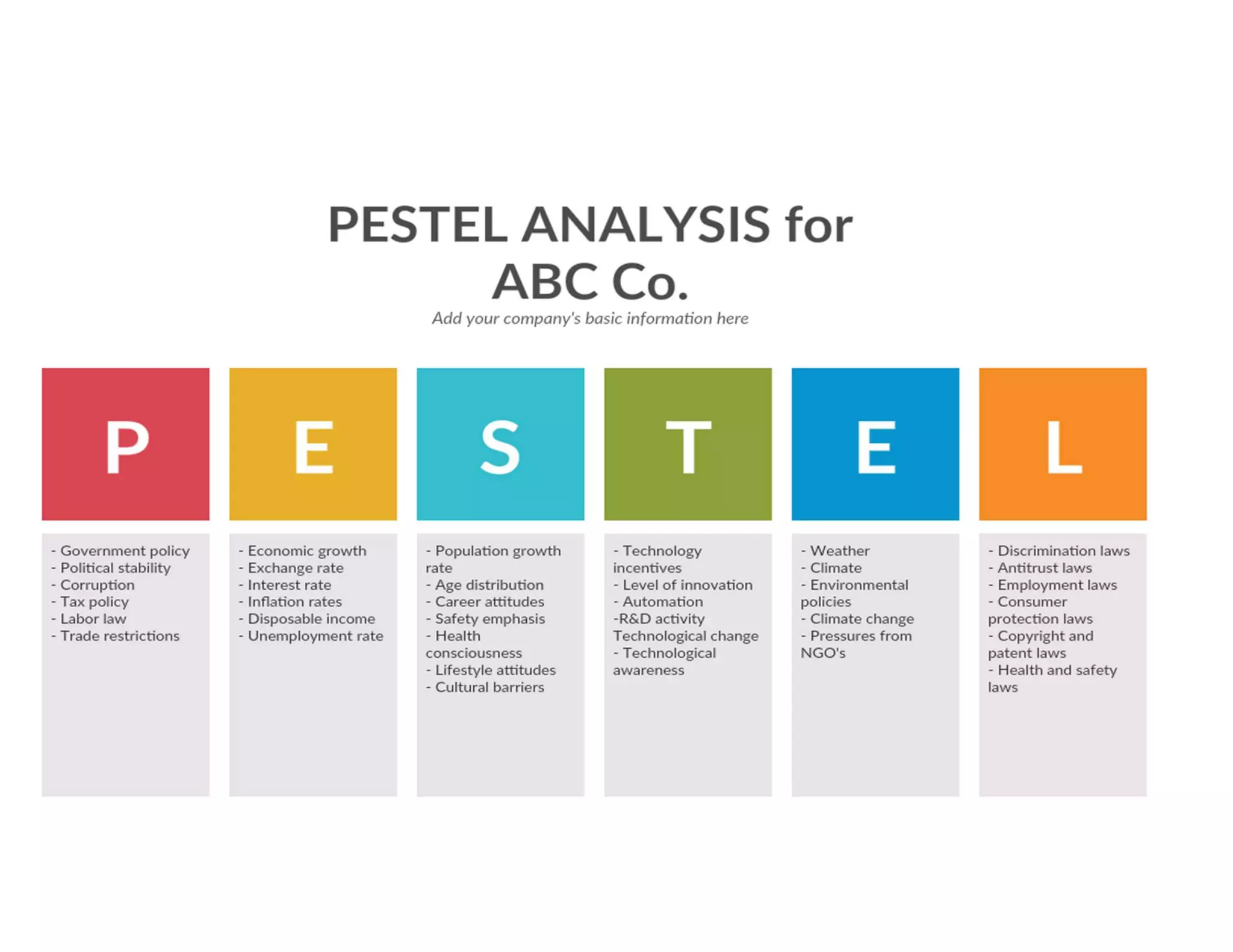
PESTLE Analysis
PESTLE analysis is a tool that is used to identify and examine the external
factors that affect a business. These macro environmental factors the
analysis try to identify are
• Political factors such as government policies, trading policies or elections
• Economic factors such as economic trends, taxes, or import/export ratios
• Social factors such as demographics, lifestyles, or ethnic issues
• Technological factors like advancing technology or technology legislation
• Legal factors such as employment laws or health and safety regulations
• Environmental factors such as climate change or environmental
regulations
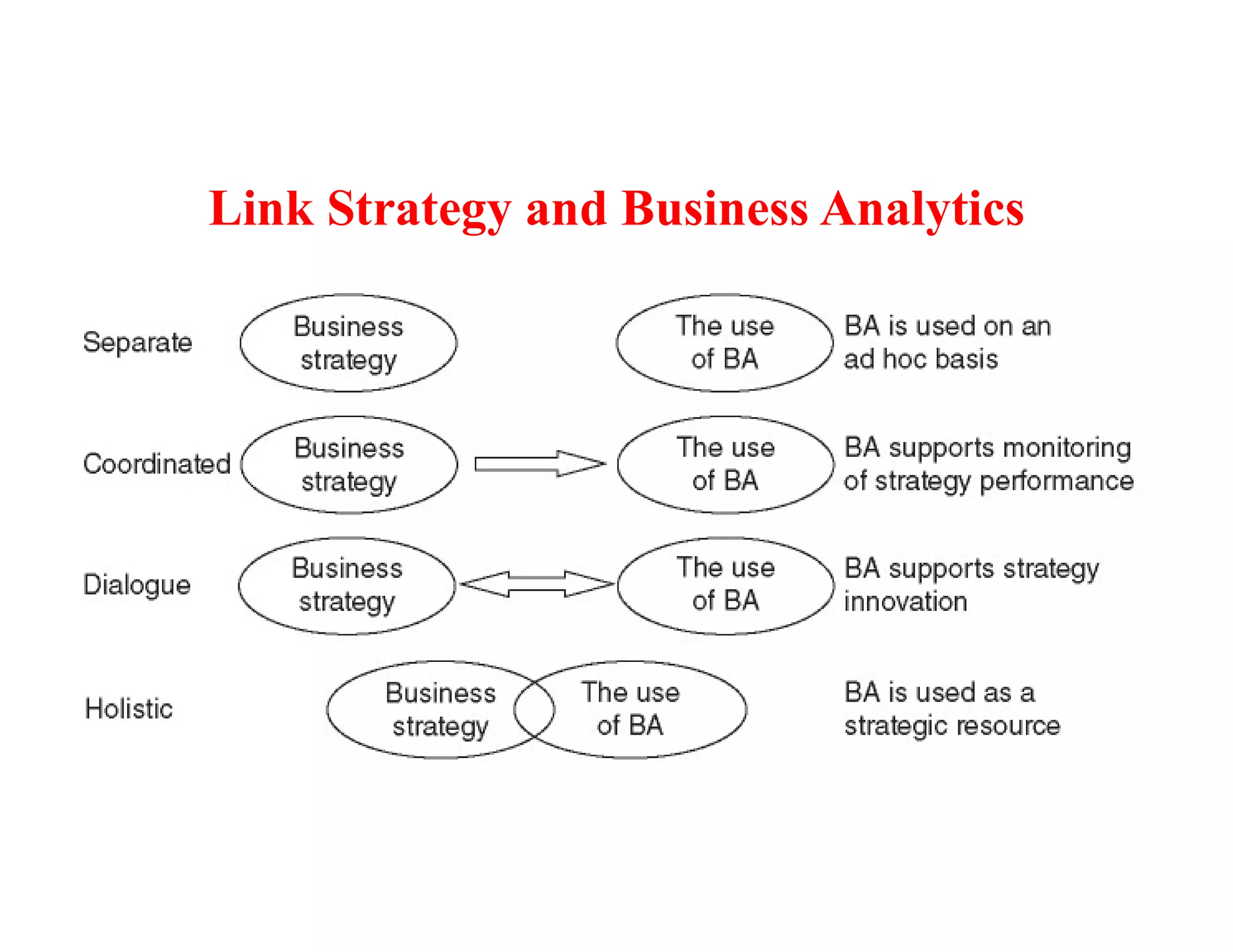
Link Strategy and Business Analytics
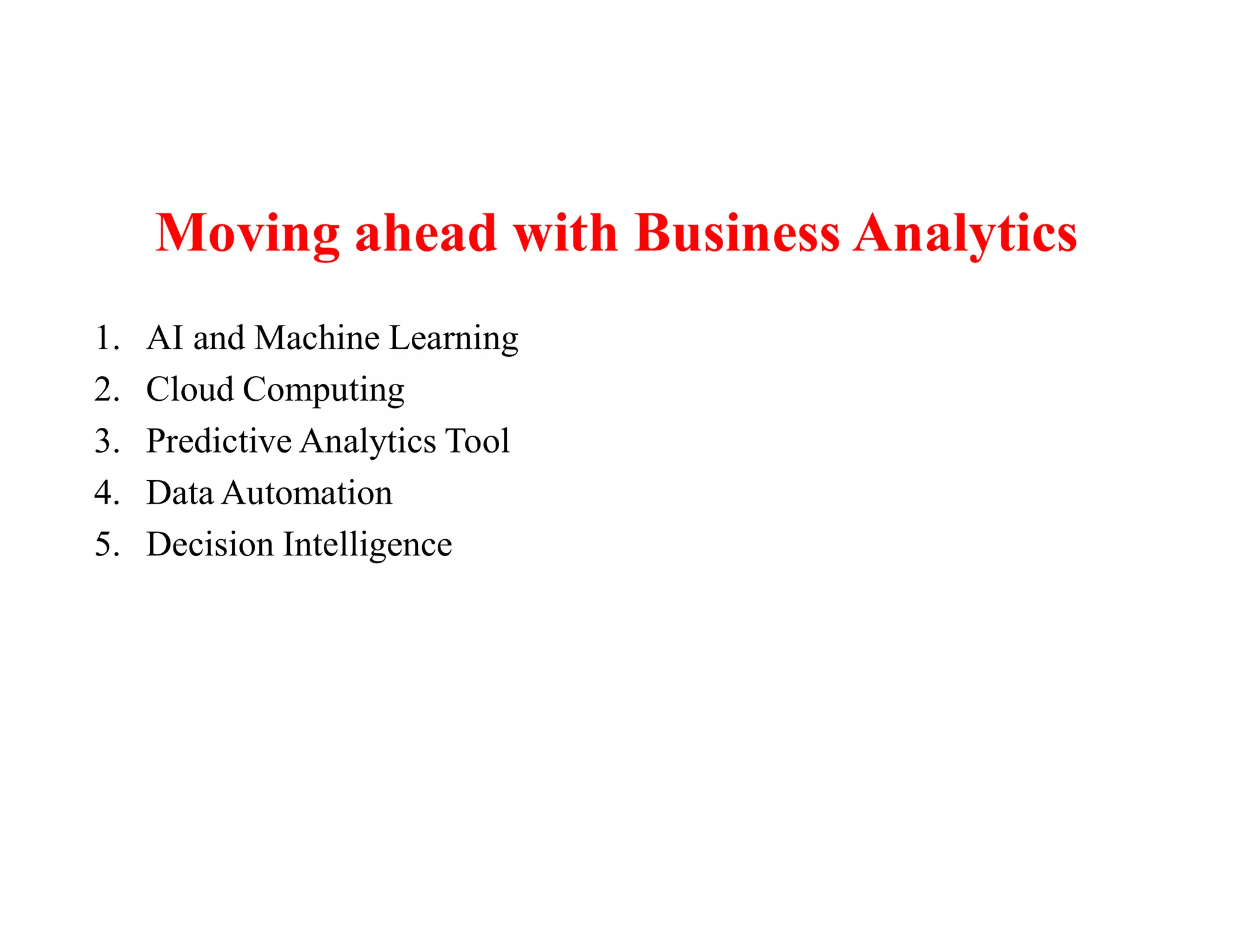
Moving ahead with Business Analytics
1. AI and Machine Learning
2. Cloud Computing
3. Predictive Analytics Tool
4. Data Automation
5. Decision Intelligence

Introduction to Business Analytics.pdf

  • 1.
    BUSINESS ANALYTICS By Prof. SukuThomas Samuel Department of Management
  • 2.
    Introduction to BusinessAnalytics • Name of the course : Business Analytics • Course code : BBA203B63 • Number of credits : 3 • Marks for the course : 75 marks : 50 marks for ESE + 25 marks for CIA
  • 3.
    Business Analytics: BBA203B63 Chaptername Chapter No Introduction to Business Analytics 1 Types of Business Analytics 2 Digital Data and Data Warehouse 3 Risk Return Measurement 4
  • 4.
    Chapter 1 Introduction toBusiness Analytics By Prof. Suku Thomas Samuel Department of Management
  • 5.
    Key terminologies Data isa sequence of characters or symbols that are stored and processed for analysis purposes. A database is an organized collection of structured information, or data, typically stored electronically in a computer system. A relational database is a type of database that stores and provides access to data points that are related to one another. Relational databases are based on the relational model, an intuitive, straightforward way of representing data in tables.
  • 6.
  • 7.
    Business Analytics What isAnalytics? Analytics is the process of discovering, interpreting, and communicating significant patterns in data. Applying analytics in context to business scenarios is called as Business Analytics.
  • 8.
    Business Analytics • Businessanalytics (BA) refers to the skills, technologies, and practices for continuous iterative exploration and investigation of past business performance to gain insight and drive business planning. • Business analytics focuses on developing new insights and understanding of business performance based on data and statistical methods. • Business analytics makes extensive use of analytical modeling and numerical analysis, including explanatory and predictive modeling, and fact-based management to drive decision making.
  • 9.
    Steps to BusinessAnalytics Data driven decisions Analysis to generate insights Processing Data Collecting Data
  • 10.
    History of BusinessAnalytics • 1865 - Staying ahead Mr. Richard Miller Devens described in his book - Cyclopaedia of Commercial and Business Anecdotes, how Sir Henry Furnese, a British banker of 16th century, was always one step ahead by actively gathering information and acting on it before any of his competitors. • 1890 - Introduction of Scientific Management It took over seven years for the U.S. Census Bureau to process the collected information and complete a final report. Inventor Herman Hollerith produced a “tabulating machine”. The tabulating machine helped in processing data recorded on punch card and the census of 1890 was finished in 18 months.
  • 11.
    History of BusinessAnalytics • Late 1800s - Introduction of Scientific Management Frederick Taylor introduced the first-ever system of business analytics in the USA. The approach was called scientific management. The purpose of the system was to analyze the production techniques and laborer's body movements to identify greater efficiencies. • Early 1900s - Transformation of the Manufacturing Industry Henry Ford introduced the assembly line of production, and the analysis transformed the manufacturing industry across the globe.
  • 12.
    History of BusinessAnalytics • 1950s - First hard drive disk by IBM Computers had a massive demand during World War II. Until then punch cards or tapes were used to store information. In 1956, the tech giant, IBM invented the first hard disk drive which allowed users to save a vast amount of data with better flexibility. • 1970’s – Relational databases Relational databases were invented by Edgar F. Codd in the 1970s and became quite popular in the 1980s. Relational databases (RDBMs), in turn, allowed users to write in sequel (SQL) and retrieve data from their database.
  • 13.
    History of BusinessAnalytics • Late 1980s - Emergence of Business Intelligence Business intelligence solutions emerged. However, there was a considerable amount of data available but not a centralized place to store it. Ralph Kimball and Bill Inmon proposed strategies to build data warehouses (DW). • Early 2000's - Relational Databases Companies like SAP, Microsoft, SAS and IBM introduced various solutions and software with relational databases. • 2005: Big data! In 2005, big data was coined by Roger Magoulasdescribing a large amount of data, which seemed almost impossible to cope with using the Business Intelligence tools available at the time
  • 14.
    History of BusinessAnalytics Punch card used in early 1900’s
  • 15.
    History of BusinessAnalytics Tape drives used in 1940’s
  • 16.
    History of BusinessAnalytics Hard drive used in 1970’s
  • 17.
    History of BusinessAnalytics Inside a data center
  • 18.
    Components of BusinessAnalytics The following are the core components of Business Analytics: 1. Data Storage • Data needs to be stored for future use. • Approach to storage can be file storage, object storage or block storage. 2. Data Visualization • Representation of the date using visual aids. • Makes the communication of outputs to the stakeholder easier. 3. Data Insights • Outputs generated by processing data. • Refers to the inferences/ conclusions drawn from data. 4. Data Security • Monitoring and identifying malicious activities in the security networks. • Identifying vulnerabilities in the system.
  • 19.
  • 20.
    Benefits of BusinessAnalytics • Data-driven decisions Quantifying root causes and clearly identifying trends creates a smarter way to look at the future of an organization to take better decisions. • Easy visualization Business analytics software helps in taking bid data and turn it into simple-yet-effective visualizations. • Go augmented Augmented analytics uses the ability to self-learn, adapt, and process bulk quantities of data to automate processes and generate insights without human bias. • Modelling of what-if scenario Creates models for users to look for trends and patterns that will affect future outcomes.
  • 21.
    Benefits of BusinessAnalytics • Budget specific decisions Application of business analytics helps with better decisions with increase in resource utilisation and minimising wastage. • Increase efficiency Business analytics helps to take real time decisions helping business to increase and improve efficiency. • Measure progress Helps in measuring the performance of the business with real time data analytics and attain goals.
  • 22.
    Types of BusinessAnalytics There are four (five) types of Business Analytics models: 1. Descriptive Analytics 2. Diagnostics Analytics 3. Predictive Analytics 4. Prescriptive Analytics 5. Cognitive Analytics
  • 23.
    Scope of BusinessAnalytics The scope of Business Analytics are as follows: 1. Client Relationship Management • Organization can accurately monitor and quantify customer service factors and consumer gratification • Make appropriate corrections and ensure client retention. 2. Inventory Management • Efficiently manage the inventory for profit maximization and growing customer delight. • Help to reduce loss of revenue and minimise cost.
  • 24.
    Scope of BusinessAnalytics 3. Market Analysis: • Helps companies to predict customer purchasing patterns for the future. 4. HR Professionals • HR analytics helps in HR functions. 5. Banking • Helps banking players to effectively profile customers.
  • 25.
  • 26.
    MOST Analysis • Mission– Mission is basically what your organization wants to accomplish or its purpose. It should be centered around your stakeholders and benefits. Write down your mission statement in the Mission box of your MOST analysis template. • Objectives – These are the individual goals that will help you complete your mission. • Strategy – This section includes the different tasks you have to do to reach your objectives. • Tactics – Here you need to identify and list down the specific tactics you need to get your activities done. • Once you’ve filled out the template, you can get a quick overview of how you need to plan your organizational strategies.
  • 27.
    PESTLE Analysis PESTLE analysisis a tool that is used to identify and examine the external factors that affect a business. These macro environmental factors the analysis try to identify are • Political factors such as government policies, trading policies or elections • Economic factors such as economic trends, taxes, or import/export ratios • Social factors such as demographics, lifestyles, or ethnic issues • Technological factors like advancing technology or technology legislation • Legal factors such as employment laws or health and safety regulations • Environmental factors such as climate change or environmental regulations
  • 29.
    Link Strategy andBusiness Analytics
  • 30.
    Moving ahead withBusiness Analytics 1. AI and Machine Learning 2. Cloud Computing 3. Predictive Analytics Tool 4. Data Automation 5. Decision Intelligence