INTRODUCTION TO BASIC CONCEPTS IN REFRIGERATION.pptx
This presentation describes the basic concepts of refrigeration, difference between heat pump and refrigeration, the methods and units of refrigeration and its applications.
INTRODUCTION TO BASIC CONCEPTS IN REFRIGERATION.pptx
1.
Chapter One
BASIC CONCEPTSIN REFRIGERATION
Henok G.
ARBA MINCH UNIVERSITY
SAWLA CAMPUS
DEPARTMENT OF AUTOMOTIVE
ENGINEERING
Refrigeration & Air conditioning (EMEng4203)
03/21/2025
2.
OUTLINES
2
Basic concepts– Refrigeration
Refrigerator and Heat pumps
Methods of refrigeration
Unit of refrigeration
Coefficient of performance of a Refrigerator
Applications of Refrigeration
3.
1.1 Basic concepts– Refrigeration
3
Refrigeration is the process of removing heat from a substance under
controlled conditions.
It also includes the process of reducing and maintaining the temperature of
a body below the general temperature of its surroundings.
In other words, the refrigeration means continued extraction of heat from a
body whose temperature is already below the temperature of its
surroundings.
For example, if some space (say in cold storage) is to be kept at -2°C
(271K), we must continuously extract heat which flows into it due to
leakage through the walls and also the heat which is brought into it with the
particles stored after the temperature is once reduced to -2°C (271K).
Thus in a refrigerator, heat is virtually being pumped from a lower
temperature to a higher temperature.
4.
4
According toSecond Law of Thermodynamics, this process can only be performed with
the aid of some external work. It is thus obvious that supply of power (say electric
motor) is regularly required to drive a refrigerator.
Theoretically, a refrigerator is a reversed heat engine or a heat pump which pumps heat
from a cold body and delivers it to a hot body.The substance which works in a heat pump
to extract heat from a cold body and to deliver it to a hot body is called a refrigerant.
The refrigeration system is known to the man since the middle of nineteenth century.
The scientists, of the time, developed a few stray machines to achieve some pleasure. But
it paved the way by inviting the attention of scientists for proper studies and research.
They were able to build a reasonably reliable machine by the end of nineteenth century
for refrigeration jobs. But with the advent of efficient rotary compressors and gas
turbines, the science of refrigeration reached the present height.
Today it is used for the manufacture of ice and similar products. It is also widely used for
the cooling of storage chambers in which perishable foods, drinks and medicines are
stored. The refrigeration has also wide applications in submarine ships, aircraft and
rockets
5.
1.2 Refrigerator andHeat pump
5
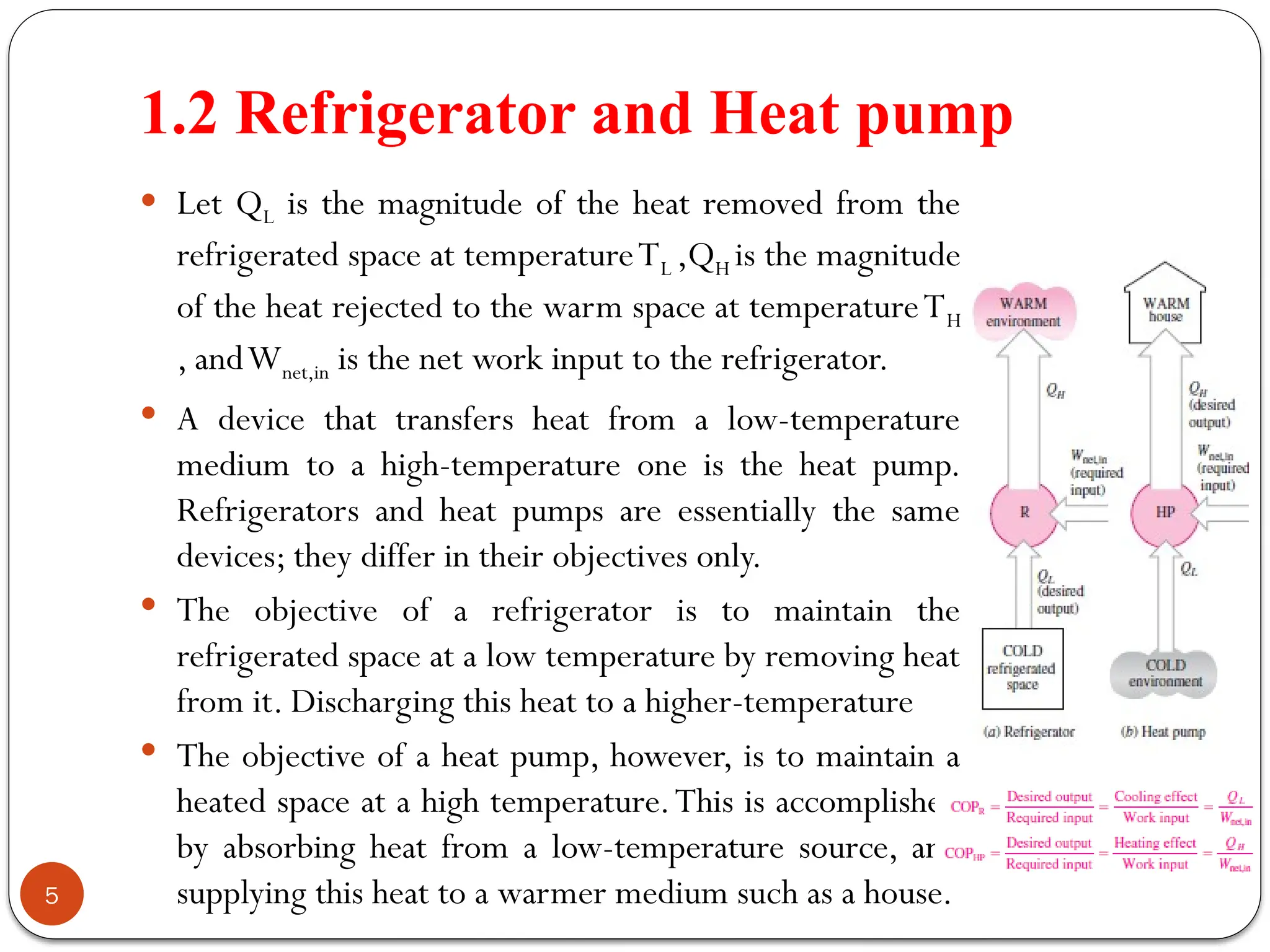
Let QL is the magnitude of the heat removed from the
refrigerated space at temperatureTL ,QH is the magnitude
of the heat rejected to the warm space at temperatureTH
, andWnet,in is the net work input to the refrigerator.
A device that transfers heat from a low-temperature
medium to a high-temperature one is the heat pump.
Refrigerators and heat pumps are essentially the same
devices; they differ in their objectives only.
The objective of a refrigerator is to maintain the
refrigerated space at a low temperature by removing heat
from it. Discharging this heat to a higher-temperature
The objective of a heat pump, however, is to maintain a
heated space at a high temperature.This is accomplished
by absorbing heat from a low-temperature source, and
supplying this heat to a warmer medium such as a house.
6.
1.3 METHODS OFREFRIGERATION
1.3.1. Natural Methods
6
Use of ice: ice can be found naturally or made by nocturnal cooling. In the later
method ice was made by keeping a thin layer of water in a shallow earthen tray, and
then exposing the tray to the night sky.
Compacted hay of about 0.3 m thickness was used as insulation.The water looses heat
by radiation to the stratosphere, which is at around -55°C and by early morning hours
the water in the trays freezes to ice.
But, ice is not available every place and it can not meet the desired low temperature..
Use of water/ice and salt mixture: Certain substances such as common salt,
when added to water dissolve in water and absorb its heat of solution from water
(endothermic process).
This reduces the temperature of the solution (water+salt). Sodium Chloride salt
(NaCl) can yield temperatures up to -20°C and Calcium Chloride (CaCl2) up to -
50°C in properly insulated containers.
However, as it is this process has limited application, as the dissolved salt has to be
recovered from its solution by heating.
In many towns, ice-cream is made using hand freezers employing ice and salt mixture
for freezing of ice-cream.
7.
7
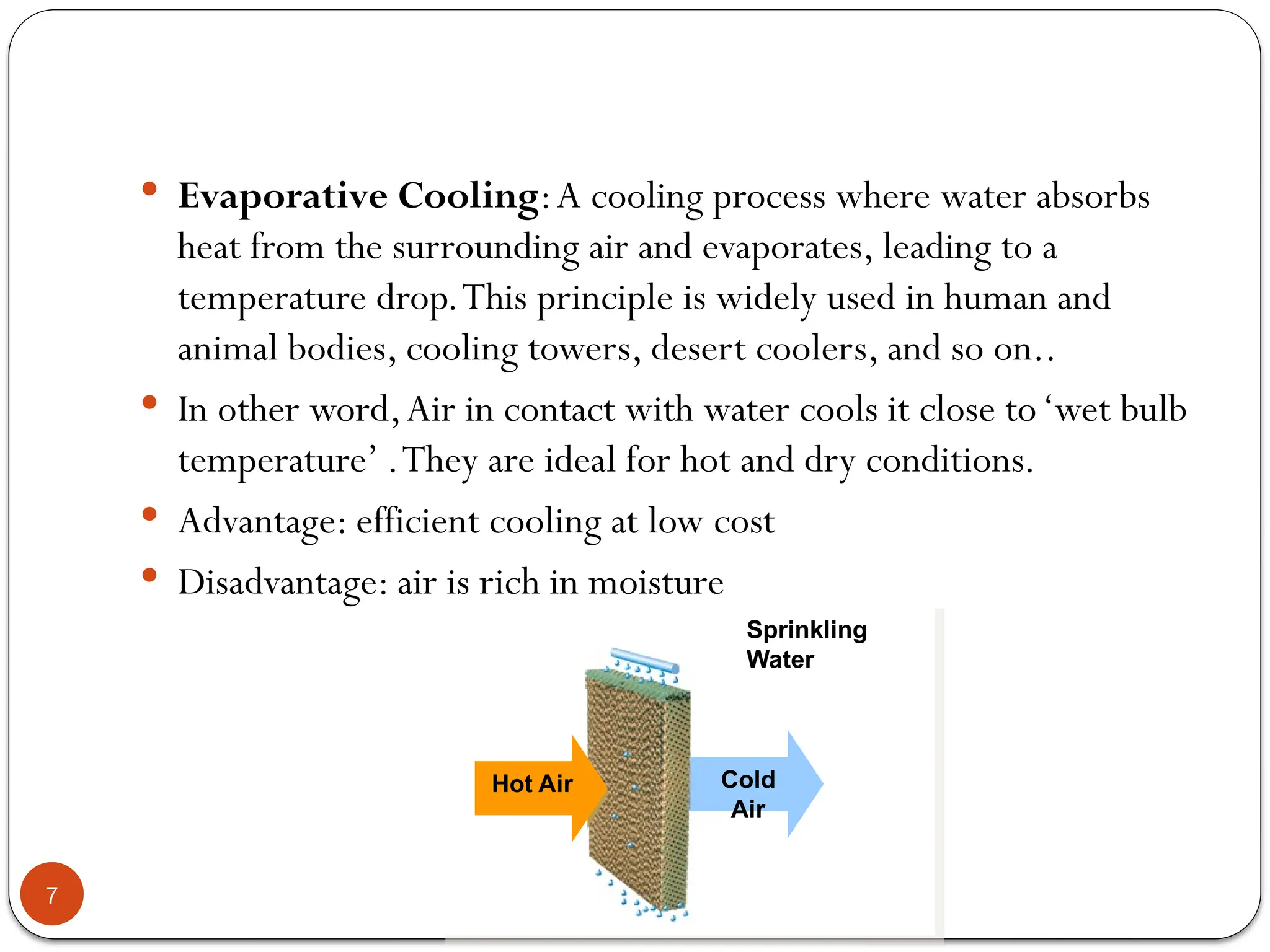
Evaporative Cooling:Acooling process where water absorbs
heat from the surrounding air and evaporates, leading to a
temperature drop.This principle is widely used in human and
animal bodies, cooling towers, desert coolers, and so on..
In other word,Air in contact with water cools it close to‘wet bulb
temperature’ .They are ideal for hot and dry conditions.
Advantage: efficient cooling at low cost
Disadvantage: air is rich in moisture
Cold
Air
Hot Air
Sprinkling
Water
8.
1.3.2. Artificial methods
8
It acts by evaporating a special liquid (a refrigerant).The heat required for
evaporation is absorbed from an enclosed area or material, reducing the
temperature of the area.
So, the refrigerant in the fridge evaporates by absorbing the heat from the
food and the surroundings, keeping the insides cool!
This refrigeration system can be:
Vapour Compression Refrigeration (VCR): uses mechanical energy
and operates by compressing a refrigerant gas, condensing it into a liquid,
and then allowing it to evaporate in a controlled manner to absorb heat. It
was first built by Jakob Perkins.
Vapour Absorption Refrigeration (VAR): Unlike vapour compression
systems, this refrigeration system does not use a mechanical compressor.
Instead, it relies on a heat source (such as gas, solar energy, or waste heat)
9.
9
Some ofthe refrigeration systems may include:
Gas/Air Cycle Refrigeration System: This system uses air/gas as the
working fluid.The cycle follows these steps:
Air is compressed, increasing its pressure and temperature.
The high-pressure air is cooled in a heat exchanger.
The cooled air is expanded in an expansion device, significantly lowering its
temperature.
This type of system is primarily used in aircraft refrigeration due to its
lightweight and high-reliability characteristics.
The gas cycle is less efficient than the vapor compression cycle because the
gas cycle works on the reverse Brayton cycle instead of the reverse
Rankine cycle.
Vapour Jet Refrigeration: Uses a high-velocity steam jet to create a
vacuum that induces cooling. It is often employed in industrial cooling
applications where waste heat is available.
10.
10
Thermoelectric Refrigeration:Based on the Peltier effect, where
electric current generates a temperature difference across two
semiconductor materials. It is used in portable coolers, medical
refrigeration, and space applications.
VortexTube Refrigeration:A system that separates compressed air
into hot and cold streams using a vortex effect, commonly used for spot
cooling in industrial applications.
Intermittent-Solar Refrigeration:A system that uses solar energy to
drive an absorption refrigeration cycle in an intermittent manner, making
it useful for off-grid cooling solutions.
Combined Cycles:A hybrid approach integrating multiple
refrigeration technologies to enhance efficiency and performance,
commonly used in advanced cooling systems for power plants and
industrial applications.
11.
1.4 UNIT OFREFRIGERATION
11
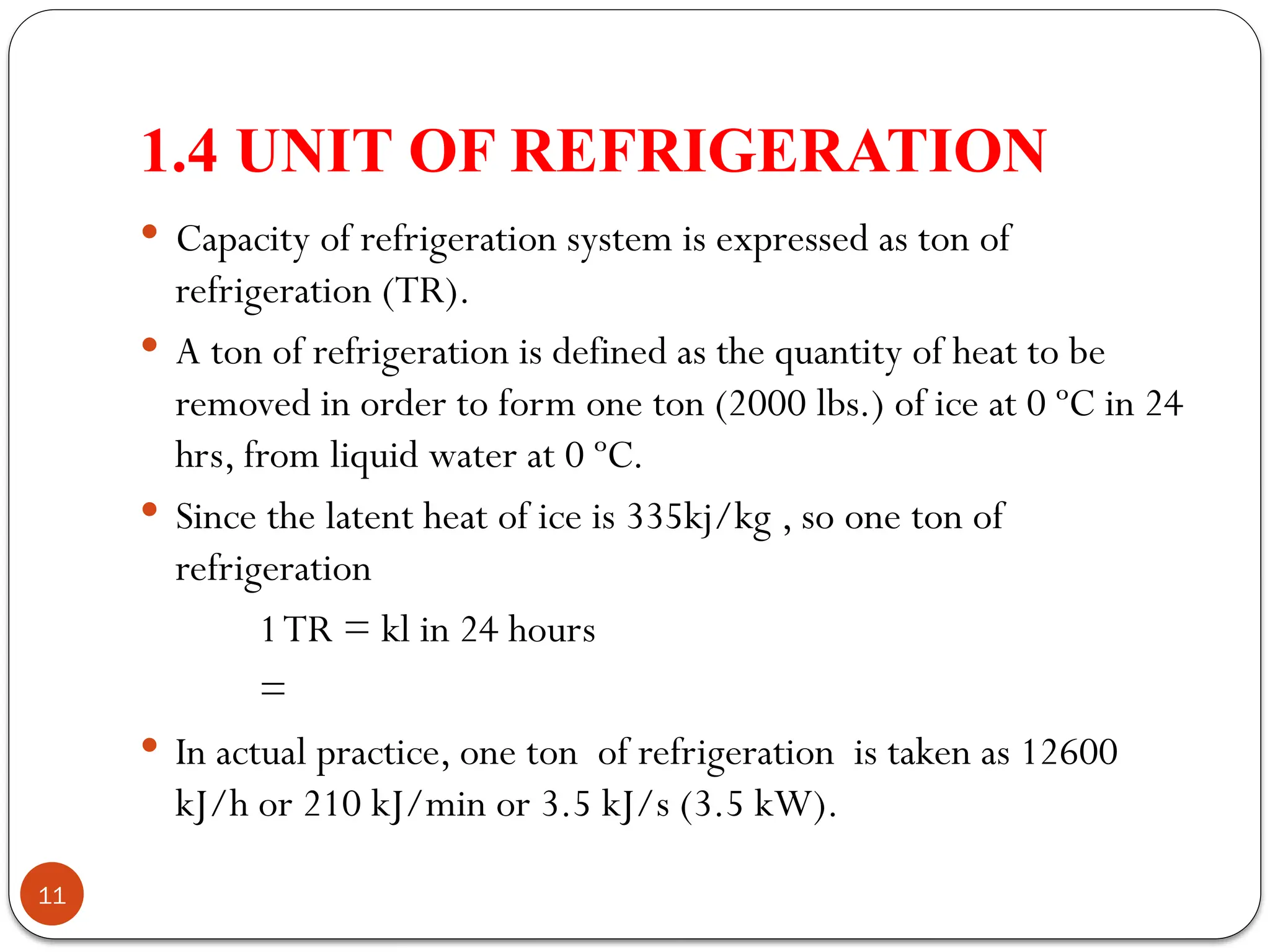
Capacity of refrigeration system is expressed as ton of
refrigeration (TR).
A ton of refrigeration is defined as the quantity of heat to be
removed in order to form one ton (2000 lbs.) of ice at 0 ºC in 24
hrs, from liquid water at 0 ºC.
Since the latent heat of ice is 335kj/kg , so one ton of
refrigeration
1TR = kl in 24 hours
=
In actual practice, one ton of refrigeration is taken as 12600
kJ/h or 210 kJ/min or 3.5 kJ/s (3.5 kW).
12.
1.5 Coefficient ofPerformance of a
Refrigerator
12
Coefficient of Performance(COP) is the ratio of heat extracted in
the refrigerator to the work done on the refrigerant.
Q = amount of heat extracted in the
refrigerator(capacity of refrigerator)
W = amount of work done on the refrigerant.
Relative COP is the ratio ofActual COP to theoretical COP.
The COP is always greater than 1 and known as
theoretical coefficient of performance.
13.
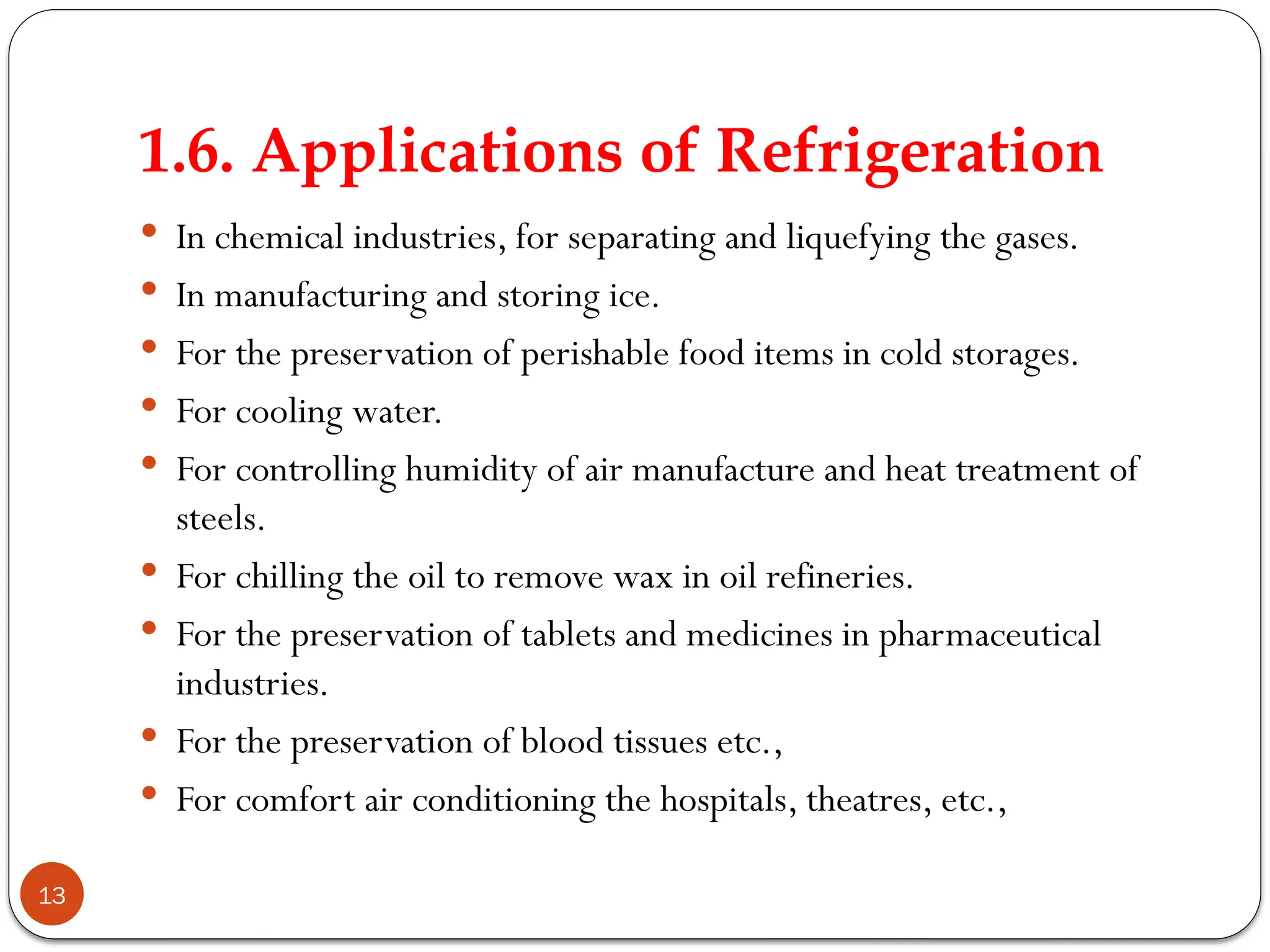
1.6. Applications ofRefrigeration
13
In chemical industries, for separating and liquefying the gases.
In manufacturing and storing ice.
For the preservation of perishable food items in cold storages.
For cooling water.
For controlling humidity of air manufacture and heat treatment of
steels.
For chilling the oil to remove wax in oil refineries.
For the preservation of tablets and medicines in pharmaceutical
industries.
For the preservation of blood tissues etc.,
For comfort air conditioning the hospitals, theatres, etc.,
#7 evaporation of part of water takes place by using sensible heat of the
same air. As the sensible heat of the air decreases, the dry bulb temperature of the air decreases.
#9
Air is cheap, safe, non-toxic and non-flammable. Leakage of air is not a problem
ii. Cold air can directly be used for cooling thus eliminating the low temperature heat exchanger (open systems) leading to lower weight
iii. The aircraft engine already consists of a high speed turbo-compressor, hence separate compressor for cooling system is not required. This reduces the weight per kW cooling considerably. Typically, less than 50% of an equivalent vapour compression system
iv. Design of the complete system is much simpler due to low pressures. Maintenance required is also less.


![[1] Introduction to Refrigeration Systems_removed.pdf](https://cdn.slidesharecdn.com/ss_thumbnails/1introductiontorefrigerationsystemsremoved-250209055201-82af8ab5-thumbnail.jpg?width=640&height=640&fit=bounds)


![Refrigeration_and_Air_conditioning_03-08-23[1] short.pdf](https://cdn.slidesharecdn.com/ss_thumbnails/refrigerationandairconditioning03-08-231short-240807114508-73019542-thumbnail.jpg?width=640&height=640&fit=bounds)


