Course Code : HRT 552
Course Title : BIOTECHNOLOGY OF
HORTICULTURAL CROPS
Lecture 2: Introduction to basic biotechnology
(Importance, prospects, scope and limitations of bio-technology in
horticulture)
This Photo by Unknown Author is licensed under
we need better and more efficient ways to
produce food
With increasing demand for food and
limiting resources...
one option is through
Biotechnology
Bio - life
Technology
- any technique or
procedure to develop
new products
Biotechnology
- any technique that uses whole or part
of a living thing to make new products,
improve or develop plants, animals
and other organisms for specific use
Crops biotechnology
3. Varieties resistant to pests and diseases
2. High yielding crops
4. Improved postharvest qualities
1. Tissue cultured planting materials
5. Improved food quality and food processing
5. Improved quality traits
Genetic engineering
Technique that transfers gene(s)
of interest to develop and
improve plants, animals and
other organisms
- basic physical and functional
units of heredity which carries
information for the expression of
a particular trait
Gene
Conventional
Breeding
Wild
Relative
Crop
Plant
Genetic
Engineering
Wild
Relative
Crop
Plant
• limited to exchanges between
the same or very closely
related species
• little or no guarantee of
obtaining any particular gene
combination from the millions
of crosses generated
• undesirable genes can be
transferred along with
desirable genes
• take a long time to achieve
desired results
Conventional Breeding Genetic Engineering
• Allows the direct transfer of
one or just a few genes,
between either closely or
distantly related organisms
• Crop improvement can be
achieved in a shorter time
compared to conventional
breeding
Products developed through genetic engineering
Genetically Modified
Organisms (GMOs) = Transgenics
Organic agriculture and GMO’s
- GMO is not a part of Organic farming
• GM crops contribute to a reduction in fuel use due to less-frequent
herbicide or insecticide applications and a reduction in the energy use
in soil cultivation. Reduced soil cultivation is associated with herbicide
tolerant crops.
Greenhouse
• Papaya with delayed ripening trait
• Papaya resistant to ringspot virus
Laboratory
• Mango with delayed ripening trait
• Rice resistant to tungro virus
• Vitamin A-enriched rice
• Banana resistant to bunchy top
disease
• Coconut with higher amount of
MCTs
• Sweet potato resistant to feathery
mottle virus
Rice help to overcome Vitamin-A deficiency
among kids
Genetic Engineering
• Engineering the genes
• Modifying the genes
• Insert desirable gene (Bt gene/ CryAc1)
• Insert gene of interest
• Gene transfer to host require Vector
Commonly used vector- Plasmid (small, circular, double
stranded, self replicating extra chromosomal material of bacteria)
• First recombinant DNA was constructed- Stanley Cohen &
Herbert Boyer (1972) by linking gene encoding for antibiotic
resistance with plasmid of Salmonella typhimurium
• Isolation of desirable gene (antibiotic resistant)- cutting out piece of
DNA from a plasmid responsible of antibiotic resistance which involve
‘molecular scissors’- restriction enzymes
• Desirable gene/ alien DNA – linked with plasmid (vector) to transfer into
host organism
• Linking of DNA involves DNA ligase- acts on cut DNA molecules & join
their ends- new combination circular autonomously replicating DNA
created in vitro- Recombinant DNA
Some basic concepts
• Restriction enzymes belongs to nuclease class of
enzymes. Its of two types:
1. Restriction exonuclease – removes nucleotides
from the end of DNA
2. Restriction endonuclease – cut at specific
positions within DNA
Haploid Breeding / Double Haploid
• Haploid cells are produced from pollen or egg cells or from other
cells of the gametophyte
• By induced or spontaneous chromosome doubling, a doubled
haploid cell is produced, which can be grown into a doubled
haploid plant.
• A doubled haploid (DH) is a genotype formed when haploid cells
undergo chromosome doubling. Artificial production of doubled
haploids is important in plant breeding.
• If the original plant was diploid, the haploid cells are monoploid,
and the term doubled monoploid may be used for the doubled
haploids.
Advantages
• The ability to produce homozygous lines after a single round
recombination saves a lot of time for the plant breeders.
• Studies conclude that random DH’s are comparable to the selected
lines in pedigree inbreeding.
• The other advantages include development of large number of
homozygous lines, efficient genetic analysis and development of
markers for useful traits in much less time.
• More specific benefits include the possibility of seed propagation as an
alternative to vegetative multiplication in ornamentals, and in species
such as trees in which long life cycles and inbreeding depression
preclude traditional breeding methods, doubled haploidy provides new
alternatives.
Embryo culture
•Embryo culture is the culture of isolated
immature or mature embryos.
•Zygotic or seed embryos are often used
advantageously as explants in plant tissue
culture, for example, to initiate callus cultures.
•This embryo develops properly when
nourishing tissue; endosperm was present in
the seed during the development.
Use of Embryo culture
• Breeding of incompatible interspecific and
intergeneric species
• Overcoming seed dormancy
• Determination of seed viability
• Recovery of maternal haploids that develop as a
result of chromosome elimination following
interspecific hybridization
• Used in studies on the physiology of seed
germination and development
Protoplasm fusion
•Protoplast fusion has opened up a novel approach to
raising new hybrids.
•This technique of hybrid production through the
fusion of body cells, bypassing sex altogether, is called
somatic hybridization.
•During enzymatic degradation of cell walls some of
the adjacent protoplasts fuse together forming
homokaryons (also referred to as homokaryocytes,
each with two to several nuclei)
Somatic hybrids and cybrids
• Fusion products with the nucleus of one parent and extra-nuclear
genome/s of the other parent are referred to as cybrid
• The process to obtain cells or plants with such genetic combination/s
is called cybridization.
In vitro mutation
• When mutation is produced in a segment of cloned DNA.
• The DNA is then inserted into a cell or organism, and the effects
of the mutation are studied.
• Mutations are useful to geneticists in enabling them to
investigate the components of any biological process.
Synthetic seeds/Synseeds
• A synthetic seed is defined as an artificially encapsulated
somatic embryo (protocorm-like bodies in case of orchids) or
meristematic tissue (shoot tips, nodal segments, corm, and
bulb) that portrays the role of a seed and has the proficiency of
germinating into complete plantlets.
Cryopreservation
• Preservation at extreme low temperature.
• The process of cooling and storing cells, tissues,
or organs at very low temperatures to maintain
their viability.
• For example, the technology of cooling and storing
cells at a temperature below the freezing point (‘-196'
C) permits high rates of survivability of the cells upon
thawing.
• Liquid Nitrogen
• Liquid CO2
International Symposium Feb15-17, Rome
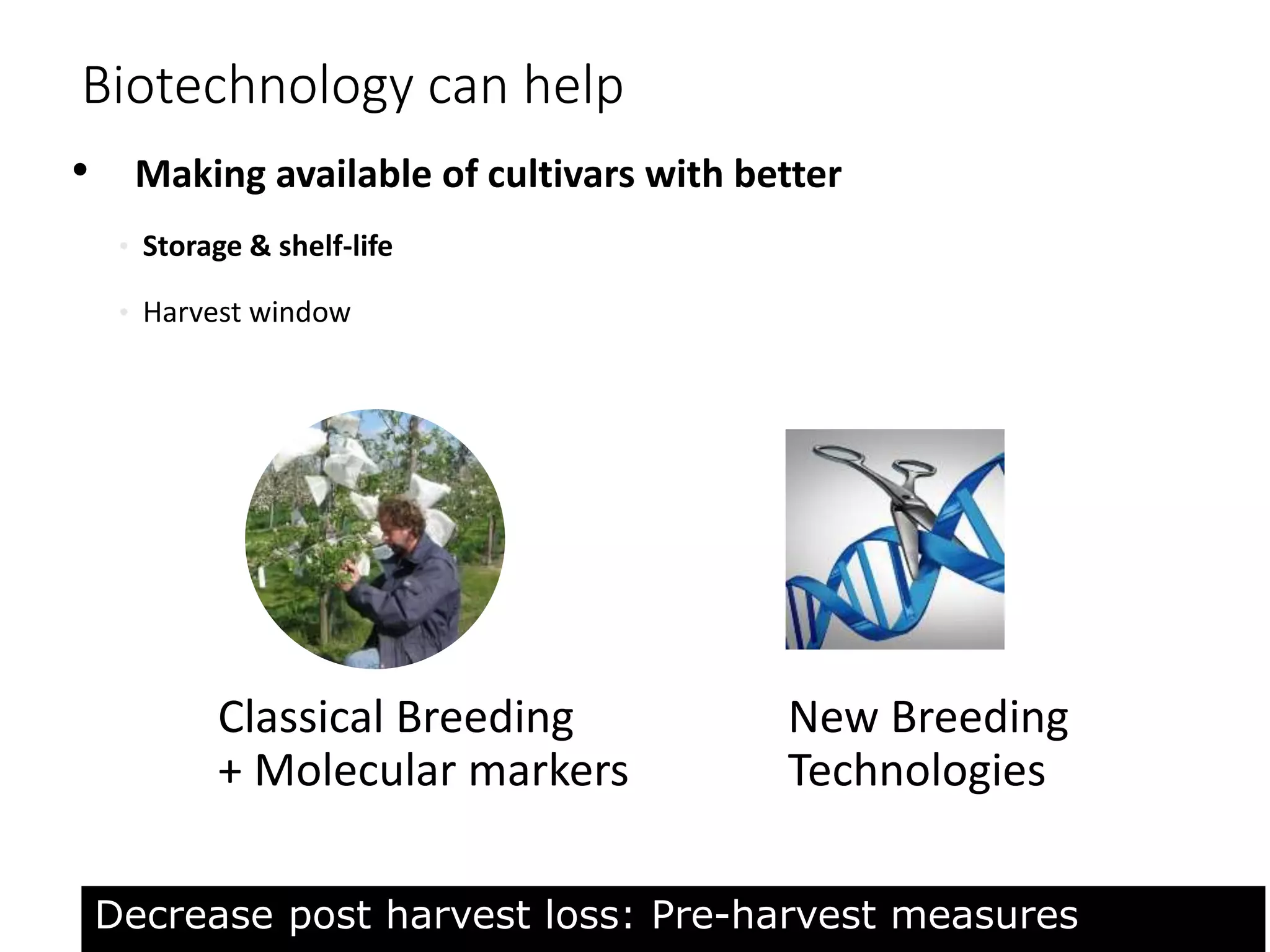
Biotechnology can help
• Making available of cultivars with better
• Storage & shelf-life
• Harvest window
Classical Breeding
+ Molecular markers
New Breeding
Technologies
Decrease post harvest loss: Pre-harvest measures
International Symposium Feb15-17, Rome
Experiences Tomato, apple......
• Some specific genes involved in
1. Production and perception of ethylene in fruit
2. Production/ activity cell-wall degrading enzymes
ACS
ACO
Ethylene
ETR
Effects
ACO-Gene
2 genes for
production
1 gene for
perception
- Other functions maintained !
- On-off switches
On/
Off
On/
Off
One for fruit maturation
- On-switch corrupted
- No ethylene production
- Deletion of 2 nucleotides
International Symposium Feb15-17, Rome
Prospects Tropical crops: Mango?
• Harvested fruit: Limited storability & shelf-life
• ~96% production for home-market, ~4% export
 Storability & shelf improved:
● Harvesting unripe fruit
● Forced ripening close to selling:
● Ethylene + Temperature treatment
● Less tasty
http://www.fruitnet.com/americafruit/article/164144/first-aussie-mangoes-shipped-to-the-us
http://www.dawn.com/news/1182818 http://www.skymetweather.com/content/agriculture-and-economy/mango-exports-from-india-
face-a-hard-time/
http://www.ctvnews.ca/business/why-the-eu-alphonso-mango-ban-s-sweet-news-in-india-1.1809895
International Symposium Feb15-17, Rome
GM-fruit: Current status
•Approved
• Apple No flesh browning
• Eggplant Insect resistance
• Plum Virus resistance
• Melon Storability, shelf-life
• Papaya Virus resistance
• Tomato Storability, shelf-life,
•Field tests
• Banana Black Sigatoka fungus
• Orange Citrus greening
International Symposium Feb15-17, Rome
Storability & shelf life: Current GMO’s
• Derived from two approaches:
1. Insertion foreign gene
• Redirecting pathways
• New products
• Additional antibiotic gene added to trace GMO-cells
2. Silencing:
• Blocking genes = pathways
• No new proteins produced
• Methods not specific: similar genes blocked too
• Additional gene added to trace GMO-cells
International Symposium Feb15-17, Rome
Storability & shelf life: Innovation
• Precision Biotechnology
• Editing : Removal of a tiny DNA segment
• Promotor : Switch off !
Changes only in
 specific tissue(s)
 Specific development stage(s)
 e.g. only Mature Fruit
GEAC
Genetic Engineering Approval Committee
Some achievements of biotechnology in
horticultural crops
• To be discussed in upcoming classes
Thank you 

Introduction to basic biotechnology part b

  • 1.
    Course Code :HRT 552 Course Title : BIOTECHNOLOGY OF HORTICULTURAL CROPS
  • 2.
    Lecture 2: Introductionto basic biotechnology (Importance, prospects, scope and limitations of bio-technology in horticulture) This Photo by Unknown Author is licensed under
  • 3.
    we need betterand more efficient ways to produce food With increasing demand for food and limiting resources... one option is through Biotechnology
  • 4.
    Bio - life Technology -any technique or procedure to develop new products
  • 5.
    Biotechnology - any techniquethat uses whole or part of a living thing to make new products, improve or develop plants, animals and other organisms for specific use
  • 6.
    Crops biotechnology 3. Varietiesresistant to pests and diseases 2. High yielding crops 4. Improved postharvest qualities 1. Tissue cultured planting materials 5. Improved food quality and food processing 5. Improved quality traits
  • 7.
    Genetic engineering Technique thattransfers gene(s) of interest to develop and improve plants, animals and other organisms
  • 8.
    - basic physicaland functional units of heredity which carries information for the expression of a particular trait Gene
  • 9.
  • 10.
    • limited toexchanges between the same or very closely related species • little or no guarantee of obtaining any particular gene combination from the millions of crosses generated • undesirable genes can be transferred along with desirable genes • take a long time to achieve desired results Conventional Breeding Genetic Engineering • Allows the direct transfer of one or just a few genes, between either closely or distantly related organisms • Crop improvement can be achieved in a shorter time compared to conventional breeding
  • 11.
    Products developed throughgenetic engineering Genetically Modified Organisms (GMOs) = Transgenics
  • 12.
    Organic agriculture andGMO’s - GMO is not a part of Organic farming • GM crops contribute to a reduction in fuel use due to less-frequent herbicide or insecticide applications and a reduction in the energy use in soil cultivation. Reduced soil cultivation is associated with herbicide tolerant crops.
  • 13.
    Greenhouse • Papaya withdelayed ripening trait • Papaya resistant to ringspot virus Laboratory • Mango with delayed ripening trait • Rice resistant to tungro virus • Vitamin A-enriched rice • Banana resistant to bunchy top disease • Coconut with higher amount of MCTs • Sweet potato resistant to feathery mottle virus
  • 14.
    Rice help toovercome Vitamin-A deficiency among kids
  • 16.
    Genetic Engineering • Engineeringthe genes • Modifying the genes • Insert desirable gene (Bt gene/ CryAc1) • Insert gene of interest
  • 17.
    • Gene transferto host require Vector Commonly used vector- Plasmid (small, circular, double stranded, self replicating extra chromosomal material of bacteria) • First recombinant DNA was constructed- Stanley Cohen & Herbert Boyer (1972) by linking gene encoding for antibiotic resistance with plasmid of Salmonella typhimurium • Isolation of desirable gene (antibiotic resistant)- cutting out piece of DNA from a plasmid responsible of antibiotic resistance which involve ‘molecular scissors’- restriction enzymes • Desirable gene/ alien DNA – linked with plasmid (vector) to transfer into host organism • Linking of DNA involves DNA ligase- acts on cut DNA molecules & join their ends- new combination circular autonomously replicating DNA created in vitro- Recombinant DNA Some basic concepts
  • 23.
    • Restriction enzymesbelongs to nuclease class of enzymes. Its of two types: 1. Restriction exonuclease – removes nucleotides from the end of DNA 2. Restriction endonuclease – cut at specific positions within DNA
  • 24.
    Haploid Breeding /Double Haploid • Haploid cells are produced from pollen or egg cells or from other cells of the gametophyte • By induced or spontaneous chromosome doubling, a doubled haploid cell is produced, which can be grown into a doubled haploid plant. • A doubled haploid (DH) is a genotype formed when haploid cells undergo chromosome doubling. Artificial production of doubled haploids is important in plant breeding. • If the original plant was diploid, the haploid cells are monoploid, and the term doubled monoploid may be used for the doubled haploids.
  • 25.
    Advantages • The abilityto produce homozygous lines after a single round recombination saves a lot of time for the plant breeders. • Studies conclude that random DH’s are comparable to the selected lines in pedigree inbreeding. • The other advantages include development of large number of homozygous lines, efficient genetic analysis and development of markers for useful traits in much less time. • More specific benefits include the possibility of seed propagation as an alternative to vegetative multiplication in ornamentals, and in species such as trees in which long life cycles and inbreeding depression preclude traditional breeding methods, doubled haploidy provides new alternatives.
  • 26.
    Embryo culture •Embryo cultureis the culture of isolated immature or mature embryos. •Zygotic or seed embryos are often used advantageously as explants in plant tissue culture, for example, to initiate callus cultures. •This embryo develops properly when nourishing tissue; endosperm was present in the seed during the development.
  • 27.
    Use of Embryoculture • Breeding of incompatible interspecific and intergeneric species • Overcoming seed dormancy • Determination of seed viability • Recovery of maternal haploids that develop as a result of chromosome elimination following interspecific hybridization • Used in studies on the physiology of seed germination and development
  • 28.
    Protoplasm fusion •Protoplast fusionhas opened up a novel approach to raising new hybrids. •This technique of hybrid production through the fusion of body cells, bypassing sex altogether, is called somatic hybridization. •During enzymatic degradation of cell walls some of the adjacent protoplasts fuse together forming homokaryons (also referred to as homokaryocytes, each with two to several nuclei)
  • 29.
    Somatic hybrids andcybrids • Fusion products with the nucleus of one parent and extra-nuclear genome/s of the other parent are referred to as cybrid • The process to obtain cells or plants with such genetic combination/s is called cybridization.
  • 30.
    In vitro mutation •When mutation is produced in a segment of cloned DNA. • The DNA is then inserted into a cell or organism, and the effects of the mutation are studied. • Mutations are useful to geneticists in enabling them to investigate the components of any biological process.
  • 31.
    Synthetic seeds/Synseeds • Asynthetic seed is defined as an artificially encapsulated somatic embryo (protocorm-like bodies in case of orchids) or meristematic tissue (shoot tips, nodal segments, corm, and bulb) that portrays the role of a seed and has the proficiency of germinating into complete plantlets.
  • 32.
    Cryopreservation • Preservation atextreme low temperature. • The process of cooling and storing cells, tissues, or organs at very low temperatures to maintain their viability. • For example, the technology of cooling and storing cells at a temperature below the freezing point (‘-196' C) permits high rates of survivability of the cells upon thawing. • Liquid Nitrogen • Liquid CO2
  • 33.
    International Symposium Feb15-17,Rome Biotechnology can help • Making available of cultivars with better • Storage & shelf-life • Harvest window Classical Breeding + Molecular markers New Breeding Technologies Decrease post harvest loss: Pre-harvest measures
  • 35.
    International Symposium Feb15-17,Rome Experiences Tomato, apple...... • Some specific genes involved in 1. Production and perception of ethylene in fruit 2. Production/ activity cell-wall degrading enzymes ACS ACO Ethylene ETR Effects ACO-Gene 2 genes for production 1 gene for perception - Other functions maintained ! - On-off switches On/ Off On/ Off One for fruit maturation - On-switch corrupted - No ethylene production - Deletion of 2 nucleotides
  • 36.
    International Symposium Feb15-17,Rome Prospects Tropical crops: Mango? • Harvested fruit: Limited storability & shelf-life • ~96% production for home-market, ~4% export  Storability & shelf improved: ● Harvesting unripe fruit ● Forced ripening close to selling: ● Ethylene + Temperature treatment ● Less tasty http://www.fruitnet.com/americafruit/article/164144/first-aussie-mangoes-shipped-to-the-us http://www.dawn.com/news/1182818 http://www.skymetweather.com/content/agriculture-and-economy/mango-exports-from-india- face-a-hard-time/ http://www.ctvnews.ca/business/why-the-eu-alphonso-mango-ban-s-sweet-news-in-india-1.1809895
  • 37.
    International Symposium Feb15-17,Rome GM-fruit: Current status •Approved • Apple No flesh browning • Eggplant Insect resistance • Plum Virus resistance • Melon Storability, shelf-life • Papaya Virus resistance • Tomato Storability, shelf-life, •Field tests • Banana Black Sigatoka fungus • Orange Citrus greening
  • 38.
    International Symposium Feb15-17,Rome Storability & shelf life: Current GMO’s • Derived from two approaches: 1. Insertion foreign gene • Redirecting pathways • New products • Additional antibiotic gene added to trace GMO-cells 2. Silencing: • Blocking genes = pathways • No new proteins produced • Methods not specific: similar genes blocked too • Additional gene added to trace GMO-cells
  • 39.
    International Symposium Feb15-17,Rome Storability & shelf life: Innovation • Precision Biotechnology • Editing : Removal of a tiny DNA segment • Promotor : Switch off ! Changes only in  specific tissue(s)  Specific development stage(s)  e.g. only Mature Fruit
  • 40.
  • 41.
    Some achievements ofbiotechnology in horticultural crops • To be discussed in upcoming classes
  • 42.