Introduction To AI
Systems
By: Nehal Varma
What is Artificial Intelligence?
 AI is an area of computer science that emphasizes the
creation of intelligent machines that work and react like
humans.
 some of the activities computer with artificial
intelligence are designed for include:
 speech reconization
 Learning
 Planning
 Problem Solving
History
Alan Turing
The Turing Test was the first serious proposal in the
philosophy of artificial intelligence in 1956.
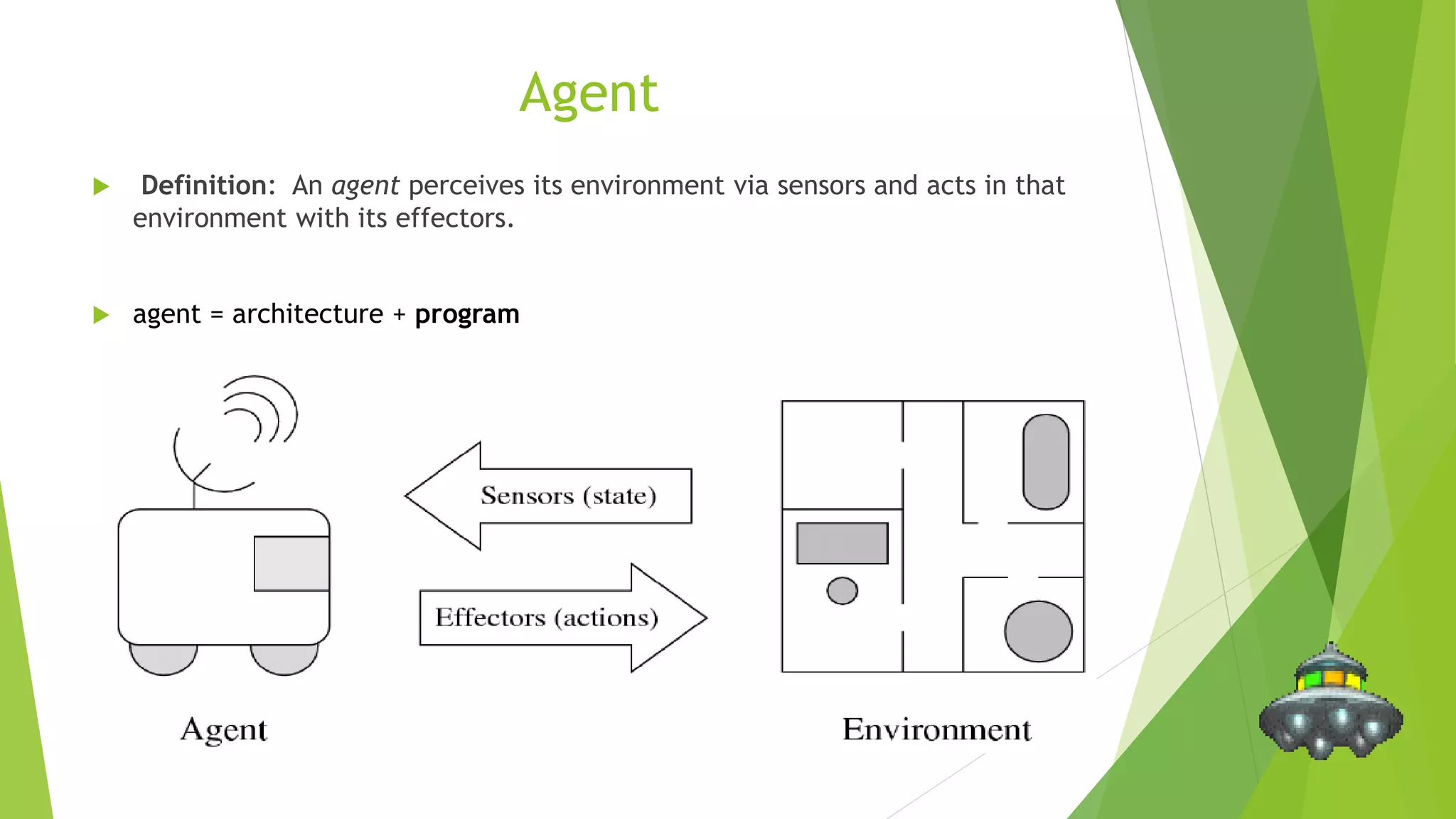
Agent
 Definition: An agent perceives its environment via sensors and acts in that
environment with its effectors.
 agent = architecture + program
Intelligent Agent
 An agent is anything that can be viewed as perceiving its environment
through sensors and acting upon that environment through actuators.
 Example Of Agents:
 A human agent has eyes, ears, and other organs for sensors and hands,
legs, vocal tract, and so on for actuators.
 A robotic agent might have cameras and infrared range finders for
sensors and various motors for actuators.
 A software agent receives keystrokes, file contents, and network
packets as sensory inputs and acts on the environment by displaying on
the screen, writing files, and sending network packets.
Rational Agents
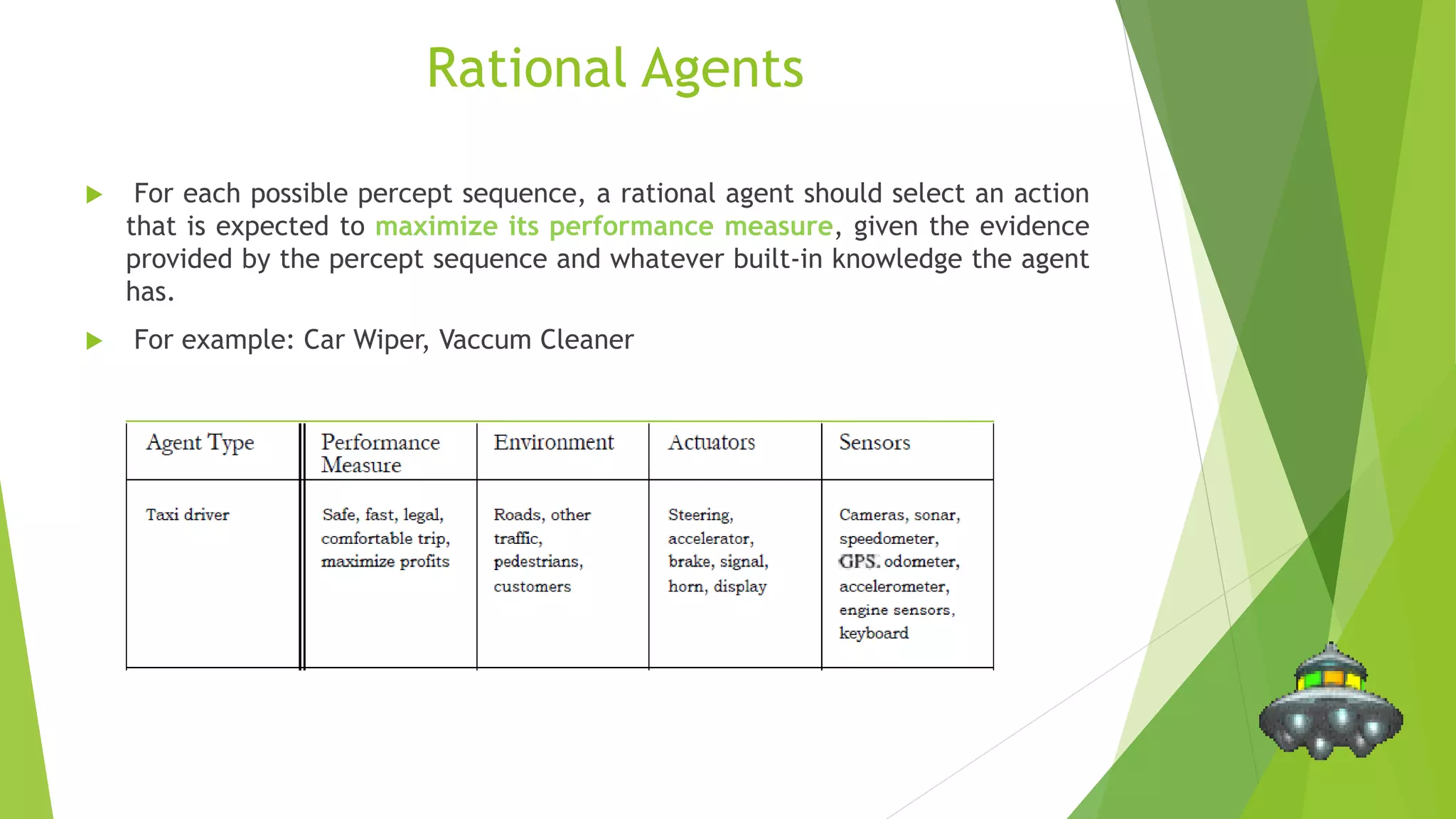
 For each possible percept sequence, a rational agent should select an action
that is expected to maximize its performance measure, given the evidence
provided by the percept sequence and whatever built-in knowledge the agent
has.
 For example: Car Wiper, Vaccum Cleaner
Environment Types
 Fully observed: An agent’s sensors give it access to the
complete state of the environment at each point in time.
 Deterministic: The next state of environment is
completely determined by the current state and action
executed by the agent.
 Episodic: The agent experience is divided into atomic
episodes and the choice of actions & quality in each
episodes depends only on the episode, because subsequent
episodes do not depend on what actions occur in previous
episodes.  Do not need to think ahead.
Types Of Agents
 Simple Reflex Agents
 Model Based Reflex Agents
 Goal Based Agents
 Utility Based Agents
Simple Reflex Agents
 It is the simplest type. These agents select actions on the
bases of current percept.
 Has no memory.
 EX: if car-in-front-is-breaking then initiate-braking
 function REFLEX-VACUUM-AGENT( [location,status])
returns an action
if status = Dirty then return Suck
else if location = A then return Right
else if location = B then return Left
Simple Reflex Agents
Model Based Reflex Agents
 It keeps track of the current state of the world using an
internal model(Environment). It then chooses an action in
the same way as the reflex agent.
Goal Based Agents
 Knowing something about the current state of the
environment is not always enough to decide what to do.
For example. at a road junction, the taxi can turn left,
turn right, or go straight on.
 The agent needs some sort of goal information.
 for example, passenger's destination.
 Sometimes goal-based action selection is straight forward.
Sometimes it will be more tricky—for example, when the
agent has to consider long sequences of twists and turns
in order to find a way to achieve the goal.
Utility Based Agents
 Goals alone are not enough to generate high-quality
behavior in most environments. For example, many action
sequences will get the taxi to its destination (thereby
achieving the goal) but some are quicker, safer, more
reliable, or cheaper than others.
 How well can the goal be achieved (degree of happiness)
Introduction To Artificial Intelligence

Introduction To Artificial Intelligence

  • 1.
  • 2.
    What is ArtificialIntelligence?  AI is an area of computer science that emphasizes the creation of intelligent machines that work and react like humans.  some of the activities computer with artificial intelligence are designed for include:  speech reconization  Learning  Planning  Problem Solving
  • 3.
  • 4.
    Alan Turing The TuringTest was the first serious proposal in the philosophy of artificial intelligence in 1956.
  • 5.
    Agent  Definition: Anagent perceives its environment via sensors and acts in that environment with its effectors.  agent = architecture + program
  • 6.
    Intelligent Agent  Anagent is anything that can be viewed as perceiving its environment through sensors and acting upon that environment through actuators.  Example Of Agents:  A human agent has eyes, ears, and other organs for sensors and hands, legs, vocal tract, and so on for actuators.  A robotic agent might have cameras and infrared range finders for sensors and various motors for actuators.  A software agent receives keystrokes, file contents, and network packets as sensory inputs and acts on the environment by displaying on the screen, writing files, and sending network packets.
  • 7.
    Rational Agents  Foreach possible percept sequence, a rational agent should select an action that is expected to maximize its performance measure, given the evidence provided by the percept sequence and whatever built-in knowledge the agent has.  For example: Car Wiper, Vaccum Cleaner
  • 8.
    Environment Types  Fullyobserved: An agent’s sensors give it access to the complete state of the environment at each point in time.  Deterministic: The next state of environment is completely determined by the current state and action executed by the agent.  Episodic: The agent experience is divided into atomic episodes and the choice of actions & quality in each episodes depends only on the episode, because subsequent episodes do not depend on what actions occur in previous episodes.  Do not need to think ahead.
  • 9.
    Types Of Agents Simple Reflex Agents  Model Based Reflex Agents  Goal Based Agents  Utility Based Agents
  • 10.
    Simple Reflex Agents It is the simplest type. These agents select actions on the bases of current percept.  Has no memory.  EX: if car-in-front-is-breaking then initiate-braking  function REFLEX-VACUUM-AGENT( [location,status]) returns an action if status = Dirty then return Suck else if location = A then return Right else if location = B then return Left
  • 11.
  • 12.
    Model Based ReflexAgents  It keeps track of the current state of the world using an internal model(Environment). It then chooses an action in the same way as the reflex agent.
  • 13.
    Goal Based Agents Knowing something about the current state of the environment is not always enough to decide what to do. For example. at a road junction, the taxi can turn left, turn right, or go straight on.  The agent needs some sort of goal information.  for example, passenger's destination.  Sometimes goal-based action selection is straight forward. Sometimes it will be more tricky—for example, when the agent has to consider long sequences of twists and turns in order to find a way to achieve the goal.
  • 14.
    Utility Based Agents Goals alone are not enough to generate high-quality behavior in most environments. For example, many action sequences will get the taxi to its destination (thereby achieving the goal) but some are quicker, safer, more reliable, or cheaper than others.  How well can the goal be achieved (degree of happiness)