Administrative law
is abranch of public law which fixes the organization
of the government and determines the competence
of administrative authorities who execute the law
and makes available to the individual the relief
against the administrative action.
3.
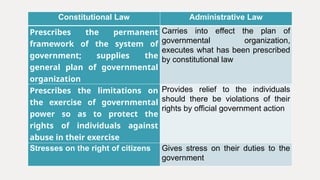
Constitutional Law AdministrativeLaw
Prescribes the permanent
framework of the system of
government; supplies the
general plan of governmental
organization
Carries into effect the plan of
governmental organization,
executes what has been prescribed
by constitutional law
Prescribes the limitations on
the exercise of governmental
power so as to protect the
rights of individuals against
abuse in their exercise
Provides relief to the individuals
should there be violations of their
rights by official government action
Stresses on the right of citizens Gives stress on their duties to the
government
4.
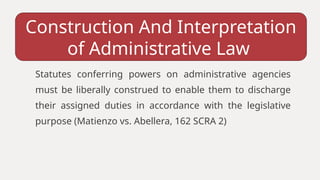
Statutes conferring powerson administrative agencies
must be liberally construed to enable them to discharge
their assigned duties in accordance with the legislative
purpose (Matienzo vs. Abellera, 162 SCRA 2)
Construction And Interpretation
of Administrative Law
5.
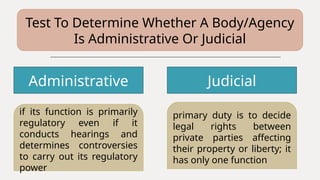
Test To DetermineWhether A Body/Agency
Is Administrative Or Judicial
Administrative
if its function is primarily
regulatory even if it
conducts hearings and
determines controversies
to carry out its regulatory
power
Judicial
primary duty is to decide
legal rights between
private parties affecting
their property or liberty; it
has only one function
6.
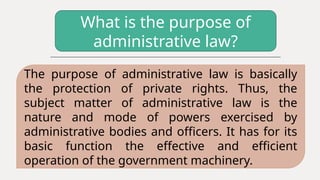
What is thepurpose of
administrative law?
The purpose of administrative law is basically
the protection of private rights. Thus, the
subject matter of administrative law is the
nature and mode of powers exercised by
administrative bodies and officers. It has for its
basic function the effective and efficient
operation of the government machinery.
7.
What is theorigin of
administrative law?
The origin of administrative law is in legislation
and precedes from the increased functions of
individuals because of complexities of modern
society thus, a new venture the so-called fourth
branch of the government.
8.
Why is itcoined as the fourth
branch of the government?
Basically because there are administrative
bodies created by statutes which are given
powers by the Legislature, classified as quasi-
legislative and quasi-judicial powers.
9.
The reason forthis is the multiplication of the
activities of man in the outset. There were but few
activities that have to be regulated by the State. But
subsequently, the State through the legislature and
the courts found it necessary to create agencies in
order to de-clog court dockets. The State found it
unable to keep up with the various activities of
individuals. Thus, there was a so-called venture into
the 4th branch of the government which is actually a
delegation of legislative power to the administrative
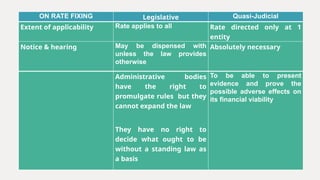
bodies.
10.
The general rulehere is that, there
should be no delegation of
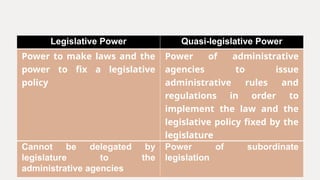
legislative powers. But you have
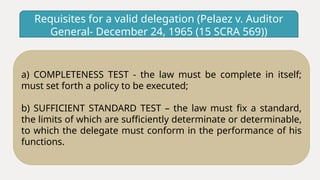
administrative agencies created
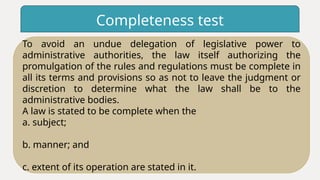
basically to answer the pressing
problems of modern society.
11.
What is theexception to the PRINCIPLE
OF SEPARATION OF POWERS?
Authority is given to administrative bodies to
promulgate rules. The nature of this
promulgation is an exercise of a quasi-legislative
function.
12.
In order toavoid unwarranted delegation, a
law is enacted by the legislature to provide for
safeguards against arbitrariness and
capriciousness in the exercise of duties by
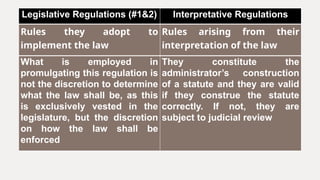
administrative authorities. Such law must be
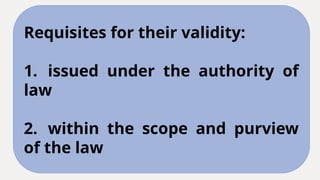
complete-complete in its terms when the
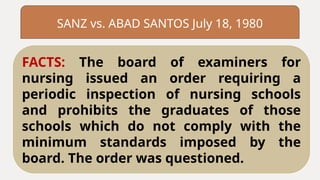
powers are completely defined and the manner
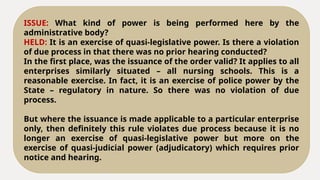
of the exercise of such powers is provided
13.
What are thetypes of quasi-judicial or
administrative bodies or agencies?
1) Administrative agencies created to carry on
governmental functions(BIR, BoC, CSC, LRA)
2) Administrative agencies created to perform
business services for the public (Philippine
Postal Authority; PNR, NFA, NHA)
14.
3) Administrative agenciescreated to regulate
businesses affected with public interest (NTC,
LTFRB, Insurance Commission, ERB, HLURB,
Bureau of Mines and Geo-Sciences)
4) Administrative agencies created to regulate
private businesses and individuals under police
power (SEC, Dangerous Drug Board, CID, PRC)
15.
6) Administrative agenciesthat grant privileges
(GSIS, SSS, PAO, Phil Veterans Adm.)
7) Administrative agencies making the
government a private party (COA, Social
Security System Adjudication Office)
So these are the basic classes of administrative
bodies of the government.
16.
Government of theRepublic of the
Philippines vs. National Government
Administrative law deals with the organization
of the government. Thus, you have the concept
of GRP (Government of the Republic of the
Philippines. This term is NOT synonymous with
the term “National Government.”
17.
Distinguish “Government ofthe Republic of the
Philippines” (GRP) from “National Government.”
The GRP or Republic of the Philippines refers to the corporate
governmental entity through which the functions of
government are exercised throughout the Philippine Islands,
including, save as the contrary appears from the context, the
various arms through which political authority is made
effective in said Islands, whether pertaining to the central
Government or to the provincial or municipal branches or
other form of local government. (Section 2, Administrative
Code)
18.
Whereas, the “NationalGovernment”
refers to the central government
consisting of the three branches or
departments of the government.
19.
MACTAN CEBU INTERNATIONALAIRPORT
AUTHORITY vs MARCOS
(September 11, 1996)
Held: Yes, the exemption from such tax granted to MCIAA in
Section 14 of its Charter, RA 6958, has been withdrawn. Any
claim to the contrary can only be justified if the petitioner can
seek refuge under any of the exceptions provided in Section
234, but not under Section 133, as it now asserts, since, the
said section is qualified by Sections 232 and 234.
Issue: WON the City of Cebu has the power to impose taxes on
petitioner
20.
It must showthat the parcels of land in question, which are
real property, are any one of those enumerated in Section
234, either by virtue of ownership, character, or use of
property.
The legislature used the phrase “National Government, its
agencies and instrumentalities” in Section 133(o), but only
the phrase “Republic of the Philippines or any of its political
subdivisions” in Section 234(a). The terms “Republic of the
Philippines” and “National Government” are not
interchangeable.
21.
“Republic of thePhilippines” is broader and synonymous
with “Government of the Republic of the Philippines” which
the Administrative Code of 1987 defines as the “corporate
governmental entity through which the functions of
government are exercised throughout the Philippines,
including, save as the contrary appears from the context, the
various arms through which political authority is made
affective in the Philippines, whether pertaining to the
autonomous regions, the provincial, city, municipal or
barangay subdivisions or other forms of local government.”
These “autonomous regions, provincial, city, municipal or
barangay subdivisions” are the political subdivisions.
22.
“National Government” refers“to the entire machinery of the
central government, as distinguished from the different
forms of local governments.” The National Government then
is composed of the three great departments: the executive,
the legislative and the judicial.
An “agency” of the Government refers to “any of the various
units of the Government, including a department, bureau,
office, instrumentality, or government-owned or controlled
corporation. It may also refer to a local government or a
distinct unit therein.”
23.
An “instrumentality” refersto “any agency of
the National Government, not integrated
within the department framework, vested with
special functions or jurisdiction by law,
endowed with some if not all corporate
powers, administering special funds, and
enjoying operational autonomy, usually
through a charter. This term includes
regulatory agencies, chartered institutions and
government-owned and controlled
corporations.”
24.
MANILA INTERNATIONAL AIRPORTAUTHORITY vs
CA, CITY OF PARANAQUE (July 20, 2006)
Held: The Supreme Court ruled that the lands used by the
MIAA are exempt from real estate taxes imposed by the Local
Government Code. The first reason for this is that MIAA is not
a GOCC but rather an instrumentality of the national
government and therefore exempt from government taxation
under Section 133 of the Local Government Code.
25.
MIAA is agovernment instrumentality vested
with corporate powers to perform efficiently its
governmental functions. MIAA is like any other
government instrumentality. The only
difference is that MIAA is vested with corporate
powers. Section 2(10) of the Introductory
Provisions of the Administrative Code defines a
government “instrumentality” as follows:
26.
SEC. 2. GeneralTerms Defined. –– x x x x
(10) Instrumentality refers to any agency of the
National Government, not integrated within
the department framework, vested with special
functions or jurisdiction by law, endowed with
some if not all corporate powers,
administering special funds, and enjoying
operational autonomy, usually through a
charter. x x x (Emphasis supplied)
27.
When the lawvests in a government
instrumentality corporate powers, the
instrumentality does not become a
corporation. Unless the government
instrumentality is organized as a stock or non-
stock corporation, it remains a government
instrumentality exercising not only
governmental but also corporate powers
28.
A government instrumentalitylike MIAA falls
under Section 133(o) of the Local Government
Code, which states: SEC. 133. Common
Limitations on the Taxing Powers of Local
Government Units. – Unless otherwise
provided herein, the exercise of the taxing
powers of provinces, cities, municipalities, and
barangays shall not extend to the levy of the
following: x x x x
29.
(o) Taxes, feesor charges of any kind on the
National Government, its agencies and
instrumentalities and local government units.
(Emphasis and underscoring)
30.
Are GOCCs includedin the Government of the
Republic of the Philippines?
Yes, if such GOCCs perform sovereign tasks
31.
CENTRAL BANK vs.CA, ABLAZA April 22, 1975 (63
SCRA 431)
Held: The Central Bank is an entity separate and
distinct from the National Government. The CB is
indeed a government instrumentality but it was
created as an autonomous body under RA 265, "to
administer the monetary and banking system of the
republic.”
ISSUE: Whether or not the Central Bank of the Philippines falls
within the concept of the “National Government.”
32.
It does notdepend on the National
Government for the financing of its operations.
It is the national Government that occasionally
resorts to it for the needed budgetary
accommodations. Under Section 14 of the
Bank's Charter, the Monetary Board may
authorize such expenditures by the CB as are in
the interest of the effective administration and
operation of the bank.
33.
Its prerogative toincur such liabilities and
expenditures is not subject to any prerequisite
found in any statute or regulation not
expressly applicable to it. Relevant to the issue
in this case, it is not subject, like the Social
Security Commission, to section 1901 and
related provisions of the Revised
Administrative Code, which require national
government construction to be done by or
under the supervision of the Bureau of Public
Works.
34.
For these reasons,the provisions of the RAC
invoked by the bank do not apply to it. To our
knowledge, in no other instance has the Bank
considered itself subject thereto.
35.
Incorporated and Non-IncorporatedGovernment
Authorities
What are examples of government authorities?
NHA (National Housing Authority); PPA (Philippine Port
Authority); ISA (Iron and Steel Authority)
36.
FONTANILLA vs. MALIAMANFebruary 27, 1991
Held: NIA is a government entity performing pecuniary
functions. Therefore, it may be held liable for the damages
caused by the negligent act of its driver who was not its
special agent. NIA is a government entity with a juridical
personality separate and distinct from the government. It is
not a mere agency of the government but a corporate body
exercising all the powers of corporation under the Corporation
Law.
ISSUE: Whether or not NIA is a government entity performing
pecuniary functions.
37.
Here are someincorporated agencies of the government
NOT included in the term “Government of the Republic of
the Philippines”:
1. National Power Corporation;
2. Philippine Ports Authority;
3. Philippine National Railways;
4. Public Estates Authority.
5. National Housing Authority;
6. Philippine National Oil Company;
38.
DOCTRINE OF PRIMARYJURISDICTION
Now, let’s go to the concept of primary jurisdiction. This
has been asked several times in the bar.
39.
Under the conceptof primary jurisdiction, the
court will not take cognizance of a controversy
involving a question requiring the technical
expertise or skills of an administrative body or
officer. Even if such an action is filed in court,
but which would require expertise or skills of
an administrative officer, the courts will defer
the matter to the authority of the
administrative agency.
40.
Experiences and servicesof the
administrative tribunal are very
important to determine technical
and intricate matters of fact and
especially when a uniform ruling or
procedure is to be administered
with the purpose of the regulatory
statute.
41.
The purposes ofthe doctrine are as
follows:
a. to give the administrative
agency the opportunity to decide
the controversy by itself correctly
and so as to enable the said
administrative tribunal to correct
its error
42.
b. to preventunnecessary and
premature resort to courts so
as to declog court dockets
(Director of Lands vs CA Feb 19,
1991)
43.
For example isthe Bureau of Immigration
(BOI). You have the case of BOC vs. DELA ROSA
(May 31, 1991). The Bureau of Immigration has
the exclusive authority to hear and try cases
involving alleged aliens. This is a power given
to it by law. The court will not and is not
empowered to look into this question as to
whether or not a person is an alleged alien.
This is within the competence of the BOI.
44.
Board of Commissionersof the Commission on
Immigration and Deportation (BOC)
vs. DELA ROSA
May 31, 1991 (197 SCRA 854)
Held: The court is not empowered to look into this question:
whether or not a person is an alleged alien. This is within the
competence of the BOI.
ISSUE: Whether or not the RTC judges have no jurisdiction over
BOC and the subject matter of the case.
45.
The Bureau ofImmigration has the exclusive authority
to hear and try cases involving alleged aliens, and in the
process, determine also their citizenship.
The Primary Jurisdiction of the Bureau of immigration
over deportation proceedings admits of an exception,
i.e. judicial intervention may be resorted to in cases
where the claim of citizenship is so substantial that there
are reasonable grounds to believe that the claim is
correct. The Bureau of Immigration is not of equal rank
as the RTC, hence its decisions may be appealable to,
and may be reviewed through a special civil action for
certiorari by the RTC.
46.
The competent courtwhich could properly take
cognizance of the proceedings instituted by Gatchalian
would be the RTC, not the CA. Ordinarily, the case would
be remanded to the RTC. But in this case, the SC
deemed it proper to decide the controversy.
The warrant of arrest was issued on August 15, 1990, 28
years after petitioners’ alleged cause of action and
deportation against respondent arose in 1962.
Petitioner’s cause of action has already prescribed and
by their inaction could not now be validly enforced by
petitioners’ against Gatchalian. Gatchalian was declared
as a Filipino citizen.
47.
Of course thereis an exception to this rule. Where there
is a claim that an individual is indeed a Filipino citizen
and there is substantial evidence and reasonable basis to
believe in that claim. In such situation, the BOI will defer
the case to the authority of the court in far as the issue of
citizenship is concerned because the issue of citizenship
falls, not within the competence of the administrative
agency, but within the jurisdiction of the regular court.
48.
INDUSTRIAL ENTERPRISES, INCvs. CA April 18,
1990 (184 SCRA 427)
Ruling: No, the Bureau of Energy Development has primary
jurisdiction over the matter. IEI's cause of action was not merely
the rescission of a contract but the reversion or return to it of
the operation of the coal blocks.
ISSUE: Whether or not the civil court has jurisdiction to hear and
decide the suit for rescission of the Memorandum of Agreement
concerning a coal operating contract over coal blocks.
49.
These are mattersproperly falling within the domain of the
BED. The application of the doctrine of primary jurisdiction,
however, does not call for the dismissal of the case below. It
needs only to be suspended until after the matters within
the competence of the BED are threshed out and
determined.
Under the doctrine of Primary jurisdiction, courts cannot and will not
determine a controversy involving a question which is within the
jurisdiction of an administrative tribunal, especially where the
question demands the exercise of sound administrative discretion
requiring the special knowledge, experience and services of the
administrative tribunal to determine the technical and intricate
matters of fact.
50.
The doctrine ofprimary jurisdiction finds application in this case
since the question of what coal areas should be exploited and
developed and which entity should be granted coal operating
contracts over said areas involves a technical determination by
the BED as the administrative agency in possession of the
specialized expertise to act on the matter. The Trial Court does
not have the competence to decide matters concerning activities
relative to the exploration, exploitation, development, and
extraction of mineral resources like coal. These issues preclude
an initial judicial determination. It behooves the courts to stand
aside even when apparently they have statutory power to
proceed in recognition of the primary jurisdiction of an
administrative agency.
51.
BRETT VS. INTERMEDIATEAPPELLATE COURT 191
SCRA 687
Under the doctrine of primary jurisdiction, courts cannot and will not
determine a controversy involving a question which is within the
jurisdiction of an administrative tribunal, especially where the question
demands the exercise of sound administrative discretion requiring
special knowledge, experience and services of the administrative
tribunal to determine technical and intricate matters of fact and where
a uniformity of ruling is essential to comply with the purposes of the
regulatory statute administered.
52.
Applying the principlein the case at bar,
respondent court correctly dismissed the
petition for certiorari of the heirs of John
Guilles, Sr. on the ground that there is a
pending appeal filed by said heirs in the Office
of the President. Indeed the awarding of
mining claims is more of an executive, and less
of a judicial, function.
53.
In situations requiringthe expertise of administrative
agencies, it is the same as to who has the power to decide
controversy. The presumption here is that, because of the
competence and skills of the administrative officer or body,
he or it is adept in ascertaining technical matters needed.
You know, because of this increasing reliance on the
expertise and training of the administrative agencies, the
old view that only the courts have the power to award
damages is already obsolete. There are now hundreds of
administrative bodies and most of them are given powers
to award damages.
54.
DAGUDAG, SAGIP KALIKASANVS. JUDGE
PADERANGA June 19, 2008
ISSUE: Whether or not Judge Paderanga violated
the doctrine of primary jurisdiction.
55.
Held: Yes. Underthe doctrine of primary jurisdiction, courts
cannot take cognizance of cases pending before
administrative agencies of special competence. The DENR is
the agency responsible for the enforcement of forestry laws.
The complaint for replevin itself stated that members of
DENR’s Task Force Sagip Kalikasan took over the forest
products and brought them to the DENR Community
Environment and Natural Resources Office. This should have
alerted Judge Paderanga that the DENR had custody of the
forest products, that administrative proceedings may have
been commenced, and that the replevin suit had to be
dismissed outright.
56.
The DENR shouldbe given a free hand unperturbed
by judicial intrusion to determine a controversy
which is well within its jurisdiction. The assumption
by the trial court, therefore, of the replevin suit filed
by private respondents constitutes an unjustified
encroachment into the domain of the
administrative agency’s prerogative. The doctrine of
primary jurisdiction does not warrant a court to
arrogate unto itself the authority to resolve a
controversy the jurisdiction over which is initially
lodged with an administrative body of special
competence.
57.
What are thereasons for the application of the
doctrine of primary jurisdiction?
The following are the reasons:
1.) to enable the administrative body to make a decision
correctly. Even if there is an error, the law allows the
administrative officer to rectify whatever error has been
committed; and
2.) for expediency – the need to de-clog court dockets.
58.
How do youdetermine whether or not an agency
or body is judicial or administrative?
If the principal function of the body is regulatory in nature
although in the process of this principal regulatory function
it is allowed by law to adjudicate controversy and this latter
function is merely an incident to its primary function, it is an
administrative body.
Otherwise, if the principal purpose in creating such body is
to adjudicate and decide given rights, then it is a matter
within the ambit of the court.
59.
You have thecase of SOLID HOMES vs. PAYAWAL
(177 SCRA 73 [1989]). The issue here involves the
rights of the parties under a contract to sell.
Generally, this is under the provisions of the Civil
Code but because of a law, the determination of the
rights of the parties under a contract to sell
subdivision lots now belongs to an administrative
agency which is the National Housing Authority
(NHA) – but now, it belongs to HLURB.
60.
Held: RTC hasno jurisdiction over the case
The Supreme Court sustained the competence of the
National Housing Authority (now HLURB) in the
exercise of its exclusive jurisdiction vested in it by PD
957 and PD 1344 to determine the rights of the parties
under a contract to sell a subdivision lot.
SOLID HOMES vs. PAYAWAL
August 29, 1989 (177 SCRA 73 )
61.
Under PD 1344,the NHA shall have exclusive
jurisdiction to hear and decide cases of the
following nature:
1) Unsound real estate business practices;
2) Claims involving refund and any other claims filed
by subdivision lot or condominium unit buyer against
the project owner, developer, dealer, broker or
salesman; and
3) Cases involving specific performance of contractual
and statutory obligations filed by buyers of
subdivision lot or condominium unit against the
owner, developer, dealer, broker or salesman.
62.
Held: Not everycontroversy involving a subdivision or
condominium unit falls under the competence of the
HLURB. The mere allegation of relationship between
the parties i.e., that of being subdivision
owner/developer and subdivision lot buyer, does not
automatically vest jurisdiction in the HLURB. For an
action to fall within the exclusive jurisdiction of the
HLURB, the decisive element is the nature of the action
as enumerated in Section 1 of PD 1344.
CADIMAS VS. CARRION 567 SCRA
103
63.
The complaint mustsufficiently describe the lot as a
subdivision lot and sold by the defendant in his
capacity as a subdivision developer to fall within the
purview of PD 1344.
Here, petitioner sought the cancellation of the
contract and the recovery of the possession and
ownership of the townhouse. Clearly, the complaint
is within the jurisdiction of the RTC.
64.
Held: RTC hasno jurisdiction over the case
Under PD 1344, the complaint for specific performance
with damages filed with the Regional Trial Court comes
under the jurisdiction of the Housing and Land use
Regulatory Board (HLURB), e.g. where the buyer of a
subdivision lot seeks specific performance of the
seller's obligation to deliver to him the corresponding
certificate of title.
CT TORRES, INC. vs. HIBIONADA
November 9, 1990 (191 SCRA 269)
65.
PD 957 knownas “The Subdivision and Condominium
Buyer’s Protective Decree” provides that the NHA (now
HLURB) shall have the exclusive authority to regulate
the real estate trade and business.
The HLURB is competent to award damages although
this is essentially a judicial power exercisable
ordinarily only by the courts. In the exercise of its
powers, the HLURB must interpret and apply
contracts, and award damages whenever appropriate
66.
The matters withinthe exclusive jurisdiction of the
HLURB are the following:
1. Unsound real estate business practices;
2. Claims involving refund and any other claims filed
by subdivision lot or condominium unit buyer against
the project owner, developer, dealer, broker or
salesman; and
3. Cases of specific performance of contractual and
statutory obligations filed by buyers against the
owner, developer, dealer, broker or salesman.
67.
The HLURB iscompetent to award damages although
this is essentially a judicial power exercisable ordinarily
only by the courts. In the exercise of its powers, the
HLURB must interpret and apply contracts, and award
damages whenever appropriate. (REALTY EXCHANGE
VENTURE CORP vs. SENDINO, 233 SCRA 666)
68.
Issue: Whether ornot SEC has
statutory authority to initiate and file
a criminal suit against respondent
corporation and its directors.
SEC VS. INTERPORT RESOURCES 567
SCRA 365
69.
Held: Yes. UnderSection 45 of the Revised
Securities Act, which is entitled
Investigations, Injunctions and Prosecution
of Offenses, the Securities Exchange
Commission (SEC) has the authority to
"make such investigations as it deem
necessary to determine whether any
person has violated or is about to violate
any provision of this Act XXX."
70.
After a findingthat a person has
violated the Revised Securities Act,
the SEC may refer the case to the
DOJ for preliminary investigation
and prosecution.
71.
While the SECinvestigation serves
the same purpose and entails
substantially similar duties as the
preliminary investigation conducted
by the DOJ, this process cannot
simply be disregarded.
72.
The said caseputs in perspective the nature
of the investigation undertaken by the SEC,
which is a requisite before a criminal case
may be referred to the DOJ. The Court
declared that it is imperative that the
criminal prosecution be initiated before the
SEC, the administrative agency with the
special competence.
73.
Indubitably, the prescriptionperiod is interrupted by
commencing the proceedings for the prosecution of
the accused. In criminal cases, this is accomplished by
initiating the preliminary investigation. The
prosecution of offenses punishable under the Revised
Securities Act and the Securities Regulations Code is
initiated by the filing of a complaint with the SEC or by
an investigation conducted by the SEC motu proprio.
Only after a finding of probable cause is made by the
SEC can the DOJ instigate a preliminary investigation.
74.
Thus, the investigationthat was commenced by
the SEC in 1995, soon after it discovered the
questionable acts of the respondents, effectively
interrupted the prescription period. Given the
nature and purpose of the investigation
conducted by the SEC, which is equivalent to the
preliminary investigation conducted by the DOJ
in criminal cases, such investigation would
surely interrupt the prescription period.
75.
Facts: BA GonzalesSurveying was granted a contract
by the Director of Lands and the Secretary of the DENR
to execute public land subdivision mapping. BA
Gonzales failed to commence the surveying contracts
leading the Director of Lands to scrap the contract. The
private respondent then filed a petition for prohibition
and mandamus with a TRO against the Dir. of Lands.
DIRECTOR OF LANDS vs. BA GONZALES
SURVEYING 194 SCRA 223
76.
Held: The courthas no jurisdiction
over this matter. The respondent
should have filed the case at the
first instance before the DENR by
virtue of the doctrine of exhaustion
of administrative remedies.
77.
It is coinedas such because administrative
bodies were created and were given quasi-
legislative and quasi-judicial powers by the
Legislature so that issues requiring
technical expertise are to be handled first by
the administrative agencies and not by the
courts.
THE FOURTH BRANCH OF THE
GOVERNMENT
78.
An Administrative tribunalhas to
determine the following:
a) Is it competent to act on the issue?
b) Is it wise for them to act on the
issue?
c) What is the law applicable on the
issue?
79.
The Administrative Tribunalmay
dispense with certain rules and
exercise its sound discretion in the
interest of justice.
This is not a violation of the
principle of separation of powers or
non-delegation of powers of the
legislature.
80.
MERALCO vs. PASAY
TRANSPORTATIONCO. November
25, 1932 (57 PHIL 600)
ISSUE: Is the law valid in view of the
doctrine of separation of powers.
HELD: No, it is a violation of the
separation of powers.
81.
The SC representsone of the 3 divisions of the powers of the
government and it exercises judicial power alone. The SC and its
members should not and cannot be required to exercise any power,
to perform any trust or to assume any duty not pertaining or
connected with administering of judicial functions.
A board of arbitrators is not a “court” in any proper sense of the
term and possesses none of the jurisdiction which the Organic Act
contemplates which shall be exercised by the Supreme Court.
If the Supreme Court, such as in the case at bar, is given a task
which is not a judicial function, then the task is in violation of the
doctrine of separation of powers.
82.
ISSUE: Whether ornot the SC
has the power to discipline
him.
NOBLEJAS vs. TEEHANKEE April 29,
1968 (23 SCRA 405)
83.
HELD: No. Noblejas’contention is wrong.
The official belongs to the executive branch and not the judiciary.
SC and the members should not and cannot be required to exercise
any power, to perform trust or to assume any duty not pertaining to
or connected with the administration of judicial function.
The privileges granted by Republic Act 1151 to the Commissioner of
Land Registration did not include, and was NOT intended to include,
the right to demand investigation by the Supreme Court, and to be
suspended or removed only upon the Court’s recommendation;
otherwise the said grant of privileges would be violative of the
Constitution and would be null and void.
84.
Generally, administrative bodiescan
only exercise those powers which are
either conferred by the Constitution or
statute or those which are necessarily
implied from their exercise.
POWERS OF ADMINISTRATIVE
BODIES
85.
Administrative bodies commonlyexercise
two (2) basic powers:
1. quasi legislative or rule-making = enables
them to promulgate implementing rules
and regulations;
2. quasi judicial or adjudicatory= enables
them to interpret and apply such regulations
86.
ON RATE FIXINGLegislative Quasi-Judicial
Extent of applicability Rate applies to all Rate directed only at 1
entity
Notice & hearing May be dispensed with
unless the law provides
otherwise
Absolutely necessary
Administrative bodies
have the right to
promulgate rules but they
cannot expand the law
They have no right to
decide what ought to be
without a standing law as
a basis
To be able to present
evidence and prove the
possible adverse effects on
its financial viability
87.
Quasi-Legislative Power
Quasi-legislative powersimply means rule-making power. So
there are three (3) basic elements for a valid issuance of rules
and regulations:
1.) The rules and regulation must be germane to the objects
and purpose of the statute;
2.) They must conform to the standards of the statute; and
3.) They must relate solely to carrying out into effect the general
provisions of the law.
88.
Congress may validlydelegate to
administrative agencies the authority to
promulgate rules and regulations in order
to implement a given legislation and
effectuate its policies. The power of
administrative agencies to promulgate rules
in the implementation of the statute is
necessarily limited to what is provided for in
the legislative enactment.
89.
If the implementingrules and regulations
are issued in excess of the rule making
authority of the agency, they are without
binding effect upon the courts. At best, the
same may be treated as administrative
interpretations of the law and as such, they
may be set aside by the Supreme Court in
the final determination of what the law
means.
90.
Legislative Power Quasi-legislativePower
Power to make laws and the
power to fix a legislative
policy
Power of administrative
agencies to issue
administrative rules and
regulations in order to
implement the law and the
legislative policy fixed by the
legislature
Cannot be delegated by
legislature to the
administrative agencies
Power of subordinate
legislation
91.
Requisites for avalid delegation (Pelaez v. Auditor
General- December 24, 1965 (15 SCRA 569))
a) COMPLETENESS TEST - the law must be complete in itself;
must set forth a policy to be executed;
b) SUFFICIENT STANDARD TEST – the law must fix a standard,
the limits of which are sufficiently determinate or determinable,
to which the delegate must conform in the performance of his
functions.
92.
Completeness test
To avoidan undue delegation of legislative power to
administrative authorities, the law itself authorizing the
promulgation of the rules and regulations must be complete in
all its terms and provisions so as not to leave the judgment or
discretion to determine what the law shall be to the
administrative bodies.
A law is stated to be complete when the
a. subject;
b. manner; and
c. extent of its operation are stated in it.
93.
The test ofcompleteness:
Whether its provisions are
sufficiently definite and certain
to enable one to know his rights
and obligations under the law.
94.
Sufficient Standard Test
Ifthe law is incomplete, the law must offer a sufficient
standard to specify the limits of the delegate’s authority,
announce the legislative policy, and specify the conditions
under which it is to be implemented.
The standard is usually embodied in the law itself and this
serves as a guide to indicate the extent and the limit of the
discretion of the administrative authorities that they may
exercise under the statute.
95.
The standard isusually embodied in
the law itself and this serves as a
guide to indicate the extent and the
limit of the discretion which the
administrative authorities may
exercise under the statute.
96.
Requisites for thevalidity of an Administrative Regulation:
1. Its promulgation must be authorized by the legislature.
2. It must be within the scope of the authority given by the
legislature
3.It must be promulgated in accordance with the prescribed
procedure
4. It must be reasonable
5. It must be applicable to all
6.It must be published (except for matters which are internal in
nature)
97.
PHIL. BANK OFCOMMUNICATIONS vs. COMMISSIONER OF INTERNAL
REVENUE
January 28, 1999 (302 SCRA 241)
HELD: The Supreme Court ruled that this rule issued by the BIR
Commissioner violates the law. The act of the BIR commissioner of
changing the prescriptive period arrogates unto himself the power to
legislate. The requirements for a valid issuance of rules and regulations by
administrative agencies are that, the rule must be germane to the object
and purposes of the law and must at all times be in conformity and within
the scope and powers as provided by the statute to the administrative
agency.
There can be no estoppel on the part of the State where the
administrative agency acting on behalf of the State has made an error.
98.
The issuance bythe administrative agency of rules
and regulations, whatever construction made by
such administrative officer should be given respect
if not finality. But if the construction is grounded
on plain error, there can be no finality. In fact, the
issuance made can be subject of a judicial review
because it is only the court which has the final
authority to rule on the issue or the matter of
proper construction and interpretation of law as
made by the agency through the issuance of rules
and regulations.
99.
SEC VS. INTERPORTRESOURCES CORP 567 SCRA
354
Held: In the absence of any constitutional or statutory infirmity, which may concern Sections 30 and 36
of the Revised Securities Act, this Court upholds these provisions as legal and binding. It is well settled
that every law has in its favor the presumption of validity. Unless and until a specific provision of the law
is declared invalid and unconstitutional, the same is valid and binding for all intents and purposes. The
mere absence of implementing rules cannot effectively invalidate provisions of law, where a reasonable
construction that will support the law may be given.
The necessity for vesting administrative authorities with power to make rules and regulations is based
on the impracticability of lawmakers' providing general regulations for various and varying details of
management. It is well established that administrative authorities have the power to promulgate rules
and regulations to implement a given statute and to effectuate its policies, provided such rules and
regulations conform to the terms and standards prescribed by the statute as well as purport to carry
into effect its general policies. Nevertheless, it is undisputable that the rules and regulations cannot
assert for themselves a more extensive prerogative or deviate from the mandate of the statute.
Moreover, where the statute contains sufficient standards and an unmistakable intent, as in the case of
Sections 30 and 36 of the Revised Securities Act, there should be no impediment to its implementation.
100.
Administrative power isconcerned with the work of applying
policies and enforcing orders as determined by proper governmental
organs. It enables the President to fix a uniform standard of
administrative efficiency and check the official conduct of his
agents. To this end, he can issue administrative orders, rules and
regulations.
Prescinding from these precepts, the SC held that A.O. No. 308
involves a subject that is not appropriate to be covered by an
administrative order.
"Sec. 3. Administrative Orders.-- Acts of the President which
relate to particular aspects of governmental operation in pursuance
of his duties as administrative head shall be promulgated in
administrative orders.”
101.
An administrative orderis an ordinance issued by the President which relates to
specific aspects in the administrative operation of government. It must be in
harmony with the law and should be for the sole purpose of implementing the law
and carrying out the legislative policy. The SC rejects the argument that A.O. No.
308 implements the legislative policy of the Administrative Code of 1987. The
Code is a general law and "incorporates in a unified document the major
structural, functional and procedural principles of governance" and "embodies
changes in administrative structures and procedures designed to serve the
people.
It cannot be argued that AO 308 merely implements the Administrative Code of
1987. The establishment of a national computerized identification reference
system requires a delicate adjustment of various contending state policies, the
primacy of national security, the extent of privacy against dossier-gathering by
the government, and choices of policies. It deals with a subject that should be
covered by a law. (what was required was a law itself)
102.
• Law authorizingPresident to suspend the operation of a
law upon the happening of an act and such ascertainment
is also given to the president = no undue delegation of
legislative power
• To avoid undue delegation, it is essential that the law
must be complete OR, in the absence of completeness of
the law, there must be sufficient guidelines or policies
Administrative Order No 308 which provided for the
adoption of a national computerized identification
reference system is unconstitutional.
103.
Kinds of AdministrativeRules and Regulations
1.Supplementary or detailed legislation
- It comprises the rules and regulations
"to fix the details" in the execution and
enforcement of a policy set out in the law
a. ex: Rules and Regulations
Implementing the Labor Code.
104.
2. Interpretative legislation— It consists of the rules and
regulations construing or interpreting the provisions of a
statute to be enforced and they are binding on all
concerned until they are changed
a. Ex: BIR Circulars, CB Circulars
b. The rules and regulations have the effect of law and are
entitled to great respect; they have in their favor the
presumption of legality.
c. The erroneous application of the law by public officers
does not bar a subsequent correct application of the law.
105.
1. Contingent legislation— It refers
to the rules and regulations made by
an administrative authority on the
existence of certain facts or things
upon which the enforcement of the
law depends.
106.
Legislative Regulations (#1&2)Interpretative Regulations
Rules they adopt to
implement the law
Rules arising from their
interpretation of the law
What is employed in
promulgating this regulation is
not the discretion to determine
what the law shall be, as this
is exclusively vested in the
legislature, but the discretion
on how the law shall be
enforced
They constitute the
administrator’s construction
of a statute and they are valid
if they construe the statute
correctly. If not, they are
subject to judicial review
107.
Requisites for theirvalidity:
1. issued under the authority of
law
2. within the scope and purview
of the law
108.
SANZ vs. ABADSANTOS July 18, 1980
FACTS: The board of examiners for
nursing issued an order requiring a
periodic inspection of nursing schools
and prohibits the graduates of those
schools which do not comply with the
minimum standards imposed by the
board. The order was questioned.
109.
ISSUE: What kindof power is being performed here by the
administrative body?
HELD: It is an exercise of quasi-legislative power. Is there a violation
of due process in that there was no prior hearing conducted?
In the first place, was the issuance of the order valid? It applies to all
enterprises similarly situated – all nursing schools. This is a
reasonable exercise. In fact, it is an exercise of police power by the
State – regulatory in nature. So there was no violation of due
process.
But where the issuance is made applicable to a particular enterprise
only, then definitely this rule violates due process because it is no
longer an exercise of quasi-legislative power but more on the
exercise of quasi-judicial power (adjudicatory) which requires prior
notice and hearing.
110.
REVIEW CENTER VS.EXEC SECRETARY 583 SCRA
428
Facts: President Arroyo issued EO 566 which
authorized CHED to supervise the establishment
and operation of all review centers and similar
entities in the Philippines after a leakage of the test
questionnaires of the nurse licensure examination
was made by members of the Nursing Board.
Issue: Whether or not EO 566 expanded the
coverage of CHED under RA 7722.
111.
Held: Yes. Thescopes of EO 566 and the RIRR clearly
expand the CHED’s coverage under RA 7722. The CHED’s
coverage under RA 7722 is limited to public and private
institutions of higher education and degree-granting
programs in all public and private post-secondary
educational institutions. EO 566 directed the CHED to
formulate a framework for the regulation of review
centers and similar entities.
The definition of a review center under EO 566 shows that
it refers to one which offers "a program or course of study
that is intended to refresh and enhance the knowledge or
competencies and skills of reviewees obtained in the
formal school setting in preparation for the licensure
examinations" given by the PRC.
112.
A review centeris not an institution of higher learning as
contemplated by RA 7722. A review course is only intended to
"refresh and enhance the knowledge or competencies and
skills of reviewees." A reviewee is not even required to enroll in
a review center or to take a review course prior to taking an
examination given by the PRC. Even if a reviewee enrolls in a
review center, attendance in a review course is not mandatory.
The reviewee is not required to attend each review class. He is
not required to take or pass an examination, and neither is he
given a grade. He is also not required to submit any thesis or
dissertation. Thus, programs given by review centers could not
be considered "programs x x x of higher learning" that would
put them under the jurisdiction of the CHED.
113.
LUPANGCO vs. CAApril 29, 1988 (160 S 848)
FACTS: This case pertains to the issuance of the PRC (Professional
Regulatory Commission) of an order requiring that the candidates for
CPA board exams are not allowed to participate in any review classes
or receive materials within 3-day period prior to the examination day.
The order was questioned by the students.
ISSUE: What kind of power performed in this case by the PRC in
issuing such order?
Whether or not the order issued by PRC infringes the right to
liberty of examinees on how to review.
114.
HELD: Basically, thePRC performed quasi-legislative power. But the
issuance of a quasi-legislative rule must be reasonable. It must not
be arbitrary. But in this case, the issuance of the order by the PRC
violated the rights not only of the students but also the right to
academic freedom of the school – how to prepare their students to
pass the CPA exam is within the ambit of this right to academic
freedom.
In the same manner, it is the right of liberty of the students to take
whatever measures they deemed proper in order that they
successfully hurdle the CPA board exams. The said order also
infringes the right of schools to academic freedom.
115.
In other words,the rule issued by the
administrative agency must not be
arbitrary. It must be reasonable and
consistent with the objective of the law.
It is precisely to carry out the object and
purpose of the statute creating the
administrative agency.
116.
CIR vs. CA,CTA, FORTUNE TOBACCO August
29,1996 (261 SCRA 236)
ISSUE: Whether or not the Revised Memorandum Circular
37-93 is merely an interpretative ruling of the BIR which can
become effective without any prior need for notice and
hearing, or publication
Whether or not there was violation of due process
117.
HELD: The orderissued by the BIR violated due process – there was a violation of property
rights of Fortune Tobacco. The order was issued in the guise of quasi-legislative power but
actually it was an exercise of quasi-judicial power because the order was made applicable
only to Fortune Tobacco.
If an administrative body is exercising a quasi-judicial power, there is a need to conduct a
hearing consistent with the due process clause.
When an administrative rule is merely interpretative, its applicability needs nothing
further than its bare issuance for it gives no real consequence more than what the law
itself has already prescribed. When the administrative rule goes beyond merely providing
for the means that can facilitate the implementation of the law but substantially adds to or
increases the burden of those governed, it behooves the agency to accord at least those
directly affected a chance to be heard and to be duly informed before that new issuance is
given the force and effect of the law. Like any other government agency, the CIR may not
disregard legal requirements or applicable principles in the exercise of its quasi-legislative
powers. The BIR did not simply interpret the law, it legislated under its quasi-legislative
authority. The due observance of the requirement of notice, of hearing and of publication
should not have been ignored.
118.
NASIPIT LUMBER vs.NWPC April 27, 1998 (289
SCRA 670)
The Labor Code, as amended by RA 6727 (Wages
Rationalization Act), grants the National Wages and
Productivity Commission (NWPC) the power to prescribe
rules and guidelines for the determination of appropriate
wages in the country. Hence, guidelines issued by the
Regional Tripartite Wages and Productivity Board (RTWPB)
without the approval of or worse, contrary to those
promulgated by the NWPC are ineffectual, void and cannot
be the source of rights and privileges.
119.
Quasi-Judicial Power
The administrativebody’s quasi-judicial power refers to the power of
the administrative agency or officer to investigate facts or ascertain
existence of facts and to make a conclusion from such findings of
facts. The exercise of this power is only incidental to its main function
which is the enforcement of law.
The rule here is, there must be a conferment by the law of this quasi-
judicial power. In the absence of the provision giving the quasi-
judicial power to the administrative body, then it is only performing a
quasi-legislative power. But almost all administrative agencies are
clothed with both powers – quasi-judicial and quasi-legislative
powers.
120.
Procedural due processshould be complied with in the exercise of its
power. It requires prior notice and hearing. For an administrative
body to be considered as acting under a quasi- judicial function there
must be an express conferment by law. Absent any express
empowerment, jurisdiction should be construed to mean mere
regulatory and supervisory, not judicial powers. Adjudicative power
must always be read and exercised as being in aid of the principal
function of an administrative body. In other words, the grant of
quasi- judicial power should not only be conferred but should instead
be only incidental to the administrative agency’s main task of
implementing the law in the specific fields of its expertise.
Otherwise, the agency becomes a specialized court of justice under
the judicial branch.
121.
A quasi-judicial proceedinginvolves:
1) gathering and evaluation of evidence
2) ascertainment of the facts of the matter based
upon the evidence presented or gathered
3) rendering an order or decision supported by the
facts proved (adjudication)
122.
The proper exerciseof the quasi- judicial power requires
compliance of two conditions:
1.) The administrative body must properly acquire
jurisdiction
Before the administrative body uses its power of
adjudication, it must first determine whether it is
authorized by law to take cognizance of the controversy
submitted before it. It must likewise decide whether it is
competent to act upon the matter. Thus, the basis is the
law itself. The law must confer upon the administrative
body the power to adjudicate the controversy. Otherwise,
the matter is resolvable not by the administrative agency
but by the courts.
123.
2.) Due processmust be observed in the conduct of the
proceedings.
The lack of notice and hearing essential to due process will, as a
general rule, invalidate the administrative proceedings.
Nevertheless, it is incorrect to say that this right is indispensable for
there are some instances when it can validly be omitted.
However, the mere fact of gathering of evidence does not make the
administrative tribunal quasi-judicial. The National Bureau of
Investigation (NBI) is limited to fact-finding and does not possess
quasi-judicial power. The Commission on Human Rights is tasked to
investigate all forms of human rights violations but its power is
limited. On its own, it cannot impose sanctions.
124.
PCGG vs. JUDGEPEÑA
April 12, 1988 (159 SCRA 556)
ISSUE: Whether or not the court has the
competence to restrain PCGG
HELD: RTC cannot restrain PCGG
Under its charter, PCGG exercises quasi-judicial
power, thus it is deemed a co-equal body of the RTC.
Co-equal bodies do not have power over each other.
125.
Quasi-Judicial is theterm applied in the action, discretion etc. of
public administrative officers who are required to investigate facts,
or ascertain the existence of facts and draw conclusions from them
as a basis for their official action, and to exercise discretion of a
judicial nature.
A quasi-judicial proceeding involves:
(1) taking and evaluation of evidence,
(2) determining facts based upon the evidence presented; and
(3) rendering an order or decision supported by the facts proved
126.
PILIPINAS SHELL vs.OIL INDUSTRY COMMISSION
G.R. No. 41315 Nov. 3, 1986
Issue: Whether or not respondent
OIC has jurisdiction to hear and
decide contractual disputes between
a gasoline dealer and an oil company.
127.
Held: No, theOIC does not have jurisdiction. A detailed
reading of the entire OIC Act (R.A. #6173) will reveal that
there is no express provision conferring upon respondent
OIC the power to hear and decide contractual disputes
between a gasoline dealer and an oil company. It is of
course a well settled principle of administrative law that
unless expressly empowered, administrative agencies like
respondent OIC, are bereft of quasi-judicial powers. Absent
an express empowerment of jurisdiction should be
construed to mean mere regulatory and supervisory, not
judicial powers.
128.
SAÑADO vs. CAG.R.No. 108338. April 17, 2001
Issue: W/N the petitioner is entitled
to the possession of the subject
fishpond area despite the conflicting
decisions of the trial court and the
Office of the President
129.
Held: The actionof an administrative agency in granting or
denying, or in suspending or revoking, a license, permit,
franchise, or certificate of public convenience and
necessity is administrative or quasi-judicial. The act is not
purely administrative but quasi-judicial or adjudicatory
since it is dependent upon the ascertainment of facts by
the administrative agency, upon which a decision is to be
made and rights and liabilities determined (De Leon,
Administrative Law: Text and Cases, 1993 ed., pp. 143-144).
As such, the July 31, 1989 decision of the Office of the
President is explicitly an official act of and an exercise of
quasi-judicial power by the Executive Department headed
by the highest officer of the land.
130.
The rendition ofthe subject July 31, 1989 Malacañang
decision is premised on the essential function of the
executive department - which is to enforce the law. In this
instance, what is being enforced is Presidential Decree No.
704 which consolidated and revised all laws and decrees
affecting fishing and fisheries. Such enforcement must be
true to the policy behind such laws which is "to accelerate
and promote the integrated development of the fishery
industry and to keep the fishery resources of the country
in optimum productive condition through proper
conservation and protection" (Section 2, P.D. No. 704).
131.
Further, the issueof whether or not petitioner is still entitled to
possession of the subject fishpond area is underpinned by an
ascertainment of facts. And such task belongs to the administrative
body which has jurisdiction over the matter - the Ministry of
Agriculture and Food. The policy of the courts as regards such
factual findings is not to interfere with actions of the executive
branch on administrative matters addressed to the sound discretion
of government agencies. This policy is specially applicable in the
grant of licenses, permits, and leases, or the approval, rejection, or
revocation of applications therefor (Manuel vs. Villena, 37 SCRA 745
[1971]). Such respect is based on the time-honored doctrine of
separation of powers and on the fact that these bodies are
considered co-equal and coordinate rank as courts. The only
exception is when there is a clear showing of capricious and
whimsical exercise of judgment or grave abuse of discretion, which
we find absent in the case at bar.
132.
The reasons givenby the Office of the President in
dismissing petitioner's appeal are quite clear. Transferring
or subletting the fishpond granted to a licensee without
the consent or approval of the administrative body
concerned, as well as the failure to develop the area
required by the fisheries rules, are definitely solid and
logical grounds for the cancellation of one's license.
Withal, if petitioner disagrees with the decision of the
Office of the President, he should have elevated the
matter by petition for review before the Court of Appeals
for the latter's exercise of judicial review. Nowhere in the
record do we find such action on petitioner's part.
133.
Understandably, to restorepetitioner to the possession of the
fishpond area is to totally disregard the July 31, 1989 decision of the
Office of the President which can hardly be described as an
unrelated matter, considering its patent implications in the result of
both Civil Case No. 2085 and CA-G.R. CV No. 23165. For how could the
appellate court award possession to the very same party whose
license has been cancelled by the executive or administrative officer
tasked to exercise licensing power as regards the development of
fishpond areas, and which cancellation has been sustained by the
Office of the President? Petitioner must remember the essence of
the grant of a license. It is not a vested right given by the
government but a privilege with corresponding obligations and is
subject to governmental regulation. Hence, to allow petitioner to
possess the subject area is to run counter to the execution and
enforcement of the July 31, 1989 decision which would easily lose its
“teeth” or force if petitioner were restored in possession.
134.
UNIVERSITY OF THEPHIL. BOARD OF REGENTS vs. CA
August 31, 1999 (313 SCRA 404)
HELD: The degree can be withdrawn; power to confer includes the
power to withdraw; there was due process because she was given the
right to be heard – a formal hearing is not required
If the conferment of a degree is founded on error or fraud, the Board
of Regents is also empowered, subject to the observance of due
process, to withdraw what it has granted without violating a
student's rights.
The pursuit of academic excellence is the university's concern -- it
should be empowered, as an act of self-defense, to take measures to
protect itself from serious threats to its integrity.
If an institution of higher learning can decide who can and who
cannot study in it, it certainly can also determine on whom it can
confer the honor or distinction of being its graduates.
135.
CARIÑO vs. CHR
December2, 1991 (204 SCRA 483)
FACTS: Teachers who participated in the
mass action were either dismissed or
suspended. While the appeal was pending
before the SC, the teachers also filed a
case before the CHR – which issued
subpoena to DECS Sec Cariño.
136.
HELD: CHR hasno power to adjudicate;
Decision of DECS Secretary is appealed to
President.
While the Constitution grants the
Commission on Human Rights (CHR) the
power to “investigate ... all forms of human
rights violations involving civil and political
rights", the power to investigate given to the
CHR does not include the power to
adjudicate.
137.
Fact-finding is notadjudication and cannot be likened to a judicial or
quasi-judicial function. The function of receiving evidence and ascertaining
there from the facts of a controversy is not a judicial function. To be
considered such, the faculty of receiving evidence and making factual
conclusions in a controversy must be accomplished by the authority of
applying the law to those factual conclusions to the end that the
controversy may be decided or determined authoritatively, finally and
definitely, subject to such appeals, or modes of review as may be provided
by law, which the Constitution has withheld from the CHR.
CHR and NBI have the power to issue subpoena. They may require
documents and records upon request of a party or upon motion during and
before the conduct of the hearing. In administrative proceedings, these
bodies can hold somebody in contempt provided that the law clearly
confers to them the power to do such.
138.
Administrative Subpoena hasthe intention to
discover evidence but not necessary to prove
a charge while Judicial Subpoena aims to
prove the charge. There is already a case or a
pending one upon issuance of the latter. In
administrative subpoena, upon discovery of a
prima facie evidence, a case can already be
filed. The demand embodied in the subpoena
must not be too indefinite.



![You have the case of SOLID HOMES vs. PAYAWAL
(177 SCRA 73 [1989]). The issue here involves the
rights of the parties under a contract to sell.
Generally, this is under the provisions of the Civil
Code but because of a law, the determination of the
rights of the parties under a contract to sell
subdivision lots now belongs to an administrative
agency which is the National Housing Authority
(NHA) – but now, it belongs to HLURB.](https://image.slidesharecdn.com/administrativelawpart1-250327131012-d34fd5ec/85/INTRODUCTION-TO-ADMINISTRATIVE-LAW-PART1-59-320.jpg)

![Further, the issue of whether or not petitioner is still entitled to
possession of the subject fishpond area is underpinned by an
ascertainment of facts. And such task belongs to the administrative
body which has jurisdiction over the matter - the Ministry of
Agriculture and Food. The policy of the courts as regards such
factual findings is not to interfere with actions of the executive
branch on administrative matters addressed to the sound discretion
of government agencies. This policy is specially applicable in the
grant of licenses, permits, and leases, or the approval, rejection, or
revocation of applications therefor (Manuel vs. Villena, 37 SCRA 745
[1971]). Such respect is based on the time-honored doctrine of
separation of powers and on the fact that these bodies are
considered co-equal and coordinate rank as courts. The only
exception is when there is a clear showing of capricious and
whimsical exercise of judgment or grave abuse of discretion, which
we find absent in the case at bar.](https://image.slidesharecdn.com/administrativelawpart1-250327131012-d34fd5ec/85/INTRODUCTION-TO-ADMINISTRATIVE-LAW-PART1-131-320.jpg)