Tsegaye Yohanes (MSc, Assistant professor)
Department of medical laboratory sciences
Arba Minch University
INTRODUCTION
TO
MEDICAL PARASITOLOGY
Introduction to Medical parasitology
1.1. Definition
 Medical parasitology ;The study of the parasites
of man and their medical consequences .
 It is a subject that researches:
 the biological features of human parasites,
 the relationship between the human being and the
parasites,
 the prevention and treatment of the parasitic diseases.
1.2. Scope of Medical Parasitology
 According to the very broad definition of
parasitology, parasites should include:-
 viruses, bacteria, fungi,
 protozoa and metazoa (multi-celled organisms)
which infect their host species.
 However, for historical reasons the first three have been
incorporated into the discipline of Microbiology.
Cont…
 Therefore, Medical parasitology consists of:-
 Protozoa (single celled animals),
 Helminths (worms)
 Arthropods
Human
Parasitology
Medical
Helminthology
Medical
Protozoology
Medical
Arthropodology
• Class Nematoda
• Class Trematoda
• Class Cestoda
• Phylum Sarcomastigophora
• Amoeba
• Flagellates
• Phylum Apicomplexa
• Phylum Microsporodia
• Phylum Ciliophora
• Class Insecta
• Class Arachnida
• Class Crustacea
• Class Chilopoda
The importance of parasitology
 Six major tropical diseases to which WHO pays great
attention include:
 malaria,
 schistosomiasis,
 filariasis,
 leishmaniasis,
 trypanosomiasis and
 leprosy.
 Five of them are parasitic diseases except leprosy.
 All the above diseases are prevalent in Ethiopia
1.3. Concepts related to medical parasitology
1.3.1. Symbiosis(literally-Sim=together,bios=life)
 Symbiosis- mean “living together”
 Any association more or less permanent is called a
symbiosis, with each member a symbiont.
 Two different organisms live together and interact,
one partner lives in or on another one’s body.
Cont….
 Types of symbiosis
 Distinguished on whether or not the association
is detrimental to one of the two partners.
 3 types:
 Mutualism
 Commensalism
 Parasitism
Cont…
Mutualism (+/+)
 Permanent association between two different
organisms that life apart is impossible,
 Two partners benefit each other,
 The mutuals are metabolically dependent on one
another;
 One cannot survive in the absence of the other.
 e.g., termites and flagellates
 Two ways benefit, no harm
Cont…
Commensalism(+/0)
 Literally means ( Co-togather, mensa-table) “ eating
at the same table”
 Association of two different organisms
 One partner is benefited while the other neither
benefited nor injured,
 Loose association
 No metabolically dependence
E.g E. Coli and man.
Cont…
Parasitism(+/_)
 Association of two different organisms
 One partner is benefited while the other is injured,
such as ascaris lumbricoides and man.
Symbiosis summary table
Organism 1 Organism 2
Mutualism + +
Commensalism + o
Parasitism + _
1.3.1.Parasite and types of parasites
Parasite:-
 It is an animal organism which lives in or on
the host in order to obtain nourishment and
shelter from the host as well as does harms to
the host.
 In parasitism, parasite is the benefited partner.
Types of Parasites
Parasite can be Classified
I. According to their habitat
A. Endoparasite
 Lives inside the body of the host
 May be just under the surface or deep in the body
 Tapeworms, flukes, protozoans
 Infection – if endoparasite produce considerable
damage
Cont’d…….
B. Ectoparasite
 Stays on outside surface of the host
 leeches, ticks, fleas, brood parasites
 Infestation – if ectoparasite produce damage
Cont’d….
 II. Based on dependency on the host
 Obligate Parasite
 Requires finding and invading the host to complete
its life cycle
 Most of the parasites we will cover are obligate
parasites
 Facultative Parasite
 May become parasitic if it is given the chance but
does not require a host.
Cont’d….
III. Amount of time spent
 Permanent Parasite
 Lives entire adult life stage on or in a host
 Usually endoparasites
 One exception is eyelash mite
 Temporary Parasite
 Spends only a short time on a host
 Usually ectoparasites
Cont’d….
IV. According to their Pathogenicity:
 Pathogenic parasites
 Non-Pathogenic (commensal)
 Opportunistic parasites
Cont’d….
Pathogenic parasites
 A parasite that causes injury to the host
Non-Pathogenic (commensal)
 A parasite that does not cause injury to the host
Opportunistic parasites
 may become pathogenic under certain conditions
V. Based on their life cycle
 Monoxenous parasites:
 Those with direct life cycles (i.e., with one host).
 Heteroxenous parasites:
 Those with inderect life cycles requiring an
intermediate host (i.e., involves 2 or more hosts).
 Heterogenetic Parasites:
 One with alteration of generations e.g., Coccidial
parasites and Strongyloides
VI. Based on host ranges
 Euryxenous parasites:
 Those with a broad host range.
 Stenoxenous parasites:
 Those with a narrow host range.
Other terminology
Aberrant parasite:
 Found in locations in the host where they
normally do not occur;
 e.g., Ascaris larvae may migrate to the brain
Insidental parasite:
 Occurs in hosts where it does not normally occur;
 e.g., Fasciola normally does not occur in man but
is incidental if found in man’s liver.
1.3.3.Hosts and types of hosts
 Host:-Hosts are organism which harbors the
parasite.
 In parasitism, it is the injured partner
 Types of Hosts: -
 Definitive host:-
 Intermediate host:-
 Definitive host :- harbors adult or sexually
reproductive stage of a parasite.
 What characterizes the primary host?
 Where sexual reproduction takes place.
 Normally where the adult parasites live.
 Normally the larger of the hosts, usually a
vertebrate.
 Intermediate host:- harbours larval or asexually
reproductive stage of a parasite.
 What characterizes the intermediate host?
 Sexually immature or larval stage of a
parasite
 Asexual multiplication takes place
 may harbor many immature stages of a
parasite;
Other terminology
 Reservoir Host
 Any animal that carries a parasite that can cause
infections in humans.
 These hosts ensure continuity of the parasite’s life cycle
and act as additional sources of human infection.
 They are an important source of infection in
epidemiology.
 Carrier host: -
 A person who harbors parasites has no any clinical
symptom. He is an important source of infection in
epidemiology
 e.g. human beings harboring cyst form of
E.histolytica
1.3.5.Vector and types of vectors
Vector:-an organism (usually an arthropod) which transfers
infective forms of a parasite from one host to the
other.
 Classification
1. Biological vectors:-
2. Mechanical Vectors:
Cont’d….
1. Biological vectors:-
 Characterized by the pathogen(parasite) either
reproduces, develops or both in the vector before its
transfer to another host .
 Propagative
 Cyclopropagative
 Cyclodevelopmental
Cont’d….
 Propagative: multiplication of the pathogen(parasite)
without developmental change.
E.g. Yersinia pestis in fleas
 Cyclopropagative: multiplication and developmental
change of the pathogen(parasite).
E.g. Plasmodium vivax in Anopheles mosquitoes
 Cyclodevelopmental: developmental change of the
pathogen without multiplication
E.g.Onchocerca volvulus in black flies
Cont’d….
2. Mechanical vector
 Parasite stay in/on the host but no parasitic
development of reproduction (multiplication)
occurs in the vector
 transmit a parasite without being a host
 Not essential to the life cycle of the parasite
Ex. Flies
1.3.6.Other terminologies
 *Infective Stage : it is a stage when a parasite can invade
human body and continue to live there. The infective
stage of ascarid is the embryonate egg.
 *Infective Route is the specific entrance through which
the parasite invades the human body. Hookworms
invade human body by skin. Man gets infection with
ascarid by mouth.
 Infective Mode means how the parasite invades human
body, such as the cercariae of the blood fluke actively
penetrate the skin of a swimming man and the infective
ascaris eggs are swallowed by man.
1.4. Epidemiology of parasite
 Epidemiology: The study of the patterns of diseases
within populations
 For parasites, this includes:
 Host range – what can it infect?
 Geographic range – where is it?
 Is it a zoonotic agent?
 Can it infect humans?
 Does it have a reservoir?
 A group of vertebrates maintaining the parasite
 Does it have a nidus?
 A small ecosystem that possesses all the factors to
maintain the parasite..
1.4.1.Geographic Distribution
 Global distribution
 parasite occur globally,
 the majority occur in tropical regions,
 Factors
 Favorable environmental conditions
 poverty, poor sanitation and personal hygiene
Factors (Endemicity):
Factors that favor constant presence of parasite
1. Presence of a suitable host
2. Habits of the host
3. Escape mechanism from the host
4. Favorable conditions outside of host
5. Economic and social conditions
1.4.2.Transmission of parasites
 Parasite can be transmitted from infected to non
infected host
 Factors required for transmission:(Three key
links of parasitic disease transmission)
1. Source of infection
2. Mode of transmission
3. Susceptible people
1. Sources of Exposure to Parasitic Infections
A. Contaminated soil:-
 Soils polluted with human excreta is commonly responsible for
exposure to infection with geohelminthes
B. Contaminated water:-
Water may contain
 (a) viable cysts of Amoeba, flagellates etc,
 (b) cercarial stages of human blood fluke,
 (c) Cyclops containing larva of Dracunculus medinensis
 (d) fresh water fishes which are sources for fish tape
worm, and intestinal flukes infection
 (e) crab or cray fishes that are sources for lung fluke and
 (f ) Water plants which are sources for Fasciolopsis buski.
Cont….
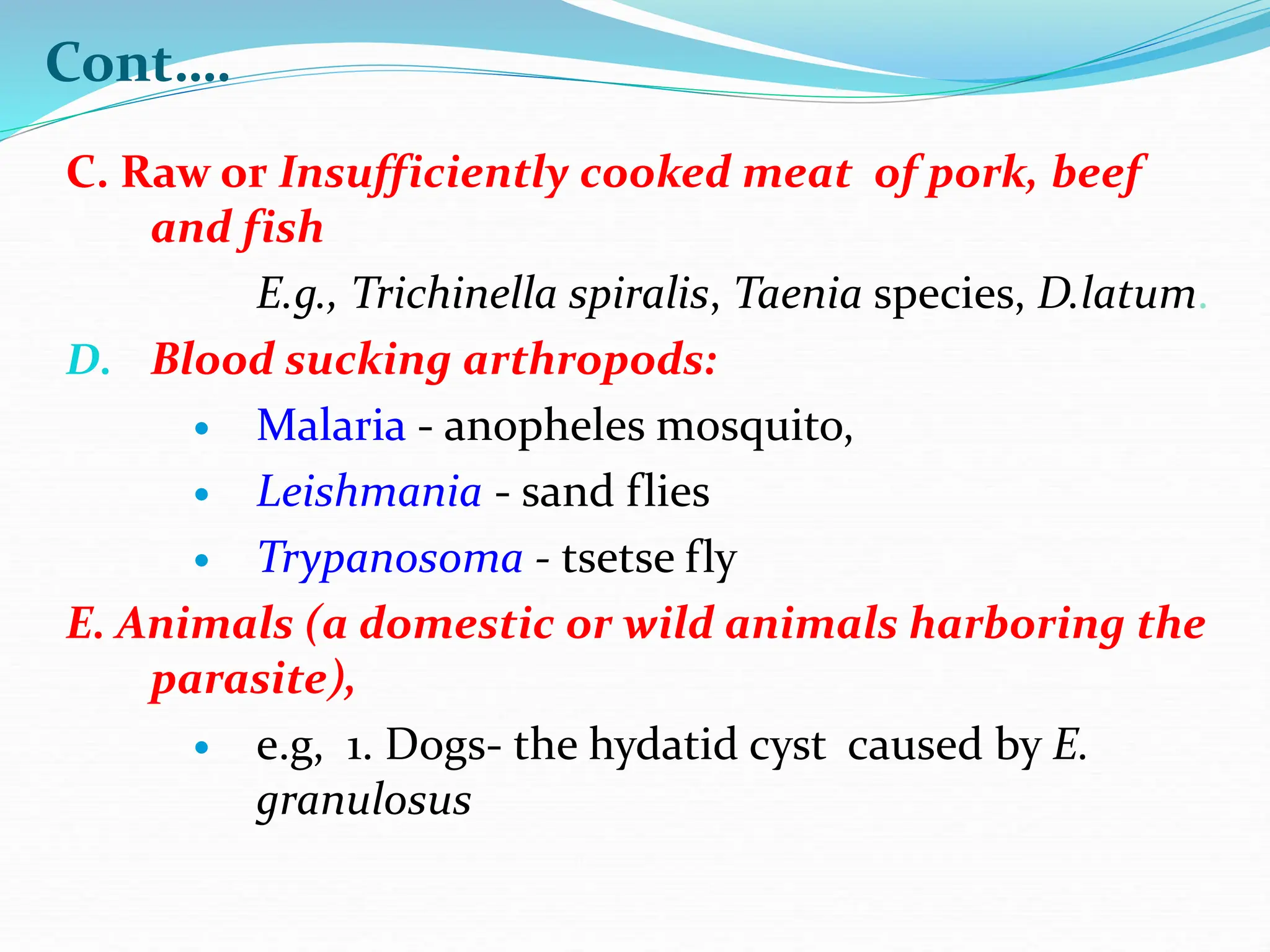
C. Raw or Insufficiently cooked meat of pork, beef
and fish
E.g., Trichinella spiralis, Taenia species, D.latum.
D. Blood sucking arthropods:
 Malaria - anopheles mosquito,
 Leishmania - sand flies
 Trypanosoma - tsetse fly
E. Animals (a domestic or wild animals harboring the
parasite),
 e.g, 1. Dogs- the hydatid cyst caused by E.
granulosus
Cont….
F. Human beings:-
 A person his/her clothing, bedding or the immediate
environment that he/she contaminated
 Autoinfection: - e.g., S. stercoralis, E. vermicularis, and
T. solium
Cont….
1.4.2.2. Mode of Transmission
A. Direct mode of Transmission:-
classified as:
I. Horizontal Direct mode of transmission: Transmission
is mainly effected through:-
 Feco-oral route: most intestinal parasites transmitted in this
way.
 Sexual intercourse
 Blood transfusion
 Direct skin penetration
II. Vertical Direct Mode of Transmission:
Transmission of the parasite is from the mother to
child through:
 Congenital / transplacental
Cont….
B - Indirect Mode of Transmission:-
 If the parasite
 has complex life cycle
 requires biological vectors and/or
 one or more intermediate hosts
Cont….
Route of Transmission
I. By ingesting infective stage of parasites:
II. Penetration of Skin When in Contact with:
 Faecally polluted soil, e.g., S.stercoralis, Hook worms
III. Through Insect Bite,
 E.g., filarial worms, Trypanosoma sp, Plasmodium sp. etc.
IV. Sexual Contact, e.g., Trichomonas vaginalis
V. Transmammary, e.g., S. stercoralis
VI. Inhalation of contaminated air, e.g., E. vermicularis, P.
carnii
VII. Transplacental, e.g., T. gondii
VIII. Kissing, e.g., Trichomonas gingivalis, T. tenax
Cont….
1.5 General Life Cycles of parasites
 Life Cycles of parasites : Describes the cycle of development
of the parasite,
 This may involve
 Passing through a number of developmental stages &
environment
 Parasitic and non-parasitic stages.
 The life of a parasite can be divided into a number of phases:
 Growth and maturation,
 Reproductive (sexual and asexual) and
 Transmission phases.
 All vitally important for the successful survival of the
parasite.
Simple or Direct Life Cycle (monoxenous)
 only one host is required to complete its cycle
 Transmitted from one host to another through the air, by a
fomite, or in contaminated food or water are example.
1.5.1 Types of Life cycles
 Can be simple or complex depending on how many different
hosts it requires to complete its cycle
Indirect or heteroxenous life cycles
 requires 2 or more hosts (a vector or intermediate host ) to
reproduce or grow in
 Frequently this may involve passing through a number of
developmental stages & Evt.
Cont……
1.5.2.Why study life cycles?
Control.
Treatment.
Epidemiology.
Fundamental research.
1.6 Parasitic Infections & Disease:
 Not all parasitic infections cause disease of clinical
significance.
 Both host and parasitic factors are involved for the
parasitic infection to cause disease or not
1.6.1.Host Factors
1. Genetic factors, E.g. Black population who lack Duffy
antigen resist P.vivax
2. Age,
3. Sex : e.g., T.vaginalis
4. Level of immunity: natural and acquired immunity
5. Nutrition (malnutrition or under nutrition)
6.Intensity and frequency of infections
7. Presence of co-existing disease or conditions, which reduces
immune response. e.g. Pregnancy, HIV
8.Life style and occupation
1.6.2.Parasite factors
1. Strain of the parasite and adaptation to human host
2. Parasite load ( number of parasite )
3. Site (s) occupied in the body
4. Metabolic processes of the parasite, particularly the nature
of any waste products or toxins produced by the parasite
during its growth and reproduction.
1.6.3. How do Parasites Cause Inquiry to their Host?
A. Competition for the host’s nutrients
- Eg. D.latum absorbs vitamin B-12, can cause anemia
- other tapeworms absorb large amounts of proteins and
sugars
- hookworm ingests blood, can be up to 250 ml/day
B. Destruction of host tissues
- some injure upon entry, some after established
- eg. Swimmers itch, cercariae penetrate and cause
inflammation
- intestinal worms, after established cause small lesions in
gut, possible secondary infection
- Entamoeba actively digest epithelial cells in large
intestine
Cont…
C. Tissue changes
- may cause serious consequences to host
- hyperplasia,. Eg Fasciola
- hypertrophy,
- metaplasia, change of tissue cell type to another type.
Eg. Paragonims (lung fluke)
- neoplasia, growth of cell to form a new structure. Eg.
Tumors
Cont…
D. Toxins and secretions
- some may cause pathogenic response, some may inhibit
immune function
- eg. Mosquito saliva
E. Mechanical interference
- Elephantiasis (filarial worms) blocks lymphatic system
- Tapeworms in large numbers can block intestine
- Plasmodium can cause RBC’s to stick together and clog
capillaries
Taxonomy of parasites
Taxonomy
kingdom protista kingdom Animalia
Sub -kingdom Protozoa Sub-kingdom Metazoa
Taxonomic classification of protozoa
Sub kingdom Phylum Sub-phylum Genus- examples Species- examples
Protozoa Sarcomastig
-ophora
further divided into
Sarcodina-- -
move by
pseudopodia
Entamoeba E. histolytica
Mastigophora
move by flagella
Giardia G. lamblia
Apicomplexa
no organelle of
locomotion
Plasmodium P. falciparum,
P. vivax,
P. malariae,
P. ovale
Ciliophora
move by cillia
Balantidium B. coli
Microspora
Spore-forming
Enterocyto-
zoa
E. bienusi
Taxonomic classification of helminths
Sub kingdom Phylum Class Genus – examples
Metazoa NEMATHELMINTHES
Round worms; appear
round in cross section,
they have body cavities,
a straight alimentary
canal and an anus
Nematodes Ascaris (roundworm)
Trichuris (whipworm)
Ancylostoma
(hookworm)
Necator (hookworm)
Enterobius (pinworm
or threadworm)
Strongyloides
Platyhelminthes
Flat worms;
dorsoventrally flattened,
no body cavity and, if
present, the alimentary
canal is blind ending
Cestodes
Adult tapeworms are found
in the intestine of their host
They have a head (scolex)
with sucking organs, a
segmented body but no
alimentary canal
Each body segment is
hermaphrodite
Taenia (tapeworm)
Trematodes
Non-segmented, usually leaf-
shaped, with two suckers but
no distinct head
They have an alimentary canal
Fasciolopsis (liver fluke)
Schistosoma (not leaf
shaped!)
Any questions?

introduction Para for nurse 2016 batch.ppt

  • 1.
    Tsegaye Yohanes (MSc,Assistant professor) Department of medical laboratory sciences Arba Minch University
  • 2.
  • 3.
    Introduction to Medicalparasitology 1.1. Definition  Medical parasitology ;The study of the parasites of man and their medical consequences .  It is a subject that researches:  the biological features of human parasites,  the relationship between the human being and the parasites,  the prevention and treatment of the parasitic diseases.
  • 4.
    1.2. Scope ofMedical Parasitology  According to the very broad definition of parasitology, parasites should include:-  viruses, bacteria, fungi,  protozoa and metazoa (multi-celled organisms) which infect their host species.  However, for historical reasons the first three have been incorporated into the discipline of Microbiology.
  • 5.
    Cont…  Therefore, Medicalparasitology consists of:-  Protozoa (single celled animals),  Helminths (worms)  Arthropods
  • 6.
    Human Parasitology Medical Helminthology Medical Protozoology Medical Arthropodology • Class Nematoda •Class Trematoda • Class Cestoda • Phylum Sarcomastigophora • Amoeba • Flagellates • Phylum Apicomplexa • Phylum Microsporodia • Phylum Ciliophora • Class Insecta • Class Arachnida • Class Crustacea • Class Chilopoda
  • 7.
    The importance ofparasitology  Six major tropical diseases to which WHO pays great attention include:  malaria,  schistosomiasis,  filariasis,  leishmaniasis,  trypanosomiasis and  leprosy.  Five of them are parasitic diseases except leprosy.  All the above diseases are prevalent in Ethiopia
  • 8.
    1.3. Concepts relatedto medical parasitology 1.3.1. Symbiosis(literally-Sim=together,bios=life)  Symbiosis- mean “living together”  Any association more or less permanent is called a symbiosis, with each member a symbiont.  Two different organisms live together and interact, one partner lives in or on another one’s body.
  • 9.
    Cont….  Types ofsymbiosis  Distinguished on whether or not the association is detrimental to one of the two partners.  3 types:  Mutualism  Commensalism  Parasitism
  • 10.
    Cont… Mutualism (+/+)  Permanentassociation between two different organisms that life apart is impossible,  Two partners benefit each other,  The mutuals are metabolically dependent on one another;  One cannot survive in the absence of the other.  e.g., termites and flagellates  Two ways benefit, no harm
  • 11.
    Cont… Commensalism(+/0)  Literally means( Co-togather, mensa-table) “ eating at the same table”  Association of two different organisms  One partner is benefited while the other neither benefited nor injured,  Loose association  No metabolically dependence E.g E. Coli and man.
  • 12.
    Cont… Parasitism(+/_)  Association oftwo different organisms  One partner is benefited while the other is injured, such as ascaris lumbricoides and man.
  • 13.
    Symbiosis summary table Organism1 Organism 2 Mutualism + + Commensalism + o Parasitism + _
  • 14.
    1.3.1.Parasite and typesof parasites Parasite:-  It is an animal organism which lives in or on the host in order to obtain nourishment and shelter from the host as well as does harms to the host.  In parasitism, parasite is the benefited partner.
  • 15.
    Types of Parasites Parasitecan be Classified I. According to their habitat A. Endoparasite  Lives inside the body of the host  May be just under the surface or deep in the body  Tapeworms, flukes, protozoans  Infection – if endoparasite produce considerable damage
  • 16.
    Cont’d……. B. Ectoparasite  Stayson outside surface of the host  leeches, ticks, fleas, brood parasites  Infestation – if ectoparasite produce damage
  • 17.
    Cont’d….  II. Basedon dependency on the host  Obligate Parasite  Requires finding and invading the host to complete its life cycle  Most of the parasites we will cover are obligate parasites  Facultative Parasite  May become parasitic if it is given the chance but does not require a host.
  • 18.
    Cont’d…. III. Amount oftime spent  Permanent Parasite  Lives entire adult life stage on or in a host  Usually endoparasites  One exception is eyelash mite  Temporary Parasite  Spends only a short time on a host  Usually ectoparasites
  • 19.
    Cont’d…. IV. According totheir Pathogenicity:  Pathogenic parasites  Non-Pathogenic (commensal)  Opportunistic parasites
  • 20.
    Cont’d…. Pathogenic parasites  Aparasite that causes injury to the host Non-Pathogenic (commensal)  A parasite that does not cause injury to the host Opportunistic parasites  may become pathogenic under certain conditions
  • 21.
    V. Based ontheir life cycle  Monoxenous parasites:  Those with direct life cycles (i.e., with one host).  Heteroxenous parasites:  Those with inderect life cycles requiring an intermediate host (i.e., involves 2 or more hosts).  Heterogenetic Parasites:  One with alteration of generations e.g., Coccidial parasites and Strongyloides
  • 22.
    VI. Based onhost ranges  Euryxenous parasites:  Those with a broad host range.  Stenoxenous parasites:  Those with a narrow host range.
  • 23.
    Other terminology Aberrant parasite: Found in locations in the host where they normally do not occur;  e.g., Ascaris larvae may migrate to the brain Insidental parasite:  Occurs in hosts where it does not normally occur;  e.g., Fasciola normally does not occur in man but is incidental if found in man’s liver.
  • 24.
    1.3.3.Hosts and typesof hosts  Host:-Hosts are organism which harbors the parasite.  In parasitism, it is the injured partner  Types of Hosts: -  Definitive host:-  Intermediate host:-
  • 25.
     Definitive host:- harbors adult or sexually reproductive stage of a parasite.  What characterizes the primary host?  Where sexual reproduction takes place.  Normally where the adult parasites live.  Normally the larger of the hosts, usually a vertebrate.
  • 26.
     Intermediate host:-harbours larval or asexually reproductive stage of a parasite.  What characterizes the intermediate host?  Sexually immature or larval stage of a parasite  Asexual multiplication takes place  may harbor many immature stages of a parasite;
  • 27.
    Other terminology  ReservoirHost  Any animal that carries a parasite that can cause infections in humans.  These hosts ensure continuity of the parasite’s life cycle and act as additional sources of human infection.  They are an important source of infection in epidemiology.  Carrier host: -  A person who harbors parasites has no any clinical symptom. He is an important source of infection in epidemiology  e.g. human beings harboring cyst form of E.histolytica
  • 28.
    1.3.5.Vector and typesof vectors Vector:-an organism (usually an arthropod) which transfers infective forms of a parasite from one host to the other.  Classification 1. Biological vectors:- 2. Mechanical Vectors:
  • 29.
    Cont’d…. 1. Biological vectors:- Characterized by the pathogen(parasite) either reproduces, develops or both in the vector before its transfer to another host .  Propagative  Cyclopropagative  Cyclodevelopmental
  • 30.
    Cont’d….  Propagative: multiplicationof the pathogen(parasite) without developmental change. E.g. Yersinia pestis in fleas  Cyclopropagative: multiplication and developmental change of the pathogen(parasite). E.g. Plasmodium vivax in Anopheles mosquitoes  Cyclodevelopmental: developmental change of the pathogen without multiplication E.g.Onchocerca volvulus in black flies
  • 31.
    Cont’d…. 2. Mechanical vector Parasite stay in/on the host but no parasitic development of reproduction (multiplication) occurs in the vector  transmit a parasite without being a host  Not essential to the life cycle of the parasite Ex. Flies
  • 32.
    1.3.6.Other terminologies  *InfectiveStage : it is a stage when a parasite can invade human body and continue to live there. The infective stage of ascarid is the embryonate egg.  *Infective Route is the specific entrance through which the parasite invades the human body. Hookworms invade human body by skin. Man gets infection with ascarid by mouth.  Infective Mode means how the parasite invades human body, such as the cercariae of the blood fluke actively penetrate the skin of a swimming man and the infective ascaris eggs are swallowed by man.
  • 33.
    1.4. Epidemiology ofparasite  Epidemiology: The study of the patterns of diseases within populations  For parasites, this includes:  Host range – what can it infect?  Geographic range – where is it?  Is it a zoonotic agent?  Can it infect humans?  Does it have a reservoir?  A group of vertebrates maintaining the parasite  Does it have a nidus?  A small ecosystem that possesses all the factors to maintain the parasite..
  • 34.
    1.4.1.Geographic Distribution  Globaldistribution  parasite occur globally,  the majority occur in tropical regions,  Factors  Favorable environmental conditions  poverty, poor sanitation and personal hygiene
  • 35.
    Factors (Endemicity): Factors thatfavor constant presence of parasite 1. Presence of a suitable host 2. Habits of the host 3. Escape mechanism from the host 4. Favorable conditions outside of host 5. Economic and social conditions
  • 36.
    1.4.2.Transmission of parasites Parasite can be transmitted from infected to non infected host  Factors required for transmission:(Three key links of parasitic disease transmission) 1. Source of infection 2. Mode of transmission 3. Susceptible people
  • 37.
    1. Sources ofExposure to Parasitic Infections A. Contaminated soil:-  Soils polluted with human excreta is commonly responsible for exposure to infection with geohelminthes B. Contaminated water:- Water may contain  (a) viable cysts of Amoeba, flagellates etc,  (b) cercarial stages of human blood fluke,  (c) Cyclops containing larva of Dracunculus medinensis  (d) fresh water fishes which are sources for fish tape worm, and intestinal flukes infection  (e) crab or cray fishes that are sources for lung fluke and  (f ) Water plants which are sources for Fasciolopsis buski. Cont….
  • 38.
    C. Raw orInsufficiently cooked meat of pork, beef and fish E.g., Trichinella spiralis, Taenia species, D.latum. D. Blood sucking arthropods:  Malaria - anopheles mosquito,  Leishmania - sand flies  Trypanosoma - tsetse fly E. Animals (a domestic or wild animals harboring the parasite),  e.g, 1. Dogs- the hydatid cyst caused by E. granulosus Cont….
  • 39.
    F. Human beings:- A person his/her clothing, bedding or the immediate environment that he/she contaminated  Autoinfection: - e.g., S. stercoralis, E. vermicularis, and T. solium Cont….
  • 40.
    1.4.2.2. Mode ofTransmission A. Direct mode of Transmission:- classified as: I. Horizontal Direct mode of transmission: Transmission is mainly effected through:-  Feco-oral route: most intestinal parasites transmitted in this way.  Sexual intercourse  Blood transfusion  Direct skin penetration
  • 41.
    II. Vertical DirectMode of Transmission: Transmission of the parasite is from the mother to child through:  Congenital / transplacental Cont….
  • 42.
    B - IndirectMode of Transmission:-  If the parasite  has complex life cycle  requires biological vectors and/or  one or more intermediate hosts Cont….
  • 43.
    Route of Transmission I.By ingesting infective stage of parasites: II. Penetration of Skin When in Contact with:  Faecally polluted soil, e.g., S.stercoralis, Hook worms III. Through Insect Bite,  E.g., filarial worms, Trypanosoma sp, Plasmodium sp. etc. IV. Sexual Contact, e.g., Trichomonas vaginalis
  • 44.
    V. Transmammary, e.g.,S. stercoralis VI. Inhalation of contaminated air, e.g., E. vermicularis, P. carnii VII. Transplacental, e.g., T. gondii VIII. Kissing, e.g., Trichomonas gingivalis, T. tenax Cont….
  • 45.
    1.5 General LifeCycles of parasites  Life Cycles of parasites : Describes the cycle of development of the parasite,  This may involve  Passing through a number of developmental stages & environment  Parasitic and non-parasitic stages.  The life of a parasite can be divided into a number of phases:  Growth and maturation,  Reproductive (sexual and asexual) and  Transmission phases.  All vitally important for the successful survival of the parasite.
  • 47.
    Simple or DirectLife Cycle (monoxenous)  only one host is required to complete its cycle  Transmitted from one host to another through the air, by a fomite, or in contaminated food or water are example. 1.5.1 Types of Life cycles  Can be simple or complex depending on how many different hosts it requires to complete its cycle
  • 48.
    Indirect or heteroxenouslife cycles  requires 2 or more hosts (a vector or intermediate host ) to reproduce or grow in  Frequently this may involve passing through a number of developmental stages & Evt. Cont……
  • 49.
    1.5.2.Why study lifecycles? Control. Treatment. Epidemiology. Fundamental research.
  • 50.
    1.6 Parasitic Infections& Disease:  Not all parasitic infections cause disease of clinical significance.  Both host and parasitic factors are involved for the parasitic infection to cause disease or not
  • 51.
    1.6.1.Host Factors 1. Geneticfactors, E.g. Black population who lack Duffy antigen resist P.vivax 2. Age, 3. Sex : e.g., T.vaginalis 4. Level of immunity: natural and acquired immunity 5. Nutrition (malnutrition or under nutrition) 6.Intensity and frequency of infections 7. Presence of co-existing disease or conditions, which reduces immune response. e.g. Pregnancy, HIV 8.Life style and occupation
  • 52.
    1.6.2.Parasite factors 1. Strainof the parasite and adaptation to human host 2. Parasite load ( number of parasite ) 3. Site (s) occupied in the body 4. Metabolic processes of the parasite, particularly the nature of any waste products or toxins produced by the parasite during its growth and reproduction.
  • 53.
    1.6.3. How doParasites Cause Inquiry to their Host? A. Competition for the host’s nutrients - Eg. D.latum absorbs vitamin B-12, can cause anemia - other tapeworms absorb large amounts of proteins and sugars - hookworm ingests blood, can be up to 250 ml/day B. Destruction of host tissues - some injure upon entry, some after established - eg. Swimmers itch, cercariae penetrate and cause inflammation - intestinal worms, after established cause small lesions in gut, possible secondary infection - Entamoeba actively digest epithelial cells in large intestine
  • 54.
    Cont… C. Tissue changes -may cause serious consequences to host - hyperplasia,. Eg Fasciola - hypertrophy, - metaplasia, change of tissue cell type to another type. Eg. Paragonims (lung fluke) - neoplasia, growth of cell to form a new structure. Eg. Tumors
  • 55.
    Cont… D. Toxins andsecretions - some may cause pathogenic response, some may inhibit immune function - eg. Mosquito saliva E. Mechanical interference - Elephantiasis (filarial worms) blocks lymphatic system - Tapeworms in large numbers can block intestine - Plasmodium can cause RBC’s to stick together and clog capillaries
  • 56.
    Taxonomy of parasites Taxonomy kingdomprotista kingdom Animalia Sub -kingdom Protozoa Sub-kingdom Metazoa
  • 57.
    Taxonomic classification ofprotozoa Sub kingdom Phylum Sub-phylum Genus- examples Species- examples Protozoa Sarcomastig -ophora further divided into Sarcodina-- - move by pseudopodia Entamoeba E. histolytica Mastigophora move by flagella Giardia G. lamblia Apicomplexa no organelle of locomotion Plasmodium P. falciparum, P. vivax, P. malariae, P. ovale Ciliophora move by cillia Balantidium B. coli Microspora Spore-forming Enterocyto- zoa E. bienusi
  • 58.
    Taxonomic classification ofhelminths Sub kingdom Phylum Class Genus – examples Metazoa NEMATHELMINTHES Round worms; appear round in cross section, they have body cavities, a straight alimentary canal and an anus Nematodes Ascaris (roundworm) Trichuris (whipworm) Ancylostoma (hookworm) Necator (hookworm) Enterobius (pinworm or threadworm) Strongyloides Platyhelminthes Flat worms; dorsoventrally flattened, no body cavity and, if present, the alimentary canal is blind ending Cestodes Adult tapeworms are found in the intestine of their host They have a head (scolex) with sucking organs, a segmented body but no alimentary canal Each body segment is hermaphrodite Taenia (tapeworm) Trematodes Non-segmented, usually leaf- shaped, with two suckers but no distinct head They have an alimentary canal Fasciolopsis (liver fluke) Schistosoma (not leaf shaped!)
  • 59.