Introduction for
Scientific Writing
Dr. Nahid Sherbini
Consultant Internal Medicine & Pulmonary
Certified from Harvard Medical School - PPCR- Principles and Practice of Clinical
Research
Scientific Writing
Types of Scientific Publication
Outline
Language
Structure & Preparation of a Paper
Types of Scientific Publication
Oral presentations
Written presentations
Books and book chapters
Review papers
Journal articles
Newspaper articles
• Conference posters
• Annual reports, quarterly reports and project
reports, Conference abstracts
• Letter to journals and book reviews
Types of Scientific Publication
Language
Simple
accurate
Precise
Grammar
Spelling
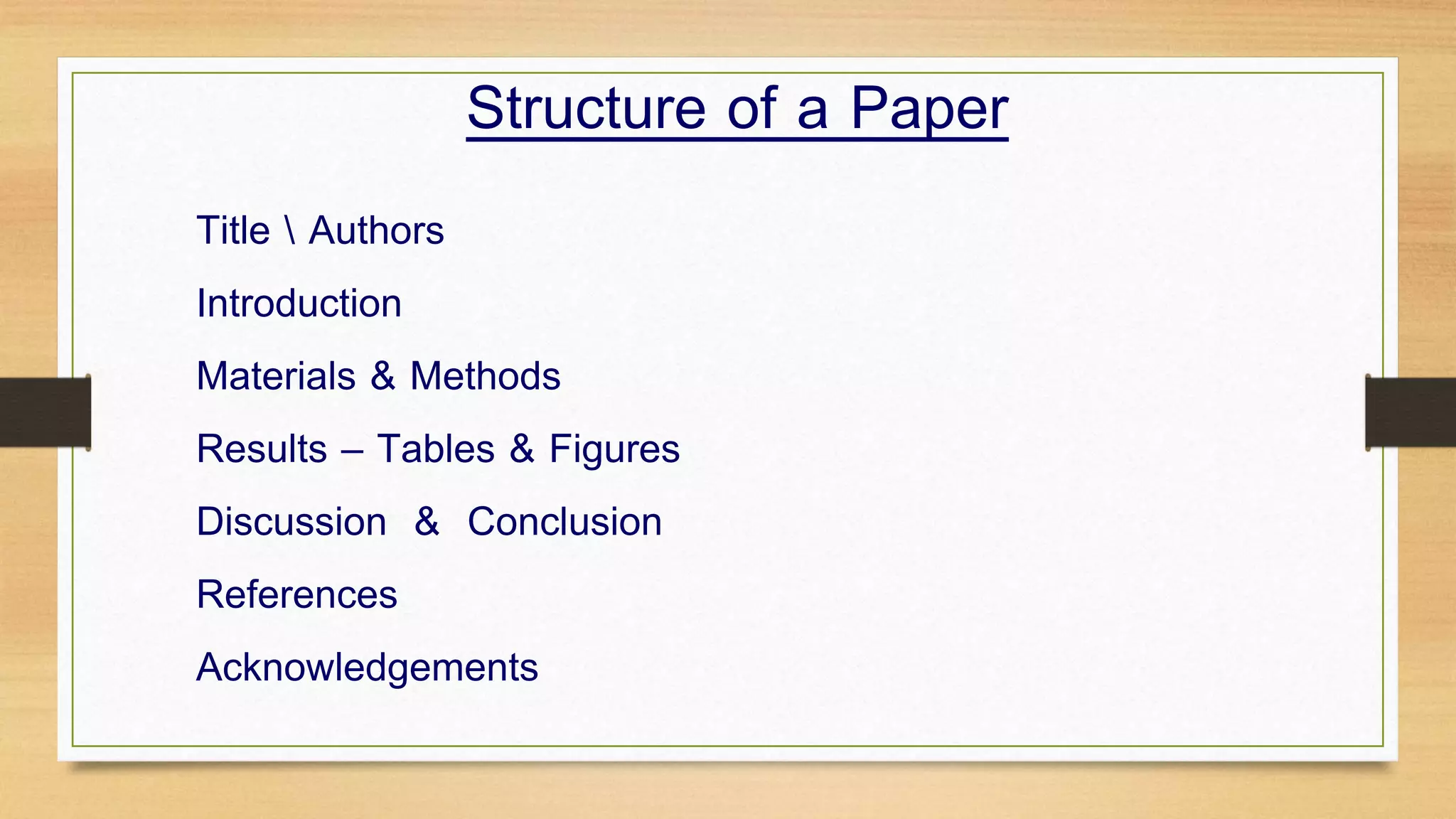
Structure of a Paper
Title  Authors
Introduction
Materials & Methods
Results – Tables & Figures
Discussion & Conclusion
References
Acknowledgements
Writing the Title of
Research
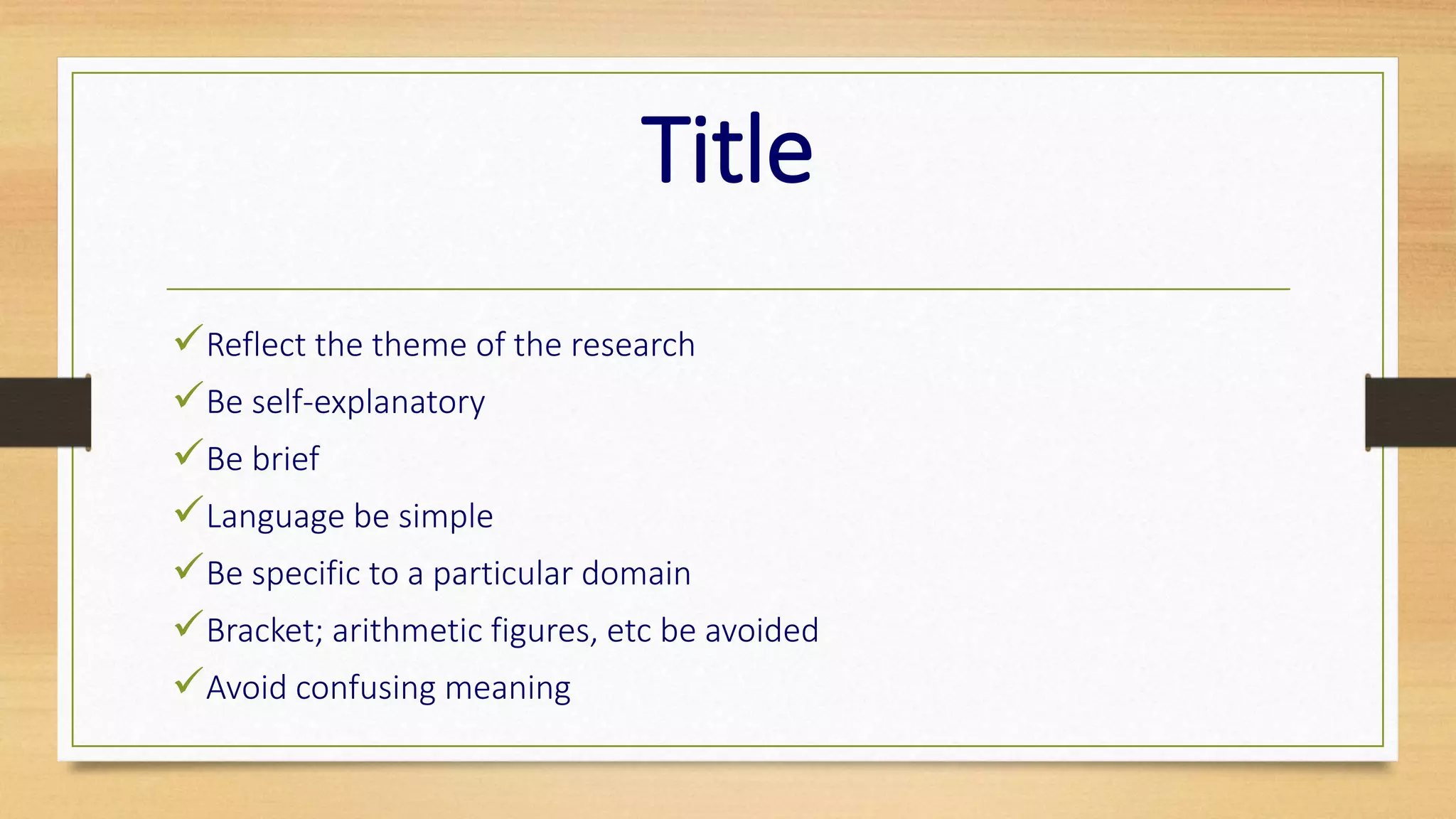
Title
Reflect the theme of the research
Be self-explanatory
Be brief
Language be simple
Be specific to a particular domain
Bracket; arithmetic figures, etc be avoided
Avoid confusing meaning
Title
• Specific & Short
• This forms the first impression about your research
Writing the Title of Research
1. Write clearly.
2. Include the main concepts.
3. Write the variables being investigated.
Writing the Title of Research
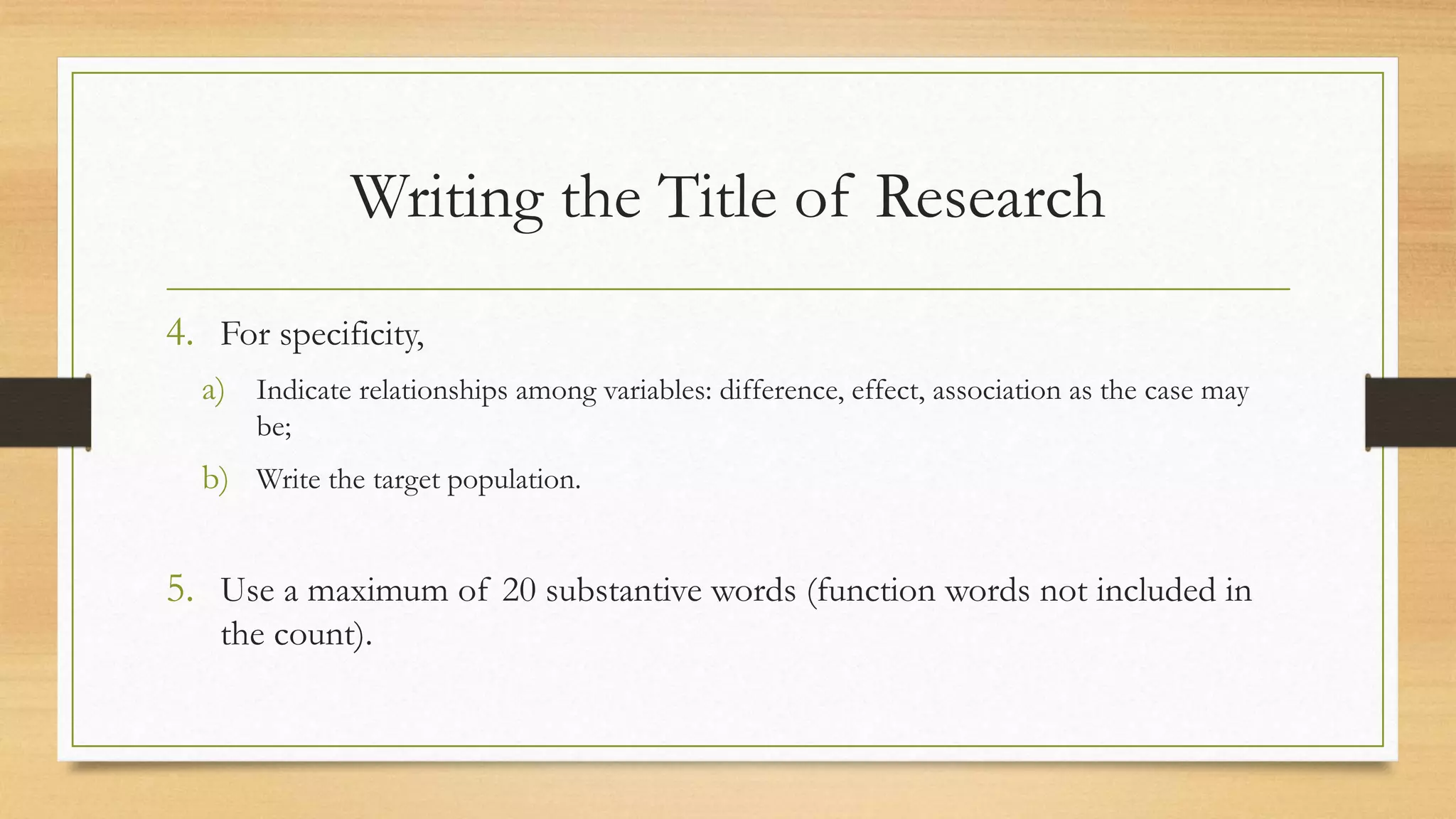
4. For specificity,
a) Indicate relationships among variables: difference, effect, association as the case may
be;
b) Write the target population.
5. Use a maximum of 20 substantive words (function words not included in
the count).
Examples
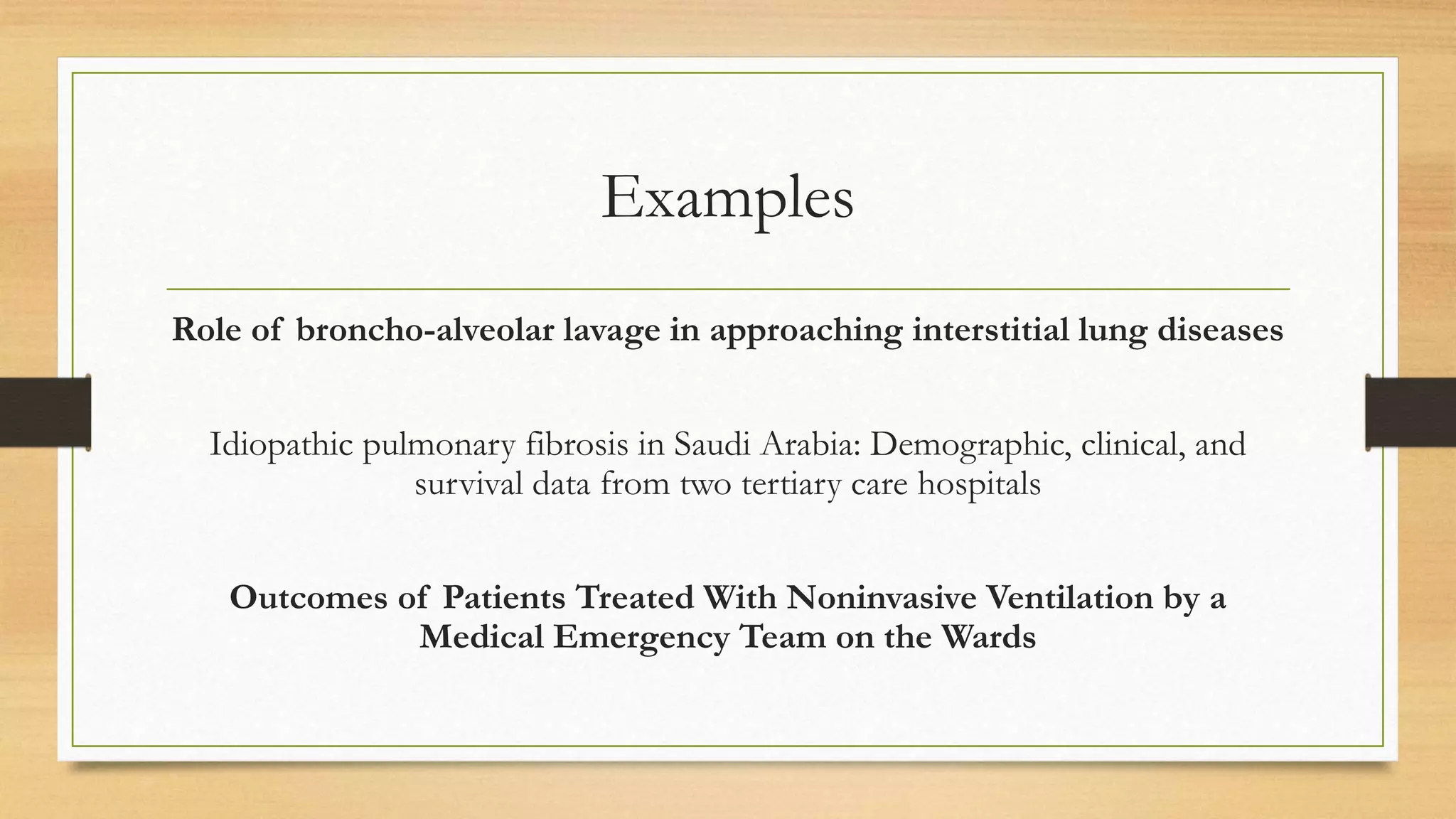
Role of broncho-alveolar lavage in approaching interstitial lung diseases
Idiopathic pulmonary fibrosis in Saudi Arabia: Demographic, clinical, and
survival data from two tertiary care hospitals
Outcomes of Patients Treated With Noninvasive Ventilation by a
Medical Emergency Team on the Wards
Writing the Outline
Writing the Outline
Functions of Outlines:
• Outlines
 show points that still need research;
 indicate items (topics) that have been over-researched;
 form basis of research report.
Main Body or Text of
the Report
The Introduction
The Introduction
1. The Background of the Study
– what leads the researcher to undertake the study.
2. The Research Problem and Sub-Problems
– anything in the universe that leads to a “better life” for man.
The Introduction
2. The Research Problem and Sub-Problems (cont’d.)
 Out of an old problem, a new problem may evolve.
 A thinker is stimulated by what he reads.
 An individual group has the urge to achieve and contribute something to society.
 An individual likes to exercise resourcefulness, ingenuity and creativeness.
The Introduction
3. The Importance or Significance of the Study
 Who are the probable users of the research results?
 In what specific manner could the findings be used?
 Will it benefit society as a whole?
 Why should the problem be explored?
The Introduction
4. The Objectives or Hypotheses
Objectives
 are set goals or those that are sought in the study;
 serve as pointers in the development of the tool used in gathering data;
 guide the organization of situations – in analysis of data or discussion of results.
Hypothesis
 is a “hunch” that is to be tested in order that it be accepted or rejected,
The Introduction
4. The Objectives or Hypotheses (cont’d.)
Objectives and Hypotheses should be
 specific
 clearly stated
 systematic in ordering situations
 short
 few
 highly relevant to the problem
The Review of Related
Literature
The Review of Related Literature
Part 1 – General concepts, principles and theories related to the study
Part 2 – Local studies done along the same line of research
Part 3 – Foreign Studies
The Review of Related Literature
Notes:
• The study should not be a repetition of a previous work or a replicate
of a previous study.
• The important past works of others are not overlooked.
• The study could be a verification of findings of past researchers.
Introduction
• Convince the reader that you have identified a research problem, worthy of investigating.
• Start very general – Broad Topic
• Highlight
• the concept
• Practical significance
• Reduce it to a narrow topic by
• Raising questions, and
• Stating answers from literature for most.
• Establish Rationale:
• Research is necessary questions for which there is no answer yet.
Research Proposal
Regardless of your research area and the methodology
you choose, all research proposals must address the
following questions:
What you plan to accomplish
why you want to do it and
how you are going to do it.
Research Proposal
First page –
title of the research; researcher’s name; name of
institute/organization where the researcher belongs; name
of the sponsoring organization, name of the supervisor, co-
supervisor; date; etc
Research Proposal
A Basic Proposal Outline:
Introduction
 Topic area
 Research question
 Significance to knowledge
Research Proposal
Literature review
 Previous research others & yours
 Interlocking findings and Unanswered questions
 Your preliminary work on the topic
 The remaining questions and inter-locking logic
 Reprise of your research question(s) in this context
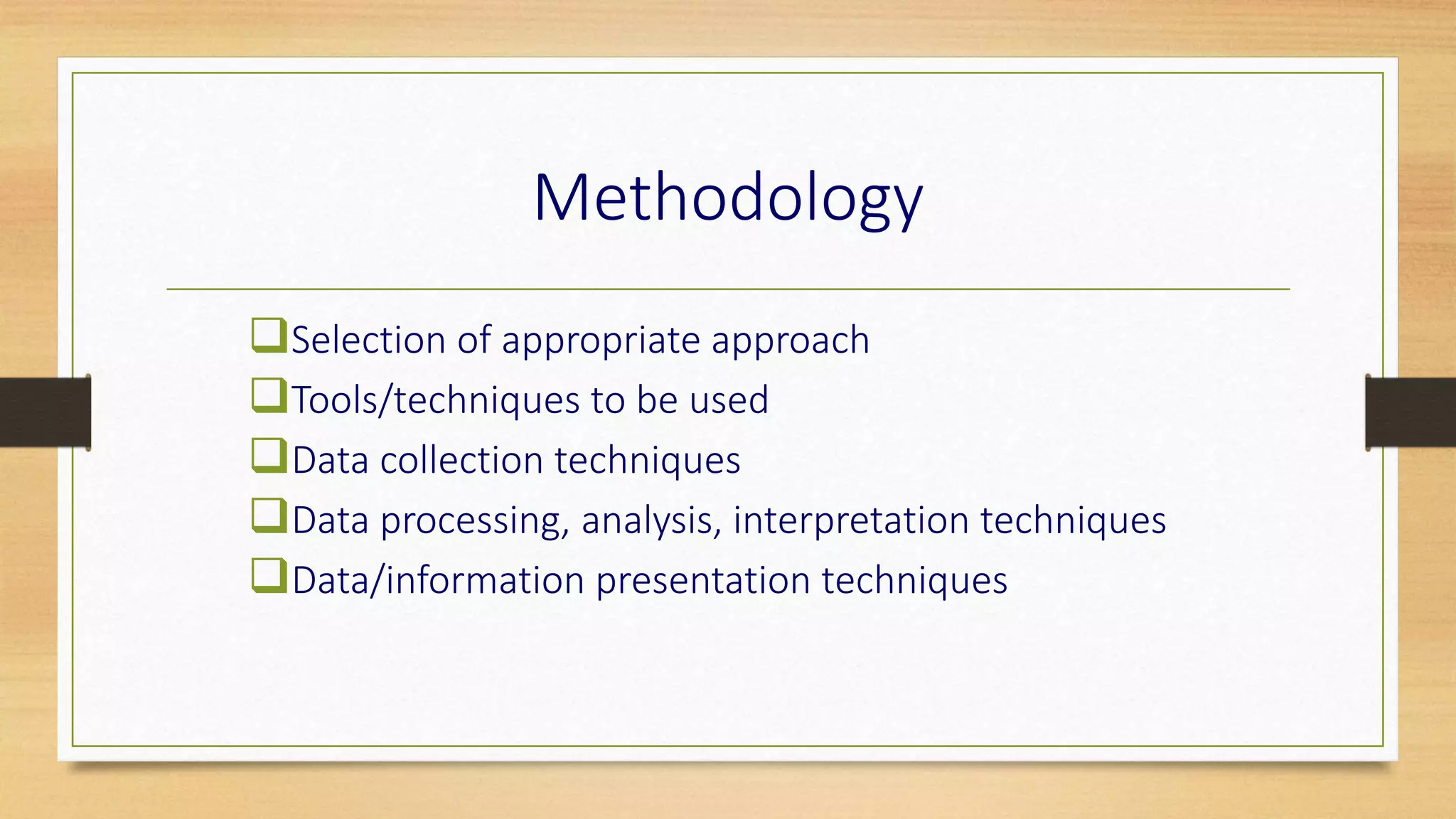
Methodology
Selection of appropriate approach
Tools/techniques to be used
Data collection techniques
Data processing, analysis, interpretation techniques
Data/information presentation techniques
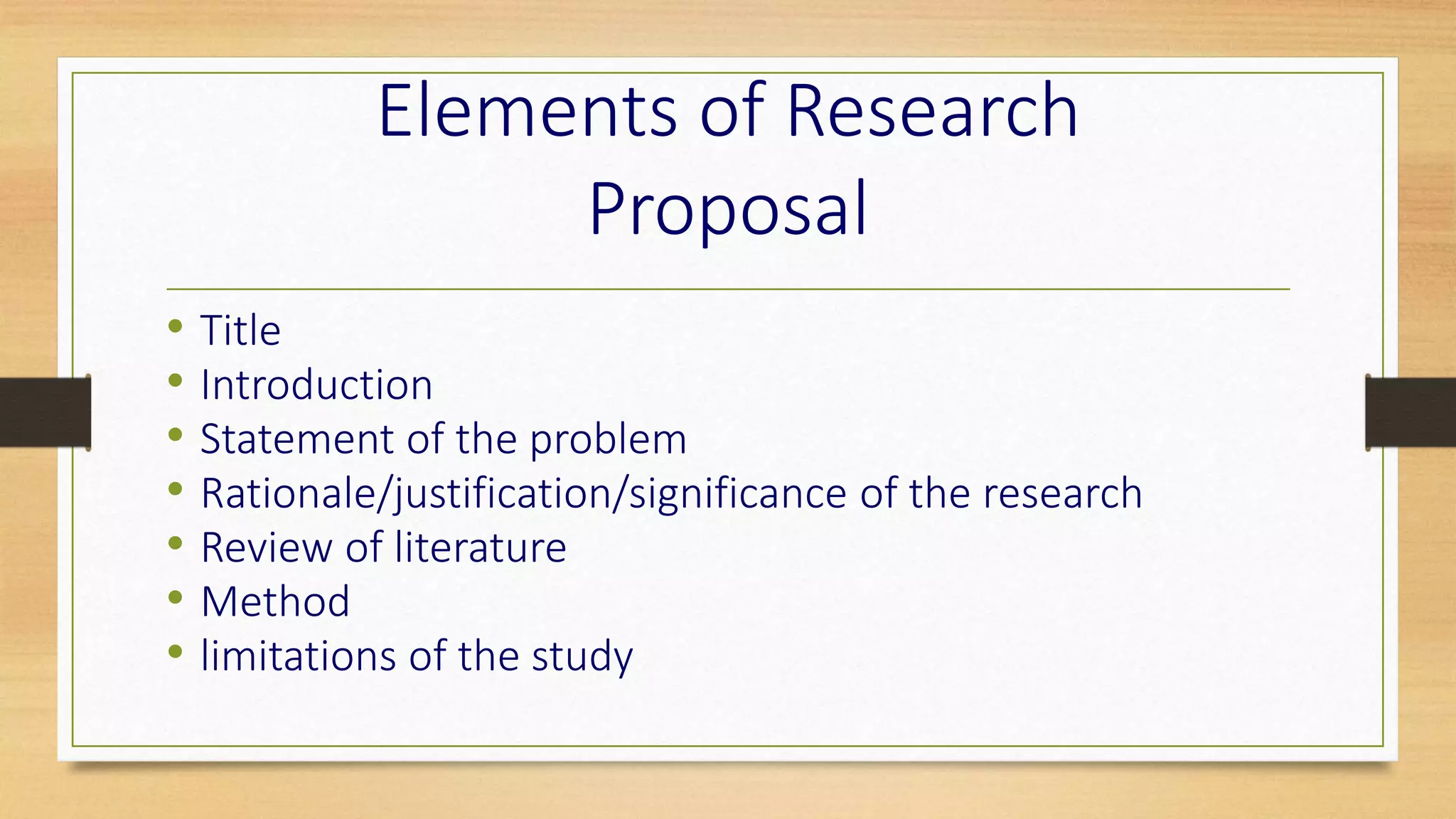
Elements of Research
Proposal
• Title
• Introduction
• Statement of the problem
• Rationale/justification/significance of the research
• Review of literature
• Method
• limitations of the study
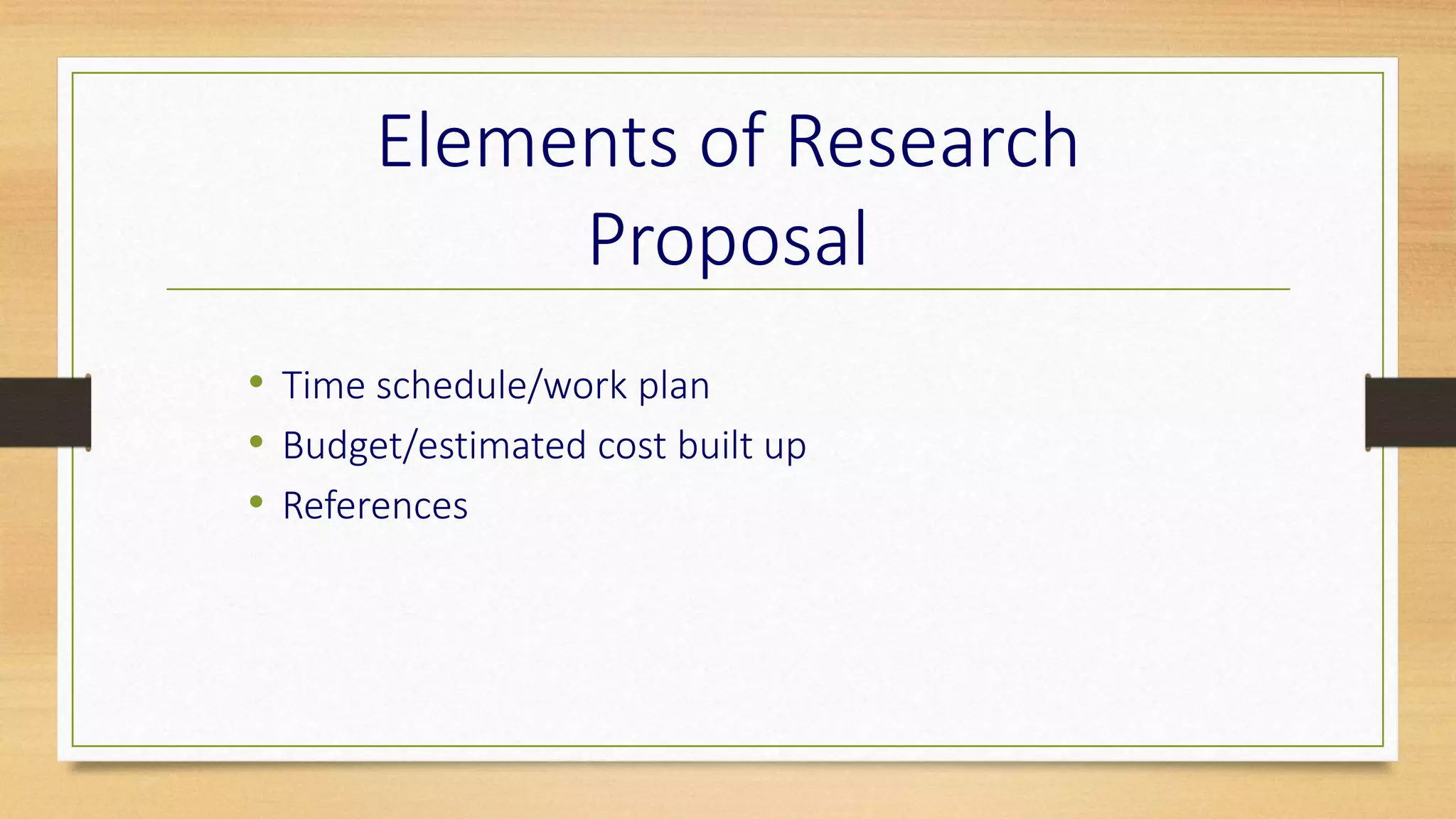
Elements of Research
Proposal
• Time schedule/work plan
• Budget/estimated cost built up
• References
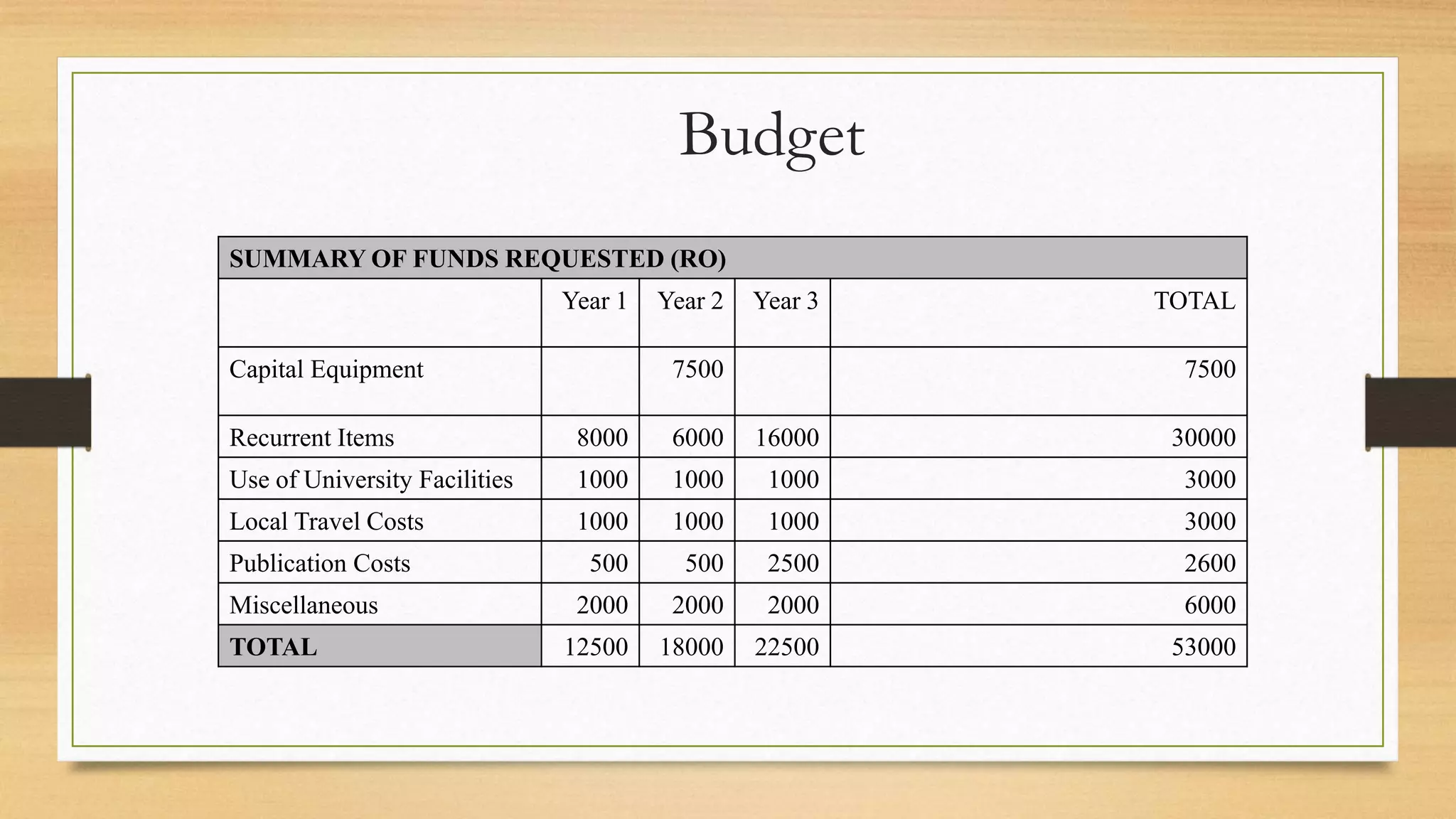
Budget
SUMMARY OF FUNDS REQUESTED (RO)
Year 1 Year 2 Year 3 TOTAL
Capital Equipment 7500 7500
Recurrent Items 8000 6000 16000 30000
Use of University Facilities 1000 1000 1000 3000
Local Travel Costs 1000 1000 1000 3000
Publication Costs 500 500 2500 2600
Miscellaneous 2000 2000 2000 6000
TOTAL 12500 18000 22500 53000
References
• List all references
• In alphabetical order
Common Mistakes
• To develop coherent arguments
• Too much detailed or too much short on major
issues
• Incorrect citation/references
DOs and DO NOTs
• DO
Produce/prepare a professional looking proposal
Make it interesting
Make it informative, meaningful
Write easy way to read
Present content in a page
Use clear headings/sub-headings
DOs and DO NOTs
• DO
Be concise, precise
Check spelling, grammar
Present in accurate/acceptable format
DO NOTs
Use no ward which you do not understand
Use of difficult ward unimpressive to the readers/ supervisor/ authority
Thanks

Introduction for scintfic writing

  • 1.
    Introduction for Scientific Writing Dr.Nahid Sherbini Consultant Internal Medicine & Pulmonary Certified from Harvard Medical School - PPCR- Principles and Practice of Clinical Research
  • 2.
    Scientific Writing Types ofScientific Publication Outline Language Structure & Preparation of a Paper
  • 3.
    Types of ScientificPublication Oral presentations Written presentations Books and book chapters Review papers Journal articles Newspaper articles
  • 4.
    • Conference posters •Annual reports, quarterly reports and project reports, Conference abstracts • Letter to journals and book reviews Types of Scientific Publication
  • 5.
  • 6.
    Structure of aPaper Title Authors Introduction Materials & Methods Results – Tables & Figures Discussion & Conclusion References Acknowledgements
  • 7.
    Writing the Titleof Research
  • 8.
    Title Reflect the themeof the research Be self-explanatory Be brief Language be simple Be specific to a particular domain Bracket; arithmetic figures, etc be avoided Avoid confusing meaning
  • 9.
    Title • Specific &Short • This forms the first impression about your research
  • 10.
    Writing the Titleof Research 1. Write clearly. 2. Include the main concepts. 3. Write the variables being investigated.
  • 11.
    Writing the Titleof Research 4. For specificity, a) Indicate relationships among variables: difference, effect, association as the case may be; b) Write the target population. 5. Use a maximum of 20 substantive words (function words not included in the count).
  • 12.
    Examples Role of broncho-alveolarlavage in approaching interstitial lung diseases Idiopathic pulmonary fibrosis in Saudi Arabia: Demographic, clinical, and survival data from two tertiary care hospitals Outcomes of Patients Treated With Noninvasive Ventilation by a Medical Emergency Team on the Wards
  • 13.
  • 14.
    Writing the Outline Functionsof Outlines: • Outlines  show points that still need research;  indicate items (topics) that have been over-researched;  form basis of research report.
  • 15.
    Main Body orText of the Report
  • 16.
  • 17.
    The Introduction 1. TheBackground of the Study – what leads the researcher to undertake the study. 2. The Research Problem and Sub-Problems – anything in the universe that leads to a “better life” for man.
  • 18.
    The Introduction 2. TheResearch Problem and Sub-Problems (cont’d.)  Out of an old problem, a new problem may evolve.  A thinker is stimulated by what he reads.  An individual group has the urge to achieve and contribute something to society.  An individual likes to exercise resourcefulness, ingenuity and creativeness.
  • 19.
    The Introduction 3. TheImportance or Significance of the Study  Who are the probable users of the research results?  In what specific manner could the findings be used?  Will it benefit society as a whole?  Why should the problem be explored?
  • 20.
    The Introduction 4. TheObjectives or Hypotheses Objectives  are set goals or those that are sought in the study;  serve as pointers in the development of the tool used in gathering data;  guide the organization of situations – in analysis of data or discussion of results. Hypothesis  is a “hunch” that is to be tested in order that it be accepted or rejected,
  • 21.
    The Introduction 4. TheObjectives or Hypotheses (cont’d.) Objectives and Hypotheses should be  specific  clearly stated  systematic in ordering situations  short  few  highly relevant to the problem
  • 22.
    The Review ofRelated Literature
  • 23.
    The Review ofRelated Literature Part 1 – General concepts, principles and theories related to the study Part 2 – Local studies done along the same line of research Part 3 – Foreign Studies
  • 24.
    The Review ofRelated Literature Notes: • The study should not be a repetition of a previous work or a replicate of a previous study. • The important past works of others are not overlooked. • The study could be a verification of findings of past researchers.
  • 25.
    Introduction • Convince thereader that you have identified a research problem, worthy of investigating. • Start very general – Broad Topic • Highlight • the concept • Practical significance • Reduce it to a narrow topic by • Raising questions, and • Stating answers from literature for most. • Establish Rationale: • Research is necessary questions for which there is no answer yet.
  • 26.
  • 27.
    Regardless of yourresearch area and the methodology you choose, all research proposals must address the following questions: What you plan to accomplish why you want to do it and how you are going to do it. Research Proposal
  • 28.
    First page – titleof the research; researcher’s name; name of institute/organization where the researcher belongs; name of the sponsoring organization, name of the supervisor, co- supervisor; date; etc
  • 29.
    Research Proposal A BasicProposal Outline: Introduction  Topic area  Research question  Significance to knowledge
  • 30.
    Research Proposal Literature review Previous research others & yours  Interlocking findings and Unanswered questions  Your preliminary work on the topic  The remaining questions and inter-locking logic  Reprise of your research question(s) in this context
  • 31.
    Methodology Selection of appropriateapproach Tools/techniques to be used Data collection techniques Data processing, analysis, interpretation techniques Data/information presentation techniques
  • 32.
    Elements of Research Proposal •Title • Introduction • Statement of the problem • Rationale/justification/significance of the research • Review of literature • Method • limitations of the study
  • 33.
    Elements of Research Proposal •Time schedule/work plan • Budget/estimated cost built up • References
  • 34.
    Budget SUMMARY OF FUNDSREQUESTED (RO) Year 1 Year 2 Year 3 TOTAL Capital Equipment 7500 7500 Recurrent Items 8000 6000 16000 30000 Use of University Facilities 1000 1000 1000 3000 Local Travel Costs 1000 1000 1000 3000 Publication Costs 500 500 2500 2600 Miscellaneous 2000 2000 2000 6000 TOTAL 12500 18000 22500 53000
  • 35.
    References • List allreferences • In alphabetical order
  • 36.
    Common Mistakes • Todevelop coherent arguments • Too much detailed or too much short on major issues • Incorrect citation/references
  • 37.
    DOs and DONOTs • DO Produce/prepare a professional looking proposal Make it interesting Make it informative, meaningful Write easy way to read Present content in a page Use clear headings/sub-headings
  • 38.
    DOs and DONOTs • DO Be concise, precise Check spelling, grammar Present in accurate/acceptable format DO NOTs Use no ward which you do not understand Use of difficult ward unimpressive to the readers/ supervisor/ authority
  • 39.