2
Introduction and importantof analytical
chemistry
Classification of Analysis
:
Units
:
Mole
:
Molecular Weight
:
lecture Overview
3.
3
What is AnalyticalChemistry
?
Branch of the chemictry which deals with methods for
identifications and determination the chemical
composition of samples
.
Roles of Analytical Chemistry
Play a vital roles in all sciences, just to name of a few
:
chemistry, biology, biotechnology, forensic science
,
food science, material science, medicine, environmental
science, etc
.
4.
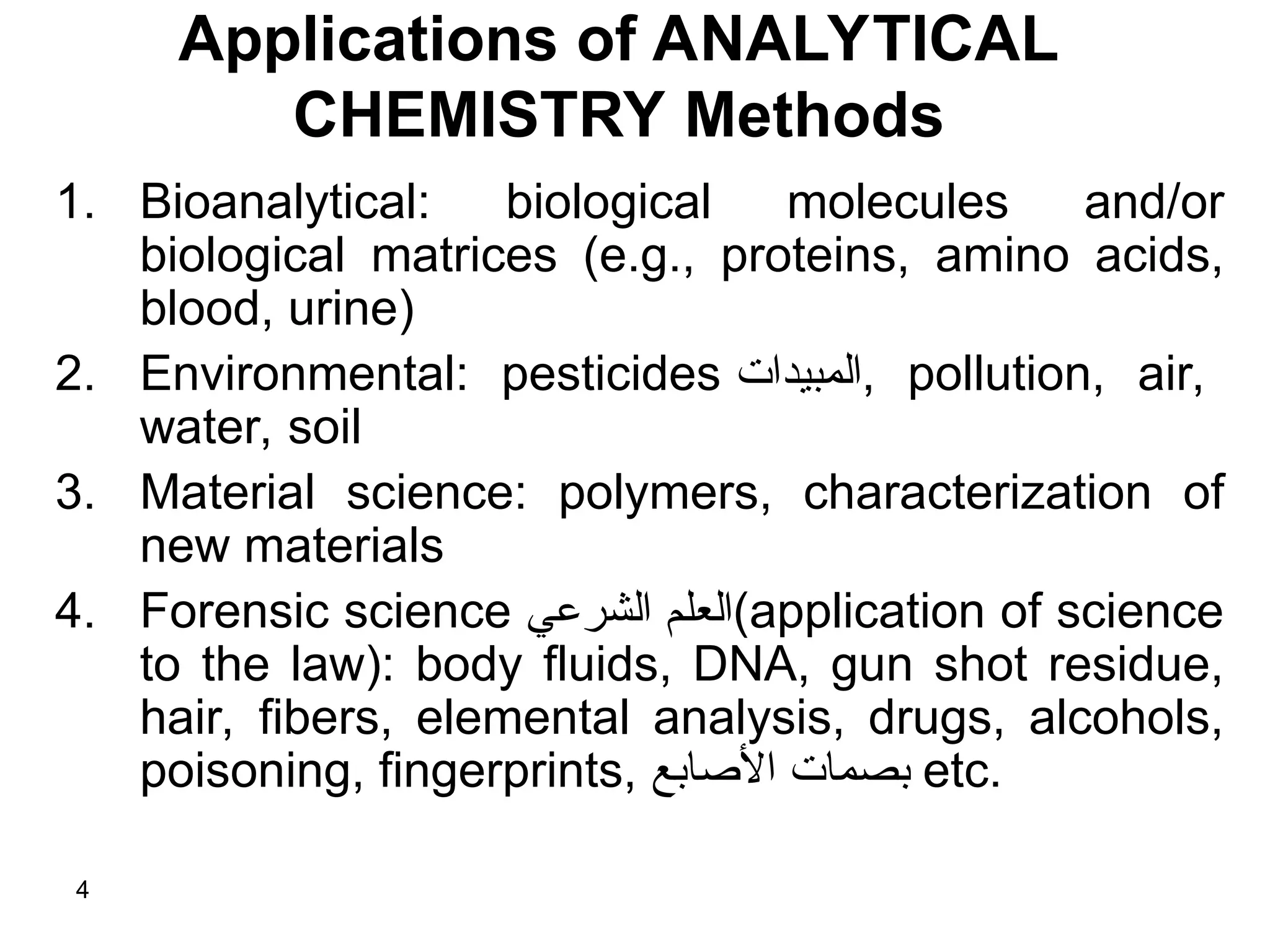
Applications of ANALYTICAL
CHEMISTRYMethods
1. Bioanalytical: biological molecules and/or
biological matrices (e.g., proteins, amino acids,
blood, urine)
2. Environmental: pesticides المبيدات, pollution, air,
water, soil
3. Material science: polymers, characterization of
new materials
4. Forensic science الشرعي م8ل(العapplication of science
to the law): body fluids, DNA, gun shot residue,
hair, fibers, elemental analysis, drugs, alcohols,
poisoning, fingerprints, األصابع بصمات etc.
4
5.
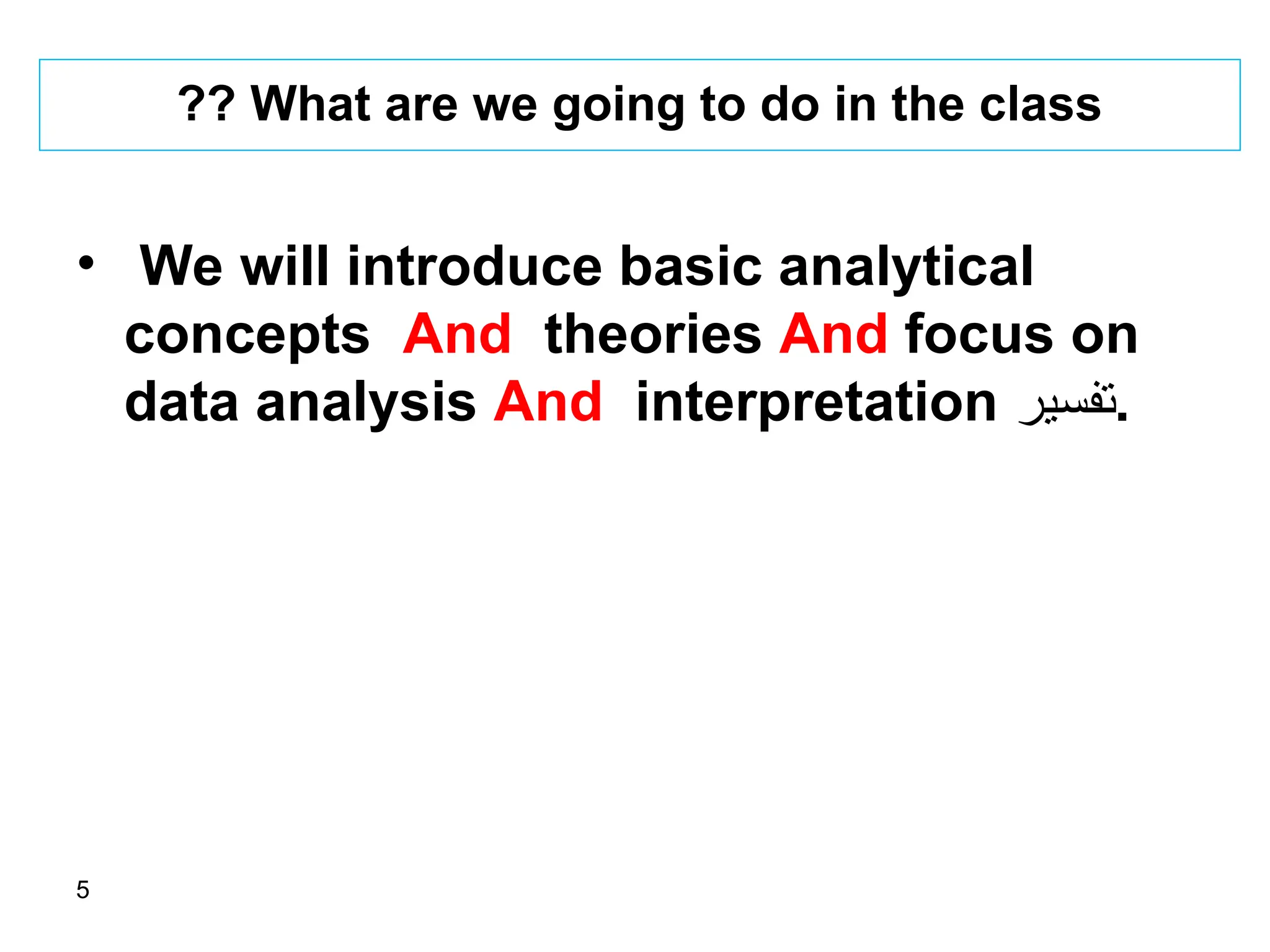
What are wegoing to do in the class
??
• We will introduce basic analytical
concepts And theories And focus on
data analysis And interpretation تفسير.
5
6.
6
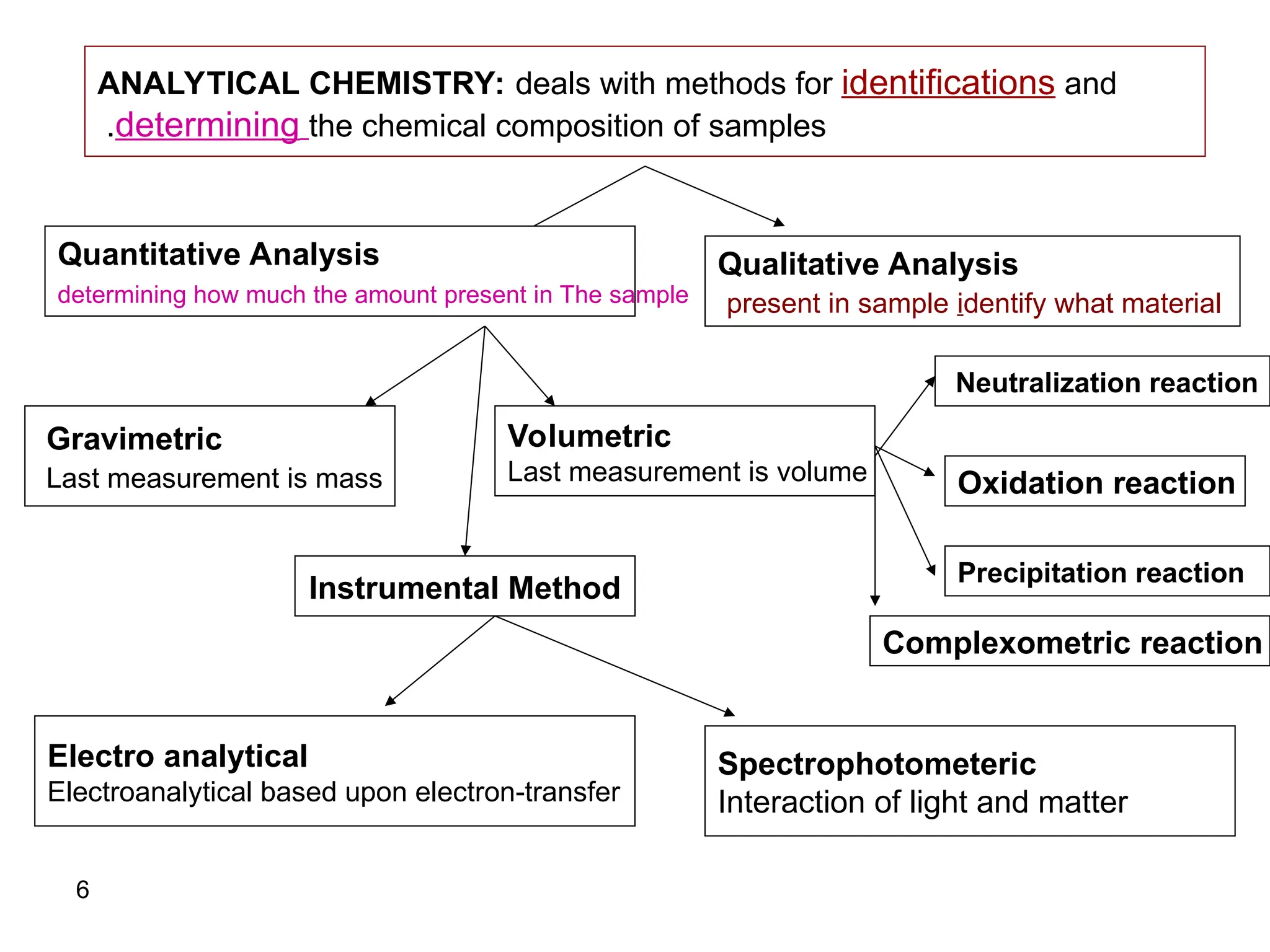
ANALYTICAL CHEMISTRY: dealswith methods for identifications and
determining the chemical composition of samples
.
Qualitative Analysis
present in sample identify what material
Quantitative Analysis
determining how much the amount present in The sample
Volumetric
Last measurement is volume
Instrumental Method
Neutralization reaction
Oxidation reaction
Precipitation reaction
Electro analytical
Electroanalytical based upon electron-transfer
Gravimetric
Last measurement is mass
Spectrophotometeric
Interaction of light and matter
Complexometric reaction
7.
7
CLASSIFICATION of ANALYTICAL
CHEMISTRY
QuantitativeAnalysis
Determining how much the amount present in
The sample
Qualitative Analysis
Identify what material present in The sample
determination of chemical identity of the
species in the sample
In order to perform quantitative analysis, typically one
needs to complete qualitative analysis
.
8.
8
Classification of Quantitative
Methodsof Analysis
*
Gravimetric Method: mass is measured
.
*
Volumetric Method: volume is measured or
used to determine volume of sample via
concentration
.
*
Instrumental Method: use an instrumental
technique to assay the amount of sample
:
Such as: Electroanalytical based upon
electron-transfer
Spectroscopy including mass spectrometry
9.
lecture3
9
Volumetric Analysis
*
Volumetric Method:depends on
interaction of substances in solution in the
ratio of their equivalent weights
.
Classification of Volumetric Methods
1
.
Acid-base titrations
.
2
.
Precipitation titrations
.
3
.
Complexometric titrations
.
4
.
Reduction-oxidation (Redox) titrations
12
ATOMIC STRUCTURE
ATOMIC STRUCTURE
4
4Atomic mass
2
2Atomic number
number of
electrons
number of
protons
The sum of
protons and neutrons
in an atom
Number of Protons
in an atom
number of
neutrons
Atomic mass
Atomic number
Atomic mass
proton
Atomic mass
electron
13.
13
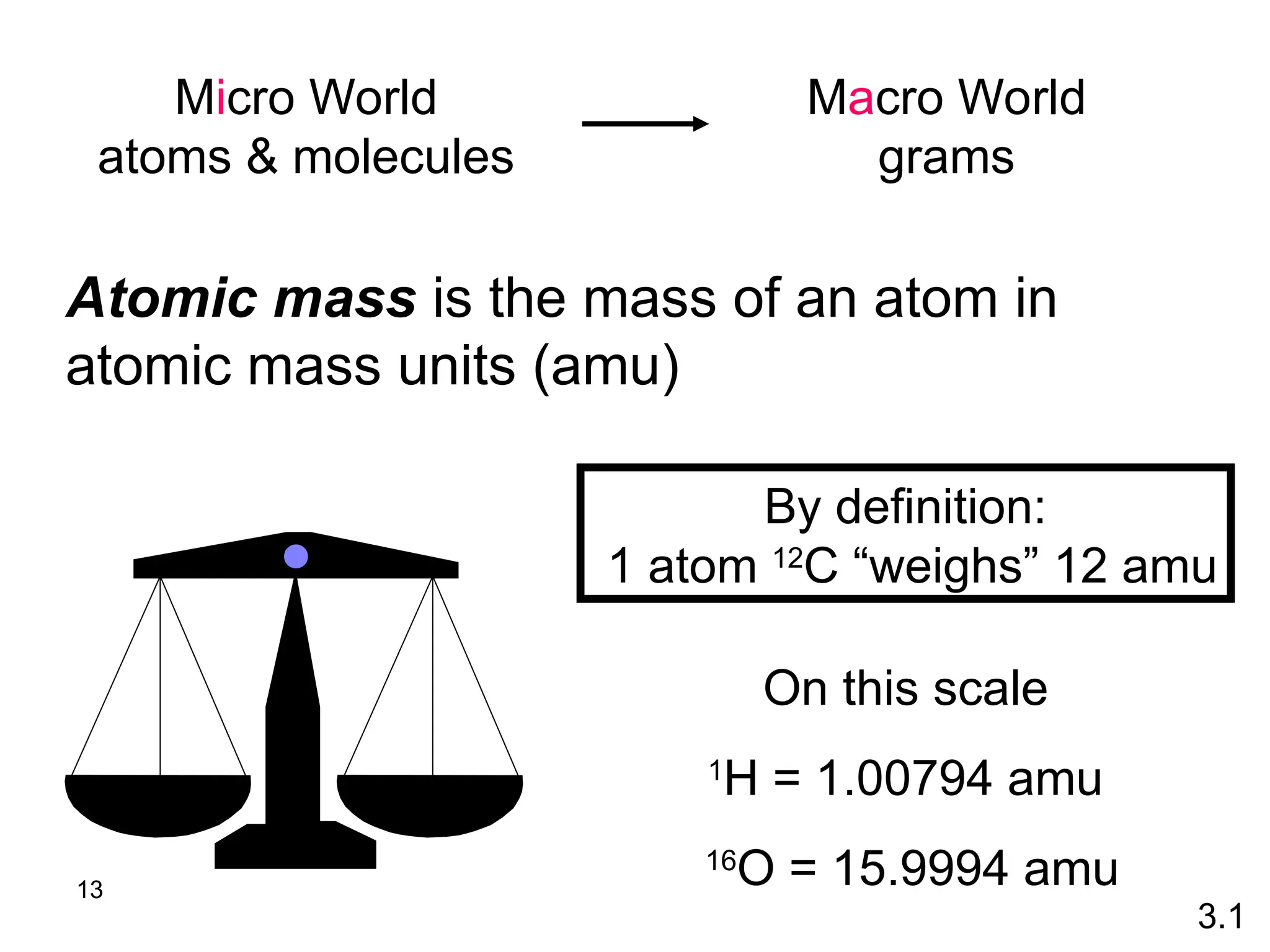
By definition:
1 atom12
C “weighs” 12 amu
On this scale
1
H = 1.00794 amu
16
O = 15.9994 amu
Atomic mass is the mass of an atom in
atomic mass units (amu)
Micro World
atoms & molecules
Macro World
grams
3.1
14.
14
How you measurehow much
?
You can measure mass,
or volume,
or you can count pieces.
We measure mass in grams.
We measure volume in liters.
We count pieces in MOLES.
15.
15
MOLES
The Mole (mol)
:
*
Aunit which defines the number of units of a chemical
species (molecules, atoms, ions, etc)
and from which
we can calculate the weight of the species
if we have a knowledge of the chemical formula of that
species
.
Avogadro Number
:
6.022
x 1023
particles is one mole
.
16.
16
MOLES
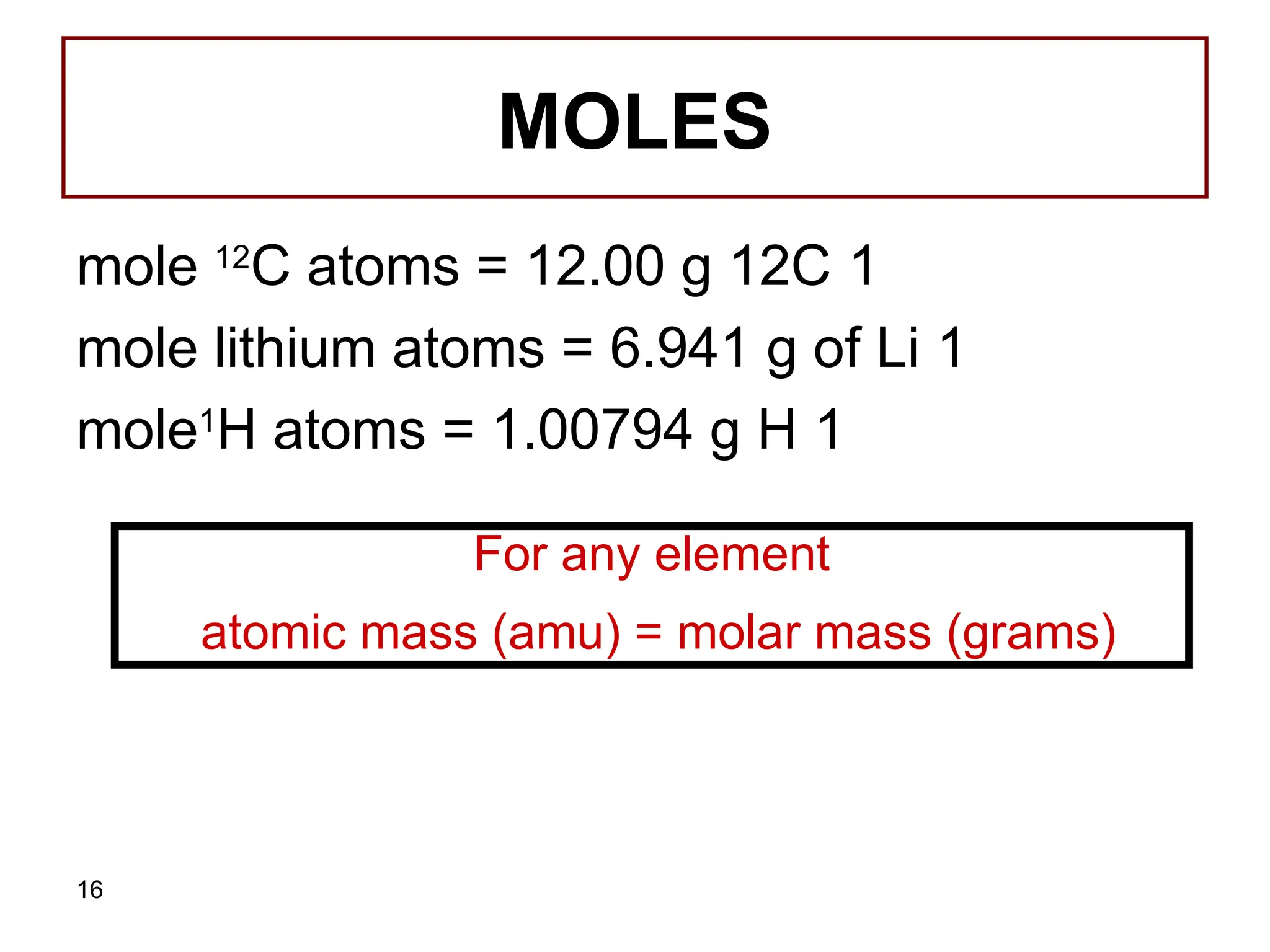
1
mole 12
C atoms= 12.00 g 12C
1
mole lithium atoms = 6.941 g of Li
1
mole1
H atoms = 1.00794 g H
For any element
atomic mass (amu) = molar mass (grams)
17.
17
The abbreviation SIcomes from the French le Système International.
*These prefixes are commonly used in chemistry.
†This is the Greek letter _(pronounced “mew”).
18.
Weight & Mass
18
Weightis the force of gravitational
attraction between that matter and the
earth
.
Location dependence
Mass is an invariant measurement of
The amount of matter
Location independence
W = mg
19.
I. Review ofStoichiometry - please refer to your freshman
chemistry text to review this concept.
A. Empirical vs molecular or structural formulas:
1. Empirical formulas give information only about the simplest
ratio between the different elements composing the molecule.
Example: HO, H2CO
2. Molecular formulas give information about the numbers of
atoms of each element found in the molecule.
Example: H2O2, H4C2O2, C2H5OH, C2H4O2, C3H6O3, C6H12O6
3. Structural formulas give information about the structure of the
molecule as well as the numbers of atoms of each element
Example: HOOH, (CH3)3COH, CH3CH2OCH2CH3
19
20.
20
Molecular mass (ormolecular weight) is the sum of
the atomic masses (in amu) in a molecule.
SO2
1S 32.07 amu
2O + 2 x 16.00 amu
SO2 64.07 amu
For any molecule
molecular mass in amu = molar mass in grams
1 molecule of SO2 weighs 64.07 amu
1 mole of SO2 weighs 64.07 g
21.
21
How to calculatemolecular mass for a
compound
• Ex. 1 H2O
Atomic masses H = 1, O = 16
Molecular mass of H2O =
One mole of H2O = gram H2O
• Ex. 2 CO2
Atomic masses C = 12, O = 16
Molecular mass of CO2 =
One mole of CO2 = gram CO2
22.
22
Ex. 3 NaOH
Atomicmasses Na = 23, H = 1, O = 16
Molecular mass of NaOH =
One mole of NaOH = gram NaOH
Ex. 4 CH3COOH
Calculate the molecular weight of acetic acid, CH3COOH ?
Atomic masses C = 12, H = 1, O = 16
Molecular mass of CH3COOH =
One mole of CH3COOH = gram CH3COOH
How to calculate molecular mass for a
compound
23.
23
Ex. 5
How manymoles and millimoles are contained in 2.00 g of pure benzoic
acid (C6H5COOH) (MW = 122.1 g/mol)
How to calculate number of moles for a
compound
l
24.
Lecture 1
24
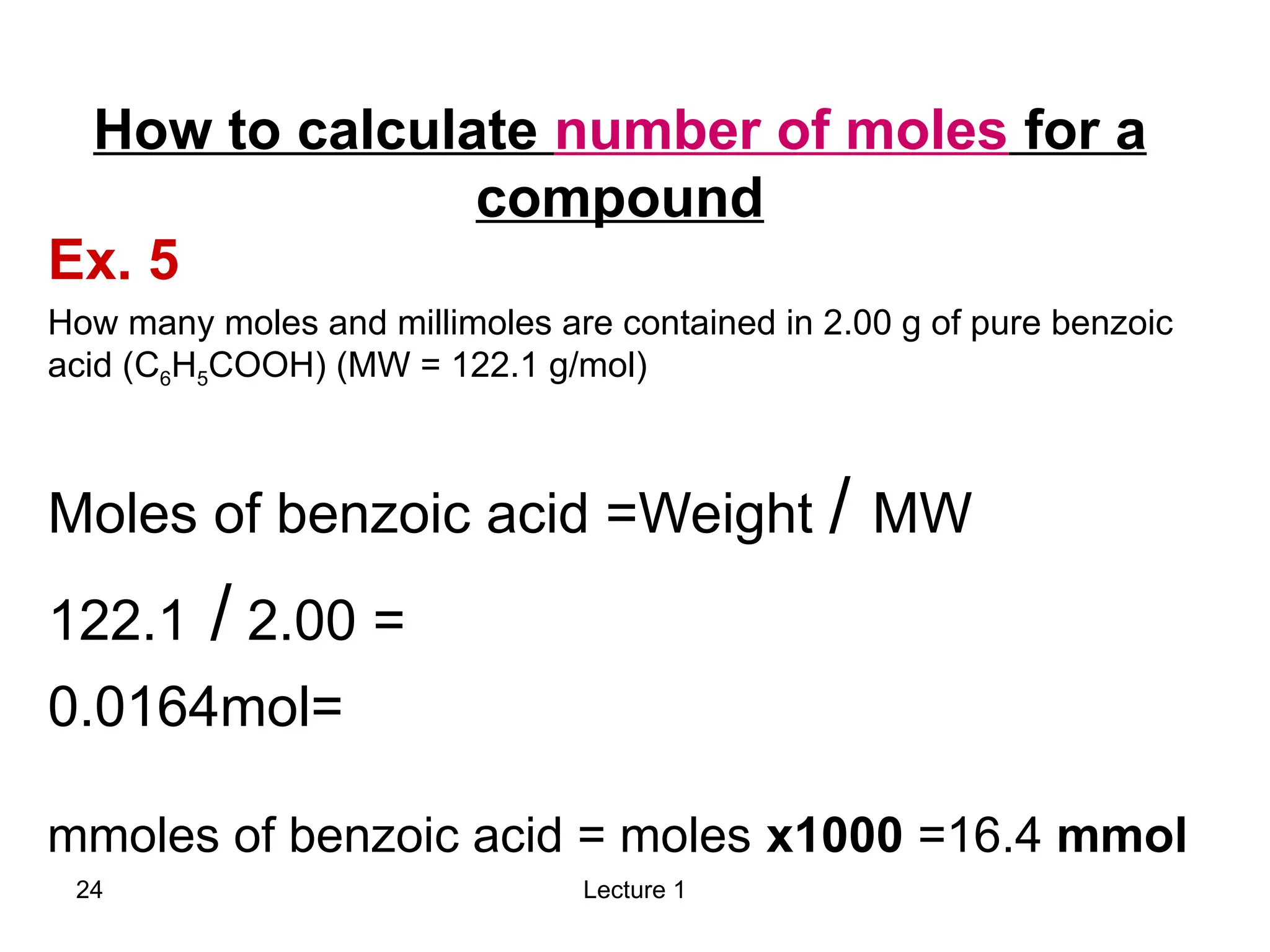
Ex. 5
Howmany moles and millimoles are contained in 2.00 g of pure benzoic
acid (C6H5COOH) (MW = 122.1 g/mol)
Moles of benzoic acid =Weight / MW
=
2.00
/
122.1
=
0.0164mol
How to calculate number of moles for a
compound
mmoles of benzoic acid = moles x1000 =16.4 mmol
25.
25
Exercise
1
.
Calculate molecular weight(molar mass) of
CH2O(Formaldehyde)
and C6H12O6 (glucose)
?
2
.
How many moles and millimoles are contained
in 5.00 g of pure Sodium carbonate (Na2CO3)
Na = 23, C = 12 , O = 16
26.
26
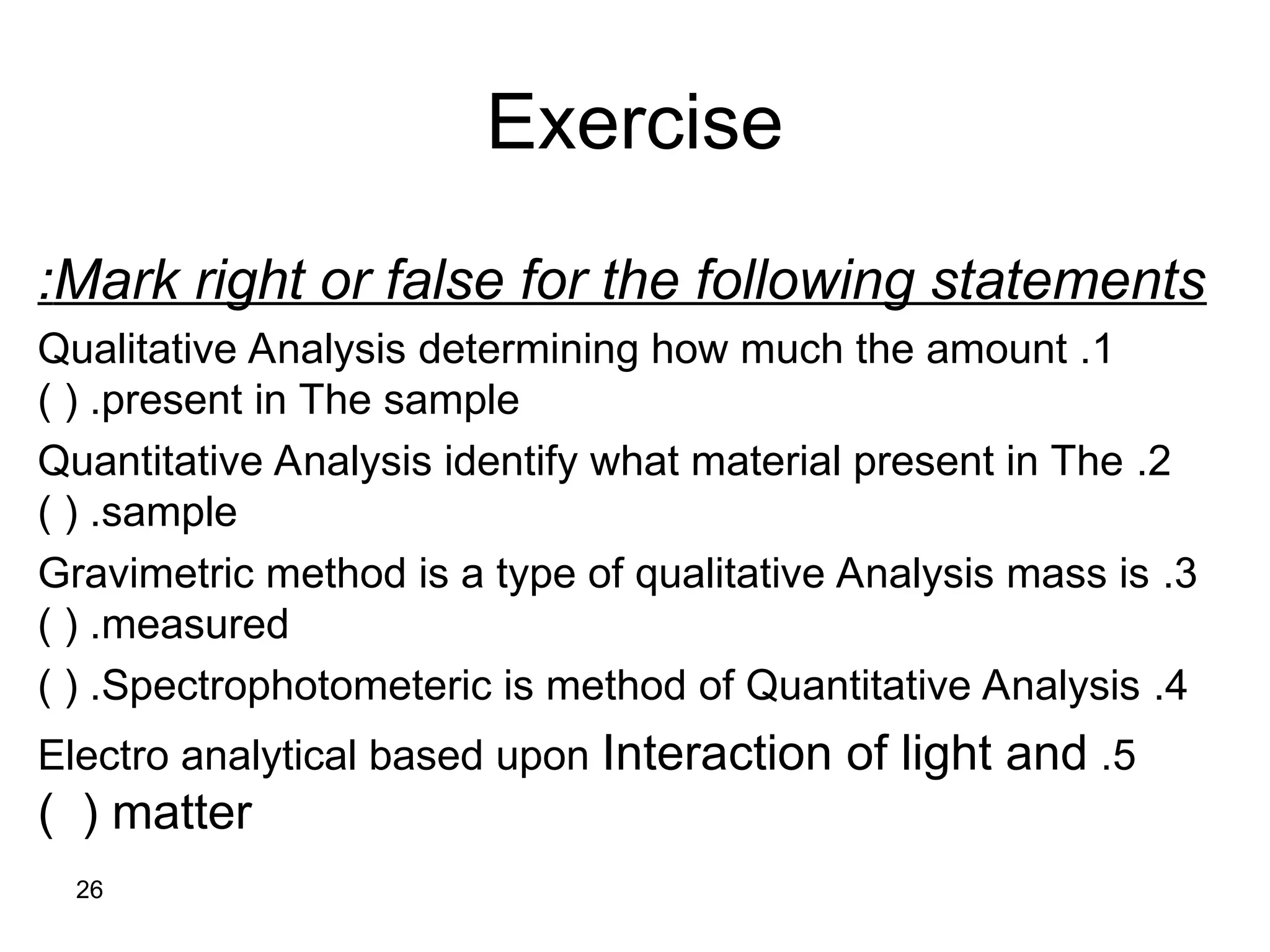
Mark right orfalse for the following statements
:
1
.
Qualitative Analysis determining how much the amount
present in The sample
) ( .
2
.
Quantitative Analysis identify what material present in The
sample
) ( .
3
.
Gravimetric method is a type of qualitative Analysis mass is
measured
) ( .
4
.
Spectrophotometeric is method of Quantitative Analysis
) ( .
5
.
Electro analytical based upon Interaction of light and
matter
) (
Exercise
27.
27
Choose the correctanswer
:
1
-
Instrumental Method use an…… technique
.
a) instrumental b) Volumetric
d) Both a &b c) Gravimetric
2 - Analytical chemistry Play a vital roles in all sciences, just to name of a few:
a)chemistry, biology, biotechnology, forensic science
,
B)food science, material science,
C) medicine, environmental science, etc
d) All previous
3. Calculate the molecular mass of NaCl?
A.) 58 B.) 22 C). 35
4.. What do you understand by the term “Quantitative analysis”?
A. Involves determining the individual constituents of a given sample.
B. Involves the determination of the relative or absolute amount of an analyte in a given sample
C. Involves the addition of measured volume of a known concentration of
reagent into a solution of the substance to be determined (analyte).
•
D. Involves determining the level of purity of an analyte
.
Exercise
28.
28
Choose the correctanswer
:
1
-
Instrumental Method use an…… technique
.
a) instrumental
b) Volumetric
c) Gravimetric
2 - Analytical chemistry Play a vital roles in all sciences, just to name of a few:
a)chemistry, biology, biotechnology, forensic science
,
B)food science, material science,
C) medicine, environmental science, etc
Exercise
29.
The Equipment
•
Volumetric analysisinvolves a few
pieces of equipment that you may not
have seen before
:
Pipette – for measuring accurate and precise
volumes of solutions
Burette – for pouring measured volumes of
solutions
Conical flask – for mixing two solutions
Wash bottles – these contain distilled water for
cleaning equipment
Funnel – for transfer of liquids without
spilling
Volumetric flasks – a flask used to make up
accurate volumes for solutions of known
concentration
29