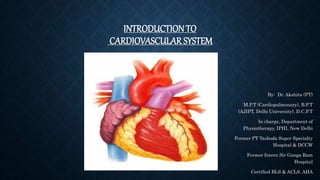

INTRODUCTIONTO
CARDIOVASCULAR SYSTEM
By: Dr. Akshita (PT)
M.P.T (Cardiopulmonary), B.P.T
(AJIPT, Delhi University), D.C.P.T
In charge, Department of
Physiotherapy, IPHI, New Delhi
Former PT Yashoda Super Specialty
Hospital & DCCW
Former Intern Sir Ganga Ram
Hospital
Certified BLS & ACLS, AHA
INTRODUCTION
• Cardiovascular system is the transport system of the body, through which
the nutrients are conveyed to places where these are utilized, and the
metabolites (waste products) are conveyed to appropriate places from
where these are expelled.
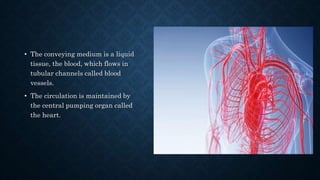
• The conveying medium is a liquid
tissue, the blood, which flows in
tubular channels called blood
vessels.
• The circulation is maintained by
the central pumping organ called
the heart.
FUNCTION OF CARDIOVASCULAR SYSTEM
 Transport nutrients, hormones
 Remove waste products
 Gaseous exchange
 Immunity
 Blood vessels transport blood
 Carries oxygen and carbon dioxide
 Also carries nutrients and wastes
 Heart pumps blood through blood vessels
COMPONENTS
Heart:
• It is a four-chambered muscular organ which pumps blood to various
parts of the body.
• Each half of the heart has a receiving chamber called atrium, and a
pumping chamber called ventricle.
• Location:
• Superior surface of diaphragm
• Left of the midline
• Anterior to the vertebral column, posterior to the sternum
FUNCTIONS OF THE HEART:
• Generating blood pressure
• Routing blood
Heart separates pulmonary and systemic
circulations
• Ensuring one-way blood flow
Heart valves ensure one-way flow
• Regulating blood supply
Changes in contraction rate and force match
blood delivery to changing metabolic needs
Arteries:
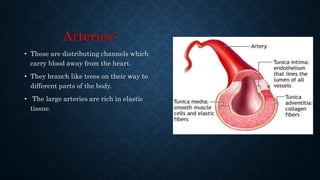
• These are distributing channels which
carry blood away from the heart.
• They branch like trees on their way to
different parts of the body.
• The large arteries are rich in elastic
tissue.
Veins:
• These are draining channels which carry blood from different parts of the body back
to the heart.
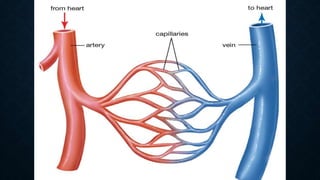
Capillaries:
• These are networks of microscopic vessels which connect arterioles with the venules.
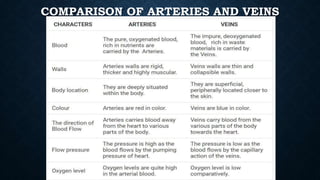
COMPARISON OF ARTERIES AND VEINS
TYPES OF CIRCULATION OF
BLOOD
•Coronary circulation – the circulation of blood
within the heart.
• Systemic Circulation
•Pulmonary circulation
•Fetal Circulation
•Portal circulation
TYPES OF CIRCULATION OF BLOOD
Systemic circulation:
 The flow of blood between the heart and the cells of the body.
• The blood flows from the left ventricle, through various parts of the body, to the
right atrium, i.e. from the left to the right side of the heart.
TYPES OF CIRCULATION OF BLOOD
Pulmonary circulation:
• The flow of blood between the heart and lungs.
• The blood flows from the right ventricle, through the lungs, to the left atrium, i.e.
from the right to the left side of the heart.
TYPES OF CIRCULATION OF BLOOD
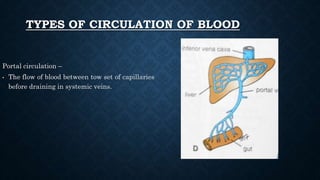
Portal circulation –
• The flow of blood between tow set of capillaries
before draining in systemic veins.
TYPES OF CIRCULATION OF BLOOD
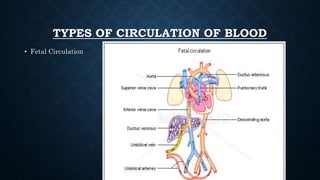
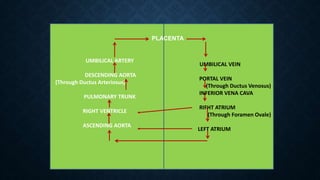
• Fetal Circulation
UMBILICAL ARTERY
DESCENDING AORTA
(Through Ductus Arteriosus)
PULMONARY TRUNK
RIGHT VENTRICLE
ASCENDING AORTA
UMBILICAL VEIN
PORTAL VEIN
(Through Ductus Venosus)
INFERIOR VENA CAVA
RIFHT ATRIUM
(Through Foramen Ovale)
LEFT ATRIUM
PLACENTA
REFERENCES
1- General Anatomy by Vishram Singh
2- Clinical Anatomy by R. Snell
3-Gray’s Anatomy
THANK
YOU!

Intro to cvs

  • 1.
    INTRODUCTIONTO CARDIOVASCULAR SYSTEM By: Dr.Akshita (PT) M.P.T (Cardiopulmonary), B.P.T (AJIPT, Delhi University), D.C.P.T In charge, Department of Physiotherapy, IPHI, New Delhi Former PT Yashoda Super Specialty Hospital & DCCW Former Intern Sir Ganga Ram Hospital Certified BLS & ACLS, AHA
  • 2.
    INTRODUCTION • Cardiovascular systemis the transport system of the body, through which the nutrients are conveyed to places where these are utilized, and the metabolites (waste products) are conveyed to appropriate places from where these are expelled.
  • 3.
    • The conveyingmedium is a liquid tissue, the blood, which flows in tubular channels called blood vessels. • The circulation is maintained by the central pumping organ called the heart.
  • 4.
    FUNCTION OF CARDIOVASCULARSYSTEM  Transport nutrients, hormones  Remove waste products  Gaseous exchange  Immunity  Blood vessels transport blood  Carries oxygen and carbon dioxide  Also carries nutrients and wastes  Heart pumps blood through blood vessels
  • 5.
    COMPONENTS Heart: • It isa four-chambered muscular organ which pumps blood to various parts of the body. • Each half of the heart has a receiving chamber called atrium, and a pumping chamber called ventricle. • Location: • Superior surface of diaphragm • Left of the midline • Anterior to the vertebral column, posterior to the sternum
  • 6.
    FUNCTIONS OF THEHEART: • Generating blood pressure • Routing blood Heart separates pulmonary and systemic circulations • Ensuring one-way blood flow Heart valves ensure one-way flow • Regulating blood supply Changes in contraction rate and force match blood delivery to changing metabolic needs
  • 7.
    Arteries: • These aredistributing channels which carry blood away from the heart. • They branch like trees on their way to different parts of the body. • The large arteries are rich in elastic tissue.
  • 8.
    Veins: • These aredraining channels which carry blood from different parts of the body back to the heart.
  • 9.
    Capillaries: • These arenetworks of microscopic vessels which connect arterioles with the venules.
  • 11.
  • 12.
    TYPES OF CIRCULATIONOF BLOOD •Coronary circulation – the circulation of blood within the heart. • Systemic Circulation •Pulmonary circulation •Fetal Circulation •Portal circulation
  • 13.
    TYPES OF CIRCULATIONOF BLOOD Systemic circulation:  The flow of blood between the heart and the cells of the body. • The blood flows from the left ventricle, through various parts of the body, to the right atrium, i.e. from the left to the right side of the heart.
  • 14.
    TYPES OF CIRCULATIONOF BLOOD Pulmonary circulation: • The flow of blood between the heart and lungs. • The blood flows from the right ventricle, through the lungs, to the left atrium, i.e. from the right to the left side of the heart.
  • 15.
    TYPES OF CIRCULATIONOF BLOOD Portal circulation – • The flow of blood between tow set of capillaries before draining in systemic veins.
  • 16.
    TYPES OF CIRCULATIONOF BLOOD • Fetal Circulation
  • 17.
    UMBILICAL ARTERY DESCENDING AORTA (ThroughDuctus Arteriosus) PULMONARY TRUNK RIGHT VENTRICLE ASCENDING AORTA UMBILICAL VEIN PORTAL VEIN (Through Ductus Venosus) INFERIOR VENA CAVA RIFHT ATRIUM (Through Foramen Ovale) LEFT ATRIUM PLACENTA
  • 18.
    REFERENCES 1- General Anatomyby Vishram Singh 2- Clinical Anatomy by R. Snell 3-Gray’s Anatomy
  • 19.