FINANCIAL
MARKET
OVERVIEW
Ruben Fuentes
B.S, M.S,MBA.
What is Financial Market :
• Mechanism that allows people to
buy and sell financial securities
(such as stocks and bonds) and
items of value at low
transaction cost.
• Markets work by placing many
interested buyers and sellers in
one “place”, thus making easier
for them to find each other.
PURPOSE OF FINANCIAL
MARKETS:
Financial Markets facilitate :
• The raising of capital.
• The transfer of risk.
• International trade.
HOW FINANCIAL MARKET
WORKS :
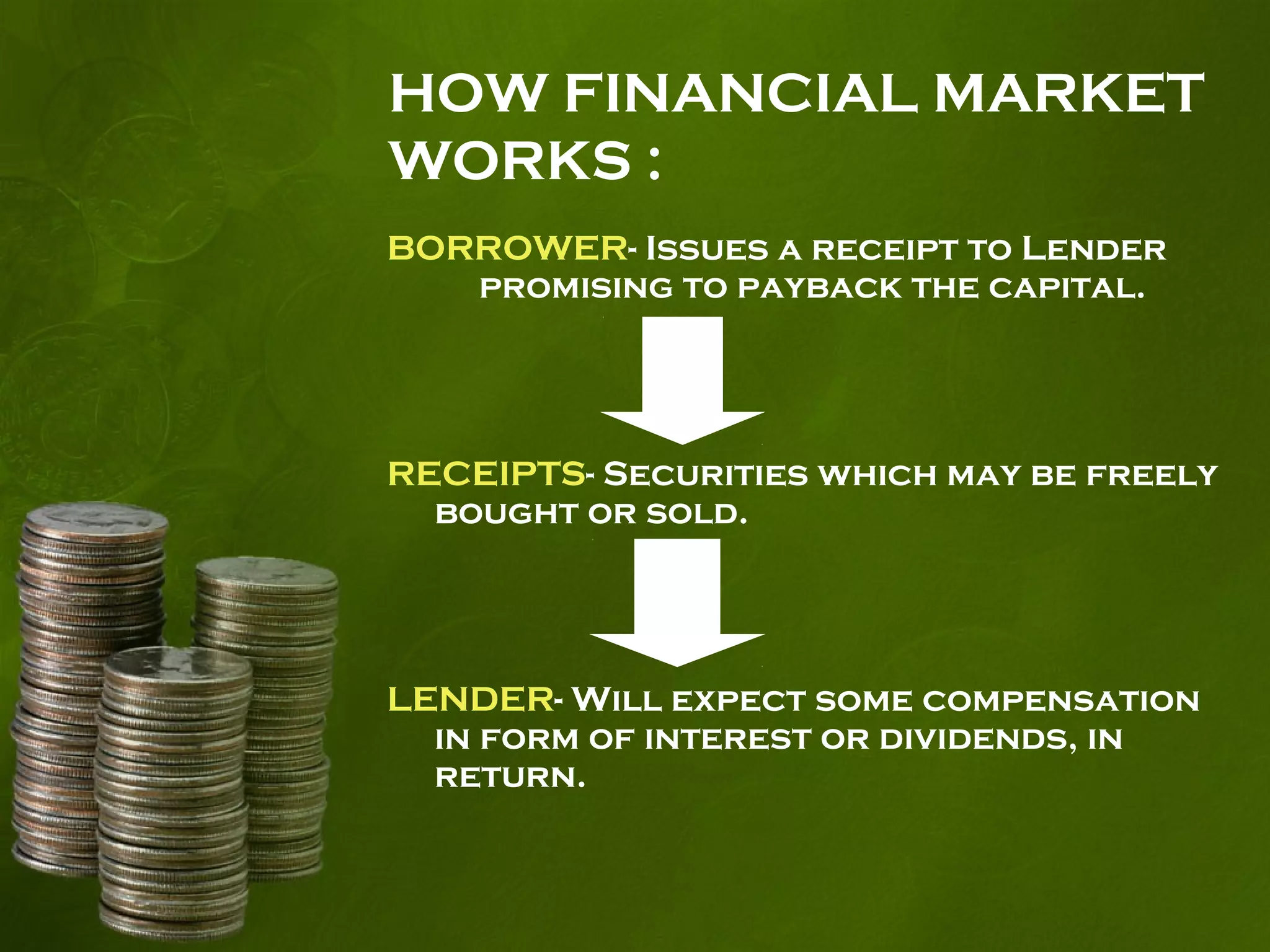
BORROWER- Issues a receipt to Lender
promising to payback the capital.
RECEIPTS- Securities which may be freely
bought or sold.
LENDER- Will expect some compensation
in form of interest or dividends, in
return.
TYPES OF FINANCIAL
MARKETS :
1.Capital Markets
• Stock Markets - Which provide
financing through the issuance
of shares or common stock ,and
enable subsequent trading.
• Bond Markets – Which provide
Financing through the issuance
of bonds , enable subsequent
trading.
TYPES OF FM CONTD….
• COMMODITY MARKETS – which
facilitate the trading of commodities.
• MONEY MARKETS – which provide
short term debt financing and
investment.
• DERIVATIVE MARKETS – which provide
instruments for the management of
financial risk
• INSURANCE MARKETS – which
facilitate redistribution of various
risks.
• FOREIGN EXCHANGE MARKETS - which
facilitate the trading of foreign
exchange.
RAISING CAPITAL
• Without financial Markets,
borrowers would have
difficulty finding buyers
themselves.
• Here the intermediaries such as
BANKS come in picture.
• Banks take money from those
who have money to save.
• They can then lend this money to
those who seek to borrow.
• Banks popularly lend money in
form of LOANS and MORTGAGES.
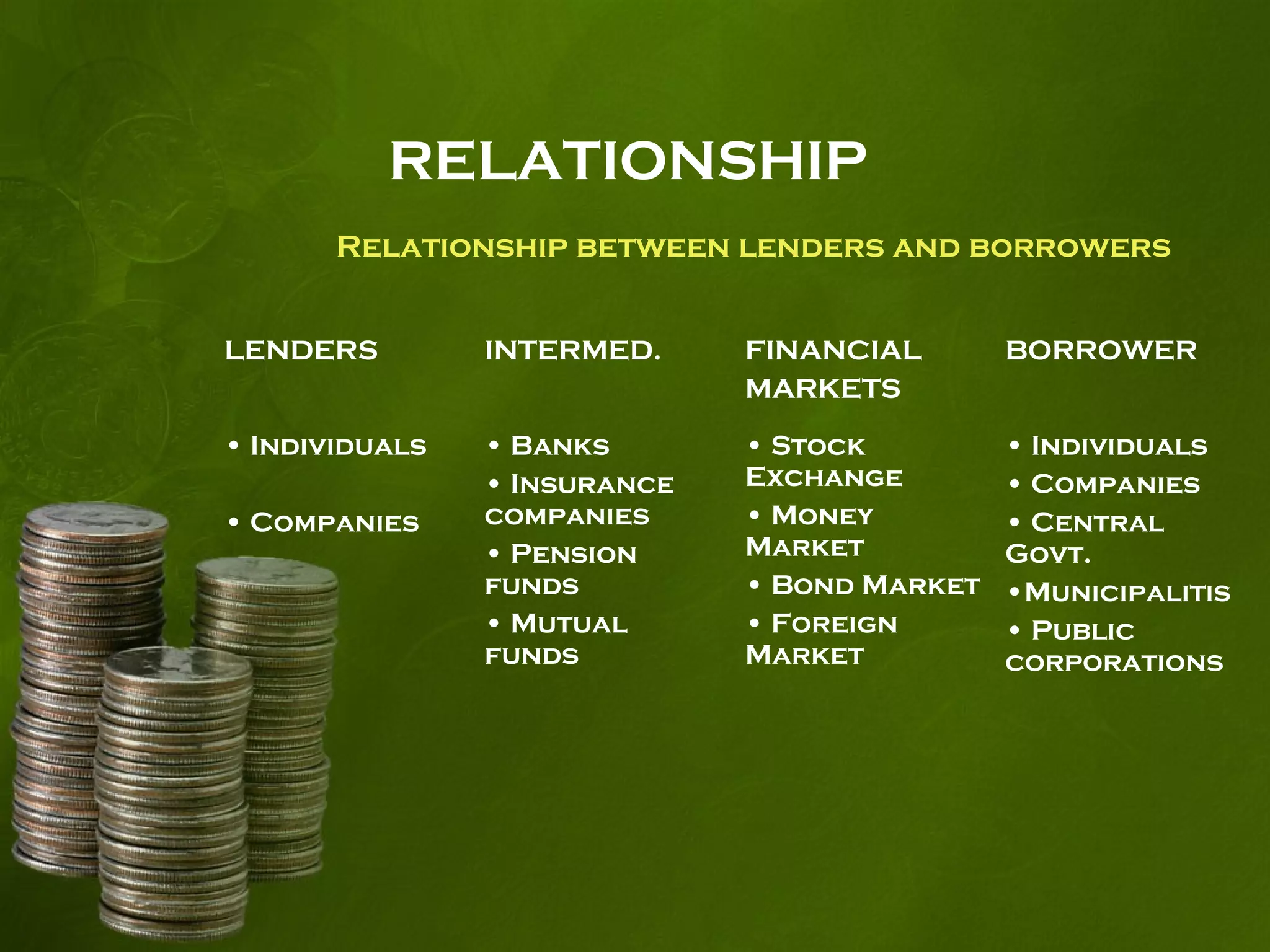
RELATIONSHIP
Relationship between lenders and borrowers
LENDERS INTERMED. FINANCIAL
MARKETS
BORROWER
• Individuals
• Companies
• Banks
• Insurance
companies
• Pension
funds
• Mutual
funds
• Stock
Exchange
• Money
Market
• Bond Market
• Foreign
Market
• Individuals
• Companies
• Central
Govt.
•Municipalitis
• Public
corporations
LENDERS
• INDIVIDUALS
Many individuals are not aware that
they are lenders, but almost everyone
lends money in some way.
A person lends money when he :
1. Puts money in a savings account at a
bank.
2. Contributes to a pension plan.
3. Pays premiums to an insurance
company.
4. Invests in government bonds.
5. Invests in company shares.
LENDERS
• COMPANIES
Companies usually tend to be
borrowers of capital . But when
they have surplus cash that is
not needed for a short period of
time, they may seek to make money
from their cash surplus by
lending it, by
Investing in bonds and stocks
BORROWERS
• Individuals – e.g. bank loans,
mortgages.
• Companies – for short term or long
term cash flows or future business
expansion.
• Governments – for spending
requirements, or on behalf of
nationalized industries, municipalities
or other public sector bodies.
• Public Corporations – e.g. postal
services, railway companies and utility
companies.
FINANCIAL MARKET
EFFICIENCY :
• Allocative Efficiency:
A market is allocatively efficient if
channels fund to those firms and
organisations with most promising real
investment opportunities.
• Operational Efficiency:
Carries its operations as low a cost as
possible.
• Information Processing Efficiency:
Any new relevant information is
quickly and accurately impounded in
prices.
CONCLUSION
Thus Financial market :
• Acts as a backbone of financial
structure of any country.
• Acts as an interface between
prospective buyers and sellers.
• Improves overall business
liquidity.
• Helps in raising capital and
improving international trade.
THANK
YOU…….

Intro Financial Market & Institutions

  • 1.
  • 2.
    What is FinancialMarket : • Mechanism that allows people to buy and sell financial securities (such as stocks and bonds) and items of value at low transaction cost. • Markets work by placing many interested buyers and sellers in one “place”, thus making easier for them to find each other.
  • 3.
    PURPOSE OF FINANCIAL MARKETS: FinancialMarkets facilitate : • The raising of capital. • The transfer of risk. • International trade.
  • 4.
    HOW FINANCIAL MARKET WORKS: BORROWER- Issues a receipt to Lender promising to payback the capital. RECEIPTS- Securities which may be freely bought or sold. LENDER- Will expect some compensation in form of interest or dividends, in return.
  • 5.
    TYPES OF FINANCIAL MARKETS: 1.Capital Markets • Stock Markets - Which provide financing through the issuance of shares or common stock ,and enable subsequent trading. • Bond Markets – Which provide Financing through the issuance of bonds , enable subsequent trading.
  • 6.
    TYPES OF FMCONTD…. • COMMODITY MARKETS – which facilitate the trading of commodities. • MONEY MARKETS – which provide short term debt financing and investment. • DERIVATIVE MARKETS – which provide instruments for the management of financial risk • INSURANCE MARKETS – which facilitate redistribution of various risks. • FOREIGN EXCHANGE MARKETS - which facilitate the trading of foreign exchange.
  • 7.
    RAISING CAPITAL • Withoutfinancial Markets, borrowers would have difficulty finding buyers themselves. • Here the intermediaries such as BANKS come in picture. • Banks take money from those who have money to save. • They can then lend this money to those who seek to borrow. • Banks popularly lend money in form of LOANS and MORTGAGES.
  • 8.
    RELATIONSHIP Relationship between lendersand borrowers LENDERS INTERMED. FINANCIAL MARKETS BORROWER • Individuals • Companies • Banks • Insurance companies • Pension funds • Mutual funds • Stock Exchange • Money Market • Bond Market • Foreign Market • Individuals • Companies • Central Govt. •Municipalitis • Public corporations
  • 9.
    LENDERS • INDIVIDUALS Many individualsare not aware that they are lenders, but almost everyone lends money in some way. A person lends money when he : 1. Puts money in a savings account at a bank. 2. Contributes to a pension plan. 3. Pays premiums to an insurance company. 4. Invests in government bonds. 5. Invests in company shares.
  • 10.
    LENDERS • COMPANIES Companies usuallytend to be borrowers of capital . But when they have surplus cash that is not needed for a short period of time, they may seek to make money from their cash surplus by lending it, by Investing in bonds and stocks
  • 11.
    BORROWERS • Individuals –e.g. bank loans, mortgages. • Companies – for short term or long term cash flows or future business expansion. • Governments – for spending requirements, or on behalf of nationalized industries, municipalities or other public sector bodies. • Public Corporations – e.g. postal services, railway companies and utility companies.
  • 12.
    FINANCIAL MARKET EFFICIENCY : •Allocative Efficiency: A market is allocatively efficient if channels fund to those firms and organisations with most promising real investment opportunities. • Operational Efficiency: Carries its operations as low a cost as possible. • Information Processing Efficiency: Any new relevant information is quickly and accurately impounded in prices.
  • 13.
    CONCLUSION Thus Financial market: • Acts as a backbone of financial structure of any country. • Acts as an interface between prospective buyers and sellers. • Improves overall business liquidity. • Helps in raising capital and improving international trade.
  • 14.