
Presented By:
Krishna Patel
Khushbu Bhakta
Bhumika Chauhan
Introduction to ASP.NET MVC
Agenda
2
 Introduction
 Choosing between webform & MVC
 How MVC Work?
 Creating Model
 Creating Controller
 Creating View
 Advantages
 Disadvantages
Introduction
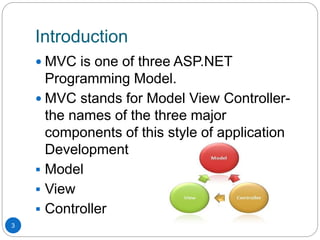
 MVC is one of three ASP.NET
Programming Model.
 MVC stands for Model View Controller-
the names of the three major
components of this style of application
Development
 Model
 View
 Controller
3
Introduction
 Model refers to a data model,which is something
that you can use to perform create
,read,update,delete(CRUD) operation on your
application data.
 View is what is present to user.[Display Data]
 Controllers are code file that bridge between
views and models.It read data from view,control
user input and send input data to the model
4
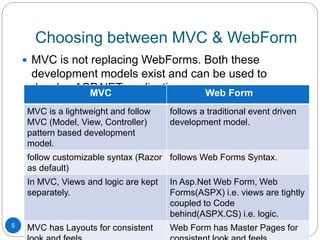
Choosing between MVC & WebForm
 MVC is not replacing WebForms. Both these
development models exist and can be used to
develop ASP.NET applications.MVC Web Form
MVC is a lightweight and follow
MVC (Model, View, Controller)
pattern based development
model.
follows a traditional event driven
development model.
follow customizable syntax (Razor
as default)
follows Web Forms Syntax.
In MVC, Views and logic are kept
separately.
In Asp.Net Web Form, Web
Forms(ASPX) i.e. views are tightly
coupled to Code
behind(ASPX.CS) i.e. logic.
MVC has Layouts for consistent Web Form has Master Pages for5
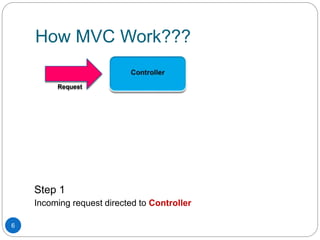
How MVC Work???
Step 1
Incoming request directed to Controller
Request
6
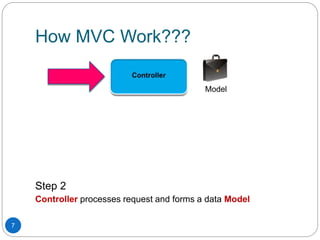
How MVC Work???
Step 2
Controller processes request and forms a data Model
Model
7
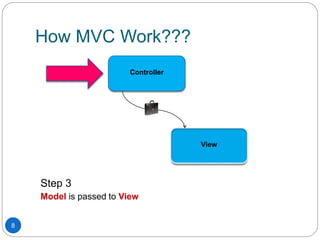
How MVC Work???
Step 3
Model is passed to View
Controller
8
How MVC Work???
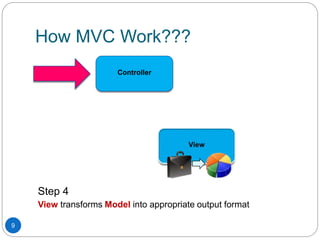
Step 4
View transforms Model into appropriate output format
Controller
9
How MVC Work???

Step 5
Response is rendered [deliver]
Response
Controller
View
10
Creating Model
 DataModel.emdx :-
This XML file defines the
schema for your data model
 DataModel.Designer.cs:-
This is C# code file
containing
the mapping object of your data model.
11
Creating Controller
 Controller process requests and determine which
view should be returned to the client.
Ex:
public ActionResult Index()
{
Db_MVC db=new Db_MVC();
return view(db.user);
}
12
Creating view
 Right click any where in code for the contoller
index
method ,and select add view option
13
Advantages of MVC
 SoC – Separation of Concerns
Separation of Concern is one of the core
advantages of ASP.NET MVC . The MVC
framework provides a clean separation of the UI
, Business Logic , Model or Data.
 More Control
The ASP.NET MVC framework provides more
control over the HTML , JavaScript and CSS
than the traditional Web Forms.
14
Advantages of MVC
 Testability
ASP.NET MVC framework provides better
testability of the Web Application and good
support for the test driven development too.
 Lightweight
ASP.NET MVC framework doesn’t use View
State and thus reduces the bandwidth of the
requests to an extent.
15
Advantages of MVC
 Full features of ASP.NET
One of the key advantages of using ASP.NET
MVC is that it is built on top of ASP.NET
framework and hence most of the features of the
ASP.NET like membership providers , roles etc
can still be used.
16
Disadvantages of MVC
17
 HTML & CSS skills must be revive
MVC requires the developer to understand how
the client-side code and HTML all play together
 MVC is still "relatively" new
18

Intro ASP MVC

  • 1.
    Presented By: Krishna Patel KhushbuBhakta Bhumika Chauhan Introduction to ASP.NET MVC
  • 2.
    Agenda 2  Introduction  Choosingbetween webform & MVC  How MVC Work?  Creating Model  Creating Controller  Creating View  Advantages  Disadvantages
  • 3.
    Introduction  MVC isone of three ASP.NET Programming Model.  MVC stands for Model View Controller- the names of the three major components of this style of application Development  Model  View  Controller 3
  • 4.
    Introduction  Model refersto a data model,which is something that you can use to perform create ,read,update,delete(CRUD) operation on your application data.  View is what is present to user.[Display Data]  Controllers are code file that bridge between views and models.It read data from view,control user input and send input data to the model 4
  • 5.
    Choosing between MVC& WebForm  MVC is not replacing WebForms. Both these development models exist and can be used to develop ASP.NET applications.MVC Web Form MVC is a lightweight and follow MVC (Model, View, Controller) pattern based development model. follows a traditional event driven development model. follow customizable syntax (Razor as default) follows Web Forms Syntax. In MVC, Views and logic are kept separately. In Asp.Net Web Form, Web Forms(ASPX) i.e. views are tightly coupled to Code behind(ASPX.CS) i.e. logic. MVC has Layouts for consistent Web Form has Master Pages for5
  • 6.
    How MVC Work??? Step1 Incoming request directed to Controller Request 6
  • 7.
    How MVC Work??? Step2 Controller processes request and forms a data Model Model 7
  • 8.
    How MVC Work??? Step3 Model is passed to View Controller 8
  • 9.
    How MVC Work??? Step4 View transforms Model into appropriate output format Controller 9
  • 10.
    How MVC Work???  Step5 Response is rendered [deliver] Response Controller View 10
  • 11.
    Creating Model  DataModel.emdx:- This XML file defines the schema for your data model  DataModel.Designer.cs:- This is C# code file containing the mapping object of your data model. 11
  • 12.
    Creating Controller  Controllerprocess requests and determine which view should be returned to the client. Ex: public ActionResult Index() { Db_MVC db=new Db_MVC(); return view(db.user); } 12
  • 13.
    Creating view  Rightclick any where in code for the contoller index method ,and select add view option 13
  • 14.
    Advantages of MVC SoC – Separation of Concerns Separation of Concern is one of the core advantages of ASP.NET MVC . The MVC framework provides a clean separation of the UI , Business Logic , Model or Data.  More Control The ASP.NET MVC framework provides more control over the HTML , JavaScript and CSS than the traditional Web Forms. 14
  • 15.
    Advantages of MVC Testability ASP.NET MVC framework provides better testability of the Web Application and good support for the test driven development too.  Lightweight ASP.NET MVC framework doesn’t use View State and thus reduces the bandwidth of the requests to an extent. 15
  • 16.
    Advantages of MVC Full features of ASP.NET One of the key advantages of using ASP.NET MVC is that it is built on top of ASP.NET framework and hence most of the features of the ASP.NET like membership providers , roles etc can still be used. 16
  • 17.
    Disadvantages of MVC 17 HTML & CSS skills must be revive MVC requires the developer to understand how the client-side code and HTML all play together  MVC is still "relatively" new
  • 18.