

Artificial Intelligence
Hans-Dieter Wehle, hdw@idhorb.de
AGENDA
1. Introduction
2. Areas &
Samples
ARTIFICIAL INTELLIGENCE
introduction
ARTIFICIAL INTELLIGENCE
Any organization that is not a math house now
or is unable to become one soon is already
a legacy company.
Ram Charan
(author)
ARTIFICIAL INTELLIGENCE
INTRODUCTION
Definition
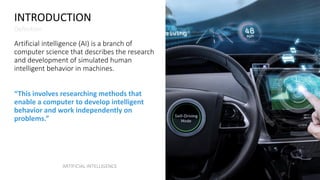
Artificial intelligence (AI) is a branch of
computer science that describes the research
and development of simulated human
intelligent behavior in machines.
“This involves researching methods that
enable a computer to develop intelligent
behavior and work independently on
problems.”
ARTIFICIAL INTELLIGENCE
INTRODUCTION
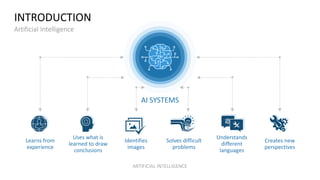
Artificial Intelligence
ARTIFICIAL INTELLIGENCE
Learns from
experience
Uses what is
learned to draw
conclusions
Identifies
images
Solves difficult
problems
Understands
different
languages
Creates new
perspectives
AI SYSTEMS
INTRODUCTION
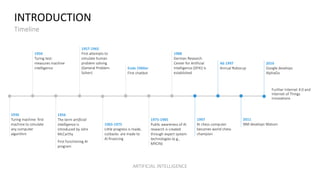
Timeline
1950
Turing test:
measures machine
intelligence
1957-1965
First attempts to
simulate human
problem solving
(General Problem
Solver)
Ende 1960er
First chatbot
1988
German Research
Center for Artificial
Intelligence (DFKI) is
established
Ab 1997
Annual Robocup
1956
The term artificial
intelligence is
introduced by John
McCarthy
First functioning AI
program
1965-1975
Little progress is made,
cutbacks are made to
AI financing
1975-1985
Public awareness of AI
research is created
through expert system
technologies (e.g.,
MYCIN)
1997
AI chess computer
becomes world chess
champion
2011
IBM develops Watson
2016
Google develops
AlphaGo
1936
Turing machine: first
machine to simulate
any computer
algorithm
Further Internet 4.0 and
Internet of Things
innovations
ARTIFICIAL INTELLIGENCE
INTRODUCTION
AI Opportunities and Challenges
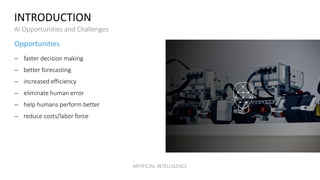
Opportunities
− faster decision making
− better forecasting
− increased efficiency
− eliminate human error
− help humans perform better
− reduce costs/labor force
ARTIFICIAL INTELLIGENCE
INTRODUCTION
AI Opportunities and Challenges
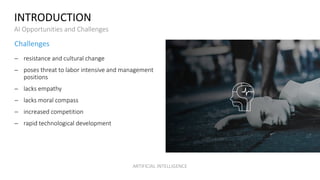
Challenges
− resistance and cultural change
− poses threat to labor intensive and management
positions
− lacks empathy
− lacks moral compass
− increased competition
− rapid technological development
ARTIFICIAL INTELLIGENCE
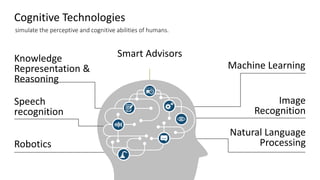
Cognitive Technologies
simulate the perceptive and cognitive abilities of humans.
Knowledge
Representation &
Reasoning
Speech
recognition
Robotics
Smart Advisors
Machine Learning
Image
Recognition
Natural Language
Processing
Areas
ARTIFICIAL INTELLIGENCE
AREAS
Areas Using Artificial Intelligence
Intelligent Data
Management
Intelligent Robots
Smart Homes Autonomous Cars
Adaptive Learning
Software
Smart Warehouses
Smart Meters Smart Control Systems
ARTIFICIAL INTELLIGENCE
AREAS
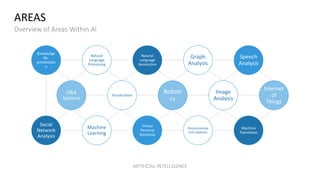
Overview of Areas Within AI
ARTIFICIAL INTELLIGENCE
Q&A
Systems
Machine
Translation
Social
Network
Analysis
Roboti
cs
Graph
Analysis
Machine
Learning
Visualization
Internet
of
Things
Speech
Analysis
Image
Analysis
Recommenda
tion Systems
Natural
Language
Generation
Natural
Language
Processing
Virtual
Personal
Assistants
Knowledge
Re-
presentatio
n
AREAS
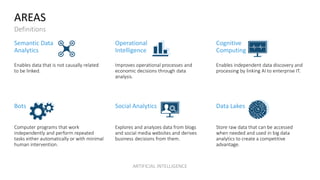
Definitions
Semantic Data
Analytics
Enables data that is not causally related
to be linked.
Operational
Intelligence
Improves operational processes and
economic decisions through data
analysis.
Cognitive
Computing
Enables independent data discovery and
processing by linking AI to enterprise IT.
Bots
Computer programs that work
independently and perform repeated
tasks either automatically or with minimal
human intervention.
Social Analytics
Explores and analyzes data from blogs
and social media websites and derives
business decisions from them.
Data Lakes
Store raw data that can be accessed
when needed and used in big data
analytics to create a competitive
advantage.
ARTIFICIAL INTELLIGENCE
AREAS
Deep Learning
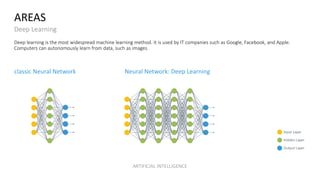
Deep learning is the most widespread machine learning method. It is used by IT companies such as Google, Facebook, and Apple.
Computers can autonomously learn from data, such as images.
ARTIFICIAL INTELLIGENCE
classic Neural Network Neural Network: Deep Learning
Input Layer
Hidden Layer
Output Layer
AREAS
Machine Learning
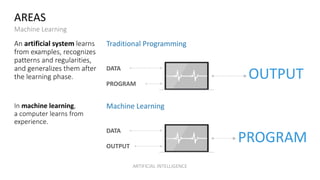
An artificial system learns
from examples, recognizes
patterns and regularities,
and generalizes them after
the learning phase.
ARTIFICIAL INTELLIGENCE
Traditional Programming
Machine Learning
DATA
PROGRAM
DATA
OUTPUT
PROGRAM
OUTPUT
In machine learning,
a computer learns from
experience.

Intro Artificial Intelligence

  • 1.
  • 2.
    AGENDA 1. Introduction 2. Areas& Samples ARTIFICIAL INTELLIGENCE
  • 3.
  • 4.
    Any organization thatis not a math house now or is unable to become one soon is already a legacy company. Ram Charan (author) ARTIFICIAL INTELLIGENCE
  • 5.
    INTRODUCTION Definition Artificial intelligence (AI)is a branch of computer science that describes the research and development of simulated human intelligent behavior in machines. “This involves researching methods that enable a computer to develop intelligent behavior and work independently on problems.” ARTIFICIAL INTELLIGENCE
  • 6.
    INTRODUCTION Artificial Intelligence ARTIFICIAL INTELLIGENCE Learnsfrom experience Uses what is learned to draw conclusions Identifies images Solves difficult problems Understands different languages Creates new perspectives AI SYSTEMS
  • 7.
    INTRODUCTION Timeline 1950 Turing test: measures machine intelligence 1957-1965 Firstattempts to simulate human problem solving (General Problem Solver) Ende 1960er First chatbot 1988 German Research Center for Artificial Intelligence (DFKI) is established Ab 1997 Annual Robocup 1956 The term artificial intelligence is introduced by John McCarthy First functioning AI program 1965-1975 Little progress is made, cutbacks are made to AI financing 1975-1985 Public awareness of AI research is created through expert system technologies (e.g., MYCIN) 1997 AI chess computer becomes world chess champion 2011 IBM develops Watson 2016 Google develops AlphaGo 1936 Turing machine: first machine to simulate any computer algorithm Further Internet 4.0 and Internet of Things innovations ARTIFICIAL INTELLIGENCE
  • 8.
    INTRODUCTION AI Opportunities andChallenges Opportunities − faster decision making − better forecasting − increased efficiency − eliminate human error − help humans perform better − reduce costs/labor force ARTIFICIAL INTELLIGENCE
  • 9.
    INTRODUCTION AI Opportunities andChallenges Challenges − resistance and cultural change − poses threat to labor intensive and management positions − lacks empathy − lacks moral compass − increased competition − rapid technological development ARTIFICIAL INTELLIGENCE
  • 10.
    Cognitive Technologies simulate theperceptive and cognitive abilities of humans. Knowledge Representation & Reasoning Speech recognition Robotics Smart Advisors Machine Learning Image Recognition Natural Language Processing
  • 11.
  • 12.
    AREAS Areas Using ArtificialIntelligence Intelligent Data Management Intelligent Robots Smart Homes Autonomous Cars Adaptive Learning Software Smart Warehouses Smart Meters Smart Control Systems ARTIFICIAL INTELLIGENCE
  • 13.
    AREAS Overview of AreasWithin AI ARTIFICIAL INTELLIGENCE Q&A Systems Machine Translation Social Network Analysis Roboti cs Graph Analysis Machine Learning Visualization Internet of Things Speech Analysis Image Analysis Recommenda tion Systems Natural Language Generation Natural Language Processing Virtual Personal Assistants Knowledge Re- presentatio n
  • 14.
    AREAS Definitions Semantic Data Analytics Enables datathat is not causally related to be linked. Operational Intelligence Improves operational processes and economic decisions through data analysis. Cognitive Computing Enables independent data discovery and processing by linking AI to enterprise IT. Bots Computer programs that work independently and perform repeated tasks either automatically or with minimal human intervention. Social Analytics Explores and analyzes data from blogs and social media websites and derives business decisions from them. Data Lakes Store raw data that can be accessed when needed and used in big data analytics to create a competitive advantage. ARTIFICIAL INTELLIGENCE
  • 15.
    AREAS Deep Learning Deep learningis the most widespread machine learning method. It is used by IT companies such as Google, Facebook, and Apple. Computers can autonomously learn from data, such as images. ARTIFICIAL INTELLIGENCE classic Neural Network Neural Network: Deep Learning Input Layer Hidden Layer Output Layer
  • 16.
    AREAS Machine Learning An artificialsystem learns from examples, recognizes patterns and regularities, and generalizes them after the learning phase. ARTIFICIAL INTELLIGENCE Traditional Programming Machine Learning DATA PROGRAM DATA OUTPUT PROGRAM OUTPUT In machine learning, a computer learns from experience.