Food Quality Assurance
Management
FST-721
3(2-1)
By
Dr. Ahmad Din
National Institute of Food Science And
Technology, University of Agriculture, Faisalabad
Course Outline
•Describe different approaches to define quality
•Examine different quality systems in food
businesses
•Discuss and implement different quality
management tools
•Summarize quality standards and food laws
2
DEFINITIONS
• QUALITY
Food quality represents the sum of all properties and attributes
of a food item that are acceptable to the customer. These
food quality attributes include:
• Appearance (including size, shape, color, gloss, and
consistency)
• Texture
• Flavour
• Nutritional content
• Ethical and sustainable production
• Quality Assurance
Food quality assurance is a systematic process that aims to
ensure food products meet defined safety, sensory, and
regulatory standards from raw material sourcing to final
distribution, to prevent hazards and build consumer trust.
3
Continue…
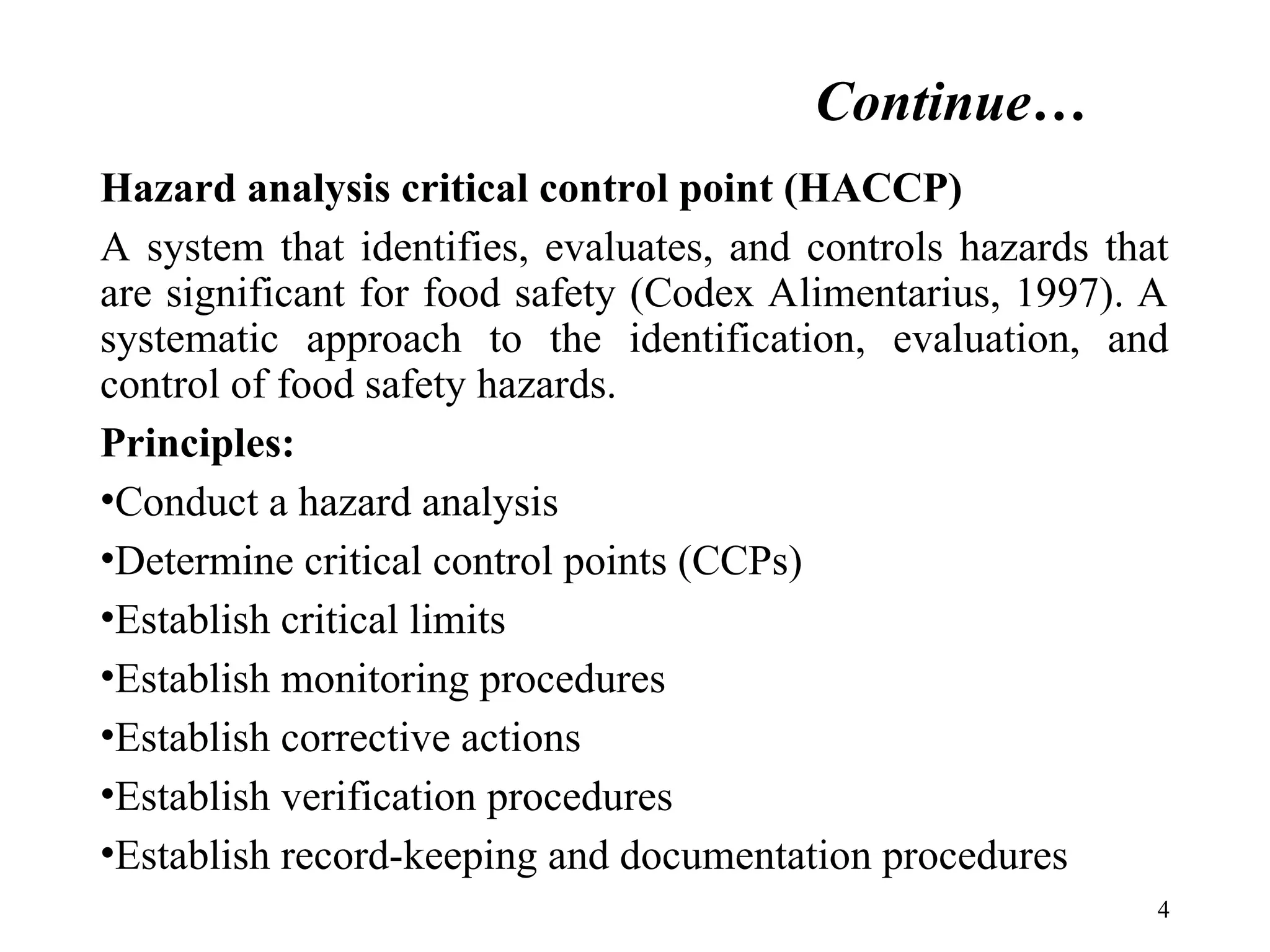
Hazard analysis critical control point (HACCP)
A system that identifies, evaluates, and controls hazards that
are significant for food safety (Codex Alimentarius, 1997). A
systematic approach to the identification, evaluation, and
control of food safety hazards.
Principles:
•Conduct a hazard analysis
•Determine critical control points (CCPs)
•Establish critical limits
•Establish monitoring procedures
•Establish corrective actions
•Establish verification procedures
•Establish record-keeping and documentation procedures
4
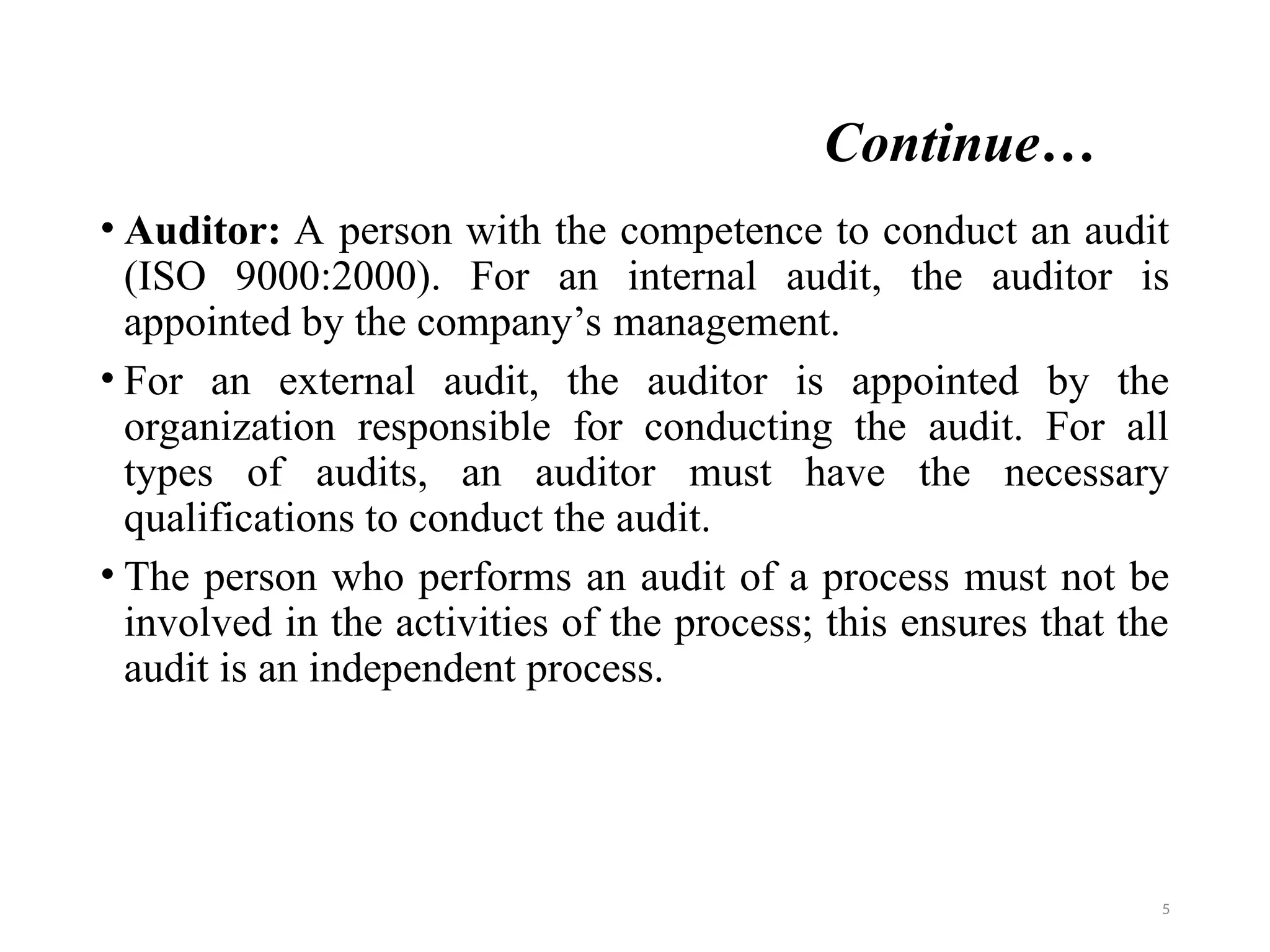
Continue…
• Auditor: A person with the competence to conduct an audit
(ISO 9000:2000). For an internal audit, the auditor is
appointed by the company’s management.
• For an external audit, the auditor is appointed by the
organization responsible for conducting the audit. For all
types of audits, an auditor must have the necessary
qualifications to conduct the audit.
• The person who performs an audit of a process must not be
involved in the activities of the process; this ensures that the
audit is an independent process.
5
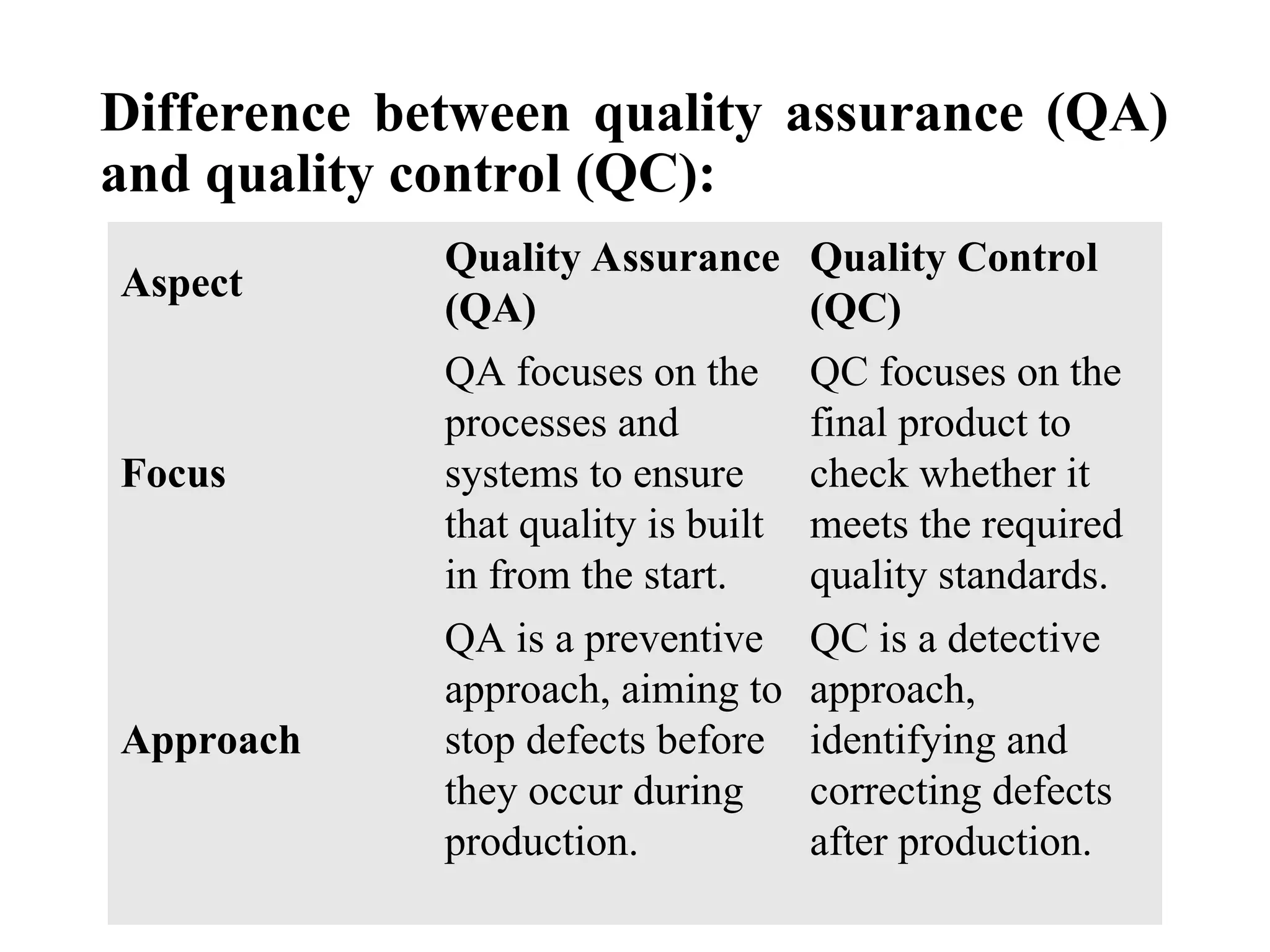
Difference between quality assurance (QA)
and quality control (QC):
Aspect
Quality Assurance
(QA)
Quality Control
(QC)
Focus
QA focuses on the
processes and
systems to ensure
that quality is built
in from the start.
QC focuses on the
final product to
check whether it
meets the required
quality standards.
Approach
QA is a preventive
approach, aiming to
stop defects before
they occur during
production.
QC is a detective
approach,
identifying and
correcting defects
after production.
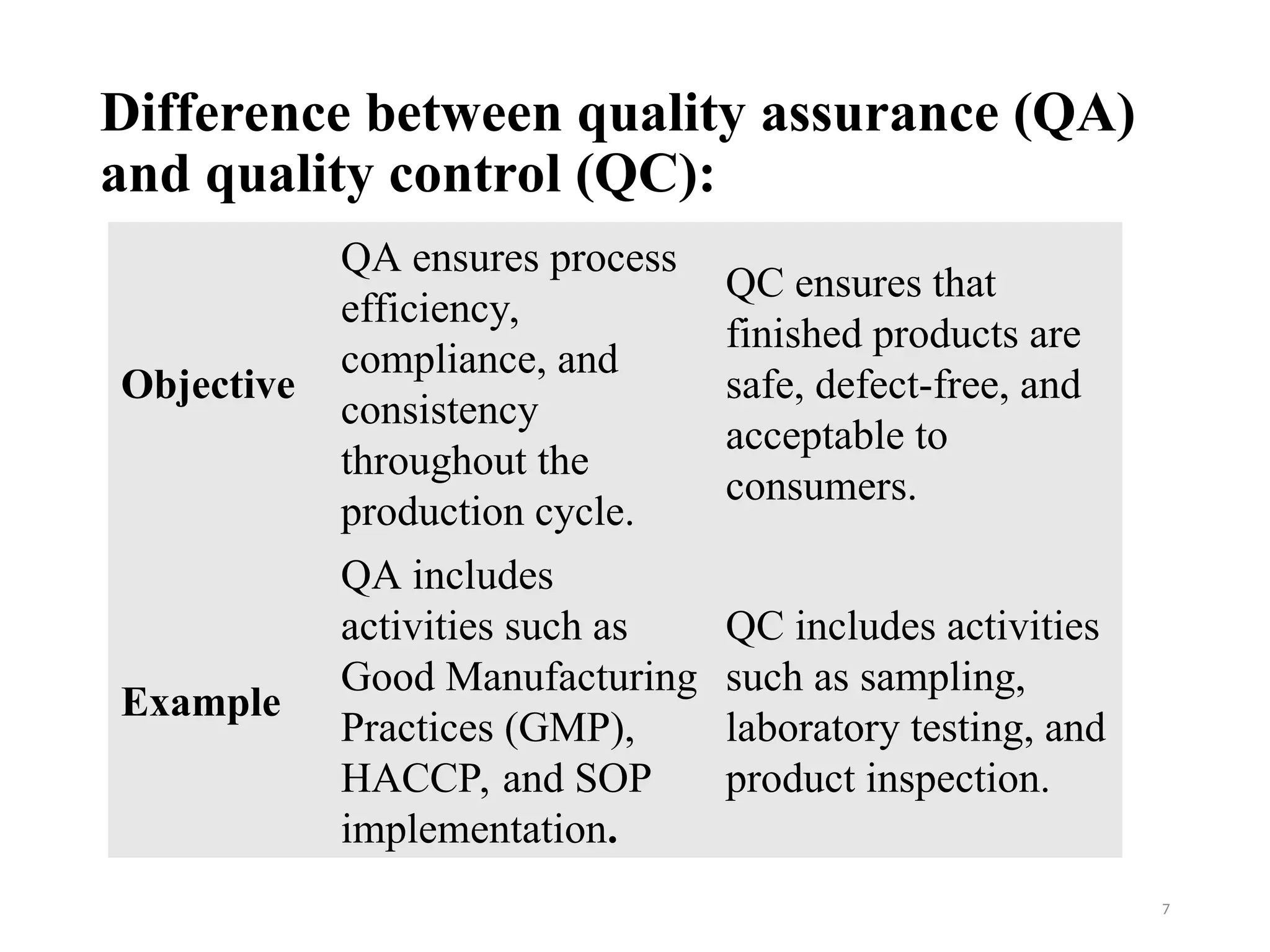
Difference between quality assurance (QA)
and quality control (QC):
7
Objective
QA ensures process
efficiency,
compliance, and
consistency
throughout the
production cycle.
QC ensures that
finished products are
safe, defect-free, and
acceptable to
consumers.
Example
QA includes
activities such as
Good Manufacturing
Practices (GMP),
HACCP, and SOP
implementation.
QC includes activities
such as sampling,
laboratory testing, and
product inspection.
Scope of food quality and food safety
• In addressing food quality and food safety, it is important to
keep in mind that the term “food” covers any unprocessed,
semi-processed, or processed item that is intended to be used
as food or drink.
• This includes any ingredient incorporated into a food or
drink, and any substance that comes into direct contact with a
food during processing, preparation, or treatment.
• Therefore, food quality and food safety principles and
practices are applied to foods from farm produce and
livestock production; manufactured and processed food
products for consumers; and all raw materials, ingredients,
processing aids, food-contact packaging materials, and food-
contact surfaces that are used in the preparation of food and
beverage products.
8
Continue…
• The scope of food quality and food safety covers foods
already in the marketplace and new or modified foods.
• When new or modified foods are developed for the
marketplace, quality and safety must be considered at the
conception, design, and development stages.
9
Food safety as part of food quality
• In the food industry, food safety principles and practices have
always been integrated into activities identified within quality
assurance or quality control programs, or within quality
management systems; therefore, these programs and systems
can address both food quality and food safety simultaneously.
• The more recent use of HACCP systems in some food
companies has resulted in a well-defined set of activities that
are specifically devoted to food safety.
• The principles and practices of the HACCP system are similar
to those of quality systems, and, therefore, the specific
activities required by the HACCP system can be integrated
within quality systems.
10
Continue…
• A food company that operates with a quality management system can
be expected to have an HACCP system that is devoted specifically to
food safety as an integral part of its quality management system.
• A food company that does not operate with the HACCP system must
continue to incorporate food safety activities and GMPs within its
existing quality program or quality system.
• Digital HACCP Systems: Integration of software solutions for real-time
monitoring and data management. Use of IoT (internet of things technology)
devices to track critical control points (CCPs) automatically. 2. Risk-Based
Approaches : Emphasis on risk assessment to prioritize hazards based on their
potential impact. Adoption of more flexible HACCP plans that adapt to
specific operational risks. 3. Enhance training and certification. 4. Global
harmonization. 5. Focus on supply chain management.
11
Intoduction of Food Quality Assurance Management

  • 1.
    Food Quality Assurance Management FST-721 3(2-1) By Dr.Ahmad Din National Institute of Food Science And Technology, University of Agriculture, Faisalabad
  • 2.
    Course Outline •Describe differentapproaches to define quality •Examine different quality systems in food businesses •Discuss and implement different quality management tools •Summarize quality standards and food laws 2
  • 3.
    DEFINITIONS • QUALITY Food qualityrepresents the sum of all properties and attributes of a food item that are acceptable to the customer. These food quality attributes include: • Appearance (including size, shape, color, gloss, and consistency) • Texture • Flavour • Nutritional content • Ethical and sustainable production • Quality Assurance Food quality assurance is a systematic process that aims to ensure food products meet defined safety, sensory, and regulatory standards from raw material sourcing to final distribution, to prevent hazards and build consumer trust. 3
  • 4.
    Continue… Hazard analysis criticalcontrol point (HACCP) A system that identifies, evaluates, and controls hazards that are significant for food safety (Codex Alimentarius, 1997). A systematic approach to the identification, evaluation, and control of food safety hazards. Principles: •Conduct a hazard analysis •Determine critical control points (CCPs) •Establish critical limits •Establish monitoring procedures •Establish corrective actions •Establish verification procedures •Establish record-keeping and documentation procedures 4
  • 5.
    Continue… • Auditor: Aperson with the competence to conduct an audit (ISO 9000:2000). For an internal audit, the auditor is appointed by the company’s management. • For an external audit, the auditor is appointed by the organization responsible for conducting the audit. For all types of audits, an auditor must have the necessary qualifications to conduct the audit. • The person who performs an audit of a process must not be involved in the activities of the process; this ensures that the audit is an independent process. 5
  • 6.
    Difference between qualityassurance (QA) and quality control (QC): Aspect Quality Assurance (QA) Quality Control (QC) Focus QA focuses on the processes and systems to ensure that quality is built in from the start. QC focuses on the final product to check whether it meets the required quality standards. Approach QA is a preventive approach, aiming to stop defects before they occur during production. QC is a detective approach, identifying and correcting defects after production.
  • 7.
    Difference between qualityassurance (QA) and quality control (QC): 7 Objective QA ensures process efficiency, compliance, and consistency throughout the production cycle. QC ensures that finished products are safe, defect-free, and acceptable to consumers. Example QA includes activities such as Good Manufacturing Practices (GMP), HACCP, and SOP implementation. QC includes activities such as sampling, laboratory testing, and product inspection.
  • 8.
    Scope of foodquality and food safety • In addressing food quality and food safety, it is important to keep in mind that the term “food” covers any unprocessed, semi-processed, or processed item that is intended to be used as food or drink. • This includes any ingredient incorporated into a food or drink, and any substance that comes into direct contact with a food during processing, preparation, or treatment. • Therefore, food quality and food safety principles and practices are applied to foods from farm produce and livestock production; manufactured and processed food products for consumers; and all raw materials, ingredients, processing aids, food-contact packaging materials, and food- contact surfaces that are used in the preparation of food and beverage products. 8
  • 9.
    Continue… • The scopeof food quality and food safety covers foods already in the marketplace and new or modified foods. • When new or modified foods are developed for the marketplace, quality and safety must be considered at the conception, design, and development stages. 9
  • 10.
    Food safety aspart of food quality • In the food industry, food safety principles and practices have always been integrated into activities identified within quality assurance or quality control programs, or within quality management systems; therefore, these programs and systems can address both food quality and food safety simultaneously. • The more recent use of HACCP systems in some food companies has resulted in a well-defined set of activities that are specifically devoted to food safety. • The principles and practices of the HACCP system are similar to those of quality systems, and, therefore, the specific activities required by the HACCP system can be integrated within quality systems. 10
  • 11.
    Continue… • A foodcompany that operates with a quality management system can be expected to have an HACCP system that is devoted specifically to food safety as an integral part of its quality management system. • A food company that does not operate with the HACCP system must continue to incorporate food safety activities and GMPs within its existing quality program or quality system. • Digital HACCP Systems: Integration of software solutions for real-time monitoring and data management. Use of IoT (internet of things technology) devices to track critical control points (CCPs) automatically. 2. Risk-Based Approaches : Emphasis on risk assessment to prioritize hazards based on their potential impact. Adoption of more flexible HACCP plans that adapt to specific operational risks. 3. Enhance training and certification. 4. Global harmonization. 5. Focus on supply chain management. 11
Editor's Notes