Making the Grade in YOUR Job
              Search:
A Teacher’s Guide to Career Success


            Interviewing 101:
    Tips and Strategies for Landing that Job

                          Presented by: Bethany Bagley
                 College of Education Career Consultant
Interviewing
Fundamentals
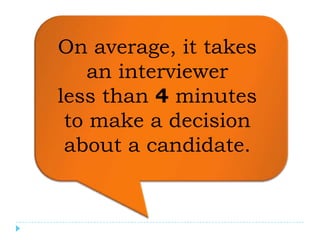
On average, it takes
    an interviewer
less than 4 minutes
 to make a decision
 about a candidate.
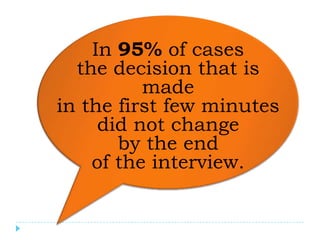
In 95% of cases
  the decision that is
          made
in the first few minutes
     did not change
       by the end
    of the interview.
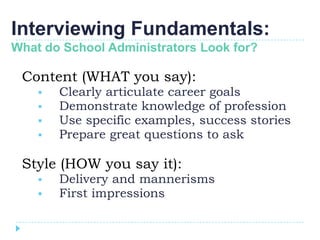
Interviewing Fundamentals:
What do School Administrators Look for?

 Content (WHAT you say):
       Clearly articulate career goals
       Demonstrate knowledge of profession
       Use specific examples, success stories
       Prepare great questions to ask

 Style (HOW you say it):
       Delivery and mannerisms
       First impressions
How to Prepare
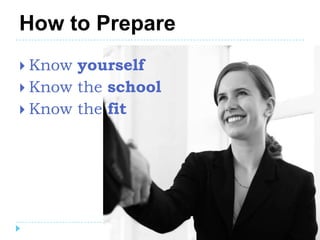
How to Prepare
 Know yourself
 Know the school
 Know the fit
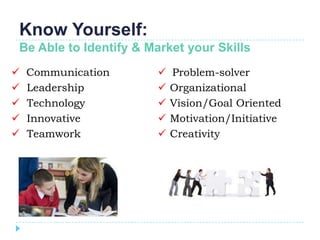
Know Yourself:
Be Able to Identify & Market your Skills
   Communication         Problem-solver
   Leadership            Organizational
   Technology            Vision/Goal Oriented
   Innovative            Motivation/Initiative
   Teamwork              Creativity
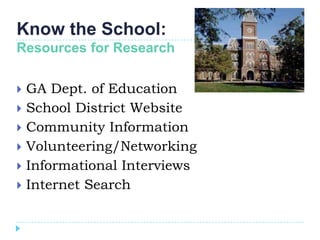
Know the School:
Resources for Research

 GA Dept. of Education
 School District Website
 Community Information
 Volunteering/Networking
 Informational Interviews
 Internet Search
Know the School:
Resources for Research

                       Demographics
     Vision

                                  Belief Statements
   Instructional
    Departments
                           Accomplishments

     Mission                              Future Goals
Making a Successful
  1st Impression
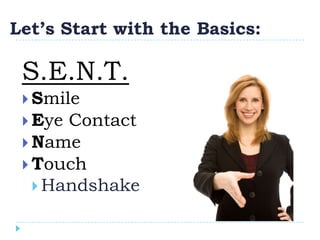
Let’s Start with the Basics:

 S.E.N.T.
  Smile
  Eye Contact
  Name
  Touch
    Handshake
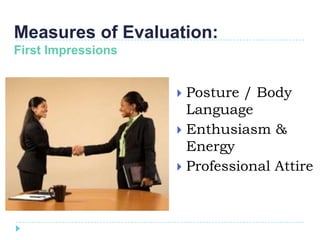
Measures of Evaluation:
First Impressions


                     Posture / Body
                      Language
                     Enthusiasm &
                      Energy
                     Professional Attire
More than 70% of
your first impression
    is based on
    appearance.
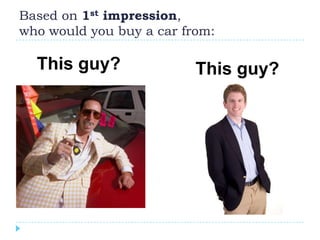
Based on 1st impression,
who would you buy a car from:

  This guy?               This guy?
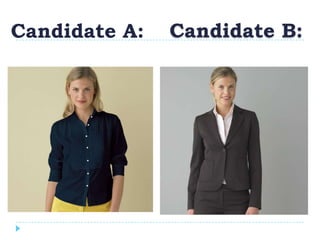
Based on 1st
impression, who would
      you hire?
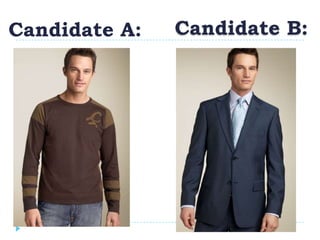
Candidate A:   Candidate B:
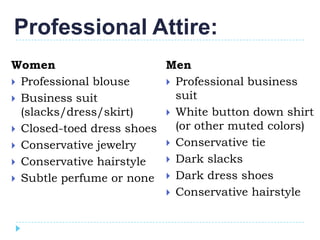
Professional Attire:
Women                     Men
 Professional blouse      Professional business
 Business suit             suit
  (slacks/dress/skirt)     White button down shirt
 Closed-toed dress shoes   (or other muted colors)
 Conservative jewelry     Conservative tie

 Conservative hairstyle   Dark slacks

 Subtle perfume or none  Dark dress shoes
                           Conservative hairstyle
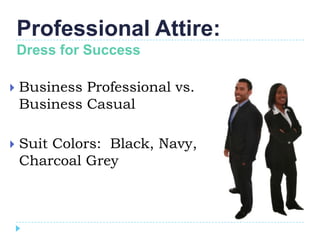
Professional Attire:
    Dress for Success

   Business Professional vs.
    Business Casual

   Suit Colors: Black, Navy,
    Charcoal Grey
Questions to
  Expect
Traditional Interview Questions
    Tell me about yourself.
    What are your career goals?
    What are your strengths (and
     weaknesses)?
    How did you choose UGA? Your major?
    Why should we hire you?

               Answers:
      Keep answer under 2 minutes.
How to Answer Questions
 Givespecific past
 examples/situations that reflect
 your accomplishments or portray
 you in a positive light

 Provideexamples of your greatest
 strengths and skill set

 Research   the district and school
Behavioral-Based
Questions
   Describe a time when….
   Tell me about a time when…
   Give me an example when…


              How to Answer

                       ?
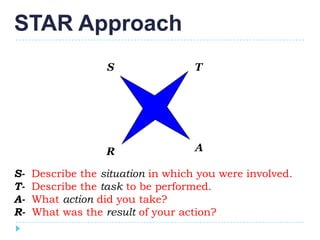
STAR Approach
                   S                T


                   R                A

S-   Describe the situation in which you were involved.
T-   Describe the task to be performed.
A-   What action did you take?
R-   What was the result of your action?
Teaching-Specific Questions
   Why do you want to teach?
   What can you contribute to our school?
   Why do you think you will be a successful teacher?
   What are the qualities of an excellent teacher?
    Which of these qualities do you have?
   Describe your student teaching experience. What
    was your biggest problem? How did you resolve it?
   How do you handle curricular content in classes with
    many levels of ability?
   What have you learned from your student teaching
    experience?
   What do you believe your role and obligations to be
    toward other faculty?
Teaching-Specific Questions
   What techniques do you use in developing rapport with
    students?
   What procedures work best for you in maintaining
    discipline?
   How would you individualize instruction in your classroom?
   Describe the role of the teacher in the learning process.
   What do you consider to be an ideal learning environment?
   How do you feel about team teaching?
   Why did you choose your particular area of preparation?
   What is the role of the school system in today’s society?
   What grade level do you feel most competent teaching?
    Why?
   What out-of-school experiences have you had working with
    children?
   What would you do if....? (hypothetical situations in the
    classroom)
Let’s Practice
Tell me about a course, work
   experience, or extracurricular
 activity in which you had to work
closely with others. How did it go?
    How did you overcome any
             difficulties?
What is your greatest
strength and weakness?
Tell me about the most challenging
experience you had during student
   teaching? What did you learn
    because of that experience?
Tell me about a time when you
exceeded your title’s expectation
   to complete a job or task.
Questions to Ask
and NOT to Ask
Questions to Ask
   Description of school district as per staff
    size, enrollment, etc.
   Professional growth requirements in the
    district, i.e., continuing education hours.
   How are parental contacts handled?
   How active is the P.T.O.? What does P.T.O.
    spend money on? How do teachers handle
    needs from P.T.O.? Does P.T.O. have a major
    project each year?
   What extra duties are expected of teachers
    (i.e., bus duty, car duty, lunch duty, etc.)?
   Are there any new “programs” (school-wide or
    grade-level) that are new or unique to the
    school? How long have they been in place?
    Are any being looked at as future
    possibilities?
   When can I expect to hear from you?
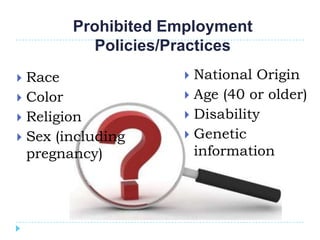
Prohibited Employment
          Policies/Practices
 Race                National Origin
 Color               Age (40 or older)

 Religion            Disability

 Sex (including      Genetic
  pregnancy)           information
How to Conclude the
     Interview
How to Conclude the Interview

                Reiterate your interest in the school
                Determine appropriate follow-up
                Get contact information from
                 interviewers
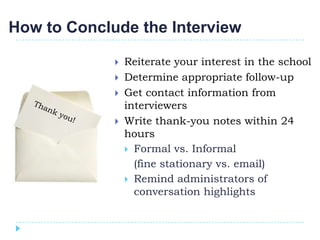
                Write thank-you notes within 24
                 hours
                  Formal vs. Informal
                   (fine stationary vs. email)
                  Remind administrators of
                   conversation highlights
Interviewing Tips
School Districts Speak Out!
What is the biggest no-no in an interview?
   “apathy, lack of flexibility”
   “Not being professional in every way -
    dress, manner, presentation, knowledge.”
   “Not dressing appropriately, looking around for others in the room while
    an interviewer is talking to them, and having a sloppy copy of their
    resume. You are looking for the small things knowing that if they take
    care of the small things, they will take care of the larger issues they will
    face on the job.”
   “Poor dress or language skills”
   “To show up late and/or unprepared”
TOP 10
       INTERVIEW TIPS
1. Research the school and the program.
2. Arrive 10-15 minutes early.
3. Dress for success.
4. Have a firm handshake and display confidence.
5. Use body language to show interest.
6. Listen.
7. Bring extra copies of your resume.
8. Have questions prepared ahead of time.
9. Ask about the next step in the process.
10. Thank the interviewers and follow-up with thank-you
    notes/emails to each interviewer.
Get Practice!
Schedule an appointment for a mock interview
          Call 706.542.3375


          www.career.uga.edu
QUESTIONS
    ?
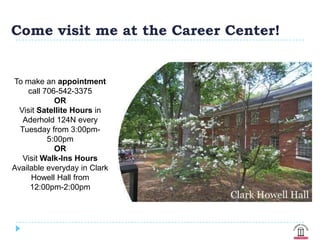
Come visit me at the Career Center!


To make an appointment
    call 706-542-3375
            OR
  Visit Satellite Hours in
   Aderhold 124N every
  Tuesday from 3:00pm-
          5:00pm
            OR
   Visit Walk-Ins Hours
Available everyday in Clark
     Howell Hall from
     12:00pm-2:00pm

Interviewing 101

  • 1.
    Making the Gradein YOUR Job Search: A Teacher’s Guide to Career Success Interviewing 101: Tips and Strategies for Landing that Job Presented by: Bethany Bagley College of Education Career Consultant
  • 2.
  • 3.
    On average, ittakes an interviewer less than 4 minutes to make a decision about a candidate.
  • 4.
    In 95% ofcases the decision that is made in the first few minutes did not change by the end of the interview.
  • 5.
    Interviewing Fundamentals: What doSchool Administrators Look for? Content (WHAT you say):  Clearly articulate career goals  Demonstrate knowledge of profession  Use specific examples, success stories  Prepare great questions to ask Style (HOW you say it):  Delivery and mannerisms  First impressions
  • 6.
  • 7.
    How to Prepare Know yourself  Know the school  Know the fit
  • 8.
    Know Yourself: Be Ableto Identify & Market your Skills  Communication  Problem-solver  Leadership  Organizational  Technology  Vision/Goal Oriented  Innovative  Motivation/Initiative  Teamwork  Creativity
  • 9.
    Know the School: Resourcesfor Research  GA Dept. of Education  School District Website  Community Information  Volunteering/Networking  Informational Interviews  Internet Search
  • 10.
    Know the School: Resourcesfor Research  Demographics  Vision  Belief Statements  Instructional Departments  Accomplishments  Mission  Future Goals
  • 11.
    Making a Successful 1st Impression
  • 12.
    Let’s Start withthe Basics: S.E.N.T.  Smile  Eye Contact  Name  Touch  Handshake
  • 13.
    Measures of Evaluation: FirstImpressions  Posture / Body Language  Enthusiasm & Energy  Professional Attire
  • 14.
    More than 70%of your first impression is based on appearance.
  • 15.
    Based on 1stimpression, who would you buy a car from: This guy? This guy?
  • 16.
    Based on 1st impression,who would you hire?
  • 17.
    Candidate A: Candidate B:
  • 18.
    Candidate A: Candidate B:
  • 19.
    Professional Attire: Women Men  Professional blouse  Professional business  Business suit suit (slacks/dress/skirt)  White button down shirt  Closed-toed dress shoes (or other muted colors)  Conservative jewelry  Conservative tie  Conservative hairstyle  Dark slacks  Subtle perfume or none  Dark dress shoes  Conservative hairstyle
  • 20.
    Professional Attire: Dress for Success  Business Professional vs. Business Casual  Suit Colors: Black, Navy, Charcoal Grey
  • 21.
  • 22.
    Traditional Interview Questions  Tell me about yourself.  What are your career goals?  What are your strengths (and weaknesses)?  How did you choose UGA? Your major?  Why should we hire you? Answers:  Keep answer under 2 minutes.
  • 23.
    How to AnswerQuestions  Givespecific past examples/situations that reflect your accomplishments or portray you in a positive light  Provideexamples of your greatest strengths and skill set  Research the district and school
  • 24.
    Behavioral-Based Questions  Describe a time when….  Tell me about a time when…  Give me an example when… How to Answer ?
  • 25.
    STAR Approach S T R A S- Describe the situation in which you were involved. T- Describe the task to be performed. A- What action did you take? R- What was the result of your action?
  • 26.
    Teaching-Specific Questions  Why do you want to teach?  What can you contribute to our school?  Why do you think you will be a successful teacher?  What are the qualities of an excellent teacher? Which of these qualities do you have?  Describe your student teaching experience. What was your biggest problem? How did you resolve it?  How do you handle curricular content in classes with many levels of ability?  What have you learned from your student teaching experience?  What do you believe your role and obligations to be toward other faculty?
  • 27.
    Teaching-Specific Questions  What techniques do you use in developing rapport with students?  What procedures work best for you in maintaining discipline?  How would you individualize instruction in your classroom?  Describe the role of the teacher in the learning process.  What do you consider to be an ideal learning environment?  How do you feel about team teaching?  Why did you choose your particular area of preparation?  What is the role of the school system in today’s society?  What grade level do you feel most competent teaching? Why?  What out-of-school experiences have you had working with children?  What would you do if....? (hypothetical situations in the classroom)
  • 28.
  • 29.
    Tell me abouta course, work experience, or extracurricular activity in which you had to work closely with others. How did it go? How did you overcome any difficulties?
  • 30.
    What is yourgreatest strength and weakness?
  • 31.
    Tell me aboutthe most challenging experience you had during student teaching? What did you learn because of that experience?
  • 32.
    Tell me abouta time when you exceeded your title’s expectation to complete a job or task.
  • 33.
  • 34.
    Questions to Ask  Description of school district as per staff size, enrollment, etc.  Professional growth requirements in the district, i.e., continuing education hours.  How are parental contacts handled?  How active is the P.T.O.? What does P.T.O. spend money on? How do teachers handle needs from P.T.O.? Does P.T.O. have a major project each year?  What extra duties are expected of teachers (i.e., bus duty, car duty, lunch duty, etc.)?  Are there any new “programs” (school-wide or grade-level) that are new or unique to the school? How long have they been in place? Are any being looked at as future possibilities?  When can I expect to hear from you?
  • 35.
    Prohibited Employment Policies/Practices  Race  National Origin  Color  Age (40 or older)  Religion  Disability  Sex (including  Genetic pregnancy) information
  • 36.
    How to Concludethe Interview
  • 37.
    How to Concludethe Interview  Reiterate your interest in the school  Determine appropriate follow-up  Get contact information from interviewers  Write thank-you notes within 24 hours  Formal vs. Informal (fine stationary vs. email)  Remind administrators of conversation highlights
  • 38.
  • 39.
    School Districts SpeakOut! What is the biggest no-no in an interview?  “apathy, lack of flexibility”  “Not being professional in every way - dress, manner, presentation, knowledge.”  “Not dressing appropriately, looking around for others in the room while an interviewer is talking to them, and having a sloppy copy of their resume. You are looking for the small things knowing that if they take care of the small things, they will take care of the larger issues they will face on the job.”  “Poor dress or language skills”  “To show up late and/or unprepared”
  • 40.
    TOP 10 INTERVIEW TIPS 1. Research the school and the program. 2. Arrive 10-15 minutes early. 3. Dress for success. 4. Have a firm handshake and display confidence. 5. Use body language to show interest. 6. Listen. 7. Bring extra copies of your resume. 8. Have questions prepared ahead of time. 9. Ask about the next step in the process. 10. Thank the interviewers and follow-up with thank-you notes/emails to each interviewer.
  • 41.
    Get Practice! Schedule anappointment for a mock interview Call 706.542.3375 www.career.uga.edu
  • 42.
  • 43.
    Come visit meat the Career Center! To make an appointment call 706-542-3375 OR Visit Satellite Hours in Aderhold 124N every Tuesday from 3:00pm- 5:00pm OR Visit Walk-Ins Hours Available everyday in Clark Howell Hall from 12:00pm-2:00pm