intertextuality
What is intertextualityThe shaping of texts’ meanings by other texts.Introduced by Julia KristevaKristeva argued against the concept of a text as a isolated entity which operates in a self-contained manner and states that:“any text is the absorption and transformation of another”
Where a text alludes to, or references, another text.Every text (and we can insert any cultural object here: image, film, web content, music etc.) is a mosaic of references to other texts, genres, and discourses.
intertextualitySome texts refer directly to each other – such as in ‘remakes’ of films, extra-diegetic references to the media / society in the animated cartoon The Simpsons, and many amusing contemporary TV ads.The interpretation of these references is influenced by the audiences’ prior knowledge of other texts.
Intertextuality in music videosJohn Stuarts description of the music video as “incorporating, raiding and reconstructing” is essentially the essence of intertextuality.Using something familiar to the audience may generate both potentially nostalgic associations and new meanings.It is perhaps more explicitly evident in the music video than in any other media form, with the possible exception of advertising.
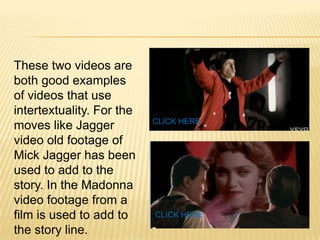
These two videos are both good examples of videos that use intertextuality. For the moves like Jagger video old footage of Mick Jagger has been used to add to the story. In the Madonna video footage from a film is used to add to the story line.CLICK HERECLICK HERE
In 1968 Barthes announced ‘the death of the author’ and ‘the birth of the reader’, declaring that  ‘a text’s unity lies not in its origin but in its destination’ –in other words there is no longer such a thing as an original text.This highlights how interpretation lies with the audience – that it is subjective – it is the audience that creates meaning.

Intertextuality

  • 1.
  • 2.
    What is intertextualityTheshaping of texts’ meanings by other texts.Introduced by Julia KristevaKristeva argued against the concept of a text as a isolated entity which operates in a self-contained manner and states that:“any text is the absorption and transformation of another”
  • 3.
    Where a textalludes to, or references, another text.Every text (and we can insert any cultural object here: image, film, web content, music etc.) is a mosaic of references to other texts, genres, and discourses.
  • 4.
    intertextualitySome texts referdirectly to each other – such as in ‘remakes’ of films, extra-diegetic references to the media / society in the animated cartoon The Simpsons, and many amusing contemporary TV ads.The interpretation of these references is influenced by the audiences’ prior knowledge of other texts.
  • 5.
    Intertextuality in musicvideosJohn Stuarts description of the music video as “incorporating, raiding and reconstructing” is essentially the essence of intertextuality.Using something familiar to the audience may generate both potentially nostalgic associations and new meanings.It is perhaps more explicitly evident in the music video than in any other media form, with the possible exception of advertising.
  • 6.
    These two videosare both good examples of videos that use intertextuality. For the moves like Jagger video old footage of Mick Jagger has been used to add to the story. In the Madonna video footage from a film is used to add to the story line.CLICK HERECLICK HERE
  • 7.
    In 1968 Barthesannounced ‘the death of the author’ and ‘the birth of the reader’, declaring that ‘a text’s unity lies not in its origin but in its destination’ –in other words there is no longer such a thing as an original text.This highlights how interpretation lies with the audience – that it is subjective – it is the audience that creates meaning.