INTERPERSONAL COMMUNICATION TIPS
Nwakerendu Ike
OUTLINE
Introduction
The Communication Process
Modes of Communication
Forms of Communication
Interpersonal Communication
How to keep communication simple
Some tips on Listening Skills
Principles of Listening
Barriers To Effective Communication
INTRODUCTION
Being able to communicate effectively is the most important of all life skills.
Communication is simply the act of sharing information from one person or place to
another.
This can be vocal (using voice), written (using printed or digital media such as books,
magazines, websites or emails), visual (using logos, maps, charts or graphs) or non-verbal
(using body language, gestures, the tone and pitch of voice).
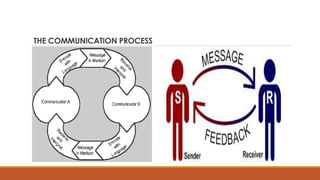
THE COMMUNICATION PROCESS
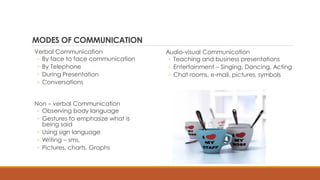
MODES OF COMMUNICATION
Verbal Communication
◦ By face to face communication
◦ By Telephone
◦ During Presentation
◦ Conversations
Non – verbal Communication
◦ Observing body language
◦ Gestures to emphasize what is
being said
◦ Using sign language
◦ Writing – sms,
◦ Pictures, charts, Graphs
Audio-visual Communication
◦ Teaching and business presentations
◦ Entertainment – Singing, Dancing, Acting
◦ Chat rooms, e-mail, pictures, symbols
FORMS OF COMMUNICATION
Intrapersonal Communication–Within oneself
Interpersonal Communication – With two or more people.
◦ Dyadic – Two people
◦ Group Communication – More than two
Mass Communication – To a scattered audience
INTERPERSONAL COMMUNICATION
Interpersonal communication is the process by which people exchange information,
feelings, and meaning through verbal and non-verbal messages
It is face-to-face communication.
Interpersonal communication is not just about what is actually said - the language used -
but how it is said and the non-verbal messages sent through tone of voice, facial
expressions, gestures and body language.
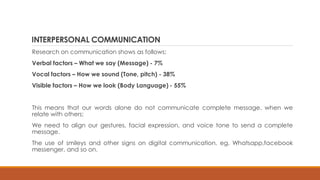
INTERPERSONAL COMMUNICATION
Research on communication shows as follows:
Verbal factors – What we say (Message) - 7%
Vocal factors – How we sound (Tone, pitch) - 38%
Visible factors – How we look (Body Language) - 55%
This means that our words alone do not communicate complete message, when we
relate with others;
We need to align our gestures, facial expression, and voice tone to send a complete
message.
The use of smileys and other signs on digital communication, eg. Whatsapp,facebook
messenger, and so on.
INTERPERSONAL COMMUNICATION
When two or more people are in the same place and are aware of each other's
presence, then communication is taking place, no matter how subtle or unintentional.
An observer may be using cues of posture, facial expression, and dress to form an
impression of the other's role, emotional state, personality or intentions.
Although no communication may be intended, people receive messages through such
forms of non-verbal behaviour.
HOW TO KEEP COMMUNICATION SIMPLE
Be brief – KISS – Keep It Short and Simple
◦ Don’t use ambiguous words
◦ Be precise
◦ Avoid using jargons
◦ Avoid repetitions
◦ Use pictures
◦ Use active verbs
◦ Make proper use of punctuations
◦ Highlight key words
HOW TO KEEP COMMUNICATION SIMPLE
 Use the right grammar
 Use the right language and channel
for the recipient
 Use bullet points
 Use sub-headings - helps to lead the
reader
 Use graphs to communicate at a
glance
 Use short sentences
LISTENING SKILL
Listening is the ability to accurately receive and interpret messages in the
communication process.
Without the ability to listen effectively, messages are easily misunderstood –
communication breaks down and the sender of the message can easily become
frustrated or irritated.
Spend some time thinking about and developing your listening skills – they are the
building blocks of success
LISTENING SKILL
Four levels of Listening:
Ignoring
Pretending
Selective
Attentive or Emphatic
Attentive Listening
Listening with intent to understand
Listening with empathy (get inside another person’s frame of mind)
Seek first to understand, then be understood
LISTENING IS NOT SAME AS HEARING
◦ Hearing refers to the sounds that you hear; listening requires focus.
◦ Listening means paying attention not only to the story, but also to how it is told.
◦ The use of language and voice; body language.
◦ It means being aware of both verbal and non-verbal messages.
PRINCIPLES OF LISTENING
Stop Talking - Don't talk, listen.
◦ “If we were supposed to talk more than we listen, we would have two tongues and
one ear.” Mark Twain.
Prepare Yourself to Listen - Relax
◦ Focus on the speaker. Put other things out of mind.
Put the Speaker at Ease - Help the speaker to feel free to speak.
◦ Nod or use other gestures or words to encourage them to continue.
PRINCIPLES OF LISTENING
Remove Distractions - Focus on what is being said.
◦ Don’t doodle, shuffle papers, look out the window, pick your fingernails or similar.
Empathise -Try to understand the other person’s point of view.
◦ Look at issues from their perspective. Let go of preconceived ideas.
Be Patient - A pause, even a long pause, does not necessarily mean that the speaker has
finished.
◦ Never interrupt or finish a sentence for someone
PRINCIPLES OF LISTENING
Avoid Personal Prejudice - Try to be impartial.
◦ Don't become irritated and don't let someone’s habits or mannerisms distract you from what the
speaker is really saying.
Listen to the Tone - Volume and tone add to what someone is saying.
◦ A good speaker will use both volume and tone to their advantage.
Listen for Ideas – Not Just Words
◦ You need to get the whole picture, not just isolated bits and pieces.
Wait and Watch for Non-Verbal Communication
◦ Gestures, facial expressions, and eye-movements can all be important.
BARRIERS TO EFFECTIVE COMMUNICATION
There are many barriers to communication and these may occur at any stage in the
communication process.
May distort message, wasting both time and money by causing confusion and
misunderstanding.
Effective communication involves overcoming these barriers and conveying a clear and
concise message. These include:
BARRIERS TO EFFECTIVE COMMUNICATION
Noise – may be in various forms
Voice texture, wrong spelling, poor punctuation
The use of jargon: over-complicated, unfamiliar and technical terms.
Emotional barriers and taboos. Some people may find it difficult to express their emotions
and some topics may be completely 'off-limits' or taboo.
Lack of attention, interest, distractions
Differences in perception and viewpoint.
Physical disabilities such as hearing problems or speech difficulties.
Language differences and the difficulty in understanding unfamiliar accents.
Cultural differences. The norms of social interaction vary greatly in different cultures, as
do the way in which emotions are expressed.
THANK YOU

Interpersonal Communication Tips

  • 1.
  • 2.
    OUTLINE Introduction The Communication Process Modesof Communication Forms of Communication Interpersonal Communication How to keep communication simple Some tips on Listening Skills Principles of Listening Barriers To Effective Communication
  • 3.
    INTRODUCTION Being able tocommunicate effectively is the most important of all life skills. Communication is simply the act of sharing information from one person or place to another. This can be vocal (using voice), written (using printed or digital media such as books, magazines, websites or emails), visual (using logos, maps, charts or graphs) or non-verbal (using body language, gestures, the tone and pitch of voice).
  • 4.
  • 5.
    MODES OF COMMUNICATION VerbalCommunication ◦ By face to face communication ◦ By Telephone ◦ During Presentation ◦ Conversations Non – verbal Communication ◦ Observing body language ◦ Gestures to emphasize what is being said ◦ Using sign language ◦ Writing – sms, ◦ Pictures, charts, Graphs Audio-visual Communication ◦ Teaching and business presentations ◦ Entertainment – Singing, Dancing, Acting ◦ Chat rooms, e-mail, pictures, symbols
  • 6.
    FORMS OF COMMUNICATION IntrapersonalCommunication–Within oneself Interpersonal Communication – With two or more people. ◦ Dyadic – Two people ◦ Group Communication – More than two Mass Communication – To a scattered audience
  • 7.
    INTERPERSONAL COMMUNICATION Interpersonal communicationis the process by which people exchange information, feelings, and meaning through verbal and non-verbal messages It is face-to-face communication. Interpersonal communication is not just about what is actually said - the language used - but how it is said and the non-verbal messages sent through tone of voice, facial expressions, gestures and body language.
  • 8.
    INTERPERSONAL COMMUNICATION Research oncommunication shows as follows: Verbal factors – What we say (Message) - 7% Vocal factors – How we sound (Tone, pitch) - 38% Visible factors – How we look (Body Language) - 55% This means that our words alone do not communicate complete message, when we relate with others; We need to align our gestures, facial expression, and voice tone to send a complete message. The use of smileys and other signs on digital communication, eg. Whatsapp,facebook messenger, and so on.
  • 9.
    INTERPERSONAL COMMUNICATION When twoor more people are in the same place and are aware of each other's presence, then communication is taking place, no matter how subtle or unintentional. An observer may be using cues of posture, facial expression, and dress to form an impression of the other's role, emotional state, personality or intentions. Although no communication may be intended, people receive messages through such forms of non-verbal behaviour.
  • 10.
    HOW TO KEEPCOMMUNICATION SIMPLE Be brief – KISS – Keep It Short and Simple ◦ Don’t use ambiguous words ◦ Be precise ◦ Avoid using jargons ◦ Avoid repetitions ◦ Use pictures ◦ Use active verbs ◦ Make proper use of punctuations ◦ Highlight key words
  • 11.
    HOW TO KEEPCOMMUNICATION SIMPLE  Use the right grammar  Use the right language and channel for the recipient  Use bullet points  Use sub-headings - helps to lead the reader  Use graphs to communicate at a glance  Use short sentences
  • 12.
    LISTENING SKILL Listening isthe ability to accurately receive and interpret messages in the communication process. Without the ability to listen effectively, messages are easily misunderstood – communication breaks down and the sender of the message can easily become frustrated or irritated. Spend some time thinking about and developing your listening skills – they are the building blocks of success
  • 13.
    LISTENING SKILL Four levelsof Listening: Ignoring Pretending Selective Attentive or Emphatic Attentive Listening Listening with intent to understand Listening with empathy (get inside another person’s frame of mind) Seek first to understand, then be understood
  • 14.
    LISTENING IS NOTSAME AS HEARING ◦ Hearing refers to the sounds that you hear; listening requires focus. ◦ Listening means paying attention not only to the story, but also to how it is told. ◦ The use of language and voice; body language. ◦ It means being aware of both verbal and non-verbal messages.
  • 15.
    PRINCIPLES OF LISTENING StopTalking - Don't talk, listen. ◦ “If we were supposed to talk more than we listen, we would have two tongues and one ear.” Mark Twain. Prepare Yourself to Listen - Relax ◦ Focus on the speaker. Put other things out of mind. Put the Speaker at Ease - Help the speaker to feel free to speak. ◦ Nod or use other gestures or words to encourage them to continue.
  • 16.
    PRINCIPLES OF LISTENING RemoveDistractions - Focus on what is being said. ◦ Don’t doodle, shuffle papers, look out the window, pick your fingernails or similar. Empathise -Try to understand the other person’s point of view. ◦ Look at issues from their perspective. Let go of preconceived ideas. Be Patient - A pause, even a long pause, does not necessarily mean that the speaker has finished. ◦ Never interrupt or finish a sentence for someone
  • 17.
    PRINCIPLES OF LISTENING AvoidPersonal Prejudice - Try to be impartial. ◦ Don't become irritated and don't let someone’s habits or mannerisms distract you from what the speaker is really saying. Listen to the Tone - Volume and tone add to what someone is saying. ◦ A good speaker will use both volume and tone to their advantage. Listen for Ideas – Not Just Words ◦ You need to get the whole picture, not just isolated bits and pieces. Wait and Watch for Non-Verbal Communication ◦ Gestures, facial expressions, and eye-movements can all be important.
  • 18.
    BARRIERS TO EFFECTIVECOMMUNICATION There are many barriers to communication and these may occur at any stage in the communication process. May distort message, wasting both time and money by causing confusion and misunderstanding. Effective communication involves overcoming these barriers and conveying a clear and concise message. These include:
  • 19.
    BARRIERS TO EFFECTIVECOMMUNICATION Noise – may be in various forms Voice texture, wrong spelling, poor punctuation The use of jargon: over-complicated, unfamiliar and technical terms. Emotional barriers and taboos. Some people may find it difficult to express their emotions and some topics may be completely 'off-limits' or taboo. Lack of attention, interest, distractions Differences in perception and viewpoint. Physical disabilities such as hearing problems or speech difficulties. Language differences and the difficulty in understanding unfamiliar accents. Cultural differences. The norms of social interaction vary greatly in different cultures, as do the way in which emotions are expressed.
  • 20.