INTERNET PROTOCOL VERSION 6INTERNET PROTOCOL VERSION 6
Presented by:Presented by:
A.GayatriA.Gayatri
14A81A0564.14A81A0564.
ContentsContents
 IP Network AddressingIP Network Addressing
 Classful IP addressingClassful IP addressing
 Techniques to reduce addressTechniques to reduce address
shortage in IPv4shortage in IPv4
 Features of IPv6Features of IPv6
 Header ComparisonsHeader Comparisons
 Extension HeadersExtension Headers
 ConclusionsConclusions
IP Network AddressingIP Network Addressing
 INTERNETINTERNET  world’s largest publicworld’s largest public
data network, doubling in size every ninedata network, doubling in size every nine
monthsmonths
 IPv4, defines a 32-bit address - 2IPv4, defines a 32-bit address - 23232
(4,294,967,296)(4,294,967,296) IPv4 addresses availableIPv4 addresses available
 The first problem is concerned with theThe first problem is concerned with the
eventual depletion of the IP addresseventual depletion of the IP address
space.space.
 Traditional model of classful addressingTraditional model of classful addressing
does not allow the address space to bedoes not allow the address space to be
used to its maximum potential.used to its maximum potential.
Classful AddressingClassful Addressing
 When IP was first standardized in SepWhen IP was first standardized in Sep
1981, each system attached to the IP1981, each system attached to the IP
based Internet had to be assigned abased Internet had to be assigned a
unique 32-bit addressunique 32-bit address
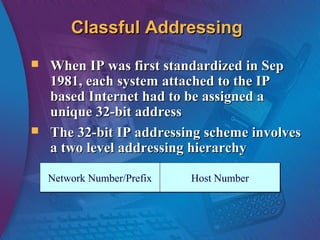
 The 32-bit IP addressing scheme involvesThe 32-bit IP addressing scheme involves
a two level addressing hierarchya two level addressing hierarchy
Network Number/PrefixNetwork Number/Prefix Host NumberHost Number
Classful Addressing…Classful Addressing…
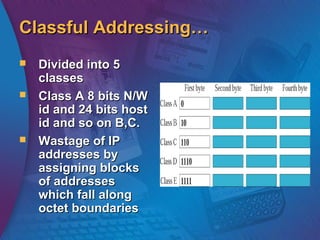
 Divided into 5Divided into 5
classesclasses
 Class A 8 bits N/WClass A 8 bits N/W
id and 24 bits hostid and 24 bits host
id and so on B,C.id and so on B,C.
 Wastage of IPWastage of IP
addresses byaddresses by
assigning blocksassigning blocks
of addressesof addresses
which fall alongwhich fall along
octet boundariesoctet boundaries
Techniques to reduce addressTechniques to reduce address
shortage in IPv4shortage in IPv4
 SubnettingSubnetting
 Classless Inter Domain RoutingClassless Inter Domain Routing
(CIDR)(CIDR)
 Network Address Translation (NAT)Network Address Translation (NAT)
SubnettingSubnetting
 Three-level hierarchy: network,Three-level hierarchy: network,
subnet, and host.subnet, and host.
 The extended-network-prefix hasThe extended-network-prefix has
traditionally been identified by thetraditionally been identified by the
subnet masksubnet mask
Network-Prefix Subnet-Number Host-Number
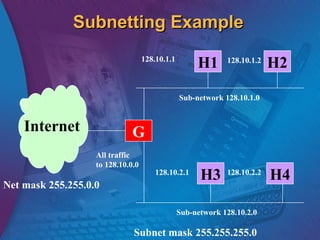
Subnetting ExampleSubnetting Example
Internet G
H1 H2
H3 H4
Subnet mask 255.255.255.0
All traffic
to 128.10.0.0
128.10.1.1 128.10.1.2
128.10.2.1 128.10.2.2
Sub-network 128.10.1.0
Sub-network 128.10.2.0
Net mask 255.255.0.0
Classless Inter-Domain RoutingClassless Inter-Domain Routing
 Eliminates traditional classful IPEliminates traditional classful IP
routing.routing.
 Routing information is advertisedRouting information is advertised
with a bit mask/prefix lengthwith a bit mask/prefix length
specifies the number of leftmost contiguous bitsspecifies the number of leftmost contiguous bits
in the network portion of each routing table entryin the network portion of each routing table entry
 Example: 192.168.0.0/21Example: 192.168.0.0/21
Network Address TranslationNetwork Address Translation
 Each organization- singleEach organization- single IPIP addressaddress
 Within organization – each host withWithin organization – each host with
IP unique to the orgn., from reservedIP unique to the orgn., from reserved
set of IP addressesset of IP addresses
Features of IPv6Features of IPv6
 Larger Address Space
 New host can assign its own host
address
 Efficient and Extensible IP datagram
 Stateless Address Autoconfiguration
 Security (IPsec mandatory)
 Mobility
128-bit IPv6 Address128-bit IPv6 Address
3FFE:085B:1F1F:0000:0000:0000:00A9:1234
groups of 16-bit hexadecimal numbers separated by
3FFE:85B:1F1F::A9:1234
= all zeros in one or more group of 16-bit hexadecimal numbe
Leading zeros can
be removed
40
bytes
20
bytes
IPv4
IPv6
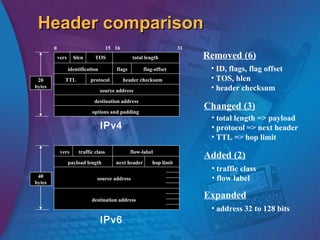
0 15 16 31
vers hlen TOS total length
identification flags flag-offset
TTL protocol header checksum
source address
destination address
options and padding
vers traffic class flow-label
payload length next header hop limit
source address
destination address
Removed (6)
• ID, flags, flag offset
• TOS, hlen
• header checksum
Changed (3)
Added (2)
Expanded
• total length => payload
• protocol => next header
• TTL => hop limit
• traffic class
• flow label
• address 32 to 128 bits
Header comparisonHeader comparison
Major Improvements ofMajor Improvements of
IPv6 HeaderIPv6 Header
 No option fieldNo option field: Replaced by: Replaced by
extension header. Result in a fixedextension header. Result in a fixed
length, 40-byte IP header.length, 40-byte IP header.
 No header checksumNo header checksum: Result in fast: Result in fast
processing.processing.
 No fragmentation at intermediateNo fragmentation at intermediate
nodesnodes: Result in fast IP forwarding.: Result in fast IP forwarding.
Extension HeadersExtension Headers
 Routing – Extended routing, like IPv4Routing – Extended routing, like IPv4
loose list of routers to visitloose list of routers to visit
 Fragmentation – Fragmentation andFragmentation – Fragmentation and
reassemblyreassembly
 Authentication – Integrity andAuthentication – Integrity and
authentication, securityauthentication, security
 Encapsulation – ConfidentialityEncapsulation – Confidentiality
 Destination Options – OptionalDestination Options – Optional
information to be examined by theinformation to be examined by the
destination nodedestination node
Stateless Address AutoconfigurationStateless Address Autoconfiguration
 3 ways to configure network3 ways to configure network
interfaces: Manually, Stateful,interfaces: Manually, Stateful,
StatelessStateless
 IPv6 addr. Separated into 2 2 parts:IPv6 addr. Separated into 2 2 parts:
network and interface id.network and interface id.
 Link- local addressesLink- local addresses
 Obtain network id through RouterObtain network id through Router
solicitation (RS)solicitation (RS)
Conclusion
 IPv6 is NEW …
– built on the experiences learned from
IPv4
– new features
– large address space
– new efficient header
– autoconfiguration
 … and OLD
– still IP
– build on a solid base
– started in 1995, a lot of
implementations and tests done
THANK YOU

INTERNET PROTOCOL VERSION 6

  • 1.
    INTERNET PROTOCOL VERSION6INTERNET PROTOCOL VERSION 6 Presented by:Presented by: A.GayatriA.Gayatri 14A81A0564.14A81A0564.
  • 2.
    ContentsContents  IP NetworkAddressingIP Network Addressing  Classful IP addressingClassful IP addressing  Techniques to reduce addressTechniques to reduce address shortage in IPv4shortage in IPv4  Features of IPv6Features of IPv6  Header ComparisonsHeader Comparisons  Extension HeadersExtension Headers  ConclusionsConclusions
  • 3.
    IP Network AddressingIPNetwork Addressing  INTERNETINTERNET  world’s largest publicworld’s largest public data network, doubling in size every ninedata network, doubling in size every nine monthsmonths  IPv4, defines a 32-bit address - 2IPv4, defines a 32-bit address - 23232 (4,294,967,296)(4,294,967,296) IPv4 addresses availableIPv4 addresses available  The first problem is concerned with theThe first problem is concerned with the eventual depletion of the IP addresseventual depletion of the IP address space.space.  Traditional model of classful addressingTraditional model of classful addressing does not allow the address space to bedoes not allow the address space to be used to its maximum potential.used to its maximum potential.
  • 4.
    Classful AddressingClassful Addressing When IP was first standardized in SepWhen IP was first standardized in Sep 1981, each system attached to the IP1981, each system attached to the IP based Internet had to be assigned abased Internet had to be assigned a unique 32-bit addressunique 32-bit address  The 32-bit IP addressing scheme involvesThe 32-bit IP addressing scheme involves a two level addressing hierarchya two level addressing hierarchy Network Number/PrefixNetwork Number/Prefix Host NumberHost Number
  • 5.
    Classful Addressing…Classful Addressing… Divided into 5Divided into 5 classesclasses  Class A 8 bits N/WClass A 8 bits N/W id and 24 bits hostid and 24 bits host id and so on B,C.id and so on B,C.  Wastage of IPWastage of IP addresses byaddresses by assigning blocksassigning blocks of addressesof addresses which fall alongwhich fall along octet boundariesoctet boundaries
  • 6.
    Techniques to reduceaddressTechniques to reduce address shortage in IPv4shortage in IPv4  SubnettingSubnetting  Classless Inter Domain RoutingClassless Inter Domain Routing (CIDR)(CIDR)  Network Address Translation (NAT)Network Address Translation (NAT)
  • 7.
    SubnettingSubnetting  Three-level hierarchy:network,Three-level hierarchy: network, subnet, and host.subnet, and host.  The extended-network-prefix hasThe extended-network-prefix has traditionally been identified by thetraditionally been identified by the subnet masksubnet mask Network-Prefix Subnet-Number Host-Number
  • 8.
    Subnetting ExampleSubnetting Example InternetG H1 H2 H3 H4 Subnet mask 255.255.255.0 All traffic to 128.10.0.0 128.10.1.1 128.10.1.2 128.10.2.1 128.10.2.2 Sub-network 128.10.1.0 Sub-network 128.10.2.0 Net mask 255.255.0.0
  • 9.
    Classless Inter-Domain RoutingClasslessInter-Domain Routing  Eliminates traditional classful IPEliminates traditional classful IP routing.routing.  Routing information is advertisedRouting information is advertised with a bit mask/prefix lengthwith a bit mask/prefix length specifies the number of leftmost contiguous bitsspecifies the number of leftmost contiguous bits in the network portion of each routing table entryin the network portion of each routing table entry  Example: 192.168.0.0/21Example: 192.168.0.0/21
  • 10.
    Network Address TranslationNetworkAddress Translation  Each organization- singleEach organization- single IPIP addressaddress  Within organization – each host withWithin organization – each host with IP unique to the orgn., from reservedIP unique to the orgn., from reserved set of IP addressesset of IP addresses
  • 11.
    Features of IPv6Featuresof IPv6  Larger Address Space  New host can assign its own host address  Efficient and Extensible IP datagram  Stateless Address Autoconfiguration  Security (IPsec mandatory)  Mobility
  • 12.
    128-bit IPv6 Address128-bitIPv6 Address 3FFE:085B:1F1F:0000:0000:0000:00A9:1234 groups of 16-bit hexadecimal numbers separated by 3FFE:85B:1F1F::A9:1234 = all zeros in one or more group of 16-bit hexadecimal numbe Leading zeros can be removed
  • 13.
    40 bytes 20 bytes IPv4 IPv6 0 15 1631 vers hlen TOS total length identification flags flag-offset TTL protocol header checksum source address destination address options and padding vers traffic class flow-label payload length next header hop limit source address destination address Removed (6) • ID, flags, flag offset • TOS, hlen • header checksum Changed (3) Added (2) Expanded • total length => payload • protocol => next header • TTL => hop limit • traffic class • flow label • address 32 to 128 bits Header comparisonHeader comparison
  • 14.
    Major Improvements ofMajorImprovements of IPv6 HeaderIPv6 Header  No option fieldNo option field: Replaced by: Replaced by extension header. Result in a fixedextension header. Result in a fixed length, 40-byte IP header.length, 40-byte IP header.  No header checksumNo header checksum: Result in fast: Result in fast processing.processing.  No fragmentation at intermediateNo fragmentation at intermediate nodesnodes: Result in fast IP forwarding.: Result in fast IP forwarding.
  • 15.
    Extension HeadersExtension Headers Routing – Extended routing, like IPv4Routing – Extended routing, like IPv4 loose list of routers to visitloose list of routers to visit  Fragmentation – Fragmentation andFragmentation – Fragmentation and reassemblyreassembly  Authentication – Integrity andAuthentication – Integrity and authentication, securityauthentication, security  Encapsulation – ConfidentialityEncapsulation – Confidentiality  Destination Options – OptionalDestination Options – Optional information to be examined by theinformation to be examined by the destination nodedestination node
  • 16.
    Stateless Address AutoconfigurationStatelessAddress Autoconfiguration  3 ways to configure network3 ways to configure network interfaces: Manually, Stateful,interfaces: Manually, Stateful, StatelessStateless  IPv6 addr. Separated into 2 2 parts:IPv6 addr. Separated into 2 2 parts: network and interface id.network and interface id.  Link- local addressesLink- local addresses  Obtain network id through RouterObtain network id through Router solicitation (RS)solicitation (RS)
  • 17.
    Conclusion  IPv6 isNEW … – built on the experiences learned from IPv4 – new features – large address space – new efficient header – autoconfiguration  … and OLD – still IP – build on a solid base – started in 1995, a lot of implementations and tests done
  • 18.