By : Mr. Swapnajit Das
Agenda
• What is IOT ?
• Components of IOT .
• Evolution of IOT .
• Applications Of IOT .
• Conclusion
INTERNET OF THINGS(IOT)
• The Internet of things refers to the ever growing network
of physical objects that feature an IP address for internet
connectivity, and the communication that occurs
between these objects and other internet enabled
devices and systems.
• In simple words, Internet of things(IOT)is an ecosystem of
connected physical objects that are accessible through
the internet.
• It also referred to as Machine-to-machine(M2M) Skynet
or Internet of Everything.
• The number of IOT devices increased 31% year-over-year to
8.4 billion in the year 2017 and it is estimated that there
will be 30 billion devices by 2020. The global market value
of IOT is projected to reach $7.1 trillion by 2020.
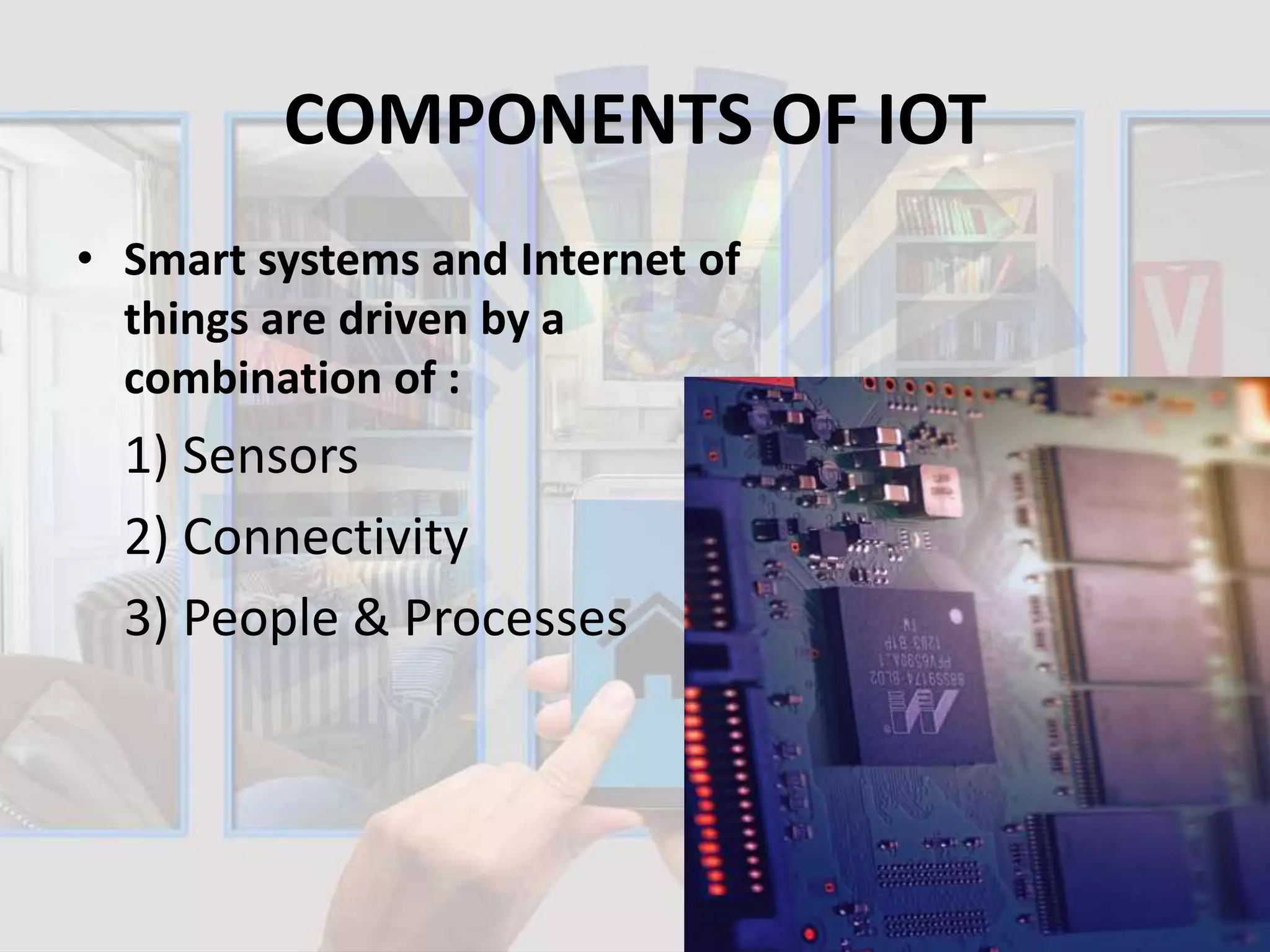
COMPONENTS OF IOT
• Smart systems and Internet of
things are driven by a
combination of :
1) Sensors
2) Connectivity
3) People & Processes
EVOLUTION OF IOT
The concept of the Internet of Things first
became popular in1999, through the Auto-ID centre
at MIT and related market-analysis publications.
Radio-frequency identification (RFID) was seen as
a prerequisite for the lot at that point .If all objects
and people in daily life were equipped with
identifiers, computers could manage and inventory
them. Besides using RFID, the tagging of things may
be achieved through such technologies as near field
communication, barcodes, QR codes, Bluetooth, and
digital watermarking.
APPLICATIONS OF IOT
• Smart Home
• Connected Cars
• Industrial Internet
• Smart Cities
• IOT in Agriculture
• Smart Retail
• Healthcare
SMART HOME
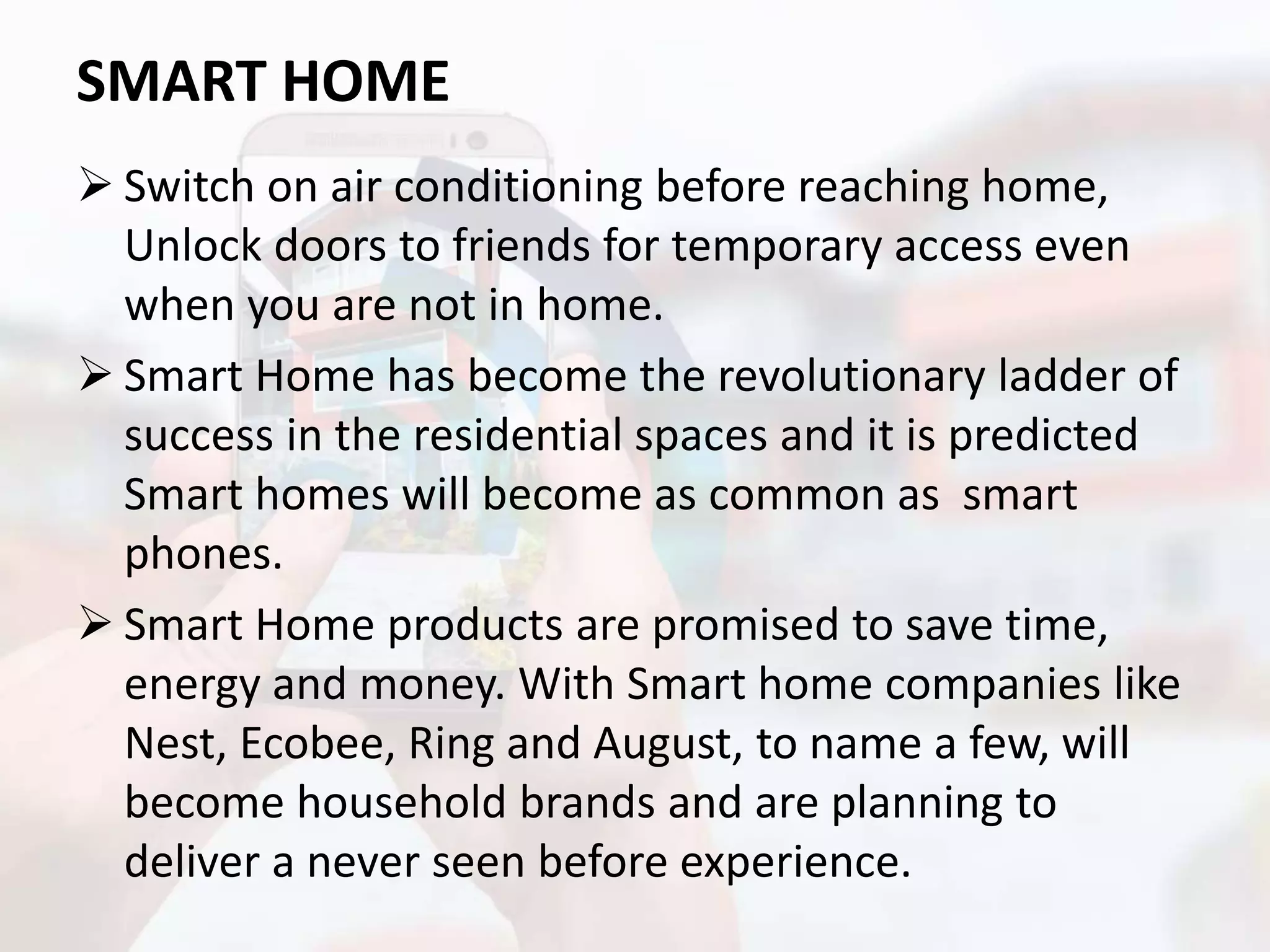
 Switch on air conditioning before reaching home,
Unlock doors to friends for temporary access even
when you are not in home.
 Smart Home has become the revolutionary ladder of
success in the residential spaces and it is predicted
Smart homes will become as common as smart
phones.
 Smart Home products are promised to save time,
energy and money. With Smart home companies like
Nest, Ecobee, Ring and August, to name a few, will
become household brands and are planning to
deliver a never seen before experience.
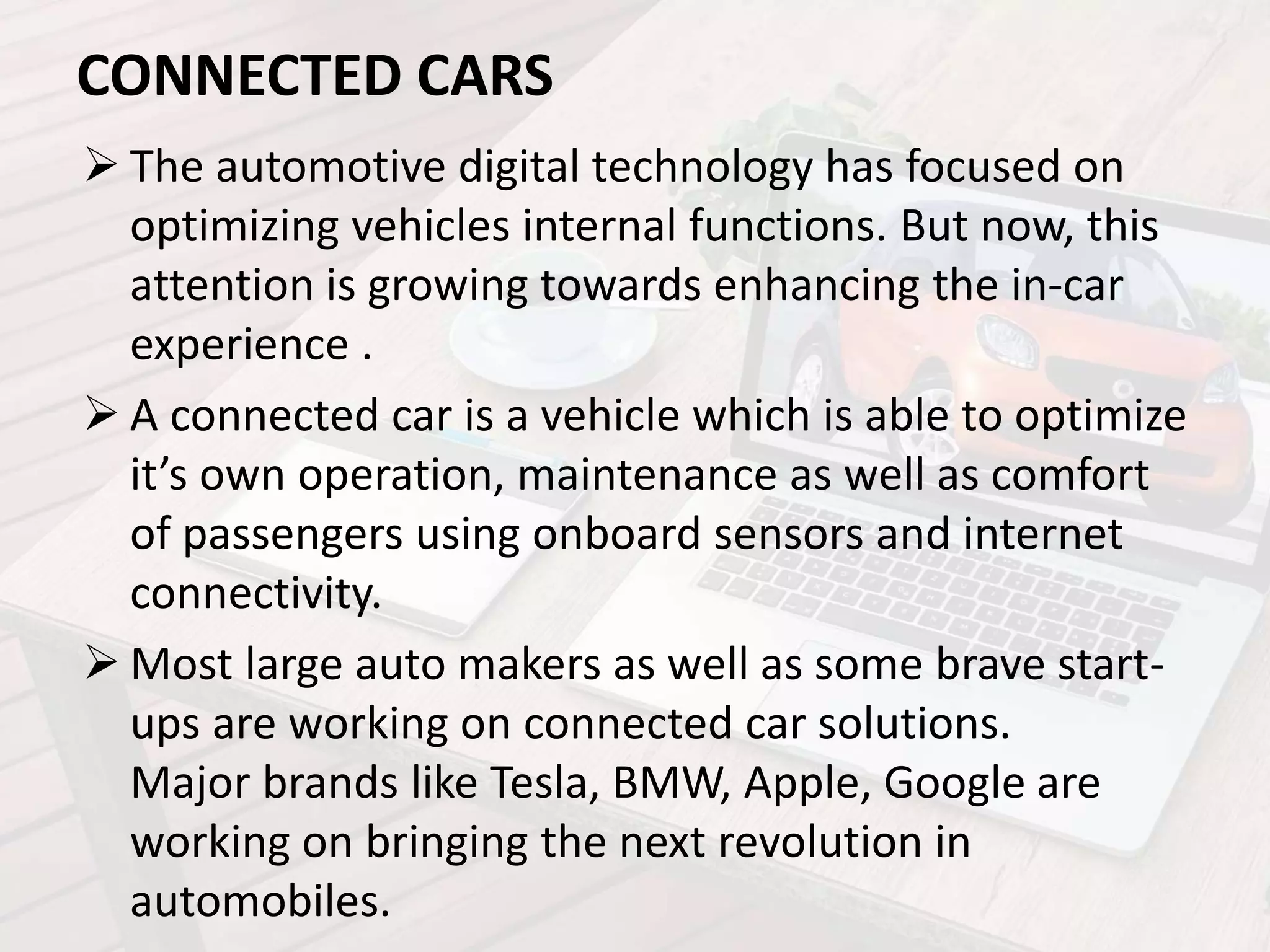
CONNECTED CARS
 The automotive digital technology has focused on
optimizing vehicles internal functions. But now, this
attention is growing towards enhancing the in-car
experience .
 A connected car is a vehicle which is able to optimize
it’s own operation, maintenance as well as comfort
of passengers using onboard sensors and internet
connectivity.
 Most large auto makers as well as some brave start-
ups are working on connected car solutions.
Major brands like Tesla, BMW, Apple, Google are
working on bringing the next revolution in
automobiles.
INDUSTRIAL INTERNET
 The industrial internet is also one of the special
Internet of Things applications. While many market
researches such as Gartner or Cisco see the industrial
internet as the IOT concept with the highest overall
potential, its popularity currently doesn’t reach the
masses like smart home or wearables do.
 The industrial internet however has a lot going for it.
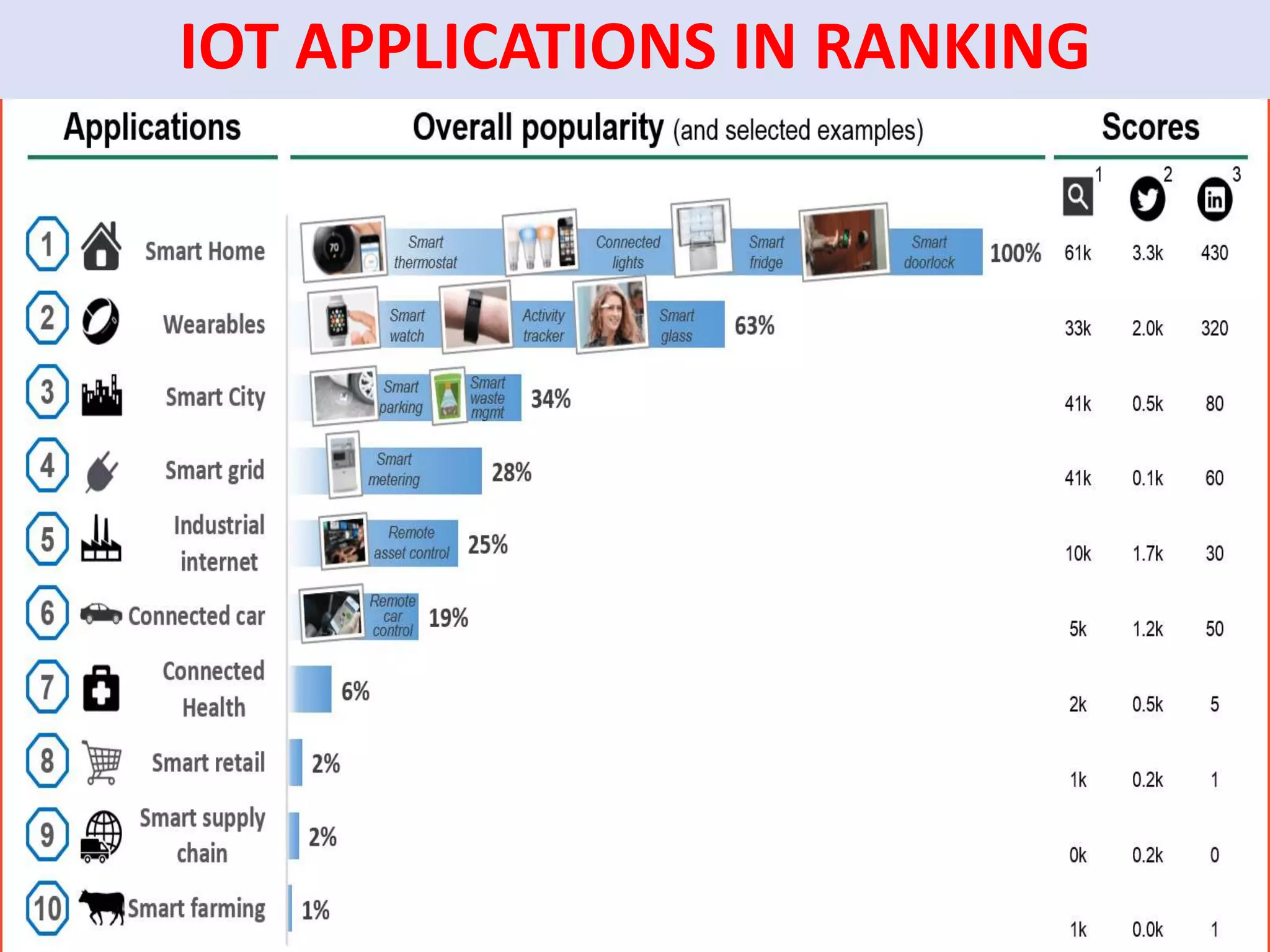
The industrial internet gets the biggest push of
people on Twitter (1,700 tweets per month)
compared to other non-consumer-oriented IOT
concepts.
SMART CITIES
 Smart city spans a wide variety of use cases, from
traffic management to water distribution, to waste
management, urban security and environmental
monitoring.
 Its popularity is fuelled by the fact that many Smart
City solutions promise to alleviate real pains of
people living in cities these days.
 IOT solutions in the area of Smart City solve traffic
congestion problems, reduce noise and pollution and
help make cities safer.
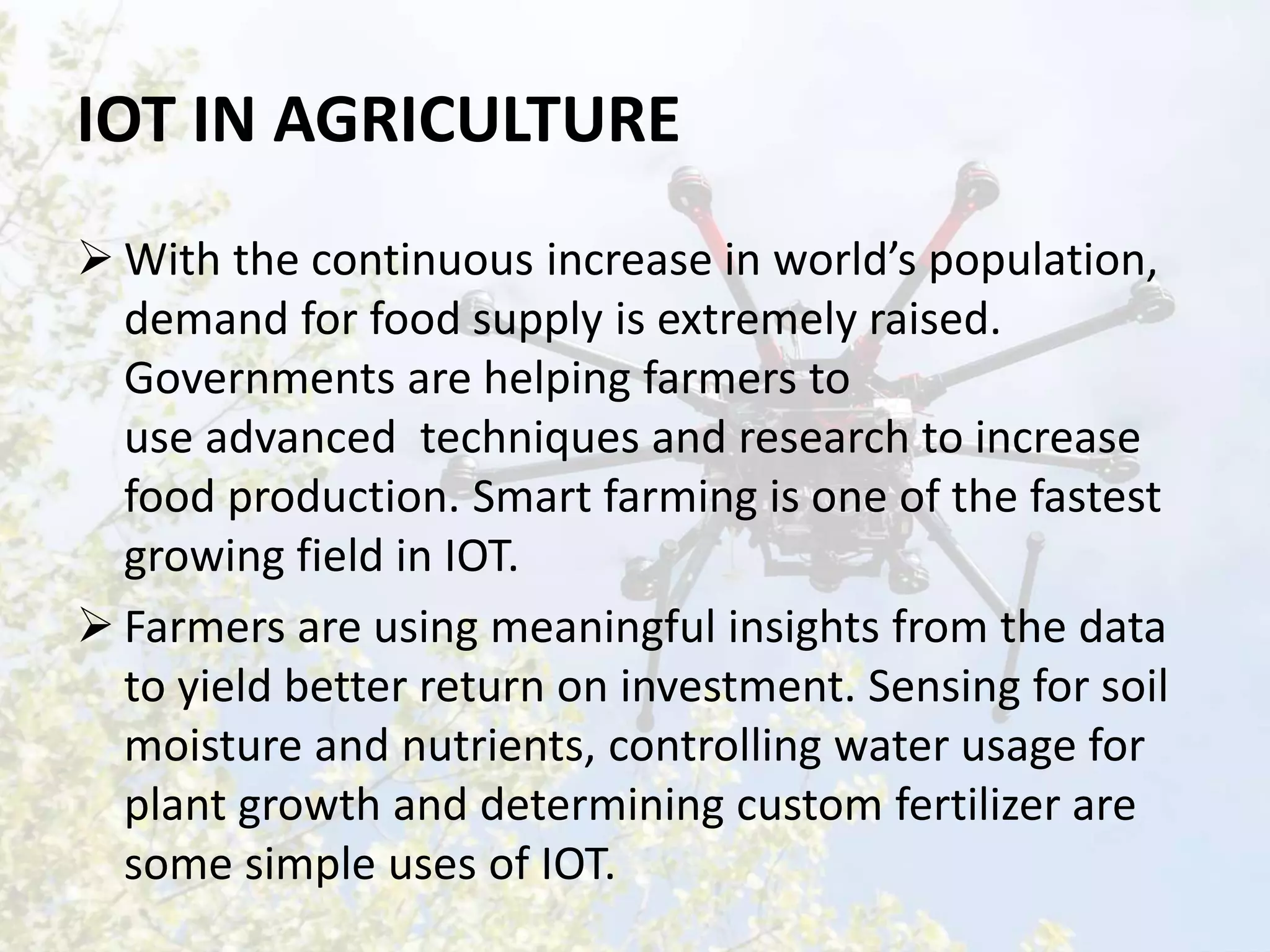
IOT IN AGRICULTURE
 With the continuous increase in world’s population,
demand for food supply is extremely raised.
Governments are helping farmers to
use advanced techniques and research to increase
food production. Smart farming is one of the fastest
growing field in IOT.
 Farmers are using meaningful insights from the data
to yield better return on investment. Sensing for soil
moisture and nutrients, controlling water usage for
plant growth and determining custom fertilizer are
some simple uses of IOT.
SMART RETAIL
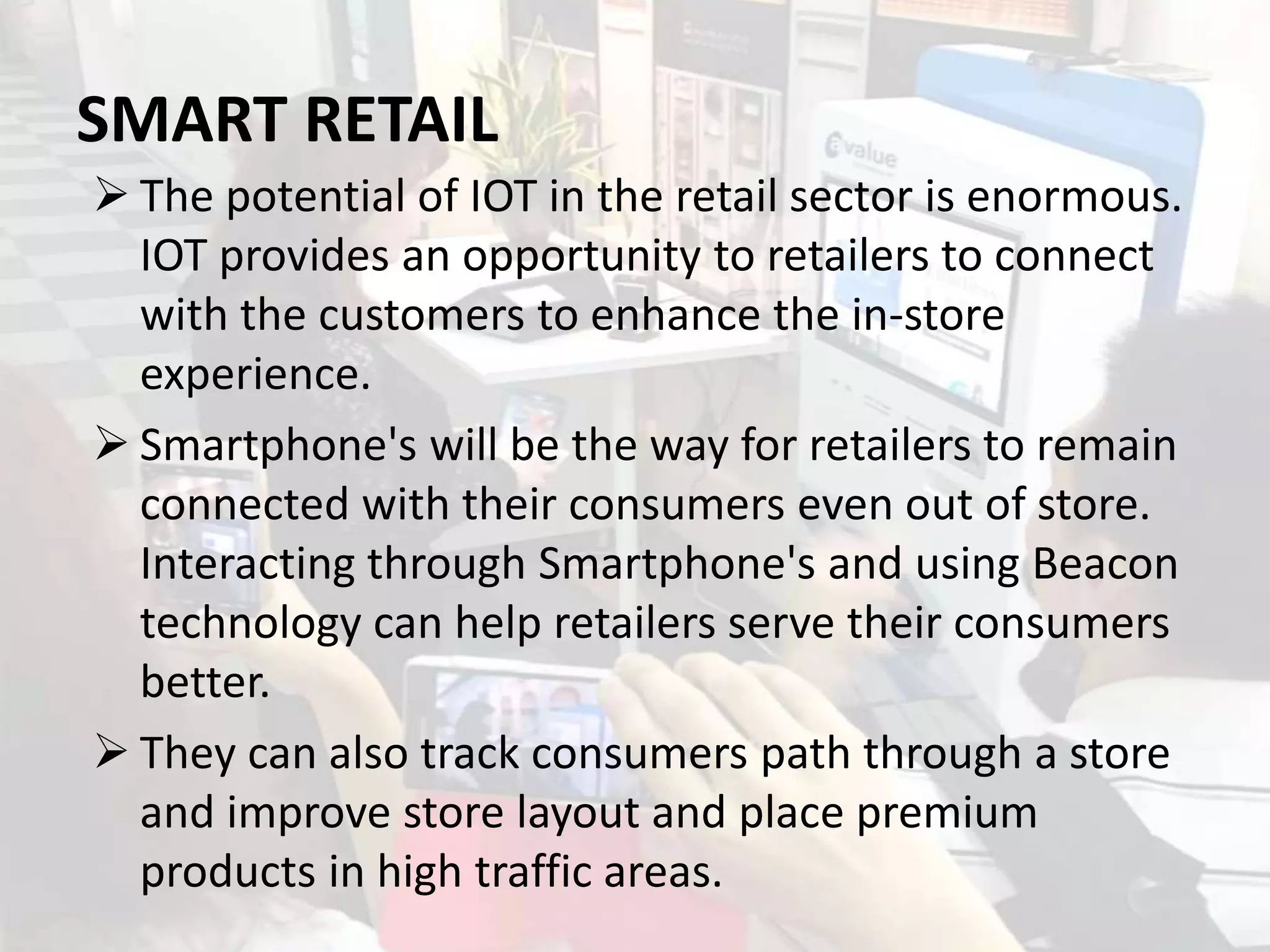
 The potential of IOT in the retail sector is enormous.
IOT provides an opportunity to retailers to connect
with the customers to enhance the in-store
experience.
 Smartphone's will be the way for retailers to remain
connected with their consumers even out of store.
Interacting through Smartphone's and using Beacon
technology can help retailers serve their consumers
better.
 They can also track consumers path through a store
and improve store layout and place premium
products in high traffic areas.
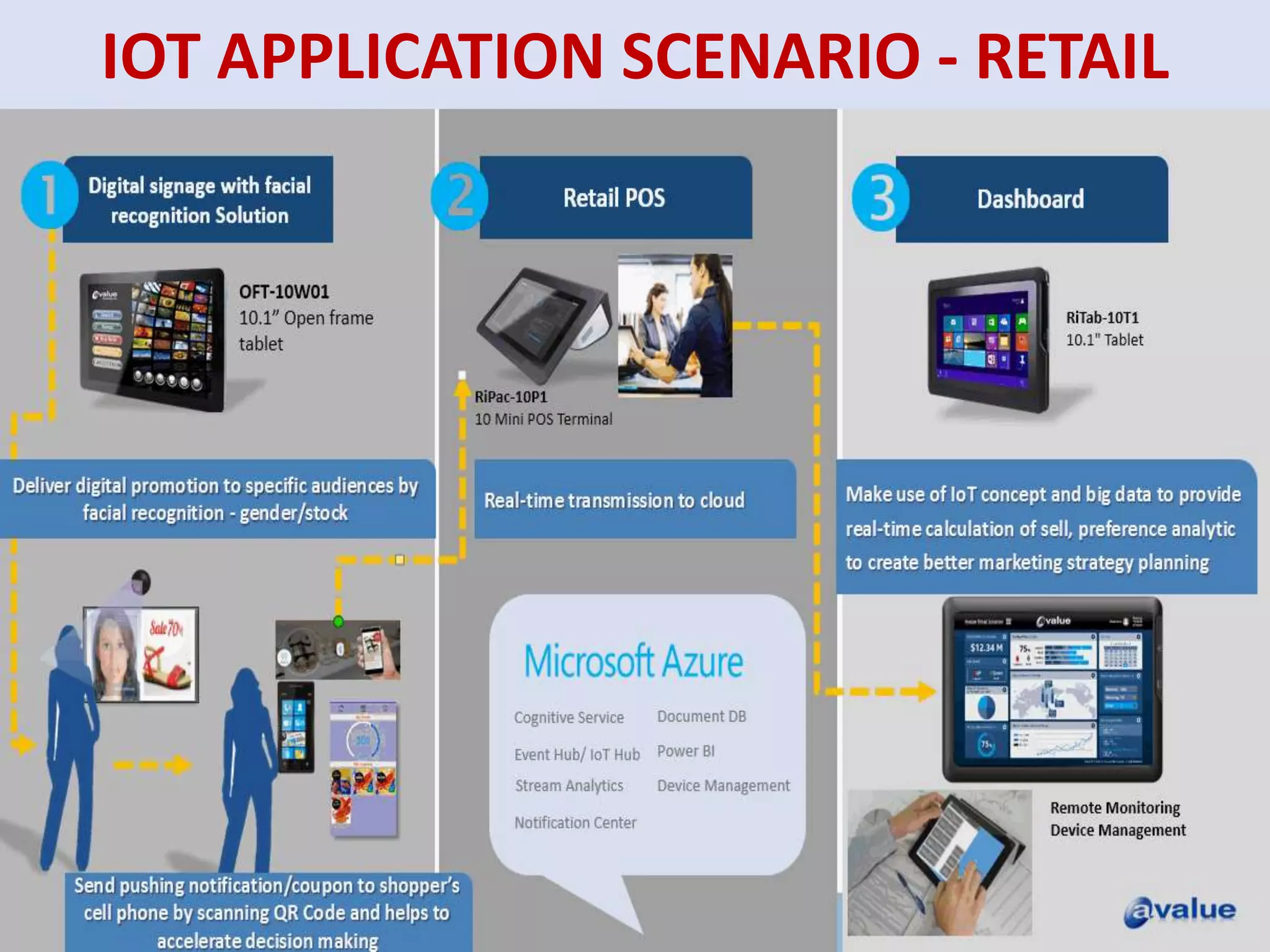
IOT APPLICATION SCENARIO - RETAIL
HEALTHCARE
 The concept of connected healthcare system and
smart medical devices bears enormous potential not
just for companies, but also for the well-being of
people in general.
 Research shows IOT in healthcare will be massive in
coming years. IOT in healthcare is aimed at
empowering people to live healthier life by wearing
connected devices.
The collected data will help in personalized
analysis of an individual’s health and provide
tailor made strategies to combat illness.
IOT APPLICATIONS IN RANKING
CONCLUSION
Projection for the impact of IOT on the
Internet and connectivity are
impressive, with some anticipating as
many as 100 billion connected IOT
devices and a global economic impact
of more than $11 trillion by 2025.

The potential economic impact of IOT is
huge, but the journey to IOT adoption
is not a seamless one. There are many
challenges that face companies looking
to implement IOT solutions. However,
the risks and disadvantages associated
with IOT can be overcome.
Internet of Things (IOT)

Internet of Things (IOT)

  • 1.
    By : Mr.Swapnajit Das
  • 2.
    Agenda • What isIOT ? • Components of IOT . • Evolution of IOT . • Applications Of IOT . • Conclusion
  • 3.
    INTERNET OF THINGS(IOT) •The Internet of things refers to the ever growing network of physical objects that feature an IP address for internet connectivity, and the communication that occurs between these objects and other internet enabled devices and systems. • In simple words, Internet of things(IOT)is an ecosystem of connected physical objects that are accessible through the internet. • It also referred to as Machine-to-machine(M2M) Skynet or Internet of Everything.
  • 4.
    • The numberof IOT devices increased 31% year-over-year to 8.4 billion in the year 2017 and it is estimated that there will be 30 billion devices by 2020. The global market value of IOT is projected to reach $7.1 trillion by 2020.
  • 5.
    COMPONENTS OF IOT •Smart systems and Internet of things are driven by a combination of : 1) Sensors 2) Connectivity 3) People & Processes
  • 6.
    EVOLUTION OF IOT Theconcept of the Internet of Things first became popular in1999, through the Auto-ID centre at MIT and related market-analysis publications. Radio-frequency identification (RFID) was seen as a prerequisite for the lot at that point .If all objects and people in daily life were equipped with identifiers, computers could manage and inventory them. Besides using RFID, the tagging of things may be achieved through such technologies as near field communication, barcodes, QR codes, Bluetooth, and digital watermarking.
  • 7.
    APPLICATIONS OF IOT •Smart Home • Connected Cars • Industrial Internet • Smart Cities • IOT in Agriculture • Smart Retail • Healthcare
  • 8.
    SMART HOME  Switchon air conditioning before reaching home, Unlock doors to friends for temporary access even when you are not in home.  Smart Home has become the revolutionary ladder of success in the residential spaces and it is predicted Smart homes will become as common as smart phones.  Smart Home products are promised to save time, energy and money. With Smart home companies like Nest, Ecobee, Ring and August, to name a few, will become household brands and are planning to deliver a never seen before experience.
  • 9.
    CONNECTED CARS  Theautomotive digital technology has focused on optimizing vehicles internal functions. But now, this attention is growing towards enhancing the in-car experience .  A connected car is a vehicle which is able to optimize it’s own operation, maintenance as well as comfort of passengers using onboard sensors and internet connectivity.  Most large auto makers as well as some brave start- ups are working on connected car solutions. Major brands like Tesla, BMW, Apple, Google are working on bringing the next revolution in automobiles.
  • 10.
    INDUSTRIAL INTERNET  Theindustrial internet is also one of the special Internet of Things applications. While many market researches such as Gartner or Cisco see the industrial internet as the IOT concept with the highest overall potential, its popularity currently doesn’t reach the masses like smart home or wearables do.  The industrial internet however has a lot going for it. The industrial internet gets the biggest push of people on Twitter (1,700 tweets per month) compared to other non-consumer-oriented IOT concepts.
  • 11.
    SMART CITIES  Smartcity spans a wide variety of use cases, from traffic management to water distribution, to waste management, urban security and environmental monitoring.  Its popularity is fuelled by the fact that many Smart City solutions promise to alleviate real pains of people living in cities these days.  IOT solutions in the area of Smart City solve traffic congestion problems, reduce noise and pollution and help make cities safer.
  • 12.
    IOT IN AGRICULTURE With the continuous increase in world’s population, demand for food supply is extremely raised. Governments are helping farmers to use advanced techniques and research to increase food production. Smart farming is one of the fastest growing field in IOT.  Farmers are using meaningful insights from the data to yield better return on investment. Sensing for soil moisture and nutrients, controlling water usage for plant growth and determining custom fertilizer are some simple uses of IOT.
  • 13.
    SMART RETAIL  Thepotential of IOT in the retail sector is enormous. IOT provides an opportunity to retailers to connect with the customers to enhance the in-store experience.  Smartphone's will be the way for retailers to remain connected with their consumers even out of store. Interacting through Smartphone's and using Beacon technology can help retailers serve their consumers better.  They can also track consumers path through a store and improve store layout and place premium products in high traffic areas.
  • 14.
  • 15.
    HEALTHCARE  The conceptof connected healthcare system and smart medical devices bears enormous potential not just for companies, but also for the well-being of people in general.  Research shows IOT in healthcare will be massive in coming years. IOT in healthcare is aimed at empowering people to live healthier life by wearing connected devices. The collected data will help in personalized analysis of an individual’s health and provide tailor made strategies to combat illness.
  • 16.
  • 17.
    CONCLUSION Projection for theimpact of IOT on the Internet and connectivity are impressive, with some anticipating as many as 100 billion connected IOT devices and a global economic impact of more than $11 trillion by 2025. The potential economic impact of IOT is huge, but the journey to IOT adoption is not a seamless one. There are many challenges that face companies looking to implement IOT solutions. However, the risks and disadvantages associated with IOT can be overcome.