And how to deal on Internet Security
Internet Issues
1
A Brief History of the World
2
Internet Issues
Identity Issues
Internet Conduct
Security Issues
Legal Issues
Social Issues
Privacy Issues
✓
6
5
4
3
2
1
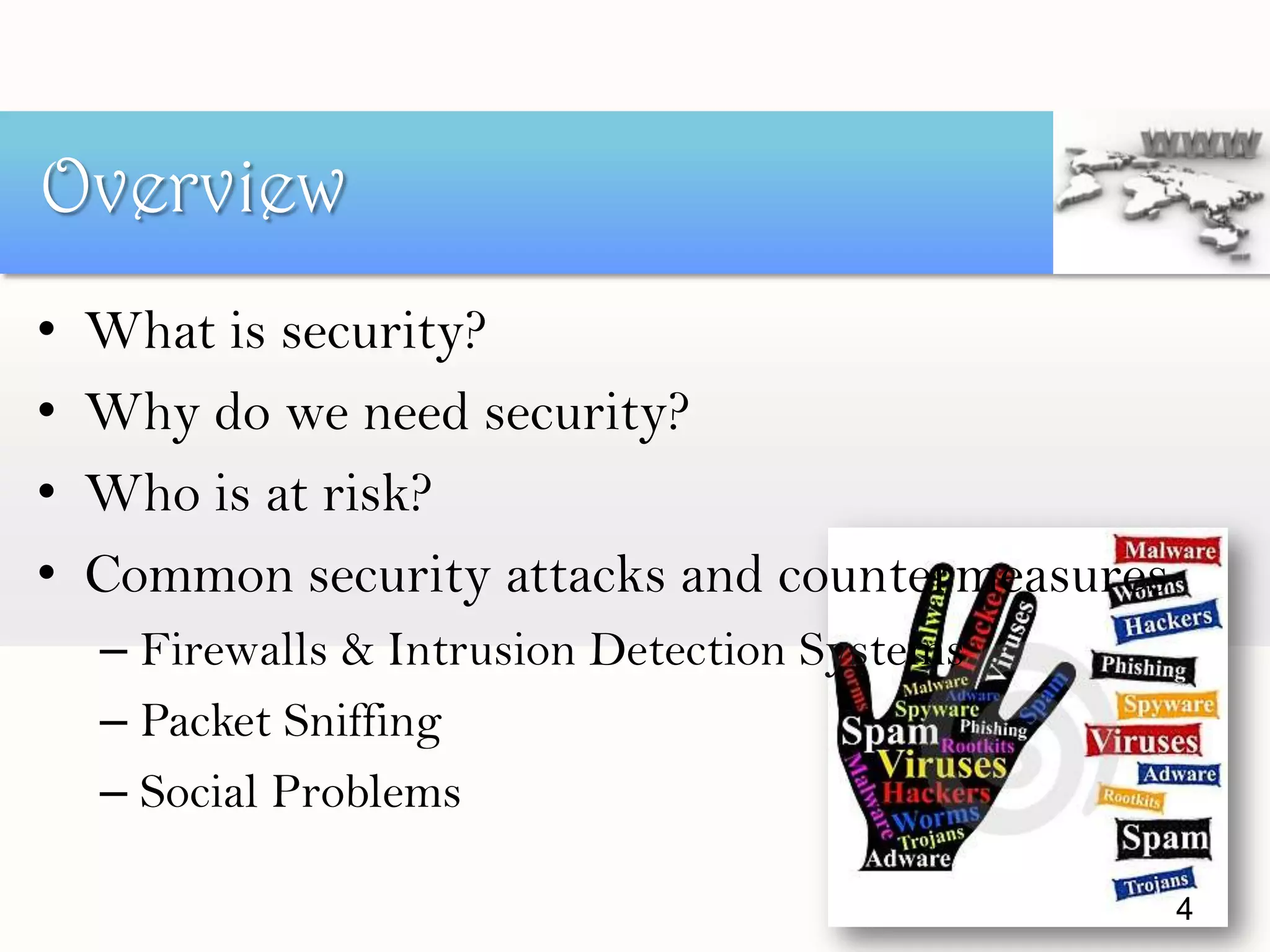
• What is security?
• Why do we need security?
• Who is at risk?
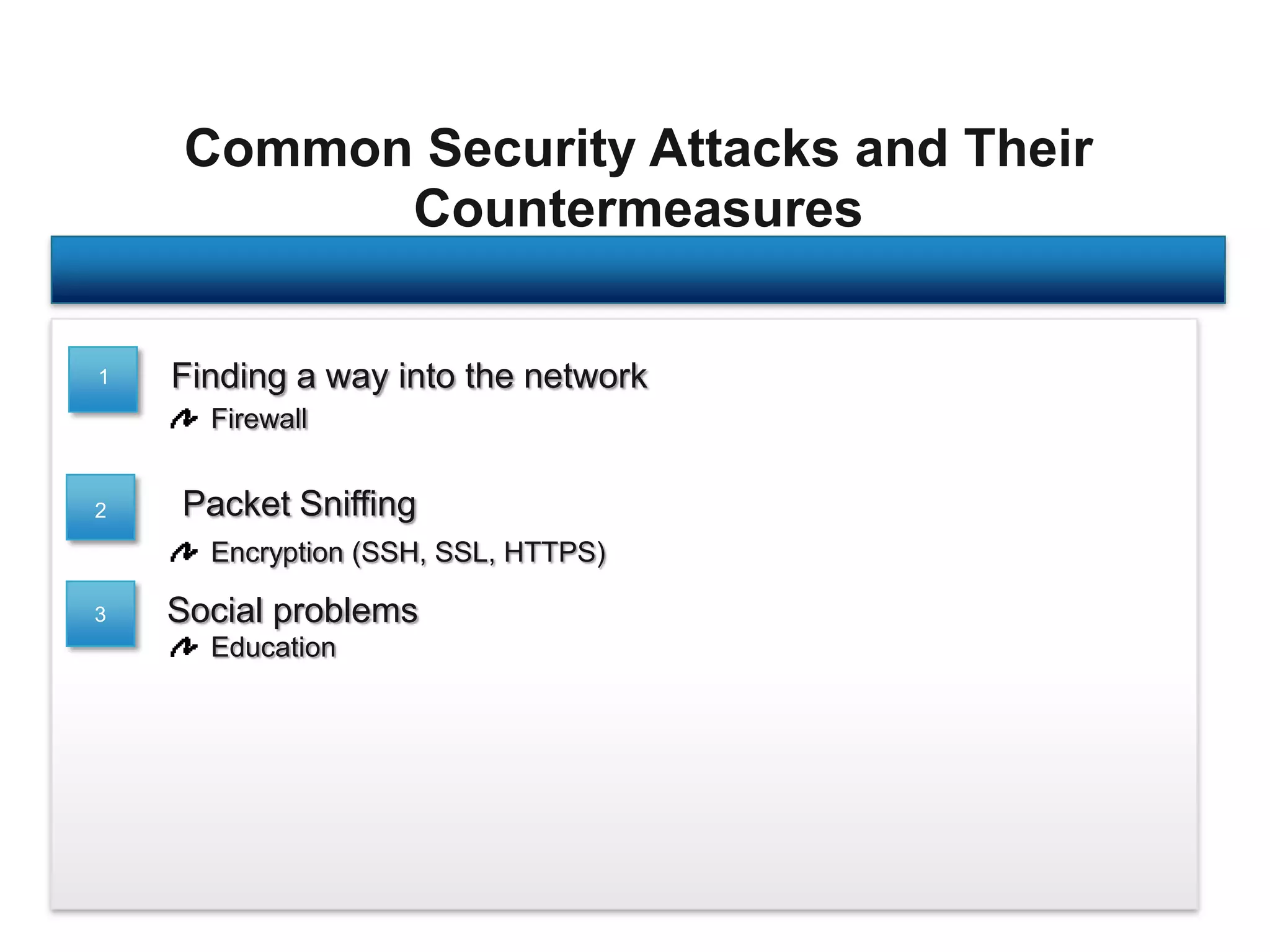
• Common security attacks and countermeasures
– Firewalls & Intrusion Detection Systems
– Packet Sniffing
– Social Problems
Overview
4
• Dictionary.com says:
– 1. Freedom from risk or danger; safety.
– 2. Freedom from doubt, anxiety, or fear; confidence.
– 3. Something that gives or assures safety, as:
• 1. A group or department of private guards: Call building security if
a visitor acts suspicious.
• 2. Measures adopted by a government to prevent
espionage, sabotage, or attack.
• 3. Measures adopted, as by a business or homeowner, to prevent a
crime such as burglary or assault: Security was lax at the firm's
smaller plant.
…etc.
What is ?SECURITY
5
• Protect vital information while still
allowing access to those who need it
–Trade secrets, medical records, etc.
• Provide authentication and access
control for resources
• Guarantee availability of resources
Why do we need ?SECURITY
6
• Financial institutions and banks
• Internet service providers
• Pharmaceutical companies
• Government and defense agencies
• Contractors to various government agencies
• Multinational corporations
• ANYONE ON THE NETWORK
Who is at risk?
7
Common Security Attacks and Their
Countermeasures
Templates
1
2
3
Finding a way into the network
Packet Sniffing
Firewall
Social problems
Education
Encryption (SSH, SSL, HTTPS)
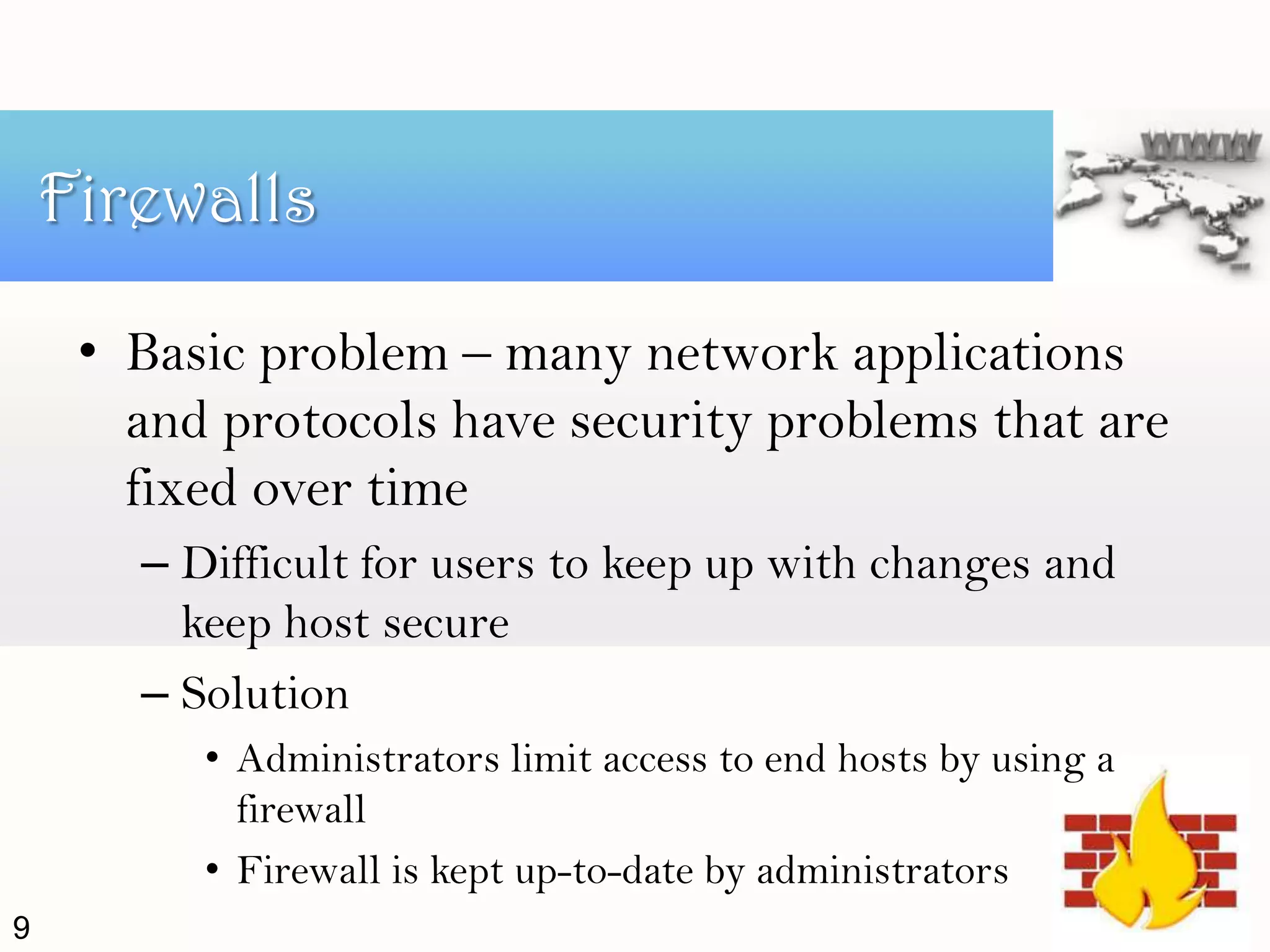
• Basic problem – many network applications
and protocols have security problems that are
fixed over time
– Difficult for users to keep up with changes and
keep host secure
– Solution
• Administrators limit access to end hosts by using a
firewall
• Firewall is kept up-to-date by administrators
Firewalls
9
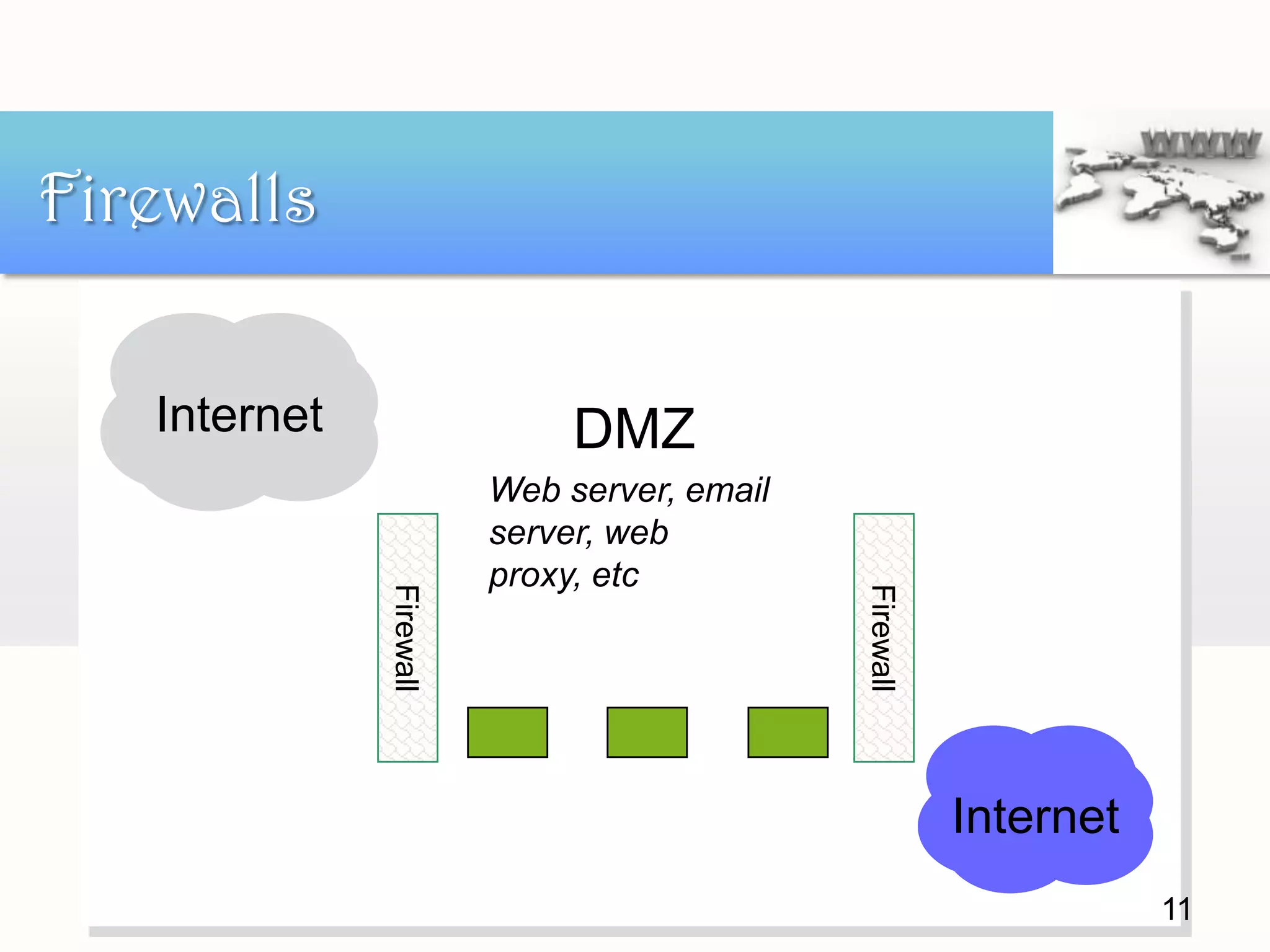
• A firewall is like a castle with a
drawbridge
• Can be hardware or software
Firewalls
10
Internet
DMZInternet
Firewall
Firewall
Web server, email
server, web
proxy, etc
Firewalls
11
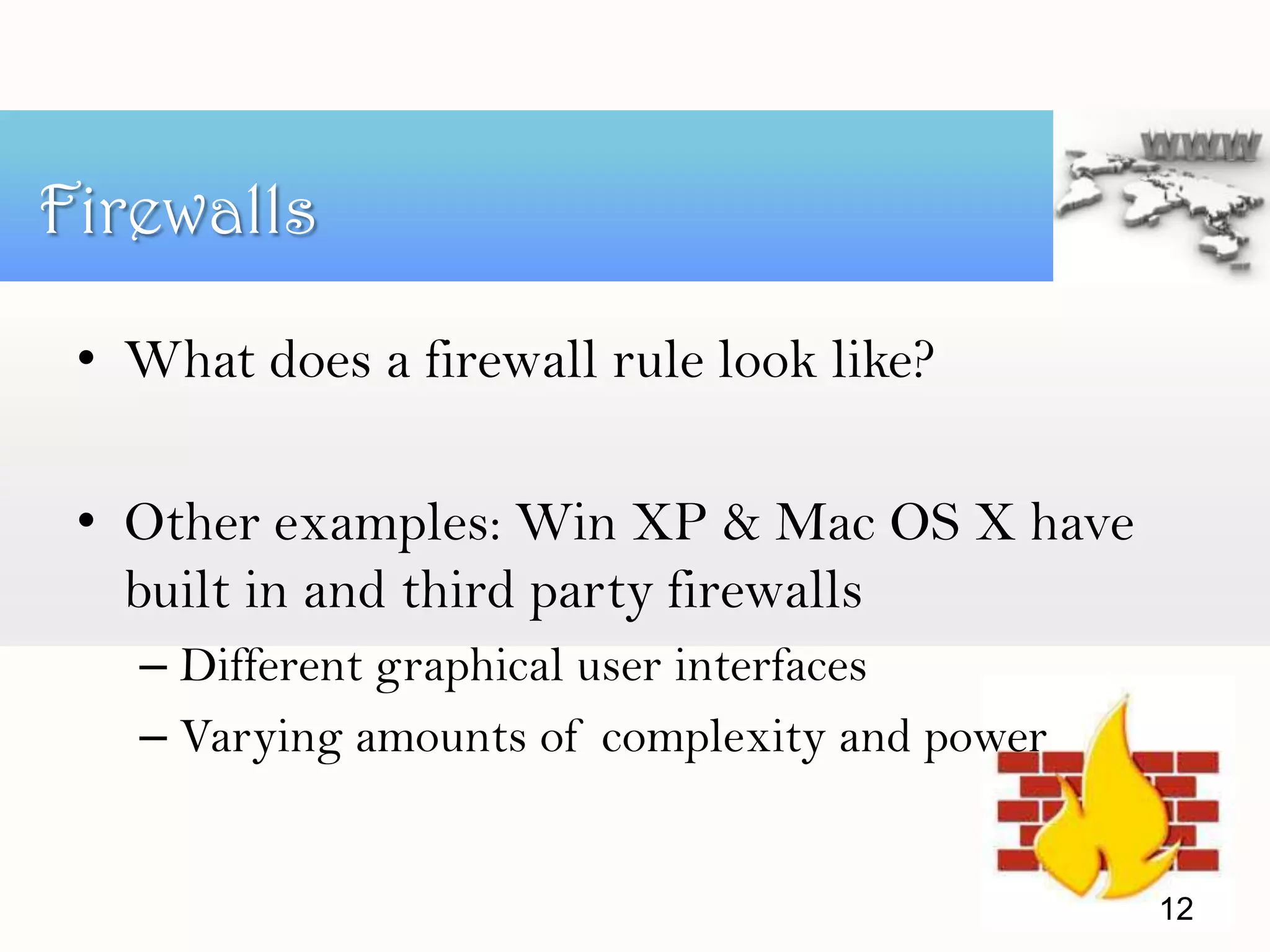
• What does a firewall rule look like?
• Other examples: Win XP & Mac OS X have
built in and third party firewalls
– Different graphical user interfaces
– Varying amounts of complexity and power
Firewalls
12
• What kinds of data can we get?
• Asked another way, what kind of
information would be most useful to a
malicious user?
• Answer: Anything in plain text
Packet Sniffing
13
How can we protect ourselves?
Packet Sniffing
14
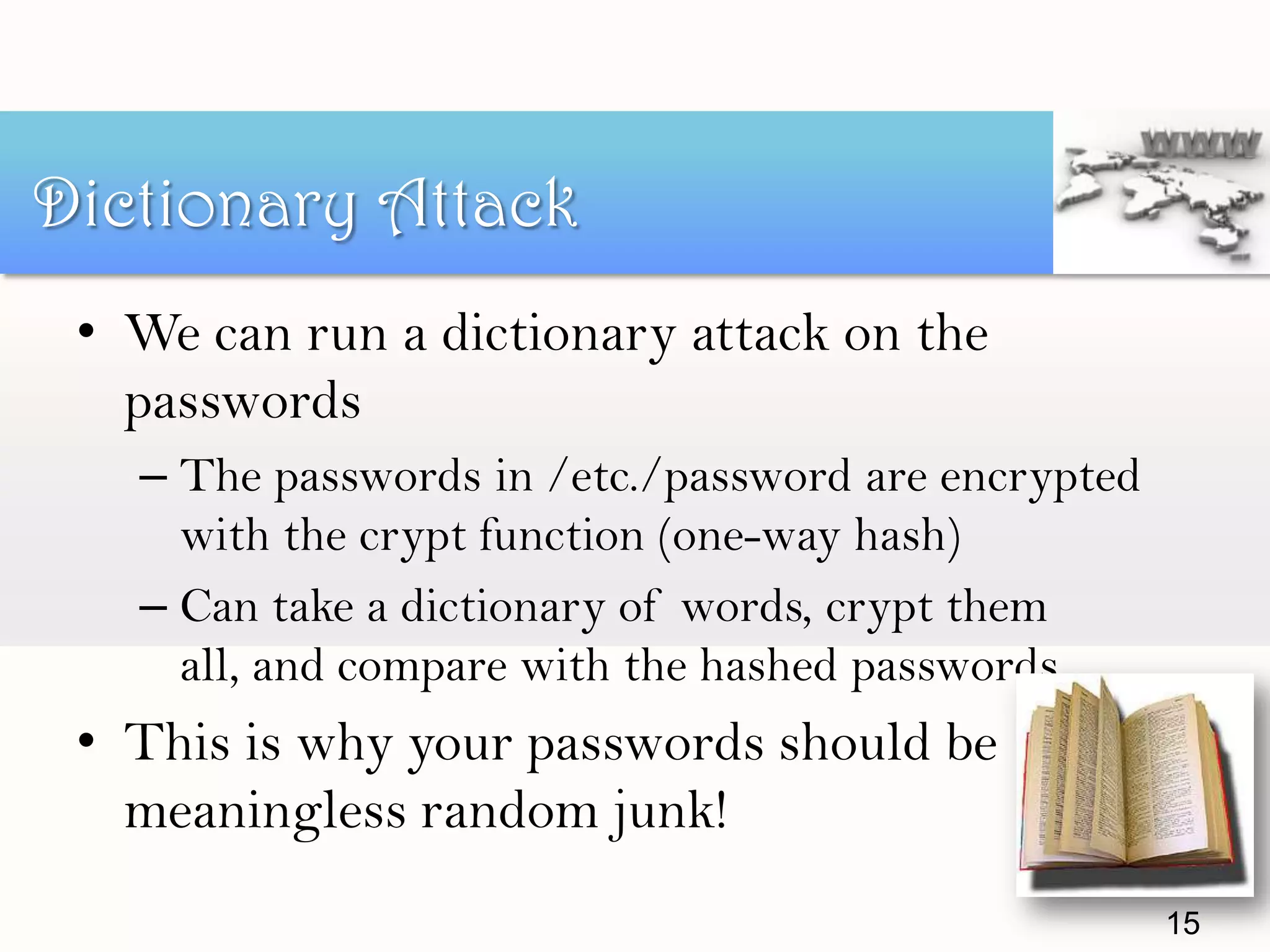
• We can run a dictionary attack on the
passwords
– The passwords in /etc./password are encrypted
with the crypt function (one-way hash)
– Can take a dictionary of words, crypt them
all, and compare with the hashed passwords
• This is why your passwords should be
meaningless random junk!
Dictionary Attack
15
• People can be just as dangerous as
unprotected computer systems.
• People can be lied
to, manipulated, bribed, threatened, harmed, to
rtured, etc. to give up valuable information.
• Most humans will breakdown once they are at
the “harmed” stage, unless they have been
specially trained.
Social Problems
16
• There aren’t always solutions to all of these problems.
• Humans will continue to be tricked into giving out
information they shouldn’t.
• Educating them may help a little here, but, depending on how
bad you want the information, there are a lot of bad things
you can do to get it.
• So, the best that can be done is to implement a wide variety
of solutions and more closely monitor who has access to what
network resources and information
• But, this solution is still not perfect.
17
Social Problems
• The Internet works only because we
indirectly trust one another
• It is very easy to exploit this trust
• The same holds true for software
• It is important to stay on top of the
latest CERT security advisories to know
how to patch any security holes
Conclusions
18
THANK YOU!

Internet Issues (How to Deal on Internet Security)

  • 1.
    And how todeal on Internet Security Internet Issues 1
  • 2.
    A Brief Historyof the World 2
  • 3.
    Internet Issues Identity Issues InternetConduct Security Issues Legal Issues Social Issues Privacy Issues ✓ 6 5 4 3 2 1
  • 4.
    • What issecurity? • Why do we need security? • Who is at risk? • Common security attacks and countermeasures – Firewalls & Intrusion Detection Systems – Packet Sniffing – Social Problems Overview 4
  • 5.
    • Dictionary.com says: –1. Freedom from risk or danger; safety. – 2. Freedom from doubt, anxiety, or fear; confidence. – 3. Something that gives or assures safety, as: • 1. A group or department of private guards: Call building security if a visitor acts suspicious. • 2. Measures adopted by a government to prevent espionage, sabotage, or attack. • 3. Measures adopted, as by a business or homeowner, to prevent a crime such as burglary or assault: Security was lax at the firm's smaller plant. …etc. What is ?SECURITY 5
  • 6.
    • Protect vitalinformation while still allowing access to those who need it –Trade secrets, medical records, etc. • Provide authentication and access control for resources • Guarantee availability of resources Why do we need ?SECURITY 6
  • 7.
    • Financial institutionsand banks • Internet service providers • Pharmaceutical companies • Government and defense agencies • Contractors to various government agencies • Multinational corporations • ANYONE ON THE NETWORK Who is at risk? 7
  • 8.
    Common Security Attacksand Their Countermeasures Templates 1 2 3 Finding a way into the network Packet Sniffing Firewall Social problems Education Encryption (SSH, SSL, HTTPS)
  • 9.
    • Basic problem– many network applications and protocols have security problems that are fixed over time – Difficult for users to keep up with changes and keep host secure – Solution • Administrators limit access to end hosts by using a firewall • Firewall is kept up-to-date by administrators Firewalls 9
  • 10.
    • A firewallis like a castle with a drawbridge • Can be hardware or software Firewalls 10
  • 11.
  • 12.
    • What doesa firewall rule look like? • Other examples: Win XP & Mac OS X have built in and third party firewalls – Different graphical user interfaces – Varying amounts of complexity and power Firewalls 12
  • 13.
    • What kindsof data can we get? • Asked another way, what kind of information would be most useful to a malicious user? • Answer: Anything in plain text Packet Sniffing 13
  • 14.
    How can weprotect ourselves? Packet Sniffing 14
  • 15.
    • We canrun a dictionary attack on the passwords – The passwords in /etc./password are encrypted with the crypt function (one-way hash) – Can take a dictionary of words, crypt them all, and compare with the hashed passwords • This is why your passwords should be meaningless random junk! Dictionary Attack 15
  • 16.
    • People canbe just as dangerous as unprotected computer systems. • People can be lied to, manipulated, bribed, threatened, harmed, to rtured, etc. to give up valuable information. • Most humans will breakdown once they are at the “harmed” stage, unless they have been specially trained. Social Problems 16
  • 17.
    • There aren’talways solutions to all of these problems. • Humans will continue to be tricked into giving out information they shouldn’t. • Educating them may help a little here, but, depending on how bad you want the information, there are a lot of bad things you can do to get it. • So, the best that can be done is to implement a wide variety of solutions and more closely monitor who has access to what network resources and information • But, this solution is still not perfect. 17 Social Problems
  • 18.
    • The Internetworks only because we indirectly trust one another • It is very easy to exploit this trust • The same holds true for software • It is important to stay on top of the latest CERT security advisories to know how to patch any security holes Conclusions 18
  • 19.