Group Members
 12063122-011 ( M.Noman
)
 12063122-017 ( Hafiz
Hamid )
 12063122-029 ( Salah
Uddin Ayubi )
 12063122-037 ( Mubashar
Naeem )
 12063122-023 ( Safi ur
rehman Tabasum )
 University Of Gujrat
(Pakistan)
Internal microprocessor
architecture
 ON the basis of programing
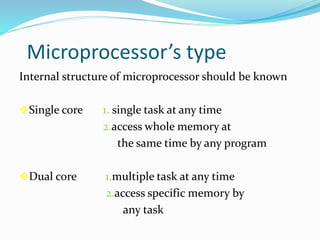
Microprocessor’s type
Internal structure of microprocessor should be known
Single core 1. single task at any time
2.access whole memory at
the same time by any program
Dual core 1.multiple task at any time
2.access specific memory by
any task
Programing model
Program visible : 8086,8088
Registers are used directly
during programing
Program invisible : 80286 and above
1. Registers are not accessible
directly during programing
2. Can be used indirectly
Programing model
Program visible : 8086,8088
Registers are used directly
during programing
Program invisible : 80286 and above
1. Registers are not accessible
directly during programing
2. Can be used indirectly
Only for 64 bit
cont.….
 We can’t access these register with the instruction used
to access general purpose register AX,BX etc….
 To access the low order byte of R8 use R8B
 To access the low order word of R10 use R10W
Cont.……
Condition flag
Special purpose flag
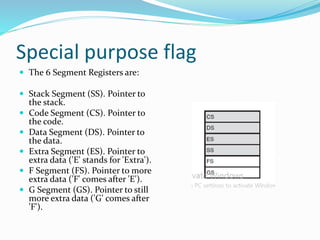
 The 6 Segment Registers are:
 Stack Segment (SS). Pointer to
the stack.
 Code Segment (CS). Pointer to
the code.
 Data Segment (DS). Pointer to
the data.
 Extra Segment (ES). Pointer to
extra data ('E' stands for 'Extra').
 F Segment (FS). Pointer to more
extra data ('F' comes after 'E').
 G Segment (GS). Pointer to still
more extra data ('G' comes after
'F').
Details about registers
Remember
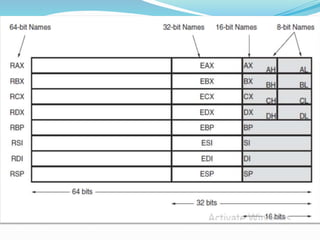
 R_ _ used in 64 bit MP
 E_ _ used in 32 bit MP
 (E stand for extended)
 Register can access as R_ _ , E_ _ , _ _ , _L ,_ H
Multipurpose or general purpose
register
Accumulator (RAX)
 Used for IO operation, rotate, shift, multiplication
and division
Base index (RBX)
 Hold the offset address of a location In a memory
system
 Also address the memory data
Count Register (CX)
 Used as default counter for various instruction like
repeated string, shift, rotate(CL), loop etc…
 Hold the offset address of memory data
 Address memory data
Data Register (DX)
 Hold the part of the result from a multiplication or
part of the dividend before division.
 Address memory data
Stack Pointer : pointing the top of the stack
in stack segment
Base Pointer: contain the offset address within
data segment
Source index : Used as a pointer to a source in
stream operations
Destination index : used as a pointer to
destination in stream
operations
 All these register also used for based
indexed, register indirect addressing
R8-R15
These register are only found in Pentium 4 and core2 if
64-bit extensions are enables
Used as general purpose register
In most application these registers remain unused
Special Purpose Register
Instruction pointer (IP) :
point to the next
instruction in a program located within
the code segment
Stack Pointer :
pointing the top of the stack
in stack segment to store data
Flag Register
Determine the current state of the process
Modified automatically after M.Operations
Conditional Flag
Carry flag:
indication of overflow condition for
unsigned integer and hold carry
Auxiliary flag :
indication the carry/borrow from
lower nibble to high nibble(D3-D4)
Parity flag : indication of parity of the result
Zero : set if result is zero
Sign flag: In signed magnitude format, if the
result of the operation is negative,
sign flag is set
Control Flag
Control the operation of the execution unit
 Trap flag : if set, then debugging operation
is allow
 Interrupt flag: control the operation of interrupt
request.
note : set by instruction STI
clear by instruction CLI
 Direction flag : used in string operation. if it is set,
string byte is accessed from higher memory
address to lower memory address
Flags for 32,64-bit
 IOPL (IO privilege level) :
used to select the privilege level for IO
devices.
 if the current privilege level is 00 ,IO
execute without hindrance
 if 11 then an interrupt occur and
suspended the execution
 NT (nested task) :
 indicate whether the task is nested with
other or not
RF (resume) :
 resume flag is used with debugging to
control the resumption of execution after
the next instruction
VM (virtual mode) :
 This allow the system program to execute
multiple DOS operation
AC (alignment check) :
 if the word or double word
Is addressed on a non-word or
non-double word boundary
VIF (virtual interrupt flag) :
 copy the interrupt flag bit
(in Pentium 4)
VIP (virtual interrupt pending) :
 Give the information about virtual mode
interrupt. Set if interrupt is pending
ID (identification) :
 The ID flag indicate that Pentium 4 micro-
processor support the CPUID or not.
 The CPUID instruction provides the system
with information about microprocessor such
as its version number and manufacturer
Segment Register
CS (code segment) :
 area of memory that hold the code
(executable program) used by MP
 Have the starting address of the memory
that hold code
 CS:IP used to access the whole 64k
memory of code segment
 SS (stack segment) :
 area of memory used for the stack
 stack is used to store data
 memory 64k can be access by SS:SP
 DS (data segment) :
 area of memory that hold all data
refer by general purpose register
(AX, BX etc. )
64k memory Accessed by using DS and offset
address register
ES (extra segment) :
 additional data segment that is used by
some of the string instructions to hold
destination data
 FS and GS :
 supplemental register used as most
extra segment in 64-bit MP. Window use
these segments for internal operation. But
no definition for their usage is available
REAL MODE MEMORY ADDRESSING
 The only mode available on the 8086-8088.
20 bit address bus  1 MB, 16 bit data bus, 16 bit registers
 80286 and above operate in either the real or
protected mode.
 Real mode operation allows addressing of only the
first 1M byte of memory space—even in Pentium 4
or Core2 microprocessor.
 the first 1M byte of memory is called the real memory,
conventional memory, or DOS memory system
Segment registers hold the base address of where a
particular segment begins in memory. There is the
 code segment (CS)
 data segment (DS)
 stack segment (SS)
 extra segment (ES).
Segments and Offsets
 All real mode memory addresses must consist of a
segment address plus an offset address.
 segment address defines the beginning address of any
64K-byte memory segment
 offset address selects any location within the
64K byte memory segment
Segments and Offsets
16-bit each
Appended 4 bits (0H)
Segment Start Address
in Segment Register
0
Then the Effective memory Address (EA) =
20-bit segment start address +
16-bit offset address
– this shows a memory
segment beginning at
10000H, ending at
location IFFFFH
• 64K bytes in length
– also shows how an offset
address, called a
displacement, of F000H
selects location 1F000H
in the memory
Segments and Offsets
 Once the starting address is known, the ending
address is found by adding FFFFH.
 because a real mode segment of memory is 64K in
length
 The offset address is always added to the segment
starting address to locate the data.
[1000:2000H]
 a segment address of 1000H; an offset of 2000H
Effective Address Calculations
• EA = segment register (SR) x 10H + offset
(a) SR: 1000H
10000 + 0023 = 10023H
(b) SR: AAF0H
AAF00 + 0134 = AB034H
(c) SR: 1200H
12000 + FFF0 = 21FF0H
Default Segment and Offset Registers
 The microprocessor has rules that apply to
segments whenever memory is addressed.
 These define the segment and offset register
combination
[CS:IP]
 The code segment register defines the start of the
code segment.
 The instruction pointer locates the next
instruction within the code segment.
Default Segment and Offset Registers
 Another of the default combinations is the stack.
 stack data are referenced through the stack segment at
the memory location addressed by either the stack pointer
(SP) or the base pointer (BP)
 a memory segment can touch or overlap if 64K bytes of
memory are not required for a segment
– think of segments as
Windows that can be
moved over any area of
memory to access data or
code
– a program can have more
than four or six segments,
• but only access four or six
segments at a time
Default Segment and Offset Registers
00000
Stack
Code
Data
Extra
0FFFF
10000
1FFFF
20000
2FFFF
30000
33FFF
34000
43FFF
44000
48FFF
49000
58FFF
59000
FFFFF
Memory
1 0 0 0 DS
2 0 0 0 CS
3 4 0 0 SS
4 9 0 0 ES
Default Segment and Offset Registers
Code should be limited to
only this portion of the
code segment, to avoid
effects of segment
overlap.
 They can occupy completely separate parts of
memory.
 Multiple segments could even coincide because
there are multiple segment registers, the CPU can
keep track of.
 A program can use, multiple segments at the same
time.
Default Segment and Offset
Registers
 Default segment numbers in:
 CS for program (code)
 SS for stack
 DS for data
 ES for string (destination) data
 Default offset addresses that go with them
Convention Example: EA = CS:[IP]
Segment Start
in Segment register
Offset: Literal
or in a CPU register
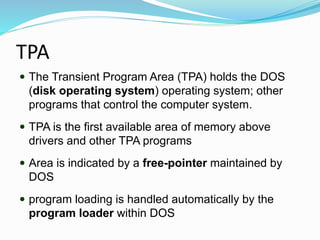
TPA
 The Transient Program Area (TPA) holds the DOS
(disk operating system) operating system; other
programs that control the computer system.
 TPA is the first available area of memory above
drivers and other TPA programs
 Area is indicated by a free-pointer maintained by
DOS
 program loading is handled automatically by the
program loader within DOS
The TPA also stores any currently active
or inactive DOS application programs.
Real Mode Addressing Scheme Allows
Relocation
 A relocatable program is one that can be placed
into any area of memory and executed without
change.
 Segment plus offset addressing allows DOS
programs to be relocated in memory.
 This mainly means using relative offsets for data
accesses and jump instructions. If this is easy/possible is
based on the type of architecture, the size of the address
space and the size of the program..
 Relocatable data are data that can be placed in any
area of memory and used without any change to the
program
Real Mode Addressing Scheme Allows
Relocation
 Because memory is addressed within a segment
by an offset address, the memory segment can be
moved to any place in the memory system without
changing any of the offset addresses.
.
 Only the contents of the segment register must be
changed to address the program
in the new area of memory.
 Windows programs are written assuming that the first 2G
of memory are available for code and data.
Internal microprocessor architecture

Internal microprocessor architecture

  • 2.
    Group Members  12063122-011( M.Noman )  12063122-017 ( Hafiz Hamid )  12063122-029 ( Salah Uddin Ayubi )  12063122-037 ( Mubashar Naeem )  12063122-023 ( Safi ur rehman Tabasum )  University Of Gujrat (Pakistan)
  • 3.
  • 4.
    Microprocessor’s type Internal structureof microprocessor should be known Single core 1. single task at any time 2.access whole memory at the same time by any program Dual core 1.multiple task at any time 2.access specific memory by any task
  • 5.
    Programing model Program visible: 8086,8088 Registers are used directly during programing Program invisible : 80286 and above 1. Registers are not accessible directly during programing 2. Can be used indirectly
  • 6.
    Programing model Program visible: 8086,8088 Registers are used directly during programing Program invisible : 80286 and above 1. Registers are not accessible directly during programing 2. Can be used indirectly
  • 8.
  • 9.
    cont.….  We can’taccess these register with the instruction used to access general purpose register AX,BX etc….  To access the low order byte of R8 use R8B  To access the low order word of R10 use R10W
  • 10.
  • 11.
  • 12.
    Special purpose flag The 6 Segment Registers are:  Stack Segment (SS). Pointer to the stack.  Code Segment (CS). Pointer to the code.  Data Segment (DS). Pointer to the data.  Extra Segment (ES). Pointer to extra data ('E' stands for 'Extra').  F Segment (FS). Pointer to more extra data ('F' comes after 'E').  G Segment (GS). Pointer to still more extra data ('G' comes after 'F').
  • 13.
  • 14.
    Remember  R_ _used in 64 bit MP  E_ _ used in 32 bit MP  (E stand for extended)  Register can access as R_ _ , E_ _ , _ _ , _L ,_ H
  • 15.
  • 16.
    Accumulator (RAX)  Usedfor IO operation, rotate, shift, multiplication and division
  • 17.
    Base index (RBX) Hold the offset address of a location In a memory system  Also address the memory data
  • 18.
    Count Register (CX) Used as default counter for various instruction like repeated string, shift, rotate(CL), loop etc…  Hold the offset address of memory data  Address memory data
  • 19.
    Data Register (DX) Hold the part of the result from a multiplication or part of the dividend before division.  Address memory data
  • 20.
    Stack Pointer :pointing the top of the stack in stack segment Base Pointer: contain the offset address within data segment Source index : Used as a pointer to a source in stream operations Destination index : used as a pointer to destination in stream operations  All these register also used for based indexed, register indirect addressing
  • 21.
    R8-R15 These register areonly found in Pentium 4 and core2 if 64-bit extensions are enables Used as general purpose register In most application these registers remain unused
  • 22.
    Special Purpose Register Instructionpointer (IP) : point to the next instruction in a program located within the code segment Stack Pointer : pointing the top of the stack in stack segment to store data
  • 23.
    Flag Register Determine thecurrent state of the process Modified automatically after M.Operations Conditional Flag Carry flag: indication of overflow condition for unsigned integer and hold carry Auxiliary flag : indication the carry/borrow from lower nibble to high nibble(D3-D4)
  • 24.
    Parity flag :indication of parity of the result Zero : set if result is zero Sign flag: In signed magnitude format, if the result of the operation is negative, sign flag is set
  • 25.
    Control Flag Control theoperation of the execution unit  Trap flag : if set, then debugging operation is allow  Interrupt flag: control the operation of interrupt request. note : set by instruction STI clear by instruction CLI  Direction flag : used in string operation. if it is set, string byte is accessed from higher memory address to lower memory address
  • 26.
    Flags for 32,64-bit IOPL (IO privilege level) : used to select the privilege level for IO devices.  if the current privilege level is 00 ,IO execute without hindrance  if 11 then an interrupt occur and suspended the execution
  • 27.
     NT (nestedtask) :  indicate whether the task is nested with other or not RF (resume) :  resume flag is used with debugging to control the resumption of execution after the next instruction
  • 28.
    VM (virtual mode):  This allow the system program to execute multiple DOS operation AC (alignment check) :  if the word or double word Is addressed on a non-word or non-double word boundary VIF (virtual interrupt flag) :  copy the interrupt flag bit (in Pentium 4)
  • 29.
    VIP (virtual interruptpending) :  Give the information about virtual mode interrupt. Set if interrupt is pending ID (identification) :  The ID flag indicate that Pentium 4 micro- processor support the CPUID or not.  The CPUID instruction provides the system with information about microprocessor such as its version number and manufacturer
  • 30.
    Segment Register CS (codesegment) :  area of memory that hold the code (executable program) used by MP  Have the starting address of the memory that hold code  CS:IP used to access the whole 64k memory of code segment
  • 31.
     SS (stacksegment) :  area of memory used for the stack  stack is used to store data  memory 64k can be access by SS:SP  DS (data segment) :  area of memory that hold all data refer by general purpose register (AX, BX etc. ) 64k memory Accessed by using DS and offset address register
  • 32.
    ES (extra segment):  additional data segment that is used by some of the string instructions to hold destination data  FS and GS :  supplemental register used as most extra segment in 64-bit MP. Window use these segments for internal operation. But no definition for their usage is available
  • 33.
    REAL MODE MEMORYADDRESSING  The only mode available on the 8086-8088. 20 bit address bus  1 MB, 16 bit data bus, 16 bit registers  80286 and above operate in either the real or protected mode.  Real mode operation allows addressing of only the first 1M byte of memory space—even in Pentium 4 or Core2 microprocessor.  the first 1M byte of memory is called the real memory, conventional memory, or DOS memory system
  • 34.
    Segment registers holdthe base address of where a particular segment begins in memory. There is the  code segment (CS)  data segment (DS)  stack segment (SS)  extra segment (ES).
  • 35.
    Segments and Offsets All real mode memory addresses must consist of a segment address plus an offset address.  segment address defines the beginning address of any 64K-byte memory segment  offset address selects any location within the 64K byte memory segment
  • 36.
    Segments and Offsets 16-biteach Appended 4 bits (0H) Segment Start Address in Segment Register 0 Then the Effective memory Address (EA) = 20-bit segment start address + 16-bit offset address
  • 37.
    – this showsa memory segment beginning at 10000H, ending at location IFFFFH • 64K bytes in length – also shows how an offset address, called a displacement, of F000H selects location 1F000H in the memory Segments and Offsets
  • 38.
    Segments and Offsets Once the starting address is known, the ending address is found by adding FFFFH.  because a real mode segment of memory is 64K in length  The offset address is always added to the segment starting address to locate the data. [1000:2000H]  a segment address of 1000H; an offset of 2000H
  • 39.
    Effective Address Calculations •EA = segment register (SR) x 10H + offset (a) SR: 1000H 10000 + 0023 = 10023H (b) SR: AAF0H AAF00 + 0134 = AB034H (c) SR: 1200H 12000 + FFF0 = 21FF0H
  • 41.
    Default Segment andOffset Registers  The microprocessor has rules that apply to segments whenever memory is addressed.  These define the segment and offset register combination [CS:IP]  The code segment register defines the start of the code segment.  The instruction pointer locates the next instruction within the code segment.
  • 42.
    Default Segment andOffset Registers  Another of the default combinations is the stack.  stack data are referenced through the stack segment at the memory location addressed by either the stack pointer (SP) or the base pointer (BP)  a memory segment can touch or overlap if 64K bytes of memory are not required for a segment
  • 43.
    – think ofsegments as Windows that can be moved over any area of memory to access data or code – a program can have more than four or six segments, • but only access four or six segments at a time Default Segment and Offset Registers 00000 Stack Code Data Extra 0FFFF 10000 1FFFF 20000 2FFFF 30000 33FFF 34000 43FFF 44000 48FFF 49000 58FFF 59000 FFFFF Memory 1 0 0 0 DS 2 0 0 0 CS 3 4 0 0 SS 4 9 0 0 ES
  • 44.
    Default Segment andOffset Registers Code should be limited to only this portion of the code segment, to avoid effects of segment overlap.
  • 45.
     They canoccupy completely separate parts of memory.  Multiple segments could even coincide because there are multiple segment registers, the CPU can keep track of.  A program can use, multiple segments at the same time.
  • 47.
    Default Segment andOffset Registers  Default segment numbers in:  CS for program (code)  SS for stack  DS for data  ES for string (destination) data  Default offset addresses that go with them Convention Example: EA = CS:[IP] Segment Start in Segment register Offset: Literal or in a CPU register
  • 49.
    TPA  The TransientProgram Area (TPA) holds the DOS (disk operating system) operating system; other programs that control the computer system.  TPA is the first available area of memory above drivers and other TPA programs  Area is indicated by a free-pointer maintained by DOS  program loading is handled automatically by the program loader within DOS
  • 50.
    The TPA alsostores any currently active or inactive DOS application programs.
  • 51.
    Real Mode AddressingScheme Allows Relocation  A relocatable program is one that can be placed into any area of memory and executed without change.  Segment plus offset addressing allows DOS programs to be relocated in memory.
  • 52.
     This mainlymeans using relative offsets for data accesses and jump instructions. If this is easy/possible is based on the type of architecture, the size of the address space and the size of the program..  Relocatable data are data that can be placed in any area of memory and used without any change to the program
  • 53.
    Real Mode AddressingScheme Allows Relocation  Because memory is addressed within a segment by an offset address, the memory segment can be moved to any place in the memory system without changing any of the offset addresses. .
  • 54.
     Only thecontents of the segment register must be changed to address the program in the new area of memory.  Windows programs are written assuming that the first 2G of memory are available for code and data.