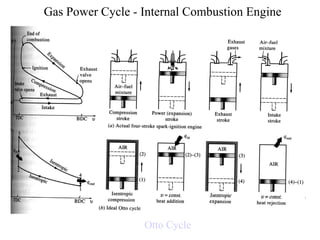
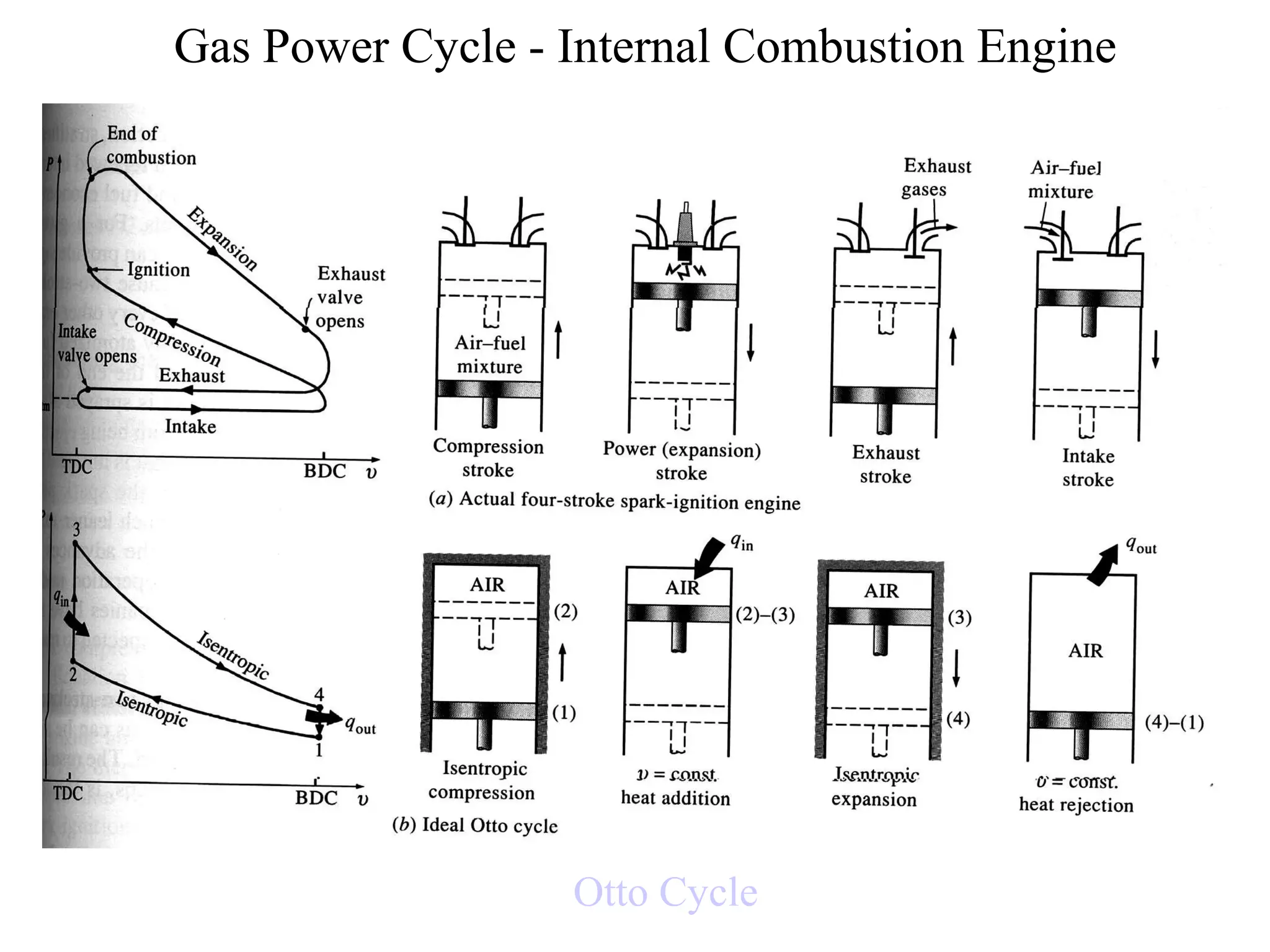
Gas Power Cycle - Internal Combustion Engine
Otto Cycle
Otto Cycle
P
v
1
2
3
4
T
s
1
2
3
4
( )cycle 3 4 1 234 12 4 1
in 23 3 2 3 2
4 14 1 1 4 1
v
3 2 3 2 2 3 2
4 1
Thermal efficiency of the system:
W [ ( )] ( )
= 1
Q ( ) ( )
( )( ) / 1
For an ideal gas, u=C , =1 1 1
( ) ( ) / 1
Since /
v
v
m u u u uW W u u
Q m u u u u
C T Tu u T T T
T
u u C T T T T T
T T
η
η
− + −+ −
= = = −
− −
 −− −
− = − = −  
− − − 
3 2
1
2
1
1 2 1
1
2 1 2
/ (why?)
1 . From isentropic compression relation for an ideal gas
1
, where r= is the volume compression ratio
k
k
T T
T
T
T V V
T V r V
η
−
−
=
= −
   
= =   
   
• 1-2 isentropic compression
• 2-3 constant volume heat
transfer
• 3-4 isentropic expansion
• 4-1 constant volume heat
rejection
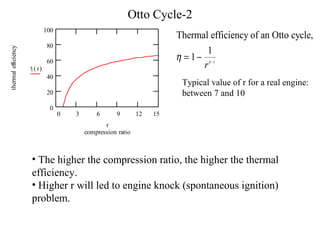
Otto Cycle-2
0 3 6 9 12 15
0
20
40
60
80
100
compression ratio
thermalefficiency
η ( )r
r
Thermal efficiency of an Otto cycle,
η = − −
1
1
1
rk
Typical value of r for a real engine:
between 7 and 10
• The higher the compression ratio, the higher the thermal
efficiency.
• Higher r will led to engine knock (spontaneous ignition)
problem.
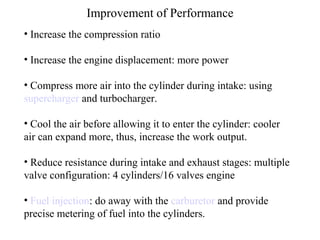
Improvement of Performance
• Increase the compression ratio
• Increase the engine displacement: more power
• Compress more air into the cylinder during intake: using
supercharger and turbocharger.
• Cool the air before allowing it to enter the cylinder: cooler
air can expand more, thus, increase the work output.
• Reduce resistance during intake and exhaust stages: multiple
valve configuration: 4 cylinders/16 valves engine
• Fuel injection: do away with the carburetor and provide
precise metering of fuel into the cylinders.
Diesel Cycle
P
v
1
2 3
4
T
s
1
2
3
4
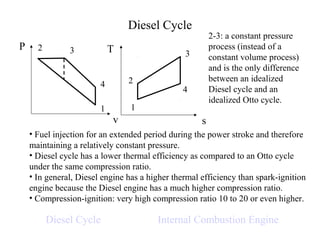
2-3: a constant pressure
process (instead of a
constant volume process)
and is the only difference
between an idealized
Diesel cycle and an
idealized Otto cycle.
• Fuel injection for an extended period during the power stroke and therefore
maintaining a relatively constant pressure.
• Diesel cycle has a lower thermal efficiency as compared to an Otto cycle
under the same compression ratio.
• In general, Diesel engine has a higher thermal efficiency than spark-ignition
engine because the Diesel engine has a much higher compression ratio.
• Compression-ignition: very high compression ratio 10 to 20 or even higher.
Diesel Cycle Internal Combustion Engine
Diesel Cycle
P
v
1
2 3
4
T
s
1
2
3
4
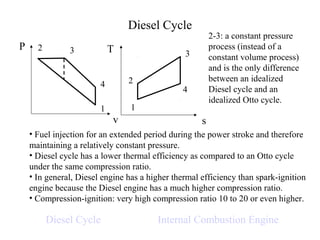
2-3: a constant pressure
process (instead of a
constant volume process)
and is the only difference
between an idealized
Diesel cycle and an
idealized Otto cycle.
• Fuel injection for an extended period during the power stroke and therefore
maintaining a relatively constant pressure.
• Diesel cycle has a lower thermal efficiency as compared to an Otto cycle
under the same compression ratio.
• In general, Diesel engine has a higher thermal efficiency than spark-ignition
engine because the Diesel engine has a much higher compression ratio.
• Compression-ignition: very high compression ratio 10 to 20 or even higher.
Diesel Cycle Internal Combustion Engine

Internal combustion engine

  • 1.
    Gas Power Cycle- Internal Combustion Engine Otto Cycle
  • 2.
    Otto Cycle P v 1 2 3 4 T s 1 2 3 4 ( )cycle3 4 1 234 12 4 1 in 23 3 2 3 2 4 14 1 1 4 1 v 3 2 3 2 2 3 2 4 1 Thermal efficiency of the system: W [ ( )] ( ) = 1 Q ( ) ( ) ( )( ) / 1 For an ideal gas, u=C , =1 1 1 ( ) ( ) / 1 Since / v v m u u u uW W u u Q m u u u u C T Tu u T T T T u u C T T T T T T T η η − + −+ − = = = − − −  −− − − = − = −   − − −  3 2 1 2 1 1 2 1 1 2 1 2 / (why?) 1 . From isentropic compression relation for an ideal gas 1 , where r= is the volume compression ratio k k T T T T T V V T V r V η − − = = −     = =        • 1-2 isentropic compression • 2-3 constant volume heat transfer • 3-4 isentropic expansion • 4-1 constant volume heat rejection
  • 3.
    Otto Cycle-2 0 36 9 12 15 0 20 40 60 80 100 compression ratio thermalefficiency η ( )r r Thermal efficiency of an Otto cycle, η = − − 1 1 1 rk Typical value of r for a real engine: between 7 and 10 • The higher the compression ratio, the higher the thermal efficiency. • Higher r will led to engine knock (spontaneous ignition) problem.
  • 4.
    Improvement of Performance •Increase the compression ratio • Increase the engine displacement: more power • Compress more air into the cylinder during intake: using supercharger and turbocharger. • Cool the air before allowing it to enter the cylinder: cooler air can expand more, thus, increase the work output. • Reduce resistance during intake and exhaust stages: multiple valve configuration: 4 cylinders/16 valves engine • Fuel injection: do away with the carburetor and provide precise metering of fuel into the cylinders.
  • 5.
    Diesel Cycle P v 1 2 3 4 T s 1 2 3 4 2-3:a constant pressure process (instead of a constant volume process) and is the only difference between an idealized Diesel cycle and an idealized Otto cycle. • Fuel injection for an extended period during the power stroke and therefore maintaining a relatively constant pressure. • Diesel cycle has a lower thermal efficiency as compared to an Otto cycle under the same compression ratio. • In general, Diesel engine has a higher thermal efficiency than spark-ignition engine because the Diesel engine has a much higher compression ratio. • Compression-ignition: very high compression ratio 10 to 20 or even higher. Diesel Cycle Internal Combustion Engine
  • 6.
    Diesel Cycle P v 1 2 3 4 T s 1 2 3 4 2-3:a constant pressure process (instead of a constant volume process) and is the only difference between an idealized Diesel cycle and an idealized Otto cycle. • Fuel injection for an extended period during the power stroke and therefore maintaining a relatively constant pressure. • Diesel cycle has a lower thermal efficiency as compared to an Otto cycle under the same compression ratio. • In general, Diesel engine has a higher thermal efficiency than spark-ignition engine because the Diesel engine has a much higher compression ratio. • Compression-ignition: very high compression ratio 10 to 20 or even higher. Diesel Cycle Internal Combustion Engine