EVALUATING COMPANY RESOURCES AND
COMPETITIVE CAPABILITIES
Internal Environmental Scanning
The process of looking at the internal factors so as to
assess the critical strengths and weaknesses that are likely
to determine if the firm will be strong enough to take
advantage of opportunities while avoiding threats
3
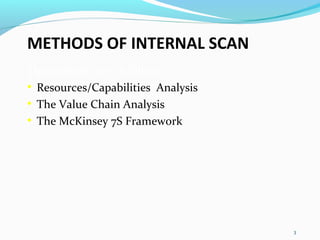
METHODS OF INTERNAL SCAN
The methods are as follows:
• Resources/Capabilities Analysis
• The Value Chain Analysis
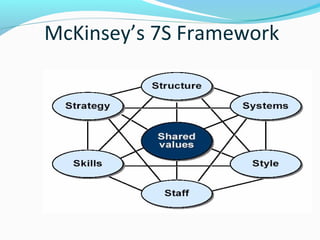
• The McKinsey 7S Framework
4
Resource Based Approach to Internal
Organisational Analysis
 A resource is an asset, competency, process,
skill, or knowledge controlled by the
corporation” (Wheelen & Hunger, 2008,).
 It (resource) is a strength if it provides the firm
with a competitive advantage.
 It becomes a weakness if the firm does not
possess the resource that other competitors do
possess, or is necessary for survival in the
industry
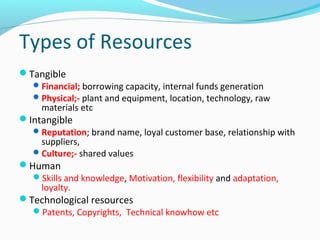
Types of Resources
Tangible
Financial; borrowing capacity, internal funds generation
Physical;- plant and equipment, location, technology, raw
materials etc
Intangible
Reputation; brand name, loyal customer base, relationship with
suppliers,
Culture;- shared values
Human
Skills and knowledge, Motivation, flexibility and adaptation,
loyalty.
Technological resources
Patents, Copyrights, Technical knowhow etc
6
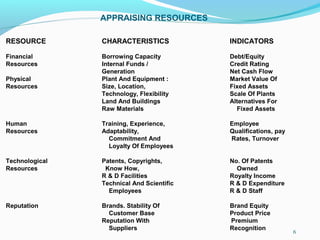
APPRAISING RESOURCES
RESOURCE CHARACTERISTICS INDICATORS
Financial Borrowing Capacity Debt/Equity
Resources Internal Funds / Credit Rating
Generation Net Cash Flow
Physical Plant And Equipment : Market Value Of
Resources Size, Location, Fixed Assets
Technology, Flexibility Scale Of Plants
Land And Buildings Alternatives For
Raw Materials Fixed Assets
Human Training, Experience, Employee
Resources Adaptability, Qualifications, pay
Commitment And Rates, Turnover
Loyalty Of Employees
Technological Patents, Copyrights, No. Of Patents
Resources Know How, Owned
R & D Facilities Royalty Income
Technical And Scientific R & D Expenditure
Employees R & D Staff
Reputation Brands. Stability Of Brand Equity
Customer Base Product Price
Reputation With Premium
Suppliers Recognition
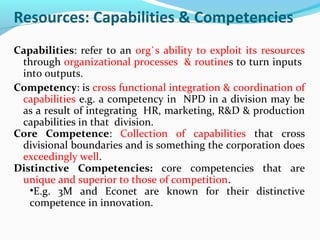
Resources: Capabilities & Competencies
Capabilities: refer to an org`s ability to exploit its resources
through organizational processes & routines to turn inputs
into outputs.
Competency: is cross functional integration & coordination of
capabilities e.g. a competency in NPD in a division may be
as a result of integrating HR, marketing, R&D & production
capabilities in that division.
Core Competence: Collection of capabilities that cross
divisional boundaries and is something the corporation does
exceedingly well.
Distinctive Competencies: core competencies that are
unique and superior to those of competition.
•E.g. 3M and Econet are known for their distinctive
competence in innovation.
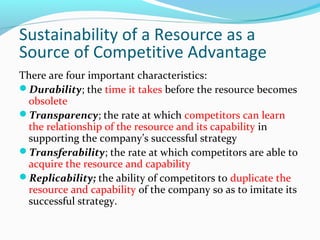
Sustainability of a Resource as a
Source of Competitive Advantage
There are four important characteristics:
Durability; the time it takes before the resource becomes
obsolete
Transparency; the rate at which competitors can learn
the relationship of the resource and its capability in
supporting the company’s successful strategy
Transferability; the rate at which competitors are able to
acquire the resource and capability
Replicability; the ability of competitors to duplicate the
resource and capability of the company so as to imitate its
successful strategy.
9
9
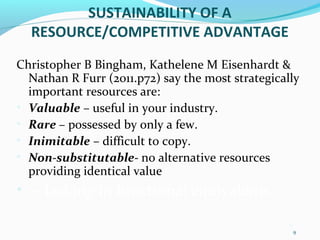
SUSTAINABILITY OF A
RESOURCE/COMPETITIVE ADVANTAGE
Christopher B Bingham, Kathelene M Eisenhardt &
Nathan R Furr (2011.p72) say the most strategically
important resources are:
• Valuable – useful in your industry.
• Rare – possessed by only a few.
• Inimitable – difficult to copy.
• Non-substitutable- no alternative resources
providing identical value
• – lacking in functional equivalents
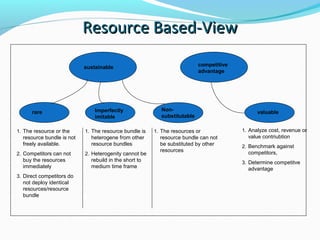
Resource Based-ViewResource Based-View
sustainable competitive
advantage
valuable
1. Analyze cost, revenue or
value contriubtion
2. Benchmark against
competitors,
3. Determine competitve
advantage
Non-
substitutable
Imperfectly
imitable
rare
1. The resources or
resource bundle can not
be substituted by other
resources
1. The resource bundle is
heterogene from other
resource bundles
2. Heterogenity cannot be
rebuild in the short to
medium time frame
1. The resource or the
resource bundle is not
freely available.
2. Competitors can not
buy the resources
immediately
3. Direct competitors do
not deploy identical
resources/resource
bundle
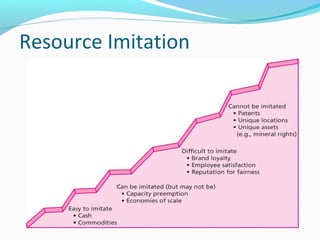
Resource Imitation
Analysing if the Company’s Costs
are Competitive
This involves assessing whether a company’s prices
and costs are competitive with those of its close rivals.
Involves the use of the Value Chain Analysis.
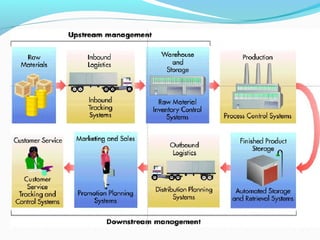
The Value Chain Concept
A company’s value chain identifies the primary
activities that create value for customers and the
related support activities.
Acts as a tool for thinking strategically about
relationships among the activities performed by the
organisation looking at which activities are
strategically critical and how core competences can
be developed.
Basis Behind the Value Chain
Each activity in the value chain incurs costs and ties
up assets.
The costs incurred in performing each activity can be
broken down into primary costs and activities and
secondary costs and activities.
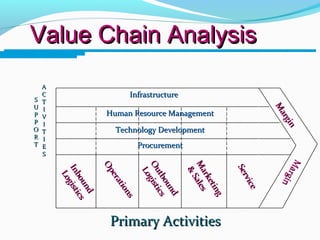
Value Chain AnalysisValue Chain Analysis
Inbound
Inbound
Logistics
Logistics
Operations
Operations
Outbound
Outbound
Logistics
Logistics
Marketing
Marketing
&
Sales
&
Sales
Service
Service
InfrastructureInfrastructure
Human Resource ManagementHuman Resource Management
Technology DevelopmentTechnology Development
ProcurementProcurement
SS
UU
PP
PP
OO
RR
TT
AA
CC
TT
II
VV
II
TT
II
EE
SS
Primary ActivitiesPrimary Activities
M
argin
M
argin
Margin
Margin
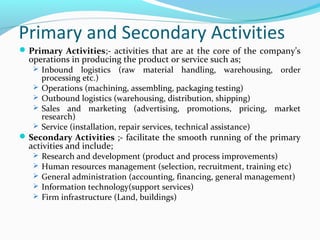
Primary and Secondary Activities
Primary Activities;- activities that are at the core of the company’s
operations in producing the product or service such as;
 Inbound logistics (raw material handling, warehousing, order
processing etc.)
 Operations (machining, assembling, packaging testing)
 Outbound logistics (warehousing, distribution, shipping)
 Sales and marketing (advertising, promotions, pricing, market
research)
 Service (installation, repair services, technical assistance)
Secondary Activities ;- facilitate the smooth running of the primary
activities and include;
 Research and development (product and process improvements)
 Human resources management (selection, recruitment, training etc)
 General administration (accounting, financing, general management)
 Information technology(support services)
 Firm infrastructure (Land, buildings)
18
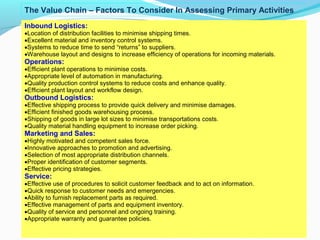
Inbound Logistics:
•Location of distribution facilities to minimise shipping times.
•Excellent material and inventory control systems.
•Systems to reduce time to send “returns” to suppliers.
•Warehouse layout and designs to increase efficiency of operations for incoming materials.
Operations:
•Efficient plant operations to minimise costs.
•Appropriate level of automation in manufacturing.
•Quality production control systems to reduce costs and enhance quality.
•Efficient plant layout and workflow design.
Outbound Logistics:
•Effective shipping process to provide quick delivery and minimise damages.
•Efficient finished goods warehousing process.
•Shipping of goods in large lot sizes to minimise transportations costs.
•Quality material handling equipment to increase order picking.
Marketing and Sales:
•Highly motivated and competent sales force.
•Innovative approaches to promotion and advertising.
•Selection of most appropriate distribution channels.
•Proper identification of customer segments.
•Effective pricing strategies.
Service:
•Effective use of procedures to solicit customer feedback and to act on information.
•Quick response to customer needs and emergencies.
•Ability to furnish replacement parts as required.
•Effective management of parts and equipment inventory.
•Quality of service and personnel and ongoing training.
•Appropriate warranty and guarantee policies.
The Value Chain – Factors To Consider In Assessing Primary Activities
19
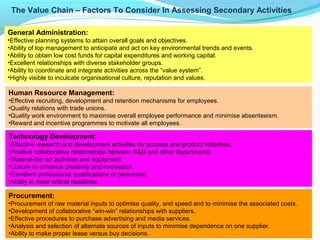
General Administration:
•Effective planning systems to attain overall goals and objectives.
•Ability of top management to anticipate and act on key environmental trends and events.
•Ability to obtain low cost funds for capital expenditures and working capital.
•Excellent relationships with diverse stakeholder groups.
•Ability to coordinate and integrate activities across the “value system”.
•Highly visible to inculcate organisational culture, reputation and values.
Human Resource Management:
•Effective recruiting, development and retention mechanisms for employees.
•Quality relations with trade unions.
•Quality work environment to maximise overall employee performance and minimise absenteeism.
•Reward and incentive programmes to motivate all employees.
Technology Development:
•Effective research and development activities for process and product initiatives.
•Positive collaborative relationships between R&D and other departments.
•State-of-the art activities and equipment.
•Culture to enhance creativity and innovation.
•Excellent professional qualifications of personnel.
•Ability to meet critical deadlines.
Procurement:
•Procurement of raw material inputs to optimise quality, and speed and to minimise the associated costs.
•Development of collaborative “win-win” relationships with suppliers.
•Effective procedures to purchase advertising and media services.
•Analysis and selection of alternate sources of inputs to minimise dependence on one supplier.
•Ability to make proper lease versus buy decisions.
The Value Chain – Factors To Consider In Assessing Secondary Activities
McKinsey’s 7S Framework
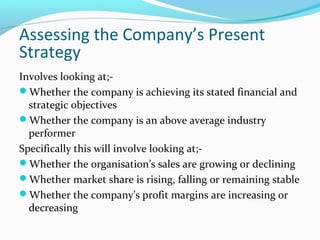
Assessing the Company’s Present
Strategy
Involves looking at;-
Whether the company is achieving its stated financial and
strategic objectives
Whether the company is an above average industry
performer
Specifically this will involve looking at;-
Whether the organisation’s sales are growing or declining
Whether market share is rising, falling or remaining stable
Whether the company’s profit margins are increasing or
decreasing
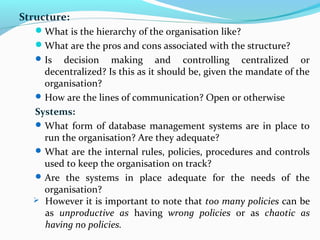
Structure:
What is the hierarchy of the organisation like?
What are the pros and cons associated with the structure?
Is decision making and controlling centralized or
decentralized? Is this as it should be, given the mandate of the
organisation?
How are the lines of communication? Open or otherwise
Systems:
What form of database management systems are in place to
run the organisation? Are they adequate?
What are the internal rules, policies, procedures and controls
used to keep the organisation on track?
Are the systems in place adequate for the needs of the
organisation?
 However it is important to note that too many policies can be
as unproductive as having wrong policies or as chaotic as
having no policies.
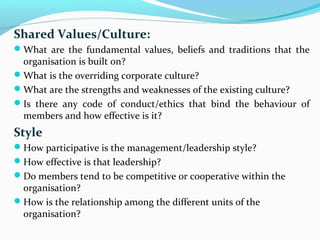
Shared Values/Culture:
What are the fundamental values, beliefs and traditions that the
organisation is built on?
What is the overriding corporate culture?
What are the strengths and weaknesses of the existing culture?
Is there any code of conduct/ethics that bind the behaviour of
members and how effective is it?
Style
How participative is the management/leadership style?
How effective is that leadership?
Do members tend to be competitive or cooperative within the
organisation?
How is the relationship among the different units of the
organisation?
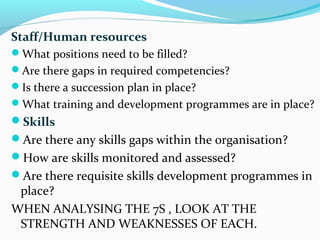
Staff/Human resources
What positions need to be filled?
Are there gaps in required competencies?
Is there a succession plan in place?
What training and development programmes are in place?
Skills
Are there any skills gaps within the organisation?
How are skills monitored and assessed?
Are there requisite skills development programmes in
place?
WHEN ANALYSING THE 7S , LOOK AT THE
STRENGTH AND WEAKNESSES OF EACH.
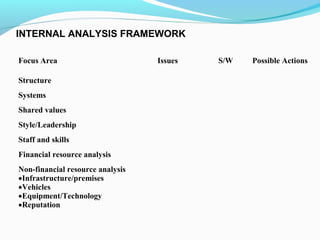
INTERNAL ANALYSIS FRAMEWORK
Focus Area Issues S/W Possible Actions
Structure      
Systems      
Shared values      
Style/Leadership      
Staff and skills      
Financial resource analysis      
Non-financial resource analysis
•Infrastructure/premises
•Vehicles
•Equipment/Technology
•Reputation
     
Group Exercise 6
Undertake an internal analysis of one of your group
member organisations.
Conclusion
A company thus needs to develop its internal
strategic capability by ensuring that its core
competencies fit or maybe used to deal with the
changing environment so as to generate competitive
advantages and distinctive competencies.

Internal analysis

  • 1.
    EVALUATING COMPANY RESOURCESAND COMPETITIVE CAPABILITIES
  • 2.
    Internal Environmental Scanning Theprocess of looking at the internal factors so as to assess the critical strengths and weaknesses that are likely to determine if the firm will be strong enough to take advantage of opportunities while avoiding threats
  • 3.
    3 METHODS OF INTERNALSCAN The methods are as follows: • Resources/Capabilities Analysis • The Value Chain Analysis • The McKinsey 7S Framework
  • 4.
    4 Resource Based Approachto Internal Organisational Analysis  A resource is an asset, competency, process, skill, or knowledge controlled by the corporation” (Wheelen & Hunger, 2008,).  It (resource) is a strength if it provides the firm with a competitive advantage.  It becomes a weakness if the firm does not possess the resource that other competitors do possess, or is necessary for survival in the industry
  • 5.
    Types of Resources Tangible Financial;borrowing capacity, internal funds generation Physical;- plant and equipment, location, technology, raw materials etc Intangible Reputation; brand name, loyal customer base, relationship with suppliers, Culture;- shared values Human Skills and knowledge, Motivation, flexibility and adaptation, loyalty. Technological resources Patents, Copyrights, Technical knowhow etc
  • 6.
    6 APPRAISING RESOURCES RESOURCE CHARACTERISTICSINDICATORS Financial Borrowing Capacity Debt/Equity Resources Internal Funds / Credit Rating Generation Net Cash Flow Physical Plant And Equipment : Market Value Of Resources Size, Location, Fixed Assets Technology, Flexibility Scale Of Plants Land And Buildings Alternatives For Raw Materials Fixed Assets Human Training, Experience, Employee Resources Adaptability, Qualifications, pay Commitment And Rates, Turnover Loyalty Of Employees Technological Patents, Copyrights, No. Of Patents Resources Know How, Owned R & D Facilities Royalty Income Technical And Scientific R & D Expenditure Employees R & D Staff Reputation Brands. Stability Of Brand Equity Customer Base Product Price Reputation With Premium Suppliers Recognition
  • 7.
    Resources: Capabilities &Competencies Capabilities: refer to an org`s ability to exploit its resources through organizational processes & routines to turn inputs into outputs. Competency: is cross functional integration & coordination of capabilities e.g. a competency in NPD in a division may be as a result of integrating HR, marketing, R&D & production capabilities in that division. Core Competence: Collection of capabilities that cross divisional boundaries and is something the corporation does exceedingly well. Distinctive Competencies: core competencies that are unique and superior to those of competition. •E.g. 3M and Econet are known for their distinctive competence in innovation.
  • 8.
    Sustainability of aResource as a Source of Competitive Advantage There are four important characteristics: Durability; the time it takes before the resource becomes obsolete Transparency; the rate at which competitors can learn the relationship of the resource and its capability in supporting the company’s successful strategy Transferability; the rate at which competitors are able to acquire the resource and capability Replicability; the ability of competitors to duplicate the resource and capability of the company so as to imitate its successful strategy.
  • 9.
    9 9 SUSTAINABILITY OF A RESOURCE/COMPETITIVEADVANTAGE Christopher B Bingham, Kathelene M Eisenhardt & Nathan R Furr (2011.p72) say the most strategically important resources are: • Valuable – useful in your industry. • Rare – possessed by only a few. • Inimitable – difficult to copy. • Non-substitutable- no alternative resources providing identical value • – lacking in functional equivalents
  • 10.
    Resource Based-ViewResource Based-View sustainablecompetitive advantage valuable 1. Analyze cost, revenue or value contriubtion 2. Benchmark against competitors, 3. Determine competitve advantage Non- substitutable Imperfectly imitable rare 1. The resources or resource bundle can not be substituted by other resources 1. The resource bundle is heterogene from other resource bundles 2. Heterogenity cannot be rebuild in the short to medium time frame 1. The resource or the resource bundle is not freely available. 2. Competitors can not buy the resources immediately 3. Direct competitors do not deploy identical resources/resource bundle
  • 11.
  • 12.
    Analysing if theCompany’s Costs are Competitive This involves assessing whether a company’s prices and costs are competitive with those of its close rivals. Involves the use of the Value Chain Analysis.
  • 13.
    The Value ChainConcept A company’s value chain identifies the primary activities that create value for customers and the related support activities. Acts as a tool for thinking strategically about relationships among the activities performed by the organisation looking at which activities are strategically critical and how core competences can be developed.
  • 14.
    Basis Behind theValue Chain Each activity in the value chain incurs costs and ties up assets. The costs incurred in performing each activity can be broken down into primary costs and activities and secondary costs and activities.
  • 15.
    Value Chain AnalysisValueChain Analysis Inbound Inbound Logistics Logistics Operations Operations Outbound Outbound Logistics Logistics Marketing Marketing & Sales & Sales Service Service InfrastructureInfrastructure Human Resource ManagementHuman Resource Management Technology DevelopmentTechnology Development ProcurementProcurement SS UU PP PP OO RR TT AA CC TT II VV II TT II EE SS Primary ActivitiesPrimary Activities M argin M argin Margin Margin
  • 17.
    Primary and SecondaryActivities Primary Activities;- activities that are at the core of the company’s operations in producing the product or service such as;  Inbound logistics (raw material handling, warehousing, order processing etc.)  Operations (machining, assembling, packaging testing)  Outbound logistics (warehousing, distribution, shipping)  Sales and marketing (advertising, promotions, pricing, market research)  Service (installation, repair services, technical assistance) Secondary Activities ;- facilitate the smooth running of the primary activities and include;  Research and development (product and process improvements)  Human resources management (selection, recruitment, training etc)  General administration (accounting, financing, general management)  Information technology(support services)  Firm infrastructure (Land, buildings)
  • 18.
    18 Inbound Logistics: •Location ofdistribution facilities to minimise shipping times. •Excellent material and inventory control systems. •Systems to reduce time to send “returns” to suppliers. •Warehouse layout and designs to increase efficiency of operations for incoming materials. Operations: •Efficient plant operations to minimise costs. •Appropriate level of automation in manufacturing. •Quality production control systems to reduce costs and enhance quality. •Efficient plant layout and workflow design. Outbound Logistics: •Effective shipping process to provide quick delivery and minimise damages. •Efficient finished goods warehousing process. •Shipping of goods in large lot sizes to minimise transportations costs. •Quality material handling equipment to increase order picking. Marketing and Sales: •Highly motivated and competent sales force. •Innovative approaches to promotion and advertising. •Selection of most appropriate distribution channels. •Proper identification of customer segments. •Effective pricing strategies. Service: •Effective use of procedures to solicit customer feedback and to act on information. •Quick response to customer needs and emergencies. •Ability to furnish replacement parts as required. •Effective management of parts and equipment inventory. •Quality of service and personnel and ongoing training. •Appropriate warranty and guarantee policies. The Value Chain – Factors To Consider In Assessing Primary Activities
  • 19.
    19 General Administration: •Effective planningsystems to attain overall goals and objectives. •Ability of top management to anticipate and act on key environmental trends and events. •Ability to obtain low cost funds for capital expenditures and working capital. •Excellent relationships with diverse stakeholder groups. •Ability to coordinate and integrate activities across the “value system”. •Highly visible to inculcate organisational culture, reputation and values. Human Resource Management: •Effective recruiting, development and retention mechanisms for employees. •Quality relations with trade unions. •Quality work environment to maximise overall employee performance and minimise absenteeism. •Reward and incentive programmes to motivate all employees. Technology Development: •Effective research and development activities for process and product initiatives. •Positive collaborative relationships between R&D and other departments. •State-of-the art activities and equipment. •Culture to enhance creativity and innovation. •Excellent professional qualifications of personnel. •Ability to meet critical deadlines. Procurement: •Procurement of raw material inputs to optimise quality, and speed and to minimise the associated costs. •Development of collaborative “win-win” relationships with suppliers. •Effective procedures to purchase advertising and media services. •Analysis and selection of alternate sources of inputs to minimise dependence on one supplier. •Ability to make proper lease versus buy decisions. The Value Chain – Factors To Consider In Assessing Secondary Activities
  • 20.
  • 21.
    Assessing the Company’sPresent Strategy Involves looking at;- Whether the company is achieving its stated financial and strategic objectives Whether the company is an above average industry performer Specifically this will involve looking at;- Whether the organisation’s sales are growing or declining Whether market share is rising, falling or remaining stable Whether the company’s profit margins are increasing or decreasing
  • 22.
    Structure: What is thehierarchy of the organisation like? What are the pros and cons associated with the structure? Is decision making and controlling centralized or decentralized? Is this as it should be, given the mandate of the organisation? How are the lines of communication? Open or otherwise Systems: What form of database management systems are in place to run the organisation? Are they adequate? What are the internal rules, policies, procedures and controls used to keep the organisation on track? Are the systems in place adequate for the needs of the organisation?  However it is important to note that too many policies can be as unproductive as having wrong policies or as chaotic as having no policies.
  • 23.
    Shared Values/Culture: What arethe fundamental values, beliefs and traditions that the organisation is built on? What is the overriding corporate culture? What are the strengths and weaknesses of the existing culture? Is there any code of conduct/ethics that bind the behaviour of members and how effective is it? Style How participative is the management/leadership style? How effective is that leadership? Do members tend to be competitive or cooperative within the organisation? How is the relationship among the different units of the organisation?
  • 24.
    Staff/Human resources What positionsneed to be filled? Are there gaps in required competencies? Is there a succession plan in place? What training and development programmes are in place? Skills Are there any skills gaps within the organisation? How are skills monitored and assessed? Are there requisite skills development programmes in place? WHEN ANALYSING THE 7S , LOOK AT THE STRENGTH AND WEAKNESSES OF EACH.
  • 25.
    INTERNAL ANALYSIS FRAMEWORK FocusArea Issues S/W Possible Actions Structure       Systems       Shared values       Style/Leadership       Staff and skills       Financial resource analysis       Non-financial resource analysis •Infrastructure/premises •Vehicles •Equipment/Technology •Reputation      
  • 26.
    Group Exercise 6 Undertakean internal analysis of one of your group member organisations.
  • 27.
    Conclusion A company thusneeds to develop its internal strategic capability by ensuring that its core competencies fit or maybe used to deal with the changing environment so as to generate competitive advantages and distinctive competencies.

Editor's Notes

  • #20 Explain the use of the Value chain (cost reduction), look at strengths and weaknesses. How can you use the Value chain as a differentiation tool?