Intermediate Perl Dave Cross Magnum Solutions Ltd [email_address]
What We Will Cover Types of variable Strict and warnings References Sorting Reusable Code Object Orientation
What We Will Cover Testing Dates and Times Templates Databases Further Information
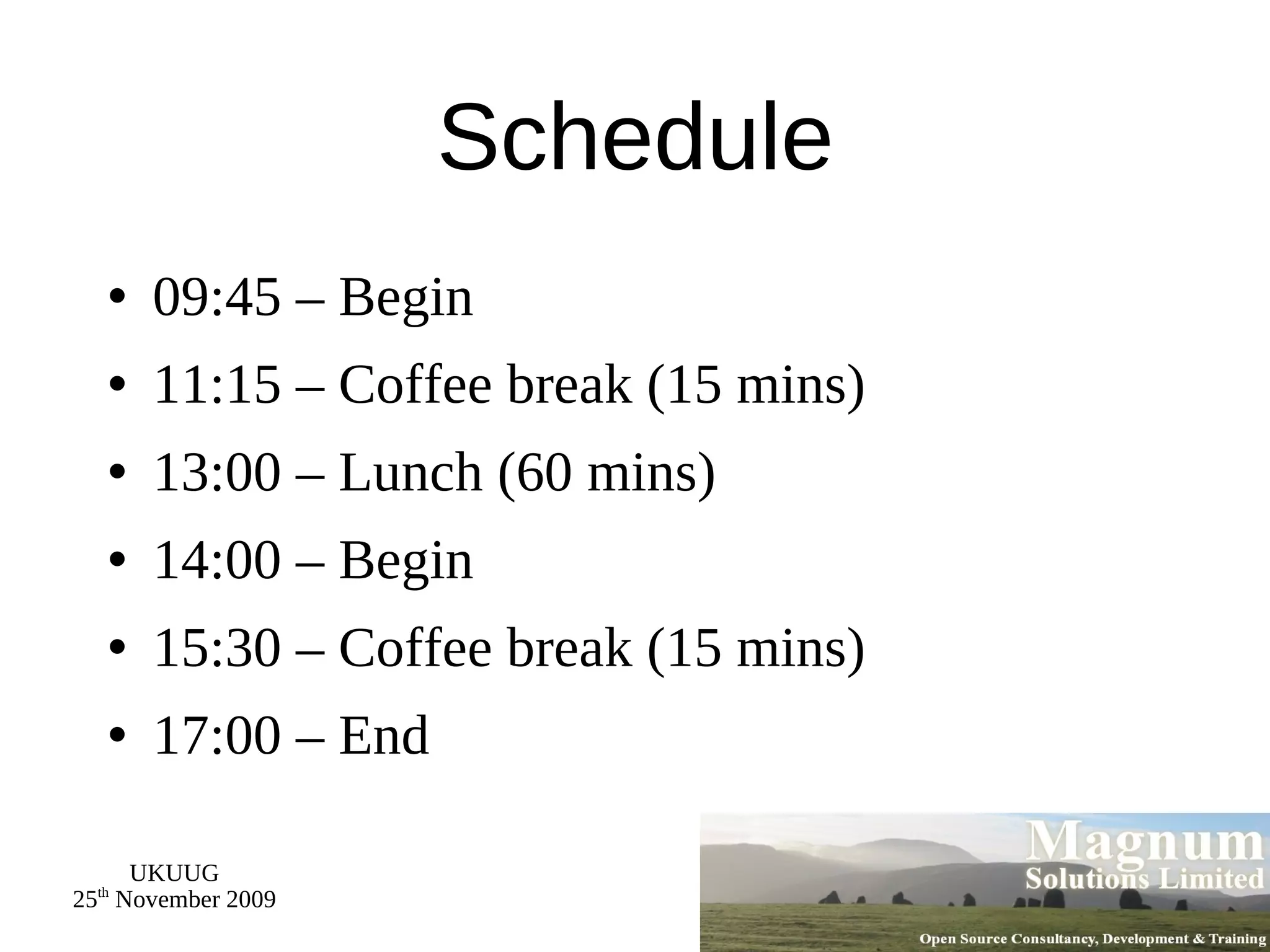
Schedule 09:45 – Begin 11:15 – Coffee break (15 mins) 13:00 – Lunch (60 mins) 14:00 – Begin 15:30 – Coffee break (15 mins) 17:00 – End
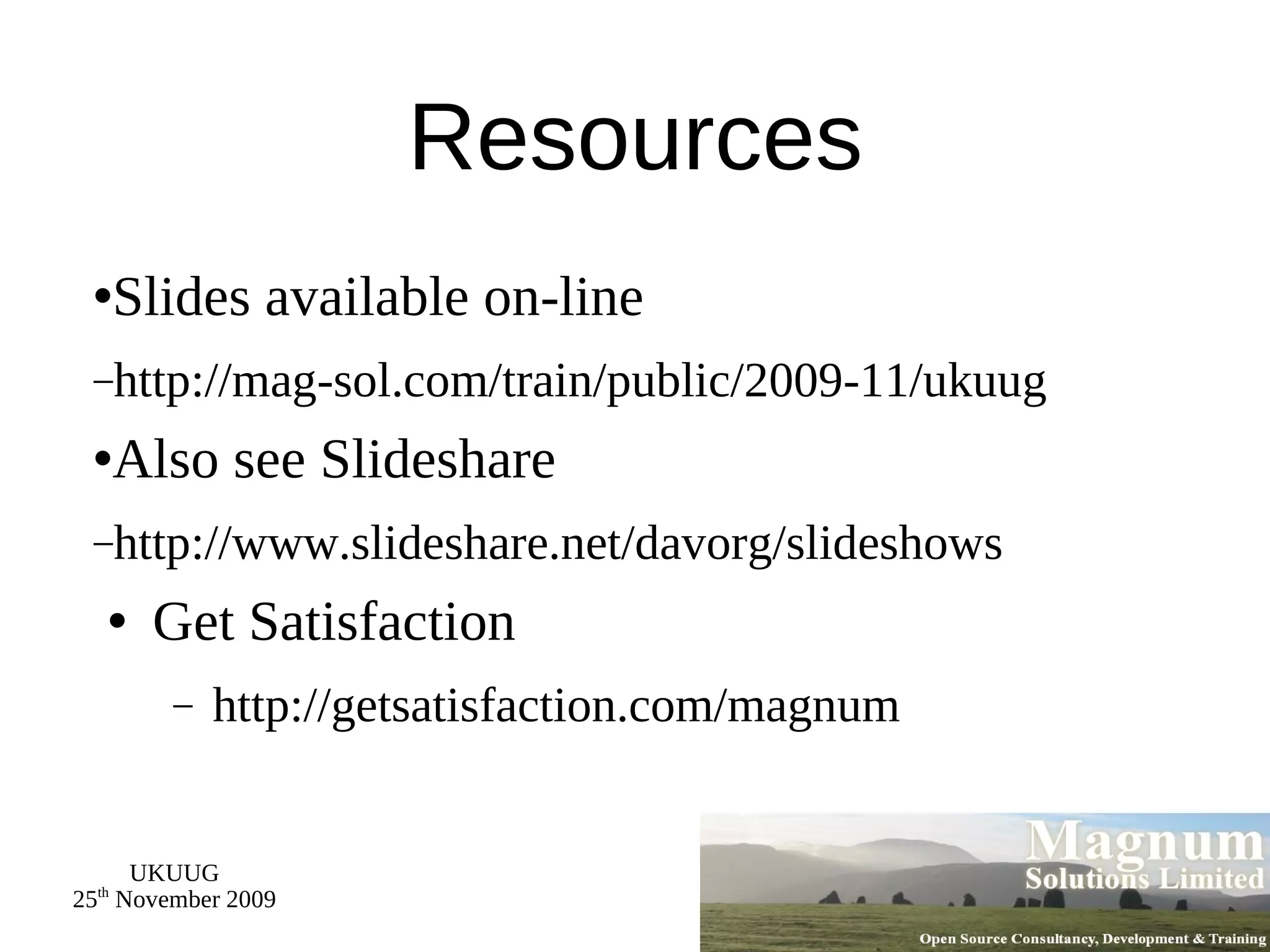
Resources Slides available on-line http://mag-sol.com/train/public/2009-11/ukuug Also see Slideshare http://www.slideshare.net/davorg/slideshows Get Satisfaction http://getsatisfaction.com/magnum
Types of Variable
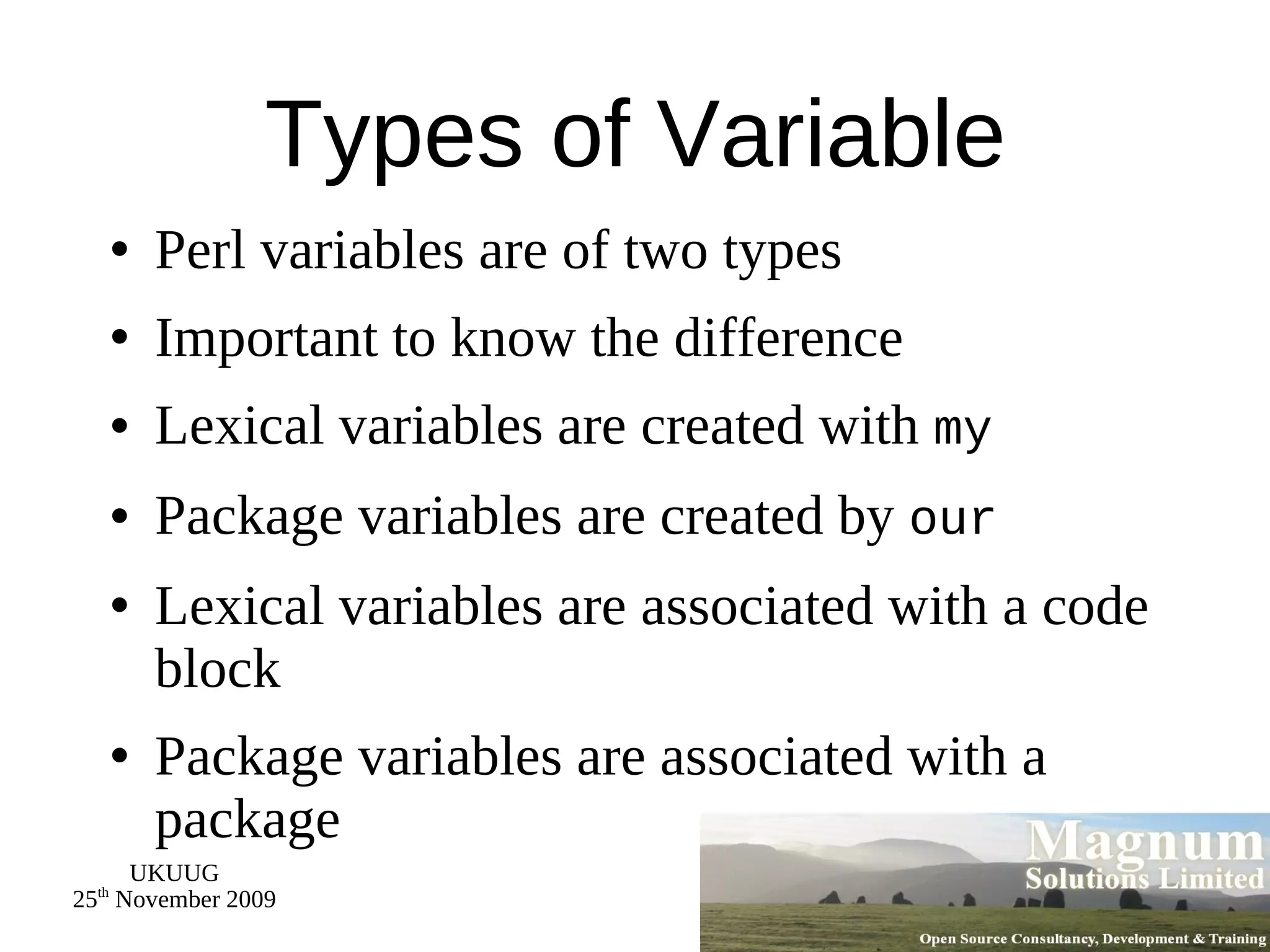
Types of Variable Perl variables are of two types Important to know the difference Lexical variables are created with  my Package variables are created by  our Lexical variables are associated with a code block Package variables are associated with a package
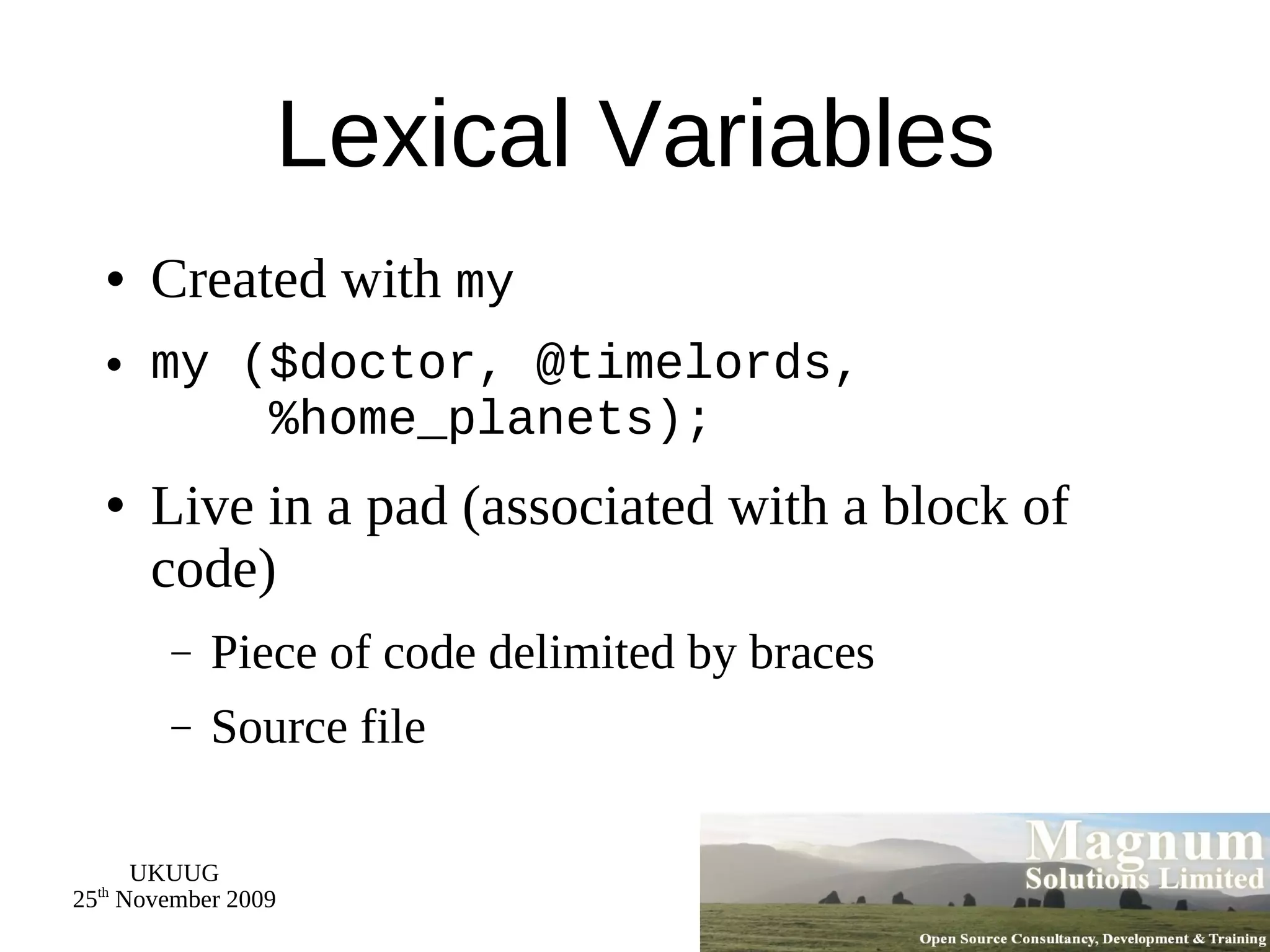
Lexical Variables Created with  my my ($doctor, @timelords,   %home_planets); Live in a pad (associated with a block of code) Piece of code delimited by braces Source file
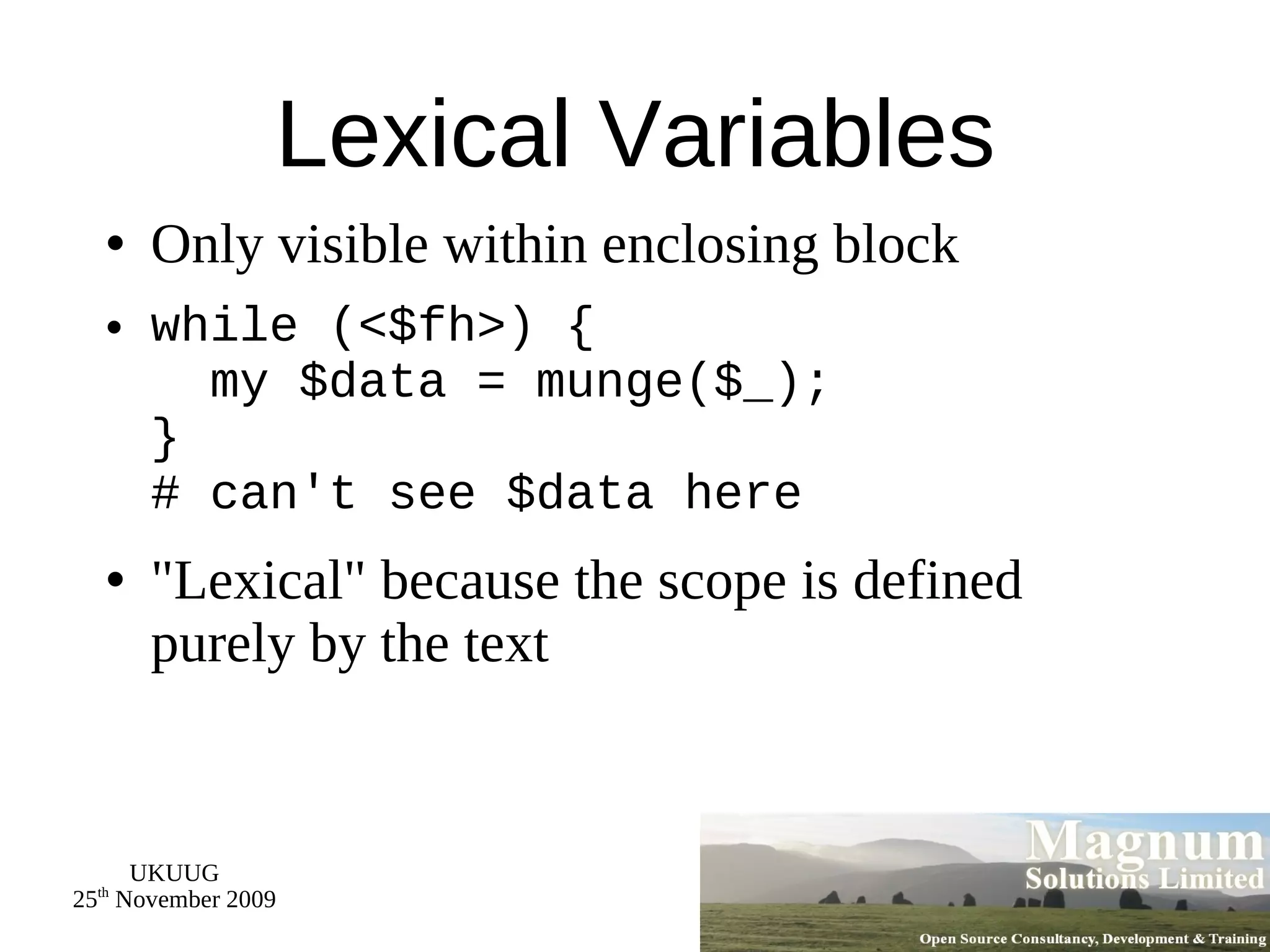
Lexical Variables Only visible within enclosing block while (<$fh>) {   my $data = munge($_); } # can't see $data here &quot;Lexical&quot; because the scope is defined purely by the text
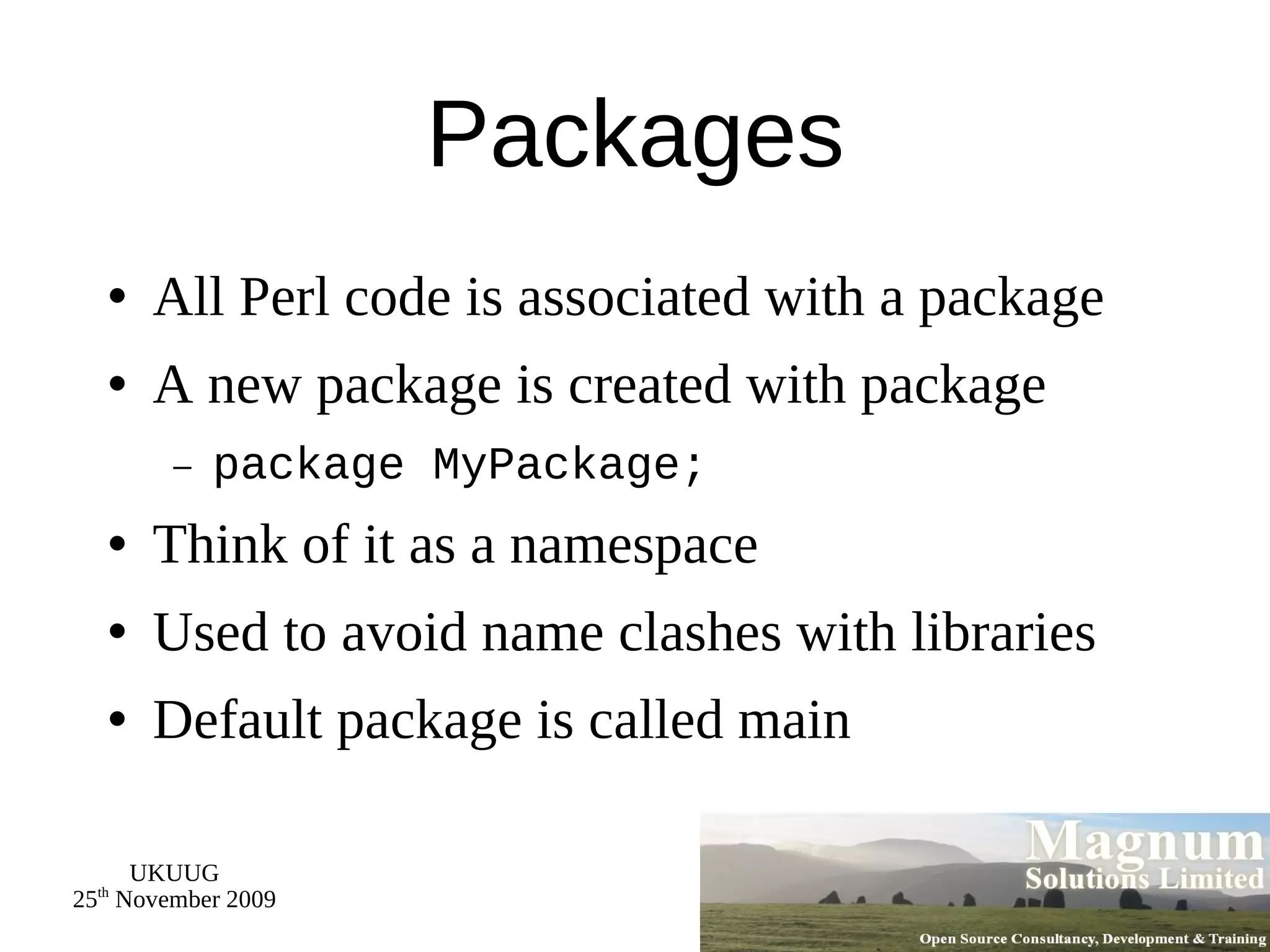
Packages All Perl code is associated with a package A new package is created with package package MyPackage; Think of it as a namespace Used to avoid name clashes with libraries Default package is called main
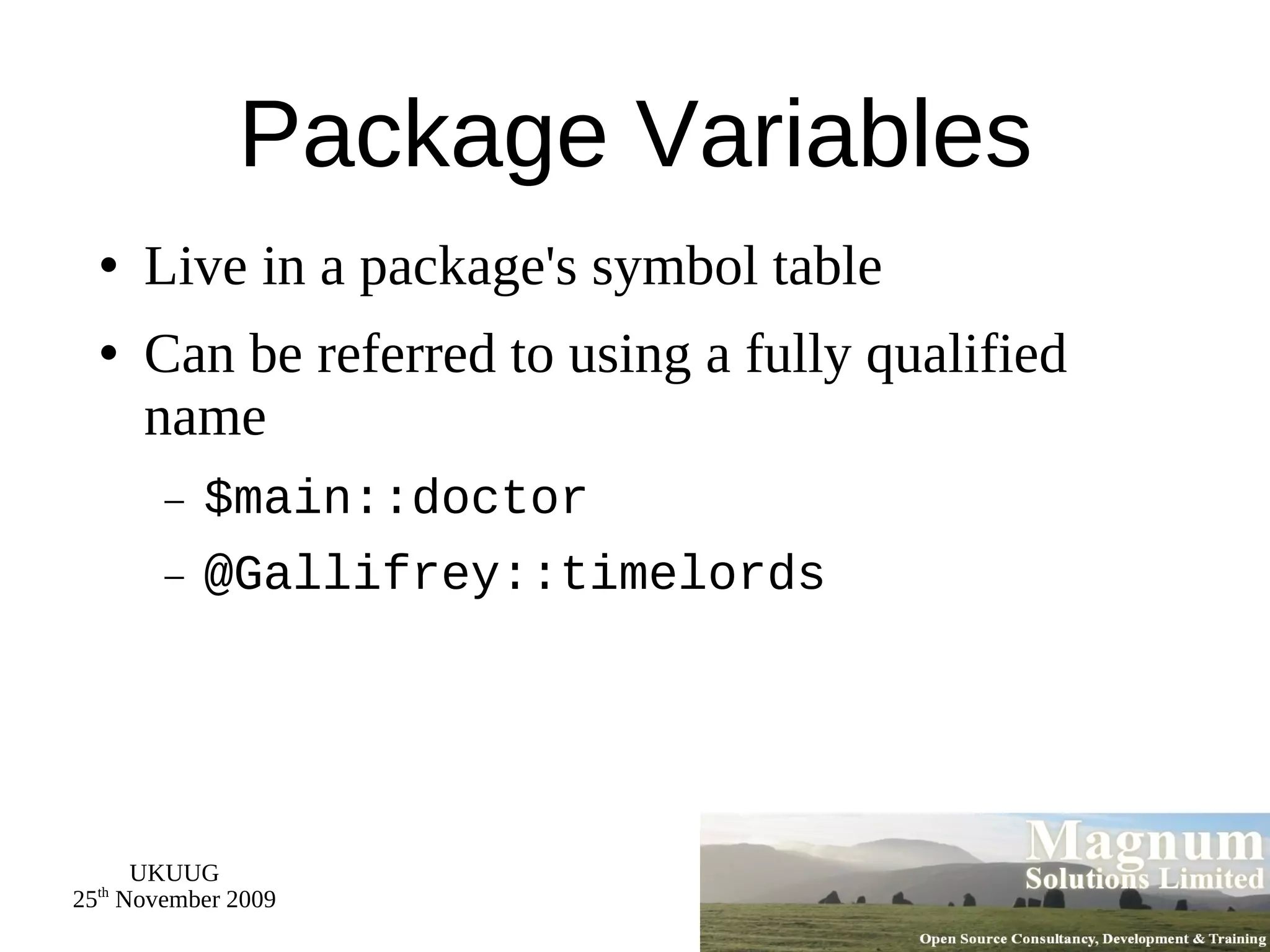
Package Variables Live in a package's symbol table Can be referred to using a fully qualified name $main::doctor @Gallifrey::timelords
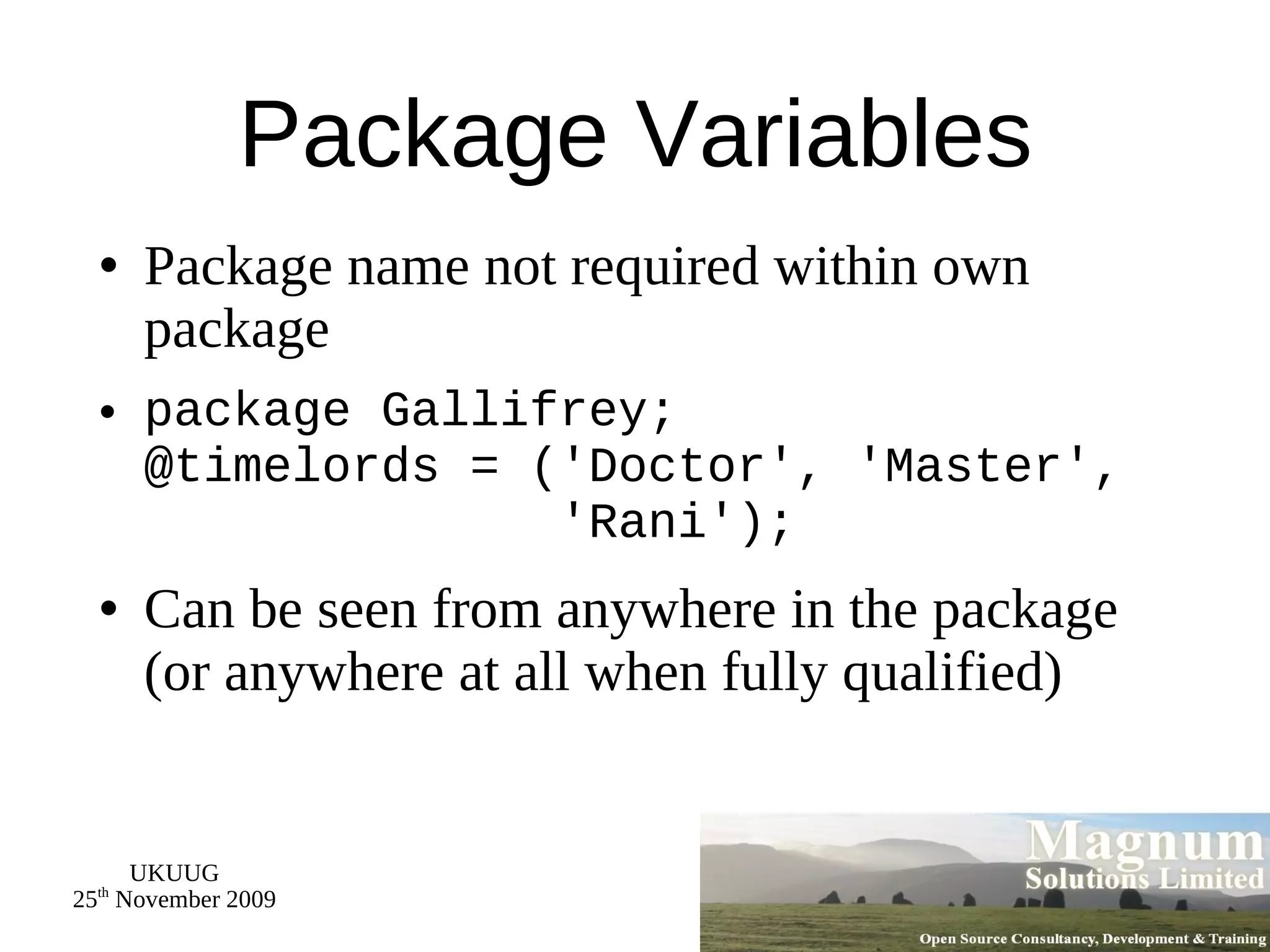
Package Variables Package name not required within own package package Gallifrey; @timelords = ('Doctor', 'Master',   'Rani'); Can be seen from anywhere in the package (or anywhere at all when fully qualified)
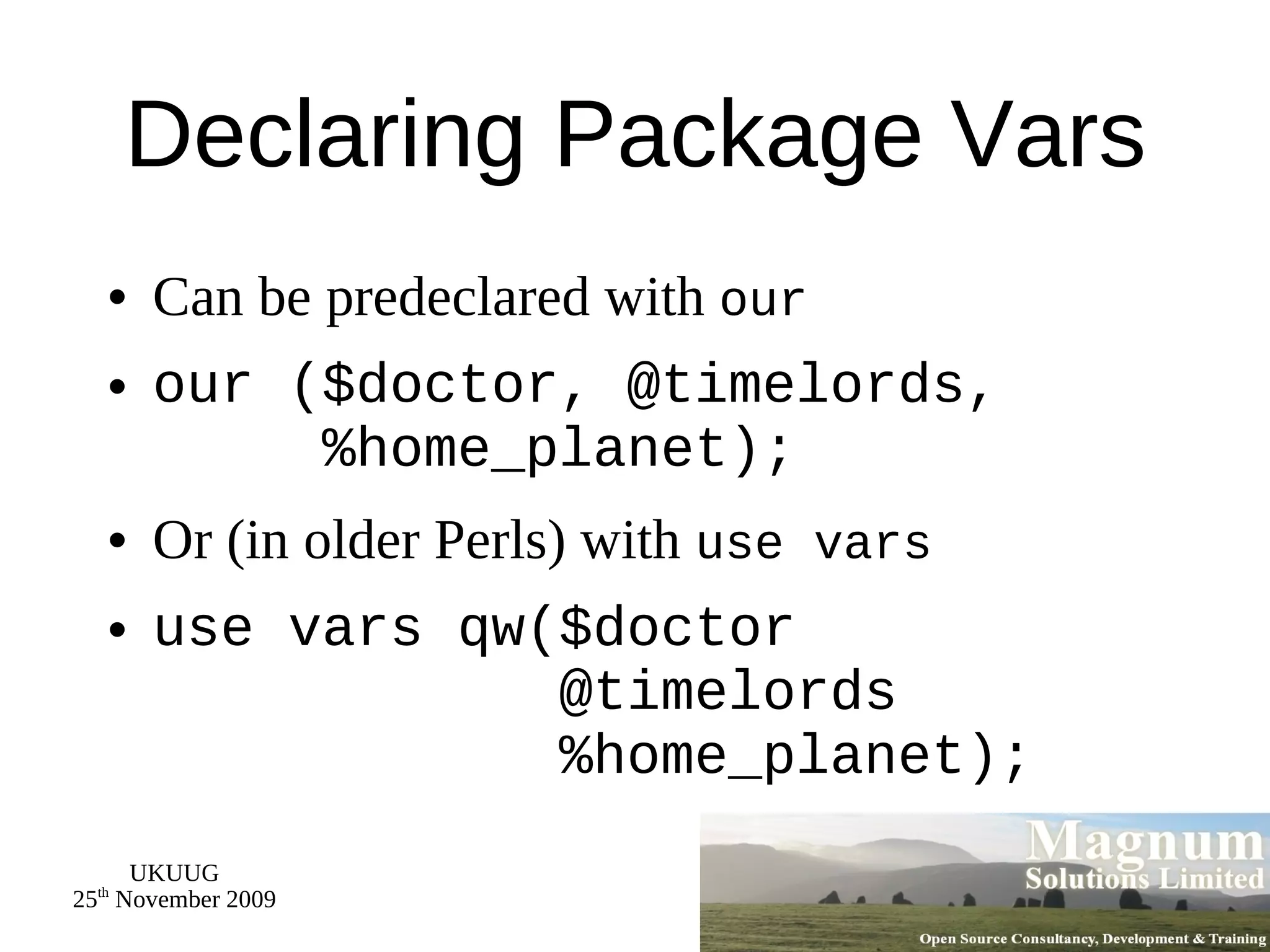
Declaring Package Vars Can be predeclared with  our our ($doctor, @timelords,   %home_planet); Or (in older Perls) with  use vars use vars qw($doctor   @timelords   %home_planet);
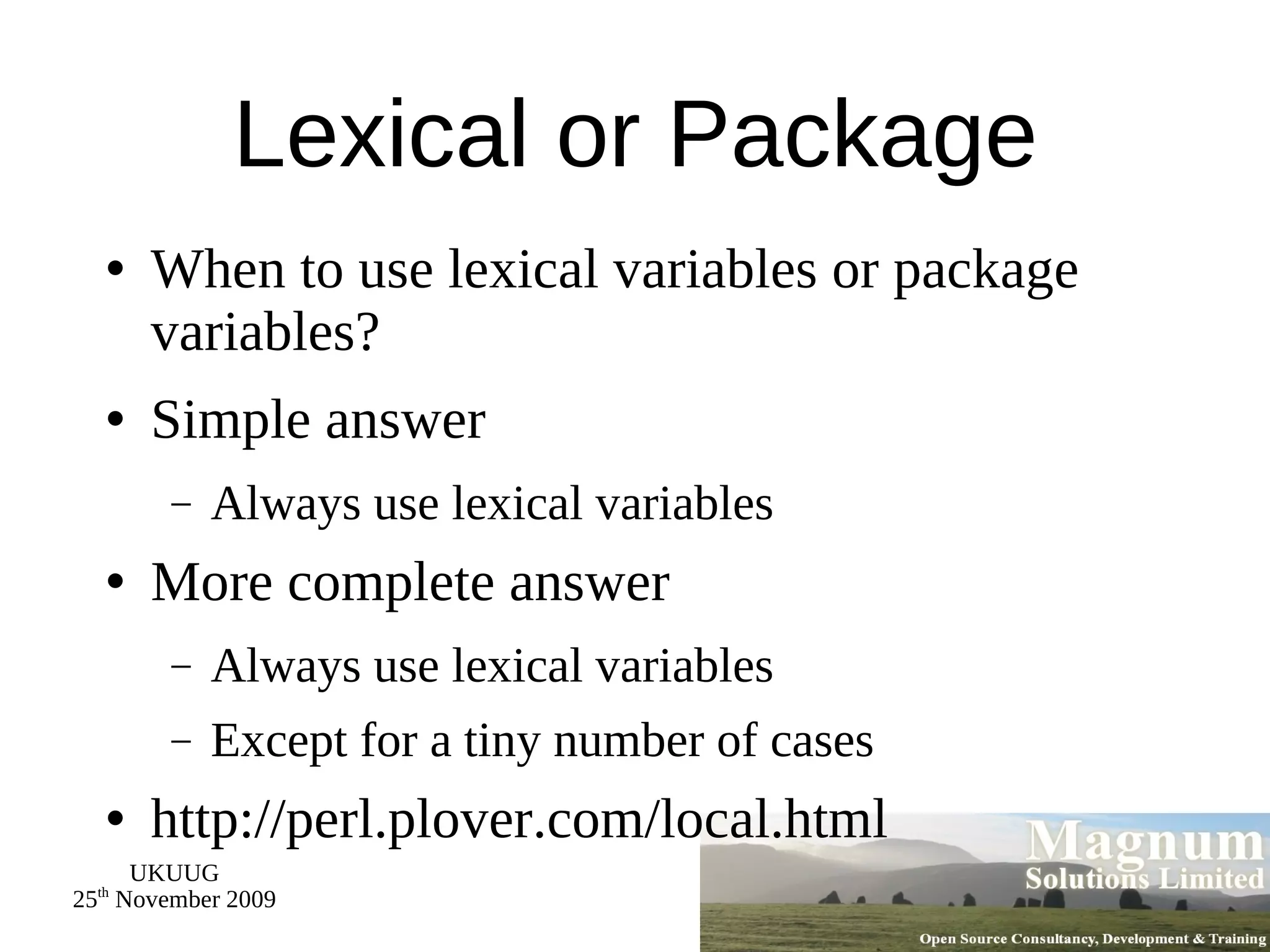
Lexical or Package When to use lexical variables or package variables? Simple answer Always use lexical variables More complete answer Always use lexical variables Except for a tiny number of cases http://perl.plover.com/local.html
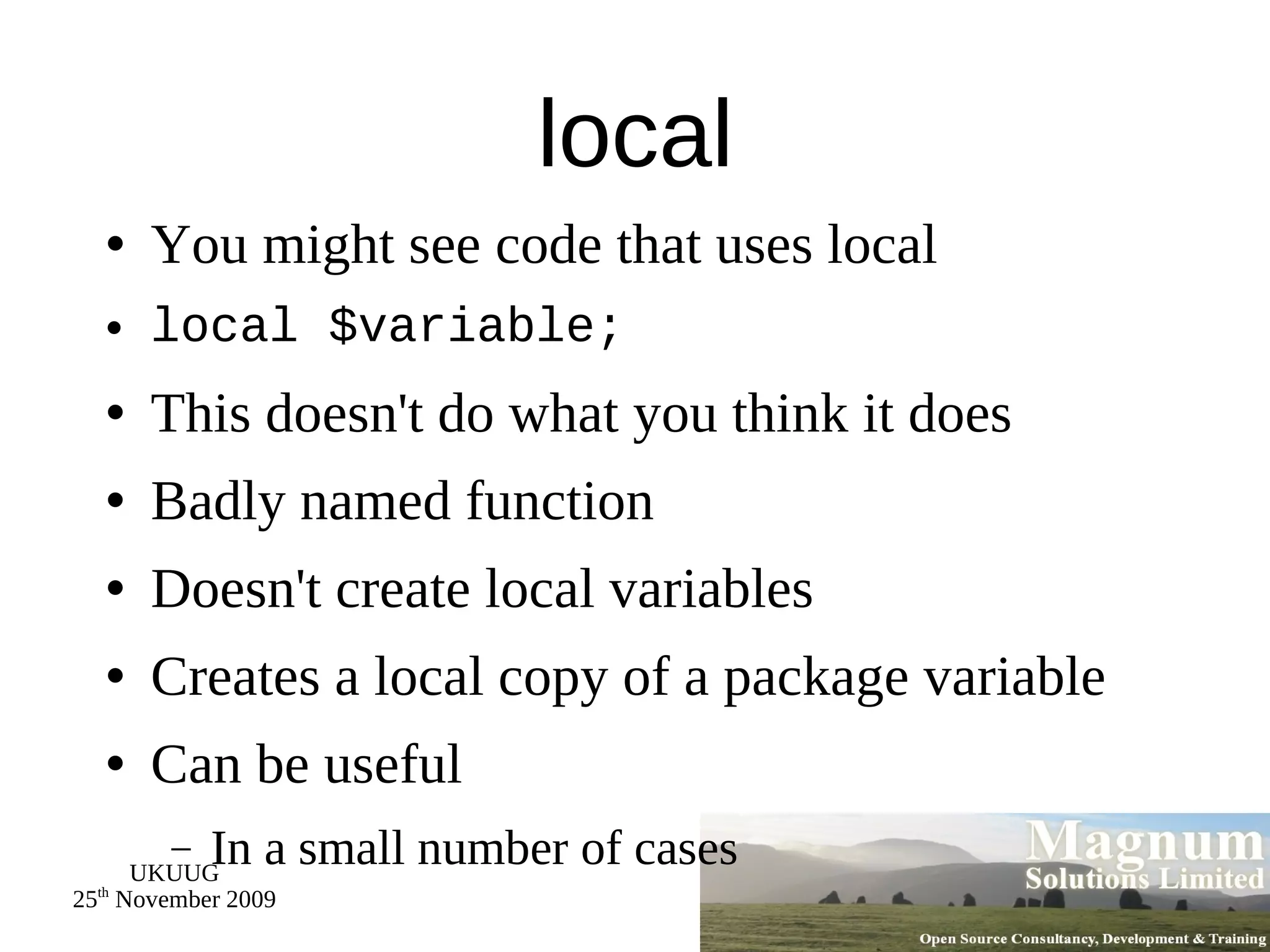
local You might see code that uses local local $variable; This doesn't do what you think it does Badly named function Doesn't create local variables Creates a local copy of a package variable Can be useful In a small number of cases
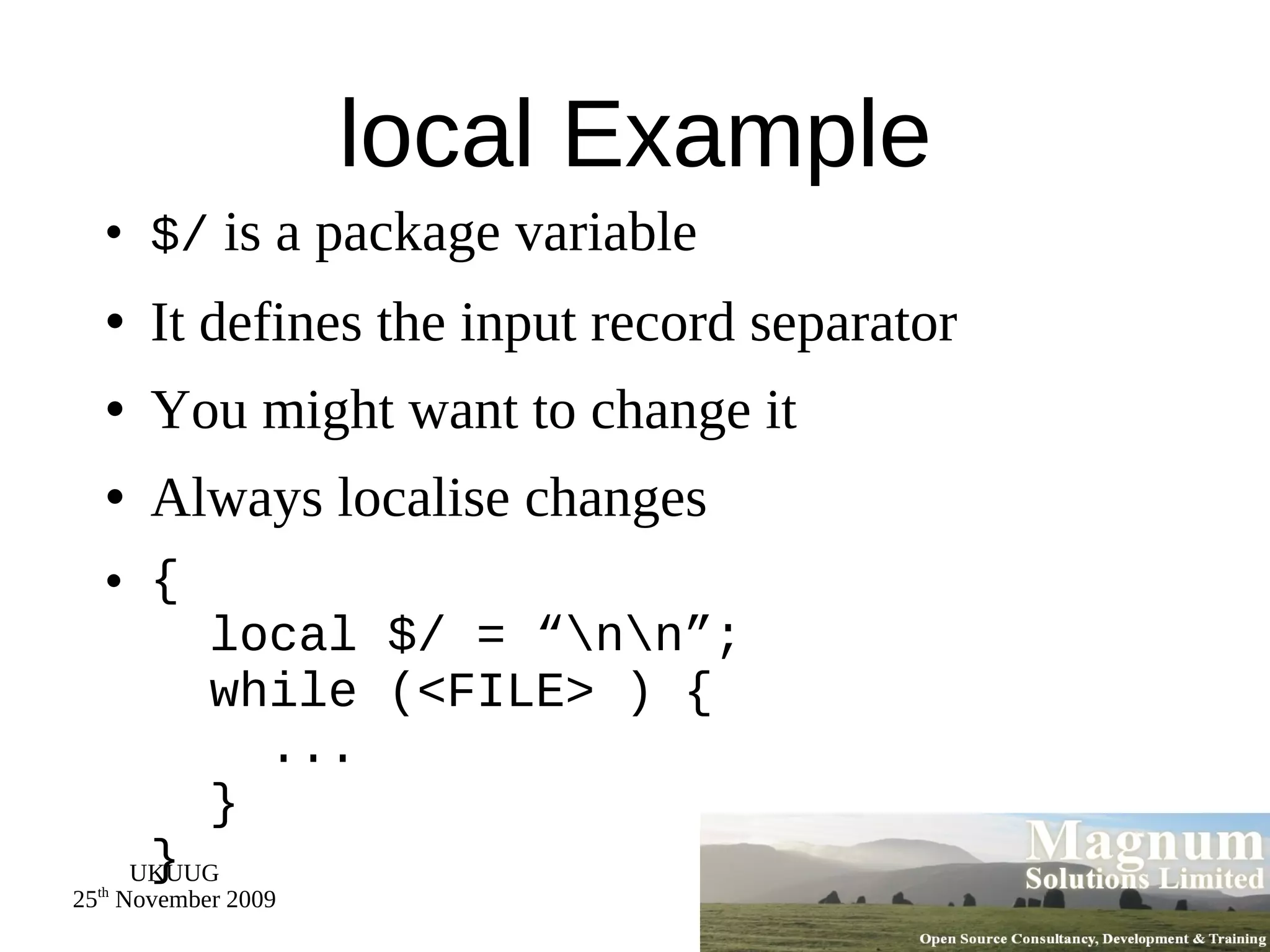
local Example $/  is a package variable It defines the input record separator You might want to change it Always localise changes {   local $/ = “\n\n”;   while (<FILE> ) {   ...   } }
Strict and Warnings
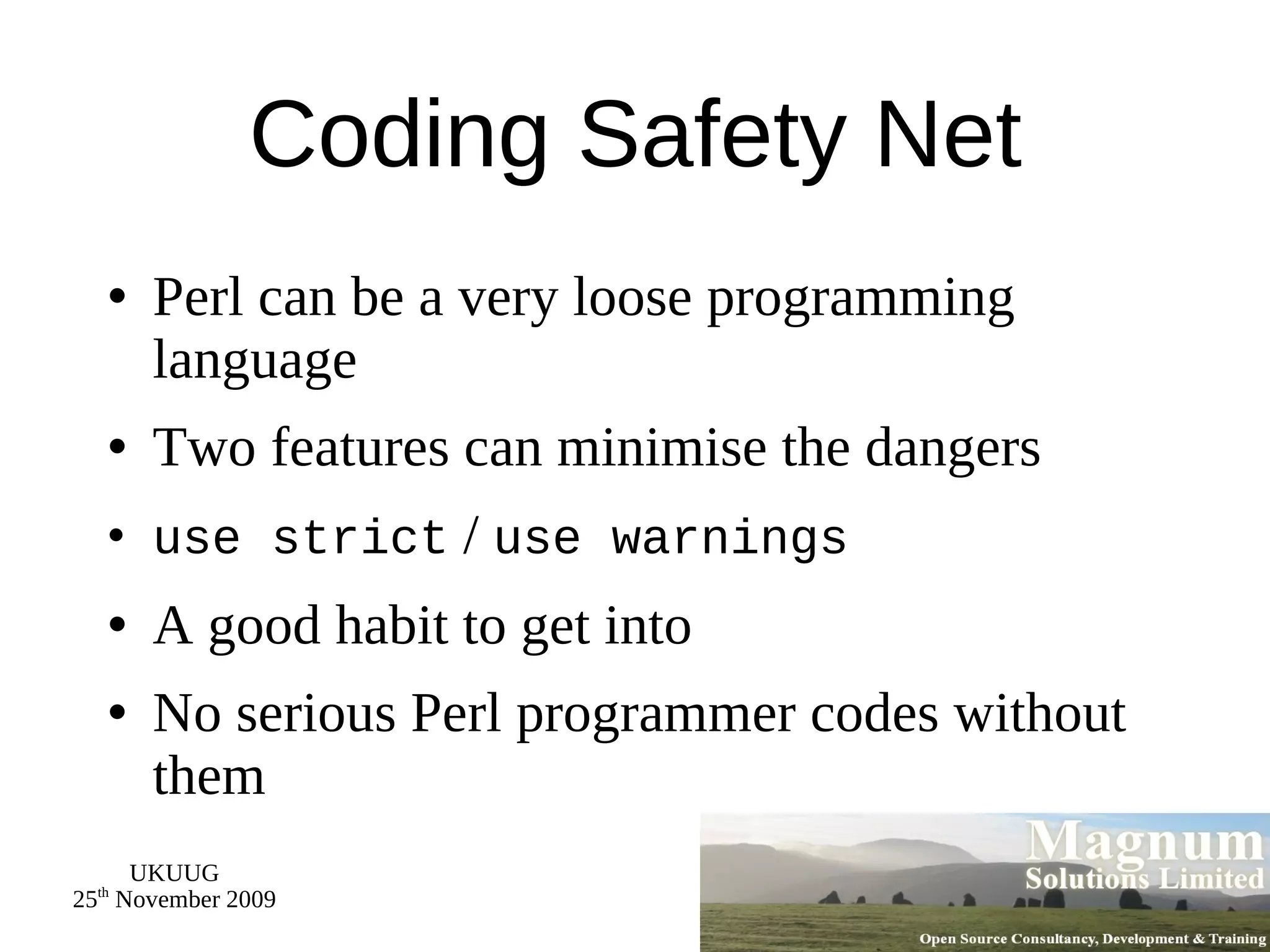
Coding Safety Net Perl can be a very loose programming language Two features can minimise the dangers use strict  /  use warnings A good habit to get into No serious Perl programmer codes without them
use strict Controls three things use strict 'refs'  – no symbolic references use strict 'subs'  – no barewords use strict 'vars'  – no undeclared variables use strict  – turn on all three at once turn them off (carefully) with  no strict
use strict 'refs' Prevents symbolic references Using a variable as another variable's name $what = 'dalek'; $$what = 'Karn'; # sets $dalek to 'Karn' What if 'dalek' came from user input? People often think this is a cool feature It isn't
use strict 'refs' (cont) Better to use a hash $what = 'dalek'; $alien{$what} = 'Karn'; Self contained namespace Less chance of clashes More information (e.g. all keys)
use strict 'subs' No barewords Bareword is a word with no other interpretation e.g. word without $, @, %, & Treated as a function call or a quoted string $dalek = Karn; May clash with future reserved words
use strict 'vars' Forces predeclaration of variable names Prevents typos Less like BASIC - more like Ada Thinking about scope is good
use warnings Warns against dubious programming habits Some typical warnings Variables used only once Using undefined variables Writing to read-only file handles And many more...
Allowing Warnings Sometimes it's too much work to make code warnings clean Turn off use warnings locally Turn off specific warnings {   no warnings 'deprecated';   # dodgy code ... } See perldoc perllexwarn
References
Introducing References A reference is a bit like pointer in languages like C and Pascal (but better) A reference is a unique way to refer to a variable. A reference can always fit into a scalar variable A reference looks like  SCALAR(0x20026730)
Creating References Put \ in front of a variable name $scalar_ref = \$scalar; $array_ref = \@array; $hash_ref = \%hash; Can now treat it just like any other scalar $var = $scalar_ref; $refs[0] = $array_ref; $another_ref = $refs[0];
Creating References [ LIST ]  creates anonymous array and returns a reference $aref = [ 'this', 'is', 'a', 'list']; $aref2 = [ @array ]; { LIST }  creates anonymous hash and returns a reference $href = { 1 => 'one', 2 => 'two' }; $href = { %hash };
Creating References @arr = (1, 2, 3, 4); $aref1 = \@arr; $aref2 = [ @arr ]; print &quot;$aref1\n$aref2\n&quot;; Output ARRAY(0x20026800) ARRAY(0x2002bc00) Second method creates a  copy  of the array
Using Array References Use  {$aref}  to get back an array that you have a reference to Whole array @array = @{$aref}; @rev = reverse @{$aref}; Single elements $elem = ${$aref}[0]; ${$aref}[0] = 'foo';
Using Hash References Use  {$href}  to get back a hash that you have a reference to Whole hash %hash = %{$href}; @keys = keys %{$href}; Single elements $elem = ${$href}{key}; ${$href}{key} = 'foo';
Using References Use arrow ( -> ) to access elements of arrays or hashes Instead of  ${$aref}[0]  you can use $aref->[0] Instead of  ${$href}{key}  you can use $href->{key}
Using References You can find out what a reference is referring to using ref $aref = [ 1, 2, 3 ]; print ref $aref; # prints ARRAY $href = { 1 => 'one',   2 => 'two' }; print ref $href; # prints HASH
Why Use References? Parameter passing Complex data structures
Parameter Passing What does this do? @arr1 = (1, 2, 3); @arr2 = (4, 5, 6); check_size(@arr1, @arr2); sub check_size {   my (@a1, @a2) = @_;   print @a1 == @a2 ?   'Yes' : 'No'; }
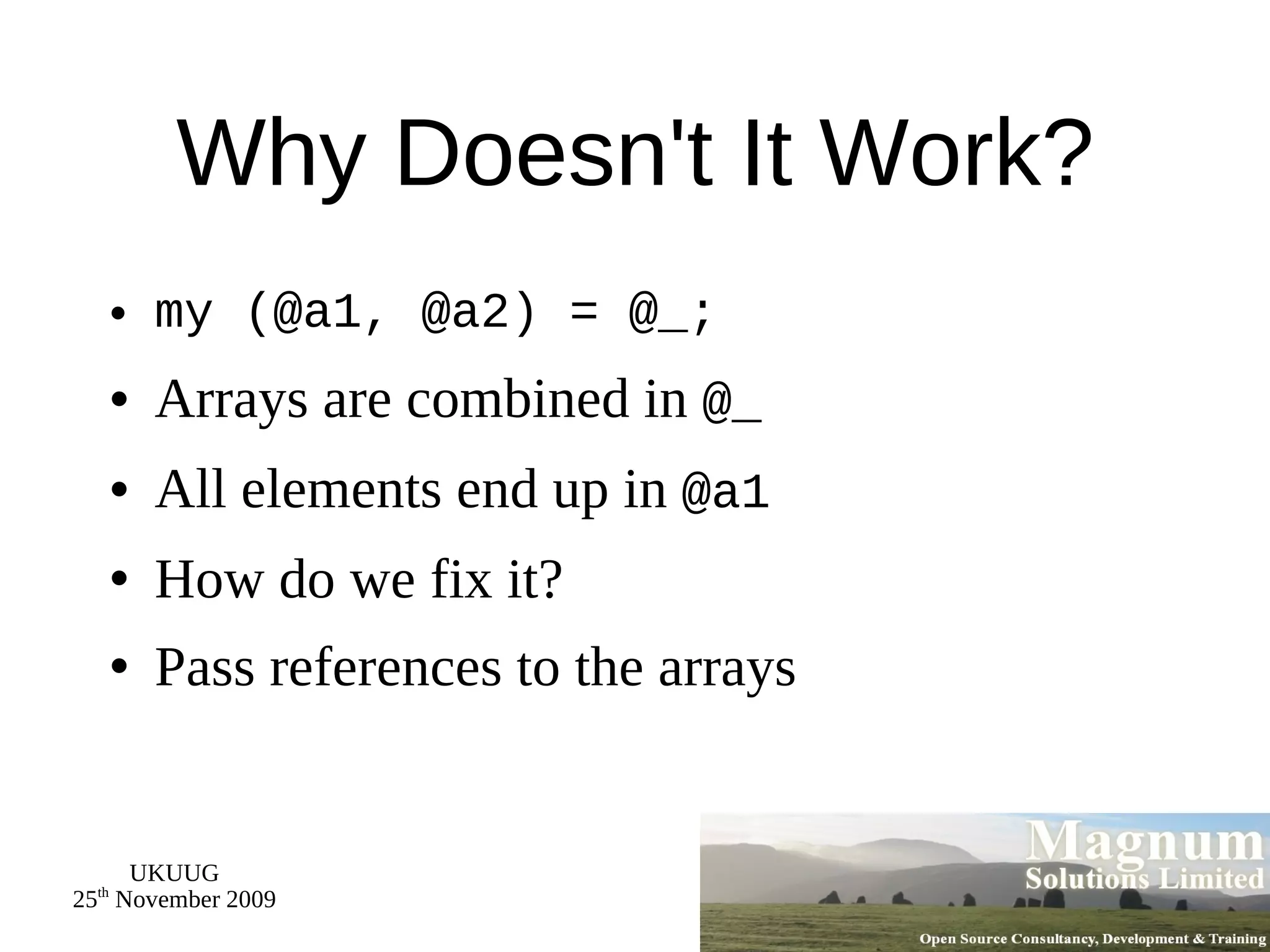
Why Doesn't It Work? my (@a1, @a2) = @_; Arrays are combined in  @_ All elements end up in  @a1 How do we fix it? Pass references to the arrays
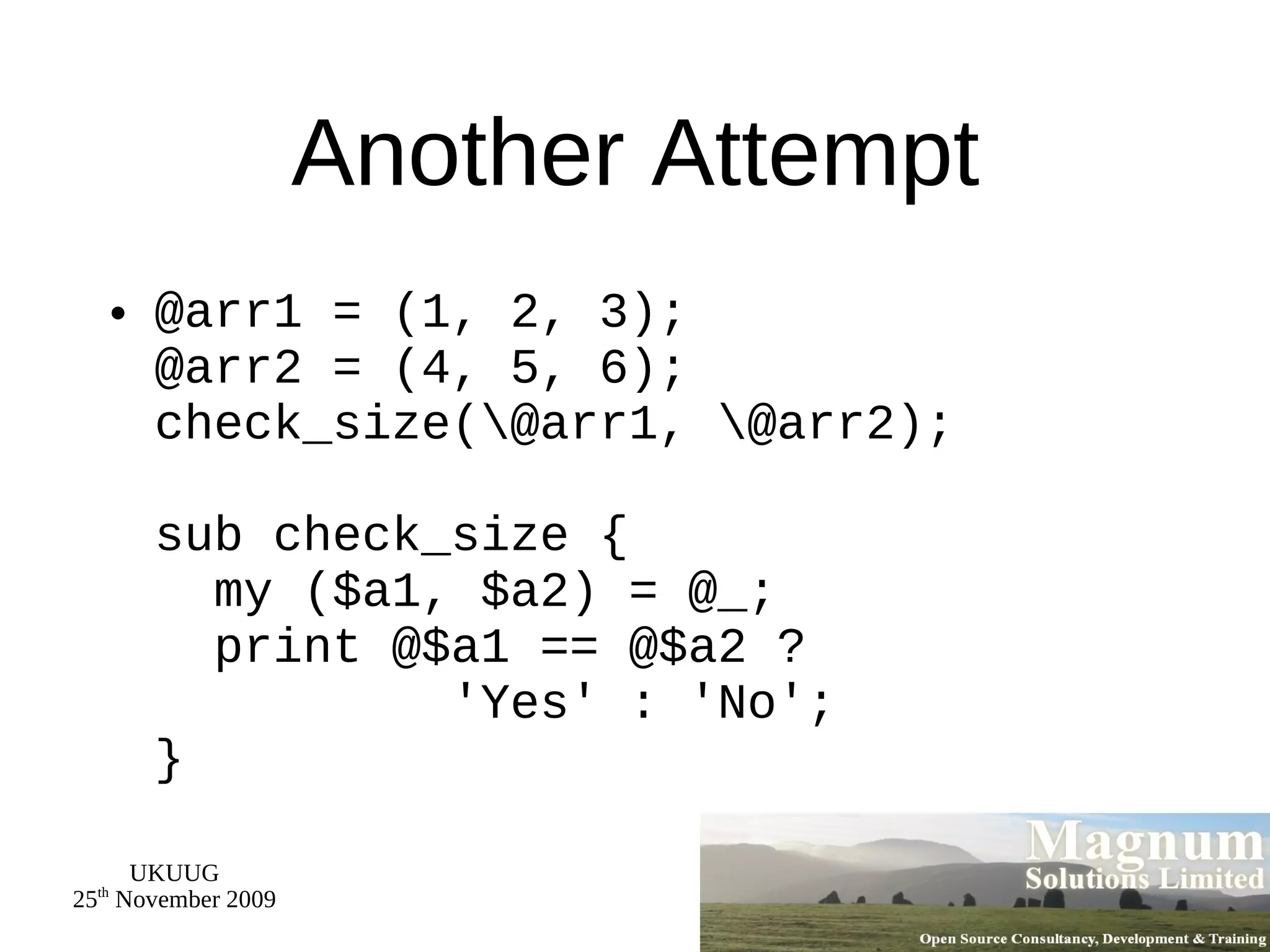
Another Attempt @arr1 = (1, 2, 3); @arr2 = (4, 5, 6); check_size(\@arr1, \@arr2); sub check_size {   my ($a1, $a2) = @_;   print @$a1 == @$a2 ?   'Yes' : 'No'; }
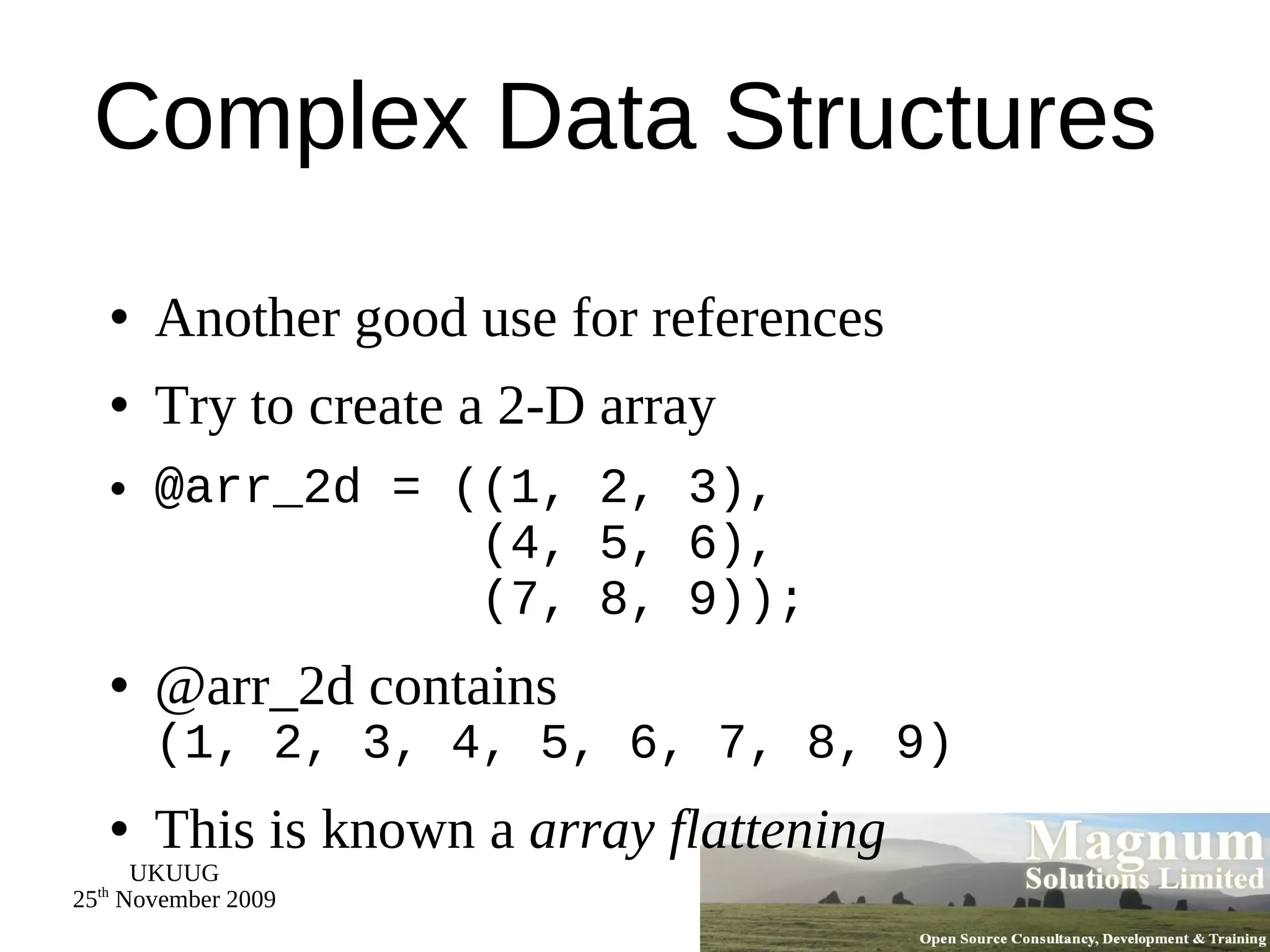
Complex Data Structures Another good use for references Try to create a 2-D array @arr_2d = ((1, 2, 3),   (4, 5, 6),   (7, 8, 9)); @arr_2d contains (1, 2, 3, 4, 5, 6, 7, 8, 9) This is known a  array flattening
Complex Data Structures 2D Array using references @arr_2d = ([1, 2, 3],   [4, 5, 6],   [7, 8, 9]); But how do you access individual elements? $arr_2d[1]  is ref to array (4, 5, 6) $arr_2d[1]->[1]  is element 5
Complex Data Structures Another 2D Array $arr_2d = [[1, 2, 3],   [4, 5, 6],   [7, 8, 9]]; $arr_2d->[1]  is ref to array (4, 5, 6) $arr_2d->[1]->[1]  is element 5 Can omit intermediate arrows $arr_2d->[1][1]
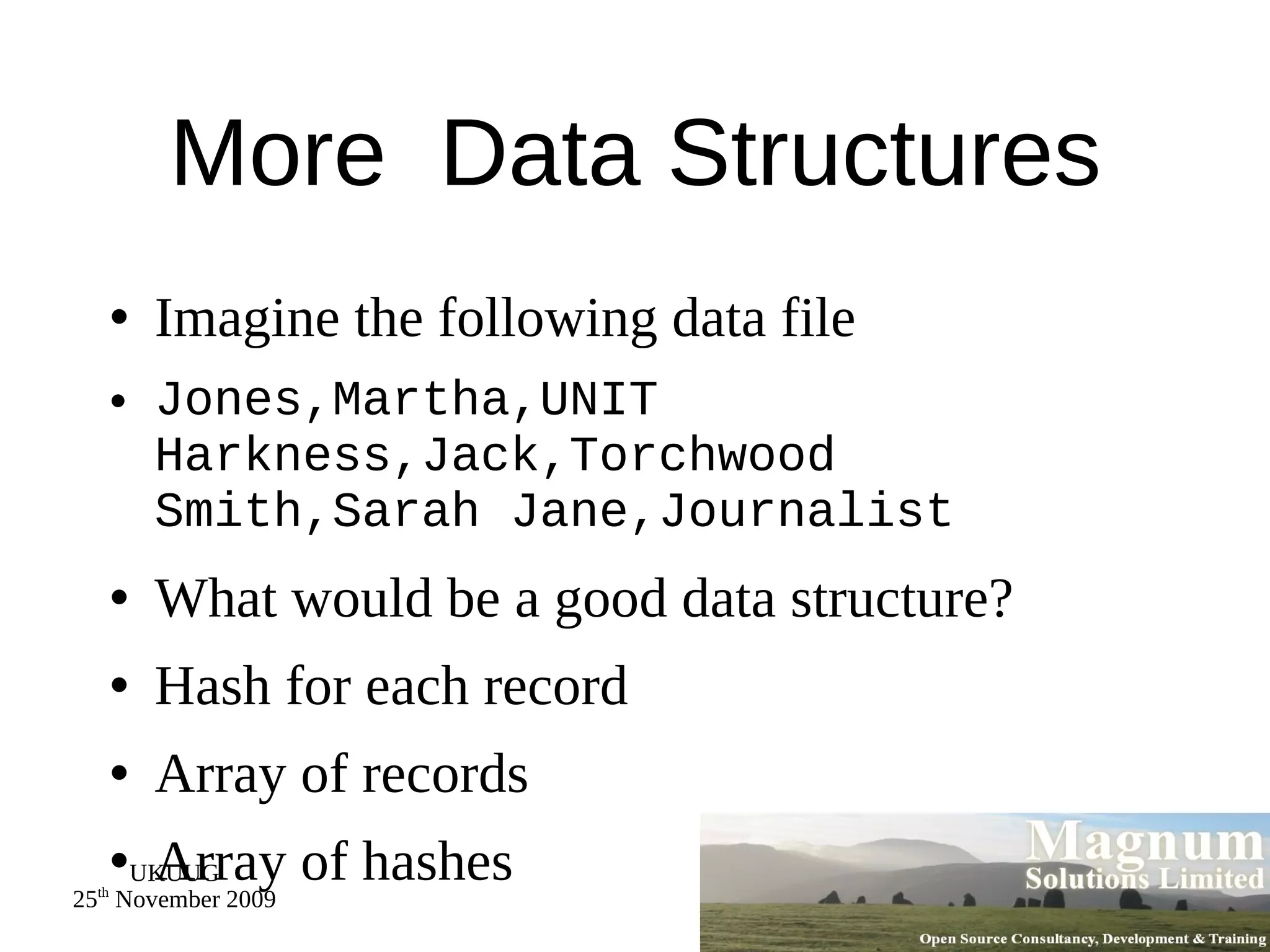
More  Data Structures Imagine the following data file Jones,Martha,UNIT Harkness,Jack,Torchwood Smith,Sarah Jane,Journalist What would be a good data structure? Hash for each record Array of records Array of hashes
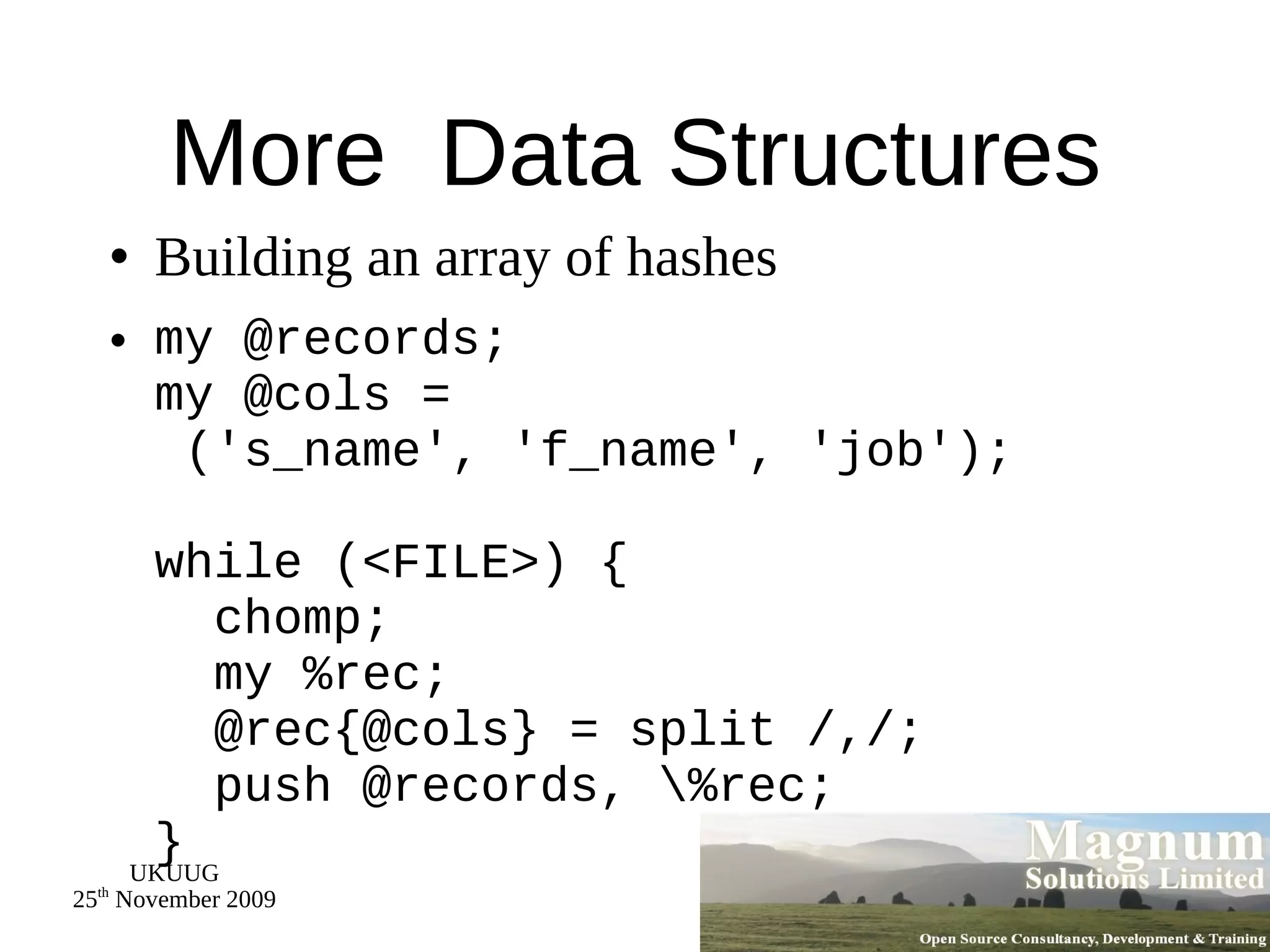
More  Data Structures Building an array of hashes my @records; my @cols =  ('s_name', 'f_name', 'job'); while (<FILE>) {   chomp;   my %rec;   @rec{@cols} = split /,/;   push @records, \%rec; }
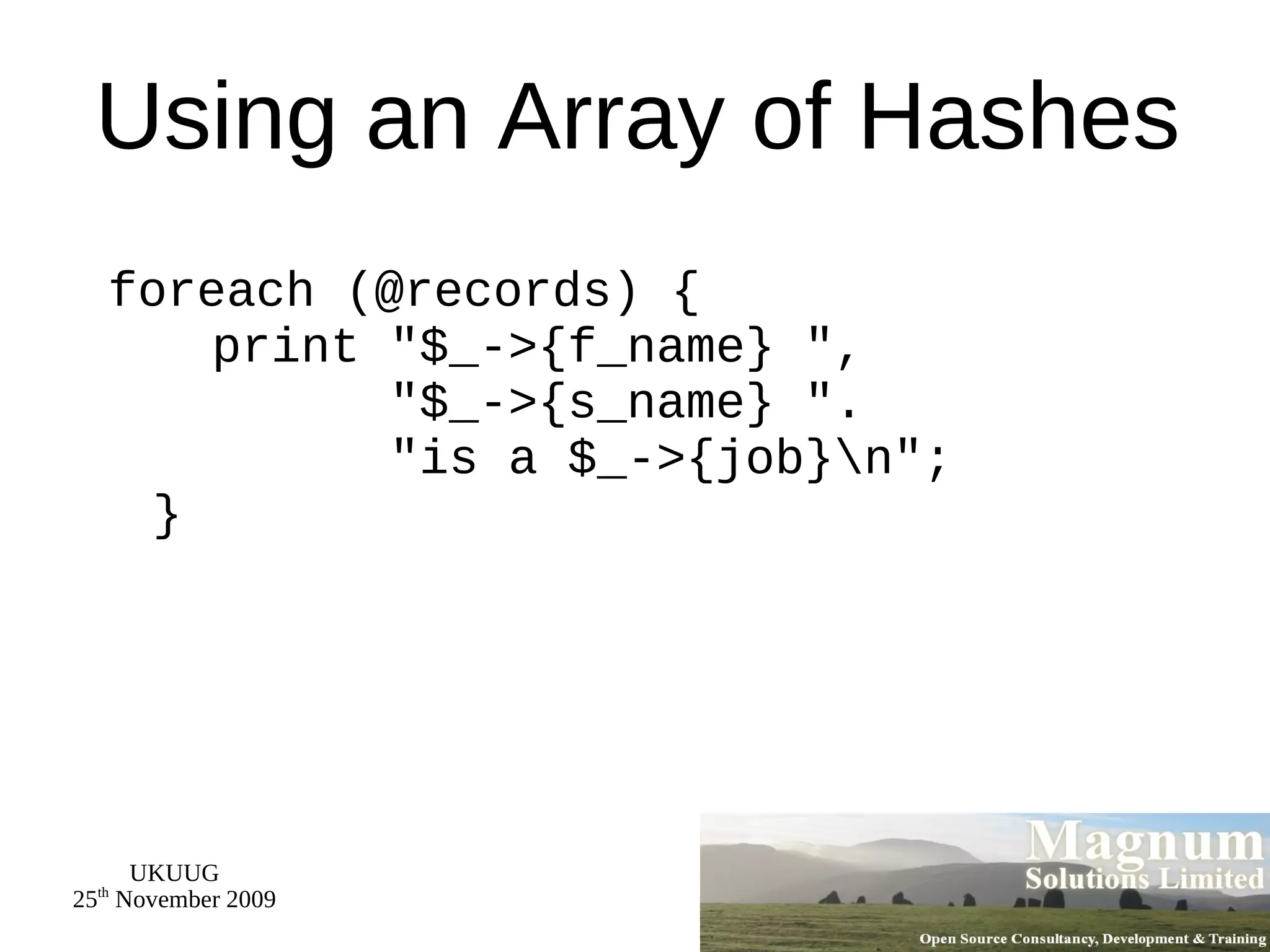
Using an Array of Hashes foreach (@records) {   print &quot;$_->{f_name} &quot;,   &quot;$_->{s_name} &quot;.   &quot;is a $_->{job}\n&quot;; }
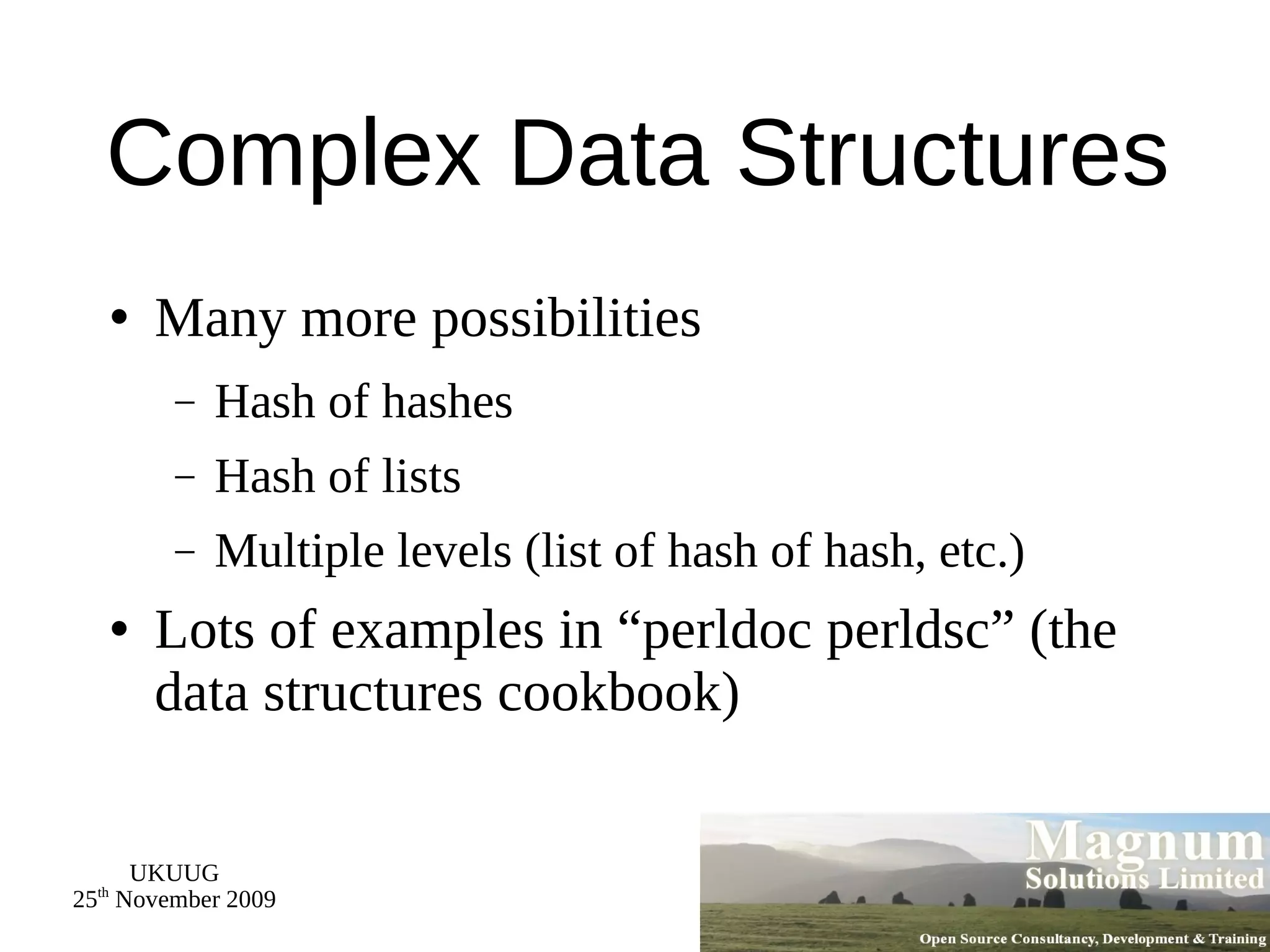
Complex Data Structures Many more possibilities Hash of hashes Hash of lists Multiple levels (list of hash of hash, etc.) Lots of examples in “perldoc perldsc” (the data structures cookbook)
Sorting
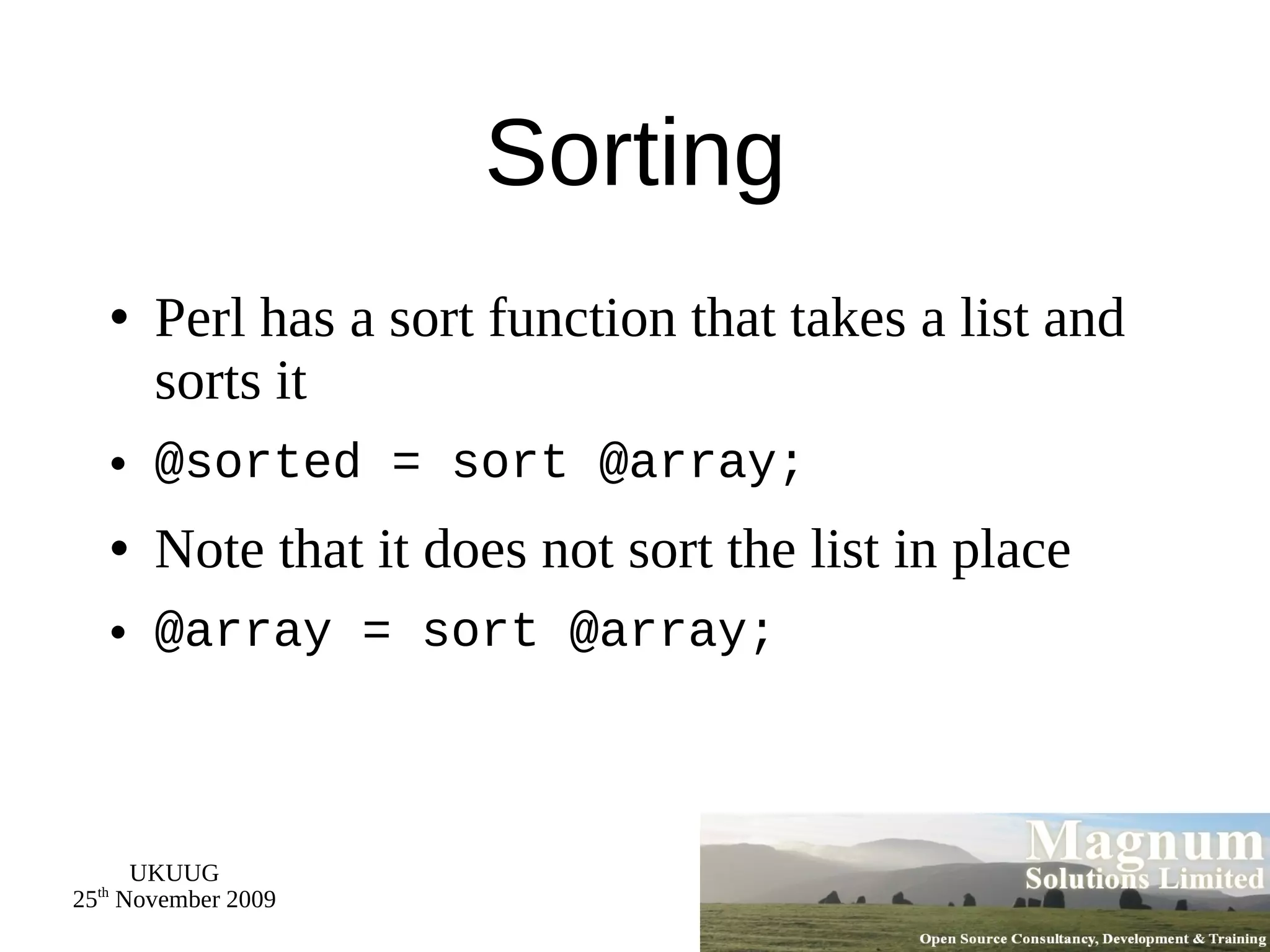
Sorting Perl has a sort function that takes a list and sorts it @sorted = sort @array; Note that it does not sort the list in place @array = sort @array;
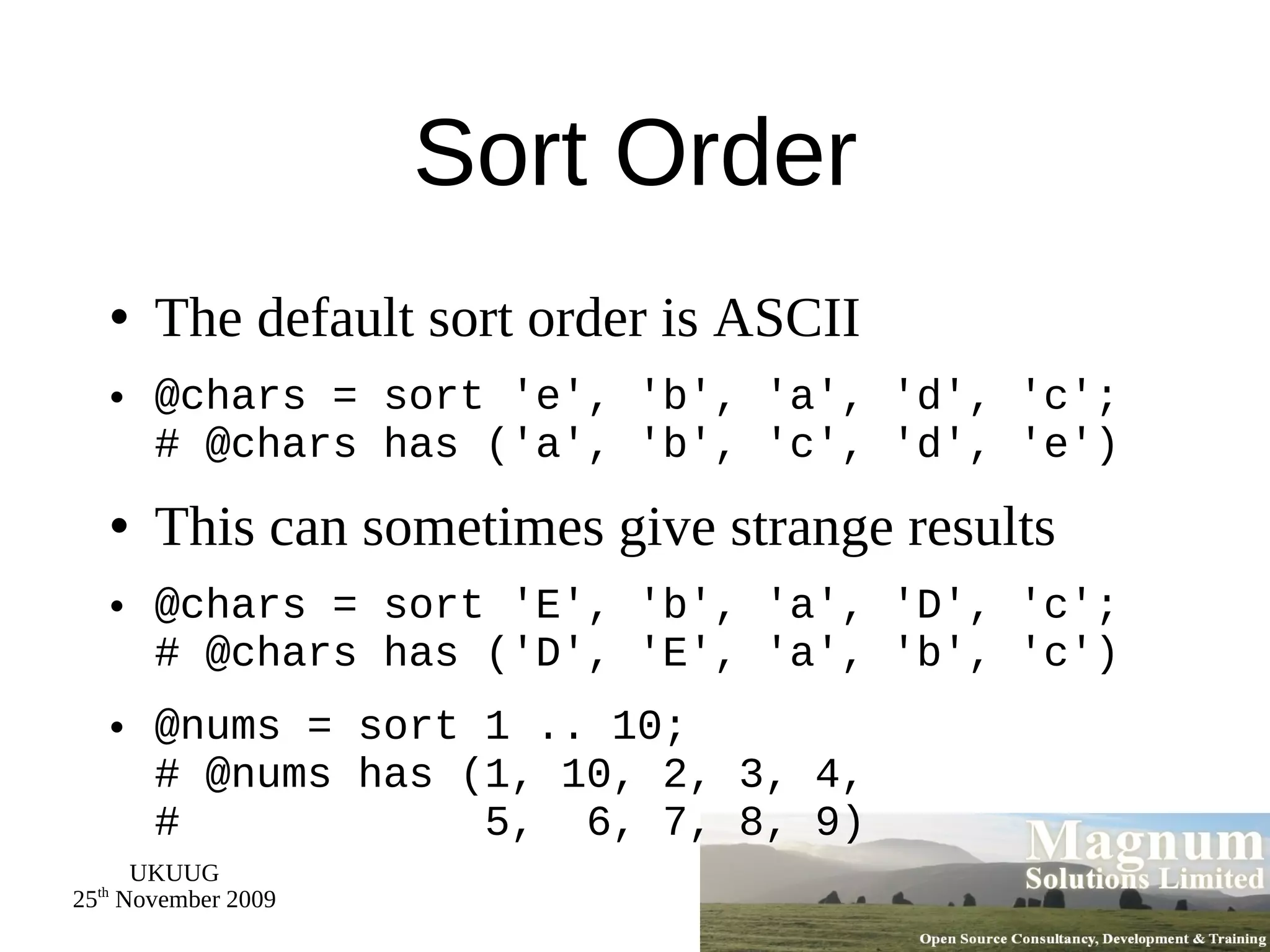
Sort Order The default sort order is ASCII @chars = sort 'e', 'b', 'a', 'd', 'c'; # @chars has ('a', 'b', 'c', 'd', 'e') This can sometimes give strange results @chars = sort 'E', 'b', 'a', 'D', 'c'; # @chars has ('D', 'E', 'a', 'b', 'c') @nums = sort 1 .. 10; # @nums has (1, 10, 2, 3, 4, #  5,  6, 7, 8, 9)
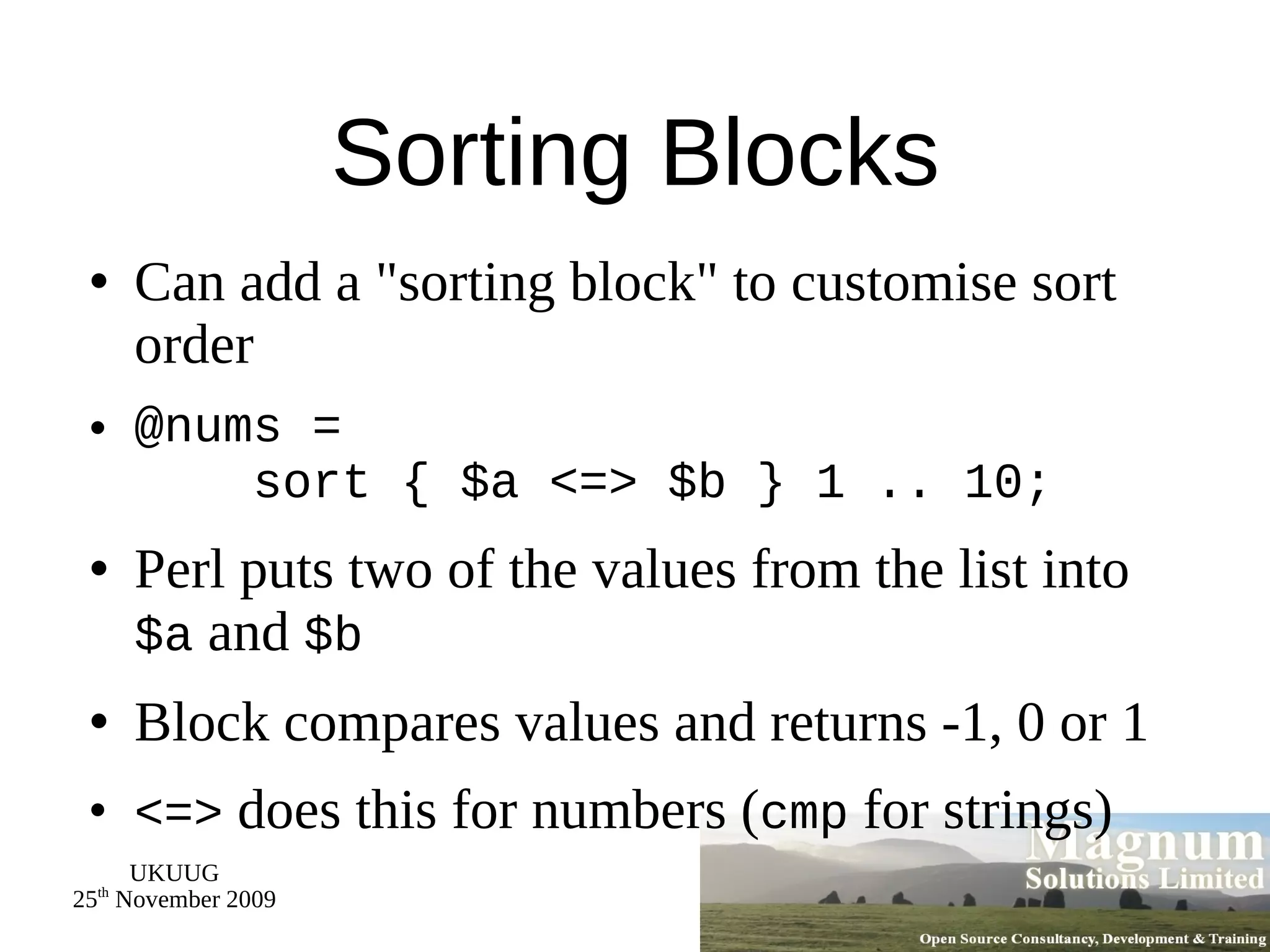
Sorting Blocks Can add a &quot;sorting block&quot; to customise sort order @nums =   sort { $a <=> $b } 1 .. 10; Perl puts two of the values from the list into  $a  and  $b Block compares values and returns -1, 0 or 1 <=>  does this for numbers ( cmp  for strings)
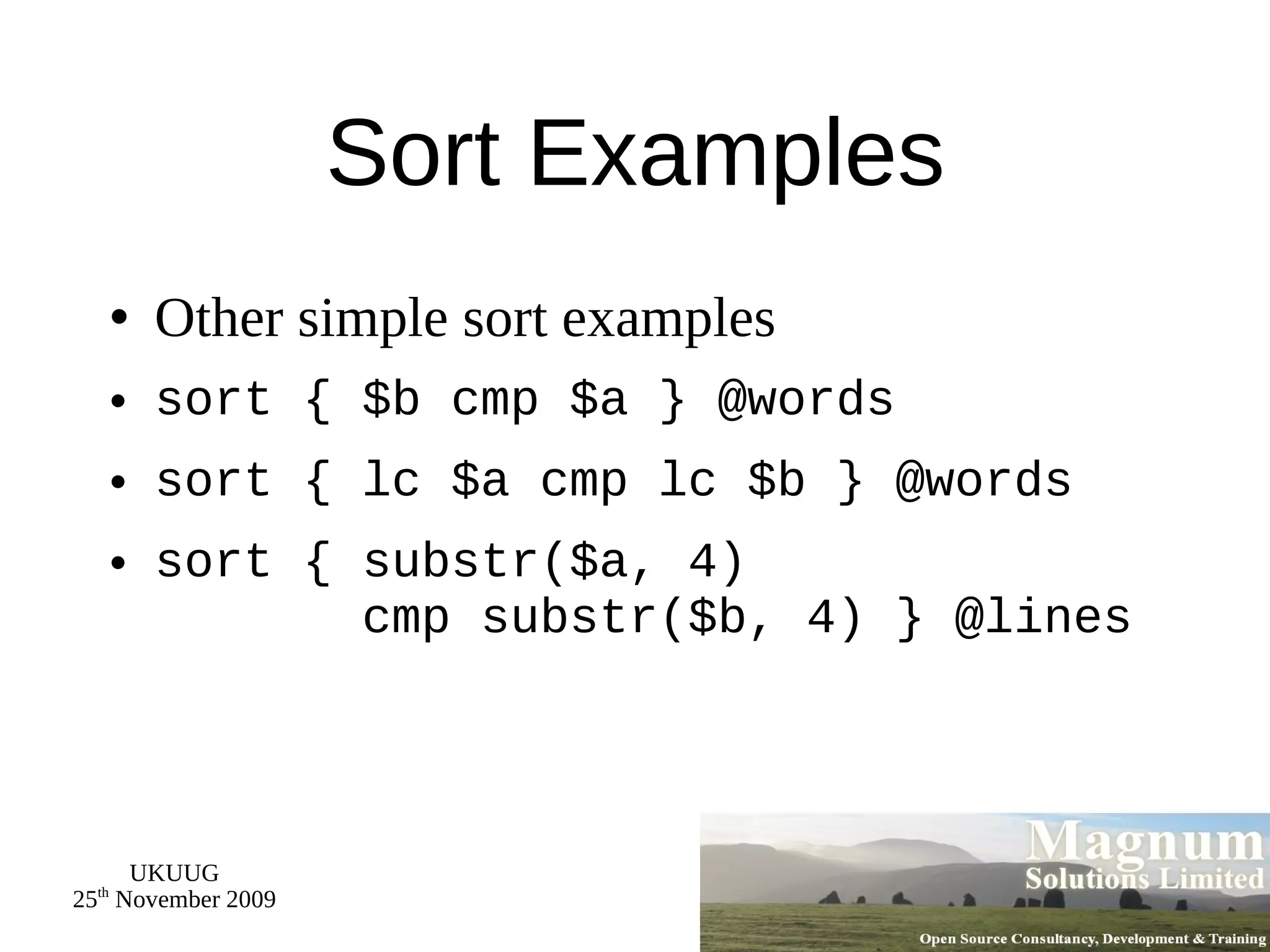
Sort Examples Other simple sort examples sort { $b cmp $a } @words sort { lc $a cmp lc $b } @words sort { substr($a, 4)    cmp substr($b, 4) } @lines
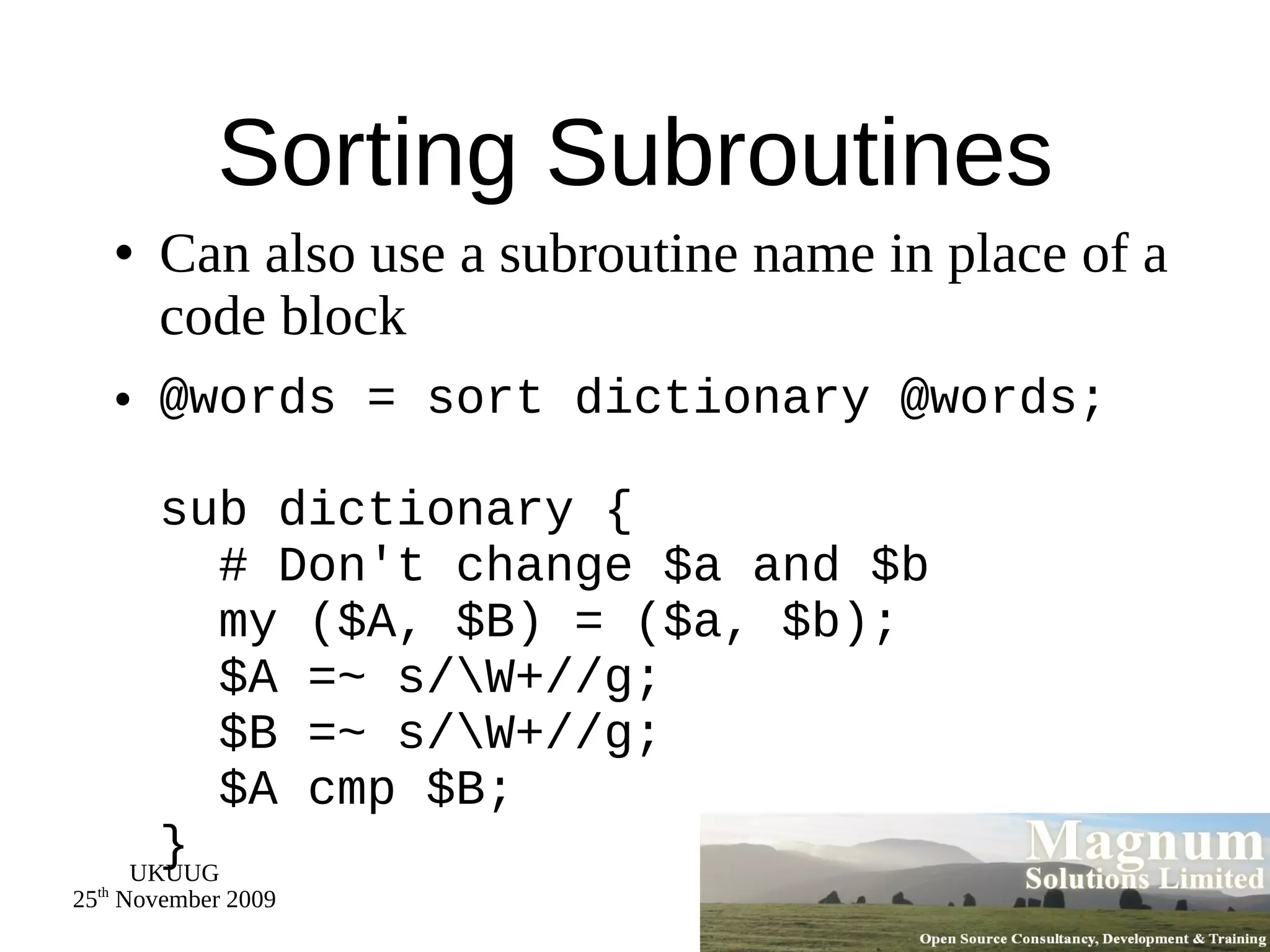
Sorting Subroutines Can also use a subroutine name in place of a code block @words = sort dictionary @words; sub dictionary {   # Don't change $a and $b   my ($A, $B) = ($a, $b);   $A =~ s/\W+//g;   $B =~ s/\W+//g;   $A cmp $B; }
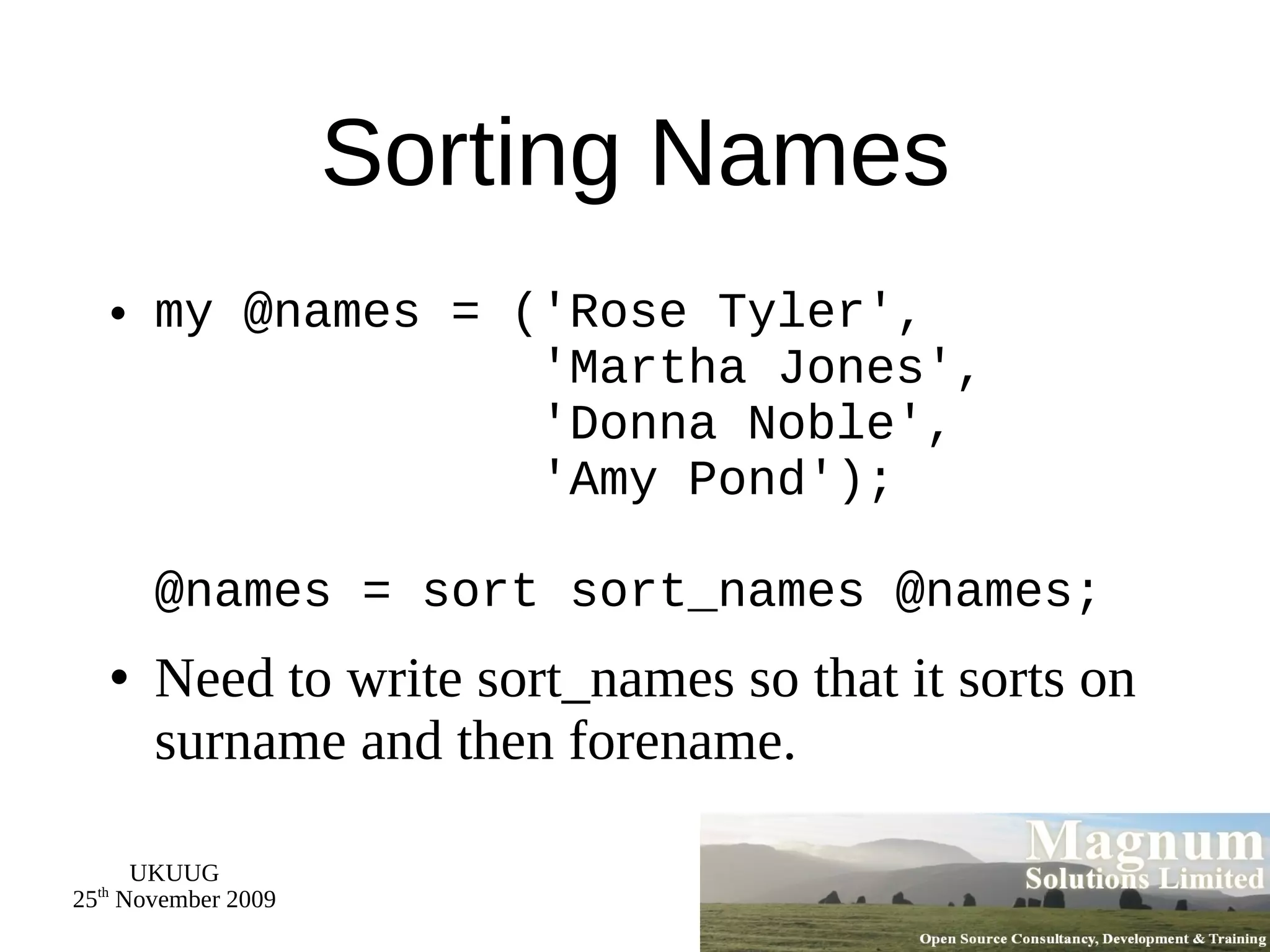
Sorting Names my @names = ('Rose Tyler',   'Martha Jones',   'Donna Noble',   'Amy Pond'); @names = sort sort_names @names; Need to write sort_names so that it sorts on surname and then forename.
Sorting Names (cont) sub sort_names {   my @a = split /\s/, $a;   my @b = split /\s/, $b;   return $a[1] cmp $b[1]   or $a[0] cmp $b[1]; }
More Complex Sorts sub sort_names {   my @a = split /\s/, $a;   my @b = split /\s/, $b;   return $a[1] cmp $b[1]   or $a[0] cmp $b[0]; } Can be inefficient on large amounts of data Multiple splits on the same data
More Efficient Sorts Split each row only once @split = map { [ split ] } @names; Do the comparison @sort = sort { $a->[1] cmp $b->[1]   or $a->[0] cmp $b->[0] } @split; Join the data together @names = map { join ' ', @$_ }    @sort;
Put It All Together Can rewrite this as @names = map  { join ' ', @$_ }   sort { $a->[1] cmp $b->[1]   || $a->[0] cmp $b->[0] }   map  { [ split ] } @names; All functions work on the output from the previous function in the chain
Schwartzian Transform @data_out =    map  { $_->[1] }   sort { $a->[0] cmp $a->[0] }   map  { [func($_), $_] }   @data_in; Old Lisp trick Named after Randal Schwartz
Reusable Code
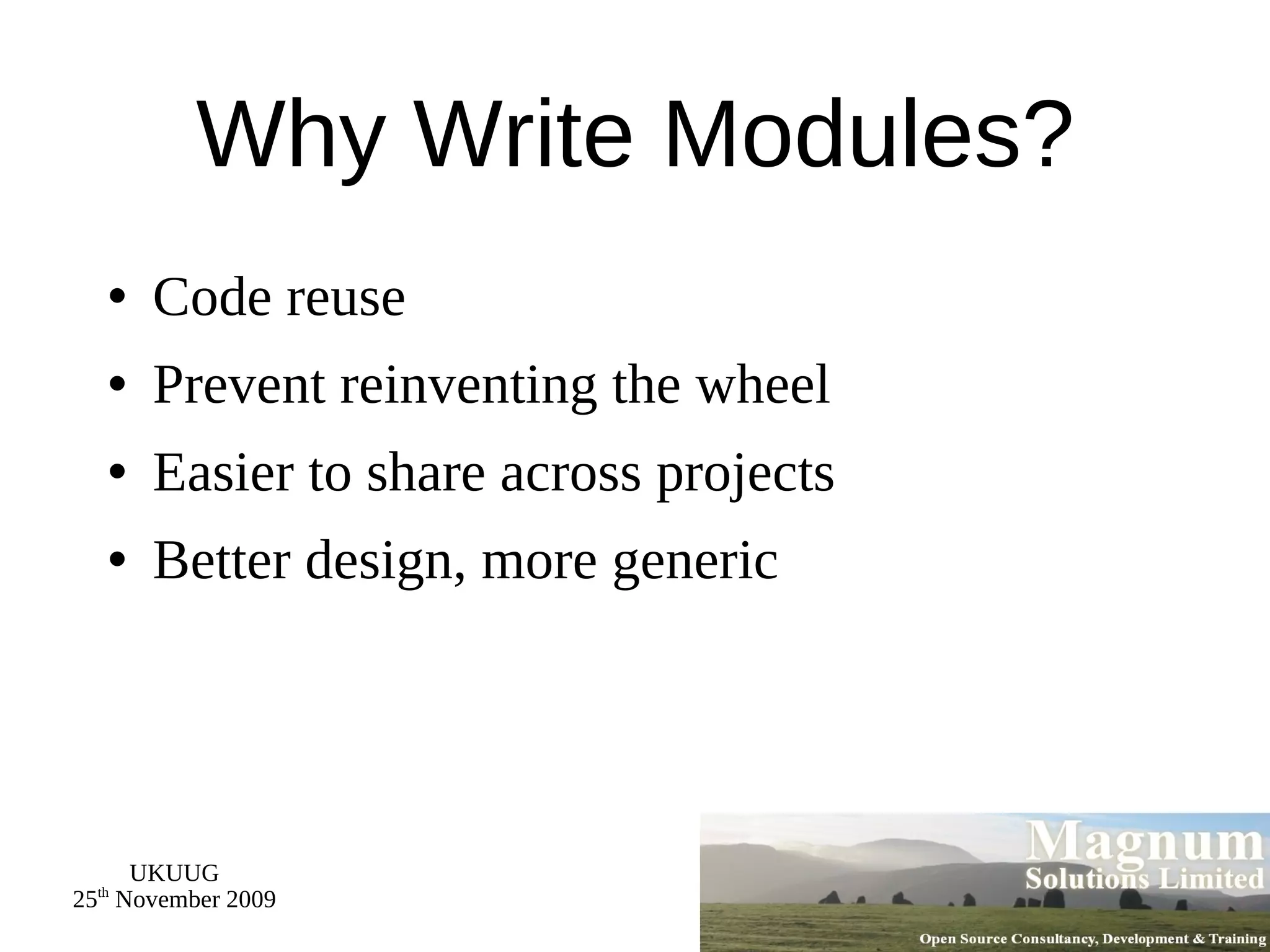
Why Write Modules? Code reuse Prevent reinventing the wheel Easier to share across projects Better design, more generic
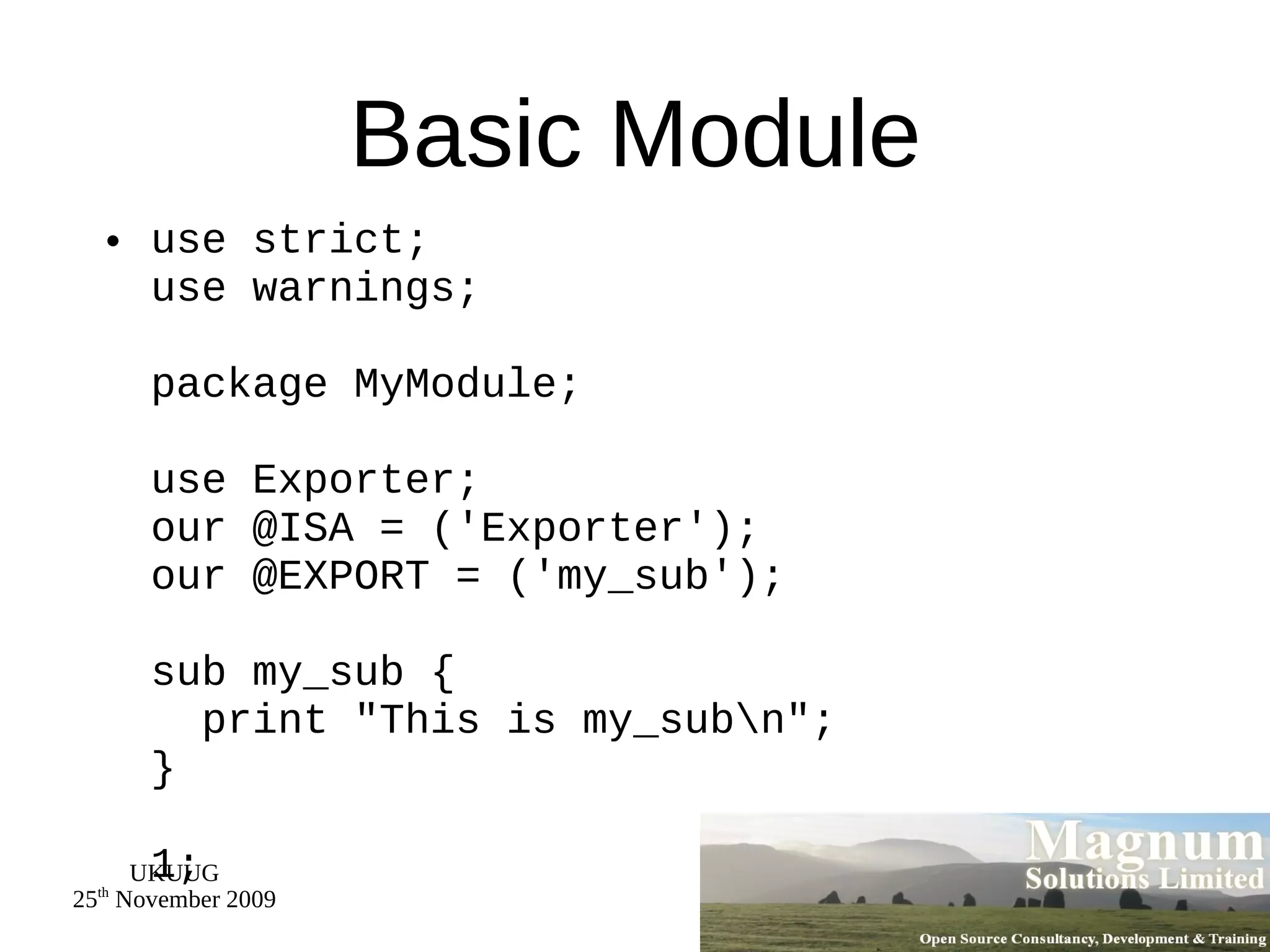
Basic Module use strict; use warnings; package MyModule; use Exporter; our @ISA = ('Exporter'); our @EXPORT = ('my_sub'); sub my_sub {   print &quot;This is my_sub\n&quot;; } 1;
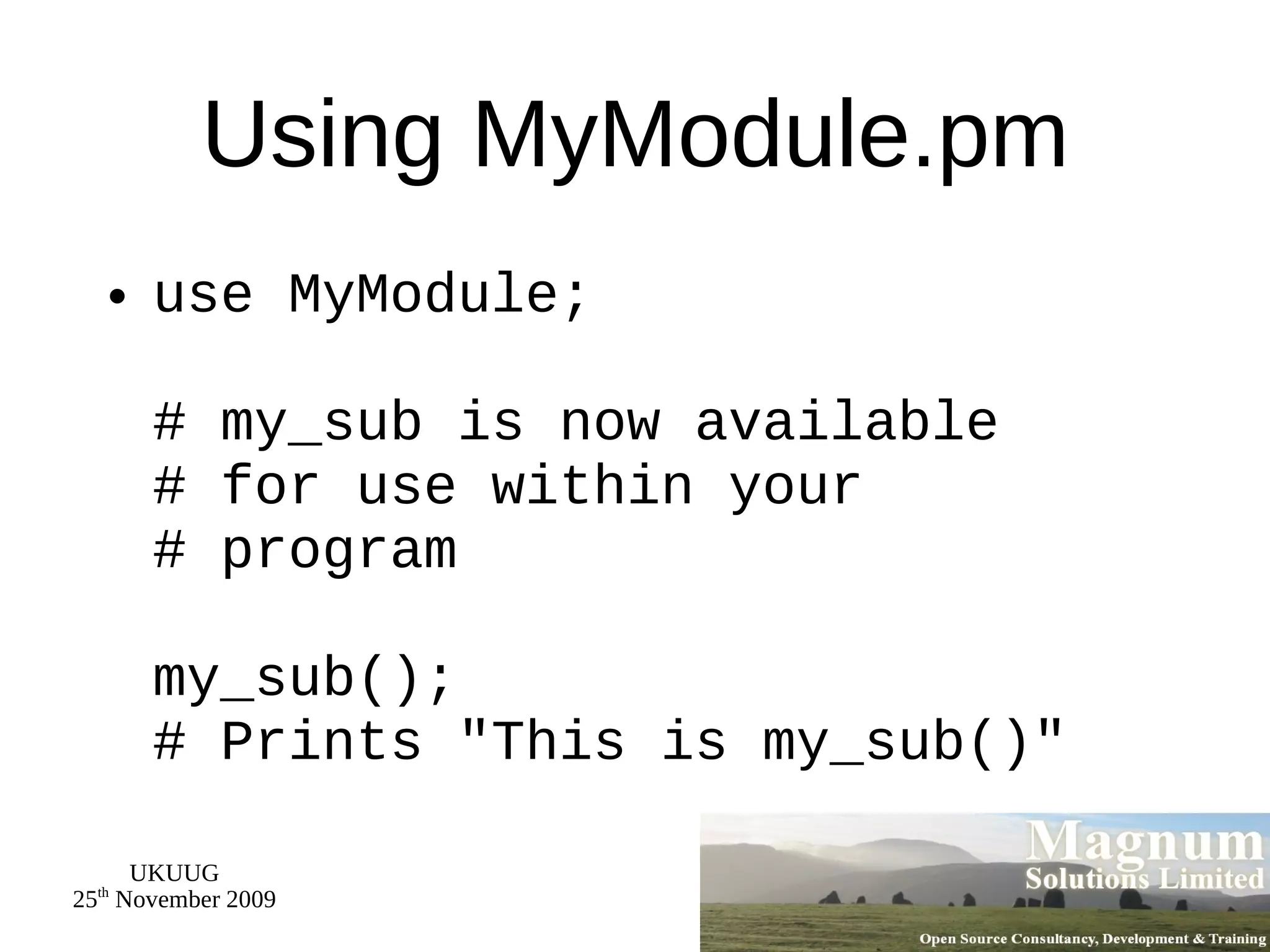
Using MyModule.pm use MyModule; # my_sub is now available  # for use within your # program my_sub();  # Prints &quot;This is my_sub()&quot;
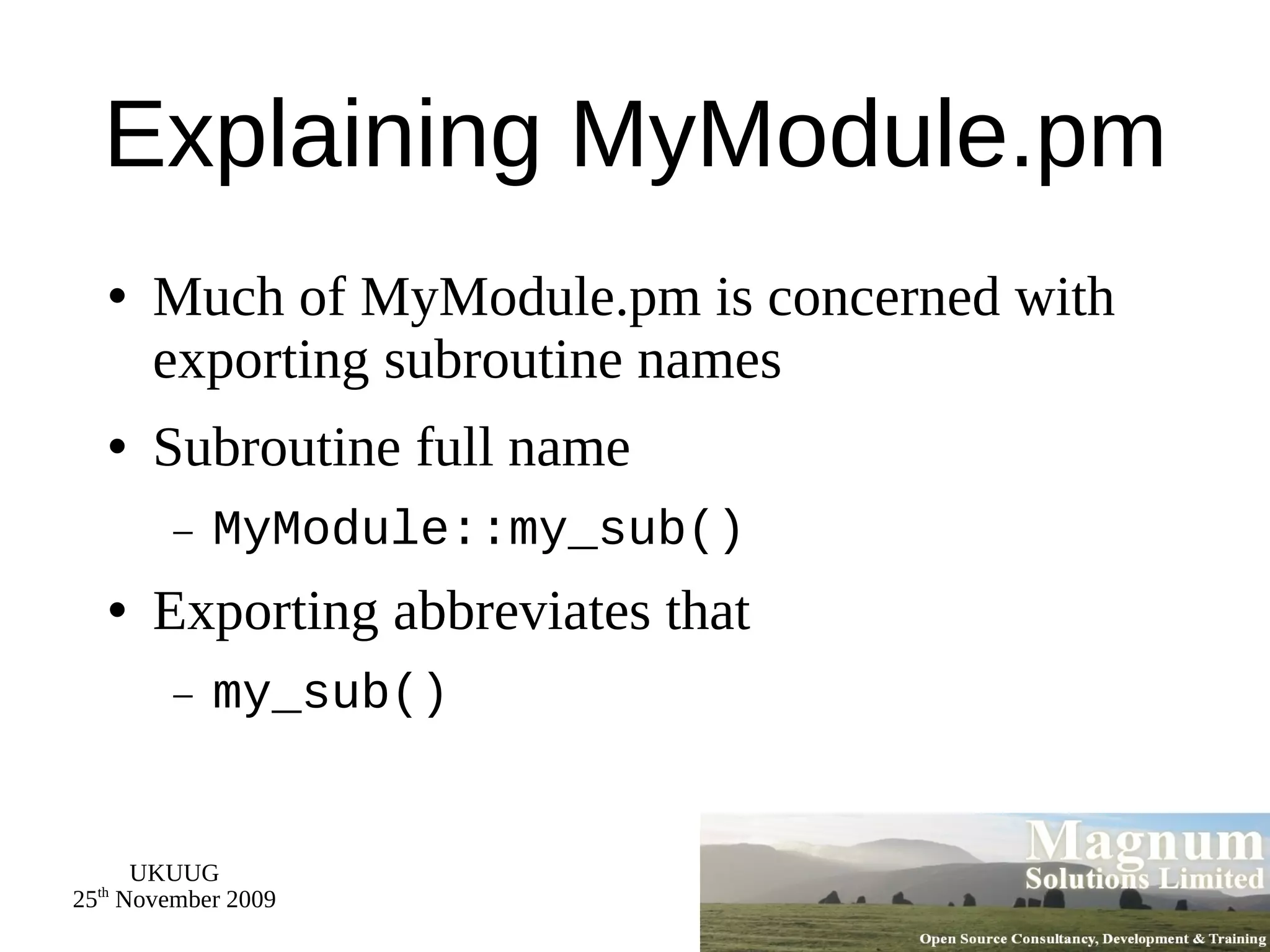
Explaining MyModule.pm Much of MyModule.pm is concerned with exporting subroutine names Subroutine full name MyModule::my_sub() Exporting abbreviates that my_sub()
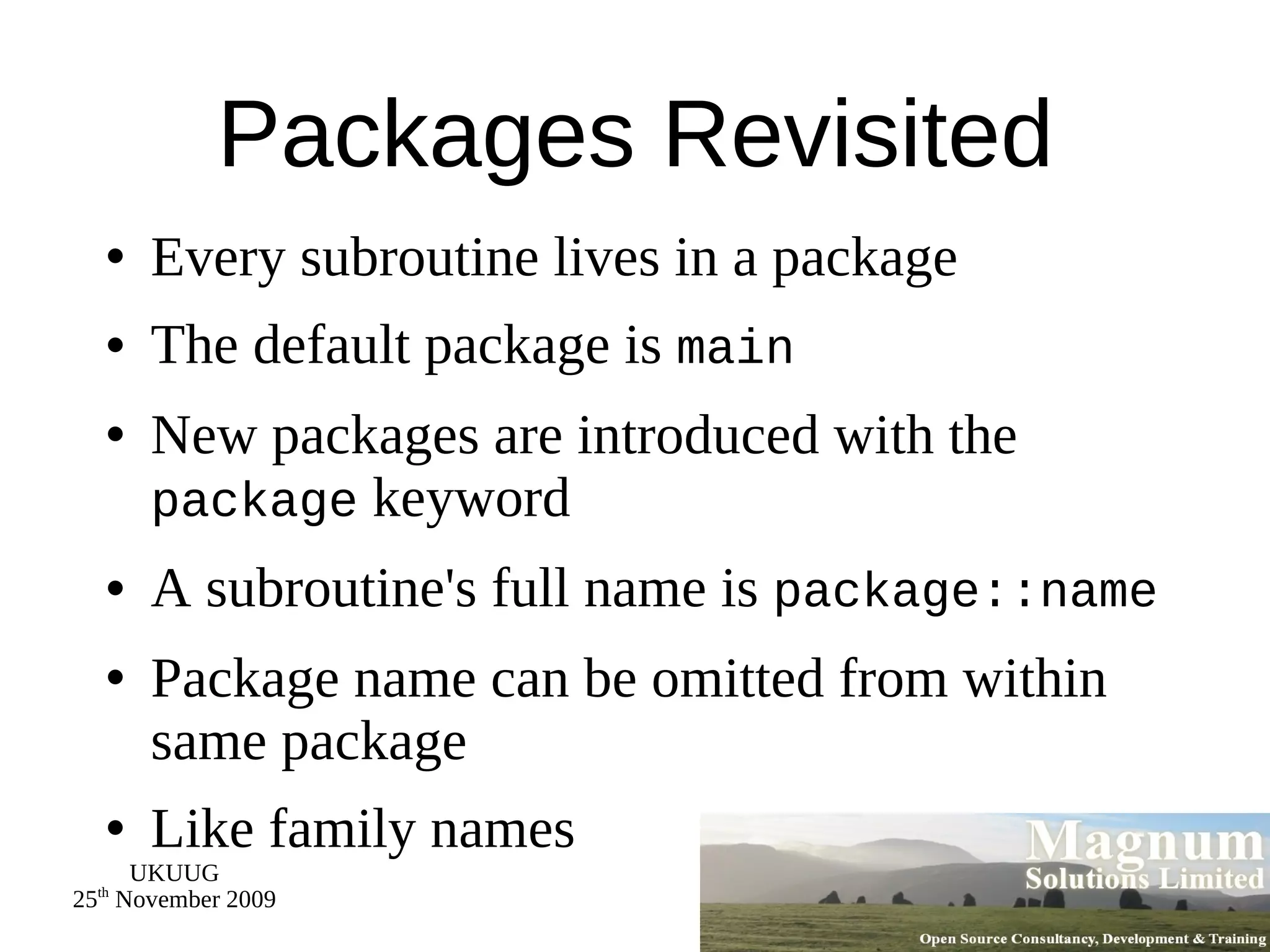
Packages Revisited Every subroutine lives in a package The default package is  main New packages are introduced with the  package  keyword A subroutine's full name is  package::name Package name can be omitted from within same package Like family names
Using Exporter The module Exporter.pm handles the export of subroutine (and variable) names Exporter.pm defines a subroutine called  import import  is automatically called whenever a module is used import  puts references to our subroutines into our caller's symbol table
How Exporter Works How does MyModule use Exporter's  import  subroutine? We make use of inheritance Inheritance is defined using the  @ISA  array If we call a subroutine that doesn't exist in our module, then the modules in  @ISA  are also checked Therefore  Exporter::import  is called
Exporting Symbols How does import know which subroutines to export? Exports are defined in  @EXPORT  or  @EXPORT_OK Automatic exports are defined in  @EXPORT Optional exports are defined in  @EXPORT_OK
Exporting Symbol Sets You can define sets of exports in  %EXPORT_TAGS Key is set name Value is reference to an array of names our %EXPORT_TAGS =   (advanced => [ qw( my_sub   my_other_sub ) ]; use MyModule qw(:advanced); my_sub(); my_other_sub();
Why Use @EXPORT_OK? Give your users the choice of which subroutines to import Less chances of name clashes Use  @EXPORT_OK  in preference to  @EXPORT Document the exported names and sets
Exporting Variables You can also export variables @EXPORT_OK = qw($scalar,   @array,   %hash); Can be part of export sets Any variables you export must be package variables
Writing Modules The Easy Way A lot of module code is similar Don't write the boilerplate yourself Copy from an existing module Or look at Module::Starter
Object Orientation
OO Programming Traditional programming has subroutines acting on methods OO inverts this Classes contain methods which define their actions Objects are instances of classes Perl has an OO system bolted on Best of both worlds
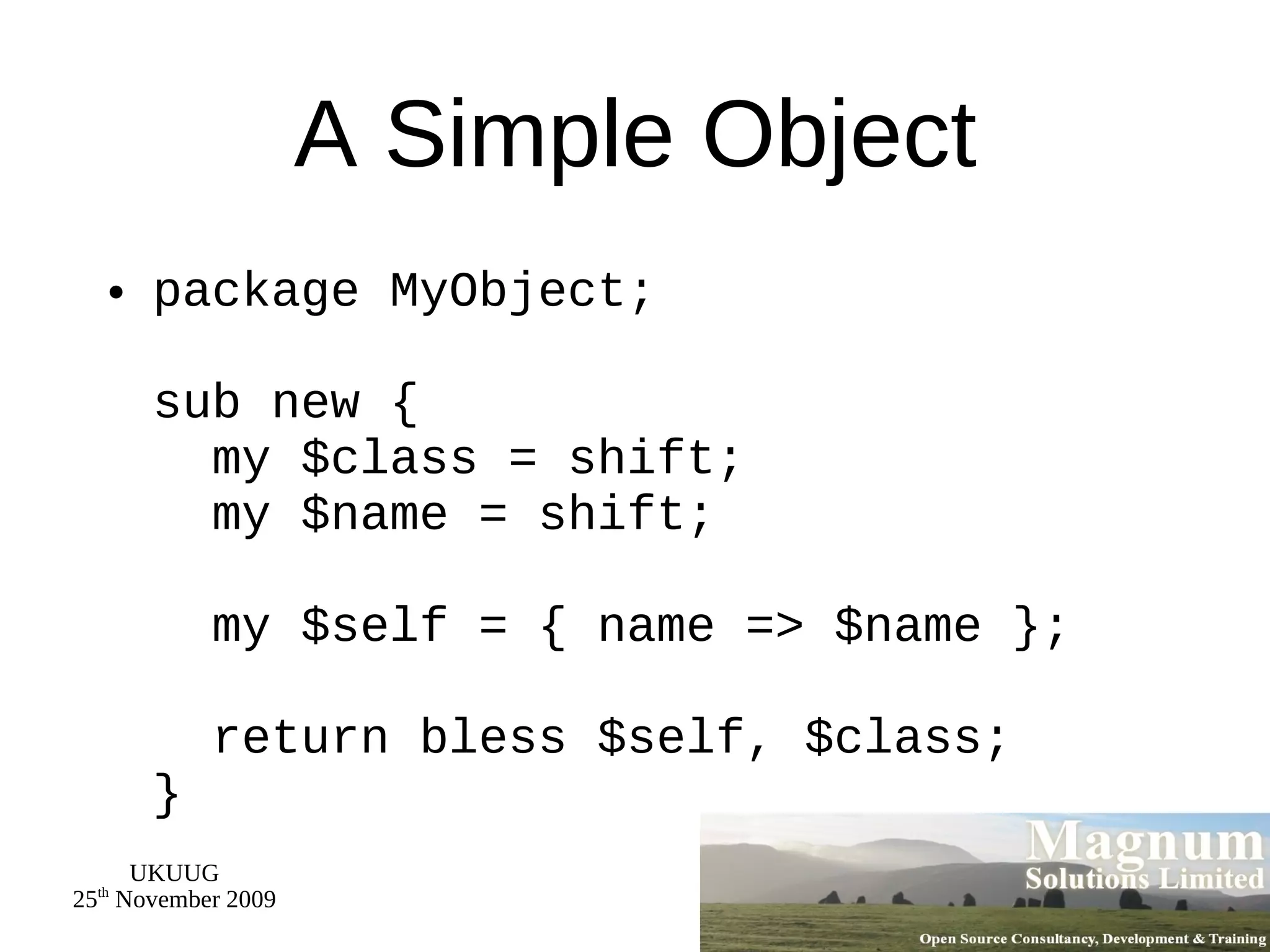
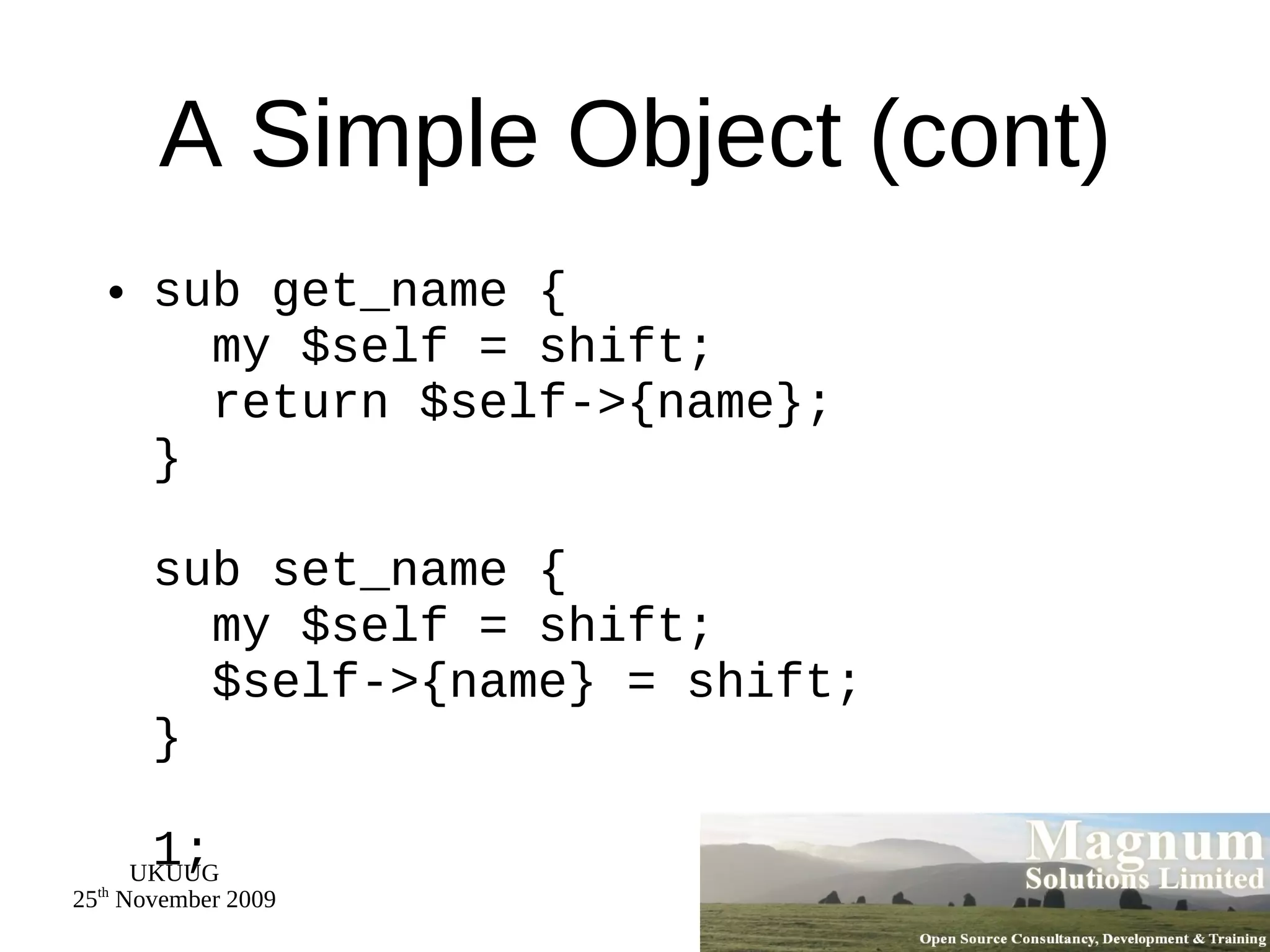
Object Oriented Perl An Object is just a module that obeys certain extra rules Three rules of Perl objects A Class is a package An Object is a reference (usually to a hash) A Method is a subroutine bless  tells a reference what kind of object it is
A Simple Object package MyObject; sub new {   my $class = shift;   my $name = shift;   my $self = { name => $name };   return bless $self, $class; }
A Simple Object (cont) sub get_name {   my $self = shift;   return $self->{name}; } sub set_name {   my $self = shift;   $self->{name} = shift; } 1;
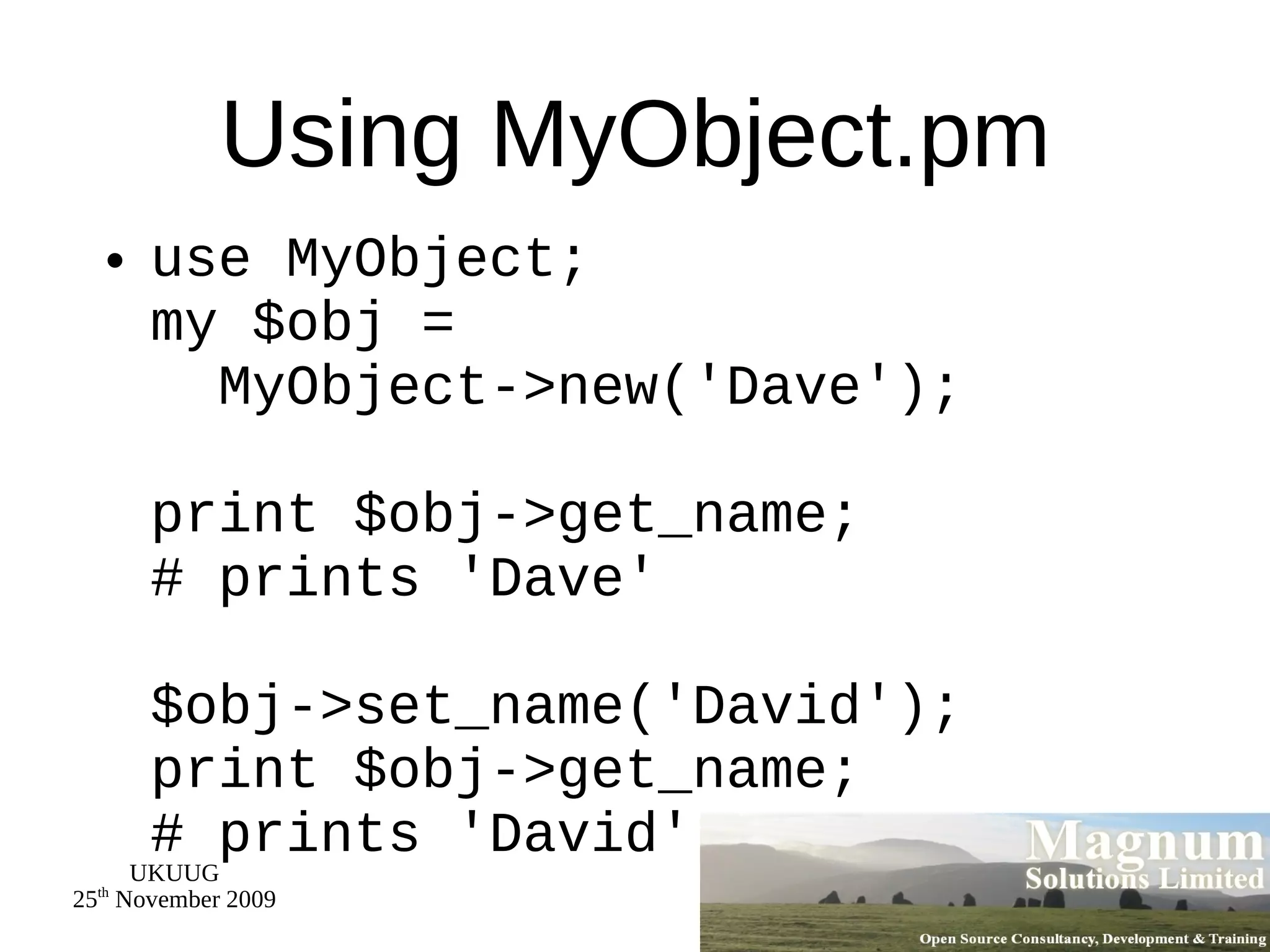
Using MyObject.pm use MyObject; my $obj =   MyObject->new('Dave'); print $obj->get_name; # prints 'Dave' $obj->set_name('David'); print $obj->get_name; # prints 'David'
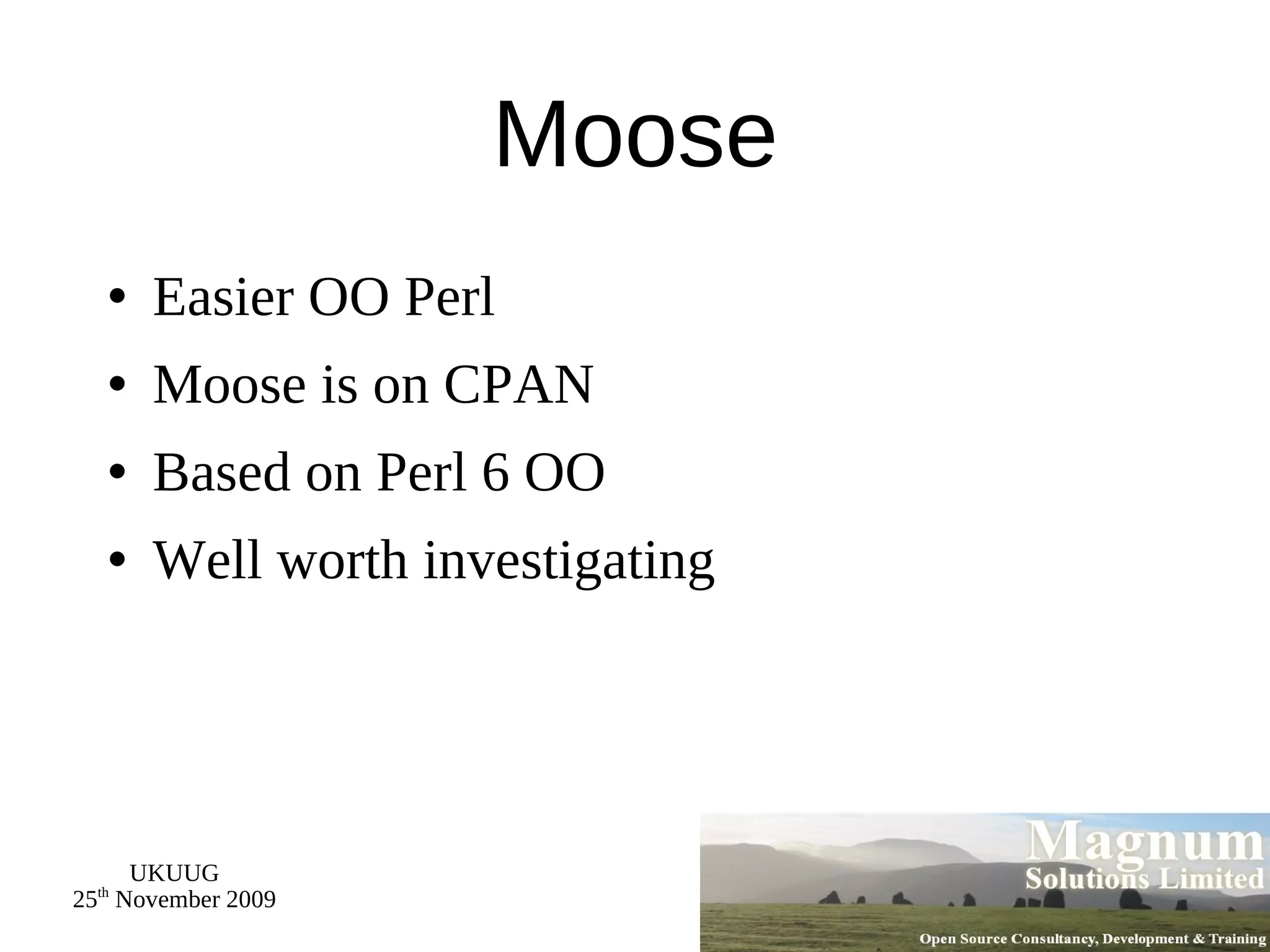
Moose Easier OO Perl Moose is on CPAN Based on Perl 6 OO Well worth investigating
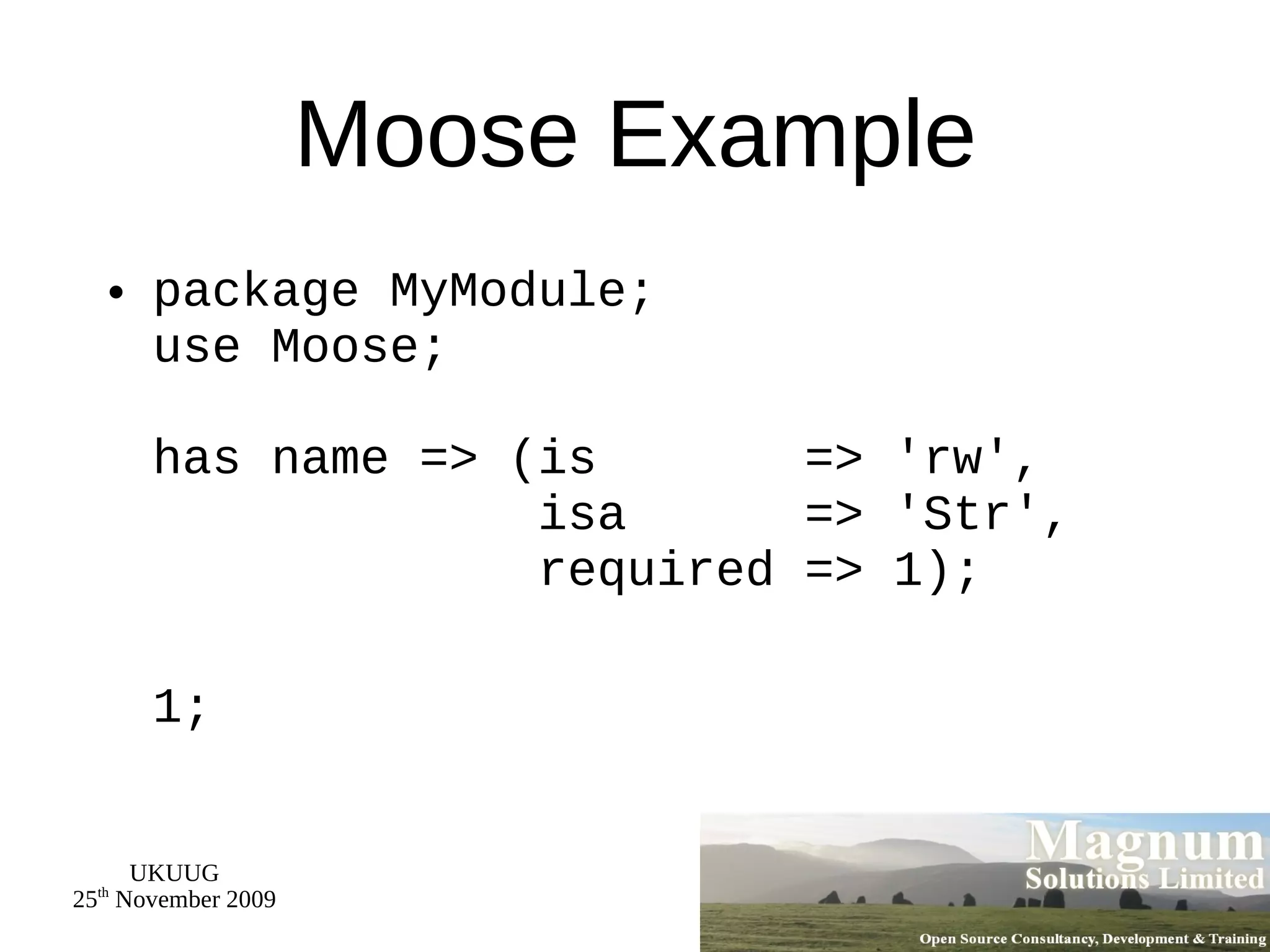
Moose Example package MyModule; use Moose; has name => (is  => 'rw',   isa  => 'Str',   required => 1); 1;
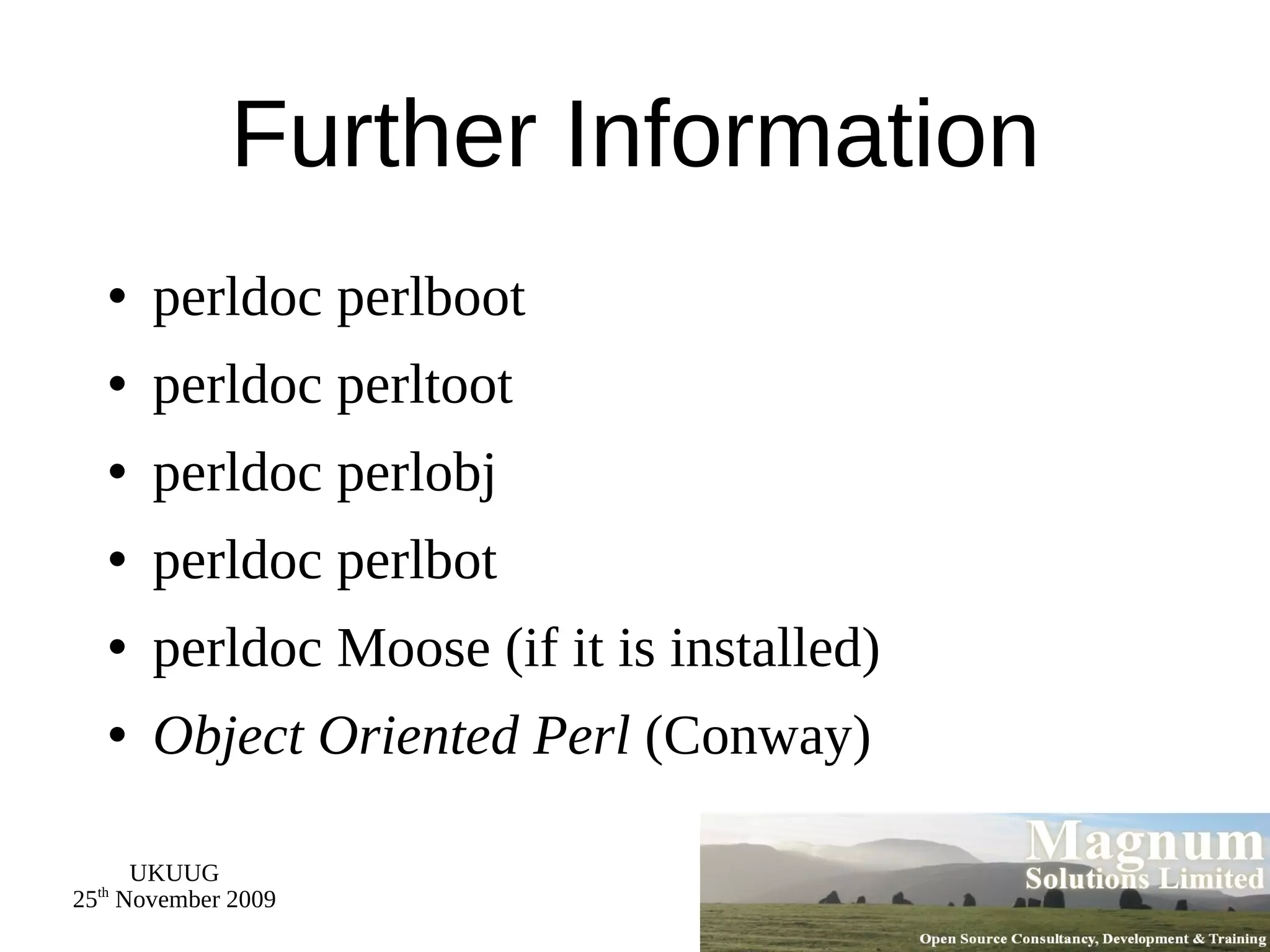
Further Information perldoc perlboot perldoc perltoot perldoc perlobj perldoc perlbot perldoc Moose (if it is installed) Object Oriented Perl  (Conway)
Testing
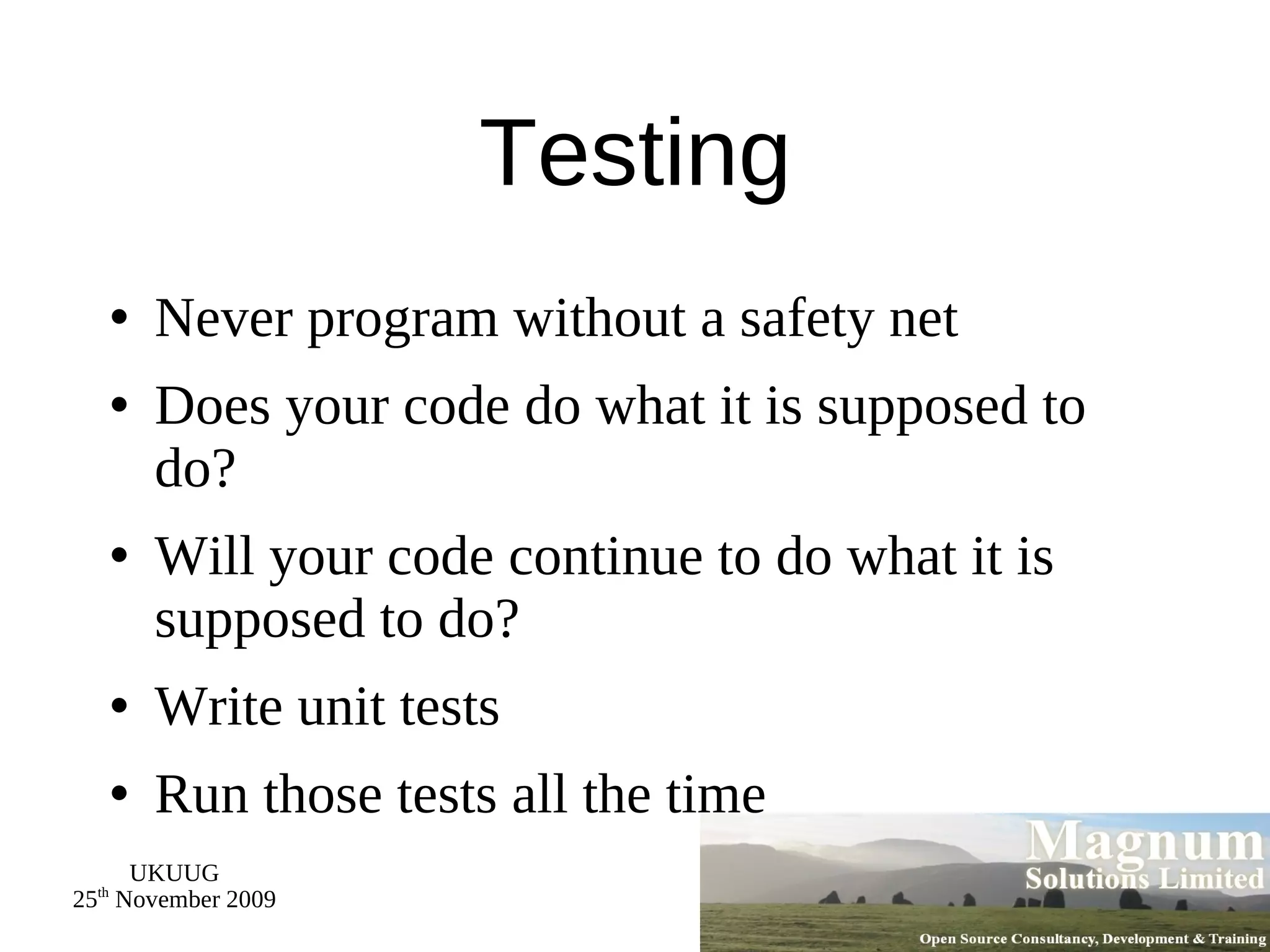
Testing Never program without a safety net Does your code do what it is supposed to do? Will your code continue to do what it is supposed to do? Write unit tests Run those tests all the time
When to Run Tests As often as possible Before you add a feature After you have added a feature Before checking in code Before releasing code Constantly, automaticall y
Testing in Perl Perl makes it easy to write test suites A lot of work in this area over the last eight years Test::Simple and Test::More included in Perl distribution Many more testing modules on CPAN
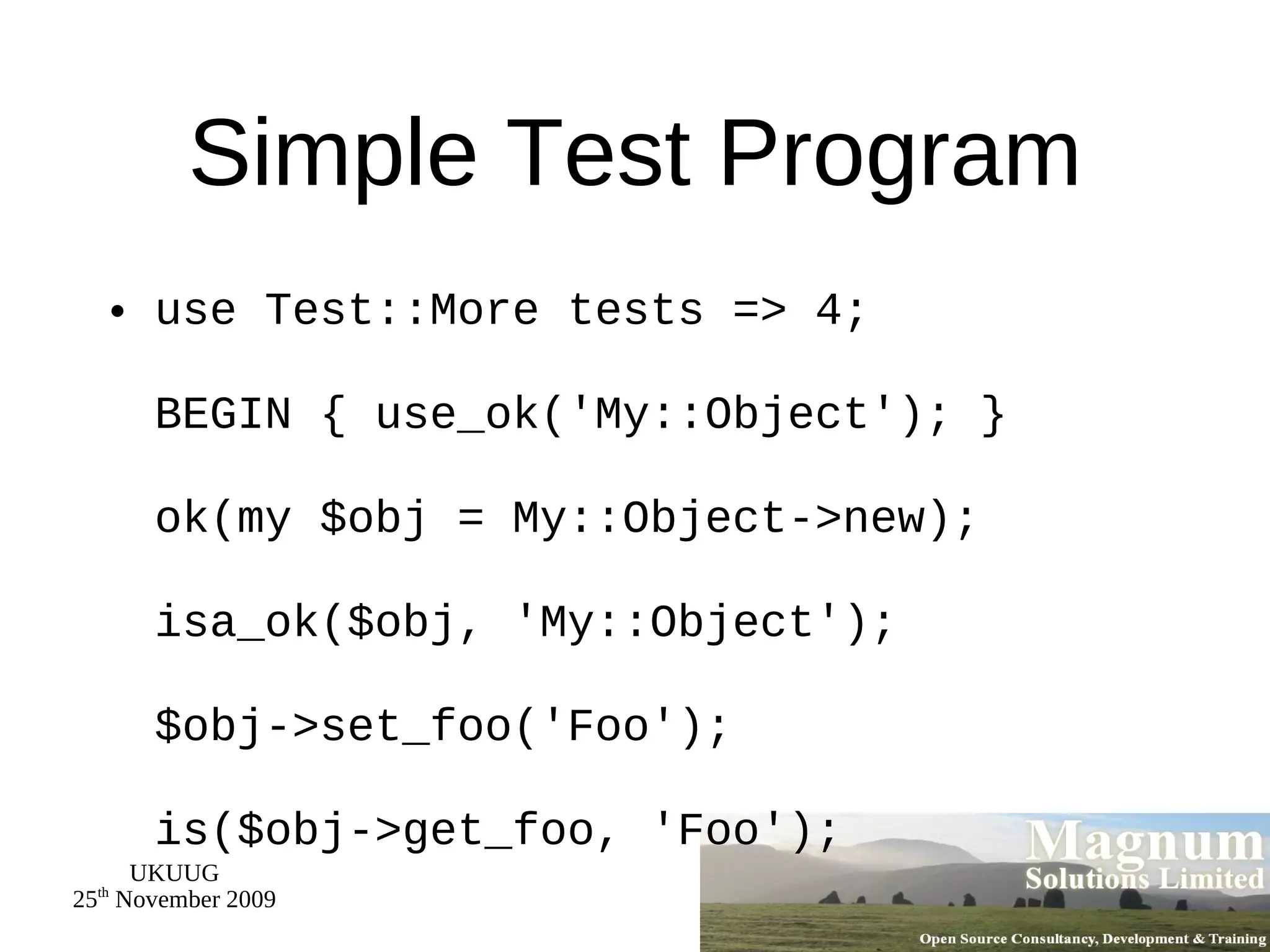
Simple Test Program use Test::More tests => 4; BEGIN { use_ok('My::Object'); } ok(my $obj = My::Object->new); isa_ok($obj, 'My::Object'); $obj->set_foo('Foo'); is($obj->get_foo, 'Foo');
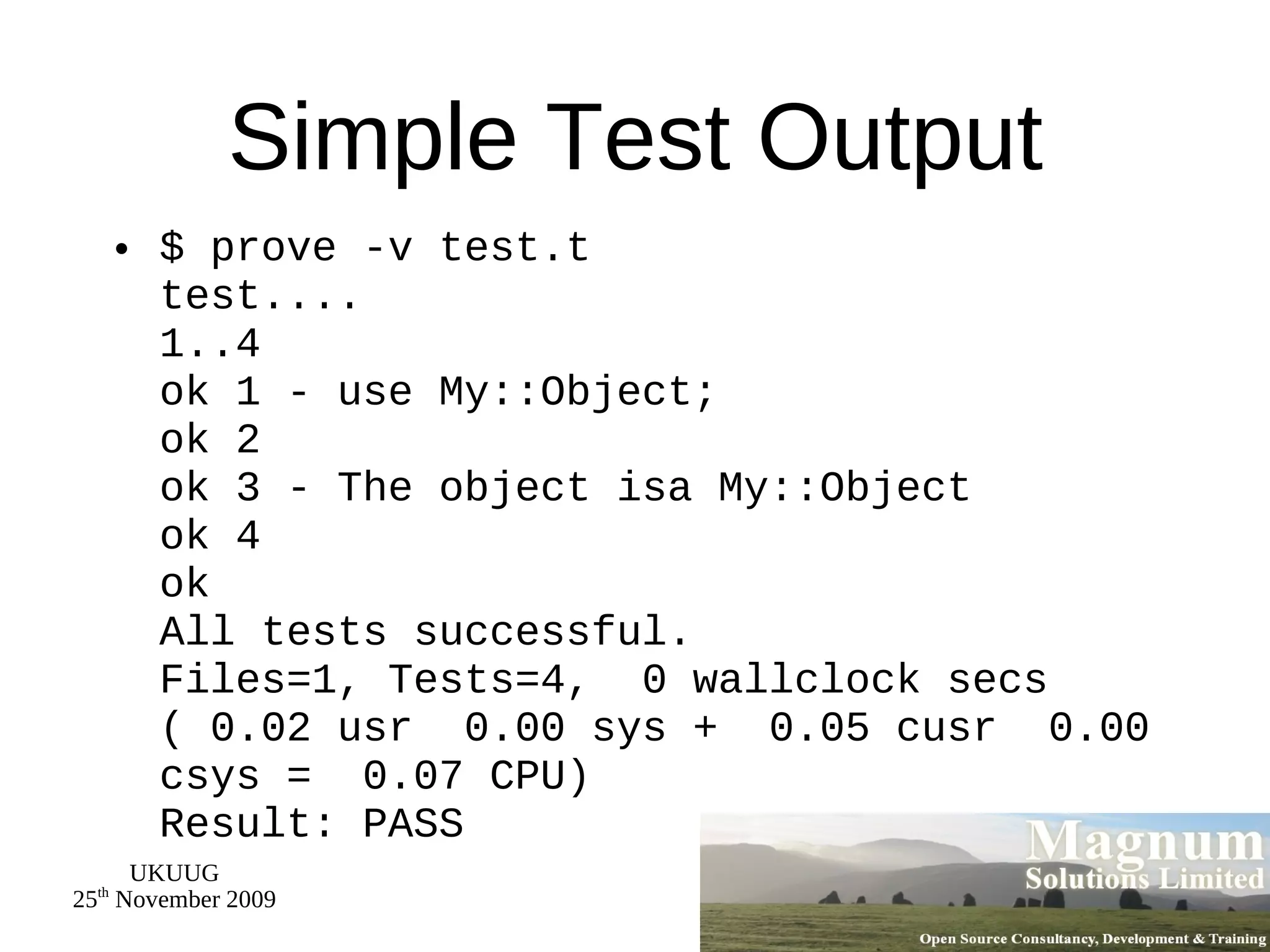
Simple Test Output $ prove -v test.t test.... 1..4 ok 1 - use My::Object; ok 2 ok 3 - The object isa My::Object ok 4 ok All tests successful. Files=1, Tests=4,  0 wallclock secs ( 0.02 usr  0.00 sys +  0.05 cusr  0.00 csys =  0.07 CPU) Result: PASS
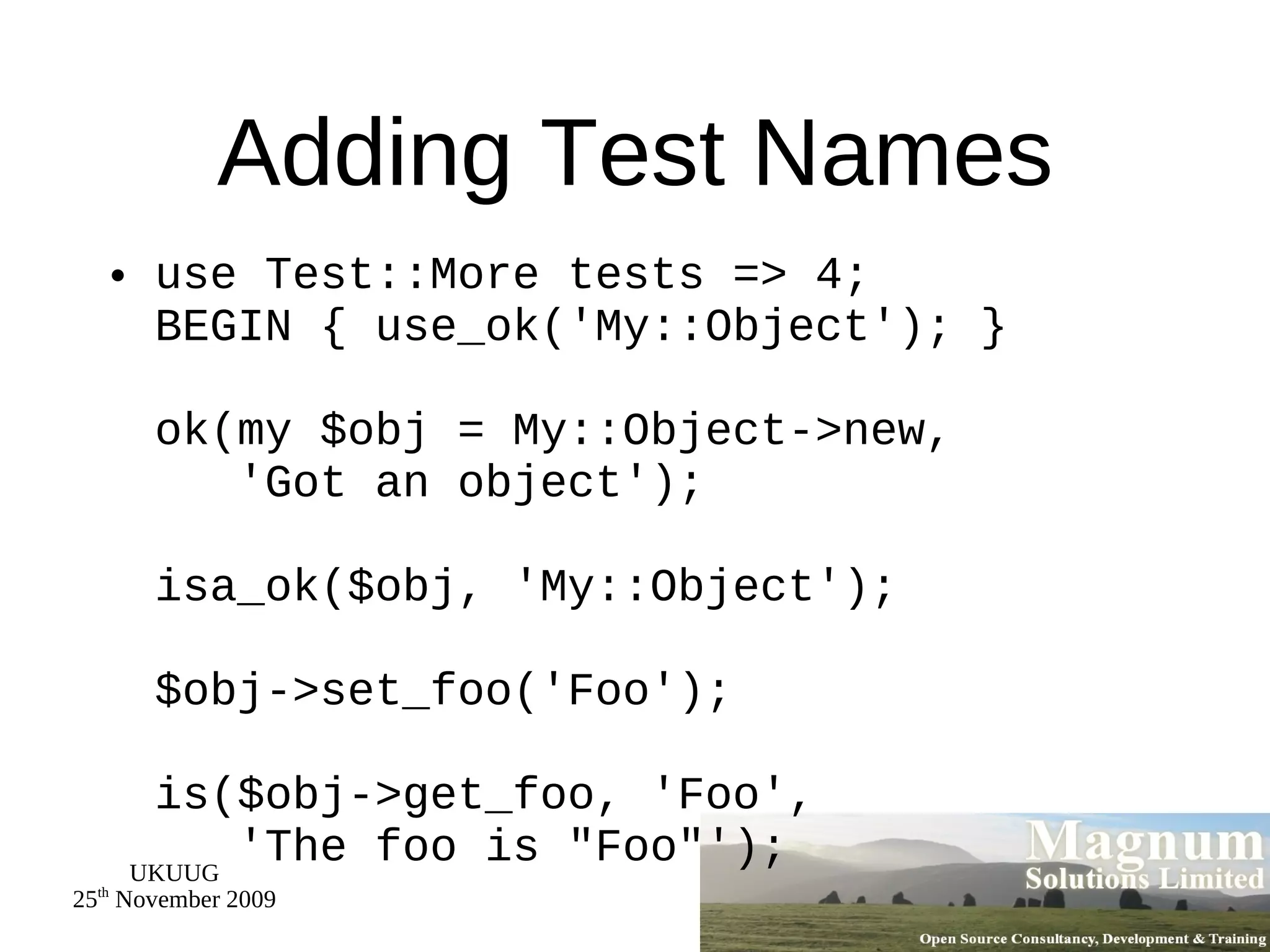
Adding Test Names use Test::More tests => 4; BEGIN { use_ok('My::Object'); } ok(my $obj = My::Object->new,   'Got an object'); isa_ok($obj, 'My::Object'); $obj->set_foo('Foo'); is($obj->get_foo, 'Foo',   'The foo is &quot;Foo&quot;');
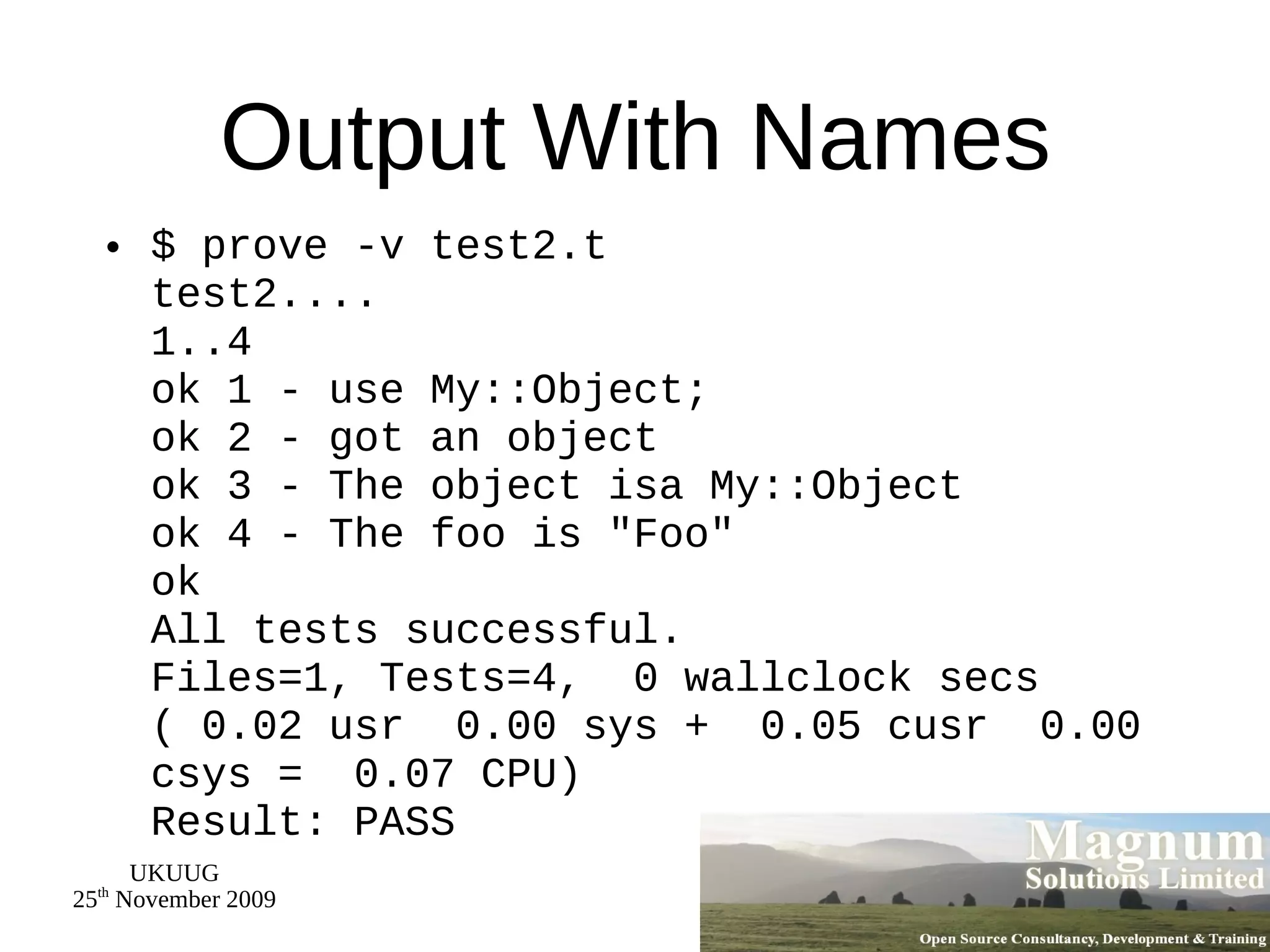
Output With Names $ prove -v test2.t test2.... 1..4 ok 1 - use My::Object; ok 2 - got an object ok 3 - The object isa My::Object ok 4 - The foo is &quot;Foo&quot; ok All tests successful. Files=1, Tests=4,  0 wallclock secs ( 0.02 usr  0.00 sys +  0.05 cusr  0.00 csys =  0.07 CPU) Result: PASS
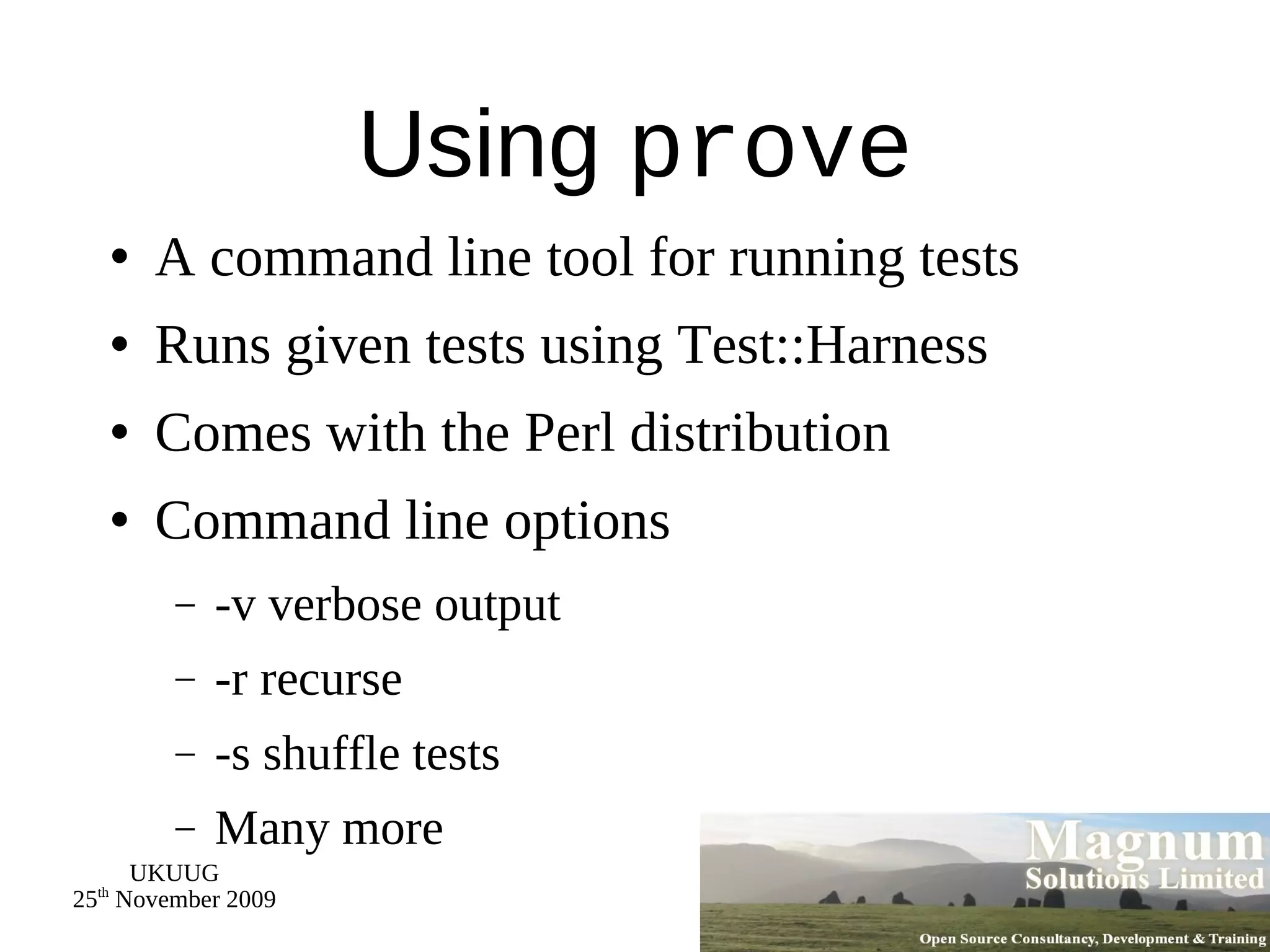
Using  prove A command line tool for running tests Runs given tests using Test::Harness Comes with the Perl distribution Command line options -v verbose output -r recurse -s shuffle tests Many more
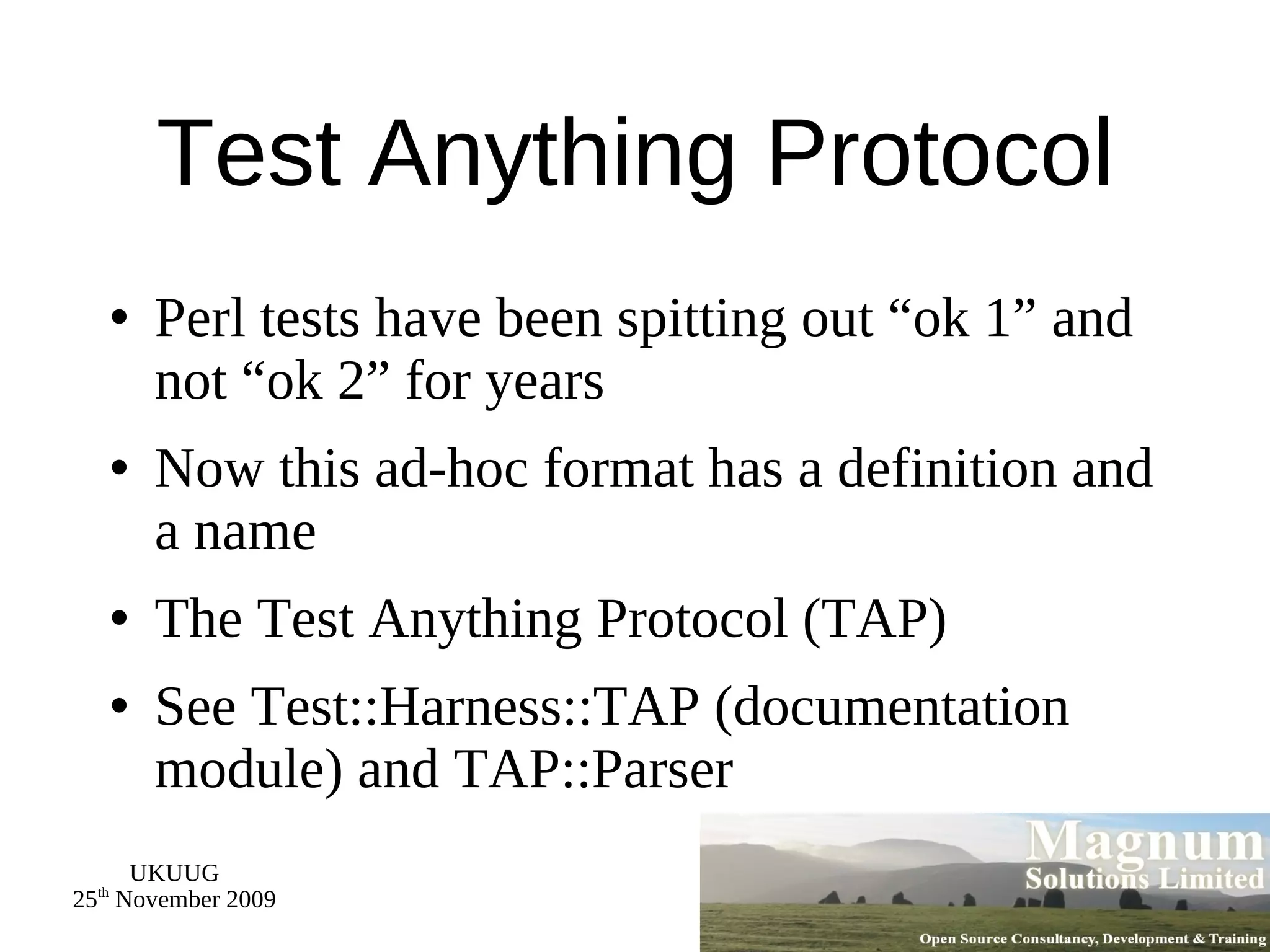
Test Anything Protocol Perl tests have been spitting out “ok 1” and not “ok 2” for years Now this ad-hoc format has a definition and a name The Test Anything Protocol (TAP) See Test::Harness::TAP (documentation module) and TAP::Parser
TAP Output More possibilities for test output TAP::Harness::Color Test::TAP::HTMLMatrix Make sense of your test results
More Testing Modules Dozens of testing modules on CPAN Some of my favourites Test::File Test::Exception, Test::Warn Test::Differences Test::XML (includes Test::XML::XPath)
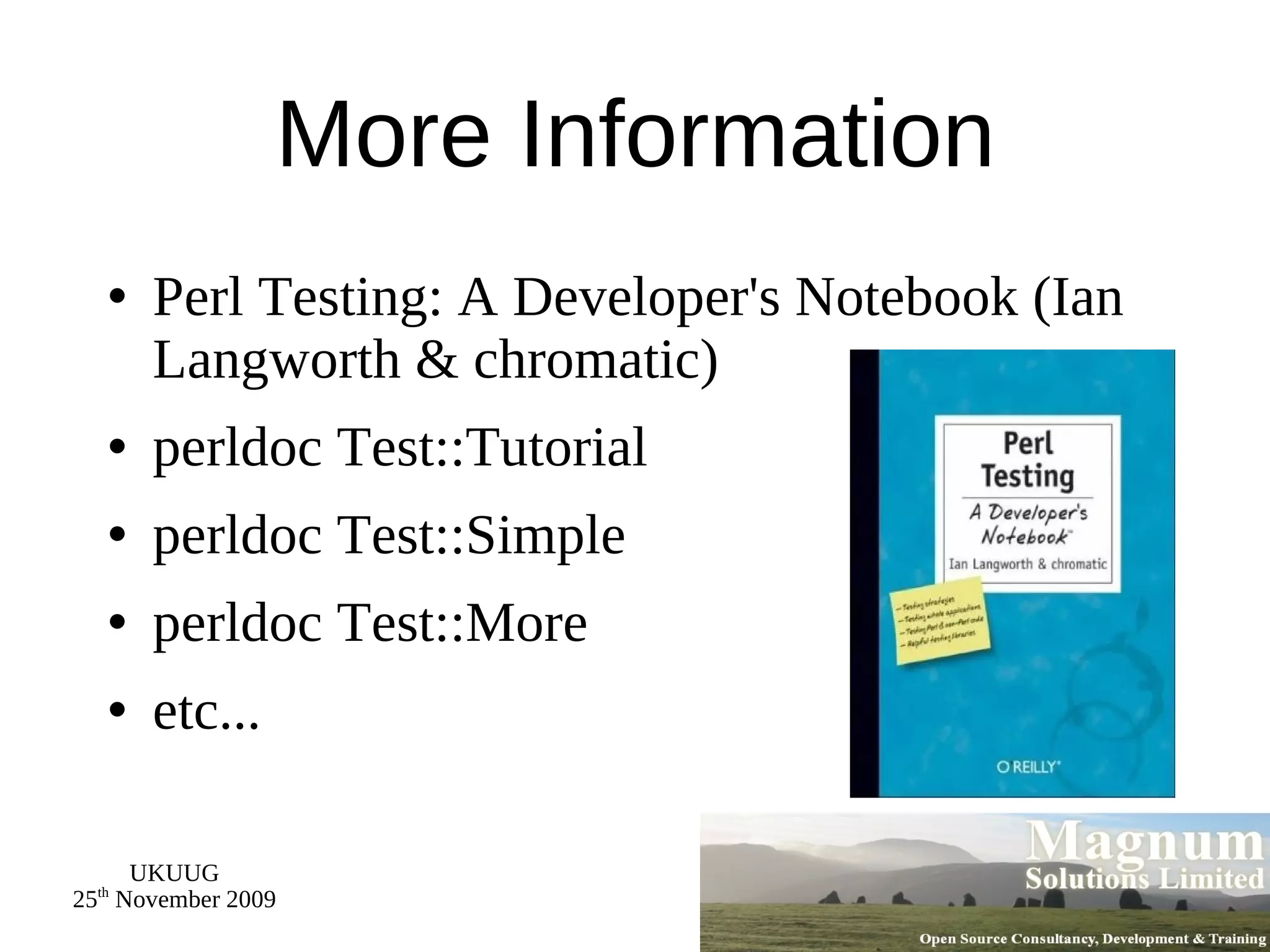
More Information Perl Testing: A Developer's Notebook (Ian Langworth & chromatic) perldoc Test::Tutorial perldoc Test::Simple perldoc Test::More etc...
Dates and Times
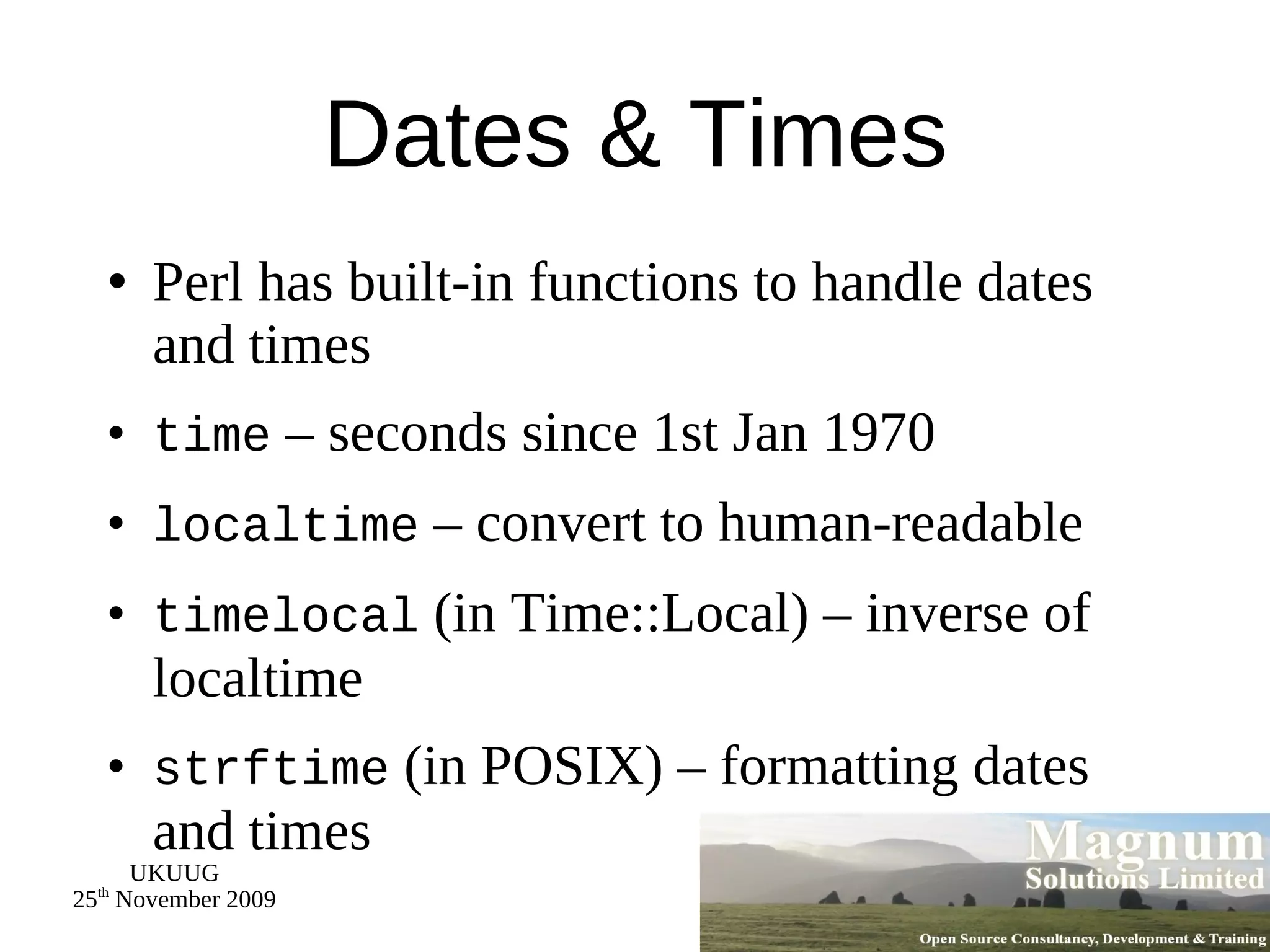
Dates & Times Perl has built-in functions to handle dates and times time  – seconds since 1st Jan 1970 localtime  – convert to human-readable timelocal  (in Time::Local) – inverse of localtime strftime  (in POSIX) – formatting dates and times
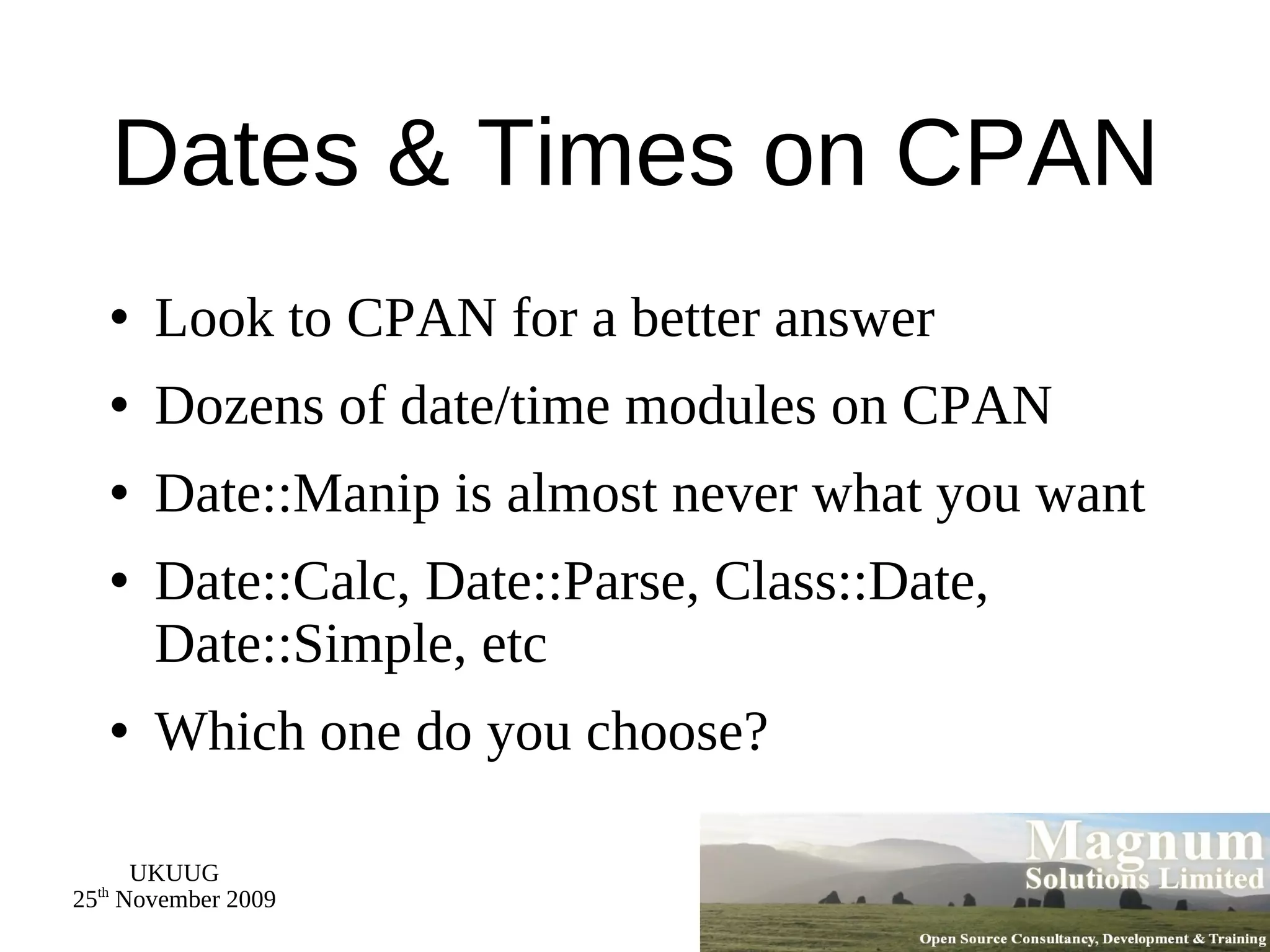
Dates & Times on CPAN Look to CPAN for a better answer Dozens of date/time modules on CPAN Date::Manip is almost never what you want Date::Calc, Date::Parse, Class::Date, Date::Simple, etc Which one do you choose?
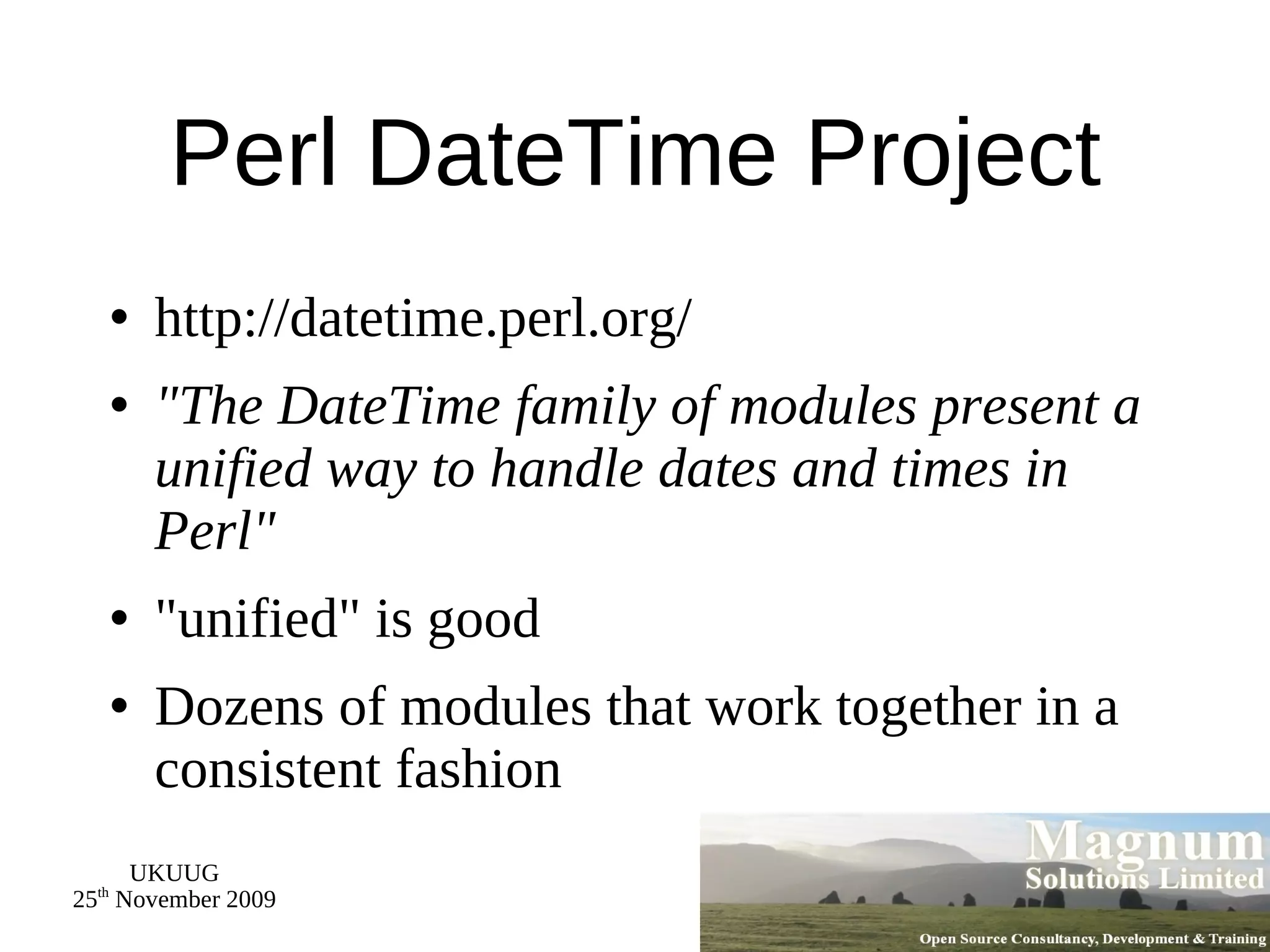
Perl DateTime Project http://datetime.perl.org/ &quot;The DateTime family of modules present a unified way to handle dates and times in Perl&quot; &quot;unified&quot; is good Dozens of modules that work together in a consistent fashion
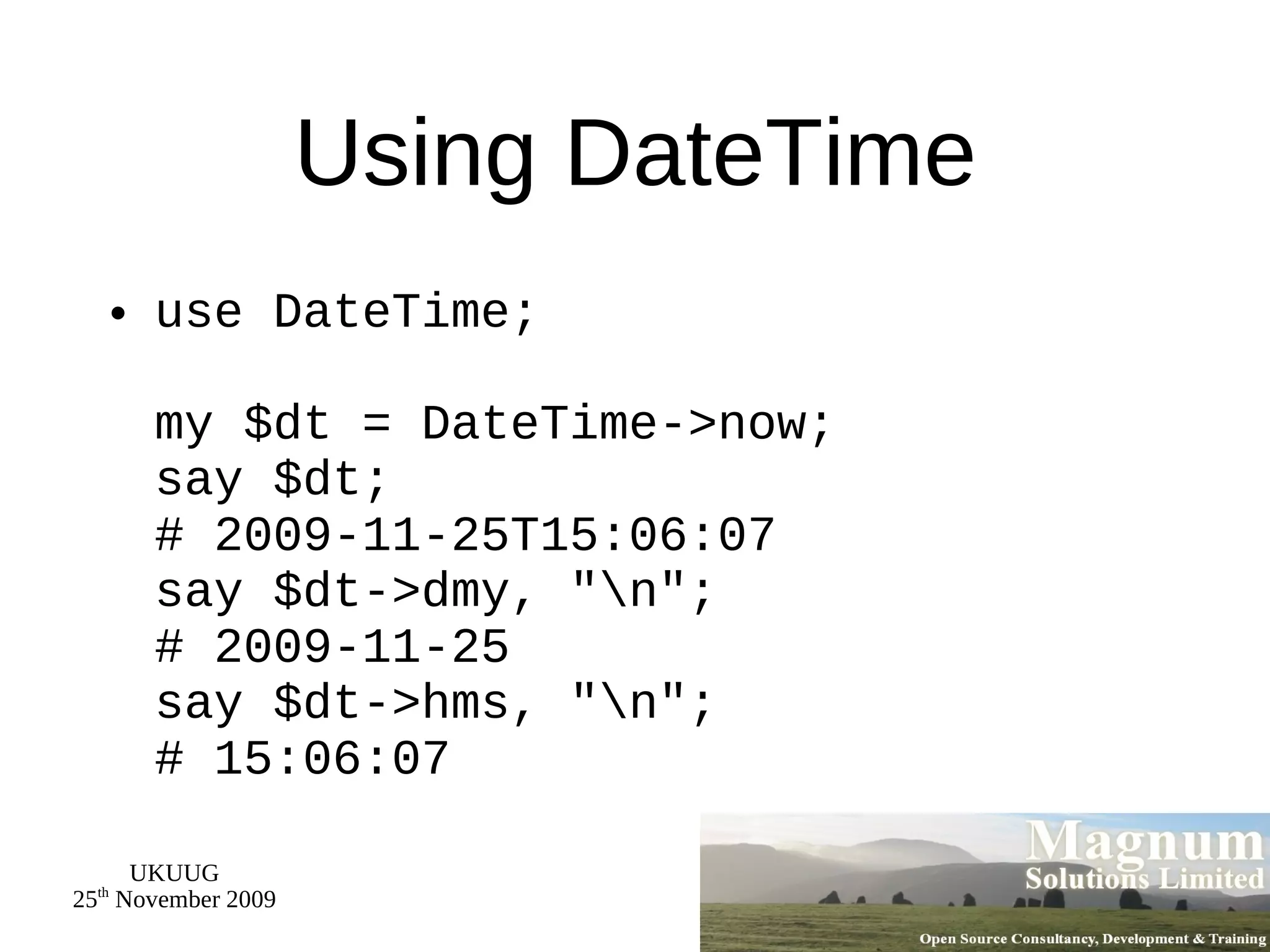
Using DateTime use DateTime; my $dt = DateTime->now; say $dt; # 2009-11-25T15:06:07 say $dt->dmy, &quot;\n&quot;; # 2009-11-25 say $dt->hms, &quot;\n&quot;; # 15:06:07
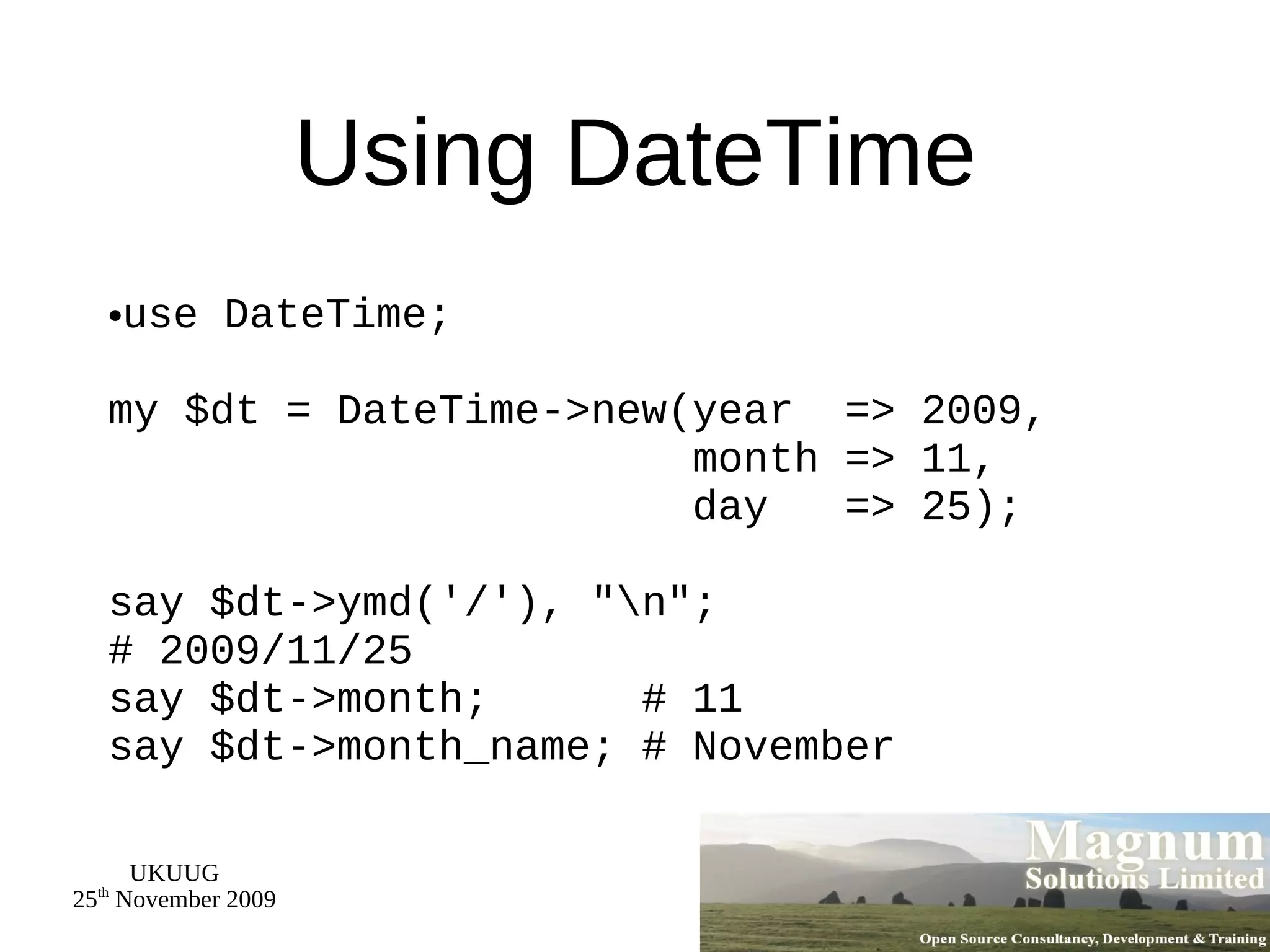
Using DateTime use DateTime; my $dt = DateTime->new(year  => 2009,   month => 11,   day  => 25); say $dt->ymd('/'), &quot;\n&quot;; # 2009/11/25 say $dt->month;  # 11 say $dt->month_name; # November
Arithmetic A DateTime object is a point in time For date arithmetic you need a duration Number of years, weeks, days, etc
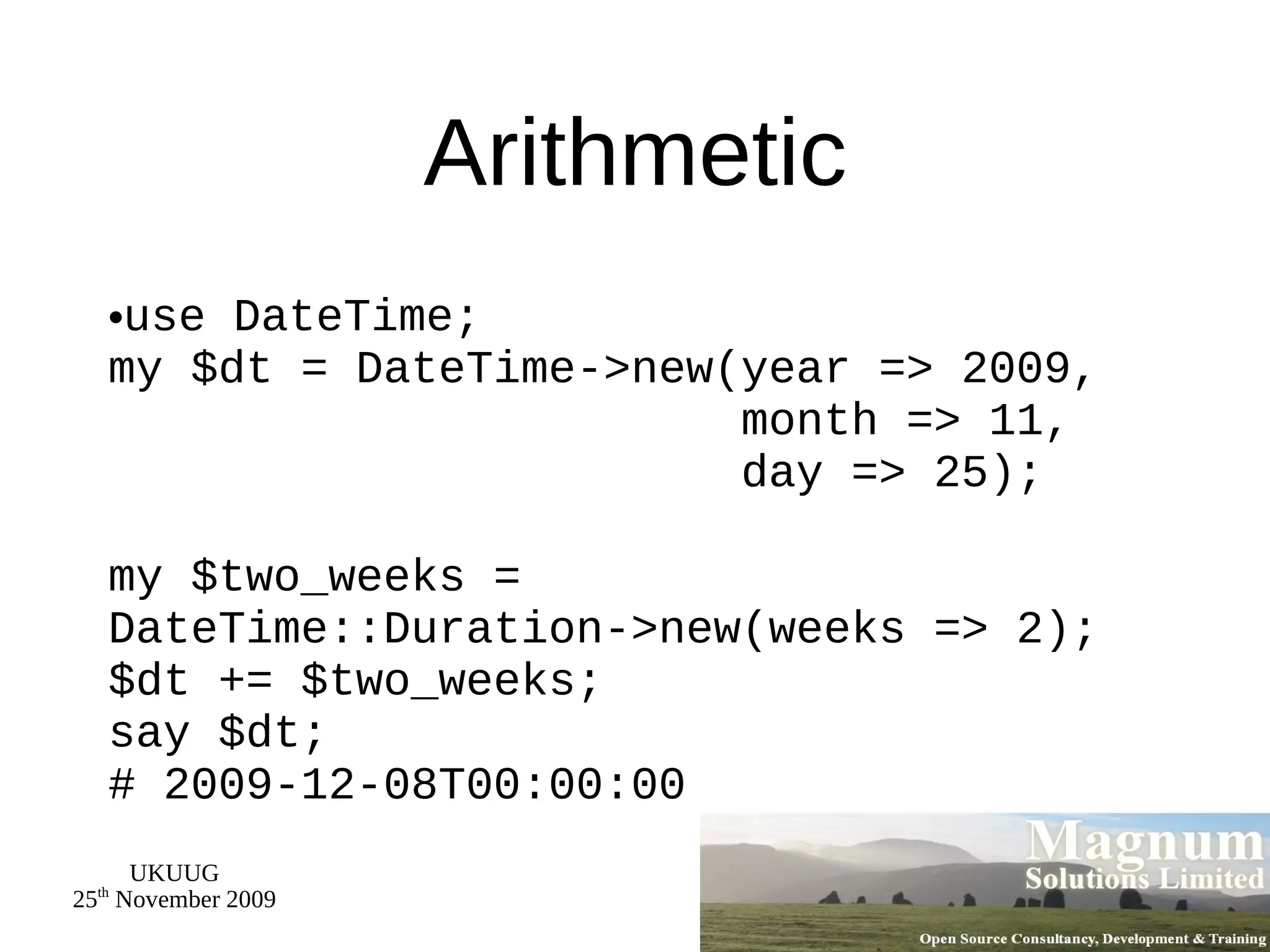
Arithmetic use DateTime; my $dt = DateTime->new(year => 2009,   month => 11,   day => 25); my $two_weeks = DateTime::Duration->new(weeks => 2); $dt += $two_weeks; say $dt; # 2009-12-08T00:00:00
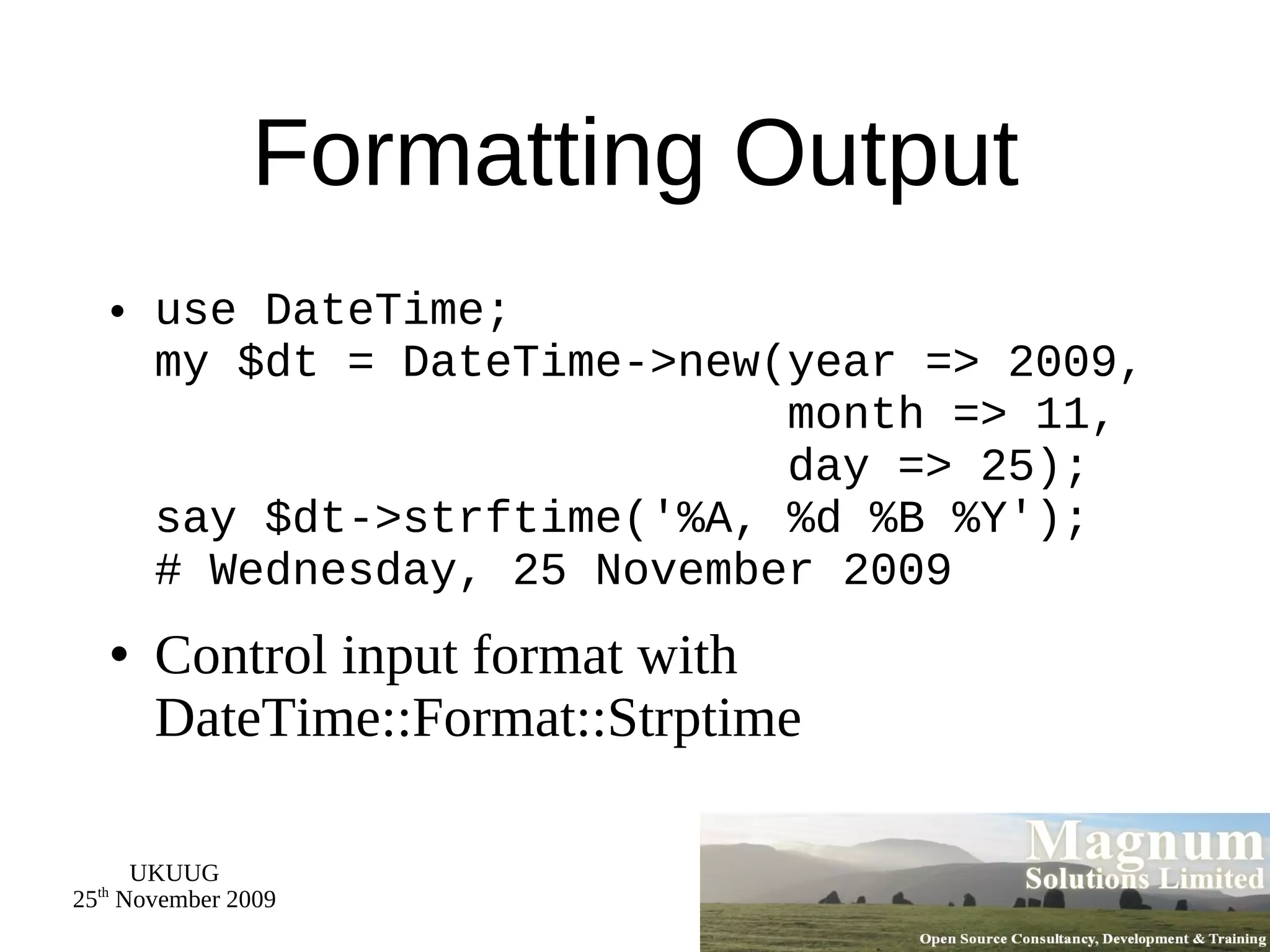
Formatting Output use DateTime; my $dt = DateTime->new(year => 2009,   month => 11,   day => 25); say $dt->strftime('%A, %d %B %Y'); # Wednesday, 25 November 2009 Control input format with DateTime::Format::Strptime
Parsing & Formatting Ready made parsers and formatters for popular date and time formats DateTime::Format::HTTP DateTime::Format::MySQL DateTime::Format::Excel DateTime::Format::Baby the big hand is on...
Alternative Calendars Handling non-standard calendars DateTime::Calendar::Julian DateTime::Calendar::Hebrew DateTime::Calendar::Mayan DateTime::Fiction::JRRTolkien::Shire
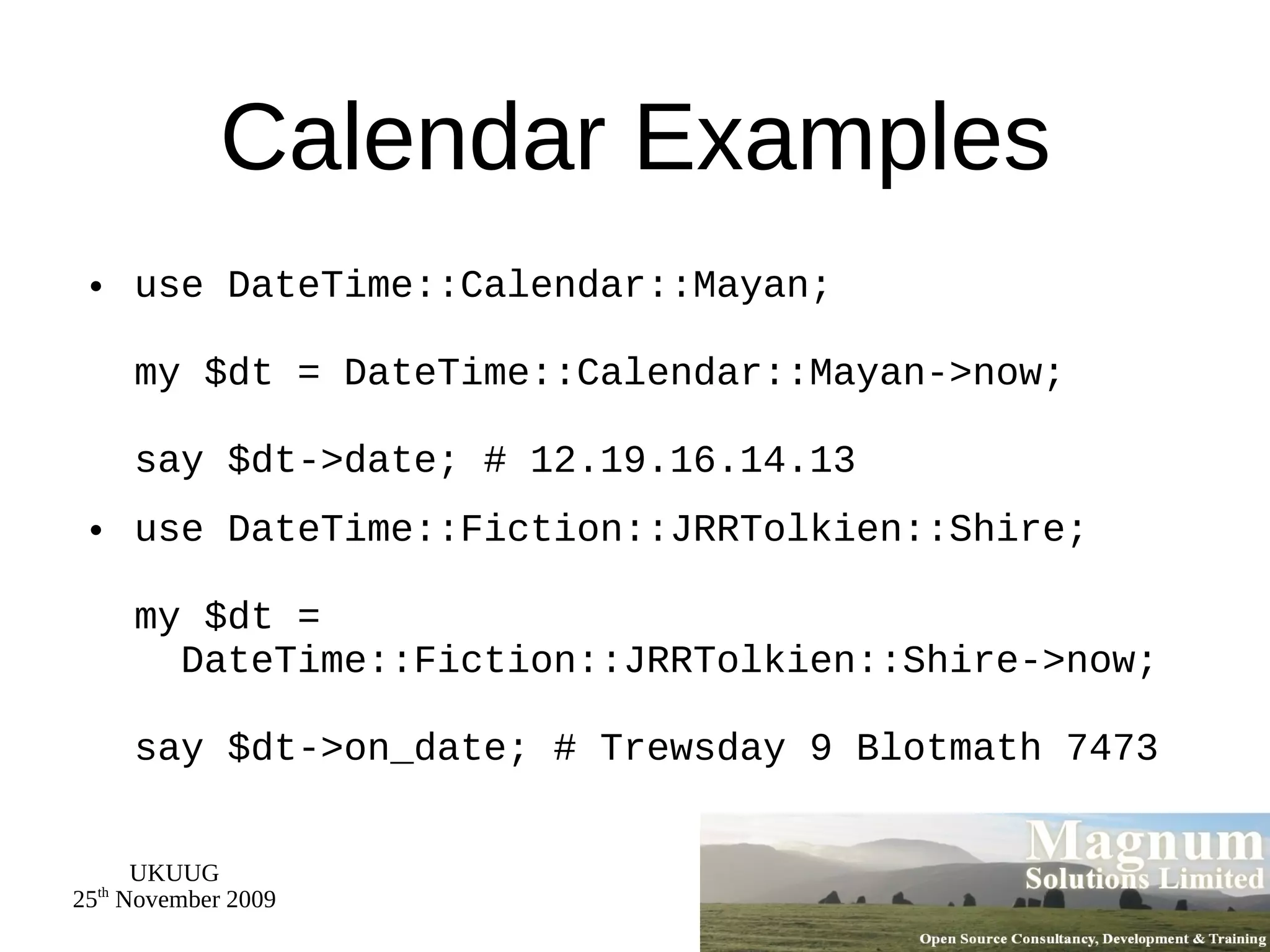
Calendar Examples use DateTime::Calendar::Mayan; my $dt = DateTime::Calendar::Mayan->now; say $dt->date; # 12.19.16.14.13 use DateTime::Fiction::JRRTolkien::Shire; my $dt =    DateTime::Fiction::JRRTolkien::Shire->now; say $dt->on_date; # Trewsday 9 Blotmath 7473
Templates
Templates Many people use templates to produce web pages Advantages are well known Standard look and feel (static/dynamic) Reusable components Separation of code logic from display logic Different skill-sets (HTML vs Perl)
Non-Web Templates The same advantages apply to non-web areas Reports Business documents Configuration files Anywhere you produce output
DIY Templating Must be easy - so many people do it See perlfaq4 “How can I expand variables in text strings?”
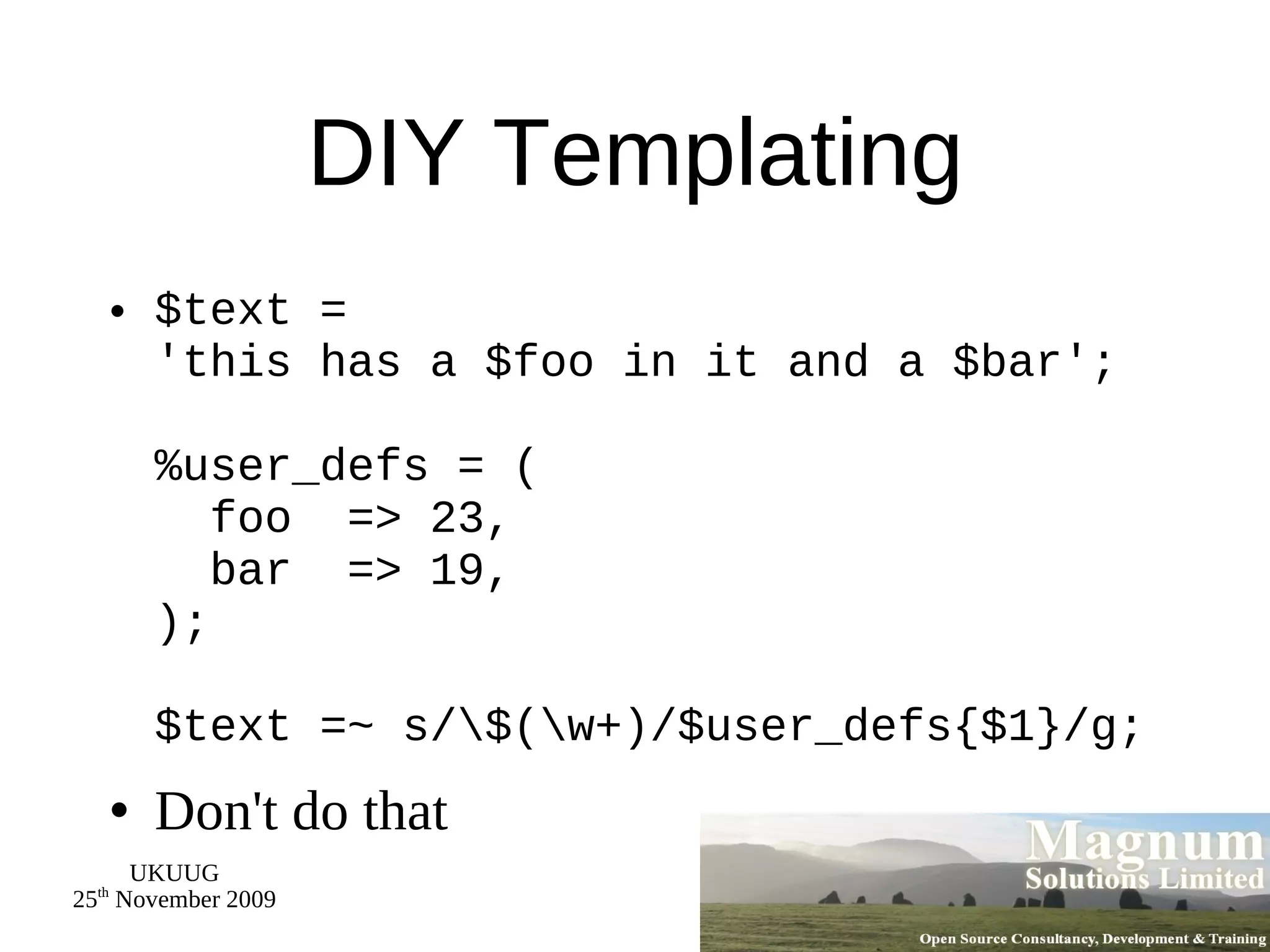
DIY Templating $text = 'this has a $foo in it and a $bar'; %user_defs = (   foo  => 23,   bar  => 19, ); $text =~ s/\$(\w+)/$user_defs{$1}/g; Don't do that
Templating Options Dozens of template modules on CPAN Text::Template, HTML::Template, Mason, Template Toolkit Many, many more Questions to consider HTML only? Template language I recommend the Template Toolkit
Template Toolkit http://tt2.org/ Very powerful Both web and non-web Simple template language Plugins give access to much of CPAN Can use Perl code if you want But don't do that
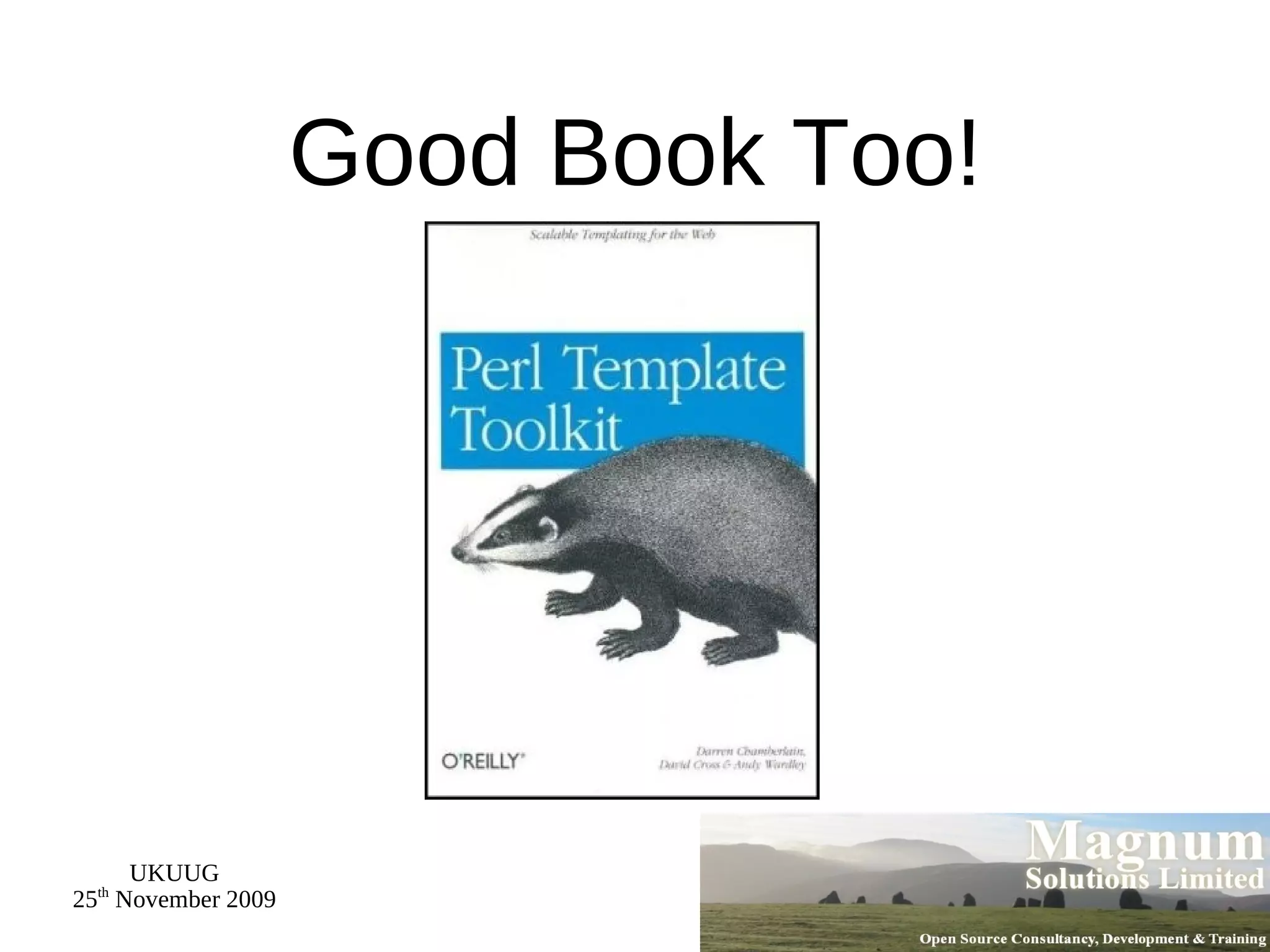
Good Book Too!
The Template Equation Data + Template = Output Data + Alternative Template = Alternative Output Different views of the same data Only the template changes
Simple TT Example use Template; use My::Object; my ($id, $format) = @ARGV; $format ||= 'html'; my $obj = My::Object->new($id)   or die; my $tt  = Template->new; $tt->process(&quot;$format.tt&quot;,   { obj => $obj },   &quot;$id.$format&quot;)   or die $tt->error;
html.tt <html>   <head>   <title>[% obj.name %]</title>   </head>   <body>   <h1>[% obj.name %]<h1>   <p><img src=“[% obj.img %]” /><br />   [% obj.desc %]</p>   <ul>   [% FOREACH child IN obj.children -%]   <li>[% child.name %]</li>   [% END %]   </body> </html>
text.tt [% obj.name | upper %] Image: [% obj.img %] [% obj.desc %] [% FOREACH child IN obj.children -%]   * [% child.name %] [% END %]
Adding New Formats No new code required Just add new output template Perl programmer need not be involved
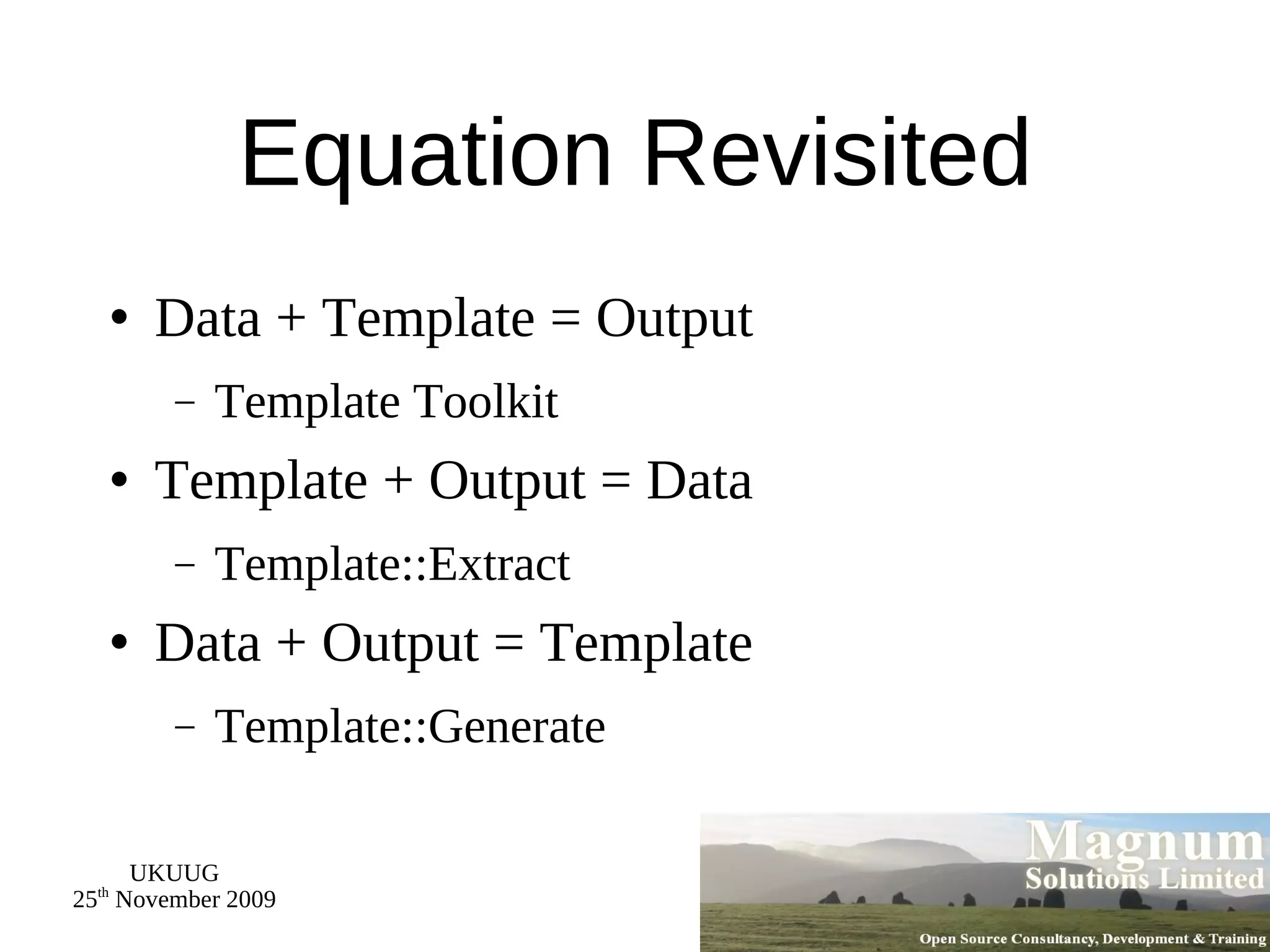
Equation Revisited Data + Template = Output Template Toolkit Template + Output = Data Template::Extract Data + Output = Template Template::Generate
Databases
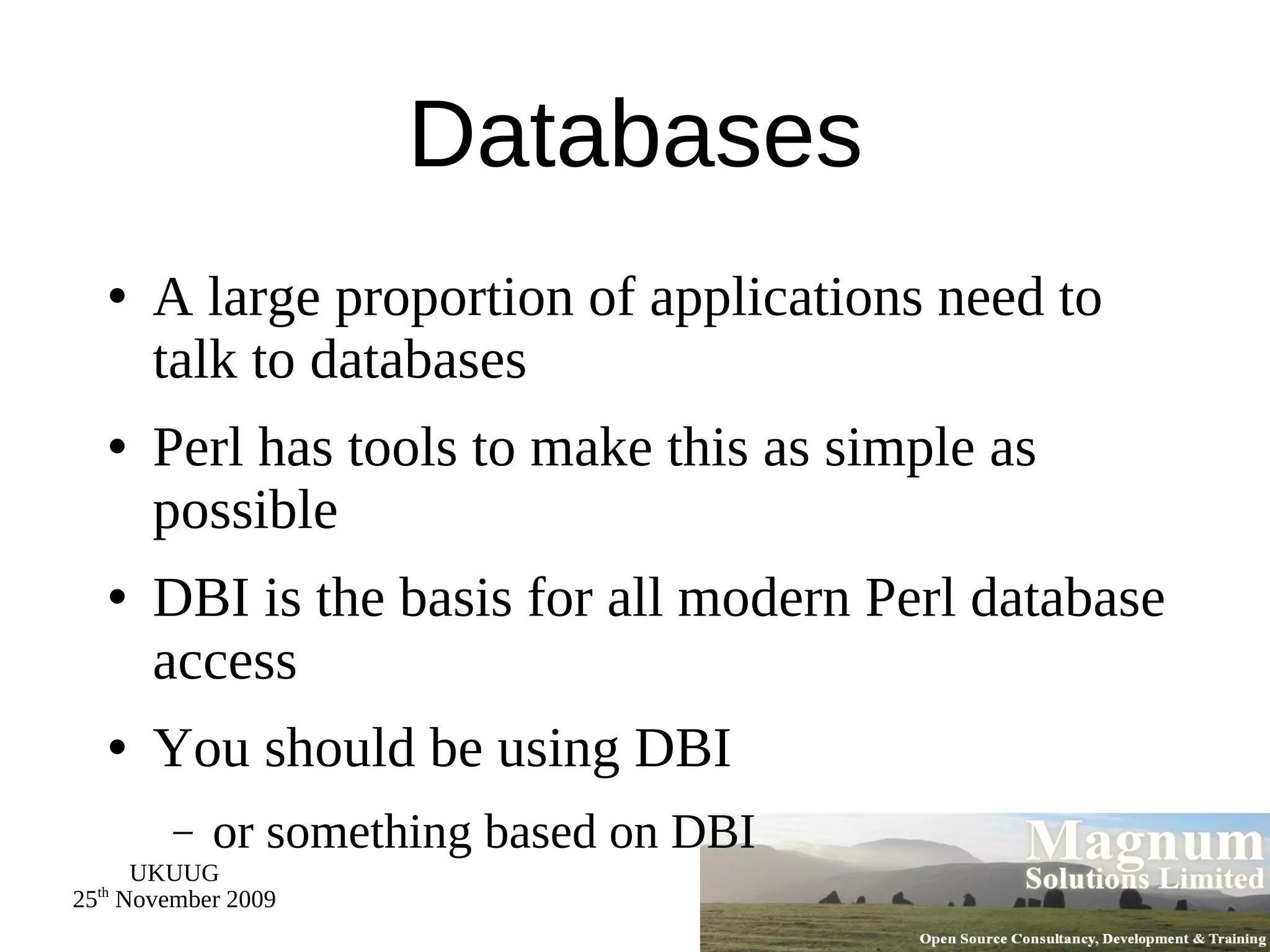
Databases A large proportion of applications need to talk to databases Perl has tools to make this as simple as possible DBI is the basis for all modern Perl database access You should be using DBI or something based on DBI
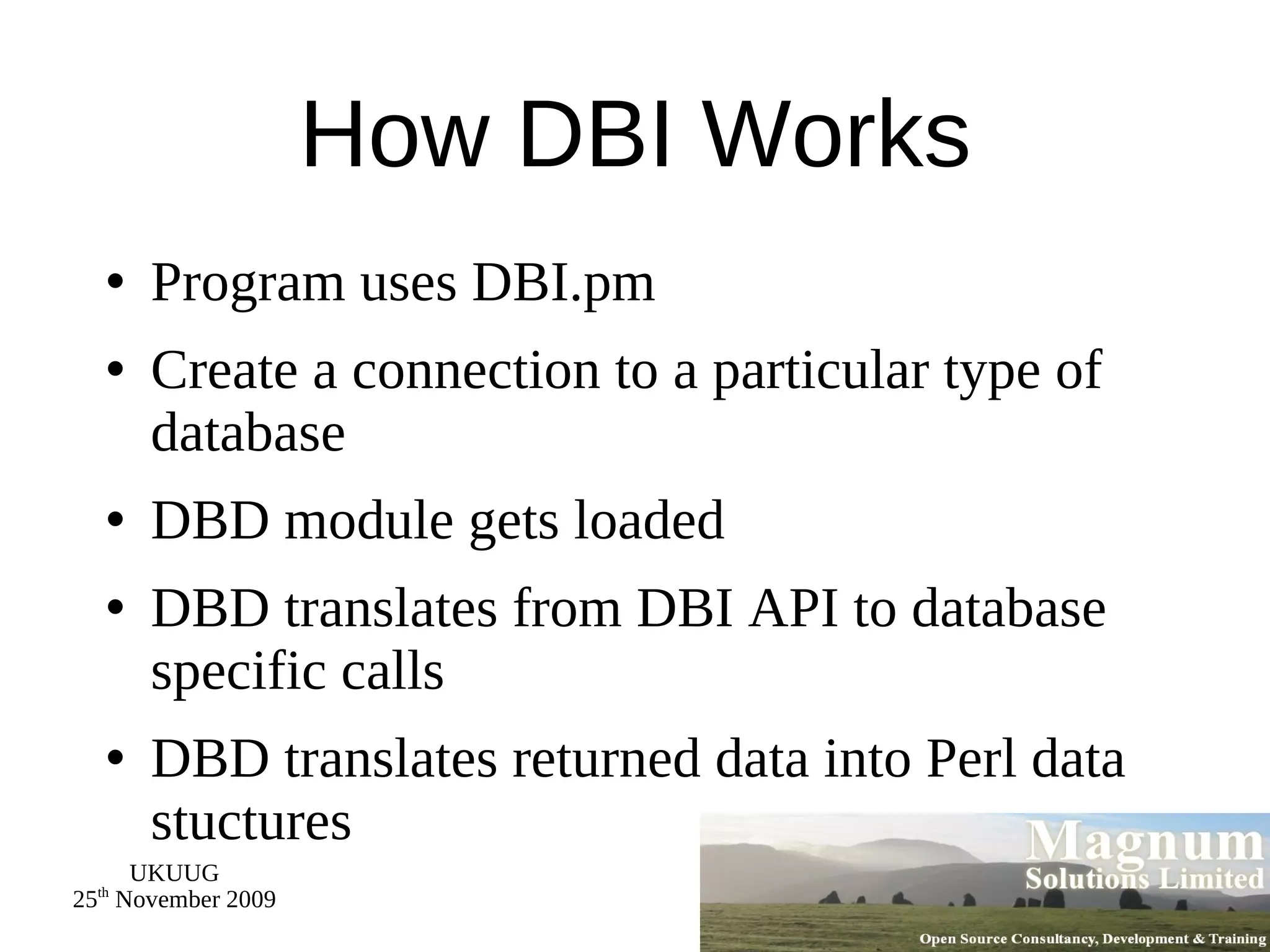
How DBI Works Program uses DBI.pm Create a connection to a particular type of database DBD module gets loaded DBD translates from DBI API to database specific calls DBD translates returned data into Perl data stuctures
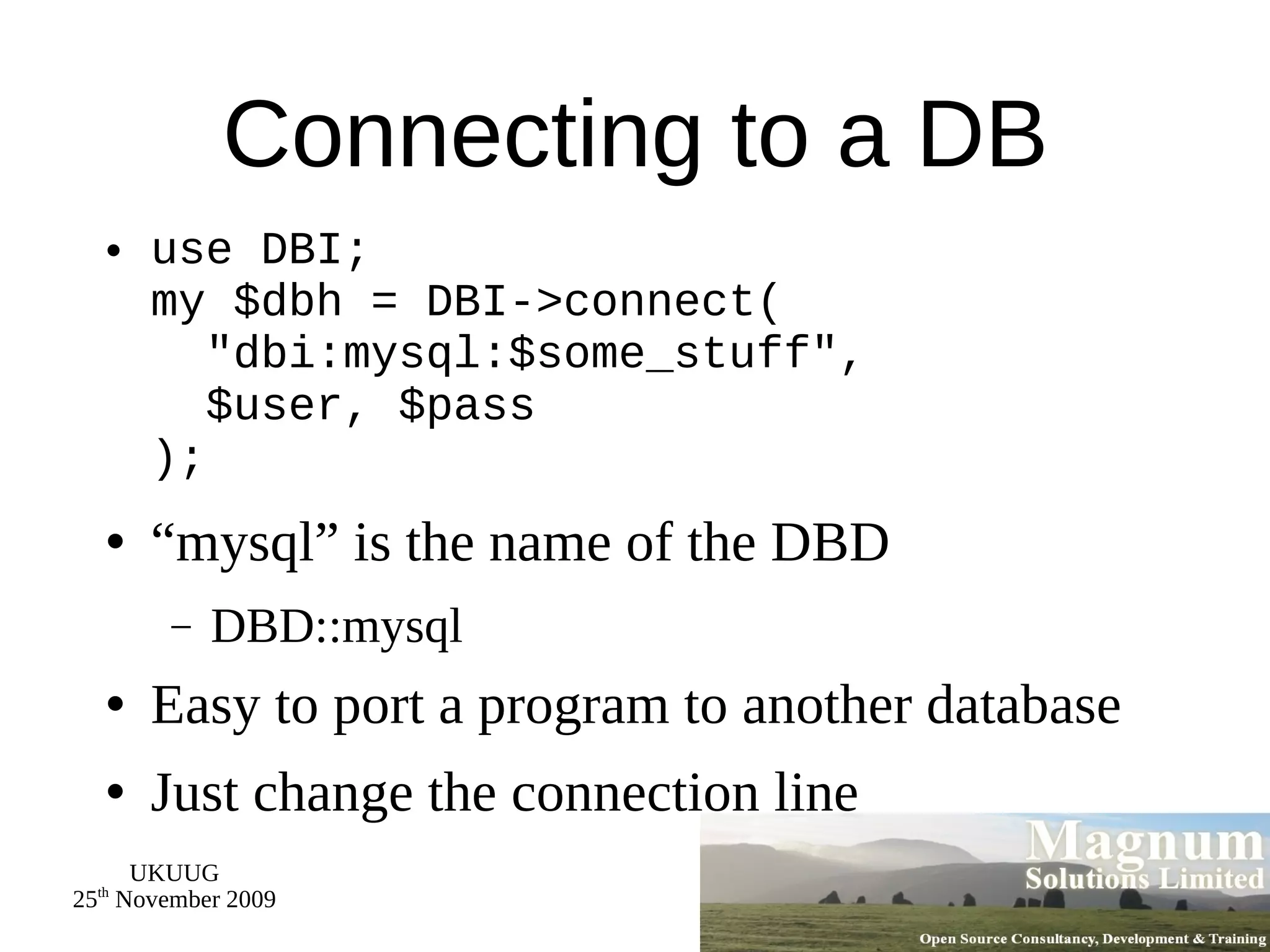
Connecting to a DB use DBI; my $dbh = DBI->connect(   &quot;dbi:mysql:$some_stuff&quot;,   $user, $pass ); “mysql” is the name of the DBD DBD::mysql Easy to port a program to another database Just change the connection line
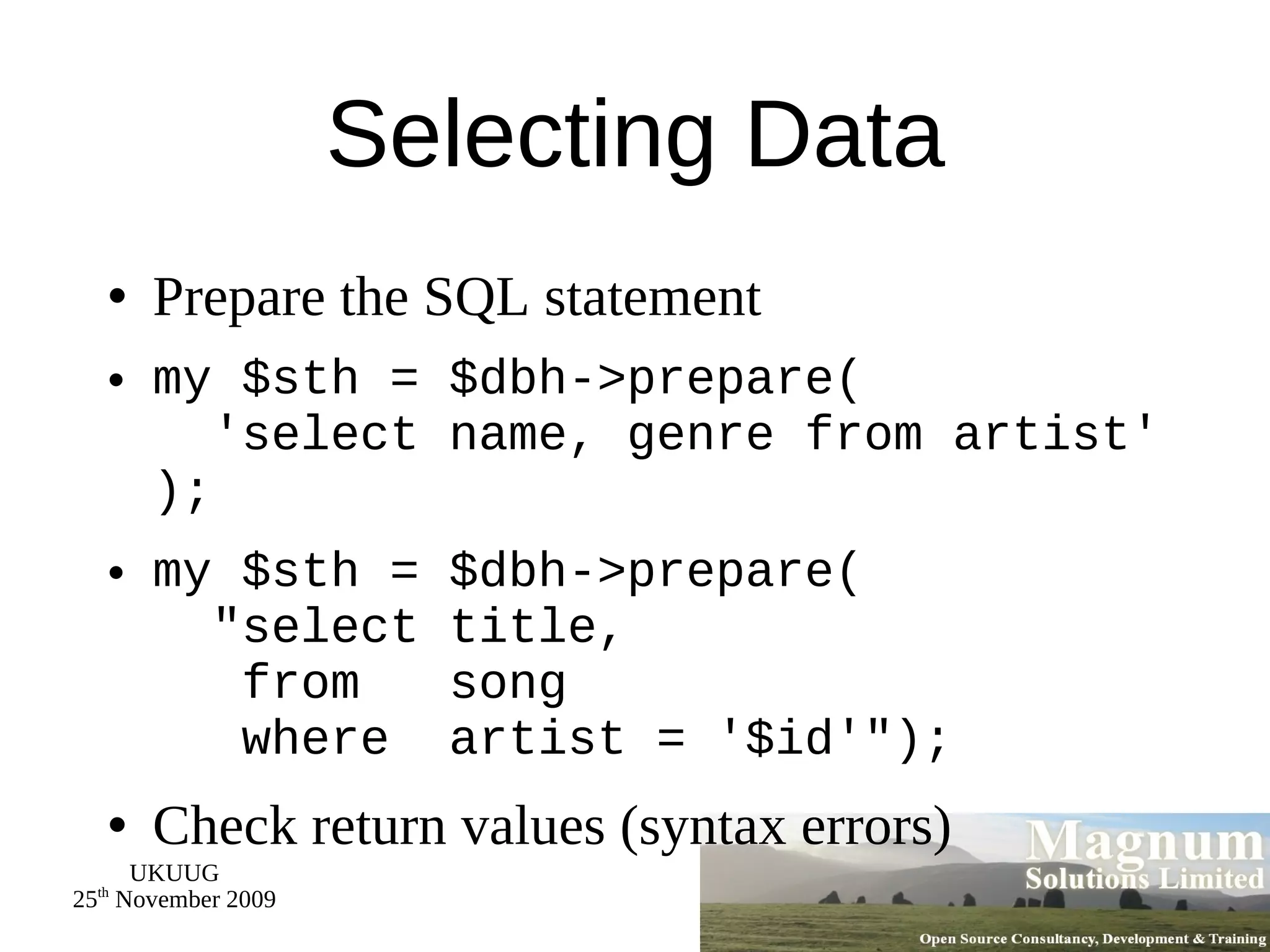
Selecting Data Prepare the SQL statement my $sth = $dbh->prepare(   'select name, genre from artist' ); my $sth = $dbh->prepare(   &quot;select title,   from  song   where  artist = '$id'&quot;); Check return values (syntax errors)
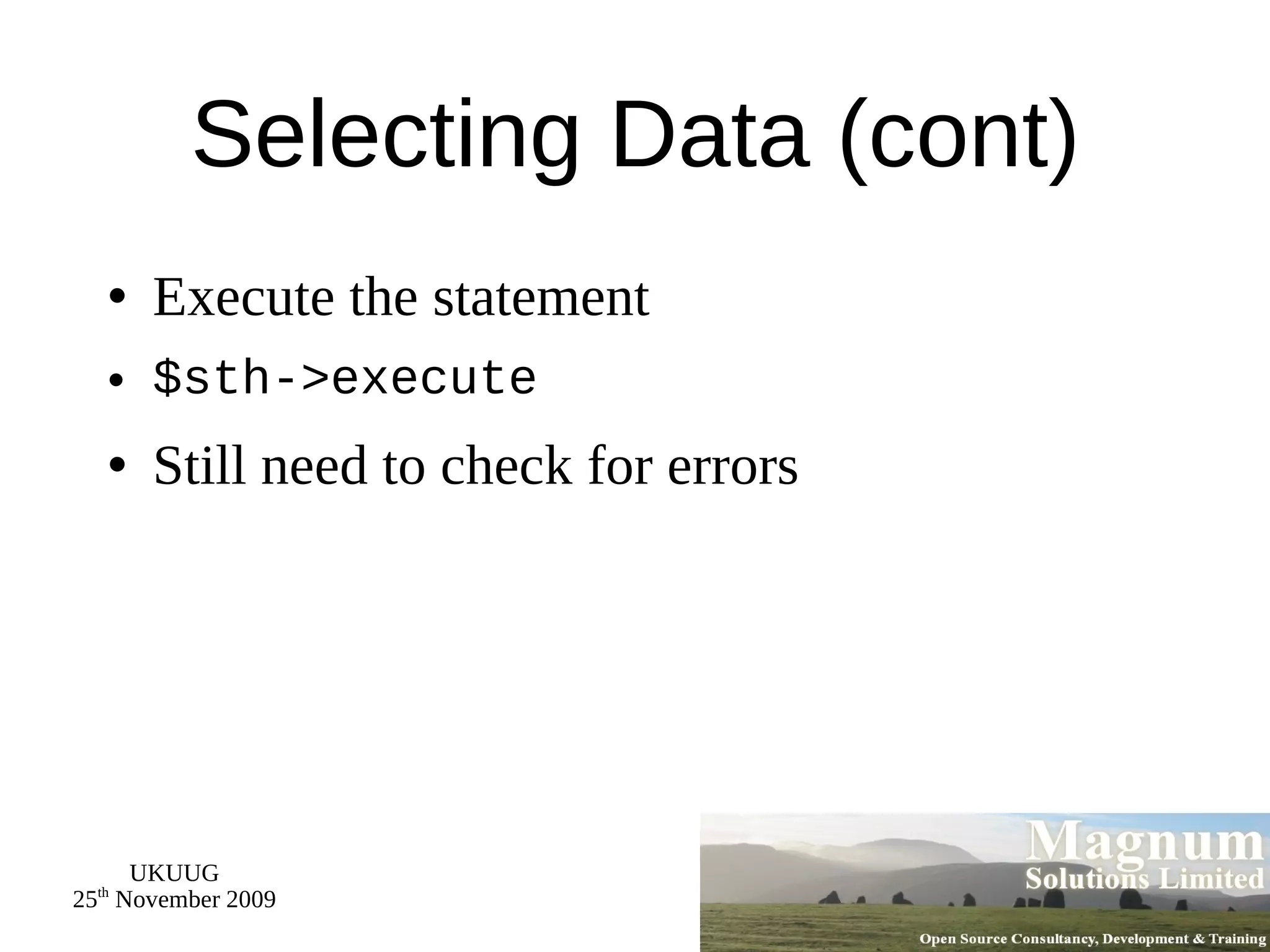
Selecting Data (cont) Execute the statement $sth->execute Still need to check for errors
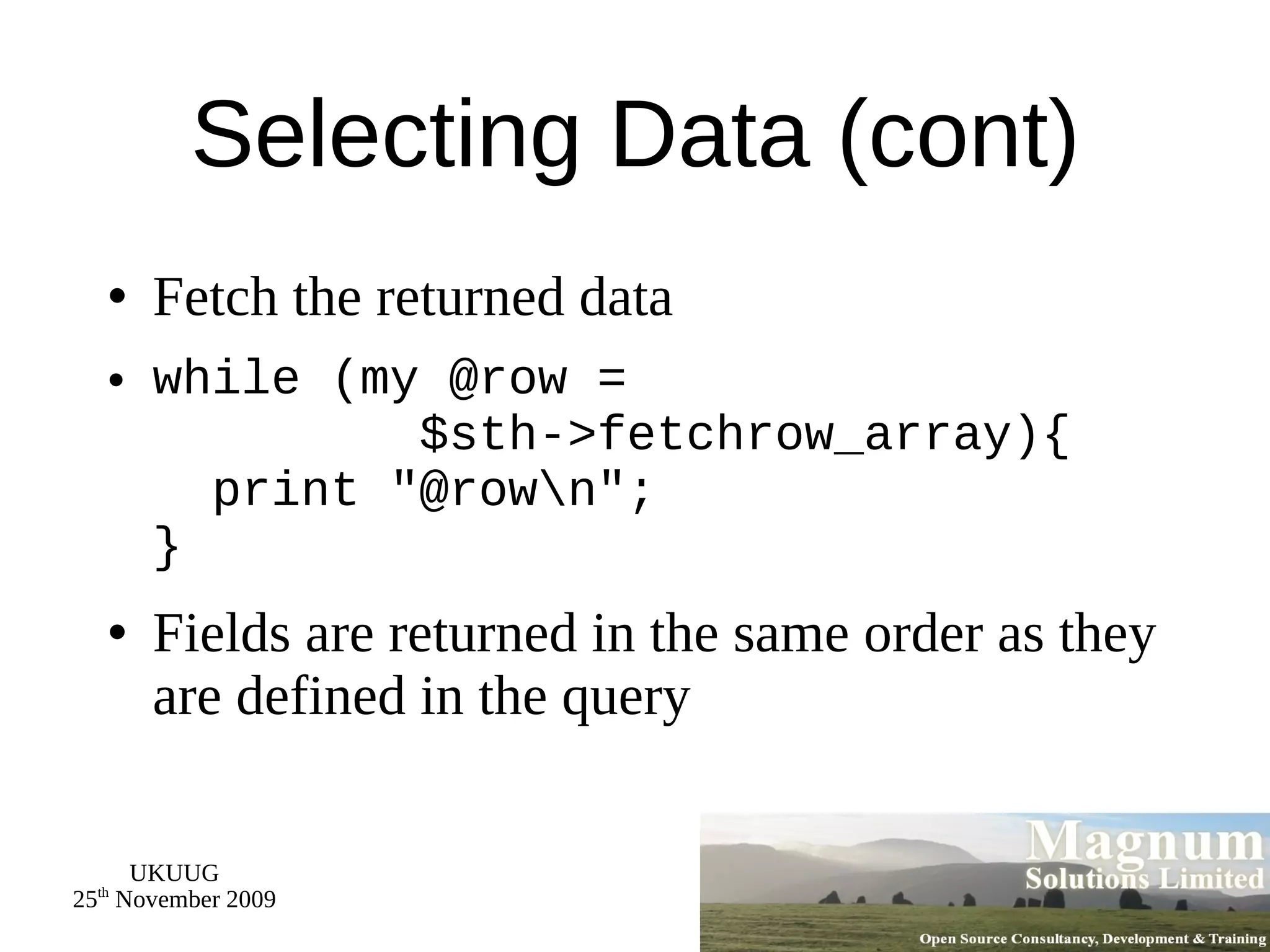
Selecting Data (cont) Fetch the returned data while (my @row =   $sth->fetchrow_array){   print &quot;@row\n&quot;; } Fields are returned in the same order as they are defined in the query
Other Select Functions Other fetch methods are available: fetchrow_arrayref fetchrow_hashref  (keys are column names) fetchall_arrayref fetch  (alias for fetchrow_arrayref) Many more added each week
Some Caveats If you're using a fetch method that returns an array Never use &quot;select *&quot; For (hopefully) obvious reasons If you're using a fetch method that returns a hash Ensure all your columns have (unique) names For (hopefully) obvious reasons
Insert, Update & Delete Statements that don't return data can be executed the same way my $sql = &quot;update table1   set col1 = '$val'   where id_col = $id&quot;; my $sth  = $dbh->prepare($sql); $sth->execute; But there's a shortcut $rows = $dbh->do($sql);
Multiple Insertions while (<FILE>) {   chomp;   my @data = split;   my $sql = &quot;insert into tab   values ($data[0],   $data[1],   $data[2]&quot;);   $dbh->do($sql); } Recompiles the SQL every time Very inefficient
Binding Data Prepare statement once, use many times my $sql = &quot;insert into tab   values (?, ?, ?)&quot;; my $sth = $dbh->prepare($sql); while (<FILE>) {   my @data = split;   bind_param(1, $data[0]);   bind_param(2, $data[1]);   bind_param(3, $data[2]);   $sth->execute; } Bonus - binding handles quoting for you
Binding Data (cont) Even easier – extra parameters to execute my $sql = &quot;insert into tab   values (?, ?, ?)&quot;; my $sth = $dbh->prepare($sql); while (<FILE>) {   chomp;   my @data = split;   $sth->execute(@data); }
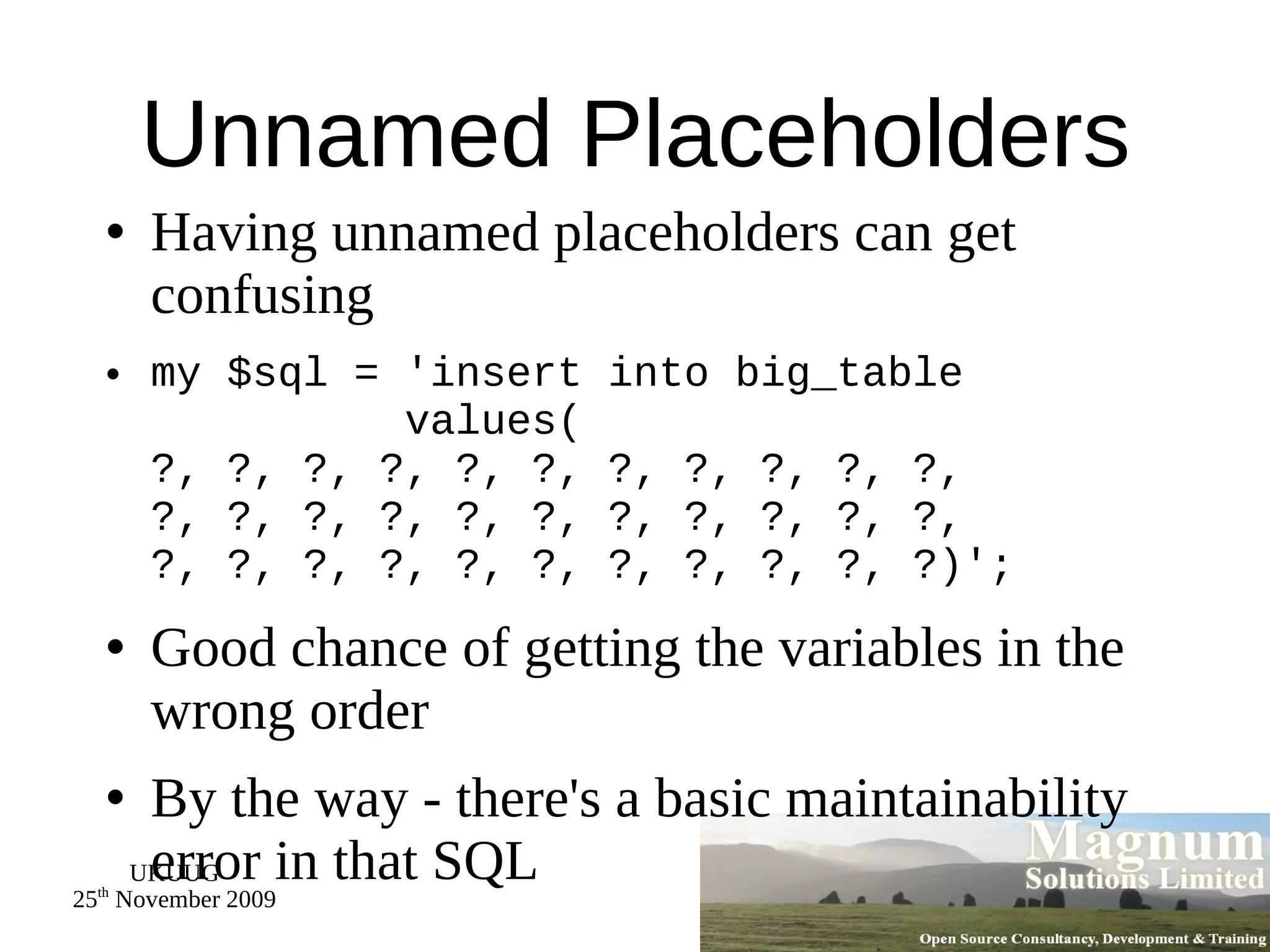
Unnamed Placeholders Having unnamed placeholders can get confusing my $sql = 'insert into big_table   values(  ?, ?, ?, ?, ?, ?, ?, ?, ?, ?, ?, ?, ?, ?, ?, ?, ?, ?, ?, ?, ?, ?, ?, ?, ?, ?, ?, ?, ?, ?, ?, ?, ?)'; Good chance of getting the variables in the wrong order By the way - there's a basic maintainability error in that SQL
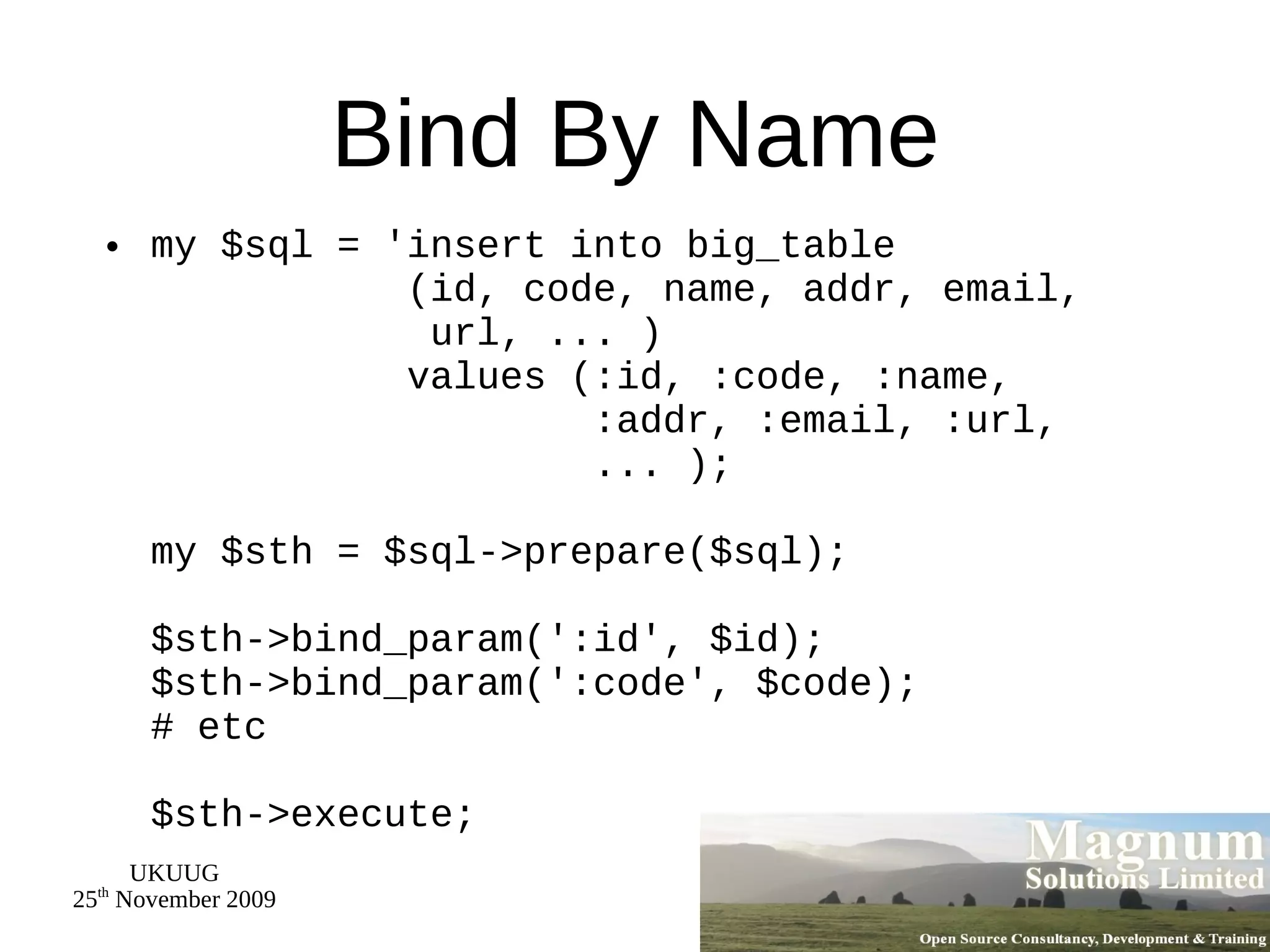
Bind By Name my $sql = 'insert into big_table   (id, code, name, addr, email,   url, ... )   values (:id, :code, :name,   :addr, :email, :url,   ... ); my $sth = $sql->prepare($sql); $sth->bind_param(':id', $id); $sth->bind_param(':code', $code); # etc $sth->execute;
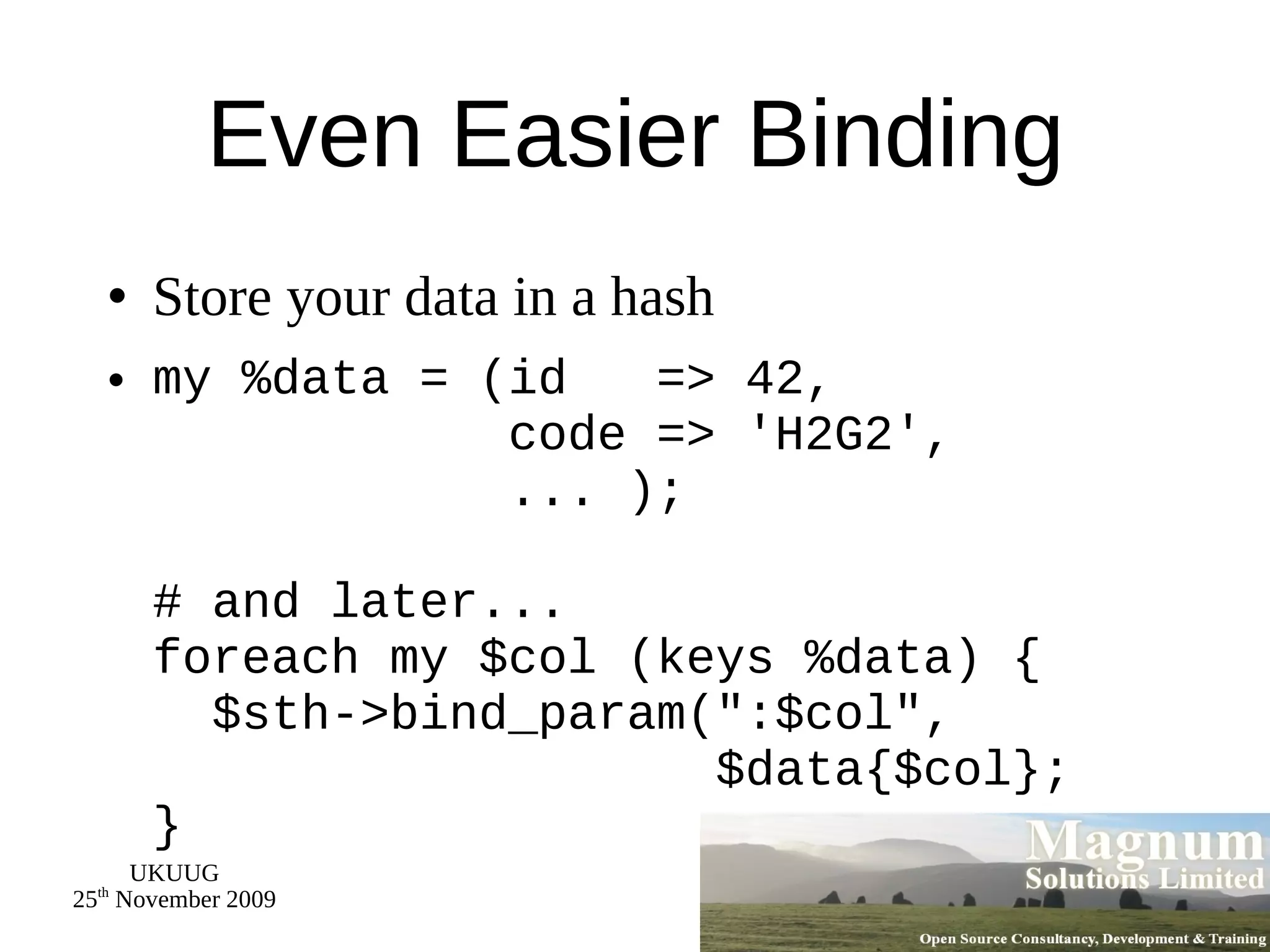
Even Easier Binding Store your data in a hash my %data = (id  => 42,   code => 'H2G2',   ... ); # and later... foreach my $col (keys %data) {   $sth->bind_param(&quot;:$col&quot;,  $data{$col}; }
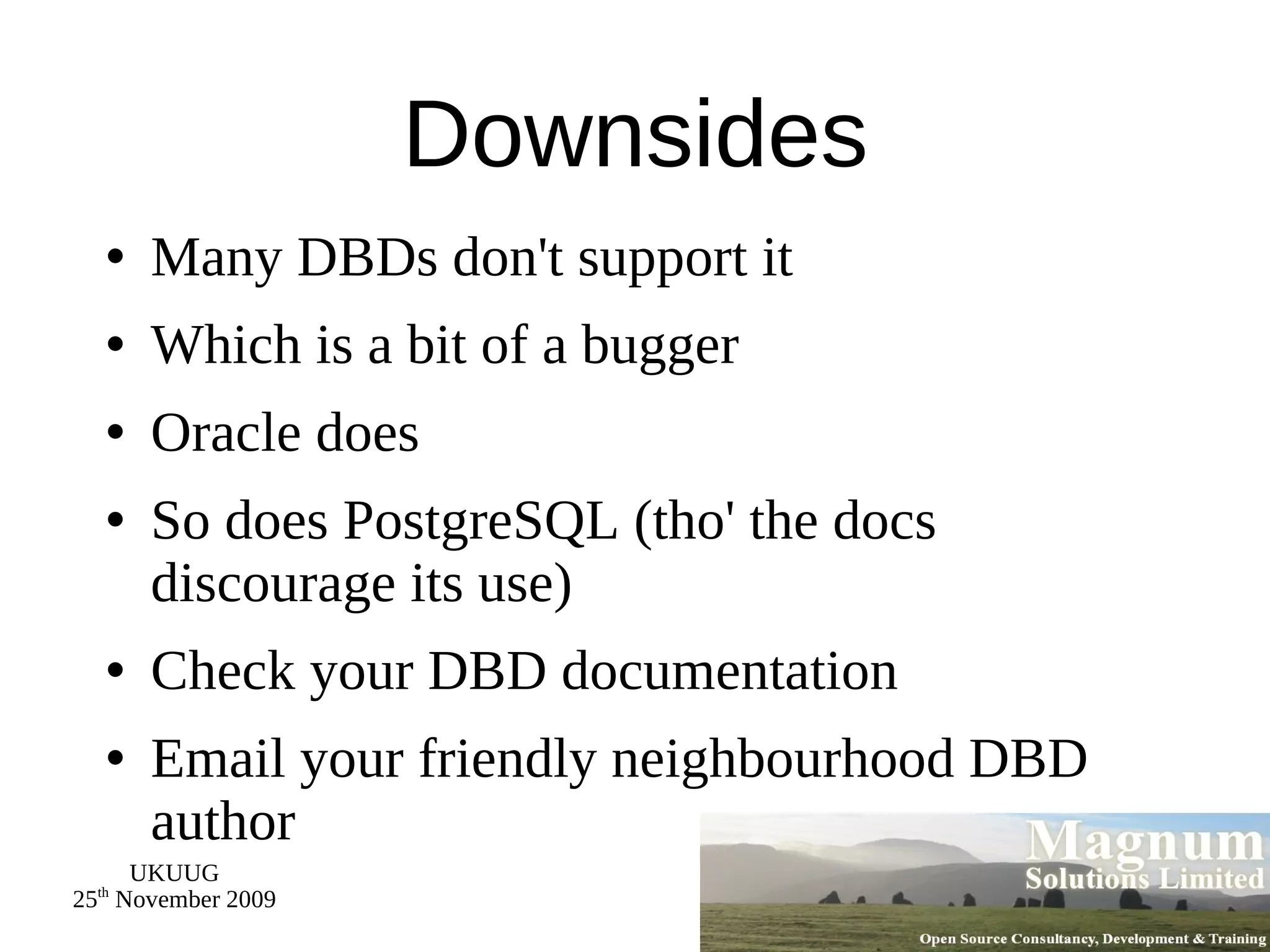
Downsides Many DBDs don't support it Which is a bit of a bugger Oracle does So does PostgreSQL (tho' the docs discourage its use) Check your DBD documentation Email your friendly neighbourhood DBD author
Some Tips Make your life as easy as possible Don't hard-code connection data Config file, command line options, environment variables Send all of your data access through one function Store SQL queries externally and reference them by name Use named bind parameters if you can
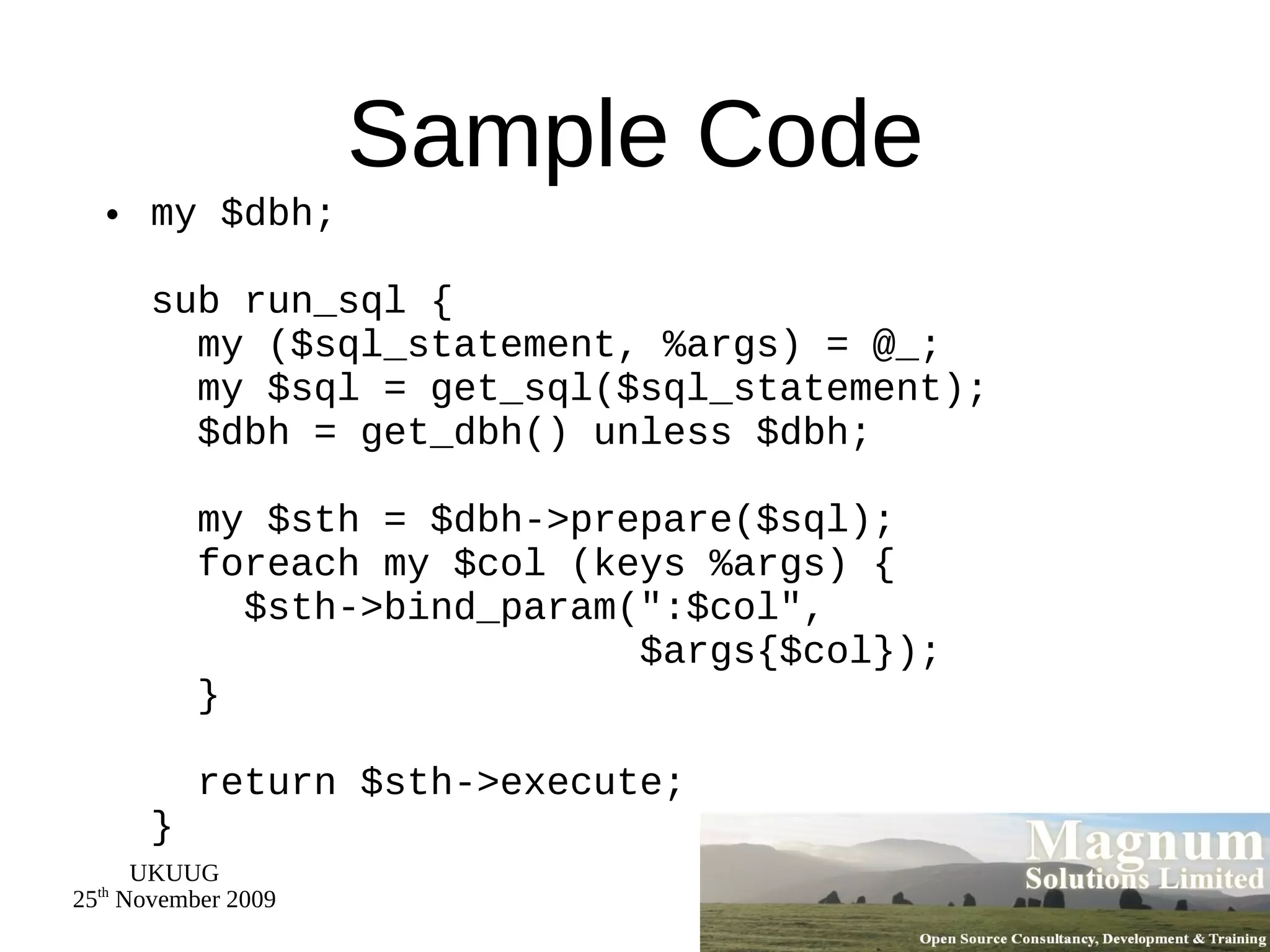
Sample Code my $dbh; sub run_sql {   my ($sql_statement, %args) = @_;   my $sql = get_sql($sql_statement);   $dbh = get_dbh() unless $dbh;   my $sth = $dbh->prepare($sql);   foreach my $col (keys %args) {   $sth->bind_param(&quot;:$col&quot;,   $args{$col});   }   return $sth->execute; }
Not Writing SQL Writing SQL is boring It's often similar Select the id and name from this table Select all the details of this row Select something about related tables Update this row with these values Insert a new record with these values Delete this record Must be a better way
Object Relational Mapping Mapping database relations into objects Tables (relations) map onto classes Rows (tuples) map onto objects Columns (attributes) map onto attributes Don't write SQL
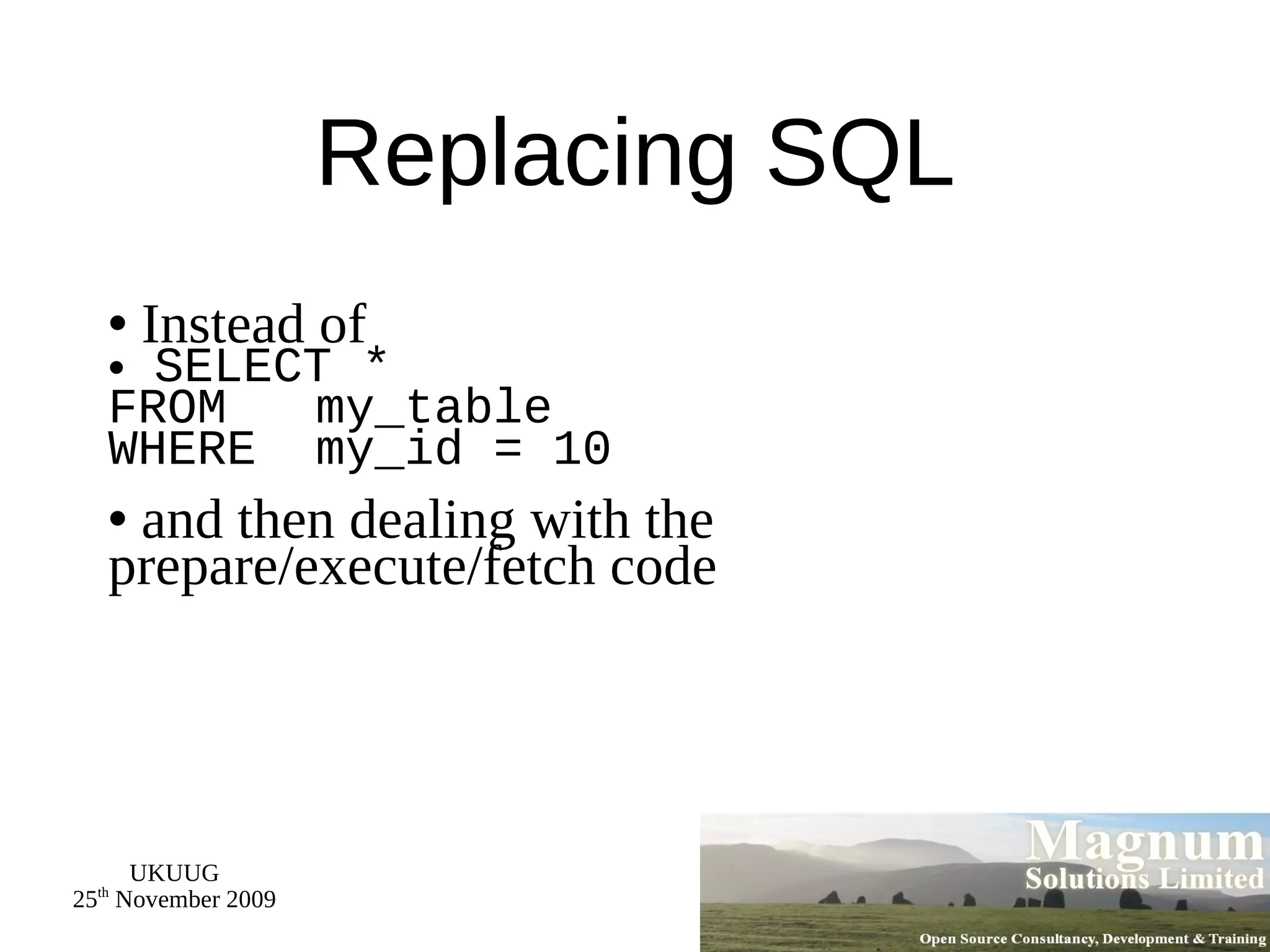
Replacing SQL Instead of SELECT * FROM  my_table WHERE  my_id = 10 and then dealing with the prepare/execute/fetch code
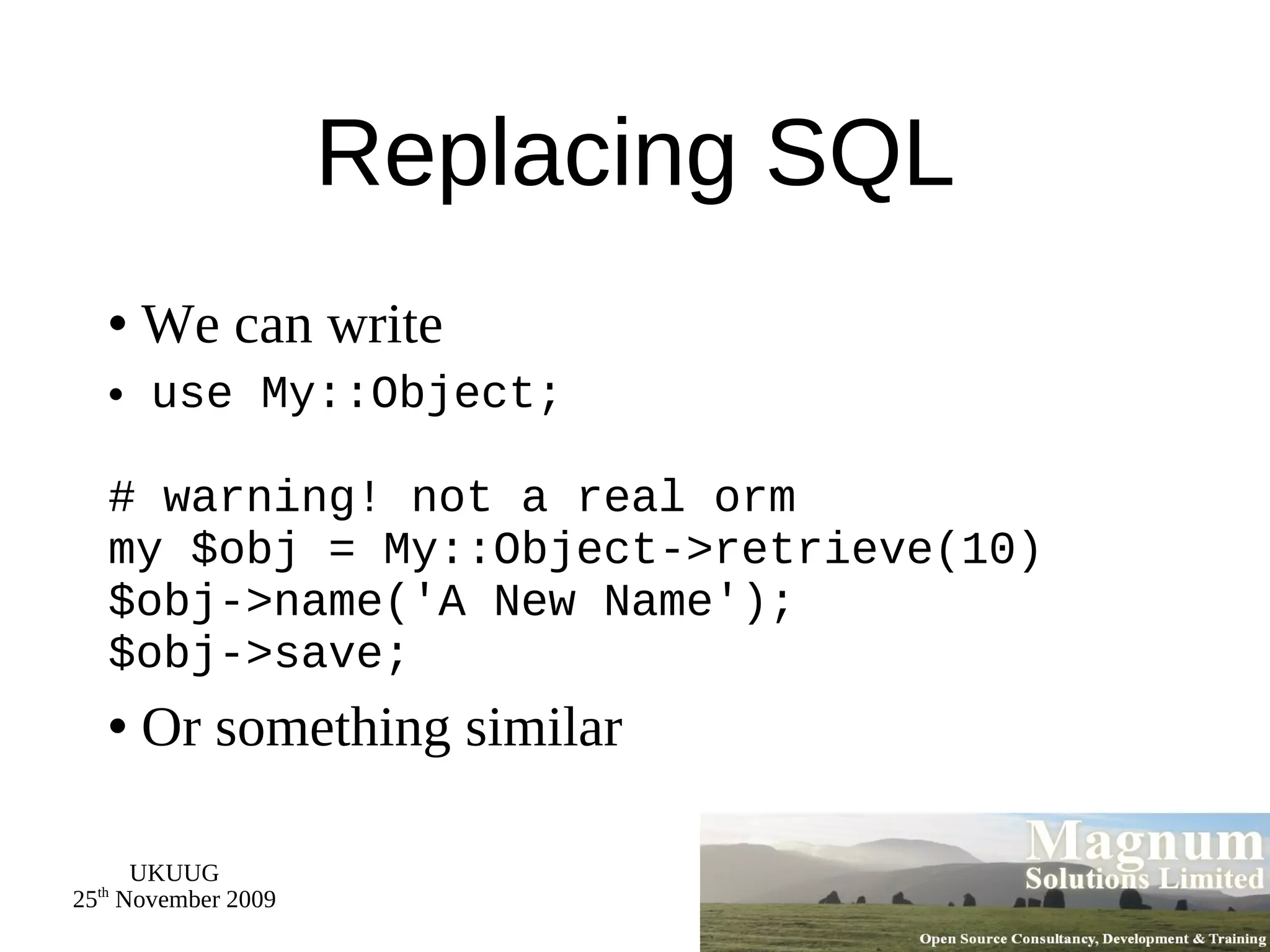
Replacing SQL We can write use My::Object; # warning! not a real orm my $obj = My::Object->retrieve(10) $obj->name('A New Name'); $obj->save; Or something similar
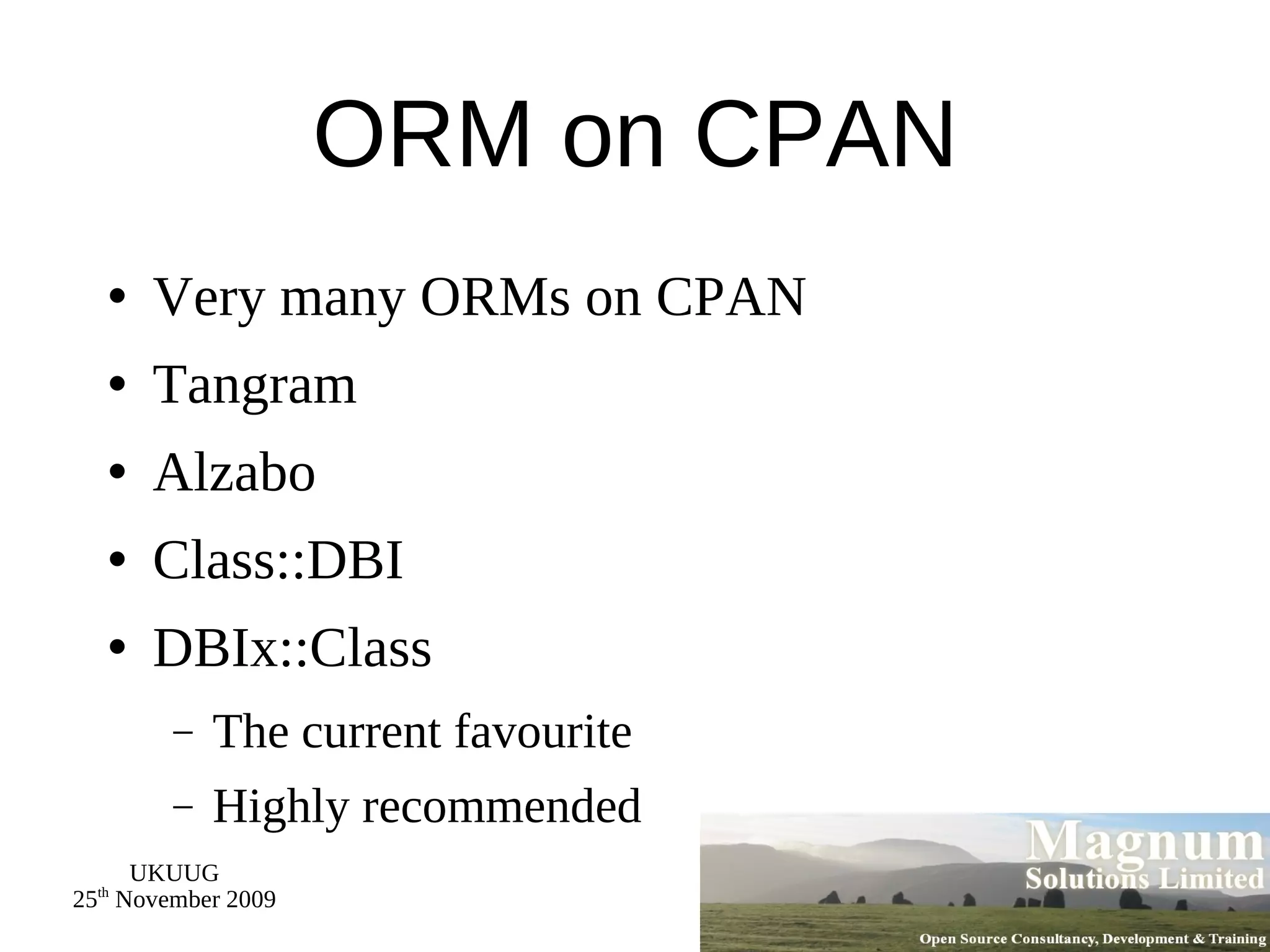
ORM on CPAN Very many ORMs on CPAN Tangram Alzabo Class::DBI DBIx::Class The current favourite Highly recommended
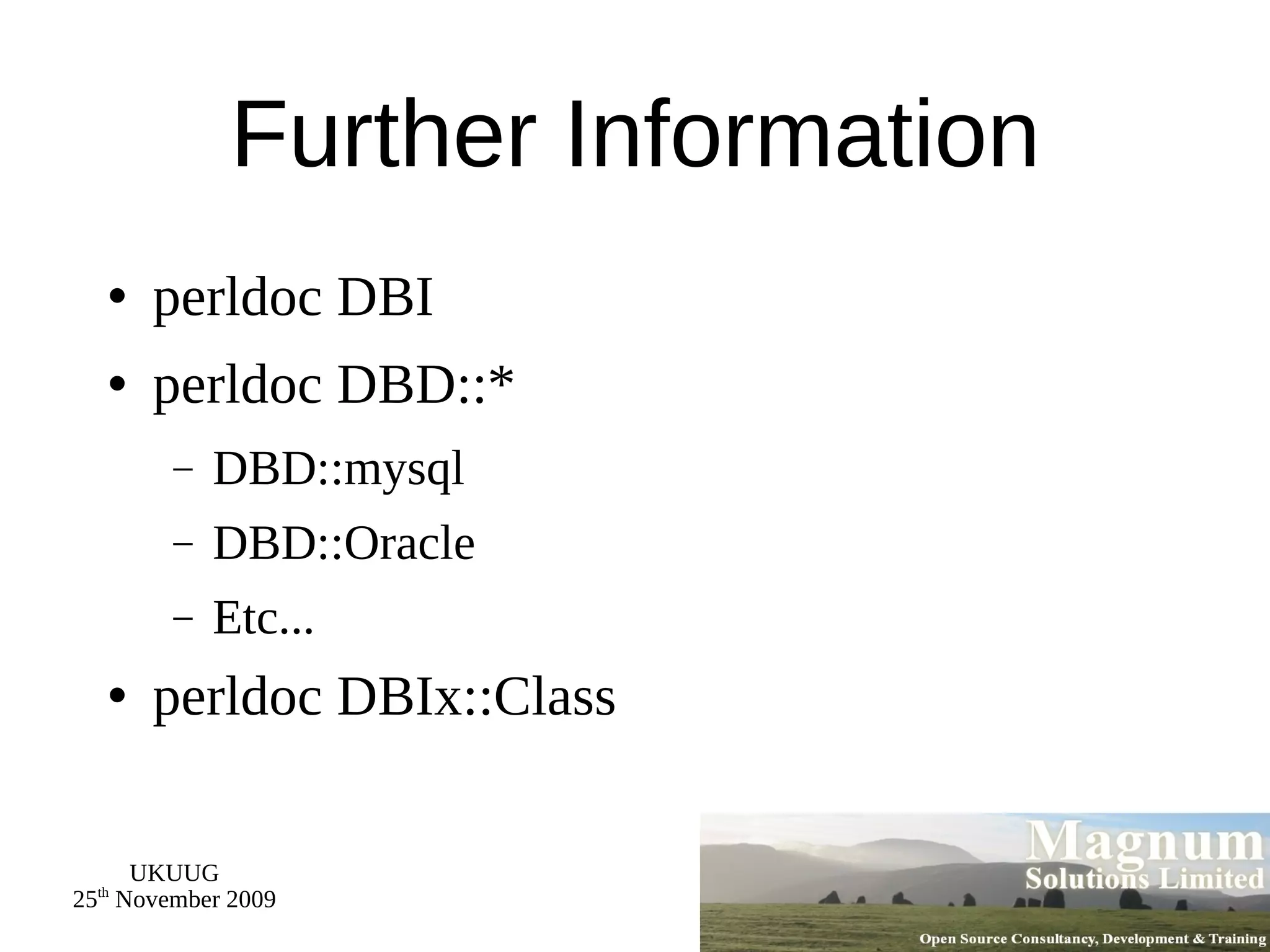
Further Information perldoc DBI perldoc DBD::* DBD::mysql DBD::Oracle Etc... perldoc DBIx::Class
That's All Folks Any Questions?

Intermediate Perl

  • 1.
    Intermediate Perl DaveCross Magnum Solutions Ltd [email_address]
  • 2.
    What We WillCover Types of variable Strict and warnings References Sorting Reusable Code Object Orientation
  • 3.
    What We WillCover Testing Dates and Times Templates Databases Further Information
  • 4.
    Schedule 09:45 –Begin 11:15 – Coffee break (15 mins) 13:00 – Lunch (60 mins) 14:00 – Begin 15:30 – Coffee break (15 mins) 17:00 – End
  • 5.
    Resources Slides availableon-line http://mag-sol.com/train/public/2009-11/ukuug Also see Slideshare http://www.slideshare.net/davorg/slideshows Get Satisfaction http://getsatisfaction.com/magnum
  • 6.
  • 7.
    Types of VariablePerl variables are of two types Important to know the difference Lexical variables are created with my Package variables are created by our Lexical variables are associated with a code block Package variables are associated with a package
  • 8.
    Lexical Variables Createdwith my my ($doctor, @timelords, %home_planets); Live in a pad (associated with a block of code) Piece of code delimited by braces Source file
  • 9.
    Lexical Variables Onlyvisible within enclosing block while (<$fh>) { my $data = munge($_); } # can't see $data here &quot;Lexical&quot; because the scope is defined purely by the text
  • 10.
    Packages All Perlcode is associated with a package A new package is created with package package MyPackage; Think of it as a namespace Used to avoid name clashes with libraries Default package is called main
  • 11.
    Package Variables Livein a package's symbol table Can be referred to using a fully qualified name $main::doctor @Gallifrey::timelords
  • 12.
    Package Variables Packagename not required within own package package Gallifrey; @timelords = ('Doctor', 'Master', 'Rani'); Can be seen from anywhere in the package (or anywhere at all when fully qualified)
  • 13.
    Declaring Package VarsCan be predeclared with our our ($doctor, @timelords, %home_planet); Or (in older Perls) with use vars use vars qw($doctor @timelords %home_planet);
  • 14.
    Lexical or PackageWhen to use lexical variables or package variables? Simple answer Always use lexical variables More complete answer Always use lexical variables Except for a tiny number of cases http://perl.plover.com/local.html
  • 15.
    local You mightsee code that uses local local $variable; This doesn't do what you think it does Badly named function Doesn't create local variables Creates a local copy of a package variable Can be useful In a small number of cases
  • 16.
    local Example $/ is a package variable It defines the input record separator You might want to change it Always localise changes { local $/ = “\n\n”; while (<FILE> ) { ... } }
  • 17.
  • 18.
    Coding Safety NetPerl can be a very loose programming language Two features can minimise the dangers use strict / use warnings A good habit to get into No serious Perl programmer codes without them
  • 19.
    use strict Controlsthree things use strict 'refs' – no symbolic references use strict 'subs' – no barewords use strict 'vars' – no undeclared variables use strict – turn on all three at once turn them off (carefully) with no strict
  • 20.
    use strict 'refs'Prevents symbolic references Using a variable as another variable's name $what = 'dalek'; $$what = 'Karn'; # sets $dalek to 'Karn' What if 'dalek' came from user input? People often think this is a cool feature It isn't
  • 21.
    use strict 'refs'(cont) Better to use a hash $what = 'dalek'; $alien{$what} = 'Karn'; Self contained namespace Less chance of clashes More information (e.g. all keys)
  • 22.
    use strict 'subs'No barewords Bareword is a word with no other interpretation e.g. word without $, @, %, & Treated as a function call or a quoted string $dalek = Karn; May clash with future reserved words
  • 23.
    use strict 'vars'Forces predeclaration of variable names Prevents typos Less like BASIC - more like Ada Thinking about scope is good
  • 24.
    use warnings Warnsagainst dubious programming habits Some typical warnings Variables used only once Using undefined variables Writing to read-only file handles And many more...
  • 25.
    Allowing Warnings Sometimesit's too much work to make code warnings clean Turn off use warnings locally Turn off specific warnings { no warnings 'deprecated'; # dodgy code ... } See perldoc perllexwarn
  • 26.
  • 27.
    Introducing References Areference is a bit like pointer in languages like C and Pascal (but better) A reference is a unique way to refer to a variable. A reference can always fit into a scalar variable A reference looks like SCALAR(0x20026730)
  • 28.
    Creating References Put\ in front of a variable name $scalar_ref = \$scalar; $array_ref = \@array; $hash_ref = \%hash; Can now treat it just like any other scalar $var = $scalar_ref; $refs[0] = $array_ref; $another_ref = $refs[0];
  • 29.
    Creating References [LIST ] creates anonymous array and returns a reference $aref = [ 'this', 'is', 'a', 'list']; $aref2 = [ @array ]; { LIST } creates anonymous hash and returns a reference $href = { 1 => 'one', 2 => 'two' }; $href = { %hash };
  • 30.
    Creating References @arr= (1, 2, 3, 4); $aref1 = \@arr; $aref2 = [ @arr ]; print &quot;$aref1\n$aref2\n&quot;; Output ARRAY(0x20026800) ARRAY(0x2002bc00) Second method creates a copy of the array
  • 31.
    Using Array ReferencesUse {$aref} to get back an array that you have a reference to Whole array @array = @{$aref}; @rev = reverse @{$aref}; Single elements $elem = ${$aref}[0]; ${$aref}[0] = 'foo';
  • 32.
    Using Hash ReferencesUse {$href} to get back a hash that you have a reference to Whole hash %hash = %{$href}; @keys = keys %{$href}; Single elements $elem = ${$href}{key}; ${$href}{key} = 'foo';
  • 33.
    Using References Usearrow ( -> ) to access elements of arrays or hashes Instead of ${$aref}[0] you can use $aref->[0] Instead of ${$href}{key} you can use $href->{key}
  • 34.
    Using References Youcan find out what a reference is referring to using ref $aref = [ 1, 2, 3 ]; print ref $aref; # prints ARRAY $href = { 1 => 'one', 2 => 'two' }; print ref $href; # prints HASH
  • 35.
    Why Use References?Parameter passing Complex data structures
  • 36.
    Parameter Passing Whatdoes this do? @arr1 = (1, 2, 3); @arr2 = (4, 5, 6); check_size(@arr1, @arr2); sub check_size { my (@a1, @a2) = @_; print @a1 == @a2 ? 'Yes' : 'No'; }
  • 37.
    Why Doesn't ItWork? my (@a1, @a2) = @_; Arrays are combined in @_ All elements end up in @a1 How do we fix it? Pass references to the arrays
  • 38.
    Another Attempt @arr1= (1, 2, 3); @arr2 = (4, 5, 6); check_size(\@arr1, \@arr2); sub check_size { my ($a1, $a2) = @_; print @$a1 == @$a2 ? 'Yes' : 'No'; }
  • 39.
    Complex Data StructuresAnother good use for references Try to create a 2-D array @arr_2d = ((1, 2, 3), (4, 5, 6), (7, 8, 9)); @arr_2d contains (1, 2, 3, 4, 5, 6, 7, 8, 9) This is known a array flattening
  • 40.
    Complex Data Structures2D Array using references @arr_2d = ([1, 2, 3], [4, 5, 6], [7, 8, 9]); But how do you access individual elements? $arr_2d[1] is ref to array (4, 5, 6) $arr_2d[1]->[1] is element 5
  • 41.
    Complex Data StructuresAnother 2D Array $arr_2d = [[1, 2, 3], [4, 5, 6], [7, 8, 9]]; $arr_2d->[1] is ref to array (4, 5, 6) $arr_2d->[1]->[1] is element 5 Can omit intermediate arrows $arr_2d->[1][1]
  • 42.
    More DataStructures Imagine the following data file Jones,Martha,UNIT Harkness,Jack,Torchwood Smith,Sarah Jane,Journalist What would be a good data structure? Hash for each record Array of records Array of hashes
  • 43.
    More DataStructures Building an array of hashes my @records; my @cols = ('s_name', 'f_name', 'job'); while (<FILE>) { chomp; my %rec; @rec{@cols} = split /,/; push @records, \%rec; }
  • 44.
    Using an Arrayof Hashes foreach (@records) { print &quot;$_->{f_name} &quot;, &quot;$_->{s_name} &quot;. &quot;is a $_->{job}\n&quot;; }
  • 45.
    Complex Data StructuresMany more possibilities Hash of hashes Hash of lists Multiple levels (list of hash of hash, etc.) Lots of examples in “perldoc perldsc” (the data structures cookbook)
  • 46.
  • 47.
    Sorting Perl hasa sort function that takes a list and sorts it @sorted = sort @array; Note that it does not sort the list in place @array = sort @array;
  • 48.
    Sort Order Thedefault sort order is ASCII @chars = sort 'e', 'b', 'a', 'd', 'c'; # @chars has ('a', 'b', 'c', 'd', 'e') This can sometimes give strange results @chars = sort 'E', 'b', 'a', 'D', 'c'; # @chars has ('D', 'E', 'a', 'b', 'c') @nums = sort 1 .. 10; # @nums has (1, 10, 2, 3, 4, # 5, 6, 7, 8, 9)
  • 49.
    Sorting Blocks Canadd a &quot;sorting block&quot; to customise sort order @nums = sort { $a <=> $b } 1 .. 10; Perl puts two of the values from the list into $a and $b Block compares values and returns -1, 0 or 1 <=> does this for numbers ( cmp for strings)
  • 50.
    Sort Examples Othersimple sort examples sort { $b cmp $a } @words sort { lc $a cmp lc $b } @words sort { substr($a, 4) cmp substr($b, 4) } @lines
  • 51.
    Sorting Subroutines Canalso use a subroutine name in place of a code block @words = sort dictionary @words; sub dictionary { # Don't change $a and $b my ($A, $B) = ($a, $b); $A =~ s/\W+//g; $B =~ s/\W+//g; $A cmp $B; }
  • 52.
    Sorting Names my@names = ('Rose Tyler', 'Martha Jones', 'Donna Noble', 'Amy Pond'); @names = sort sort_names @names; Need to write sort_names so that it sorts on surname and then forename.
  • 53.
    Sorting Names (cont)sub sort_names { my @a = split /\s/, $a; my @b = split /\s/, $b; return $a[1] cmp $b[1] or $a[0] cmp $b[1]; }
  • 54.
    More Complex Sortssub sort_names { my @a = split /\s/, $a; my @b = split /\s/, $b; return $a[1] cmp $b[1] or $a[0] cmp $b[0]; } Can be inefficient on large amounts of data Multiple splits on the same data
  • 55.
    More Efficient SortsSplit each row only once @split = map { [ split ] } @names; Do the comparison @sort = sort { $a->[1] cmp $b->[1] or $a->[0] cmp $b->[0] } @split; Join the data together @names = map { join ' ', @$_ } @sort;
  • 56.
    Put It AllTogether Can rewrite this as @names = map { join ' ', @$_ } sort { $a->[1] cmp $b->[1] || $a->[0] cmp $b->[0] } map { [ split ] } @names; All functions work on the output from the previous function in the chain
  • 57.
    Schwartzian Transform @data_out= map { $_->[1] } sort { $a->[0] cmp $a->[0] } map { [func($_), $_] } @data_in; Old Lisp trick Named after Randal Schwartz
  • 58.
  • 59.
    Why Write Modules?Code reuse Prevent reinventing the wheel Easier to share across projects Better design, more generic
  • 60.
    Basic Module usestrict; use warnings; package MyModule; use Exporter; our @ISA = ('Exporter'); our @EXPORT = ('my_sub'); sub my_sub { print &quot;This is my_sub\n&quot;; } 1;
  • 61.
    Using MyModule.pm useMyModule; # my_sub is now available # for use within your # program my_sub(); # Prints &quot;This is my_sub()&quot;
  • 62.
    Explaining MyModule.pm Muchof MyModule.pm is concerned with exporting subroutine names Subroutine full name MyModule::my_sub() Exporting abbreviates that my_sub()
  • 63.
    Packages Revisited Everysubroutine lives in a package The default package is main New packages are introduced with the package keyword A subroutine's full name is package::name Package name can be omitted from within same package Like family names
  • 64.
    Using Exporter Themodule Exporter.pm handles the export of subroutine (and variable) names Exporter.pm defines a subroutine called import import is automatically called whenever a module is used import puts references to our subroutines into our caller's symbol table
  • 65.
    How Exporter WorksHow does MyModule use Exporter's import subroutine? We make use of inheritance Inheritance is defined using the @ISA array If we call a subroutine that doesn't exist in our module, then the modules in @ISA are also checked Therefore Exporter::import is called
  • 66.
    Exporting Symbols Howdoes import know which subroutines to export? Exports are defined in @EXPORT or @EXPORT_OK Automatic exports are defined in @EXPORT Optional exports are defined in @EXPORT_OK
  • 67.
    Exporting Symbol SetsYou can define sets of exports in %EXPORT_TAGS Key is set name Value is reference to an array of names our %EXPORT_TAGS = (advanced => [ qw( my_sub my_other_sub ) ]; use MyModule qw(:advanced); my_sub(); my_other_sub();
  • 68.
    Why Use @EXPORT_OK?Give your users the choice of which subroutines to import Less chances of name clashes Use @EXPORT_OK in preference to @EXPORT Document the exported names and sets
  • 69.
    Exporting Variables Youcan also export variables @EXPORT_OK = qw($scalar, @array, %hash); Can be part of export sets Any variables you export must be package variables
  • 70.
    Writing Modules TheEasy Way A lot of module code is similar Don't write the boilerplate yourself Copy from an existing module Or look at Module::Starter
  • 71.
  • 72.
    OO Programming Traditionalprogramming has subroutines acting on methods OO inverts this Classes contain methods which define their actions Objects are instances of classes Perl has an OO system bolted on Best of both worlds
  • 73.
    Object Oriented PerlAn Object is just a module that obeys certain extra rules Three rules of Perl objects A Class is a package An Object is a reference (usually to a hash) A Method is a subroutine bless tells a reference what kind of object it is
  • 74.
    A Simple Objectpackage MyObject; sub new { my $class = shift; my $name = shift; my $self = { name => $name }; return bless $self, $class; }
  • 75.
    A Simple Object(cont) sub get_name { my $self = shift; return $self->{name}; } sub set_name { my $self = shift; $self->{name} = shift; } 1;
  • 76.
    Using MyObject.pm useMyObject; my $obj = MyObject->new('Dave'); print $obj->get_name; # prints 'Dave' $obj->set_name('David'); print $obj->get_name; # prints 'David'
  • 77.
    Moose Easier OOPerl Moose is on CPAN Based on Perl 6 OO Well worth investigating
  • 78.
    Moose Example packageMyModule; use Moose; has name => (is => 'rw', isa => 'Str', required => 1); 1;
  • 79.
    Further Information perldocperlboot perldoc perltoot perldoc perlobj perldoc perlbot perldoc Moose (if it is installed) Object Oriented Perl (Conway)
  • 80.
  • 81.
    Testing Never programwithout a safety net Does your code do what it is supposed to do? Will your code continue to do what it is supposed to do? Write unit tests Run those tests all the time
  • 82.
    When to RunTests As often as possible Before you add a feature After you have added a feature Before checking in code Before releasing code Constantly, automaticall y
  • 83.
    Testing in PerlPerl makes it easy to write test suites A lot of work in this area over the last eight years Test::Simple and Test::More included in Perl distribution Many more testing modules on CPAN
  • 84.
    Simple Test Programuse Test::More tests => 4; BEGIN { use_ok('My::Object'); } ok(my $obj = My::Object->new); isa_ok($obj, 'My::Object'); $obj->set_foo('Foo'); is($obj->get_foo, 'Foo');
  • 85.
    Simple Test Output$ prove -v test.t test.... 1..4 ok 1 - use My::Object; ok 2 ok 3 - The object isa My::Object ok 4 ok All tests successful. Files=1, Tests=4, 0 wallclock secs ( 0.02 usr 0.00 sys + 0.05 cusr 0.00 csys = 0.07 CPU) Result: PASS
  • 86.
    Adding Test Namesuse Test::More tests => 4; BEGIN { use_ok('My::Object'); } ok(my $obj = My::Object->new, 'Got an object'); isa_ok($obj, 'My::Object'); $obj->set_foo('Foo'); is($obj->get_foo, 'Foo', 'The foo is &quot;Foo&quot;');
  • 87.
    Output With Names$ prove -v test2.t test2.... 1..4 ok 1 - use My::Object; ok 2 - got an object ok 3 - The object isa My::Object ok 4 - The foo is &quot;Foo&quot; ok All tests successful. Files=1, Tests=4, 0 wallclock secs ( 0.02 usr 0.00 sys + 0.05 cusr 0.00 csys = 0.07 CPU) Result: PASS
  • 88.
    Using proveA command line tool for running tests Runs given tests using Test::Harness Comes with the Perl distribution Command line options -v verbose output -r recurse -s shuffle tests Many more
  • 89.
    Test Anything ProtocolPerl tests have been spitting out “ok 1” and not “ok 2” for years Now this ad-hoc format has a definition and a name The Test Anything Protocol (TAP) See Test::Harness::TAP (documentation module) and TAP::Parser
  • 90.
    TAP Output Morepossibilities for test output TAP::Harness::Color Test::TAP::HTMLMatrix Make sense of your test results
  • 91.
    More Testing ModulesDozens of testing modules on CPAN Some of my favourites Test::File Test::Exception, Test::Warn Test::Differences Test::XML (includes Test::XML::XPath)
  • 92.
    More Information PerlTesting: A Developer's Notebook (Ian Langworth & chromatic) perldoc Test::Tutorial perldoc Test::Simple perldoc Test::More etc...
  • 93.
  • 94.
    Dates & TimesPerl has built-in functions to handle dates and times time – seconds since 1st Jan 1970 localtime – convert to human-readable timelocal (in Time::Local) – inverse of localtime strftime (in POSIX) – formatting dates and times
  • 95.
    Dates & Timeson CPAN Look to CPAN for a better answer Dozens of date/time modules on CPAN Date::Manip is almost never what you want Date::Calc, Date::Parse, Class::Date, Date::Simple, etc Which one do you choose?
  • 96.
    Perl DateTime Projecthttp://datetime.perl.org/ &quot;The DateTime family of modules present a unified way to handle dates and times in Perl&quot; &quot;unified&quot; is good Dozens of modules that work together in a consistent fashion
  • 97.
    Using DateTime useDateTime; my $dt = DateTime->now; say $dt; # 2009-11-25T15:06:07 say $dt->dmy, &quot;\n&quot;; # 2009-11-25 say $dt->hms, &quot;\n&quot;; # 15:06:07
  • 98.
    Using DateTime useDateTime; my $dt = DateTime->new(year => 2009, month => 11, day => 25); say $dt->ymd('/'), &quot;\n&quot;; # 2009/11/25 say $dt->month; # 11 say $dt->month_name; # November
  • 99.
    Arithmetic A DateTimeobject is a point in time For date arithmetic you need a duration Number of years, weeks, days, etc
  • 100.
    Arithmetic use DateTime;my $dt = DateTime->new(year => 2009, month => 11, day => 25); my $two_weeks = DateTime::Duration->new(weeks => 2); $dt += $two_weeks; say $dt; # 2009-12-08T00:00:00
  • 101.
    Formatting Output useDateTime; my $dt = DateTime->new(year => 2009, month => 11, day => 25); say $dt->strftime('%A, %d %B %Y'); # Wednesday, 25 November 2009 Control input format with DateTime::Format::Strptime
  • 102.
    Parsing & FormattingReady made parsers and formatters for popular date and time formats DateTime::Format::HTTP DateTime::Format::MySQL DateTime::Format::Excel DateTime::Format::Baby the big hand is on...
  • 103.
    Alternative Calendars Handlingnon-standard calendars DateTime::Calendar::Julian DateTime::Calendar::Hebrew DateTime::Calendar::Mayan DateTime::Fiction::JRRTolkien::Shire
  • 104.
    Calendar Examples useDateTime::Calendar::Mayan; my $dt = DateTime::Calendar::Mayan->now; say $dt->date; # 12.19.16.14.13 use DateTime::Fiction::JRRTolkien::Shire; my $dt = DateTime::Fiction::JRRTolkien::Shire->now; say $dt->on_date; # Trewsday 9 Blotmath 7473
  • 105.
  • 106.
    Templates Many peopleuse templates to produce web pages Advantages are well known Standard look and feel (static/dynamic) Reusable components Separation of code logic from display logic Different skill-sets (HTML vs Perl)
  • 107.
    Non-Web Templates Thesame advantages apply to non-web areas Reports Business documents Configuration files Anywhere you produce output
  • 108.
    DIY Templating Mustbe easy - so many people do it See perlfaq4 “How can I expand variables in text strings?”
  • 109.
    DIY Templating $text= 'this has a $foo in it and a $bar'; %user_defs = ( foo => 23, bar => 19, ); $text =~ s/\$(\w+)/$user_defs{$1}/g; Don't do that
  • 110.
    Templating Options Dozensof template modules on CPAN Text::Template, HTML::Template, Mason, Template Toolkit Many, many more Questions to consider HTML only? Template language I recommend the Template Toolkit
  • 111.
    Template Toolkit http://tt2.org/Very powerful Both web and non-web Simple template language Plugins give access to much of CPAN Can use Perl code if you want But don't do that
  • 112.
  • 113.
    The Template EquationData + Template = Output Data + Alternative Template = Alternative Output Different views of the same data Only the template changes
  • 114.
    Simple TT Exampleuse Template; use My::Object; my ($id, $format) = @ARGV; $format ||= 'html'; my $obj = My::Object->new($id) or die; my $tt = Template->new; $tt->process(&quot;$format.tt&quot;, { obj => $obj }, &quot;$id.$format&quot;) or die $tt->error;
  • 115.
    html.tt <html> <head> <title>[% obj.name %]</title> </head> <body> <h1>[% obj.name %]<h1> <p><img src=“[% obj.img %]” /><br /> [% obj.desc %]</p> <ul> [% FOREACH child IN obj.children -%] <li>[% child.name %]</li> [% END %] </body> </html>
  • 116.
    text.tt [% obj.name| upper %] Image: [% obj.img %] [% obj.desc %] [% FOREACH child IN obj.children -%] * [% child.name %] [% END %]
  • 117.
    Adding New FormatsNo new code required Just add new output template Perl programmer need not be involved
  • 118.
    Equation Revisited Data+ Template = Output Template Toolkit Template + Output = Data Template::Extract Data + Output = Template Template::Generate
  • 119.
  • 120.
    Databases A largeproportion of applications need to talk to databases Perl has tools to make this as simple as possible DBI is the basis for all modern Perl database access You should be using DBI or something based on DBI
  • 121.
    How DBI WorksProgram uses DBI.pm Create a connection to a particular type of database DBD module gets loaded DBD translates from DBI API to database specific calls DBD translates returned data into Perl data stuctures
  • 122.
    Connecting to aDB use DBI; my $dbh = DBI->connect( &quot;dbi:mysql:$some_stuff&quot;, $user, $pass ); “mysql” is the name of the DBD DBD::mysql Easy to port a program to another database Just change the connection line
  • 123.
    Selecting Data Preparethe SQL statement my $sth = $dbh->prepare( 'select name, genre from artist' ); my $sth = $dbh->prepare( &quot;select title, from song where artist = '$id'&quot;); Check return values (syntax errors)
  • 124.
    Selecting Data (cont)Execute the statement $sth->execute Still need to check for errors
  • 125.
    Selecting Data (cont)Fetch the returned data while (my @row = $sth->fetchrow_array){ print &quot;@row\n&quot;; } Fields are returned in the same order as they are defined in the query
  • 126.
    Other Select FunctionsOther fetch methods are available: fetchrow_arrayref fetchrow_hashref (keys are column names) fetchall_arrayref fetch (alias for fetchrow_arrayref) Many more added each week
  • 127.
    Some Caveats Ifyou're using a fetch method that returns an array Never use &quot;select *&quot; For (hopefully) obvious reasons If you're using a fetch method that returns a hash Ensure all your columns have (unique) names For (hopefully) obvious reasons
  • 128.
    Insert, Update &Delete Statements that don't return data can be executed the same way my $sql = &quot;update table1 set col1 = '$val' where id_col = $id&quot;; my $sth = $dbh->prepare($sql); $sth->execute; But there's a shortcut $rows = $dbh->do($sql);
  • 129.
    Multiple Insertions while(<FILE>) { chomp; my @data = split; my $sql = &quot;insert into tab values ($data[0], $data[1], $data[2]&quot;); $dbh->do($sql); } Recompiles the SQL every time Very inefficient
  • 130.
    Binding Data Preparestatement once, use many times my $sql = &quot;insert into tab values (?, ?, ?)&quot;; my $sth = $dbh->prepare($sql); while (<FILE>) { my @data = split; bind_param(1, $data[0]); bind_param(2, $data[1]); bind_param(3, $data[2]); $sth->execute; } Bonus - binding handles quoting for you
  • 131.
    Binding Data (cont)Even easier – extra parameters to execute my $sql = &quot;insert into tab values (?, ?, ?)&quot;; my $sth = $dbh->prepare($sql); while (<FILE>) { chomp; my @data = split; $sth->execute(@data); }
  • 132.
    Unnamed Placeholders Havingunnamed placeholders can get confusing my $sql = 'insert into big_table values( ?, ?, ?, ?, ?, ?, ?, ?, ?, ?, ?, ?, ?, ?, ?, ?, ?, ?, ?, ?, ?, ?, ?, ?, ?, ?, ?, ?, ?, ?, ?, ?, ?)'; Good chance of getting the variables in the wrong order By the way - there's a basic maintainability error in that SQL
  • 133.
    Bind By Namemy $sql = 'insert into big_table (id, code, name, addr, email, url, ... ) values (:id, :code, :name, :addr, :email, :url, ... ); my $sth = $sql->prepare($sql); $sth->bind_param(':id', $id); $sth->bind_param(':code', $code); # etc $sth->execute;
  • 134.
    Even Easier BindingStore your data in a hash my %data = (id => 42, code => 'H2G2', ... ); # and later... foreach my $col (keys %data) { $sth->bind_param(&quot;:$col&quot;, $data{$col}; }
  • 135.
    Downsides Many DBDsdon't support it Which is a bit of a bugger Oracle does So does PostgreSQL (tho' the docs discourage its use) Check your DBD documentation Email your friendly neighbourhood DBD author
  • 136.
    Some Tips Makeyour life as easy as possible Don't hard-code connection data Config file, command line options, environment variables Send all of your data access through one function Store SQL queries externally and reference them by name Use named bind parameters if you can
  • 137.
    Sample Code my$dbh; sub run_sql { my ($sql_statement, %args) = @_; my $sql = get_sql($sql_statement); $dbh = get_dbh() unless $dbh; my $sth = $dbh->prepare($sql); foreach my $col (keys %args) { $sth->bind_param(&quot;:$col&quot;, $args{$col}); } return $sth->execute; }
  • 138.
    Not Writing SQLWriting SQL is boring It's often similar Select the id and name from this table Select all the details of this row Select something about related tables Update this row with these values Insert a new record with these values Delete this record Must be a better way
  • 139.
    Object Relational MappingMapping database relations into objects Tables (relations) map onto classes Rows (tuples) map onto objects Columns (attributes) map onto attributes Don't write SQL
  • 140.
    Replacing SQL Insteadof SELECT * FROM my_table WHERE my_id = 10 and then dealing with the prepare/execute/fetch code
  • 141.
    Replacing SQL Wecan write use My::Object; # warning! not a real orm my $obj = My::Object->retrieve(10) $obj->name('A New Name'); $obj->save; Or something similar
  • 142.
    ORM on CPANVery many ORMs on CPAN Tangram Alzabo Class::DBI DBIx::Class The current favourite Highly recommended
  • 143.
    Further Information perldocDBI perldoc DBD::* DBD::mysql DBD::Oracle Etc... perldoc DBIx::Class
  • 144.
    That's All FolksAny Questions?