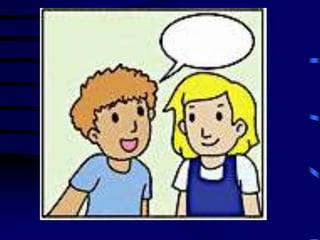
WHAT IF WE EXIST IN A
WORLD WHERE WE CAN
ONLY EXPRESS OUR FEELING
IN ONE WORLD? IS IS
POSSIBLE?
Do you think we can express
ourselves effectively?
Parts of Speech: What is a
INTERJECTION?
English 9
Mr. Margallo
So, what is an
INTERJECTION ?
A INTERJECTION is a word that is added to a
sentence to convey emotion or show sounds.
A INTERJECTION is one of the 8 parts of speech.
Parts of Speech: What is an INTERJECTION?
So, what is an
INTERJECTION ?
INTERJECTIONS are not grammatically related to
any other part of the sentence.
They are uncommon in formal academic writing
except in direct quotations. They most often show
emotion or excitement.
Parts of Speech: What is an INTERJECTION?
So, what is an
INTERJECTION ?
Usually, an exclamation point follows an
INTERJECTION. They are often set off separately
from complete sentences.
Awesome! Our team won the game!
Hey! Don’t tease me.
Parts of Speech: What is an INTERJECTION?
So, what is an
INTERJECTION ?
Common INTERJECTIONS stand by themselves and
show excitement or emotion:
Awesome! Hey! No! Yes! Wow! Yikes! Yuck!
Oh no! Holy cow! Hooray!
Parts of Speech: What is an INTERJECTION?
So, what is an
INTERJECTION ?
Some INTERJECTIONS show sounds:
Awww! Grrr! Yippee! hmmm, ugh, hah!
Whoopee! Whoa!
Parts of Speech: What is an INTERJECTION?
So, what is an
INTERJECTION ?
Some INTERJECTIONS can actually be a part of a
normal sentence (though they are not related to any
other words):
Ouch, eh, good lord, wow, oh, um, huh,
gosh, alas, ahoy, amen
Parts of Speech: What is an INTERJECTION?
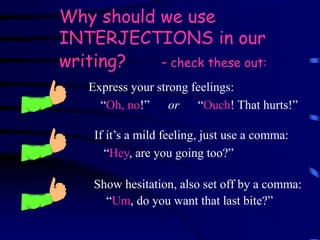
Why should we use
INTERJECTIONS in our
writing? – check these out:
Show hesitation, also set off by a comma:
“Um, do you want that last bite?”
Express your strong feelings:
“Oh, no!” or “Ouch! That hurts!”
If it’s a mild feeling, just use a comma:
“Hey, are you going too?”
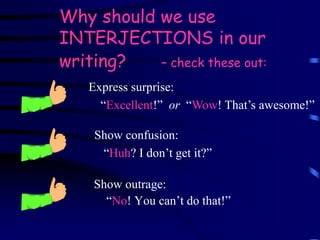
Why should we use
INTERJECTIONS in our
writing? – check these out:
Show outrage:
“No! You can’t do that!”
Express surprise:
“Excellent!” or “Wow! That’s awesome!”
Show confusion:
“Huh? I don’t get it?”
How can using Interjections
help you?
• Communicating your ideas clearly
• Demonstrating you have control
over your writing
• Making your writing
more exciting &
fun to read
What are the rules when using
interjections?
• Punctuations (a
comma or
exclamation point)
is used to set an
interjection off
from rest of the
sentence
• Interjections should
be in between
commas when used
in the middle of the
sentence.
What do we think of authors
or writers who don’t use
Interjections?
• They do not proofread.
• They are lazy
(and probably boring).
• They do not take the time
to re-read their work.
• They don’t care if the
reader enjoys their writing
Knowing the Parts of Speech
IS Important!!!
• For knowledge
• For a job
• For education
• For clarity
• For communication
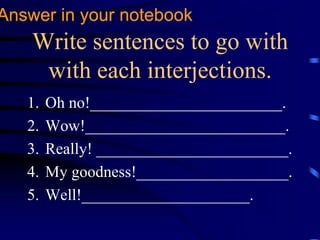
Write sentences to go with
with each interjections.
1. Oh no!________________________.
2. Wow!_________________________.
3. Really! ________________________.
4. My goodness!___________________.
5. Well!_____________________.
Answer in your notebook

Interjection_Gr7PPT.ppt

  • 1.
    WHAT IF WEEXIST IN A WORLD WHERE WE CAN ONLY EXPRESS OUR FEELING IN ONE WORLD? IS IS POSSIBLE?
  • 2.
    Do you thinkwe can express ourselves effectively?
  • 7.
    Parts of Speech:What is a INTERJECTION? English 9 Mr. Margallo
  • 8.
    So, what isan INTERJECTION ? A INTERJECTION is a word that is added to a sentence to convey emotion or show sounds. A INTERJECTION is one of the 8 parts of speech. Parts of Speech: What is an INTERJECTION?
  • 9.
    So, what isan INTERJECTION ? INTERJECTIONS are not grammatically related to any other part of the sentence. They are uncommon in formal academic writing except in direct quotations. They most often show emotion or excitement. Parts of Speech: What is an INTERJECTION?
  • 10.
    So, what isan INTERJECTION ? Usually, an exclamation point follows an INTERJECTION. They are often set off separately from complete sentences. Awesome! Our team won the game! Hey! Don’t tease me. Parts of Speech: What is an INTERJECTION?
  • 11.
    So, what isan INTERJECTION ? Common INTERJECTIONS stand by themselves and show excitement or emotion: Awesome! Hey! No! Yes! Wow! Yikes! Yuck! Oh no! Holy cow! Hooray! Parts of Speech: What is an INTERJECTION?
  • 12.
    So, what isan INTERJECTION ? Some INTERJECTIONS show sounds: Awww! Grrr! Yippee! hmmm, ugh, hah! Whoopee! Whoa! Parts of Speech: What is an INTERJECTION?
  • 13.
    So, what isan INTERJECTION ? Some INTERJECTIONS can actually be a part of a normal sentence (though they are not related to any other words): Ouch, eh, good lord, wow, oh, um, huh, gosh, alas, ahoy, amen Parts of Speech: What is an INTERJECTION?
  • 14.
    Why should weuse INTERJECTIONS in our writing? – check these out: Show hesitation, also set off by a comma: “Um, do you want that last bite?” Express your strong feelings: “Oh, no!” or “Ouch! That hurts!” If it’s a mild feeling, just use a comma: “Hey, are you going too?”
  • 15.
    Why should weuse INTERJECTIONS in our writing? – check these out: Show outrage: “No! You can’t do that!” Express surprise: “Excellent!” or “Wow! That’s awesome!” Show confusion: “Huh? I don’t get it?”
  • 16.
    How can usingInterjections help you? • Communicating your ideas clearly • Demonstrating you have control over your writing • Making your writing more exciting & fun to read
  • 17.
    What are therules when using interjections? • Punctuations (a comma or exclamation point) is used to set an interjection off from rest of the sentence • Interjections should be in between commas when used in the middle of the sentence.
  • 18.
    What do wethink of authors or writers who don’t use Interjections? • They do not proofread. • They are lazy (and probably boring). • They do not take the time to re-read their work. • They don’t care if the reader enjoys their writing
  • 19.
    Knowing the Partsof Speech IS Important!!! • For knowledge • For a job • For education • For clarity • For communication
  • 20.
    Write sentences togo with with each interjections. 1. Oh no!________________________. 2. Wow!_________________________. 3. Really! ________________________. 4. My goodness!___________________. 5. Well!_____________________. Answer in your notebook