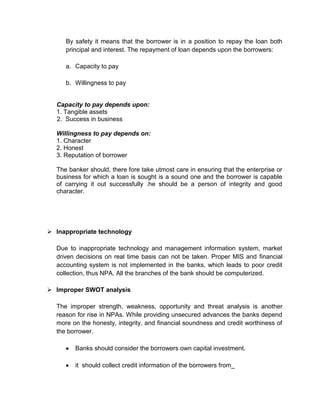
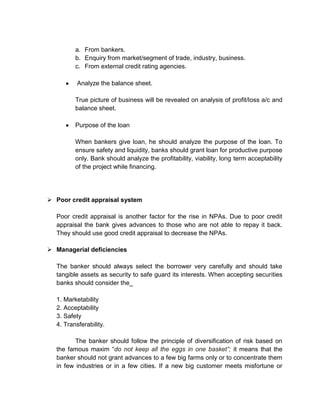
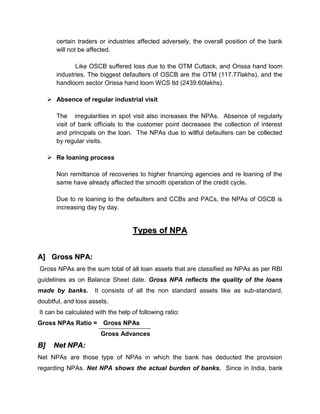
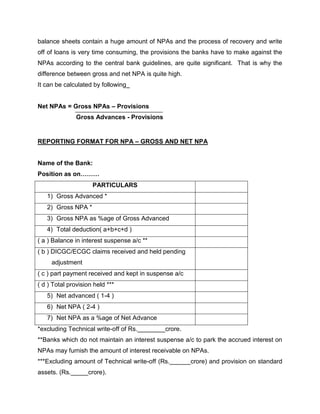
An<br />INTERIM REPORT<br />ON<br /> COMPARATIVE ANALYSIS ON<br />NON PERFORMING ASSETS<br />  OF PRIVATE AND PUBLIC SECTOR BANKS<br />SUBMITTED IN PARTIAL FULFILLMENT OF REQUIRMENT OF PG Programe<br />IBS Mumbai<br />SUBMITTED BY:<br />Gaurav Gupta<br />09BS0000775<br />     <br />Session: 2009-2011<br />ACKNOWLEDGEMENT<br />With a deep sense of gratitude I express we thanks to all those who have been instrumental in the development of the project report.<br />I am also grateful to IBS Mumbai, who gave me a valuable opportunity of involving me in real live business project. I am thankful to all the professors whose positive attitude, guidance and faith in my ability spurred me to perform well.<br />I am also indebted to all lecturers, friends and associates for their valuable advice, stimulated suggestions and overwhelming support without which the project would not have been a success.<br />INTRODUCTION<br />                  The accumulation of huge non-performing assets in banks has assumed great importance.  The depth of the problem of bad debts was first realized only in early 1990s.  The magnitude of NPAs in banks and financial institutions is over Rs.1,50,000 crores.  <br />                   While gross NPA reflects the quality of the loans made by banks, net NPA shows the actual burden of banks.  Now it is increasingly evident that the major defaulters are the big borrowers coming from the non-priority sector.  The banks and financial institutions have to take the initiative to reduce NPAs in a time bound strategic approach.<br />                    Public sector banks figure prominently in the debate not only because they dominate the banking industries, but also since they have much larger NPAs compared with the private sector banks.  This raises a concern in the industry and academia because it is generally felt that NPAs reduce the profitability of a banks, weaken its financial health and erode its solvency.<br />                      For the recovery of NPAs a broad framework has evolved for the management of NPAs under which several options are provided for debt recovery and restructuring.  Banks and FIs have the freedom to design and implement their own policies for recovery and write-off incorporating compromise and negotiated settlements.<br />RESEARCH METHODOLOGY<br />Type of Research<br />The research methodology adopted for carrying out the study were
In this project Descriptive research methodologies were use.
At the first stage theoretical study is attempted.
At the second stage Historical study is attempted.
At the Third stage Comparative study of NPA is undertaken.Scope of the Study<br />Concept of Non Performing Asset<br />Guidelines <br />Impact of NPAs<br />Reasons for NPAs<br />Preventive Measures <br />Tools to manage NPAs<br />Sampling plan<br />To prepare this Project we took five banks from public sector as well as five banks from private sector.<br />OBJECTIVES OF THE STUDY<br />The basic idea behind undertaking the Grand Project on NPA was to:<br />To evaluate NPAs (Gross and Net) in different banks.
To study the past trends of NPA
To calculate the weighted of NPA in risk management in Banking
To analyze financial performance of banks at different level of NPA
To evaluate profitability positions of banks
To evaluate NPA level in different economic situation.
To Know the Concept of Non Performing Asset
 To Know the Impact of NPAs
To Know the Reasons for NPAs
To learn Preventive Measures Source of data collection<br />The data collected for the study was secondary data in Nature.<br />Introduction to the topic<br />The three letters “NPA” Strike terror in banking sector and business circle today. NPA is short form of “Non Performing Asset”. The dreaded NPA rule says simply this: when interest or other due to a bank remains unpaid for more than 90 days, the entire bank loan automatically turns a non performing asset. The recovery of loan has always been problem for banks and financial institution. To come out of these first we need to think is it possible to avoid NPA, no can not be then left is to look after the factor responsible for it and managing those factors.<br />Definitions:<br />An asset, including a leased asset, becomes non-performing when it ceases to generate income for the bank. <br />A ‘non-performing asset’ (NPA) was defined as a credit facility in respect of which the interest and/ or instalment of principal has remained ‘past due’ for a specified period of time. <br />With a view to moving towards international best practices and to ensure greater transparency, it has been decided to adopt the ‘90 days’ overdue’ norm for identification of NPAs, from the year ending March 31, 2004. Accordingly, with effect from March 31, 2004, a non-performing asset (NPA) shall be a loan or an advance where;<br /> <br />Interest and/ or instalment of principal remain overdue for a period of     more than 90 days in respect of a term loan,<br />The account remains ‘out of order’ for a period of more than 90 days, in respect of an Overdraft/Cash Credit (OD/CC),<br />The bill remains overdue for a period of more than 90 days in the case of bills purchased and discounted,<br />Interest and/or instalment of principal remains overdue for two harvest seasons but for a period not exceeding two half years in the case of an advance granted for agricultural purposes, and<br />Any amount to be received remains overdue for a period of more than 90 days in respect of other accounts. <br />As a facilitating measure for smooth transition to 90 days norm, banks have been advised to move over to charging of interest at monthly rests, by April 1, 2002. However, the date of classification of an advance as NPA should not be changed on account of charging of interest at monthly rests. Banks should, therefore, continue to classify an account as NPA only if the interest charged during any quarter is not serviced fully within 180 days from the end of the quarter with effect from April 1, 2002 and 90 days from the end of the quarter with effect from March 31, 2004.<br />FACTORS FOR RISE IN NPAs<br />The banking sector has been facing the serious problems of the rising NPAs.  But the problem of NPAs is more in public sector banks when compared to private sector banks and foreign banks. The NPAs in PSB are growing due to external as well as internal factors.<br />EXTERNAL FACTORS :-<br />----------------------------------<br /> Ineffective  recovery tribunal
The Govt. has set of numbers of recovery tribunals, which works for recovery of loans and advances. Due to their negligence and ineffectiveness in their work the bank suffers the consequence of non-recover, their by reducing their profitability and liquidity.
Willful  DefaultsThere are borrowers who are able to payback loans but are intentionally withdrawing it. These groups of people should be identified and proper measures should be taken in order to get back the money extended to them as advances and loans.<br />Natural calamities
This is the measure factor, which is creating alarming rise in NPAs of the PSBs. every  now and then India is hit by major natural calamities thus making the borrowers unable to pay back there loans. Thus the bank has to make large amount of provisions in order to compensate those loans, hence end up the fiscal with a reduced profit.
 Mainly ours farmers depends on rain fall for cropping. Due to irregularities of rain fall the farmers are not to achieve the production level thus they are not repaying the loans.
Industrial  sickness
Improper project  handling , ineffective management , lack of adequate resources , lack of advance technology , day to day changing govt. Policies give birth to industrial sickness. Hence the banks that finance those industries ultimately end up with a low recovery of their loans reducing their profit and liquidity.

Interim report

  • 1.
    An<br />INTERIM REPORT<br/>ON<br /> COMPARATIVE ANALYSIS ON<br />NON PERFORMING ASSETS<br /> OF PRIVATE AND PUBLIC SECTOR BANKS<br />SUBMITTED IN PARTIAL FULFILLMENT OF REQUIRMENT OF PG Programe<br />IBS Mumbai<br />SUBMITTED BY:<br />Gaurav Gupta<br />09BS0000775<br /> <br />Session: 2009-2011<br />ACKNOWLEDGEMENT<br />With a deep sense of gratitude I express we thanks to all those who have been instrumental in the development of the project report.<br />I am also grateful to IBS Mumbai, who gave me a valuable opportunity of involving me in real live business project. I am thankful to all the professors whose positive attitude, guidance and faith in my ability spurred me to perform well.<br />I am also indebted to all lecturers, friends and associates for their valuable advice, stimulated suggestions and overwhelming support without which the project would not have been a success.<br />INTRODUCTION<br /> The accumulation of huge non-performing assets in banks has assumed great importance. The depth of the problem of bad debts was first realized only in early 1990s. The magnitude of NPAs in banks and financial institutions is over Rs.1,50,000 crores. <br /> While gross NPA reflects the quality of the loans made by banks, net NPA shows the actual burden of banks. Now it is increasingly evident that the major defaulters are the big borrowers coming from the non-priority sector. The banks and financial institutions have to take the initiative to reduce NPAs in a time bound strategic approach.<br /> Public sector banks figure prominently in the debate not only because they dominate the banking industries, but also since they have much larger NPAs compared with the private sector banks. This raises a concern in the industry and academia because it is generally felt that NPAs reduce the profitability of a banks, weaken its financial health and erode its solvency.<br /> For the recovery of NPAs a broad framework has evolved for the management of NPAs under which several options are provided for debt recovery and restructuring. Banks and FIs have the freedom to design and implement their own policies for recovery and write-off incorporating compromise and negotiated settlements.<br />RESEARCH METHODOLOGY<br />Type of Research<br />The research methodology adopted for carrying out the study were
  • 2.
    In this projectDescriptive research methodologies were use.
  • 3.
    At the firststage theoretical study is attempted.
  • 4.
    At the secondstage Historical study is attempted.
  • 5.
    At the Thirdstage Comparative study of NPA is undertaken.Scope of the Study<br />Concept of Non Performing Asset<br />Guidelines <br />Impact of NPAs<br />Reasons for NPAs<br />Preventive Measures <br />Tools to manage NPAs<br />Sampling plan<br />To prepare this Project we took five banks from public sector as well as five banks from private sector.<br />OBJECTIVES OF THE STUDY<br />The basic idea behind undertaking the Grand Project on NPA was to:<br />To evaluate NPAs (Gross and Net) in different banks.
  • 6.
    To study thepast trends of NPA
  • 7.
    To calculate theweighted of NPA in risk management in Banking
  • 8.
    To analyze financialperformance of banks at different level of NPA
  • 9.
    To evaluate profitabilitypositions of banks
  • 10.
    To evaluate NPAlevel in different economic situation.
  • 11.
    To Know theConcept of Non Performing Asset
  • 12.
    To Knowthe Impact of NPAs
  • 13.
    To Know theReasons for NPAs
  • 14.
    To learn PreventiveMeasures Source of data collection<br />The data collected for the study was secondary data in Nature.<br />Introduction to the topic<br />The three letters “NPA” Strike terror in banking sector and business circle today. NPA is short form of “Non Performing Asset”. The dreaded NPA rule says simply this: when interest or other due to a bank remains unpaid for more than 90 days, the entire bank loan automatically turns a non performing asset. The recovery of loan has always been problem for banks and financial institution. To come out of these first we need to think is it possible to avoid NPA, no can not be then left is to look after the factor responsible for it and managing those factors.<br />Definitions:<br />An asset, including a leased asset, becomes non-performing when it ceases to generate income for the bank. <br />A ‘non-performing asset’ (NPA) was defined as a credit facility in respect of which the interest and/ or instalment of principal has remained ‘past due’ for a specified period of time. <br />With a view to moving towards international best practices and to ensure greater transparency, it has been decided to adopt the ‘90 days’ overdue’ norm for identification of NPAs, from the year ending March 31, 2004. Accordingly, with effect from March 31, 2004, a non-performing asset (NPA) shall be a loan or an advance where;<br /> <br />Interest and/ or instalment of principal remain overdue for a period of more than 90 days in respect of a term loan,<br />The account remains ‘out of order’ for a period of more than 90 days, in respect of an Overdraft/Cash Credit (OD/CC),<br />The bill remains overdue for a period of more than 90 days in the case of bills purchased and discounted,<br />Interest and/or instalment of principal remains overdue for two harvest seasons but for a period not exceeding two half years in the case of an advance granted for agricultural purposes, and<br />Any amount to be received remains overdue for a period of more than 90 days in respect of other accounts. <br />As a facilitating measure for smooth transition to 90 days norm, banks have been advised to move over to charging of interest at monthly rests, by April 1, 2002. However, the date of classification of an advance as NPA should not be changed on account of charging of interest at monthly rests. Banks should, therefore, continue to classify an account as NPA only if the interest charged during any quarter is not serviced fully within 180 days from the end of the quarter with effect from April 1, 2002 and 90 days from the end of the quarter with effect from March 31, 2004.<br />FACTORS FOR RISE IN NPAs<br />The banking sector has been facing the serious problems of the rising NPAs. But the problem of NPAs is more in public sector banks when compared to private sector banks and foreign banks. The NPAs in PSB are growing due to external as well as internal factors.<br />EXTERNAL FACTORS :-<br />----------------------------------<br /> Ineffective recovery tribunal
  • 15.
    The Govt. hasset of numbers of recovery tribunals, which works for recovery of loans and advances. Due to their negligence and ineffectiveness in their work the bank suffers the consequence of non-recover, their by reducing their profitability and liquidity.
  • 16.
    Willful DefaultsThereare borrowers who are able to payback loans but are intentionally withdrawing it. These groups of people should be identified and proper measures should be taken in order to get back the money extended to them as advances and loans.<br />Natural calamities
  • 17.
    This is themeasure factor, which is creating alarming rise in NPAs of the PSBs. every now and then India is hit by major natural calamities thus making the borrowers unable to pay back there loans. Thus the bank has to make large amount of provisions in order to compensate those loans, hence end up the fiscal with a reduced profit.
  • 18.
    Mainly oursfarmers depends on rain fall for cropping. Due to irregularities of rain fall the farmers are not to achieve the production level thus they are not repaying the loans.
  • 19.
  • 20.
    Improper project handling , ineffective management , lack of adequate resources , lack of advance technology , day to day changing govt. Policies give birth to industrial sickness. Hence the banks that finance those industries ultimately end up with a low recovery of their loans reducing their profit and liquidity.