INTELLECTUAL
PROPERTY RIGHTS (IPR)
PREPARED BY:
KISHAN RAM
M.PHARM , SEM-1
QUALITY ASSURANCE
GUIDED BY:
Dr. DAYA CHOTHANI
Ms. URVI J. CHOTALIYA
ASSISTANT- PROFESSOR
BKMGPC RAJKOT
CONTENTS:
• Introduction to IPR
• Types of IPR
• INDUSTRIAL DESIGNS
• TRADE MARKS
• TRADE SECRETS
• GEOGRAPHICAL INDICATIONS
• COPYRIGHT
• PATENTS
• References
2
INTRODUCTION TO IPRs :
•Intellectual Property (IP) is any creations of human mind.
Like tangible property, their creation has a value and, as with all
property, it needs to be protected.
• Intellectual Property Rights (IPR):
“Exclusive rights granted by the State
for inventions, new and original designs, trademarks, new plant
varieties and artistic and literary works”.
3
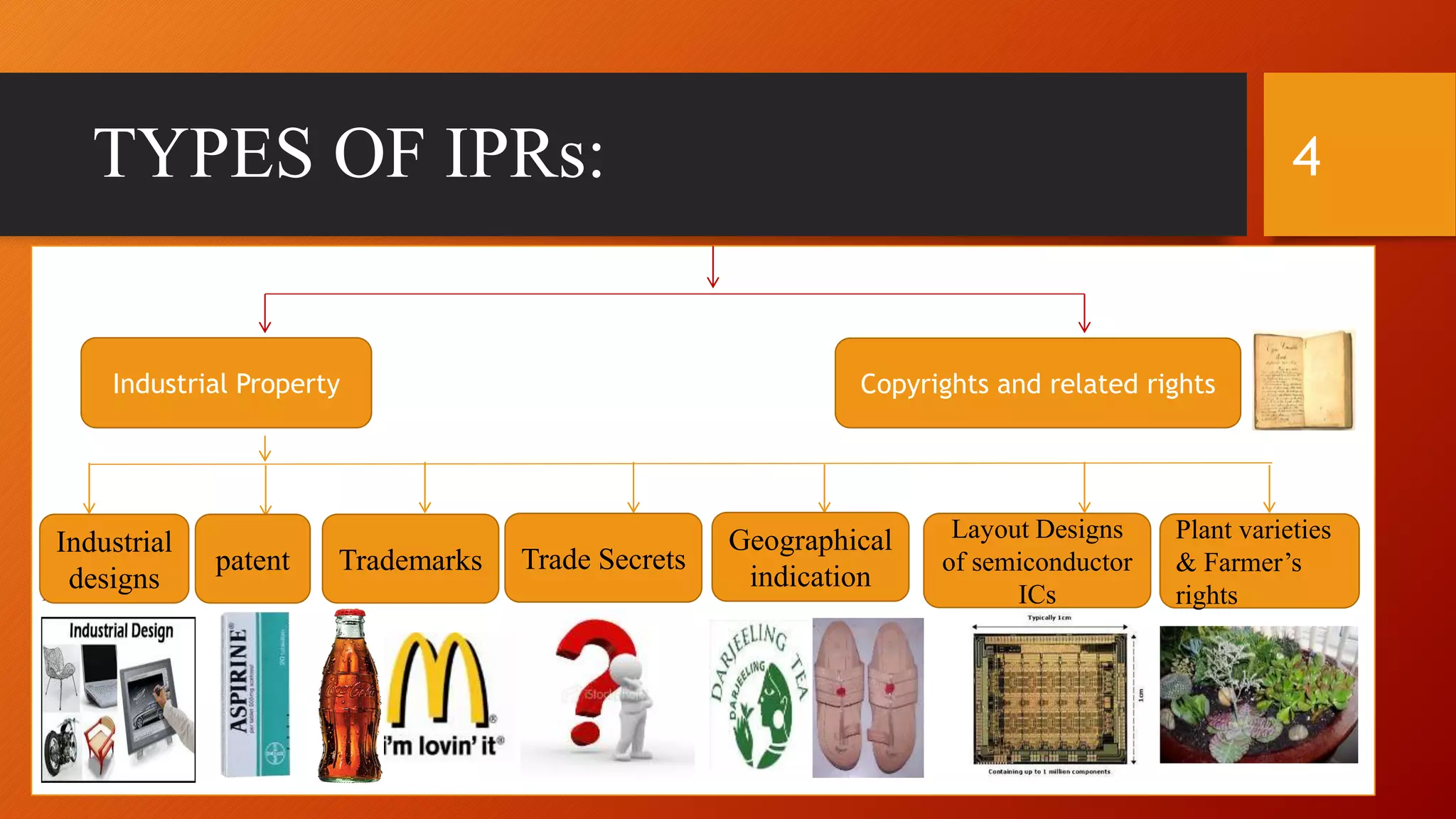
TYPES OF IPRs:
p
Industrial
designs
Industrial Property Copyrights and related rights
patent Trademarks Trade Secrets
Geographical
indication
Plant varieties
& Farmer’s
rights
Layout Designs
of semiconductor
ICs
4
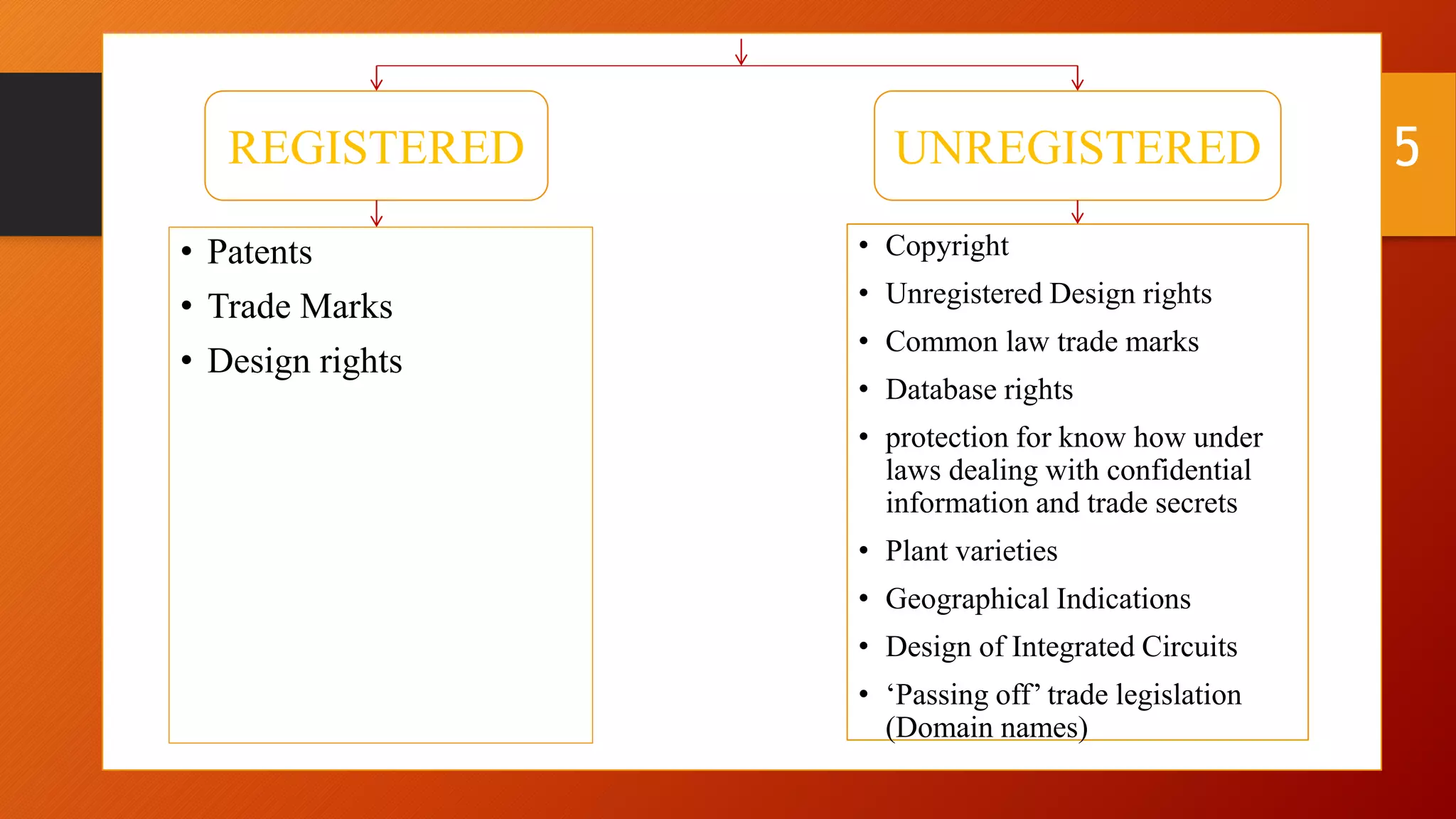
REGISTERED UNREGISTERED
• Copyright
• Unregistered Design rights
• Common law trade marks
• Database rights
• protection for know how under
laws dealing with confidential
information and trade secrets
• Plant varieties
• Geographical Indications
• Design of Integrated Circuits
• ‘Passing off’ trade legislation
(Domain names)
• Patents
• Trade Marks
• Design rights
5
1. INDUSTRIAL DESIGNS:
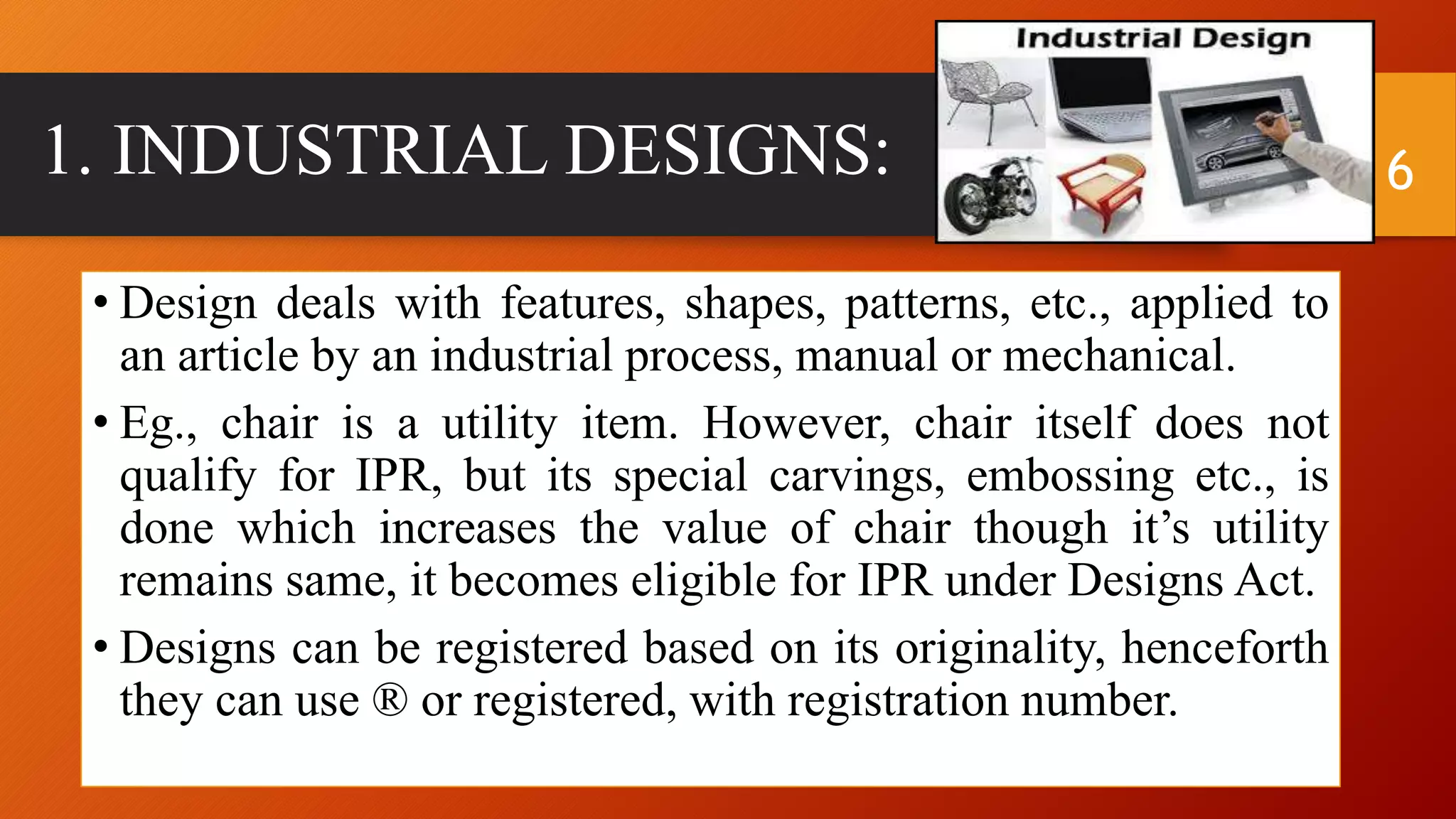
• Design deals with features, shapes, patterns, etc., applied to
an article by an industrial process, manual or mechanical.
• Eg., chair is a utility item. However, chair itself does not
qualify for IPR, but its special carvings, embossing etc., is
done which increases the value of chair though it’s utility
remains same, it becomes eligible for IPR under Designs Act.
• Designs can be registered based on its originality, henceforth
they can use ® or registered, with registration number.
6
• The laws governing designs are the Designs Act of 2000 and
the Designs Rules of 2001. In India designs are defined as
follows:
• ‘A design refers to the features of shape, configuration, pattern,
ornamentation or composition of lines or colors applied to any
article, in two or three dimensional (or both) forms’. (Design
Office, Kolkata: Guidelines for Registration)
• Designs are valid for a maximum of ten years, renewable for
a further five years.
7
2.TRADE MARKS :
 Trade Marks Act, 1999 defines TM as a mark capable of being
represented graphically and which is capable of distinguishing the goods
or services of one person from those of others and may include shape of
goods, their packaging and combination of colours.
 Mark includes “Device, brand, heading, label, ticket, name, signature,
word, letter, numeral, shape of goods, packaging, combination of
colours, and any combination thereof.”
 Brand refers to a name, term, sign, symbol, or design, or a combination
of them, intended to identify the goods or services of one seller or group
of sellers and to differentiate them from those of competitors. E.g.
McDonald for restaurants, Cycle brand agarbattis, etc.
8
Brand Name is that part of a brand which can be vocalized-the
utterable.
Brand Mark is that part of a brand which can be recognised but
is not a utterable, such as symbol, design or distinctive
colouring or lettering.
Device refers to pictorial representations – e.g. animals, birds,
landscape buildings, etc.
Letter as a mark is the identity created out of letterforms and
has its inbuilt strength of distinctiveness and individuality – e.g.
IBM, GM, ELBEE, 3M etc.
9
10
Name
Logotype
Symbol
Slogan
Shape
Color
3. Trade Secrets:
• Trade secret is any intellectual work or product used for a
business purpose that can be classified as belonging to that
business provided it is not based on information in public
domain.
• A trade secret consists of
• a formula, device, idea, process, pattern, or compilation of information that
gives the owner a competitive advantage in the marketplace,
• a novel idea that is not common knowledge and is kept in a confidential state.
11
• A trade secret is not protected by federal law
• Can only be protected through employment contracts
and/or maintaining tight security
• Recipes, ingredients, codes, manufacturing costs etc.
12
4.GEOGRAPHICAL INDICATIONS:
• This is an indication, that originates from a definite
geographical area, which is used to identify natural or
manufactured product.
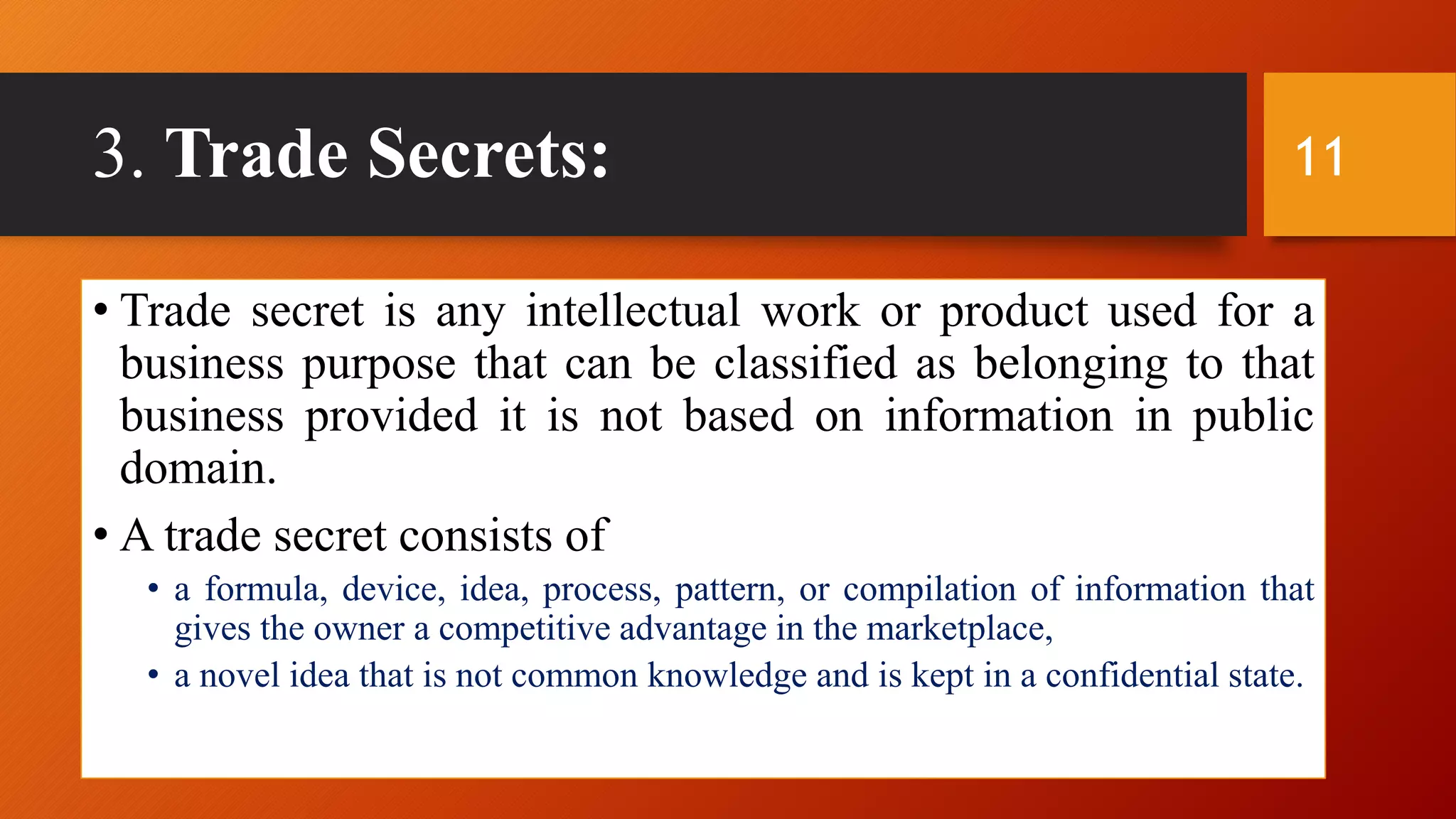
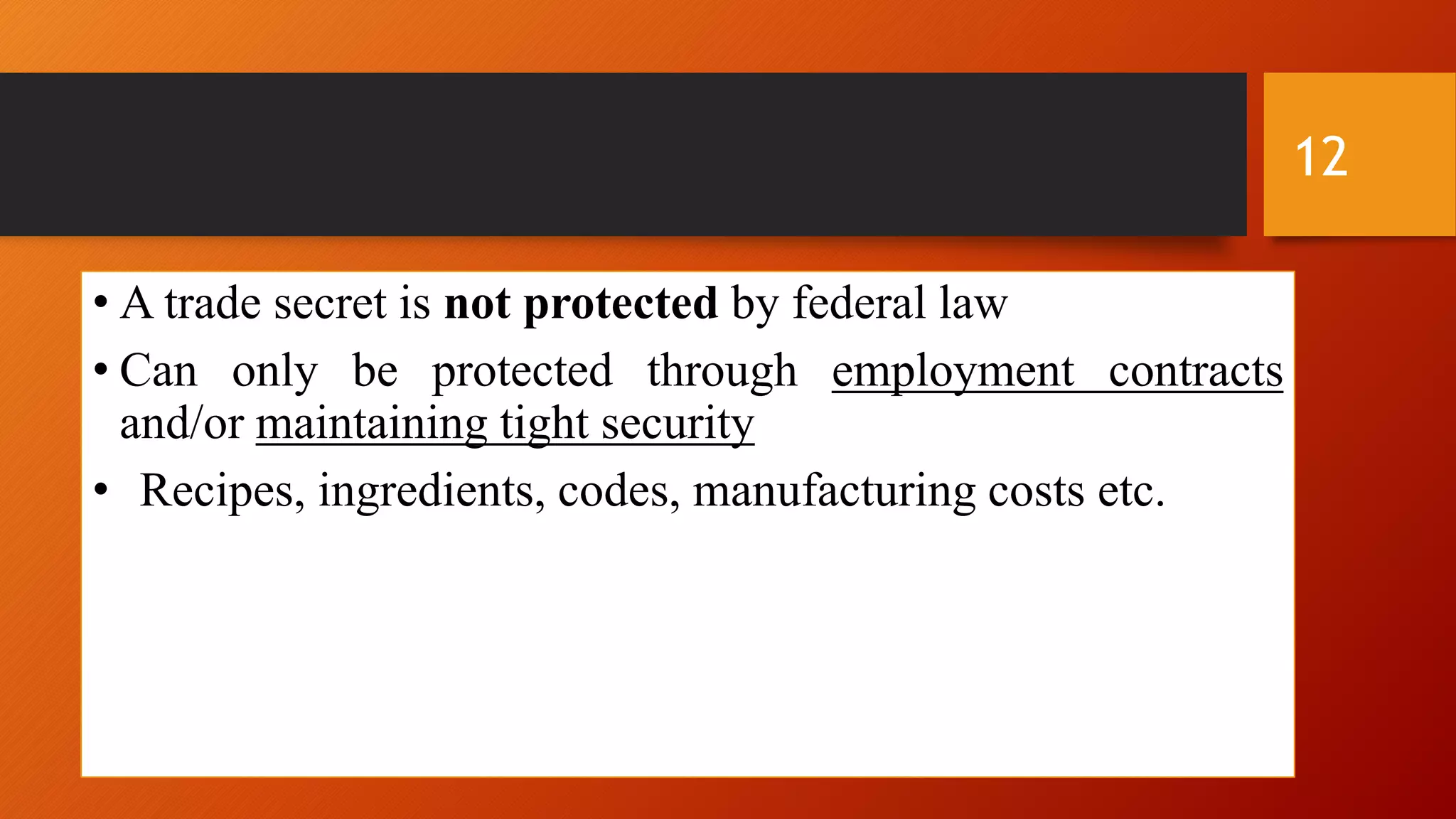
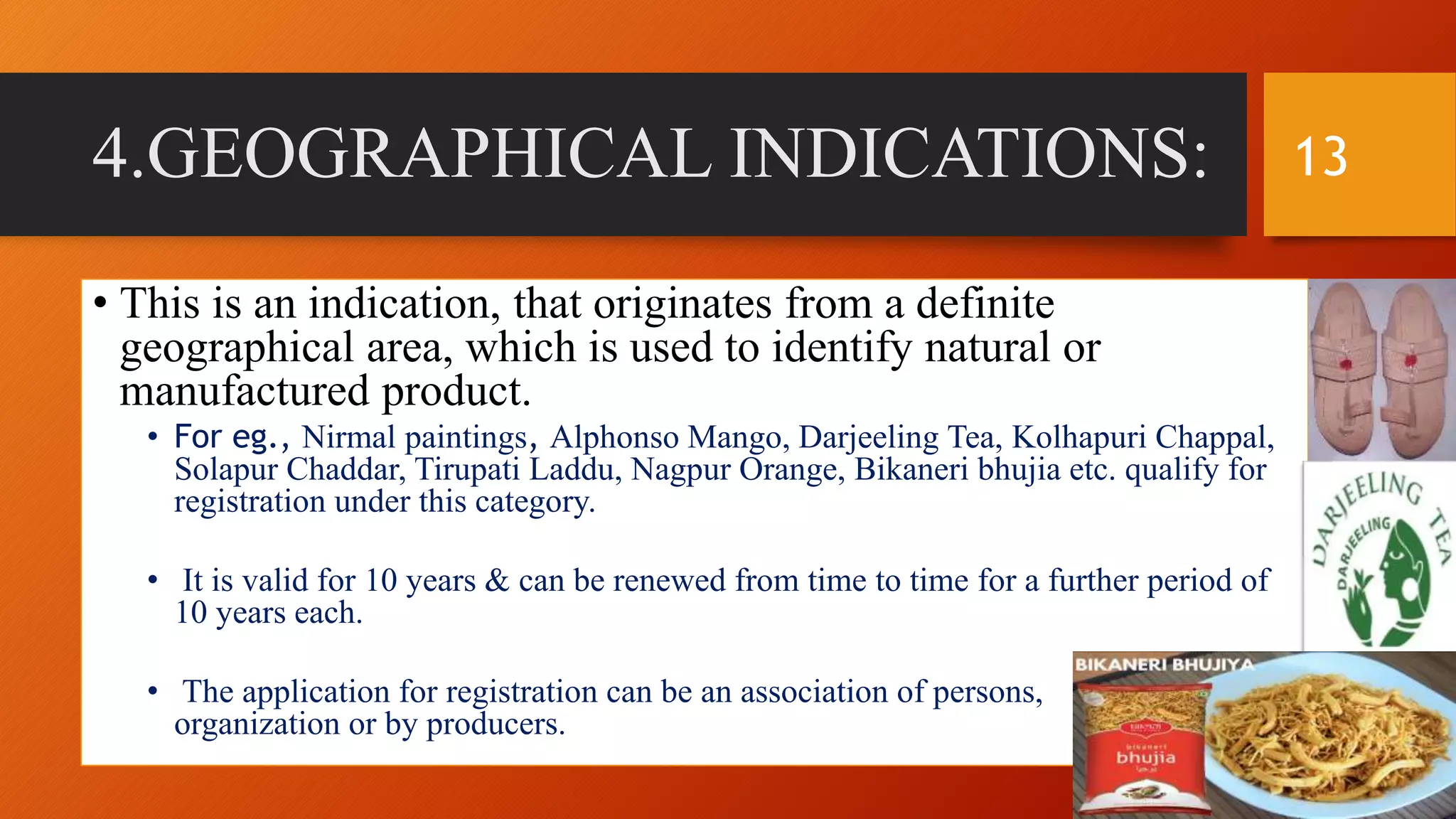
• For eg., Nirmal paintings, Alphonso Mango, Darjeeling Tea, Kolhapuri Chappal,
Solapur Chaddar, Tirupati Laddu, Nagpur Orange, Bikaneri bhujia etc. qualify for
registration under this category.
• It is valid for 10 years & can be renewed from time to time for a further period of
10 years each.
• The application for registration can be an association of persons,
organization or by producers.
13
5.COPYRIGHT:
• Copyright is a monopoly right restraining others from
exercising that right which has been conferred on the owner of
copyright.
• It is a negative right meaning thereby that it is prohibitory in
nature. It is a right to prevent others from copying or
reproducing the work.
14
• The object of copyright is to encourage authors, composers
and artists to create original works by rewarding them the
exclusive right for a specific period to reproduce the works
for publishing and selling them to the public.
• Copyright is not a single right. It is a bundle of rights in
the same work.
• For e,g. in the case of a literary work, copyright consists
of reproduction in print media, the right of dramatic and
cinematographic versions, the right of translation,
adaptation, abridgement and the right of public
performance.
15
TERM (Period) OF COPYRIGHT
• In the case of any literary, dramatic, musical or a artistic work
(other than a photograph), life time of the author + 60 years.
• In the case of photograph, cine films, sound recording and Govt.
Work, 60 years from the beginning of the calendar year next
following the year in which the work is first published.
• In the case of broadcasters/performers, reproduction right shall
subsist until 25 years from the calendar year next following the
year in which the broadcast/performance is made.
16
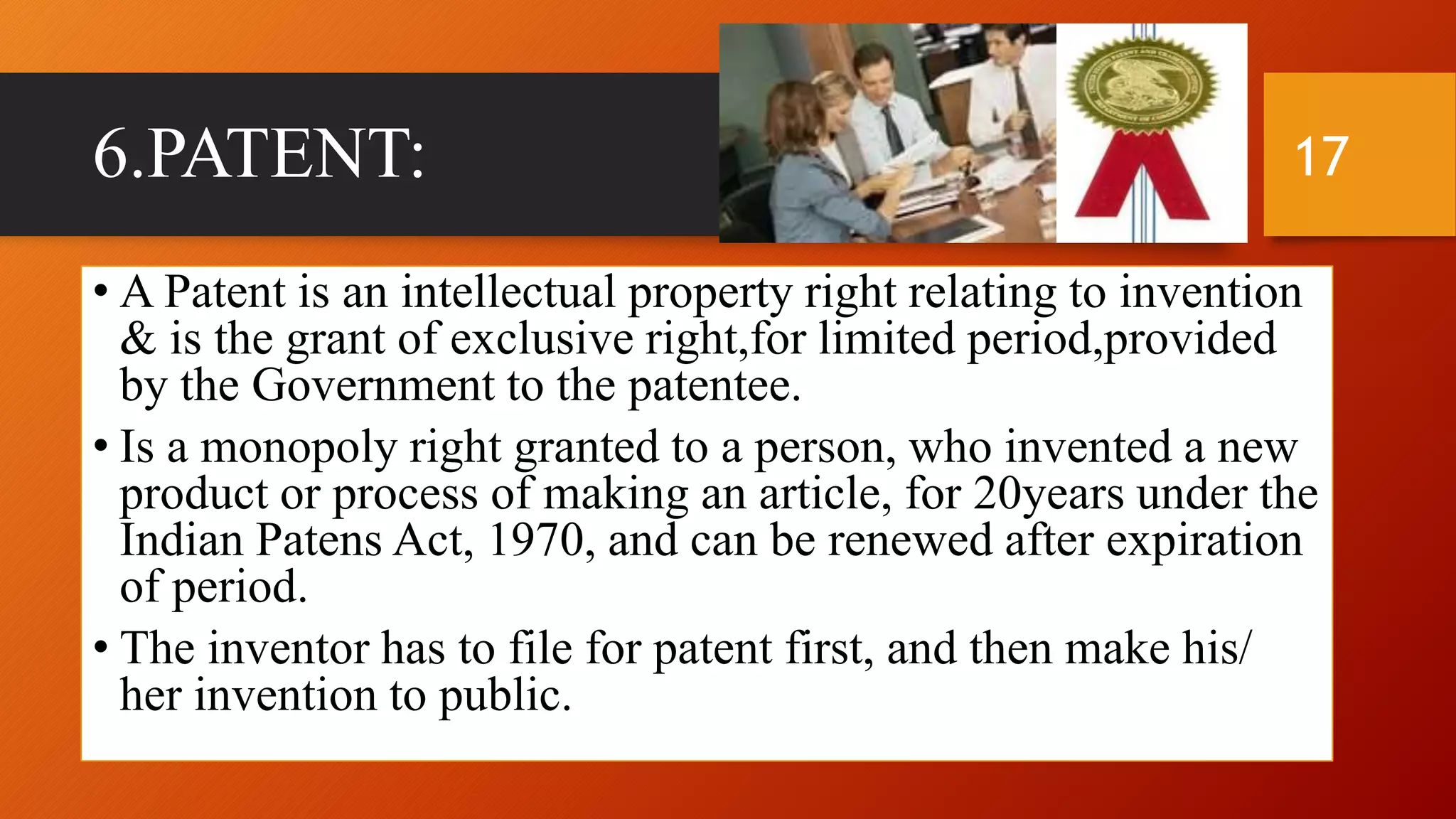
6.PATENT:
• A Patent is an intellectual property right relating to invention
& is the grant of exclusive right,for limited period,provided
by the Government to the patentee.
• Is a monopoly right granted to a person, who invented a new
product or process of making an article, for 20years under the
Indian Patens Act, 1970, and can be renewed after expiration
of period.
• The inventor has to file for patent first, and then make his/
her invention to public.
17
• A patent has to be applied in each country by the inventor,
to claim his rights in that country.
• Eg: A group of scientists working on new drug
development in Himalaya Drugs for some salary. The
patent of the drug developed is given to Himalaya Drugs,
but not to the scientists. The drug may have many patents
like composition, process, and product etc.
18
Invention:
Indian patent act (amendment) 2002 define the term invention
is:
“A new product or process involving an inventive step
and capable of industrial application.”
“Inventive step” is the feature that makes the invention non-obvious to a person
skilled in the art.
“Capable of industrial application” means an invention should have
commercial value in the market.
19
Who is Inventer ?
• Any person who invents or discovers any new and useful :
Process
Machine
Manufacture or
Composition of matter, or
Any new and useful improvement thereof, may obtain a
patent.
20
WHAT ARE PATENTABLE INVENTION ?
• An invention to be patentable should be technical in
nature and should meet the following criteria-
 Novel
 Non obvious
 Useful
Capable of industrial aplication
21
What are Non patentable inventions?
Discovery of any living thing or non living substances
occurring in nature.
A method of agriculture or horticulture.eg the method
of terrace farming cannot be patented.
22
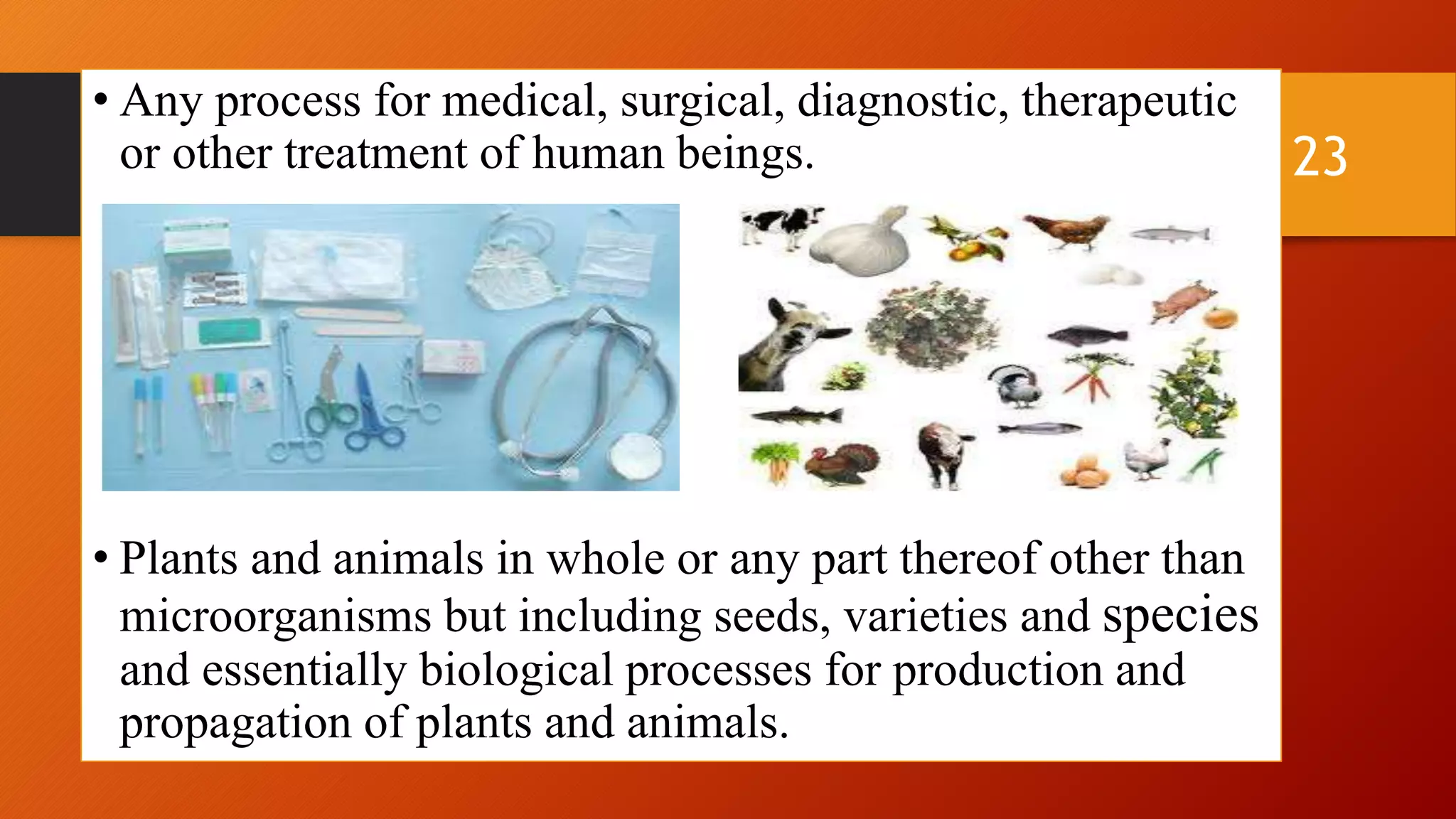
• Any process for medical, surgical, diagnostic, therapeutic
or other treatment of human beings.
• Plants and animals in whole or any part thereof other than
microorganisms but including seeds, varieties and species
and essentially biological processes for production and
propagation of plants and animals.
23
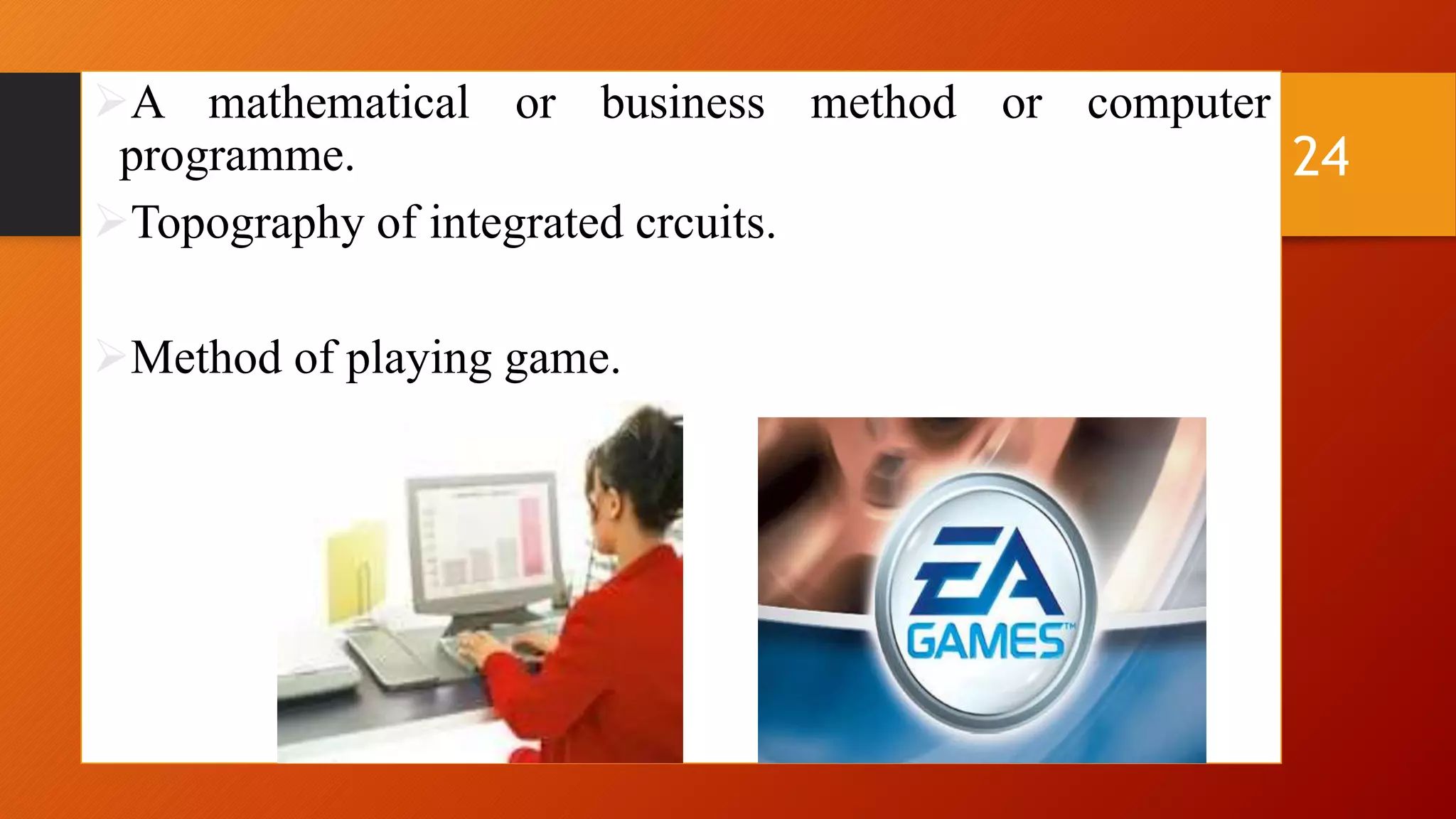
A mathematical or business method or computer
programme.
Topography of integrated crcuits.
Method of playing game.
24
Types of Patent Applications
Ordinary Application
Application for Patent of Addition(granted For Improvement or
Modification of the already patented invention,for an unexpired term of
the main patent).
Divisional Application(in case of Plurality of inventions disclosed in
the main application)
Convention application, claiming priority date on the basis of filling
Convention Countries.
National Phase Application under PCT.
25
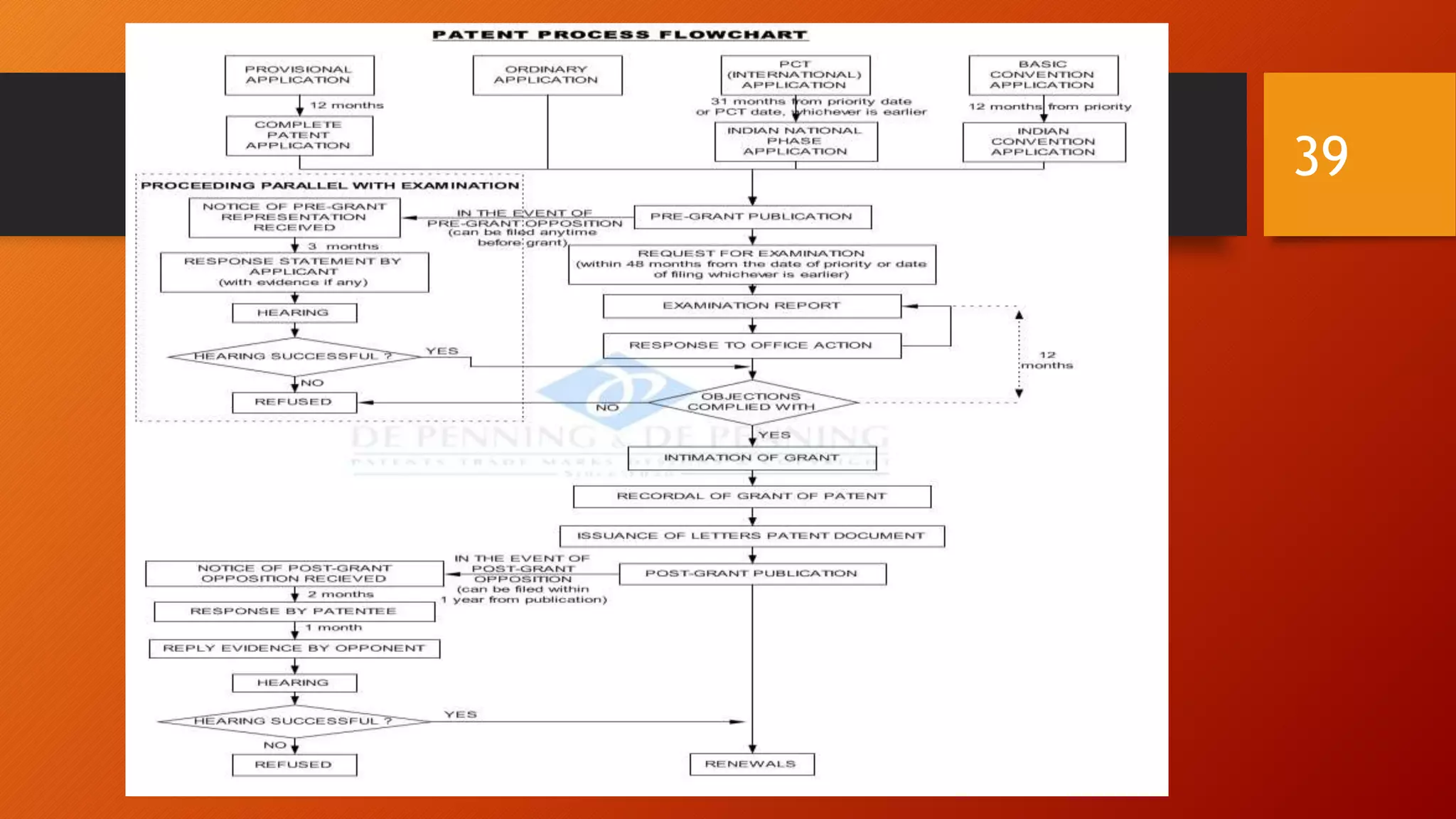
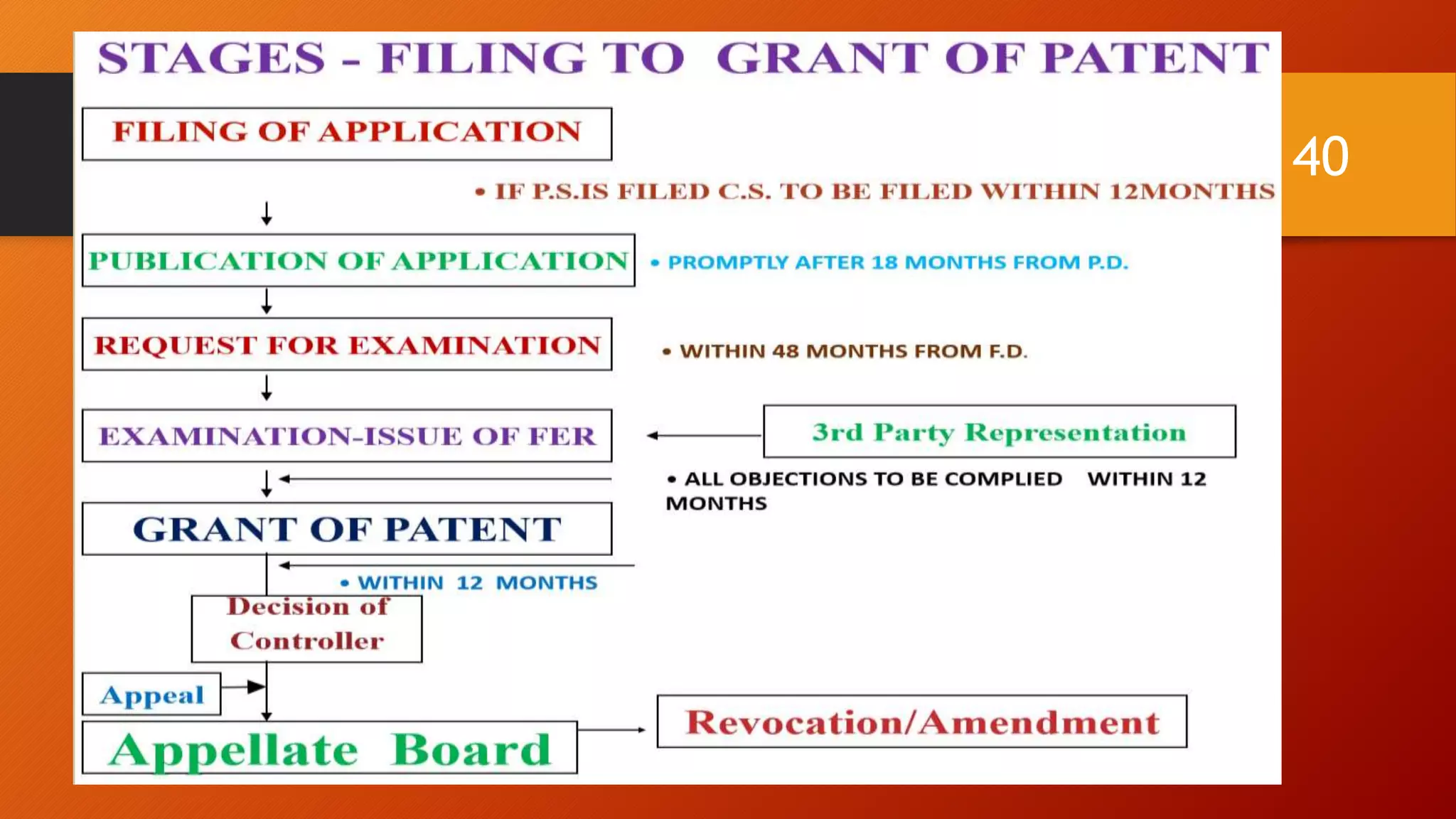
 PROCEDURE TO GET PATENT
• A patent application can be filed at only of the four patent
offices in India (Kolkata, Delhi, Mumbai and Chennai).
• The patent application passes through the following stages:
A.FILING
B.PUBLICATION
C.EXAMINATION
D.OPPOSITION
E. GRANT
26
A. Filing
• 1. Applicant : An application for a patent can be filed
by the true and first inventor. It can also be filed the
by the assignee or legal representative of the inventor.
• 2. Form of Application: Every application shall be
accompanied by a provisional or complete
specification.
27
Provisional Patent Application
An applicant may file a provisional specification
containing incomplete & general description of the
invention.
No need to file claims.
Objective of it is to fix the priority date
Complete specification is to be filed within 12+3 (15
months) from the date of filing provisional specification.
28
Complete Specification
• Submission of complete specification is necessary to
obtain a patent it must be submitted within 12 months of
filing the provisional specification.
• Contents of complete specification would include
following-
1)Title of the invention
2)Field to which the invention belongs
3)Background of the invention including prior art giving drawbacks of the
known inventions and practices
29
4) Complete description of the invention along with
experimental results
5) Drawings (if necessary)
6) Claims, which are statements of technical facts
expressed in legal terms, related to the invention on
which legal proprietorship is being sought. therefore the
claims have to be drafted very carefully.
30
FORM - 2
THE PATENTS ACT, 1970
(39 of 1970)
COMPLETE SPECIFICATION
[SECTION 10; RULE 13]
1. Title of Invention
2. (a) Name of Applicant
(b) Address of Applicant
(c) Nationality: Indian.
The following specification particularly describes the nature of this invention and the manner
in which it is to be performed.
31
• 5 Documents to be submitted at the time of filing.
The following documents have to be submitted at the
time of filing a patent application:
a. Form 1 - Application for the grant of patent.
b. Form 2 - Provisional or Complete Specification.
c. Form 3 - Statement and undertaking by the applicant.
d. Form 5 - Declaration as to inventorship.
e. Form 26 - Authorization of patent agent or any other
‘ person
32
B.PUBLICATION
• A patent application will be published on expiry of eighteen
months after the priority date. It can be published earlier, if
such a request is made by the applicant.
• On publication, specification including drawings and deposits
shall be open for public inspection. The rights of the patentee
start from the date of publication but they cannot be enforced
until after patent grant.
33
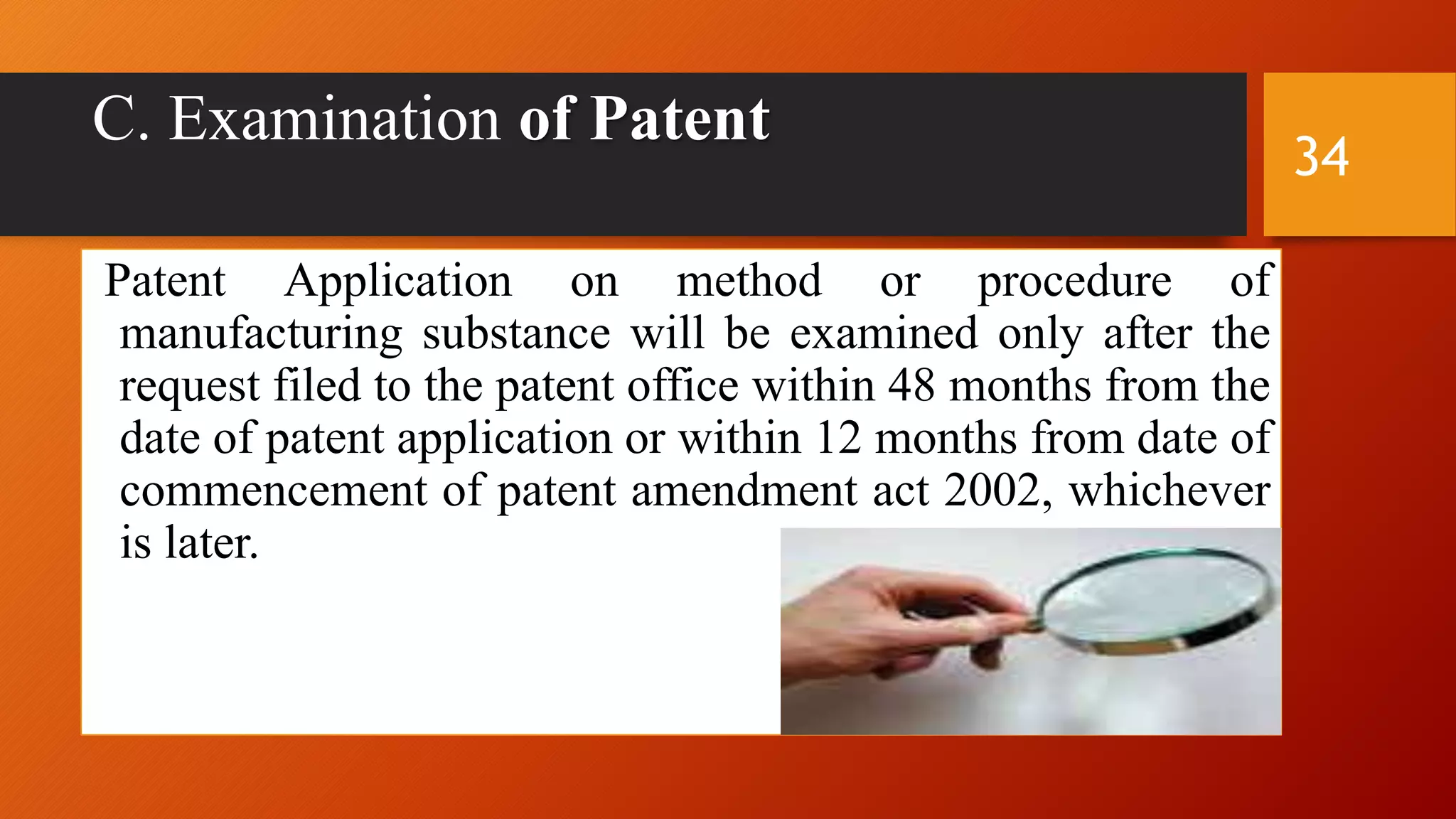
C. Examination of Patent
Patent Application on method or procedure of
manufacturing substance will be examined only after the
request filed to the patent office within 48 months from the
date of patent application or within 12 months from date of
commencement of patent amendment act 2002, whichever
is later.
34
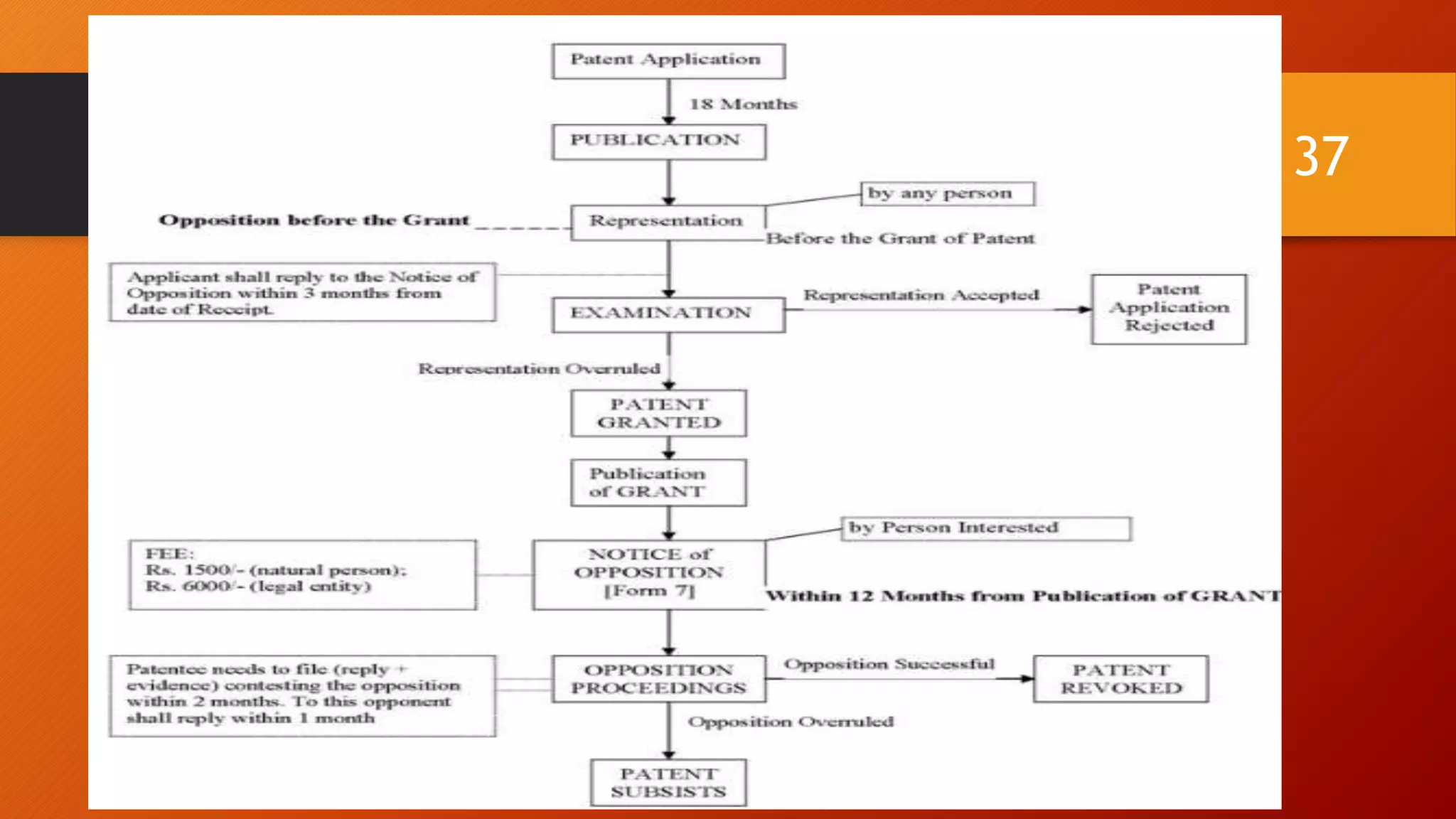
D. OPPOSITION
•1. Pre-grant Opposition
• Any person can file an opposition for grant of patent after the
application has been published. Opposition may be filed on any of the
following grounds:
a. Non compliance of patentability requirements.
b. Nondisclosure or Wrongful disclosure of genetic resources or
traditional knowledge
35
2. Post-grant Opposition
Any person can file an opposition within a period twelve months after the grant of
a patent. It can be filed based on the following grounds:
a. Wrongful obtainment of the invention by the inventor.
b. Publication of the claimed invention before the priority date.
c. Sale or Import of the invention before the priority date.
d. Public use or display of the invention.
e. The invention doesn’t satisfy the patentability requirements.
f. Disclosure of false information to patent office.
g. Application for the invention is not filed within twelve months from the date of
convention application.
h. Nondisclosure or wrongful disclosure of the biological source.
i. Invention is anticipated by traditional knowledge.
36
37
E. GRANT:
• If the application satisfies all the requirements of the
patent act, the application is said to be in order for grant.
• A granted patent gives the patent holder the exclusive
right to make, use, sell, offer for sale and import the
product or use the process.
38
39
40
Importance of Patent
It maintain continuous stream of new ideas and experimentation so it directly
point out at growth of a country.
The burden of duplication of the invention is avoided : it saves further
spending of time and money.
Any interested person may buy the Patent, wherein the Patent becomes a nice
tool for the transfer of technology.
Patent provides protection to the Patentee, wherein, if the Patent is infringed,
the Patentee may seek the legal remedies. Thus Patent is a form of social
security to an inventor.
Once, the life of the Patent is over, any person may freely, without paying any
royalty to the Patentee, may enjoy the invent.
41
References
• Controller General of Patents, Designs and Trade Marks
http://www.patentoffice.nic.in/
• Copyright Office http://copyright.gov.in/
• Indian IPR Foundation (NIPO) http://www.nipo.org.in/
• Guidelines for Design Registration `
http://www.patentoffice.nic.in/ipr/design/designs_filing.pdf
• Patents and Trade Marks: http://www.nipo.org.in/iplaws.htm
• Industrial Designs, Geographical Indications, Copyright and Unfair Competition:
• http://www.nipo.org.in/iplawsmn2.htm
• Overview by ipr.co.uk:
http://www.ipr.co.uk/IP_conventions/community_trade_marks.html
42
43

Intellectual property rights (ipr) new

  • 1.
    INTELLECTUAL PROPERTY RIGHTS (IPR) PREPAREDBY: KISHAN RAM M.PHARM , SEM-1 QUALITY ASSURANCE GUIDED BY: Dr. DAYA CHOTHANI Ms. URVI J. CHOTALIYA ASSISTANT- PROFESSOR BKMGPC RAJKOT
  • 2.
    CONTENTS: • Introduction toIPR • Types of IPR • INDUSTRIAL DESIGNS • TRADE MARKS • TRADE SECRETS • GEOGRAPHICAL INDICATIONS • COPYRIGHT • PATENTS • References 2
  • 3.
    INTRODUCTION TO IPRs: •Intellectual Property (IP) is any creations of human mind. Like tangible property, their creation has a value and, as with all property, it needs to be protected. • Intellectual Property Rights (IPR): “Exclusive rights granted by the State for inventions, new and original designs, trademarks, new plant varieties and artistic and literary works”. 3
  • 4.
    TYPES OF IPRs: p Industrial designs IndustrialProperty Copyrights and related rights patent Trademarks Trade Secrets Geographical indication Plant varieties & Farmer’s rights Layout Designs of semiconductor ICs 4
  • 5.
    REGISTERED UNREGISTERED • Copyright •Unregistered Design rights • Common law trade marks • Database rights • protection for know how under laws dealing with confidential information and trade secrets • Plant varieties • Geographical Indications • Design of Integrated Circuits • ‘Passing off’ trade legislation (Domain names) • Patents • Trade Marks • Design rights 5
  • 6.
    1. INDUSTRIAL DESIGNS: •Design deals with features, shapes, patterns, etc., applied to an article by an industrial process, manual or mechanical. • Eg., chair is a utility item. However, chair itself does not qualify for IPR, but its special carvings, embossing etc., is done which increases the value of chair though it’s utility remains same, it becomes eligible for IPR under Designs Act. • Designs can be registered based on its originality, henceforth they can use ® or registered, with registration number. 6
  • 7.
    • The lawsgoverning designs are the Designs Act of 2000 and the Designs Rules of 2001. In India designs are defined as follows: • ‘A design refers to the features of shape, configuration, pattern, ornamentation or composition of lines or colors applied to any article, in two or three dimensional (or both) forms’. (Design Office, Kolkata: Guidelines for Registration) • Designs are valid for a maximum of ten years, renewable for a further five years. 7
  • 8.
    2.TRADE MARKS : Trade Marks Act, 1999 defines TM as a mark capable of being represented graphically and which is capable of distinguishing the goods or services of one person from those of others and may include shape of goods, their packaging and combination of colours.  Mark includes “Device, brand, heading, label, ticket, name, signature, word, letter, numeral, shape of goods, packaging, combination of colours, and any combination thereof.”  Brand refers to a name, term, sign, symbol, or design, or a combination of them, intended to identify the goods or services of one seller or group of sellers and to differentiate them from those of competitors. E.g. McDonald for restaurants, Cycle brand agarbattis, etc. 8
  • 9.
    Brand Name isthat part of a brand which can be vocalized-the utterable. Brand Mark is that part of a brand which can be recognised but is not a utterable, such as symbol, design or distinctive colouring or lettering. Device refers to pictorial representations – e.g. animals, birds, landscape buildings, etc. Letter as a mark is the identity created out of letterforms and has its inbuilt strength of distinctiveness and individuality – e.g. IBM, GM, ELBEE, 3M etc. 9
  • 10.
  • 11.
    3. Trade Secrets: •Trade secret is any intellectual work or product used for a business purpose that can be classified as belonging to that business provided it is not based on information in public domain. • A trade secret consists of • a formula, device, idea, process, pattern, or compilation of information that gives the owner a competitive advantage in the marketplace, • a novel idea that is not common knowledge and is kept in a confidential state. 11
  • 12.
    • A tradesecret is not protected by federal law • Can only be protected through employment contracts and/or maintaining tight security • Recipes, ingredients, codes, manufacturing costs etc. 12
  • 13.
    4.GEOGRAPHICAL INDICATIONS: • Thisis an indication, that originates from a definite geographical area, which is used to identify natural or manufactured product. • For eg., Nirmal paintings, Alphonso Mango, Darjeeling Tea, Kolhapuri Chappal, Solapur Chaddar, Tirupati Laddu, Nagpur Orange, Bikaneri bhujia etc. qualify for registration under this category. • It is valid for 10 years & can be renewed from time to time for a further period of 10 years each. • The application for registration can be an association of persons, organization or by producers. 13
  • 14.
    5.COPYRIGHT: • Copyright isa monopoly right restraining others from exercising that right which has been conferred on the owner of copyright. • It is a negative right meaning thereby that it is prohibitory in nature. It is a right to prevent others from copying or reproducing the work. 14
  • 15.
    • The objectof copyright is to encourage authors, composers and artists to create original works by rewarding them the exclusive right for a specific period to reproduce the works for publishing and selling them to the public. • Copyright is not a single right. It is a bundle of rights in the same work. • For e,g. in the case of a literary work, copyright consists of reproduction in print media, the right of dramatic and cinematographic versions, the right of translation, adaptation, abridgement and the right of public performance. 15
  • 16.
    TERM (Period) OFCOPYRIGHT • In the case of any literary, dramatic, musical or a artistic work (other than a photograph), life time of the author + 60 years. • In the case of photograph, cine films, sound recording and Govt. Work, 60 years from the beginning of the calendar year next following the year in which the work is first published. • In the case of broadcasters/performers, reproduction right shall subsist until 25 years from the calendar year next following the year in which the broadcast/performance is made. 16
  • 17.
    6.PATENT: • A Patentis an intellectual property right relating to invention & is the grant of exclusive right,for limited period,provided by the Government to the patentee. • Is a monopoly right granted to a person, who invented a new product or process of making an article, for 20years under the Indian Patens Act, 1970, and can be renewed after expiration of period. • The inventor has to file for patent first, and then make his/ her invention to public. 17
  • 18.
    • A patenthas to be applied in each country by the inventor, to claim his rights in that country. • Eg: A group of scientists working on new drug development in Himalaya Drugs for some salary. The patent of the drug developed is given to Himalaya Drugs, but not to the scientists. The drug may have many patents like composition, process, and product etc. 18
  • 19.
    Invention: Indian patent act(amendment) 2002 define the term invention is: “A new product or process involving an inventive step and capable of industrial application.” “Inventive step” is the feature that makes the invention non-obvious to a person skilled in the art. “Capable of industrial application” means an invention should have commercial value in the market. 19
  • 20.
    Who is Inventer? • Any person who invents or discovers any new and useful : Process Machine Manufacture or Composition of matter, or Any new and useful improvement thereof, may obtain a patent. 20
  • 21.
    WHAT ARE PATENTABLEINVENTION ? • An invention to be patentable should be technical in nature and should meet the following criteria-  Novel  Non obvious  Useful Capable of industrial aplication 21
  • 22.
    What are Nonpatentable inventions? Discovery of any living thing or non living substances occurring in nature. A method of agriculture or horticulture.eg the method of terrace farming cannot be patented. 22
  • 23.
    • Any processfor medical, surgical, diagnostic, therapeutic or other treatment of human beings. • Plants and animals in whole or any part thereof other than microorganisms but including seeds, varieties and species and essentially biological processes for production and propagation of plants and animals. 23
  • 24.
    A mathematical orbusiness method or computer programme. Topography of integrated crcuits. Method of playing game. 24
  • 25.
    Types of PatentApplications Ordinary Application Application for Patent of Addition(granted For Improvement or Modification of the already patented invention,for an unexpired term of the main patent). Divisional Application(in case of Plurality of inventions disclosed in the main application) Convention application, claiming priority date on the basis of filling Convention Countries. National Phase Application under PCT. 25
  • 26.
     PROCEDURE TOGET PATENT • A patent application can be filed at only of the four patent offices in India (Kolkata, Delhi, Mumbai and Chennai). • The patent application passes through the following stages: A.FILING B.PUBLICATION C.EXAMINATION D.OPPOSITION E. GRANT 26
  • 27.
    A. Filing • 1.Applicant : An application for a patent can be filed by the true and first inventor. It can also be filed the by the assignee or legal representative of the inventor. • 2. Form of Application: Every application shall be accompanied by a provisional or complete specification. 27
  • 28.
    Provisional Patent Application Anapplicant may file a provisional specification containing incomplete & general description of the invention. No need to file claims. Objective of it is to fix the priority date Complete specification is to be filed within 12+3 (15 months) from the date of filing provisional specification. 28
  • 29.
    Complete Specification • Submissionof complete specification is necessary to obtain a patent it must be submitted within 12 months of filing the provisional specification. • Contents of complete specification would include following- 1)Title of the invention 2)Field to which the invention belongs 3)Background of the invention including prior art giving drawbacks of the known inventions and practices 29
  • 30.
    4) Complete descriptionof the invention along with experimental results 5) Drawings (if necessary) 6) Claims, which are statements of technical facts expressed in legal terms, related to the invention on which legal proprietorship is being sought. therefore the claims have to be drafted very carefully. 30
  • 31.
    FORM - 2 THEPATENTS ACT, 1970 (39 of 1970) COMPLETE SPECIFICATION [SECTION 10; RULE 13] 1. Title of Invention 2. (a) Name of Applicant (b) Address of Applicant (c) Nationality: Indian. The following specification particularly describes the nature of this invention and the manner in which it is to be performed. 31
  • 32.
    • 5 Documentsto be submitted at the time of filing. The following documents have to be submitted at the time of filing a patent application: a. Form 1 - Application for the grant of patent. b. Form 2 - Provisional or Complete Specification. c. Form 3 - Statement and undertaking by the applicant. d. Form 5 - Declaration as to inventorship. e. Form 26 - Authorization of patent agent or any other ‘ person 32
  • 33.
    B.PUBLICATION • A patentapplication will be published on expiry of eighteen months after the priority date. It can be published earlier, if such a request is made by the applicant. • On publication, specification including drawings and deposits shall be open for public inspection. The rights of the patentee start from the date of publication but they cannot be enforced until after patent grant. 33
  • 34.
    C. Examination ofPatent Patent Application on method or procedure of manufacturing substance will be examined only after the request filed to the patent office within 48 months from the date of patent application or within 12 months from date of commencement of patent amendment act 2002, whichever is later. 34
  • 35.
    D. OPPOSITION •1. Pre-grantOpposition • Any person can file an opposition for grant of patent after the application has been published. Opposition may be filed on any of the following grounds: a. Non compliance of patentability requirements. b. Nondisclosure or Wrongful disclosure of genetic resources or traditional knowledge 35
  • 36.
    2. Post-grant Opposition Anyperson can file an opposition within a period twelve months after the grant of a patent. It can be filed based on the following grounds: a. Wrongful obtainment of the invention by the inventor. b. Publication of the claimed invention before the priority date. c. Sale or Import of the invention before the priority date. d. Public use or display of the invention. e. The invention doesn’t satisfy the patentability requirements. f. Disclosure of false information to patent office. g. Application for the invention is not filed within twelve months from the date of convention application. h. Nondisclosure or wrongful disclosure of the biological source. i. Invention is anticipated by traditional knowledge. 36
  • 37.
  • 38.
    E. GRANT: • Ifthe application satisfies all the requirements of the patent act, the application is said to be in order for grant. • A granted patent gives the patent holder the exclusive right to make, use, sell, offer for sale and import the product or use the process. 38
  • 39.
  • 40.
  • 41.
    Importance of Patent Itmaintain continuous stream of new ideas and experimentation so it directly point out at growth of a country. The burden of duplication of the invention is avoided : it saves further spending of time and money. Any interested person may buy the Patent, wherein the Patent becomes a nice tool for the transfer of technology. Patent provides protection to the Patentee, wherein, if the Patent is infringed, the Patentee may seek the legal remedies. Thus Patent is a form of social security to an inventor. Once, the life of the Patent is over, any person may freely, without paying any royalty to the Patentee, may enjoy the invent. 41
  • 42.
    References • Controller Generalof Patents, Designs and Trade Marks http://www.patentoffice.nic.in/ • Copyright Office http://copyright.gov.in/ • Indian IPR Foundation (NIPO) http://www.nipo.org.in/ • Guidelines for Design Registration ` http://www.patentoffice.nic.in/ipr/design/designs_filing.pdf • Patents and Trade Marks: http://www.nipo.org.in/iplaws.htm • Industrial Designs, Geographical Indications, Copyright and Unfair Competition: • http://www.nipo.org.in/iplawsmn2.htm • Overview by ipr.co.uk: http://www.ipr.co.uk/IP_conventions/community_trade_marks.html 42
  • 43.