Download as PDF, PPTX
![Step4-1: L2fwd Sample Build
Sender VM DPDK VM Receiver VM
CentOS 6.3 CentOS 6.3 CentOS 6.3
ixgbe ixgbe ixgbe ixgbe
10.0.10.11 eth1 port0 port1 10.0.10.22 eth1
e.g. MAC addr (AA:BB:CC:DD:EE:FF)
• L2fwd/L3fwd samples are very simple
• One-way only. Don’t expect ping/pong
• Dest MAC address is hard-coded...
$ cd examples/l2fwd
$ diff -up main.c.0 main.c
@@ -293,7 +293,7 @@ l2fwd_simple_forward(struct rte_mbuf *m,
/* 00:09:c0:00:00:xx */
tmp = ð->d_addr.addr_bytes[0];
- *((uint64_t *)tmp) = 0x000000c00900 + (dst_port << 24);
+ *((uint64_t *)tmp) = 0xFFEEDDCCBBAA; /* AA:BB:CC:DD:EE:FF */
/* src addr */
ether_addr_copy(&l2fwd_ports_eth_addr[dst_port], ð->s_addr);
$ RTE_SDK=/home/dpdktest/DPDK make](https://image.slidesharecdn.com/dpdkstepbystep-130104034631-phpapp01/75/Intel-DPDK-Step-by-Step-instructions-8-2048.jpg)
![Step5-1: L3fwd Sample Build
Sender VM DPDK VM Receiver VM
CentOS 6.3 CentOS 6.3 CentOS 6.3
ixgbe ixgbe ixgbe ixgbe
10.0.10.11 eth1 port0 port1 10.0.20.22 eth1
• L3 fwd sample has two functions to determine destination port e.g. MAC addr (AA:BB:CC:DD:EE:FF)
• [default] destination IP address (LPM-based)
• 5-tuples (Hash-based)
$ cd examples/l3fwd
$ diff -up main.c.0 main.c
@@ -282,6 +282,8 @@ static struct l3fwd_route l3fwd_route_ar
{IPv4(6,1,1,0), 24, 5},
{IPv4(7,1,1,0), 24, 6},
{IPv4(8,1,1,0), 24, 7},
+ {IPv4(10,0,10,11), 24, 0},
+ {IPv4(10,0,20,22), 24, 1},
};
#define L3FWD_NUM_ROUTES
@@ -475,7 +477,7 @@ l3fwd_simple_forward(struct rte_mbuf *m,
/* 00:09:c0:00:00:xx */
tmp = ð_hdr->d_addr.addr_bytes[0];
- *((uint64_t *)tmp) = 0x000000c00900 + (dst_port << 24);
+ *((uint64_t *)tmp) = 0xFFEEDDCCBBAA; /* AA:BB:CC:DD:EE:FF */
$ RTE_SDK=/home/dpdktest/DPDK make](https://image.slidesharecdn.com/dpdkstepbystep-130104034631-phpapp01/75/Intel-DPDK-Step-by-Step-instructions-10-2048.jpg)
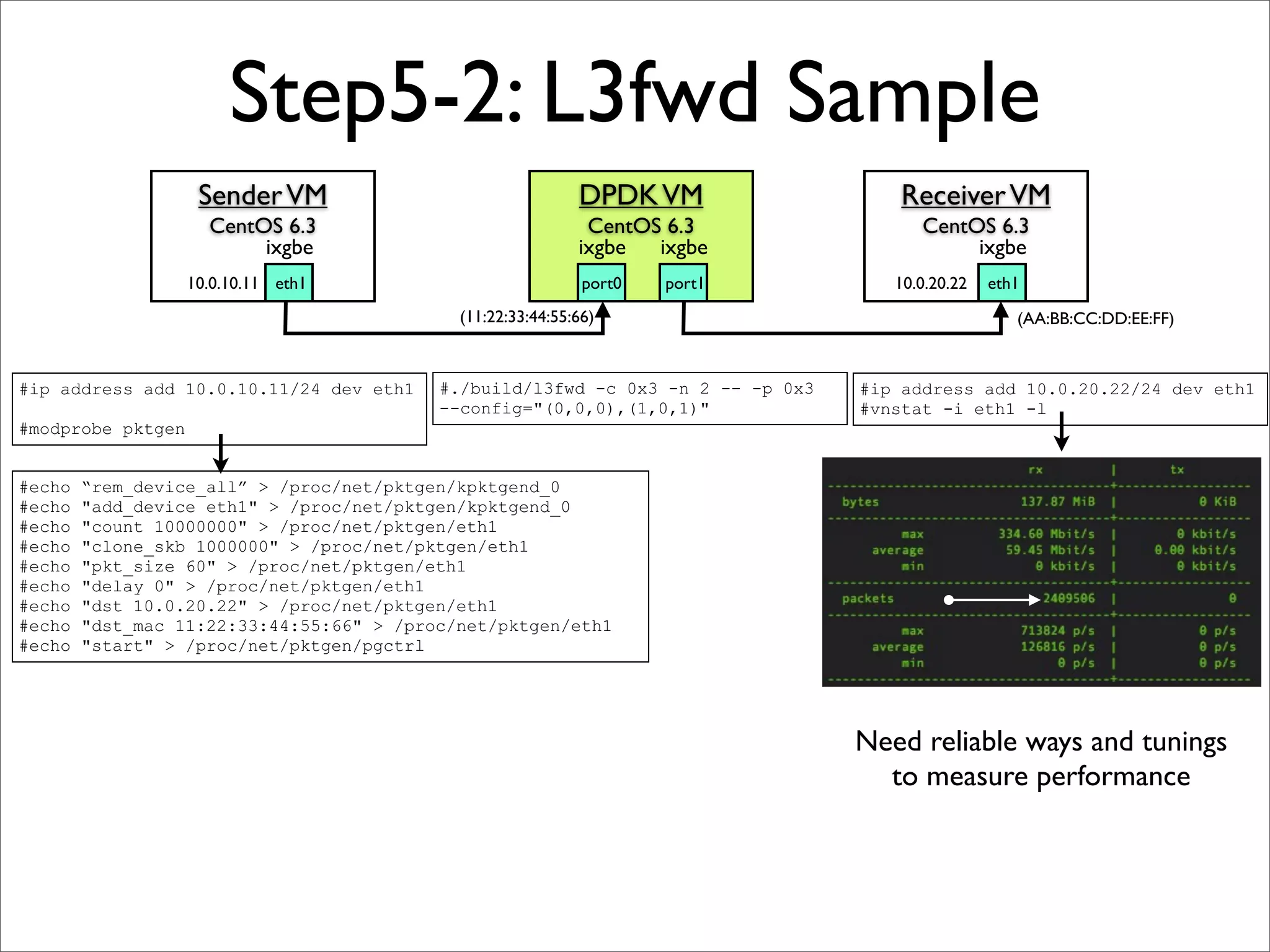

The document provides step-by-step instructions for building and running Intel DPDK sample applications on a test environment with 3 virtual machines connected by 10G NICs. It describes compiling and running the helloworld, L2 forwarding, and L3 forwarding applications, as well as using the pktgen tool for packet generation between VMs to test forwarding performance. Key steps include preparing the Linux kernel for DPDK, compiling applications, configuring ports and MAC addresses, and observing packet drops to identify performance bottlenecks.
Introduction of Intel DPDK and objectives including building sample applications like helloworld, L2fwd, and L3fwd, as well as packet forwarding processes.
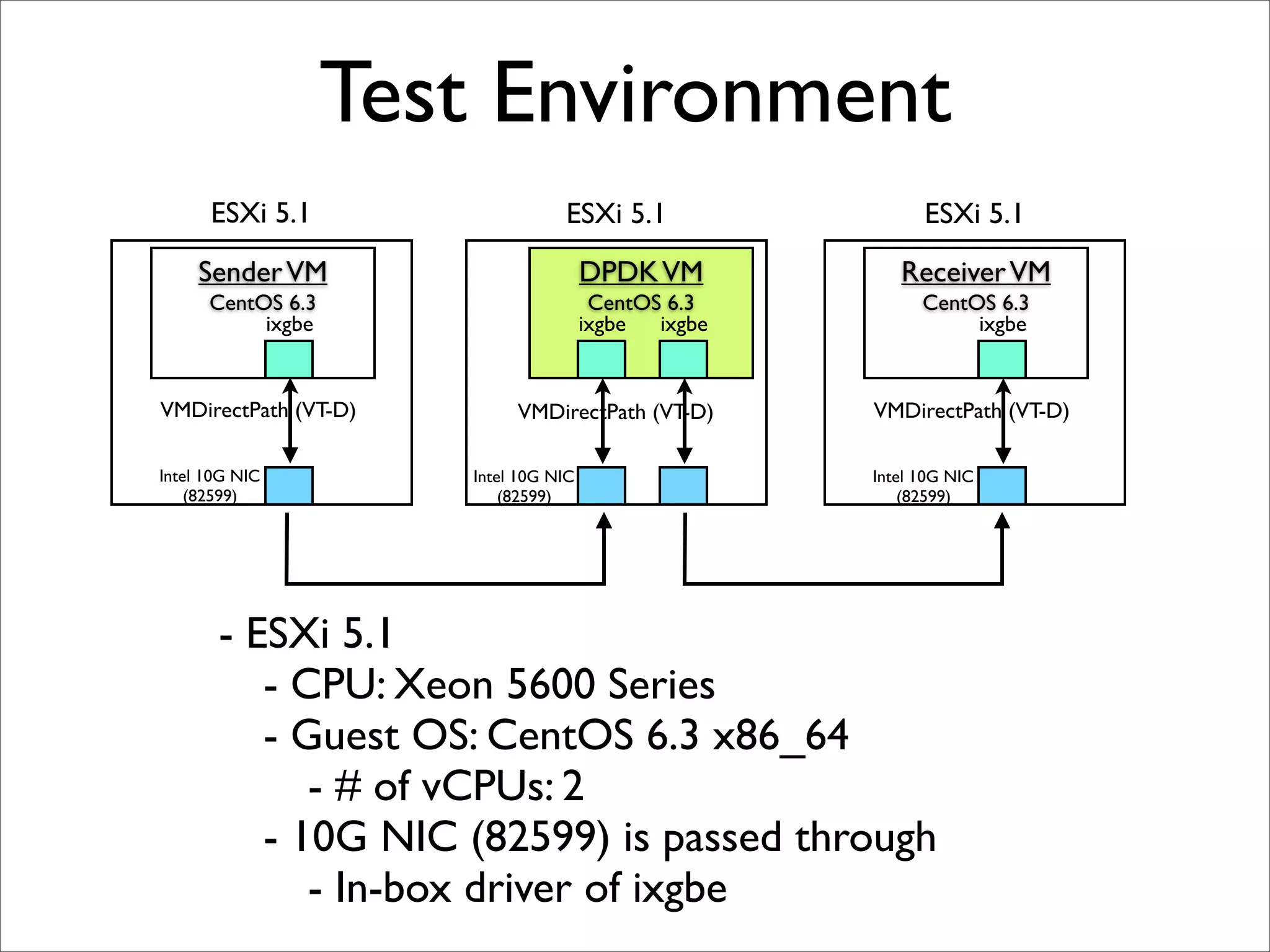
Details of the test environment using ESXi 5.1, indicating CentOS 6.3 VMs, Intel 10G NICs and system specifications including CPU and vCPUs.
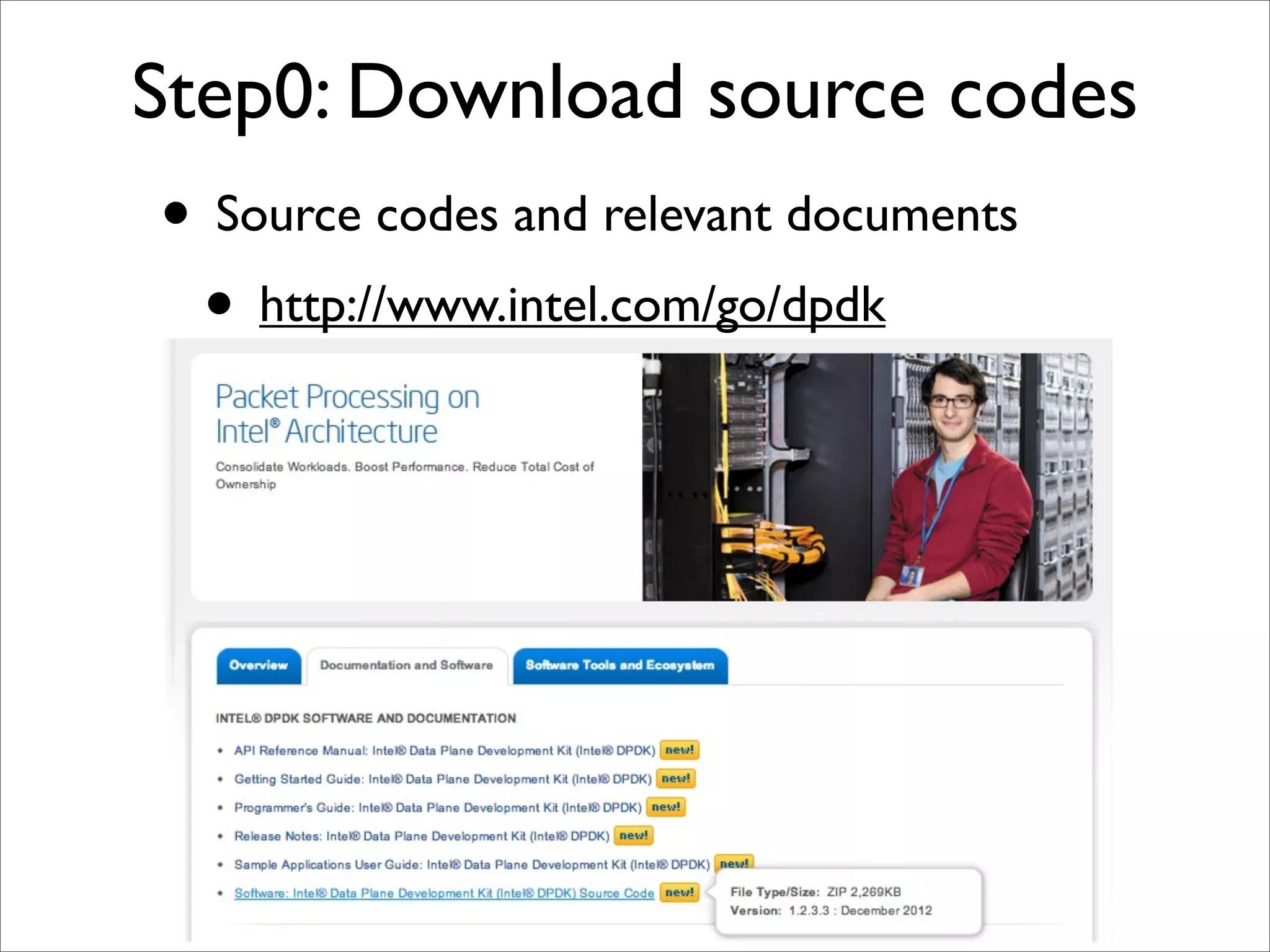
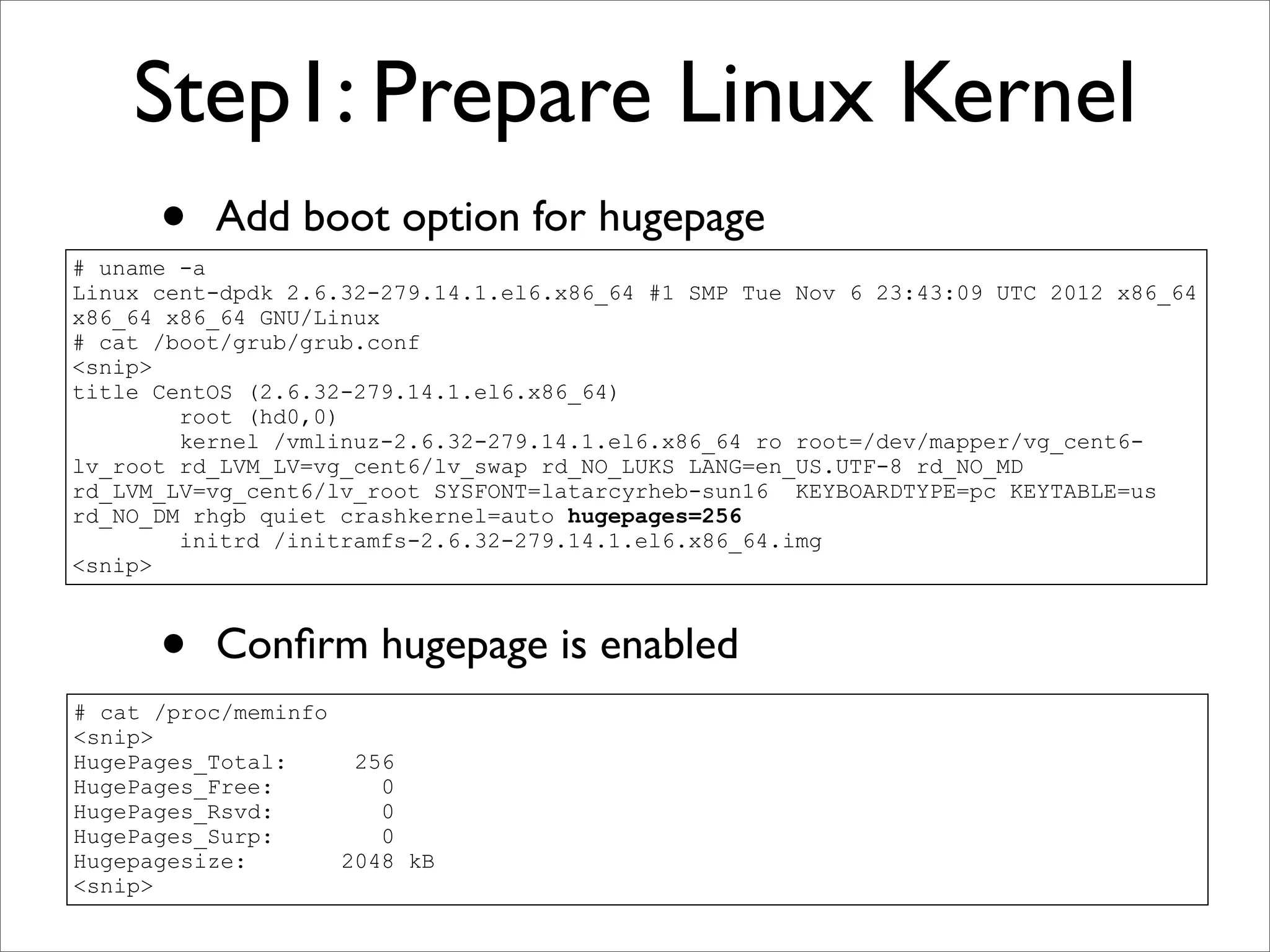
Instructions to download DPDK source codes and preparation of the Linux kernel, including configurations for hugepages.
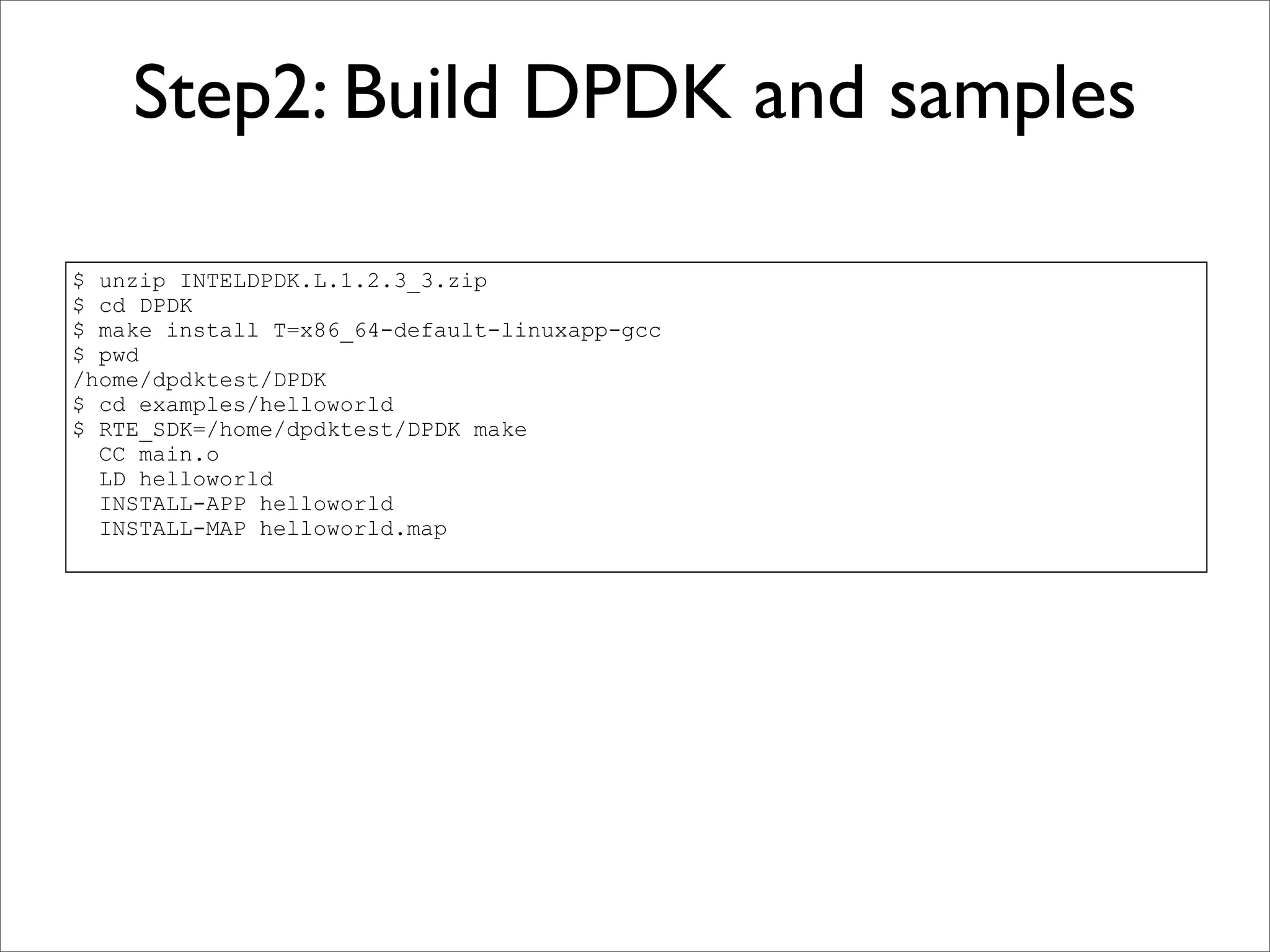
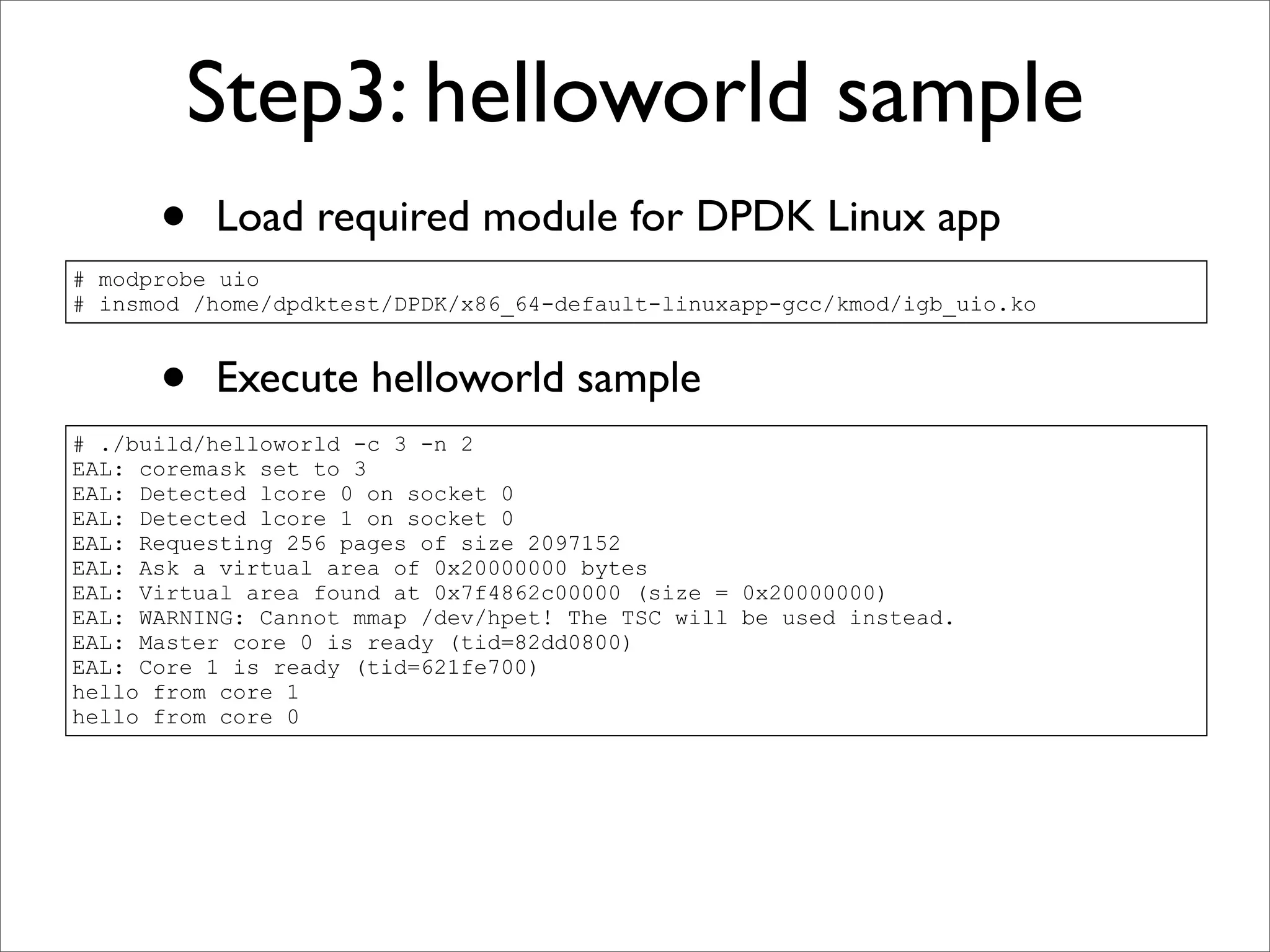
Steps to build DPDK with examples, specifically executing the 'helloworld' sample application.
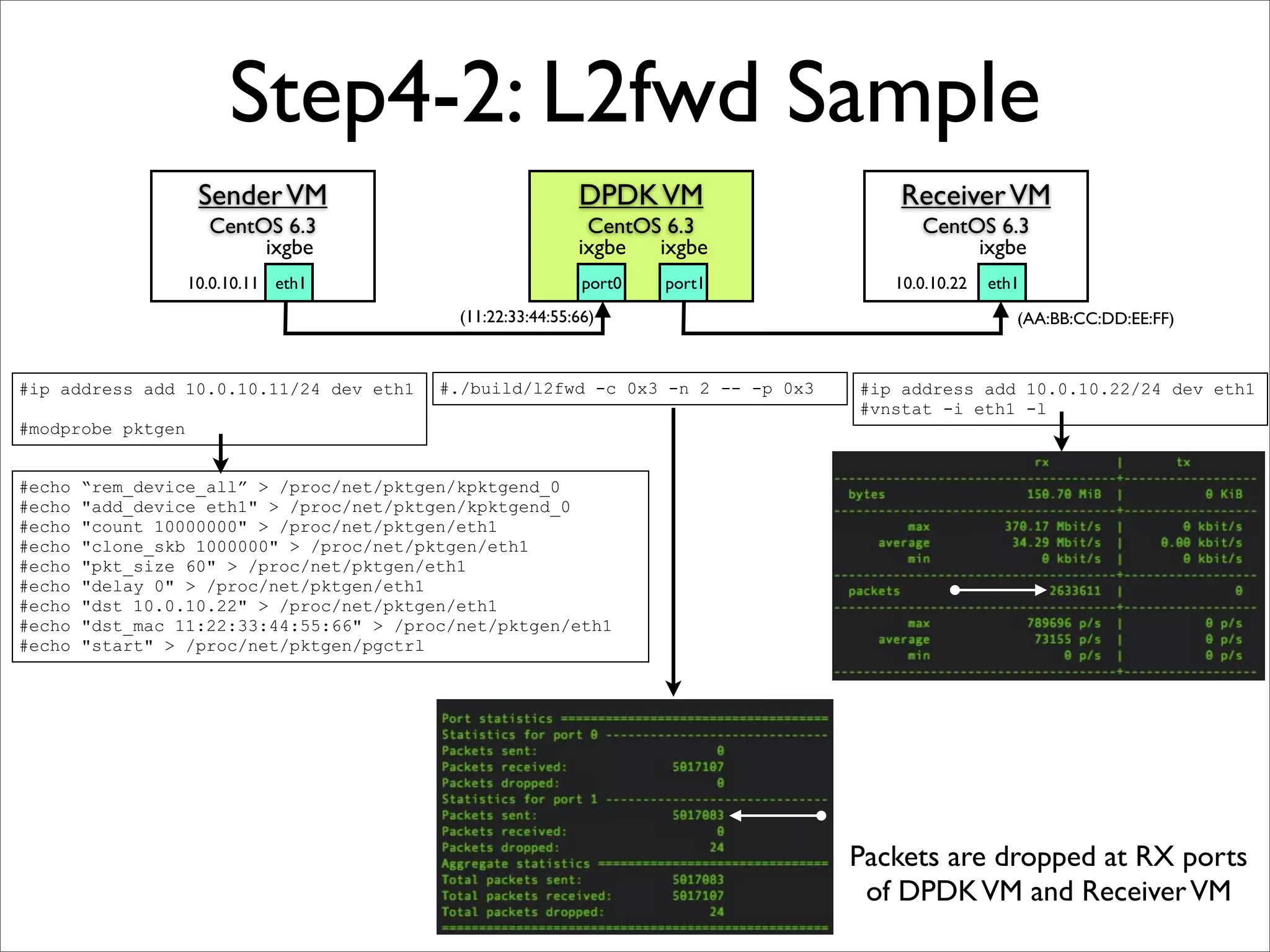
Building L2fwd and L3fwd samples; includes environment configuration, code changes, and running the applications with packet generation.
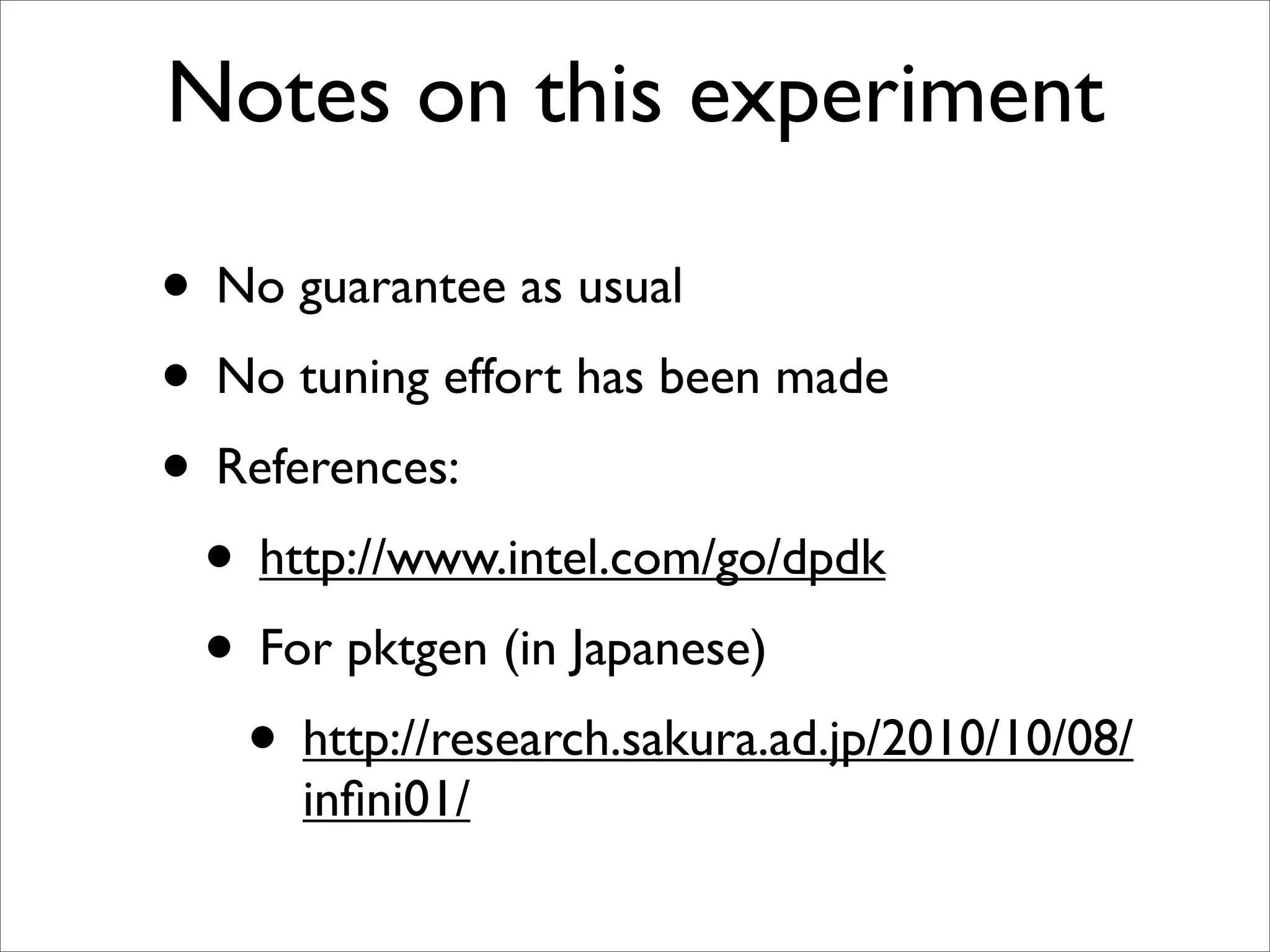
Summary notes on the experiment including performance reliability, lack of tuning efforts, and references for additional resources.


