Integrating Risk Buffers Into Your Critical Path When & How
1.
1
2011-2025 Orangescrum ResearchLab, San Jose, California | www.orangescrum.com
onstruction projects are complex, deadline-driven, and highly unpredictable.
Delays can occur anytime due to design changes, adverse weather, labor shortages,
or supply chain issues. Delays from these project changes can be mitigated using
critical path analysis. That’s why successful project managers add risk buffers to
protect project timelines.
When applied correctly, risk buffers reduce uncertainty, safeguard key milestones,
and keep execution on track even when things go wrong.
In this blog, you will learn when and how to integrate risk buffers into your critical
path, along with practical strategies to improve schedule resilience and delivery
performance.
2.
2
2011-2025 Orangescrum ResearchLab, San Jose, California | www.orangescrum.com
What Are Risk Buffers in Project Scheduling?
Risk buffers are extra time added strategically to absorb unexpected delays along the
critical path.
They prevent schedule slippage and help contractors maintain delivery
commitments.
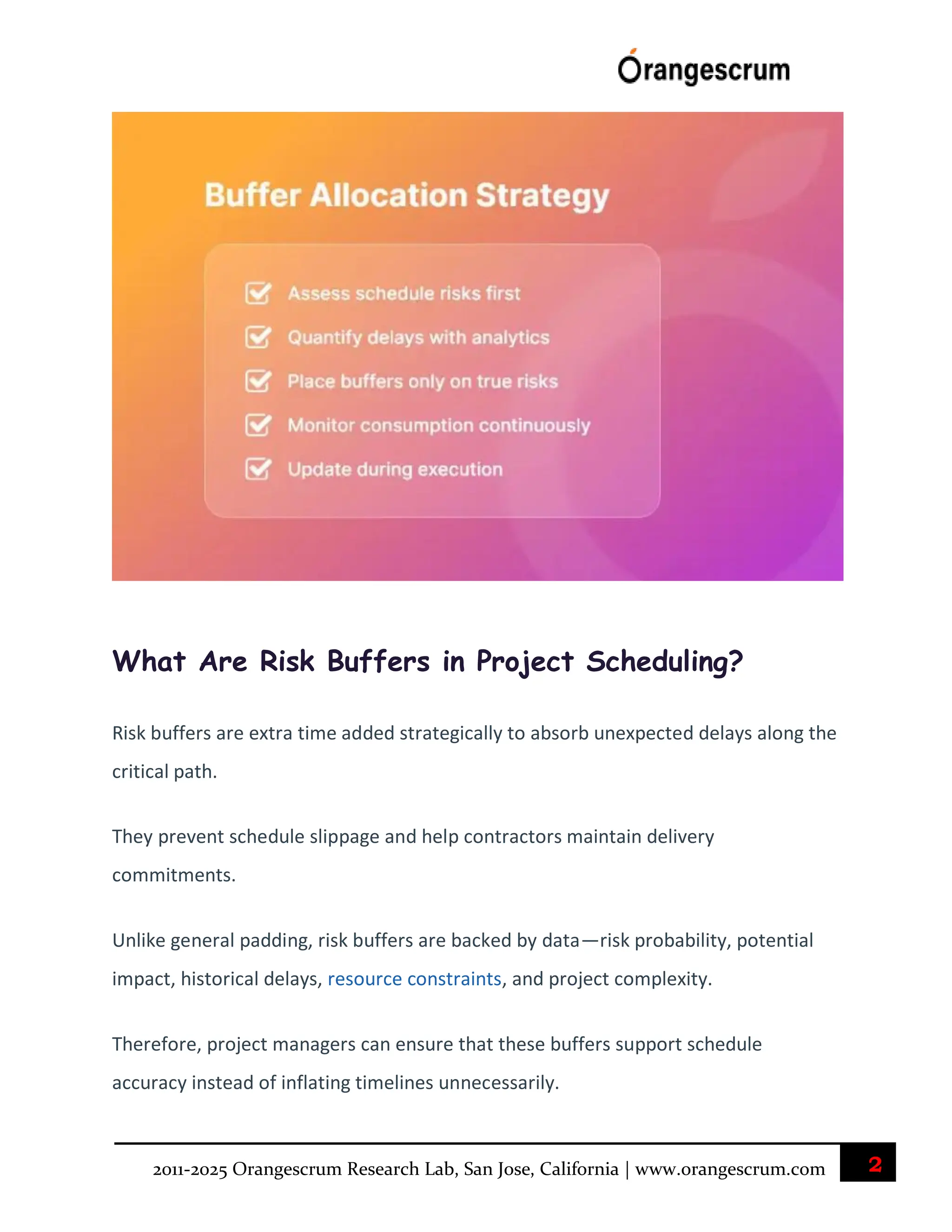
Unlike general padding, risk buffers are backed by data—risk probability, potential
impact, historical delays, resource constraints, and project complexity.
Therefore, project managers can ensure that these buffers support schedule
accuracy instead of inflating timelines unnecessarily.
3.
3
2011-2025 Orangescrum ResearchLab, San Jose, California | www.orangescrum.com
Why Risk Buffers Are Essential for Critical Path
The critical path defines the longest sequence of tasks required to complete a
project. Even a one-task delay here can push the entire delivery deadline. Risk
buffers act as shock absorbers across this path and offer:
Higher predictability and on-time delivery
Greater stakeholder confidence
Better control over cascading delays
Reduced penalty or rework costs
Improved decision-making during uncertainty
Thus, risk buffers become a key tool for proactive project control.
When Should You Integrate Risk Buffers?
You should add risk buffers to the critical path, especially when:
Tasks Are Highly Uncertain
When activities involve new technology, untested vendors, or unpredictable
weather, risk buffers are crucial.
4.
4
2011-2025 Orangescrum ResearchLab, San Jose, California | www.orangescrum.com
Dependencies Are Heavy
If the delay of one task affects multiple others, risk buffers help avoid the domino
effect.
Material and Workforce Volatility Exists
Procurement delays or limited skilled labor can disrupt sequencing; risk buffers
provide recovery space.
There Are Strict Regulatory Approvals
Compliance processes often take longer than expected—risk buffers protect
deadlines from bureaucratic delays.
Whenever the probability and impact of delay significantly affect milestones, risk
buffers must be introduced.
Types of Risk Buffers You Can Apply
To integrate risk buffers effectively, project managers typically use three buffer
types:
Project Buffer: Added at the end of the critical path to protect final delivery.
Feeding Buffers: Places where non-critical activities feed into critical tasks.
Resource Buffers: Used to ensure resources are available exactly when
required.
5.
5
2011-2025 Orangescrum ResearchLab, San Jose, California | www.orangescrum.com
Using these types strategically ensures risk buffers protect every fragile point of the
schedule.
How to Add Risk Buffers to the Critical Path (Step-
by-Step)
Follow these steps to incorporate risk buffers accurately:
Step 1: Perform a Detailed Risk Assessment
Identify top schedule risks, delay probabilities, and historical patterns.
Step 2: Quantify Buffer Duration
Use data-driven methods like PERT or Monte Carlo analysis to define realistic risk
buffers.
Step 3: Place Buffers Strategically
Only insert risk buffers in areas directly linked to schedule uncertainty—not
everywhere.
Step 4: Track Buffer Consumption
Monitor how much of each buffer is consumed during project execution to prevent
overrun.
6.
6
2011-2025 Orangescrum ResearchLab, San Jose, California | www.orangescrum.com
Step 5: Communicate Clearly
Make sure all stakeholders understand where and why risk buffers exist in the
schedule.
Digital Tools Make It Easier
Modern construction planning software automates critical path analysis and risk
buffers allocation. Digital scheduling tools also:
Track real-time risk impacts
Predict milestone delays early
Optimize buffer placement with data
Enable fast scenario simulation
Because of this, risk buffers become reliable and measurable—not guesses.
Best Practices for Effective Risk Buffers
To prevent misuse or overestimation, keep these guidelines in mind:
Base risk buffers on actual project risk—never guess
Review buffers continuously as risks evolve
Move unused buffers to other critical areas if needed
Keep reports transparent to boost team accountability
7.
7
2011-2025 Orangescrum ResearchLab, San Jose, California | www.orangescrum.com
Done right, risk buffers ensure timelines stay safe without stretching overall project
duration unnecessarily.
Conclusion
Delays are inevitable in construction projects, but failure isn’t. By adding well-
planned risk buffers to the critical path, contractors can protect delivery schedules,
minimize disruption, and maintain cost control.
Moreover, consistent monitoring and data-driven buffer management take project
performance to the next level.
Integrating risk buffers isn’t just a planning tactic—it’s a competitive advantage.