INSULATED VINYL SIDING 101
An Introduction to
Insulated Vinyl Siding
PART I
When building or renovating your house, a big
part of the thought and planning must go into
ensuring that the exterior is sound and secure –
which means choosing a good siding material is
of utmost importance. One of the most popular
types of siding today is vinyl siding. It is chosen
by many homeowners because it offers a number
of benefits at a fraction of the cost of other siding
materials, making it a cost-effective option. But
what if you add insulation to vinyl siding, which
can make your home cooler as well as energy-
efficient? Will the additional expense be worth it?
INSULATED VINYL SIDING 101
AN INTRODUCTION TO INSUALATED VINYL SIDING
Let us take a look at insulated vinyl siding to better
discern if it is indeed worth your investment.
WHAT IS INSULATED VINYL SIDING?
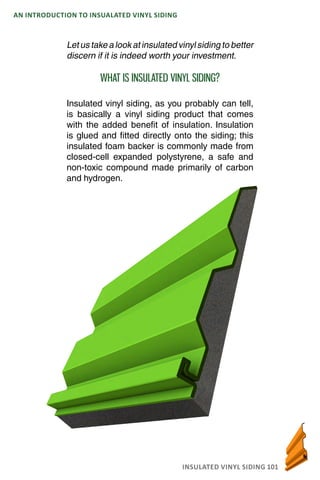
Insulated vinyl siding, as you probably can tell,
is basically a vinyl siding product that comes
with the added benefit of insulation. Insulation
is glued and fitted directly onto the siding; this
insulated foam backer is commonly made from
closed-cell expanded polystyrene, a safe and
non-toxic compound made primarily of carbon
and hydrogen.
INSULATED VINYL SIDING 101
AN INTRODUCTION TO INSUALATED VINYL SIDING
In the next part of this e-book, we will take a more in-
depth look at the advantages of insulated vinyl siding.
Stay tuned!
IMPORTANCE OF SIDING INSULATION:
CLADDING WITH BENEFITS
Every homeowner already has an idea how important
siding is -- it improves your home’s look from the
outside, and it also protects your walls against
damage from different sources. By insulating your
siding - or better yet - installing insulated siding, you
are ensuring double protection for your cladding.
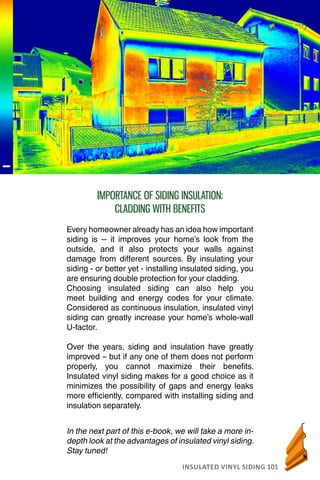
Choosing insulated siding can also help you
meet building and energy codes for your climate.
Considered as continuous insulation, insulated vinyl
siding can greatly increase your home’s whole-wall
U-factor.
Over the years, siding and insulation have greatly
improved – but if any one of them does not perform
properly, you cannot maximize their benefits.
Insulated vinyl siding makes for a good choice as it
minimizes the possibility of gaps and energy leaks
more efficiently, compared with installing siding and
insulation separately.
INSULATED VINYL SIDING 101
The Advantages of
Insulated Vinyl Siding
PART 2
In the first part of this series, we defined
what insulated vinyl siding is and
established how it is better than regular
vinyl siding. Now, let us take a closer look
at its advantages and find more reasons
why you should choose the product for
yourhomeifyouwantaworthyinvestment.
INSULATED VINYL SIDING 101
THE ADVANTAGES OF INSULATED VINYL SIDING
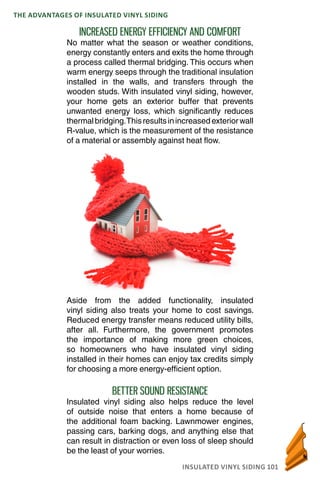
INCREASED ENERGY EFFICIENCY AND COMFORT
No matter what the season or weather conditions,
energy constantly enters and exits the home through
a process called thermal bridging. This occurs when
warm energy seeps through the traditional insulation
installed in the walls, and transfers through the
wooden studs. With insulated vinyl siding, however,
your home gets an exterior buffer that prevents
unwanted energy loss, which significantly reduces
thermalbridging.Thisresultsinincreasedexteriorwall
R-value, which is the measurement of the resistance
of a material or assembly against heat flow.
Aside from the added functionality, insulated
vinyl siding also treats your home to cost savings.
Reduced energy transfer means reduced utility bills,
after all. Furthermore, the government promotes
the importance of making more green choices,
so homeowners who have insulated vinyl siding
installed in their homes can enjoy tax credits simply
for choosing a more energy-efficient option.
BETTER SOUND RESISTANCE
Insulated vinyl siding also helps reduce the level
of outside noise that enters a home because of
the additional foam backing. Lawnmower engines,
passing cars, barking dogs, and anything else that
can result in distraction or even loss of sleep should
be the least of your worries.
INSULATED VINYL SIDING 101
THE ADVANTAGES OF INSULATED VINYL SIDING
ENHANCED IMPACT RESISTANCE
On its own, vinyl siding is known for being durable
and virtually maintenance-free – and it only gets
better with its reinforced insulated alternative. With
the polystyrene foam backing that fills the hollow
space between the siding and the walls and acts like
a shock absorber against common impact sources,
insulated vinyl siding is stronger, thus allowing for
better resistance against hail, stones, and other
similar sources of potential damage.
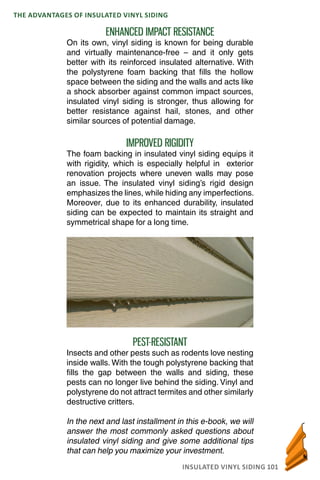
IMPROVED RIGIDITY
The foam backing in insulated vinyl siding equips it
with rigidity, which is especially helpful in exterior
renovation projects where uneven walls may pose
an issue. The insulated vinyl siding’s rigid design
emphasizes the lines, while hiding any imperfections.
Moreover, due to its enhanced durability, insulated
siding can be expected to maintain its straight and
symmetrical shape for a long time.
PEST-RESISTANT
Insects and other pests such as rodents love nesting
inside walls. With the tough polystyrene backing that
fills the gap between the walls and siding, these
pests can no longer live behind the siding. Vinyl and
polystyrene do not attract termites and other similarly
destructive critters.
In the next and last installment in this e-book, we will
answer the most commonly asked questions about
insulated vinyl siding and give some additional tips
that can help you maximize your investment.
INSULATED VINYL SIDING 101
Insulated Vinyl Siding
FAQ
PART 3
There are a number of things to learn and
love about insulated vinyl siding. In this
FAQ page, we aim to address the most
common questions that you may have
about this cladding material and help you
understand it better, so as to make better
decisions that involve the material.
INSULATED VINYL SIDING 101
INSULATED VINYL SIDING FAQ
WE’VE LEARNED ABOUT ITS ADVANTAGES – BUT DOES
IT HAVE ANY DISADVANTAGES?
Just like all other home-building materials, insulated
vinyl siding also has disadvantages. For one, it is
pricier than vinyl siding. However, the extra cost may
be worth it, as insulated vinyl siding offers better
performance in terms of energy efficiency compared
to when vinyl siding and insulation are installed
separately.
CAN YOU INSTALL INSULATED VINYL SIDING IN ANY
HOME?
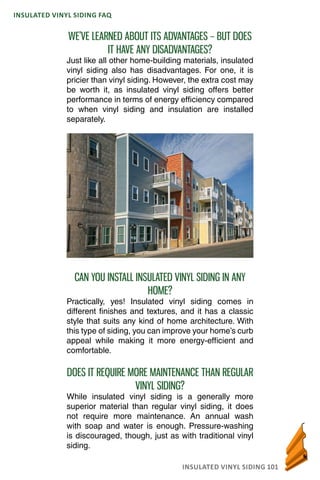
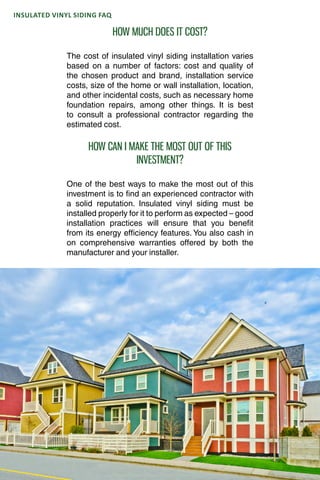
Practically, yes! Insulated vinyl siding comes in
different finishes and textures, and it has a classic
style that suits any kind of home architecture. With
this type of siding, you can improve your home’s curb
appeal while making it more energy-efficient and
comfortable.
DOES IT REQUIRE MORE MAINTENANCE THAN REGULAR
VINYL SIDING?
While insulated vinyl siding is a generally more
superior material than regular vinyl siding, it does
not require more maintenance. An annual wash
with soap and water is enough. Pressure-washing
is discouraged, though, just as with traditional vinyl
siding.
INSULATED VINYL SIDING 101
INSULATED VINYL SIDING FAQ
HOW MUCH DOES IT COST?
The cost of insulated vinyl siding installation varies
based on a number of factors: cost and quality of
the chosen product and brand, installation service
costs, size of the home or wall installation, location,
and other incidental costs, such as necessary home
foundation repairs, among other things. It is best
to consult a professional contractor regarding the
estimated cost.
HOW CAN I MAKE THE MOST OUT OF THIS
INVESTMENT?
One of the best ways to make the most out of this
investment is to find an experienced contractor with
a solid reputation. Insulated vinyl siding must be
installed properly for it to perform as expected – good
installation practices will ensure that you benefit
from its energy efficiency features. You also cash in
on comprehensive warranties offered by both the
manufacturer and your installer.
INSULATED VINYL SIDING 101
INSULATED VINYL SIDING FAQ
DRYTECH ROOFING COMPANY INC.
3435 Walnut Road Aberdeen, MD 21001
(240) 547-2447
www.DryTechRoofingCompany.com

Insulated Vinyl Siding 101

  • 1.
  • 2.
    INSULATED VINYL SIDING101 An Introduction to Insulated Vinyl Siding PART I When building or renovating your house, a big part of the thought and planning must go into ensuring that the exterior is sound and secure – which means choosing a good siding material is of utmost importance. One of the most popular types of siding today is vinyl siding. It is chosen by many homeowners because it offers a number of benefits at a fraction of the cost of other siding materials, making it a cost-effective option. But what if you add insulation to vinyl siding, which can make your home cooler as well as energy- efficient? Will the additional expense be worth it?
  • 3.
    INSULATED VINYL SIDING101 AN INTRODUCTION TO INSUALATED VINYL SIDING Let us take a look at insulated vinyl siding to better discern if it is indeed worth your investment. WHAT IS INSULATED VINYL SIDING? Insulated vinyl siding, as you probably can tell, is basically a vinyl siding product that comes with the added benefit of insulation. Insulation is glued and fitted directly onto the siding; this insulated foam backer is commonly made from closed-cell expanded polystyrene, a safe and non-toxic compound made primarily of carbon and hydrogen.
  • 4.
    INSULATED VINYL SIDING101 AN INTRODUCTION TO INSUALATED VINYL SIDING In the next part of this e-book, we will take a more in- depth look at the advantages of insulated vinyl siding. Stay tuned! IMPORTANCE OF SIDING INSULATION: CLADDING WITH BENEFITS Every homeowner already has an idea how important siding is -- it improves your home’s look from the outside, and it also protects your walls against damage from different sources. By insulating your siding - or better yet - installing insulated siding, you are ensuring double protection for your cladding. Choosing insulated siding can also help you meet building and energy codes for your climate. Considered as continuous insulation, insulated vinyl siding can greatly increase your home’s whole-wall U-factor. Over the years, siding and insulation have greatly improved – but if any one of them does not perform properly, you cannot maximize their benefits. Insulated vinyl siding makes for a good choice as it minimizes the possibility of gaps and energy leaks more efficiently, compared with installing siding and insulation separately.
  • 5.
    INSULATED VINYL SIDING101 The Advantages of Insulated Vinyl Siding PART 2 In the first part of this series, we defined what insulated vinyl siding is and established how it is better than regular vinyl siding. Now, let us take a closer look at its advantages and find more reasons why you should choose the product for yourhomeifyouwantaworthyinvestment.
  • 6.
    INSULATED VINYL SIDING101 THE ADVANTAGES OF INSULATED VINYL SIDING INCREASED ENERGY EFFICIENCY AND COMFORT No matter what the season or weather conditions, energy constantly enters and exits the home through a process called thermal bridging. This occurs when warm energy seeps through the traditional insulation installed in the walls, and transfers through the wooden studs. With insulated vinyl siding, however, your home gets an exterior buffer that prevents unwanted energy loss, which significantly reduces thermalbridging.Thisresultsinincreasedexteriorwall R-value, which is the measurement of the resistance of a material or assembly against heat flow. Aside from the added functionality, insulated vinyl siding also treats your home to cost savings. Reduced energy transfer means reduced utility bills, after all. Furthermore, the government promotes the importance of making more green choices, so homeowners who have insulated vinyl siding installed in their homes can enjoy tax credits simply for choosing a more energy-efficient option. BETTER SOUND RESISTANCE Insulated vinyl siding also helps reduce the level of outside noise that enters a home because of the additional foam backing. Lawnmower engines, passing cars, barking dogs, and anything else that can result in distraction or even loss of sleep should be the least of your worries.
  • 7.
    INSULATED VINYL SIDING101 THE ADVANTAGES OF INSULATED VINYL SIDING ENHANCED IMPACT RESISTANCE On its own, vinyl siding is known for being durable and virtually maintenance-free – and it only gets better with its reinforced insulated alternative. With the polystyrene foam backing that fills the hollow space between the siding and the walls and acts like a shock absorber against common impact sources, insulated vinyl siding is stronger, thus allowing for better resistance against hail, stones, and other similar sources of potential damage. IMPROVED RIGIDITY The foam backing in insulated vinyl siding equips it with rigidity, which is especially helpful in exterior renovation projects where uneven walls may pose an issue. The insulated vinyl siding’s rigid design emphasizes the lines, while hiding any imperfections. Moreover, due to its enhanced durability, insulated siding can be expected to maintain its straight and symmetrical shape for a long time. PEST-RESISTANT Insects and other pests such as rodents love nesting inside walls. With the tough polystyrene backing that fills the gap between the walls and siding, these pests can no longer live behind the siding. Vinyl and polystyrene do not attract termites and other similarly destructive critters. In the next and last installment in this e-book, we will answer the most commonly asked questions about insulated vinyl siding and give some additional tips that can help you maximize your investment.
  • 8.
    INSULATED VINYL SIDING101 Insulated Vinyl Siding FAQ PART 3 There are a number of things to learn and love about insulated vinyl siding. In this FAQ page, we aim to address the most common questions that you may have about this cladding material and help you understand it better, so as to make better decisions that involve the material.
  • 9.
    INSULATED VINYL SIDING101 INSULATED VINYL SIDING FAQ WE’VE LEARNED ABOUT ITS ADVANTAGES – BUT DOES IT HAVE ANY DISADVANTAGES? Just like all other home-building materials, insulated vinyl siding also has disadvantages. For one, it is pricier than vinyl siding. However, the extra cost may be worth it, as insulated vinyl siding offers better performance in terms of energy efficiency compared to when vinyl siding and insulation are installed separately. CAN YOU INSTALL INSULATED VINYL SIDING IN ANY HOME? Practically, yes! Insulated vinyl siding comes in different finishes and textures, and it has a classic style that suits any kind of home architecture. With this type of siding, you can improve your home’s curb appeal while making it more energy-efficient and comfortable. DOES IT REQUIRE MORE MAINTENANCE THAN REGULAR VINYL SIDING? While insulated vinyl siding is a generally more superior material than regular vinyl siding, it does not require more maintenance. An annual wash with soap and water is enough. Pressure-washing is discouraged, though, just as with traditional vinyl siding.
  • 10.
    INSULATED VINYL SIDING101 INSULATED VINYL SIDING FAQ HOW MUCH DOES IT COST? The cost of insulated vinyl siding installation varies based on a number of factors: cost and quality of the chosen product and brand, installation service costs, size of the home or wall installation, location, and other incidental costs, such as necessary home foundation repairs, among other things. It is best to consult a professional contractor regarding the estimated cost. HOW CAN I MAKE THE MOST OUT OF THIS INVESTMENT? One of the best ways to make the most out of this investment is to find an experienced contractor with a solid reputation. Insulated vinyl siding must be installed properly for it to perform as expected – good installation practices will ensure that you benefit from its energy efficiency features. You also cash in on comprehensive warranties offered by both the manufacturer and your installer.
  • 11.
    INSULATED VINYL SIDING101 INSULATED VINYL SIDING FAQ DRYTECH ROOFING COMPANY INC. 3435 Walnut Road Aberdeen, MD 21001 (240) 547-2447 www.DryTechRoofingCompany.com