Information and Network Security:30
Random Numbers
Prof Neeraj Bhargava
Vaibhav Khanna
Department of Computer Science
School of Engineering and Systems Sciences
Maharshi Dayanand Saraswati University Ajmer
Random Numbers
• many uses of random numbers in cryptography
• nonces in authentication protocols to prevent replay
• session keys
• public key generation
• keystream for a one-time pad
• in all cases its critical that these values be
• statistically random, uniform distribution, independent
• unpredictability of future values from previous values
• true random numbers provide this
• care needed with generated random numbers
• Random numbers play an important role in the use of encryption for
various network security applications.
• In this presentation, we provide a brief overview of the use of random
numbers in cryptography and network security and then focus on the
principles of pseudorandom number generation.
• Getting good random numbers is important, but difficult.
• You don't want someone guessing the key you're using to protect your
communications because your "random numbers" weren't (as happened in
an early release of Netscape SSL).
• Traditionally, the concern in the generation of a sequence of allegedly
random numbers has been that the sequence of numbers be random in
some well-defined statistical sense (with uniform distribution &
independent).
• In applications such as reciprocal authentication, session key generation,
and stream ciphers, the requirement is not just that the sequence of
numbers be statistically random but that the successive members of the
sequence are unpredictable
• (so that it is not possible to predict future values having observed previous
values).
• With "true" random sequences, each number is statistically independent of
other numbers in the sequence and therefore unpredictable.
• However, as is discussed shortly, true random numbers are seldom used;
rather, sequences of numbers that appear to be random are generated by
some algorithm.
Pseudorandom Number Generators (PRNGs)
• often use deterministic algorithmic techniques to create “random
numbers”
• although are not truly random
• can pass many tests of “randomness”
• known as “pseudorandom numbers”
• created by “Pseudorandom Number Generators (PRNGs)”
• Cryptographic applications typically make use of deterministic
algorithmic techniques for random number generation, producing
sequences of numbers that are not statistically random, but if the
algorithm is good, the resulting sequences will pass many reasonable
tests of randomness.
• Such numbers are referred to as pseudorandom numbers, created by
“Pseudorandom Number Generators (PRNGs)”.
Random & Pseudorandom Number
Generators
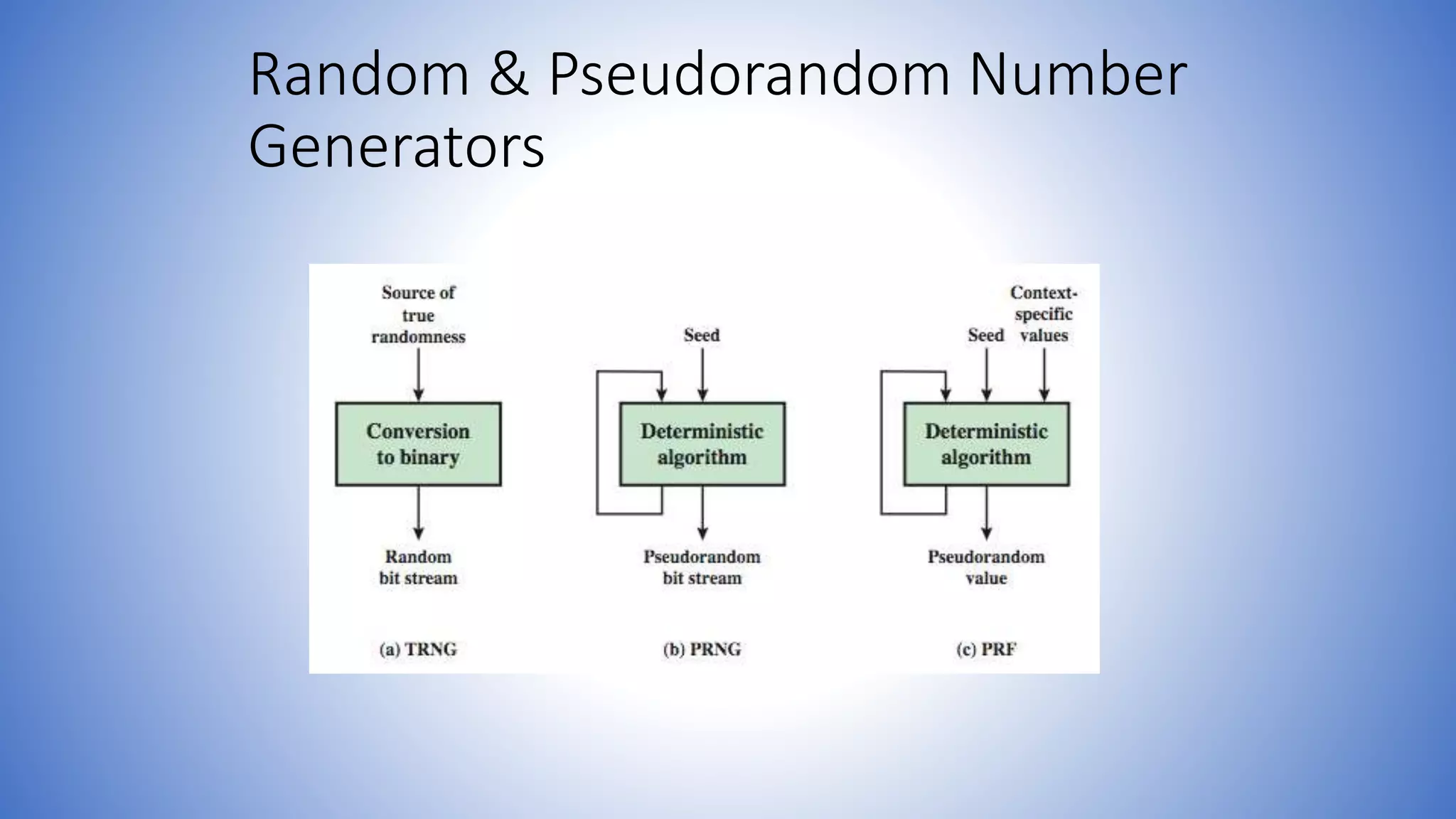
• Stallings Figure above contrasts a true random number generator (TRNG)
with two forms of pseudorandom number generators.
• A TRNG takes as input a source that is effectively random; the source is
often referred to as an entropy source.
• In contrast, a PRNG takes as input a fixed value, called the seed, and
produces a sequence of output bits using a deterministic algorithm.
• Typically, as shown, there is some feedback path by which some of the
results of the algorithm are fed back as input as additional output bits are
produced.
• The important thing to note is that the output bit stream is determined
solely by the input value or values, so that an adversary who knows the
algorithm and the seed can reproduce the entire bit stream.
• Figure above shows two different forms of PRNGs, based on
application;
• • Pseudorandom number generator: An algorithm that is used to
produce an open-ended sequence of bits is referred to as a PRNG.
• A common application for an open-ended sequence of bits is as
input to a symmetric stream cipher
• • Pseudorandom function (PRF): A PRF is used to produced a
pseudorandom string of bits of some fixed length.
• Examples are the symmetric encryption keys and nonces.
• Typically, the PRF takes as input a seed plus some context specific
values, such as a user ID or an application ID.
PRNG Requirements
• randomness
• uniformity, scalability, consistency
• unpredictability
• forward & backward unpredictability
• use same tests to check
• characteristics of the seed
• secure
• if known adversary can determine output
• so must be random or pseudorandom number
PRNG Requirements
• When a PRNG or PRF is used for a cryptographic application, then the basic
requirement is that an adversary who does not know the seed is unable to
determine the pseudorandom string.
• This general requirement for secrecy of the output of a PRNG or PRF leads
to specific requirements in the areas of randomness, unpredictability, and
the characteristics of the seed.
• In terms of randomness, the requirement for a PRNG is that the generated
bit stream appear random even though it is deterministic.
• NIST SP 800-22 (A Statistical Test Suite for Random and Pseudorandom
Number Generators for Cryptographic Applications) specifies that the tests
should seek to establish the following three characteristics: uniformity,
scalability, consistency. SP 800-22 lists 15 separate tests of randomness.
•
PRNG Requirements
• A stream of pseudorandom numbers should exhibit two forms of
unpredictability: forward unpredictability, backward unpredictability. The
same set of tests for randomness also provide a test of unpredictability. If
the generated bit stream appears random, then it is not possible to predict
some bit or bit sequence from knowledge of any previous bits. Similarly, if
the bit sequence appears random, then there is no feasible way to deduce
the seed based on the bit sequence. That is, a random sequence will have
no correlation with a fixed value (the seed).
• For cryptographic applications, the seed that serves as input to the PRNG
must be secure. Because the PRNG is a deterministic algorithm, if the
adversary can deduce the seed, then the output can also be determined.
Therefore, the seed must be unpredictable. In fact, the seed itself must be
a random or pseudorandom number.
Assignment
• Explain the working of Pseudorandom Number Generators.

Information and network security 30 random numbers

  • 1.
    Information and NetworkSecurity:30 Random Numbers Prof Neeraj Bhargava Vaibhav Khanna Department of Computer Science School of Engineering and Systems Sciences Maharshi Dayanand Saraswati University Ajmer
  • 2.
    Random Numbers • manyuses of random numbers in cryptography • nonces in authentication protocols to prevent replay • session keys • public key generation • keystream for a one-time pad • in all cases its critical that these values be • statistically random, uniform distribution, independent • unpredictability of future values from previous values • true random numbers provide this • care needed with generated random numbers
  • 3.
    • Random numbersplay an important role in the use of encryption for various network security applications. • In this presentation, we provide a brief overview of the use of random numbers in cryptography and network security and then focus on the principles of pseudorandom number generation. • Getting good random numbers is important, but difficult. • You don't want someone guessing the key you're using to protect your communications because your "random numbers" weren't (as happened in an early release of Netscape SSL). • Traditionally, the concern in the generation of a sequence of allegedly random numbers has been that the sequence of numbers be random in some well-defined statistical sense (with uniform distribution & independent).
  • 4.
    • In applicationssuch as reciprocal authentication, session key generation, and stream ciphers, the requirement is not just that the sequence of numbers be statistically random but that the successive members of the sequence are unpredictable • (so that it is not possible to predict future values having observed previous values). • With "true" random sequences, each number is statistically independent of other numbers in the sequence and therefore unpredictable. • However, as is discussed shortly, true random numbers are seldom used; rather, sequences of numbers that appear to be random are generated by some algorithm.
  • 5.
    Pseudorandom Number Generators(PRNGs) • often use deterministic algorithmic techniques to create “random numbers” • although are not truly random • can pass many tests of “randomness” • known as “pseudorandom numbers” • created by “Pseudorandom Number Generators (PRNGs)”
  • 6.
    • Cryptographic applicationstypically make use of deterministic algorithmic techniques for random number generation, producing sequences of numbers that are not statistically random, but if the algorithm is good, the resulting sequences will pass many reasonable tests of randomness. • Such numbers are referred to as pseudorandom numbers, created by “Pseudorandom Number Generators (PRNGs)”.
  • 7.
    Random & PseudorandomNumber Generators
  • 8.
    • Stallings Figureabove contrasts a true random number generator (TRNG) with two forms of pseudorandom number generators. • A TRNG takes as input a source that is effectively random; the source is often referred to as an entropy source. • In contrast, a PRNG takes as input a fixed value, called the seed, and produces a sequence of output bits using a deterministic algorithm. • Typically, as shown, there is some feedback path by which some of the results of the algorithm are fed back as input as additional output bits are produced. • The important thing to note is that the output bit stream is determined solely by the input value or values, so that an adversary who knows the algorithm and the seed can reproduce the entire bit stream.
  • 9.
    • Figure aboveshows two different forms of PRNGs, based on application; • • Pseudorandom number generator: An algorithm that is used to produce an open-ended sequence of bits is referred to as a PRNG. • A common application for an open-ended sequence of bits is as input to a symmetric stream cipher • • Pseudorandom function (PRF): A PRF is used to produced a pseudorandom string of bits of some fixed length. • Examples are the symmetric encryption keys and nonces. • Typically, the PRF takes as input a seed plus some context specific values, such as a user ID or an application ID.
  • 10.
    PRNG Requirements • randomness •uniformity, scalability, consistency • unpredictability • forward & backward unpredictability • use same tests to check • characteristics of the seed • secure • if known adversary can determine output • so must be random or pseudorandom number
  • 11.
    PRNG Requirements • Whena PRNG or PRF is used for a cryptographic application, then the basic requirement is that an adversary who does not know the seed is unable to determine the pseudorandom string. • This general requirement for secrecy of the output of a PRNG or PRF leads to specific requirements in the areas of randomness, unpredictability, and the characteristics of the seed. • In terms of randomness, the requirement for a PRNG is that the generated bit stream appear random even though it is deterministic. • NIST SP 800-22 (A Statistical Test Suite for Random and Pseudorandom Number Generators for Cryptographic Applications) specifies that the tests should seek to establish the following three characteristics: uniformity, scalability, consistency. SP 800-22 lists 15 separate tests of randomness. •
  • 12.
    PRNG Requirements • Astream of pseudorandom numbers should exhibit two forms of unpredictability: forward unpredictability, backward unpredictability. The same set of tests for randomness also provide a test of unpredictability. If the generated bit stream appears random, then it is not possible to predict some bit or bit sequence from knowledge of any previous bits. Similarly, if the bit sequence appears random, then there is no feasible way to deduce the seed based on the bit sequence. That is, a random sequence will have no correlation with a fixed value (the seed). • For cryptographic applications, the seed that serves as input to the PRNG must be secure. Because the PRNG is a deterministic algorithm, if the adversary can deduce the seed, then the output can also be determined. Therefore, the seed must be unpredictable. In fact, the seed itself must be a random or pseudorandom number.
  • 13.
    Assignment • Explain theworking of Pseudorandom Number Generators.