1 ANOOP J P
IVth Year I
SSDC, Varkala
Infant oral health care is the foundation on
which a lifetime preventive education & dental care can
be built in order to help acquire optimal oral health into
child & adulthood.
2
Nowak (1997) stated that “ the goal of the 1st Oral
supervision visit is to assess the risk for dental disease,
initiate a preventive program, providing anticipatory
guidance & decide on the Periodicity of subsequent
visits”
3
GOALS
To identify, intercept & modify the potentially harmful parenting
practices that may adversely affect the infant’s oral health.
Parent education right from the prenatal period.
Parent/caregiver orientation to perceive dental services as an
integral part of infant's overall health program.
Periodic evaluation of orofacial development 4
WHY ?
 Infectious diseases of the Oral cavity
 Traumatic injuries
 Habits(eg : Thumb sucking)
 Child Abuse
 Care of the alternatively abled children (cleft lip & palate)
 Problems of speech & language
5
CONCEPTS OF INFANT ORAL HEALTH
Risk assessment
Anticipatory Guidance
Health Supervision
6
Dental
Home
Dental Home is the ongoing relationship b/w dentist & the
patient, inclusive of all aspects of oral health care
delivered in a comprehensive, continuously accessible,
coordinated & family-centered way.
7
RISK ASSESSMENT
 Risk assessment is defined as identification of factors
known / believed to be associated with conditions/ diseases for
purposes of further diagnosis, prevention, or treatment.
 By eliminating the risk factors before disease occurs, the
disease process can be prevented in the immediate future.
 An example would be an infant sleeping with a bottle of
sweetened liquid but with no overt dental caries. Intervention
would be focused on eliminating the habit & diminishing the
risk of Early Childhood Caries
8
9
 Anticipatory Guidance is defined as proactive , developmentally
based counseling technique that focuses on the needs of a child at
each stage of life
 Anticipatory Guidance is complement to Risk assessment.
 An example of anticipatory guidance would be to discuss
ambulation of the child at the initial dental visits & warn the
parents about the possible tooth trauma that often occurs as the
infant starts to walk
10
 Anticipatory Guidance areas incl. Oral development,
Diet & Nutrition, Fluoride adequacy, Oral habits, injury
prevention & Oral hygiene.
11
HEALTH SUPERVISION
 Health supervision is defined as the longitudinal partnership
between dentist & family individualized to focus on health
outcomes for that family & child.
 Health supervision is alternative to the traditional recall
period, & health outcome is the desired changes monitored at
each interval.
 Outcomes are the measures that indicate success .These can be
physical(reduction in gingival inflammation),
cognitive(understanding of caries process), or behavioral
(elimination of nighttime bottle habit).
 For example – the presence of plaque on primary teeth in
infants is a strong predictor of future dental caries, so after
12
oral hygiene instruction parents can monitor success by
looking for the presence of plaque. The desired outcome
would be the absence of plaque.
13
ESSENTIAL STEPS TO BE TAKEN
WHEN PARENT APPROACHES A
DENTAL HOME
 History – A detailed history involving prenatal, birth &
postnatal periods is necessary. Diet & Nutrition question focus
on the frequency of sugar consumption, use of a bottle with
sweetened liquids & special diets. Fluoride adequacy refers to the
adequacy of drinking water to provide optimal fluoride
14
 Oral Examination
 The use of a dental chair is unnecessary & the least preferred
approach.
 The preferred approach to infant examination is the knee-
knee position in which parent & dental provider sit facing
each other
 their knees should touch ideally, mesh slightly, creating a
flat surface on which the child can rest.
 The infant initially is held facing the parent & then reclined
on to the lap of dentist.
 The parent holds the child’s hands & the dentist, looking
down, stabilizes the child’s head.
15
 During the examination , which may take only seconds, the
dentist also has the opportunity to demonstrate oral hygiene,
point out oral structures of importance.
 However the dentist should be familiar with developmental
milestones of children from birth to 3yrs
16
17
18
 Risk profiling –
 From the historical data & clinical data obtained from the
parent & the child, the dentist can create risk profile using the
same 6 areas of anticipatory guidance.
 Parents should be provided with explanations & an estimate
of the influence of a particular factor on health
 A usual visual for risk profiling is also the Caries Assessment
Tool of American academy of Pediatric Dentistry
19
American Academy of Pediatric Dentistry
Caries Risk Assessment Tool (CAT)
Low Risk
Clinical
Conditions
• No carious teeth in past 24 months
• No enamel demineralization
Moderate Risk
• Carious teeth in the past 24 months
• One area of enamel
High Risk
• Carious teeth in the past 12 months
• More than one area of enamel
demineralization (enamel caries
“white –spot lesions”
• Visible plaque on anterior (front)
teeth
• Radiographic enamel caries
• High titers of mutans streptococci
• Wearing dental or orthodontic
appliances
• Enamel hypoplasia
• Suboptimal systemic fluoride • Suboptimal topical fluorideEnvironmental • Optimal systemic and topical
exposure with optimal topical exposureCharacteristics fluoride exposure
• Consumption of simple sugars or exposure • Frequent (i.e., 3 or more) between-
foods strongly associated with • Occasional (i.e., 1-2) between-meal meal exposures to simple sugars or
caries initiation primarily at exposures to simple sugars or foods strongly associated with
mealtimes foods strongly associated with caries
• High caregiver socioeconomic caries • Low- level caregiver
status • Mid-level caregiver socioeconomic socioeconomic status (i.e., eligible
• Regular use of dental care in an status (i.e., eligible for school lunch for Medicaid)
• No usual source of dental careestablished dental home program or SCHIP)
• Irregular use of dental services • Active caries present in the mother
• Children with special health careGeneral Health
needsConditions
• Conditions impairing saliva
composition/flow
• No visible plaque; no gingivitis
(enamel caries “white spot lesions) demineralization
(enamel caries “white spot lesions)
• Gingivitis
December 2007
20
 The dentist is a valuable source of information
It’s the duty of the dentist to answer the queries of the
parents as to when do the teeth erupt. The age at which teeth
erupt varies greatly b/w children & a difference of 6-12 mo
can be considered normal
21
6-10
mo
• Bottom front teeth, then top front/side
bottom front teeth
9-
13mo
• Top front teeth
13-19
mo
• 1st molar then canines, then 2nd molar
2.5-
3yrs
• All teeth
22
 Feeding practices
Breast milk has several systemic &
immunological advantages over proprietary formulas.
Thus the importance of breast-feeding should be
explained to the parents.
However on the flipside prolonged & at will
breast feeding, beyond stipulated weaning of child, esp.
at night, has been associated with Nursing Caries
23
Breast feeding Bottle feeding
Function :
•It stimulates muscles around the tongue
activity for normal growth of teeth& jaws
•It allows gravity working correctly on the
muscles involved in swallowing
• Muscles don’t have to work hard
normal growth may get affected
• Milk flows continuously from the bottle ,
does not allow muscles to work
Nutrition :
• Milk is more nutritious
• Easily digestible
• High % of lactoalbumin rich in S
containing AA,VitC ,VitD
• It may not provide complete nutrition as
some children are unable to digest it
easily because of the nature of fat
• % is less
Immunologic:
• Colostrums rich in certain Ab like IgA &
contains maternal macrophages protect
against infections
•It lacks natural defense against
infections
•Others : Colostrum contain a gut control
factor& stimulate growth of GI tract
•Decreased risk of deleterious habits
•Infant controls own intake
• Doesn’t contain Colostrum
• No control over feeding & gain more
weight during 1st year of life
• Incidence is high
24
25
 Parents should also be made to realize the difference of
sucking & suckling, to prevent the onset of deleterious
oral habits.
 Suckling at the breast is good for the infant’s tooth &
jaw development.
 Nursing technically is different from artificial feeding
in that the bottle fed infant does not have to exercise the
jaws so energetically, in as much as light suckling alone
produces a rapid flow of milk .
 Bottle fed infants use their tongue in a manner quite
opposite that of breast fed baby ;the flow of milk
through the rubber nipple is produced by the thrusting
motion of the tongue with each suck while infant’s lip 26
create a negative pressure in the oral cavity, thus
suctioning the milk from the bottle.
Important Tips On Bottle Feeding
Parents should be instructed to :
 Provide more attention to the child.
 Remove the bottle immediately after feeding.
 Substitute the milk/ non-sweetened juices with plain
boil water.
 Encourage the baby to stay upright position with a
bottle.
 Use a bottle with a nipple that has a small hole to enable
the infant to work with his muscles activity to get the milk
from bottle. 27
 Introduce a cup drink as soon as possible.
 Bottle feeding be allowed in intervals.
 It should never be used as pacifier
 Give water after feeding with the bottle & clean the
mouth soon after feeding.
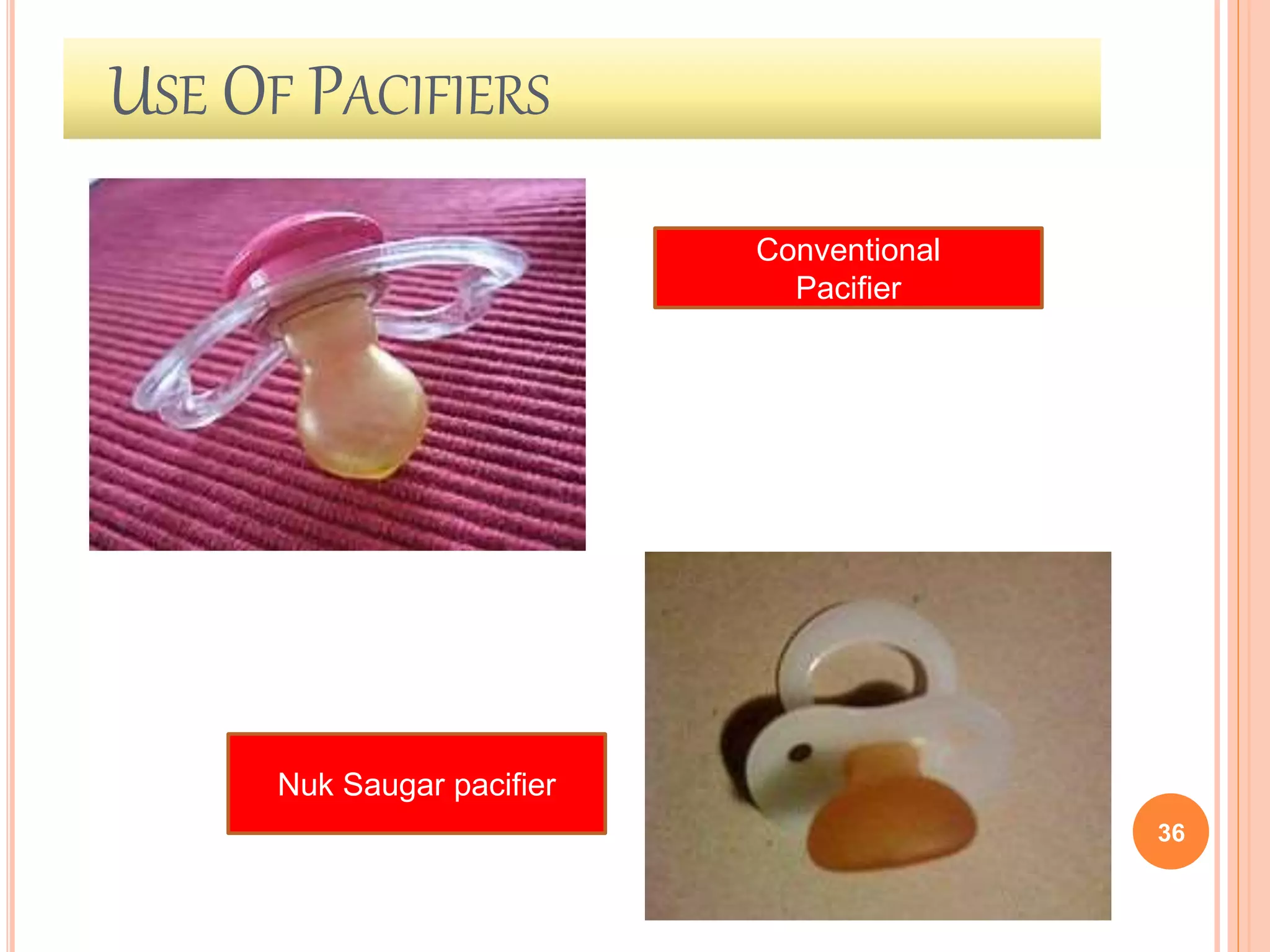
Types of Nipples
 Conventional Nipple (possess large hole at the sucking
end which doesn't help in proper jaw growth)
 Nuk Sauger Nipples(Same design as that of human teat
with a small hole & more advantageous than
conventional)
28
NUK SAUGER NIPPLE
 fdbb
29
CONVENTIONAL NIPPLE
30
 Definition – Weaning is a process of expanding the
diet to include foods & drinks other than breast
milk/milk formulae
Stages Of Weaning
 Stage 1- 4 to 6 months
 Stage 2 – 6 to 9 months
 Stage 3- 9 to 12 months
31
32
6 mo
7 mo
9.5 mo
Stage 1 (4 – 6 months)
 Its usually the solid food to be introduced before a
morning feed
 If a cereal is used its reconstituted with expressed
breast milk, infant formula/boiled water, which is
mixed to a fluid consistency & should be prepared
without adding sugar & salt.
 Initially, 1/2 teaspoons of food is adequate, but this
quantity increases as the baby’s apetite increases.
 If the baby appears at 1st to spit food out, its due to the
fact that the baby has not yet developed the skill of
using the tongue to propel the food back to mouth.
 As the baby becomes accustomed to take in food by
spoon, its made thicker & food must be pureed/ finely
minced
33
Stage 2 (6 – 9 months)
 Child is now able to chew, consequently minced &
mashed food that incl. small soft lumps can be given.
 During this stage, as the infant is proficient in chewing,
they should be encouraged to feed themselves
 soft cooked vegetables eg: carrots, & chopped soft fruits
such as banana can be introduced.
 at this stage baby must not be left alone while feeding
because of the risk of choking, & babies/toddlers must
not be given small hard sweets/nuts because of the risk
of accidental inhalation.
34
Stage 3(9 – 12 months)
 By the end of this stage baby should be eating similar
foods to the rest of the family, as 3 main meals with either
drinks of milk or snacks b/w them .
 Food no longer needs to be smashed; it can now be
chopped.
 The early morning milk is replaced by a drink of
water/diluted fruit juice.
35
USE OF PACIFIERS
36
Conventional
Pacifier
Nuk Saugar pacifier
 A Pacifier(also dummy/soother) is a rubber, plastic, or
silicone nipple given to a infant /other young child to suck
upon.
 In its standard appearance it has a teat , mouthshield & a
handle
 Mouth shield &/ handle is large enough to avoid infant
choking on it/ swallowing it.
Benefits
• Reduce rate of infant sucking
their thumb/any other finger
Drawbacks
• Its have been known to interfere
with breast feeding, if its introduced
within 6 weeks of life
37
 Infants who suck pacifiers for long is associated with
ear infection (Otitis media)
 some older infants have delayed speech development
due to the pacifiers constant presence in their mouth
preventing them from practicing their speaking skills
 Prolonged use past their 1st few years can cause dental
problems
38
Parents must be made aware of the fact that oral hygiene
is essential at this stage ; in such cases child has to
brought early & proper technique has to be demonstrated.
Cleaning of the gumpads can be started as early as within
1st of birth
Cleaning Infant’s mouth - the parents can be instructed to
:-
39
Gumpads
 Lay the baby down with his/her head in our lap & feet
pointing away
 Open the baby’s mouth & slide the fore finger inside
along the cheek & press down on the backside lower
gumpad
 Take a small gauze (2” x 2”) b/w thumb & forefinger &
wipe vigorously over the ridge of the baby’s top & bottom
jaws.
Use adequate pressure to remove the film that covers the
child’s gumpad.
 Clean at least everyday twice after morning & last feed
in the night.
 Spend at least 2 – 3 min in cleaning
40
41
The teeth is also cleaned as gum pads are been cleaned ;
nowadays specially designed infants tooth brushes finger
cots are available for infant teeth cleaning.
While performing these procedures are should be taken
that the child is supported all times & the movements
are slow & careful, so as not cause any injury .
Teeth
 The pediatricians / primary care physicians treat infants
& monitor the growth & development of children. They
are usually 1st health care providers & can act to evaluate
their oral health status .
 The dentist should establish a contact with pediatrician
& formulate a policy regarding dental health for infant.
 Following topics needs to be discussed with the
pediatrician .
 Tooth eruption
 Preventive oral hygiene
 Orofacial development
 Fluoridation
 Diet 42
 When the child is 10 mo old, the assertiveness of the
child may make the parents to give in by giving a sleep
time bottle. A solution suggested is the gradual dilution
of the liquid . Thus
 1 week – 1/3 bottle water
 2 week – 2/3 bottle water
 3 week – only water
 weaning foods free of or low in non-milk extrinsic
sugars should be recommended to the mothers.
 Depending upon the fluoride present in community
water, the requirements of the child , a fluoride
supplementation program can be instituted.
 Pediatrician should be aware of the dentist population
in his vicinity for the purposes of referral 43
Other personnel incl. Nurses, Midwives ; they can
provide information about immunization, accident
prevention & dental health
 The need for commencement of tooth brushing/
cleaning with gauze as soon as the 1st tooth erupts can be
emphasized through prenatal classes by the
gynecologist/obstetrician
 Neonatologists can also play a role by advising &
counseling parents regarding any congenital defects such
as cleft lip, & palate.
 Importance of breast-feeding can be emphasized by
these medical personnel
 Mothers can be informed about the transmission of Ab
via breast milk & their effect on dental health 44
 The parents should bring their child for his/her 1st
dental visit early, at least by the time baby is 6 mo of age.
 Breast feed the baby but don’t indulge at will.
 Avoid frequent use of bottle with sugared milk/drinks
as this can lead to nursing bottle caries
 Don’t put child to bed with the bottle/at breast.
 Dilute the milk gradually in the bottle & end with plain
water
 Feeding should be supervised all the times
 Do not use pacifiers /dummies dipped in honey/other
sugar items
 Clean the gums& later teeth with a cloth/soft brush after
every meal/before sleep 45
 Avoid extended use of sugared medicines such as syrups
 Contact the dentist immediately if there is any
accident/trauma to the baby’s teeth
 Parents should know the benefits of fluoride & its
proper use such as that used in infant formulas &
dentrifices.
 Half yearly visits to dentist should be routine.
46
 Textbook of Pedodontics – Shobha Tandon
 Principles & Practices of
Pedodontics - Arathi Rao
 Dentistry for the & Adolescent – McDonald
 Pediatric Dentistry – Pinkham, Casamassimo
 Caries Assessment Tool Of American Academy of
Pediatric Dentistry – http//www.aapd.org
47
48

Infant oral health care

  • 1.
    1 ANOOP JP IVth Year I SSDC, Varkala
  • 2.
    Infant oral healthcare is the foundation on which a lifetime preventive education & dental care can be built in order to help acquire optimal oral health into child & adulthood. 2
  • 3.
    Nowak (1997) statedthat “ the goal of the 1st Oral supervision visit is to assess the risk for dental disease, initiate a preventive program, providing anticipatory guidance & decide on the Periodicity of subsequent visits” 3
  • 4.
    GOALS To identify, intercept& modify the potentially harmful parenting practices that may adversely affect the infant’s oral health. Parent education right from the prenatal period. Parent/caregiver orientation to perceive dental services as an integral part of infant's overall health program. Periodic evaluation of orofacial development 4
  • 5.
    WHY ?  Infectiousdiseases of the Oral cavity  Traumatic injuries  Habits(eg : Thumb sucking)  Child Abuse  Care of the alternatively abled children (cleft lip & palate)  Problems of speech & language 5
  • 6.
    CONCEPTS OF INFANTORAL HEALTH Risk assessment Anticipatory Guidance Health Supervision 6 Dental Home
  • 7.
    Dental Home isthe ongoing relationship b/w dentist & the patient, inclusive of all aspects of oral health care delivered in a comprehensive, continuously accessible, coordinated & family-centered way. 7
  • 8.
    RISK ASSESSMENT  Riskassessment is defined as identification of factors known / believed to be associated with conditions/ diseases for purposes of further diagnosis, prevention, or treatment.  By eliminating the risk factors before disease occurs, the disease process can be prevented in the immediate future.  An example would be an infant sleeping with a bottle of sweetened liquid but with no overt dental caries. Intervention would be focused on eliminating the habit & diminishing the risk of Early Childhood Caries 8
  • 9.
  • 10.
     Anticipatory Guidanceis defined as proactive , developmentally based counseling technique that focuses on the needs of a child at each stage of life  Anticipatory Guidance is complement to Risk assessment.  An example of anticipatory guidance would be to discuss ambulation of the child at the initial dental visits & warn the parents about the possible tooth trauma that often occurs as the infant starts to walk 10
  • 11.
     Anticipatory Guidanceareas incl. Oral development, Diet & Nutrition, Fluoride adequacy, Oral habits, injury prevention & Oral hygiene. 11
  • 12.
    HEALTH SUPERVISION  Healthsupervision is defined as the longitudinal partnership between dentist & family individualized to focus on health outcomes for that family & child.  Health supervision is alternative to the traditional recall period, & health outcome is the desired changes monitored at each interval.  Outcomes are the measures that indicate success .These can be physical(reduction in gingival inflammation), cognitive(understanding of caries process), or behavioral (elimination of nighttime bottle habit).  For example – the presence of plaque on primary teeth in infants is a strong predictor of future dental caries, so after 12
  • 13.
    oral hygiene instructionparents can monitor success by looking for the presence of plaque. The desired outcome would be the absence of plaque. 13
  • 14.
    ESSENTIAL STEPS TOBE TAKEN WHEN PARENT APPROACHES A DENTAL HOME  History – A detailed history involving prenatal, birth & postnatal periods is necessary. Diet & Nutrition question focus on the frequency of sugar consumption, use of a bottle with sweetened liquids & special diets. Fluoride adequacy refers to the adequacy of drinking water to provide optimal fluoride 14
  • 15.
     Oral Examination The use of a dental chair is unnecessary & the least preferred approach.  The preferred approach to infant examination is the knee- knee position in which parent & dental provider sit facing each other  their knees should touch ideally, mesh slightly, creating a flat surface on which the child can rest.  The infant initially is held facing the parent & then reclined on to the lap of dentist.  The parent holds the child’s hands & the dentist, looking down, stabilizes the child’s head. 15
  • 16.
     During theexamination , which may take only seconds, the dentist also has the opportunity to demonstrate oral hygiene, point out oral structures of importance.  However the dentist should be familiar with developmental milestones of children from birth to 3yrs 16
  • 17.
  • 18.
  • 19.
     Risk profiling–  From the historical data & clinical data obtained from the parent & the child, the dentist can create risk profile using the same 6 areas of anticipatory guidance.  Parents should be provided with explanations & an estimate of the influence of a particular factor on health  A usual visual for risk profiling is also the Caries Assessment Tool of American academy of Pediatric Dentistry 19
  • 20.
    American Academy ofPediatric Dentistry Caries Risk Assessment Tool (CAT) Low Risk Clinical Conditions • No carious teeth in past 24 months • No enamel demineralization Moderate Risk • Carious teeth in the past 24 months • One area of enamel High Risk • Carious teeth in the past 12 months • More than one area of enamel demineralization (enamel caries “white –spot lesions” • Visible plaque on anterior (front) teeth • Radiographic enamel caries • High titers of mutans streptococci • Wearing dental or orthodontic appliances • Enamel hypoplasia • Suboptimal systemic fluoride • Suboptimal topical fluorideEnvironmental • Optimal systemic and topical exposure with optimal topical exposureCharacteristics fluoride exposure • Consumption of simple sugars or exposure • Frequent (i.e., 3 or more) between- foods strongly associated with • Occasional (i.e., 1-2) between-meal meal exposures to simple sugars or caries initiation primarily at exposures to simple sugars or foods strongly associated with mealtimes foods strongly associated with caries • High caregiver socioeconomic caries • Low- level caregiver status • Mid-level caregiver socioeconomic socioeconomic status (i.e., eligible • Regular use of dental care in an status (i.e., eligible for school lunch for Medicaid) • No usual source of dental careestablished dental home program or SCHIP) • Irregular use of dental services • Active caries present in the mother • Children with special health careGeneral Health needsConditions • Conditions impairing saliva composition/flow • No visible plaque; no gingivitis (enamel caries “white spot lesions) demineralization (enamel caries “white spot lesions) • Gingivitis December 2007 20
  • 21.
     The dentistis a valuable source of information It’s the duty of the dentist to answer the queries of the parents as to when do the teeth erupt. The age at which teeth erupt varies greatly b/w children & a difference of 6-12 mo can be considered normal 21
  • 22.
    6-10 mo • Bottom frontteeth, then top front/side bottom front teeth 9- 13mo • Top front teeth 13-19 mo • 1st molar then canines, then 2nd molar 2.5- 3yrs • All teeth 22
  • 23.
     Feeding practices Breastmilk has several systemic & immunological advantages over proprietary formulas. Thus the importance of breast-feeding should be explained to the parents. However on the flipside prolonged & at will breast feeding, beyond stipulated weaning of child, esp. at night, has been associated with Nursing Caries 23
  • 24.
    Breast feeding Bottlefeeding Function : •It stimulates muscles around the tongue activity for normal growth of teeth& jaws •It allows gravity working correctly on the muscles involved in swallowing • Muscles don’t have to work hard normal growth may get affected • Milk flows continuously from the bottle , does not allow muscles to work Nutrition : • Milk is more nutritious • Easily digestible • High % of lactoalbumin rich in S containing AA,VitC ,VitD • It may not provide complete nutrition as some children are unable to digest it easily because of the nature of fat • % is less Immunologic: • Colostrums rich in certain Ab like IgA & contains maternal macrophages protect against infections •It lacks natural defense against infections •Others : Colostrum contain a gut control factor& stimulate growth of GI tract •Decreased risk of deleterious habits •Infant controls own intake • Doesn’t contain Colostrum • No control over feeding & gain more weight during 1st year of life • Incidence is high 24
  • 25.
  • 26.
     Parents shouldalso be made to realize the difference of sucking & suckling, to prevent the onset of deleterious oral habits.  Suckling at the breast is good for the infant’s tooth & jaw development.  Nursing technically is different from artificial feeding in that the bottle fed infant does not have to exercise the jaws so energetically, in as much as light suckling alone produces a rapid flow of milk .  Bottle fed infants use their tongue in a manner quite opposite that of breast fed baby ;the flow of milk through the rubber nipple is produced by the thrusting motion of the tongue with each suck while infant’s lip 26
  • 27.
    create a negativepressure in the oral cavity, thus suctioning the milk from the bottle. Important Tips On Bottle Feeding Parents should be instructed to :  Provide more attention to the child.  Remove the bottle immediately after feeding.  Substitute the milk/ non-sweetened juices with plain boil water.  Encourage the baby to stay upright position with a bottle.  Use a bottle with a nipple that has a small hole to enable the infant to work with his muscles activity to get the milk from bottle. 27
  • 28.
     Introduce acup drink as soon as possible.  Bottle feeding be allowed in intervals.  It should never be used as pacifier  Give water after feeding with the bottle & clean the mouth soon after feeding. Types of Nipples  Conventional Nipple (possess large hole at the sucking end which doesn't help in proper jaw growth)  Nuk Sauger Nipples(Same design as that of human teat with a small hole & more advantageous than conventional) 28
  • 29.
  • 30.
  • 31.
     Definition –Weaning is a process of expanding the diet to include foods & drinks other than breast milk/milk formulae Stages Of Weaning  Stage 1- 4 to 6 months  Stage 2 – 6 to 9 months  Stage 3- 9 to 12 months 31
  • 32.
  • 33.
    Stage 1 (4– 6 months)  Its usually the solid food to be introduced before a morning feed  If a cereal is used its reconstituted with expressed breast milk, infant formula/boiled water, which is mixed to a fluid consistency & should be prepared without adding sugar & salt.  Initially, 1/2 teaspoons of food is adequate, but this quantity increases as the baby’s apetite increases.  If the baby appears at 1st to spit food out, its due to the fact that the baby has not yet developed the skill of using the tongue to propel the food back to mouth.  As the baby becomes accustomed to take in food by spoon, its made thicker & food must be pureed/ finely minced 33
  • 34.
    Stage 2 (6– 9 months)  Child is now able to chew, consequently minced & mashed food that incl. small soft lumps can be given.  During this stage, as the infant is proficient in chewing, they should be encouraged to feed themselves  soft cooked vegetables eg: carrots, & chopped soft fruits such as banana can be introduced.  at this stage baby must not be left alone while feeding because of the risk of choking, & babies/toddlers must not be given small hard sweets/nuts because of the risk of accidental inhalation. 34
  • 35.
    Stage 3(9 –12 months)  By the end of this stage baby should be eating similar foods to the rest of the family, as 3 main meals with either drinks of milk or snacks b/w them .  Food no longer needs to be smashed; it can now be chopped.  The early morning milk is replaced by a drink of water/diluted fruit juice. 35
  • 36.
  • 37.
     A Pacifier(alsodummy/soother) is a rubber, plastic, or silicone nipple given to a infant /other young child to suck upon.  In its standard appearance it has a teat , mouthshield & a handle  Mouth shield &/ handle is large enough to avoid infant choking on it/ swallowing it. Benefits • Reduce rate of infant sucking their thumb/any other finger Drawbacks • Its have been known to interfere with breast feeding, if its introduced within 6 weeks of life 37
  • 38.
     Infants whosuck pacifiers for long is associated with ear infection (Otitis media)  some older infants have delayed speech development due to the pacifiers constant presence in their mouth preventing them from practicing their speaking skills  Prolonged use past their 1st few years can cause dental problems 38
  • 39.
    Parents must bemade aware of the fact that oral hygiene is essential at this stage ; in such cases child has to brought early & proper technique has to be demonstrated. Cleaning of the gumpads can be started as early as within 1st of birth Cleaning Infant’s mouth - the parents can be instructed to :- 39 Gumpads
  • 40.
     Lay thebaby down with his/her head in our lap & feet pointing away  Open the baby’s mouth & slide the fore finger inside along the cheek & press down on the backside lower gumpad  Take a small gauze (2” x 2”) b/w thumb & forefinger & wipe vigorously over the ridge of the baby’s top & bottom jaws. Use adequate pressure to remove the film that covers the child’s gumpad.  Clean at least everyday twice after morning & last feed in the night.  Spend at least 2 – 3 min in cleaning 40
  • 41.
    41 The teeth isalso cleaned as gum pads are been cleaned ; nowadays specially designed infants tooth brushes finger cots are available for infant teeth cleaning. While performing these procedures are should be taken that the child is supported all times & the movements are slow & careful, so as not cause any injury . Teeth
  • 42.
     The pediatricians/ primary care physicians treat infants & monitor the growth & development of children. They are usually 1st health care providers & can act to evaluate their oral health status .  The dentist should establish a contact with pediatrician & formulate a policy regarding dental health for infant.  Following topics needs to be discussed with the pediatrician .  Tooth eruption  Preventive oral hygiene  Orofacial development  Fluoridation  Diet 42
  • 43.
     When thechild is 10 mo old, the assertiveness of the child may make the parents to give in by giving a sleep time bottle. A solution suggested is the gradual dilution of the liquid . Thus  1 week – 1/3 bottle water  2 week – 2/3 bottle water  3 week – only water  weaning foods free of or low in non-milk extrinsic sugars should be recommended to the mothers.  Depending upon the fluoride present in community water, the requirements of the child , a fluoride supplementation program can be instituted.  Pediatrician should be aware of the dentist population in his vicinity for the purposes of referral 43
  • 44.
    Other personnel incl.Nurses, Midwives ; they can provide information about immunization, accident prevention & dental health  The need for commencement of tooth brushing/ cleaning with gauze as soon as the 1st tooth erupts can be emphasized through prenatal classes by the gynecologist/obstetrician  Neonatologists can also play a role by advising & counseling parents regarding any congenital defects such as cleft lip, & palate.  Importance of breast-feeding can be emphasized by these medical personnel  Mothers can be informed about the transmission of Ab via breast milk & their effect on dental health 44
  • 45.
     The parentsshould bring their child for his/her 1st dental visit early, at least by the time baby is 6 mo of age.  Breast feed the baby but don’t indulge at will.  Avoid frequent use of bottle with sugared milk/drinks as this can lead to nursing bottle caries  Don’t put child to bed with the bottle/at breast.  Dilute the milk gradually in the bottle & end with plain water  Feeding should be supervised all the times  Do not use pacifiers /dummies dipped in honey/other sugar items  Clean the gums& later teeth with a cloth/soft brush after every meal/before sleep 45
  • 46.
     Avoid extendeduse of sugared medicines such as syrups  Contact the dentist immediately if there is any accident/trauma to the baby’s teeth  Parents should know the benefits of fluoride & its proper use such as that used in infant formulas & dentrifices.  Half yearly visits to dentist should be routine. 46
  • 47.
     Textbook ofPedodontics – Shobha Tandon  Principles & Practices of Pedodontics - Arathi Rao  Dentistry for the & Adolescent – McDonald  Pediatric Dentistry – Pinkham, Casamassimo  Caries Assessment Tool Of American Academy of Pediatric Dentistry – http//www.aapd.org 47
  • 48.