Industrial EngineeringSubjects(ManufacturingEngineeringCourses)
2008 – 2012 AppliesScience University(UTS)
Course Description
EngineeringMaterial 1. Describe the mechanical designprocessasitappliesmachine
elements;
2. Describe how and whystructuresandmachine componentsfail;
3. Determine the stressandstrainina machine component;
4. Realise the importance of stressanalysisandmaterialselectionin
machine elementdesign;
5. Predict,or designtoavoid,failure giventhe material,environment
and loadingconditions;and
6. Use theiranalytical skillsinstressanalysisandtheirknowledge of
material propertiesinmechanical design.
Statics 1. Findresultantforces
2. Draw the appropriate free-bodydiagramforeachproblem,
identifyingall externalforcesandmoments.
3. Solve forunknownforce vectorsusingparticle equilibrium.
4. Findequivalentloadingsystems.
5. Solve forthe supportforcesusingrigidbodyequilibrium.
6. Determine the internal forcesinstructural members.
7. Solve forthe internal forcesintrusses,framesandmachines.
8. Understandthe relationshipsbetweenappliedloads,internal
shearforce and internal moment.9.Determine frictionalforcesfor
equilibriumandimpendingmotion.
10. Calculate the centerof gravityandcentroidof systemsof
particlesandof bodies.
11. Calculate areamomentsof inertiaandmassmomentsof inertia.
12. Applythe principle of virtual work.
AdvancedEngineeringMath
(MathematicsforPhysical
Science)
1. Understand the use of mathematics as a tool to model real
world problems
2. use mathematical terminology and concepts
3. use formal and informal language to demonstrate
understanding of these concepts
4. demonstrate a high level of skill in the computational
techniques of the subject
5. demonstrate an understanding of the theoretical results
which justify the use of these techniques
6. apply the techniques to previously unseen problems
7. communicate the above knowledge clearly, logically and
critically
StrengthinMaterials
(StrengthinEngineering
Materials)
1. Understand, describe and use the methodology of modelling
material properties and behavior
2. understand and describe the fundamental differences in the
behaviour of different types of materials
3. understand and describe how and why things fail
4. realise the importance of material selection in engineering
design
5. predict, or design to avoid, failure given the material,
environment and loading conditions
6. Use analytical skills in stress analysis and knowledge of
material properties in mechanical design.
ProbabilityandStatics
(Mathematical Statistics)
1. define relevant terminology, notation, theorems and
concepts in mathematical terms and in your own words.
2. formulate and solve applied and theoretical problems in
probability and statistics.
3. represent and use probability distributions and random
variables
4. determine moments and generating functions for discrete
and continuous random variables
5. use the standard univariate distributions to solve theoretical
and applied problems
6. use a variety of methods for transformation and change of
variables in one and two dimensions
7. discuss and derive standard sampling distributions based on
the normal distribution and order statistics
8. discuss and explain the concepts of point estimation and be
able to determine moment and maximum likelihood
estimators and examine their properties
9. Understand different types of tests and determine the most
appropriate type of test in a given situation.
FluidMechanics 1. understand key concepts and fundamental principles,
together with the assumptions made in their development,
pertaining to fluid behaviour, both in static and flowing
conditions
2. deal effectively with practical engineering situations,
including the analysis and design of engineering systems and
devices involving fluids and flow
3. appreciate possible applications and links to other disciplines
ManufacturingProcesses
(ManufacturingEngineering)
1. explain and provide examples of manufacturing processes
involved in casting, forming machining and joining of
materials
2. identify and describe the manufacturing process by which
products are made of different materials: metals, polymers,
ceramics and composites
3. demonstrate improved technical written and graphical
communication skills by completion of specified laboratory
reports and site visit reports
4. Demonstrate basic problem-solving skills relating to
manufacturing and production.
Students learn the processes and materials available, as well
as a competent and practical approach to evaluating,
selecting and recognising the connections between the
materials/processes and engineering design.
OperationsResearch
(IntroductiontoQuantitative
Management,Optimisationin
Quantitative Management,
StochasticModels)
1. Problems from manufacturing, construction, supply chain
management and finance, together with approaches to the
formulation of the corresponding mathematical models.
Models include linear programs, nonlinear programs, integer
programs, and decision trees. Solutions for the models are
obtained using commercial decision support software
including spreadsheet add-ins and mathematical
programming modelling systems such as LINGO.
2. Introduce methods and ideas that form an indispensable part
of commercial decision support systems in such diverse fields
as supply chain management, financial analysis,
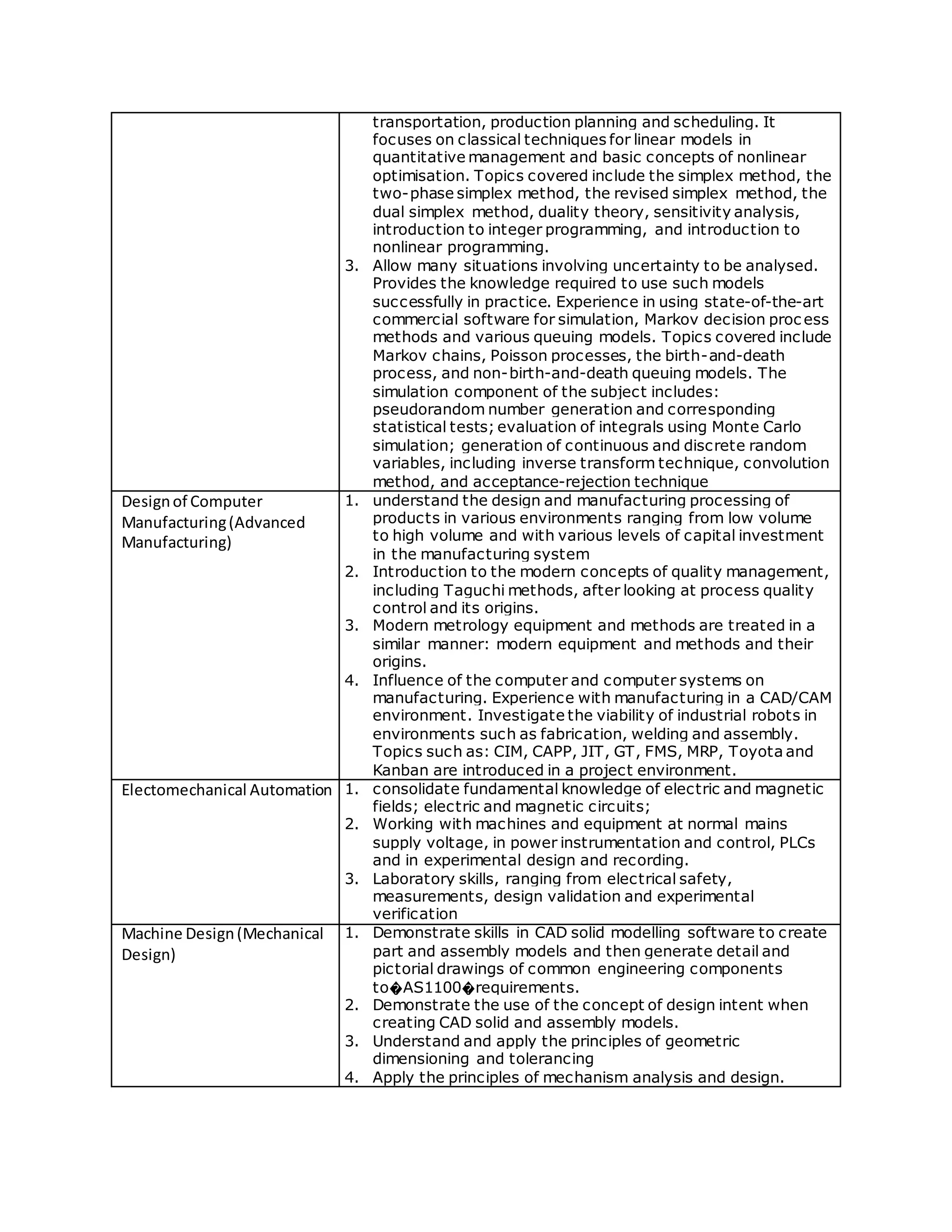
transportation, production planning and scheduling. It
focuses on classical techniques for linear models in
quantitative management and basic concepts of nonlinear
optimisation. Topics covered include the simplex method, the
two-phase simplex method, the revised simplex method, the
dual simplex method, duality theory, sensitivity analysis,
introduction to integer programming, and introduction to
nonlinear programming.
3. Allow many situations involving uncertainty to be analysed.
Provides the knowledge required to use such models
successfully in practice. Experience in using state-of-the-art
commercial software for simulation, Markov decision proc ess
methods and various queuing models. Topics covered include
Markov chains, Poisson processes, the birth-and-death
process, and non-birth-and-death queuing models. The
simulation component of the subject includes:
pseudorandom number generation and corresponding
statistical tests; evaluation of integrals using Monte Carlo
simulation; generation of continuous and discrete random
variables, including inverse transform technique, convolution
method, and acceptance-rejection technique
Designof Computer
Manufacturing(Advanced
Manufacturing)
1. understand the design and manufacturing processing of
products in various environments ranging from low volume
to high volume and with various levels of capital investment
in the manufacturing system
2. Introduction to the modern concepts of quality management,
including Taguchi methods, after looking at process quality
control and its origins.
3. Modern metrology equipment and methods are treated in a
similar manner: modern equipment and methods and their
origins.
4. Influence of the computer and computer systems on
manufacturing. Experience with manufacturing in a CAD/CAM
environment. Investigate the viability of industrial robots in
environments such as fabrication, welding and assembly.
Topics such as: CIM, CAPP, JIT, GT, FMS, MRP, Toyota and
Kanban are introduced in a project environment.
Electomechanical Automation 1. consolidate fundamental knowledge of electric and magnetic
fields; electric and magnetic circuits;
2. Working with machines and equipment at normal mains
supply voltage, in power instrumentation and control, PLCs
and in experimental design and recording.
3. Laboratory skills, ranging from electrical safety,
measurements, design validation and experimental
verification
Machine Design(Mechanical
Design)
1. Demonstrate skills in CAD solid modelling software to create
part and assembly models and then generate detail and
pictorial drawings of common engineering components
to�AS1100�requirements.
2. Demonstrate the use of the concept of design intent when
creating CAD solid and assembly models.
3. Understand and apply the principles of geometric
dimensioning and tolerancing
4. Apply the principles of mechanism analysis and design.
5. Apply good mechanical design practice to design and build a
mechanical device.
6. Apply mechatronics principles to develop a mechatronic
systemto control a mechanical device.
7. Communicate and document design ideas, decisions,
justifications, calculations and outcomes effectively
ProjectsManagement
(ProjectManagement
Integration,Engineering
ProjectManagement)
1. The processes of project management as defined by the
Project Management Body of Knowledge (PMBOK) and their
interaction within a project life cycle.
2. Project initiation including project purpose and justification,
stakeholder-needs analysis, feasibility analysis, setting
project objectives, development and evaluation of
alternatives and project definition.
3. Address the practical application of project planning,
executing, controlling and closing processes.
4. The integration of project scope, time, cost, quality, risk,
procurement and facilitating processes.
5. A holistic view of project management, considering issues
throughout a project lifecycle. It considers the legal,
contractual and managerial responsibilities of engineering
managers and organisations, from the definition phase of a
project until the project reaches its conclusion.
6. The perspective of stakeholders, particularly the project
manager, are considered. The emphasis is interdisciplinary,
of relevance to all fields of engineering.
7. Topics addressed include: project delivery; definition, timing,
costing, planning; managing risk and scheduling resources;
project leadership, teams and interoganisational
relationships; project management contract law; conflict
resolution, progress and performance and project
measurement, evaluation, audits and closure
QualityControl 1. Use statistical methods to improve the quality of
manufactured goods and services.
2. Control charts, acceptance sampling plans, process capability
and reliability measures.
ProductionPlanningand
Administration (Managing
Operations:Planningand
Control)
1. understand the critical need for effective operations
management
2. apply a number of analysis techniques to assess and improve
operations processes and performance
3. select and apply appropriate approaches for design, planning
and control of operations
4. develop awareness of the economic, social and
environmental challenges facing operations managers
5. Operations strategy, quality management, inventory
management, sales and operations planning, resource
planning, decision-making analysis, and sustainable
operations management.
Human FactorsEngineering 1. Understanding the needs and limitations of the end-user in
the development of new products, interfaces and systems
solutions.
2. The development of designs of optimum useability and
performance involves the analysis of users, their
environment and circumstance through the methodological
application of interventions, testing methods and
experimentation.
3. Analysis and reflection of the problem space and solution
concepts through design thinking reliant on the use of
prototyping skills in the pursuit of innovative solutions that
meet both ergonomic (the application of scientific
information about human capabilities and limitations) and
commercial goals.
ManagementandPlanning
Facilities(Facility
Management)
addresses how facilities and venues are planned, managed,
operated, evaluated and maintained
EngineeringCostanalysis
(EngineeringEconomicsand
Finance)
1. Economic context: the creation of wealth; a description of
the sectors in the economy, the circulation of money and
goods, the systemof national accounts, current account
deficit, the budget, economics of international trade.
2. Engineering economy: discounted cash flow analysis, cash
flow diagrams, interest, time value of money, net present
value calculations, rates of return, project-costing methods
(cost estimating), etc.
3. Cost-benefit analysis: cost-benefit analyses: types of
intangibles and costing methods, and shadow pricing.
4. Financial accounting: balance sheets and profit and loss
statements, cash flow statements, and performance ratios
5. Management accounting: cost categories, break-even
analysis, contribution margin calculations, budgets.
6. Engineering and sustainability: the relationships between
engineering practice, economics and sustainability.

Industrial Engineering Subjects

  • 1.
    Industrial EngineeringSubjects(ManufacturingEngineeringCourses) 2008 –2012 AppliesScience University(UTS) Course Description EngineeringMaterial 1. Describe the mechanical designprocessasitappliesmachine elements; 2. Describe how and whystructuresandmachine componentsfail; 3. Determine the stressandstrainina machine component; 4. Realise the importance of stressanalysisandmaterialselectionin machine elementdesign; 5. Predict,or designtoavoid,failure giventhe material,environment and loadingconditions;and 6. Use theiranalytical skillsinstressanalysisandtheirknowledge of material propertiesinmechanical design. Statics 1. Findresultantforces 2. Draw the appropriate free-bodydiagramforeachproblem, identifyingall externalforcesandmoments. 3. Solve forunknownforce vectorsusingparticle equilibrium. 4. Findequivalentloadingsystems. 5. Solve forthe supportforcesusingrigidbodyequilibrium. 6. Determine the internal forcesinstructural members. 7. Solve forthe internal forcesintrusses,framesandmachines. 8. Understandthe relationshipsbetweenappliedloads,internal shearforce and internal moment.9.Determine frictionalforcesfor equilibriumandimpendingmotion. 10. Calculate the centerof gravityandcentroidof systemsof particlesandof bodies. 11. Calculate areamomentsof inertiaandmassmomentsof inertia. 12. Applythe principle of virtual work. AdvancedEngineeringMath (MathematicsforPhysical Science) 1. Understand the use of mathematics as a tool to model real world problems 2. use mathematical terminology and concepts 3. use formal and informal language to demonstrate understanding of these concepts 4. demonstrate a high level of skill in the computational techniques of the subject 5. demonstrate an understanding of the theoretical results which justify the use of these techniques 6. apply the techniques to previously unseen problems 7. communicate the above knowledge clearly, logically and critically StrengthinMaterials (StrengthinEngineering Materials) 1. Understand, describe and use the methodology of modelling material properties and behavior 2. understand and describe the fundamental differences in the behaviour of different types of materials 3. understand and describe how and why things fail 4. realise the importance of material selection in engineering design 5. predict, or design to avoid, failure given the material, environment and loading conditions
  • 2.
    6. Use analyticalskills in stress analysis and knowledge of material properties in mechanical design. ProbabilityandStatics (Mathematical Statistics) 1. define relevant terminology, notation, theorems and concepts in mathematical terms and in your own words. 2. formulate and solve applied and theoretical problems in probability and statistics. 3. represent and use probability distributions and random variables 4. determine moments and generating functions for discrete and continuous random variables 5. use the standard univariate distributions to solve theoretical and applied problems 6. use a variety of methods for transformation and change of variables in one and two dimensions 7. discuss and derive standard sampling distributions based on the normal distribution and order statistics 8. discuss and explain the concepts of point estimation and be able to determine moment and maximum likelihood estimators and examine their properties 9. Understand different types of tests and determine the most appropriate type of test in a given situation. FluidMechanics 1. understand key concepts and fundamental principles, together with the assumptions made in their development, pertaining to fluid behaviour, both in static and flowing conditions 2. deal effectively with practical engineering situations, including the analysis and design of engineering systems and devices involving fluids and flow 3. appreciate possible applications and links to other disciplines ManufacturingProcesses (ManufacturingEngineering) 1. explain and provide examples of manufacturing processes involved in casting, forming machining and joining of materials 2. identify and describe the manufacturing process by which products are made of different materials: metals, polymers, ceramics and composites 3. demonstrate improved technical written and graphical communication skills by completion of specified laboratory reports and site visit reports 4. Demonstrate basic problem-solving skills relating to manufacturing and production. Students learn the processes and materials available, as well as a competent and practical approach to evaluating, selecting and recognising the connections between the materials/processes and engineering design. OperationsResearch (IntroductiontoQuantitative Management,Optimisationin Quantitative Management, StochasticModels) 1. Problems from manufacturing, construction, supply chain management and finance, together with approaches to the formulation of the corresponding mathematical models. Models include linear programs, nonlinear programs, integer programs, and decision trees. Solutions for the models are obtained using commercial decision support software including spreadsheet add-ins and mathematical programming modelling systems such as LINGO. 2. Introduce methods and ideas that form an indispensable part of commercial decision support systems in such diverse fields as supply chain management, financial analysis,
  • 3.
    transportation, production planningand scheduling. It focuses on classical techniques for linear models in quantitative management and basic concepts of nonlinear optimisation. Topics covered include the simplex method, the two-phase simplex method, the revised simplex method, the dual simplex method, duality theory, sensitivity analysis, introduction to integer programming, and introduction to nonlinear programming. 3. Allow many situations involving uncertainty to be analysed. Provides the knowledge required to use such models successfully in practice. Experience in using state-of-the-art commercial software for simulation, Markov decision proc ess methods and various queuing models. Topics covered include Markov chains, Poisson processes, the birth-and-death process, and non-birth-and-death queuing models. The simulation component of the subject includes: pseudorandom number generation and corresponding statistical tests; evaluation of integrals using Monte Carlo simulation; generation of continuous and discrete random variables, including inverse transform technique, convolution method, and acceptance-rejection technique Designof Computer Manufacturing(Advanced Manufacturing) 1. understand the design and manufacturing processing of products in various environments ranging from low volume to high volume and with various levels of capital investment in the manufacturing system 2. Introduction to the modern concepts of quality management, including Taguchi methods, after looking at process quality control and its origins. 3. Modern metrology equipment and methods are treated in a similar manner: modern equipment and methods and their origins. 4. Influence of the computer and computer systems on manufacturing. Experience with manufacturing in a CAD/CAM environment. Investigate the viability of industrial robots in environments such as fabrication, welding and assembly. Topics such as: CIM, CAPP, JIT, GT, FMS, MRP, Toyota and Kanban are introduced in a project environment. Electomechanical Automation 1. consolidate fundamental knowledge of electric and magnetic fields; electric and magnetic circuits; 2. Working with machines and equipment at normal mains supply voltage, in power instrumentation and control, PLCs and in experimental design and recording. 3. Laboratory skills, ranging from electrical safety, measurements, design validation and experimental verification Machine Design(Mechanical Design) 1. Demonstrate skills in CAD solid modelling software to create part and assembly models and then generate detail and pictorial drawings of common engineering components to�AS1100�requirements. 2. Demonstrate the use of the concept of design intent when creating CAD solid and assembly models. 3. Understand and apply the principles of geometric dimensioning and tolerancing 4. Apply the principles of mechanism analysis and design.
  • 4.
    5. Apply goodmechanical design practice to design and build a mechanical device. 6. Apply mechatronics principles to develop a mechatronic systemto control a mechanical device. 7. Communicate and document design ideas, decisions, justifications, calculations and outcomes effectively ProjectsManagement (ProjectManagement Integration,Engineering ProjectManagement) 1. The processes of project management as defined by the Project Management Body of Knowledge (PMBOK) and their interaction within a project life cycle. 2. Project initiation including project purpose and justification, stakeholder-needs analysis, feasibility analysis, setting project objectives, development and evaluation of alternatives and project definition. 3. Address the practical application of project planning, executing, controlling and closing processes. 4. The integration of project scope, time, cost, quality, risk, procurement and facilitating processes. 5. A holistic view of project management, considering issues throughout a project lifecycle. It considers the legal, contractual and managerial responsibilities of engineering managers and organisations, from the definition phase of a project until the project reaches its conclusion. 6. The perspective of stakeholders, particularly the project manager, are considered. The emphasis is interdisciplinary, of relevance to all fields of engineering. 7. Topics addressed include: project delivery; definition, timing, costing, planning; managing risk and scheduling resources; project leadership, teams and interoganisational relationships; project management contract law; conflict resolution, progress and performance and project measurement, evaluation, audits and closure QualityControl 1. Use statistical methods to improve the quality of manufactured goods and services. 2. Control charts, acceptance sampling plans, process capability and reliability measures. ProductionPlanningand Administration (Managing Operations:Planningand Control) 1. understand the critical need for effective operations management 2. apply a number of analysis techniques to assess and improve operations processes and performance 3. select and apply appropriate approaches for design, planning and control of operations 4. develop awareness of the economic, social and environmental challenges facing operations managers 5. Operations strategy, quality management, inventory management, sales and operations planning, resource planning, decision-making analysis, and sustainable operations management. Human FactorsEngineering 1. Understanding the needs and limitations of the end-user in the development of new products, interfaces and systems solutions. 2. The development of designs of optimum useability and performance involves the analysis of users, their environment and circumstance through the methodological application of interventions, testing methods and experimentation.
  • 5.
    3. Analysis andreflection of the problem space and solution concepts through design thinking reliant on the use of prototyping skills in the pursuit of innovative solutions that meet both ergonomic (the application of scientific information about human capabilities and limitations) and commercial goals. ManagementandPlanning Facilities(Facility Management) addresses how facilities and venues are planned, managed, operated, evaluated and maintained EngineeringCostanalysis (EngineeringEconomicsand Finance) 1. Economic context: the creation of wealth; a description of the sectors in the economy, the circulation of money and goods, the systemof national accounts, current account deficit, the budget, economics of international trade. 2. Engineering economy: discounted cash flow analysis, cash flow diagrams, interest, time value of money, net present value calculations, rates of return, project-costing methods (cost estimating), etc. 3. Cost-benefit analysis: cost-benefit analyses: types of intangibles and costing methods, and shadow pricing. 4. Financial accounting: balance sheets and profit and loss statements, cash flow statements, and performance ratios 5. Management accounting: cost categories, break-even analysis, contribution margin calculations, budgets. 6. Engineering and sustainability: the relationships between engineering practice, economics and sustainability.