Compiled By: Mr. Gokul O
Assistant Professor
Department of Mechanical Engineering
Sree Buddha College of Engineering, Pattoor
According to APJ Abdul Kalam
Technological University Syllabus
Subject- Industrial Engineering
Course code- ME404
1
1st module
2
Introduction to Industrial
Engineering
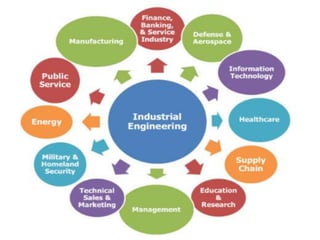
Industrial engineering is a branch of
engineering that deals with the development ,
improvement, implementation and evaluation
of integrated systems of people, wealth,
knowledge, information, equipment, energy,
materials and processes.
3
4
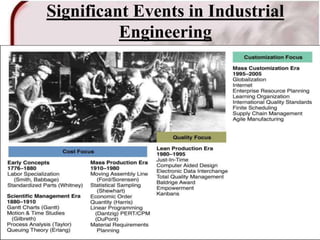
Significant Events in Industrial
Engineering
5
Significant Events in Industrial
Engineering
6
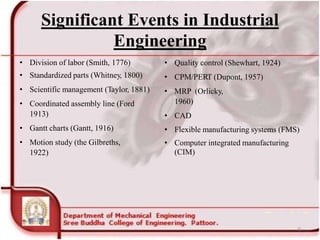
• Division of labor (Smith, 1776)
• Standardized parts (Whitney, 1800)
• Scientific management (Taylor, 1881)
• Coordinated assembly line (Ford
1913)
• Gantt charts (Gantt, 1916)
• Motion study (the Gilbreths,
1922)
• Quality control (Shewhart, 1924)
• CPM/PERT (Dupont, 1957)
• MRP (Orlicky,
1960)
• CAD
• Flexible manufacturing systems (FMS)
• Computer integrated manufacturing
(CIM)
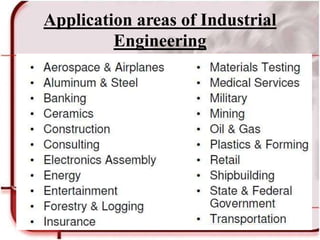
Application areas of Industrial
Engineering
7
Chronology of Industrial Engineering
• Charles Babbage visited factories in England and the
United States in the early 1800’s and began a
systematic recording of the details involved in many
factory operations. He carefully measured the cost
of performing each operation as well as the time per
operation required to manufacture. Babbage
presented this information in a table, and
demonstrated that money could be saved by using
women and children to perform the lower-skilled
operations. The higher-skilled, higher-paid men
need only perform those operations requiring the
higher skill levels
8
Chronology of Industrial Engineering
• Frederick W. Taylor(1859 to 1915) is done potential improvements to be
gained through analyzing the work content (minimum amount of work
required to accomplish the task) of a job and designing the job for
maximum efficiency.
• Frank B. Gilbreth (1917) extended Taylor’s work considerably. Gilbreth’s
primary contribution was the identification, analysis and measurement of
fundamental motions involved in performing work.
• Henry L. Gantt (1913), developed the Gantt chart. The Gantt is a
systematic graphical procedure for pre-planning and scheduling work
activities, reviewing progress, and updating the schedule.
9
Chronology of Industrial Engineering
• Hentry Ford (1913) gave to concept of mass production and
organised workstations into a conveyorised assembly line.
• Harrington Emersion (1913) evolved Emerson efficiency
plan to emphasize labour efficiency as a basis for payment
of wages.
• F.W Harris (1914) developed the first economic lot size
(EOQ)model which is still recognises the scientific inventory
control system.
• Walter Shewhart(1924) introduced the concept of
Statistical Quatity Control (SQC)also the concept of control
charts for monitoring the quality production process
10
Chronology of Industrial Engineering
• F.H Doge,H.G Roming and W.Shewhart (1931)
developed the concept of sampling inspection
and published statistical sampling tables.
• L.HC Trippet (1937) developed the concept of
work sampling to determine machine and
man power utilization and for setting
performance standard for long cycle
operations, operations involving team working
etc.
11
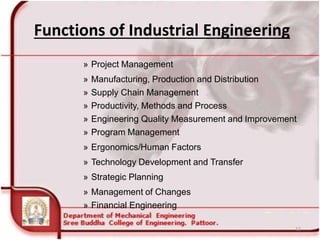
Functions of Industrial Engineering
» Project Management
» Manufacturing, Production and Distribution
» Supply Chain Management
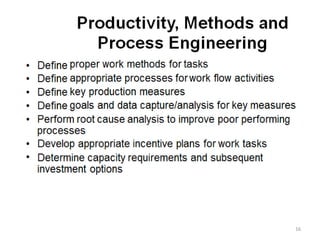
» Productivity, Methods and Process
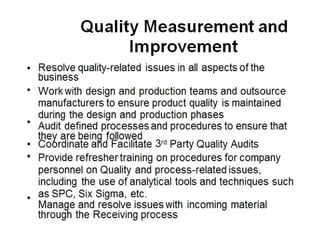
» Engineering Quality Measurement and Improvement
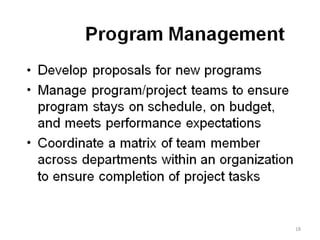
» Program Management
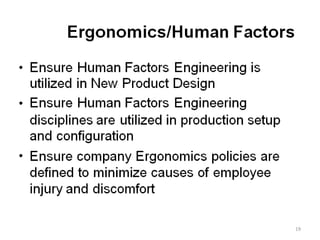
» Ergonomics/Human Factors
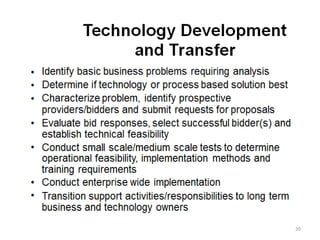
» Technology Development and Transfer
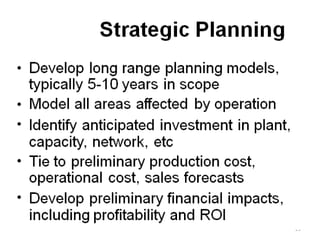
» Strategic Planning
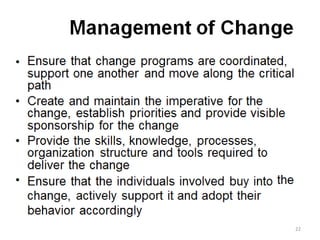
» Management of Changes
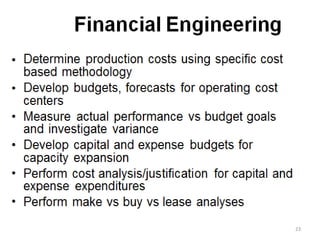
» Financial Engineering
12
13
14
15
16
17
18
19
20
21
22
23
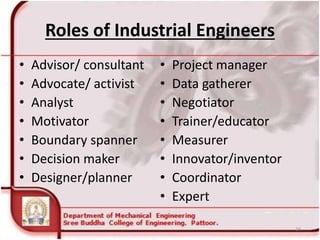
Roles of Industrial Engineers
• Advisor/ consultant
• Advocate/ activist
• Analyst
• Motivator
• Boundary spanner
• Decision maker
• Designer/planner
• Project manager
• Data gatherer
• Negotiator
• Trainer/educator
• Measurer
• Innovator/inventor
• Coordinator
• Expert
24
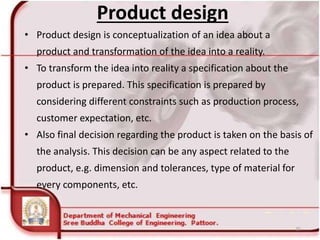
Product design
• Product design is conceptualization of an idea about a
product and transformation of the idea into a reality.
• To transform the idea into reality a specification about the
product is prepared. This specification is prepared by
considering different constraints such as production process,
customer expectation, etc.
• Also final decision regarding the product is taken on the basis of
the analysis. This decision can be any aspect related to the
product, e.g. dimension and tolerances, type of material for
every components, etc.
25
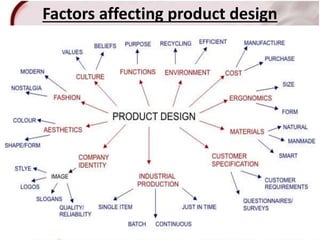
Factors affecting product design
26
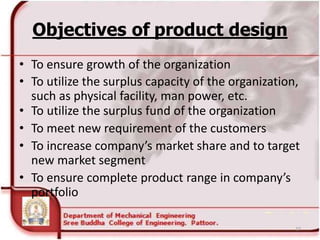
Objectives of product design
• To ensure growth of the organization
• To utilize the surplus capacity of the organization,
such as physical facility, man power, etc.
• To utilize the surplus fund of the organization
• To meet new requirement of the customers
• To increase company’s market share and to target
new market segment
• To ensure complete product range in company’s
portfolio
27
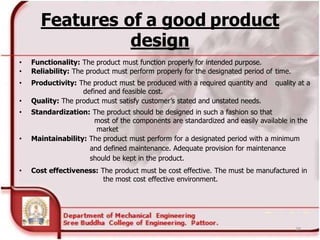
Features of a good product
design
• Functionality: The product must function properly for intended purpose.
• Reliability: The product must perform properly for the designated period of time.
• Productivity: The product must be produced with a required quantity and quality at a
defined and feasible cost.
• Quality: The product must satisfy customer’s stated and unstated needs.
• Standardization: The product should be designed in such a fashion so that
most of the components are standardized and easily available in the
market
• Maintainability: The product must perform for a designated period with a minimum
and defined maintenance. Adequate provision for maintenance
should be kept in the product.
• Cost effectiveness: The product must be cost effective. The must be manufactured in
the most cost effective environment.
28
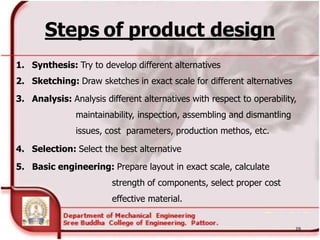
Steps of product design
29
1. Synthesis: Try to develop different alternatives
2. Sketching: Draw sketches in exact scale for different alternatives
3. Analysis: Analysis different alternatives with respect to operability,
maintainability, inspection, assembling and dismantling
issues, cost parameters, production methos, etc.
4. Selection: Select the best alternative
5. Basic engineering: Prepare layout in exact scale, calculate
strength of components, select proper cost
effective material.
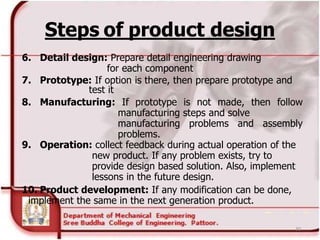
Steps of product design
6. Detail design: Prepare detail engineering drawing
for each component
7. Prototype: If option is there, then prepare prototype and
test it
8. Manufacturing: If prototype is not made, then follow
manufacturing steps and solve
manufacturing problems and assembly
problems.
9. Operation: collect feedback during actual operation of the
new product. If any problem exists, try to
provide design based solution. Also, implement
lessons in the future design.
10. Product development: If any modification can be done,
implement the same in the next generation product.
30
Product Development and
Research
• Product is an article obtained by the
transformation of raw material and is
marketed/sold by the manufacturer. ie.product
is a saleable item.
• Consumer product and industrial product.
• Development is carried out after applied
research followed by pure research
31
Product Development and Research
• Development concerns the most economically
feasible method for applying the principles
identified through research
• Development involves design, redesigning,
fabrication of new product, modification of
product, testing for its usefulness etc.
• Products can be developed by
I. Imitation
II. Adaptation/ modification
III. Invention
32
Product Development and Research
are concerned with
1. Functional efficiency
2. Quality
3. Unexplored uses
4. Investigation of materials
5. All possible substitutes
6. Utilization of waste materials
7. Standardization
8. Customer satisfaction
33
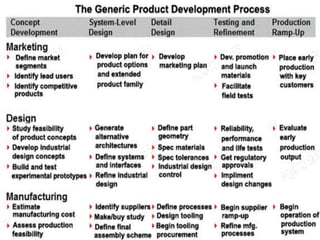
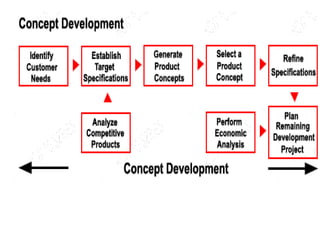
Product development procedure
1.Idea Generation
2.Idea Evaluation
3.Strategic Analysis
4.Product development and testing
5.Market Testing
6.Commercialization
7.Product Launch
34
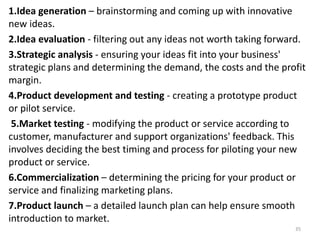
1.Idea generation – brainstorming and coming up with innovative
new ideas.
2.Idea evaluation - filtering out any ideas not worth taking forward.
3.Strategic analysis - ensuring your ideas fit into your business'
strategic plans and determining the demand, the costs and the profit
margin.
4.Product development and testing - creating a prototype product
or pilot service.
5.Market testing - modifying the product or service according to
customer, manufacturer and support organizations' feedback. This
involves deciding the best timing and process for piloting your new
product or service.
6.Commercialization – determining the pricing for your product or
service and finalizing marketing plans.
7.Product launch – a detailed launch plan can help ensure smooth
introduction to market.
35
C-V-P analysis
• Cost – Volume – Profit
• An Industry is faced with a number of uncertainties
1.Demand (consumer behavior)
2.Nature of competition
3.Cost ( control over wages, raw materials, Indirect
taxation)
4.Technology
38
Unless a firm is prepared to face the
uncertainties created by these risks, its profits
would be left to chance.
Under such circumstances, a thorough
understanding of the relationship of cost, price
andvolume is helpful
Method of determining this relationship is Break
Even Analysis.
39
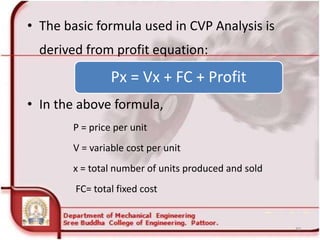
• The basic formula used in CVP Analysis is
derived from profit equation:
• In the above formula,
P = price per unit
V = variable cost per unit
x = total number of units produced and sold
FC= total fixed cost
40
Px = Vx + FC + Profit
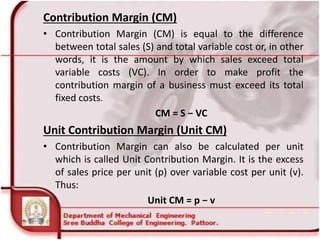
Contribution Margin (CM)
• Contribution Margin (CM) is equal to the difference
between total sales (S) and total variable cost or, in other
words, it is the amount by which sales exceed total
variable costs (VC). In order to make profit the
contribution margin of a business must exceed its total
fixed costs.
CM = S − VC
Unit Contribution Margin (Unit CM)
• Contribution Margin can also be calculated per unit
which is called Unit Contribution Margin. It is the excess
of sales price per unit (p) over variable cost per unit (v).
Thus:
Unit CM = p − v
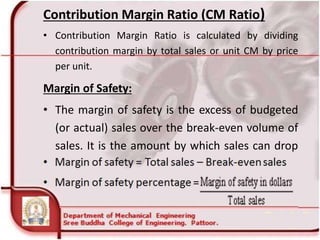
Contribution Margin Ratio (CM Ratio)
• Contribution Margin Ratio is calculated by dividing
contribution margin by total sales or unit CM by price
per unit.
Margin of Safety:
• The margin of safety is the excess of budgeted
(or actual) sales over the break-even volume of
sales. It is the amount by which sales can drop
before losses begin to be incurred.
Break Even Analysis
• A breakeven analysis is used to determine
how much sales volume your business needs
to start making a profit.
• The breakeven analysis is especially useful
when you're developing a pricing strategy,
either as part of a marketing plan or a
business plan.
43
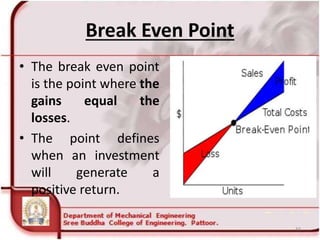
Break Even Point
• The break even point
is the point where the
gains equal the
losses.
• The point defines
when an investment
will generate a
positive return.
44
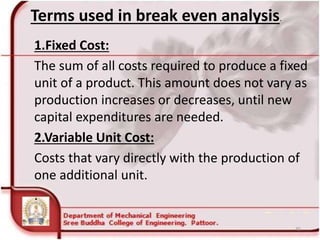
1.Fixed Cost:
The sum of all costs required to produce a fixed
unit of a product. This amount does not vary as
production increases or decreases, until new
capital expenditures are needed.
2.Variable Unit Cost:
Costs that vary directly with the production of
one additional unit.
.
45
Terms used in break even analysis.
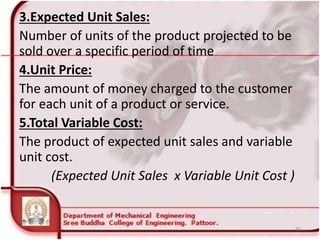
3.Expected Unit Sales:
Number of units of the product projected to be
sold over a specific period of time
4.Unit Price:
The amount of money charged to the customer
for each unit of a product or service.
5.Total Variable Cost:
The product of expected unit sales and variable
unit cost.
(Expected Unit Sales x Variable Unit Cost )
46
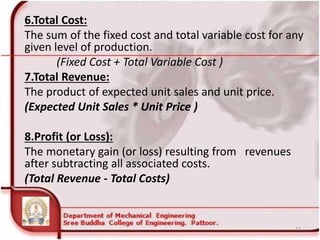
6.Total Cost:
The sum of the fixed cost and total variable cost for any
given level of production.
(Fixed Cost + Total Variable Cost )
7.Total Revenue:
The product of expected unit sales and unit price.
(Expected Unit Sales * Unit Price )
8.Profit (or Loss):
The monetary gain (or loss) resulting from revenues
after subtracting all associated costs.
(Total Revenue - Total Costs)
47
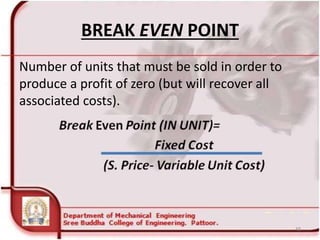
BREAK EVEN POINT
Number of units that must be sold in order to
produce a profit of zero (but will recover all
associated costs).
48
For example,
• A company has a fixed costs for producing
100,000 product were Rs.30,000 a year. Its
variable costs per product are Rs.2.20 for
materials,Rs.4.00 for labour, and Rs.0.80 for
overhead. If the company choose a selling price
of Rs.12.00 for each product, what will be the
companies break even point?
49
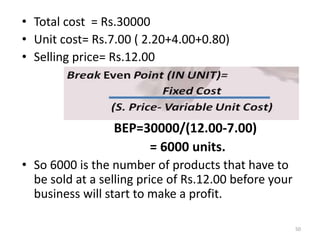
• Total cost = Rs.30000
• Unit cost= Rs.7.00 ( 2.20+4.00+0.80)
• Selling price= Rs.12.00
BEP=30000/(12.00-7.00)
= 6000 units.
• So 6000 is the number of products that have to
be sold at a selling price of Rs.12.00 before your
business will start to make a profit.
50
Prototyping
Prototype is the first fully functional model of a
design.
This is not a model but a full fledged product
made as per the design.
However models are used in certain designs to
understand the specific performance of that part
or product. (Aircraft, buildings, ships, rockets etc.)
51
Prototyping is done using the materials specified
so that their performance is also taken into
account.
Conventionally few prototypes are made for a
planned evaluation of the product from various
angles.
Producing a prototype is a costly procedure as
the requirements are limited.
Regular prototyping is done by making the design
through conventional approaches.
52
Currently 3D printing technologies have
shown their worth in this. Most of the parts
could be produced by this process and each
may take only a few hours to produce.
3D printing was earlier known as Rapid
Prototyping as they were ideally suited for
this.Currently RP technologies allow metals to
be used in the process
53
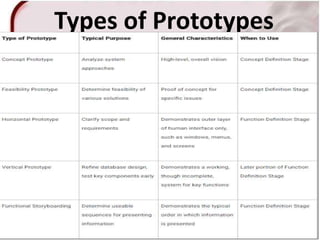
Types of Prototypes
54
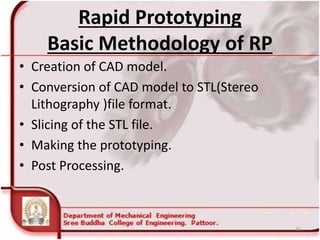
Rapid Prototyping
Basic Methodology of RP
• Creation of CAD model.
• Conversion of CAD model to STL(Stereo
Lithography )file format.
• Slicing of the STL file.
• Making the prototyping.
• Post Processing.
55
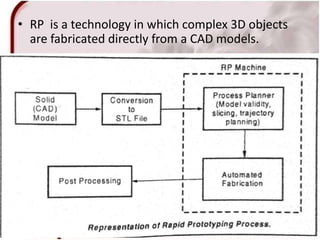
• RP is a technology in which complex 3D objects
are fabricated directly from a CAD models.
56
Testing and Evaluation of Design
• Evaluation is done to confirm whether the
design intent/criteria is satisfied.
–List of important attributes to be tested
–Set of experiments that test those
attributes
–Recording of test data
–Identify major areas of concern for any
redesign work.
57
Reasons for Testing and
Evaluation of Design.
• To asses the viability of a design
• To identify potential faults and to make improvements.
• To identify safety issues
• To scrutinize costs
• Evaluating the manufacturing process to design in an
efficient and cost effective production line.
• For providing user instructions
• Comparison of tests conducted on similar design may
lead to improvement.
58
Design Modifications
• Any change conducted to the product at any
stage in the design process.
• Clients and end users are demanding more
values for their money
• Small design changes are needed to have a
positive influences on sales and profitability.
59
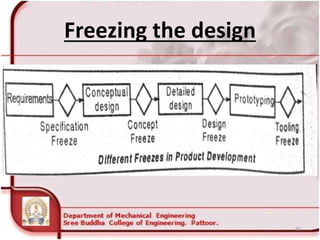
Freezing the design
60
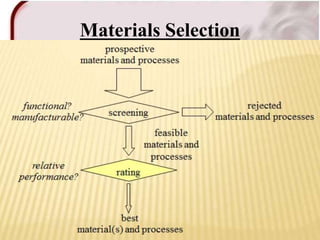
Materials Selection
61
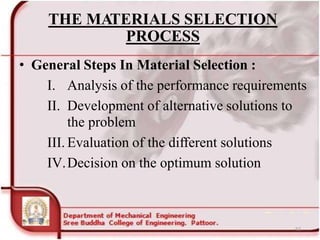
THE MATERIALS SELECTION
PROCESS
• General Steps In Material Selection :
I. Analysis of the performance requirements
II. Development of alternative solutions to
the problem
III. Evaluation of the different solutions
IV.Decision on the optimum solution
62
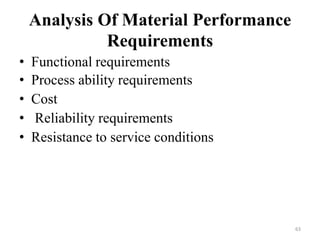
Analysis Of Material Performance
Requirements
• Functional requirements
• Process ability requirements
• Cost
• Reliability requirements
• Resistance to service conditions
63
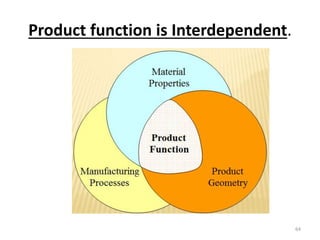
Product function is Interdependent.
64
CreatingAlternative Solutions
• Having specified material requirements, the rest of the selection
process involves the search for the material that would best meet
those requirements.
• The starting point is the entire range of engineering materials.
• Asteel may be the best material for one design concept while a
plastic is best for a different concept, even though the two designs
provide similar functions.
• The importance of this phase is that it creates alternatives without
much regard to their feasibility.
65
Comparing And Ranking
Alternatives I
Weighted Properties Method I
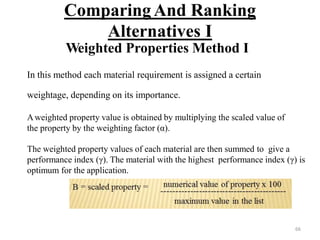
In this method each material requirement is assigned a certain
weightage, depending on its importance.
Aweighted property value is obtained by multiplying the scaled value of
the property by the weighting factor (α).
The weighted property values of each material are then summed to give a
performance index (γ). The material with the highest performance index (γ) is
optimum for the application.
66
ComparingAnd Ranking
Alternatives I
Weighted Properties Method II
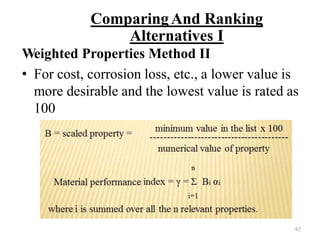
• For cost, corrosion loss, etc., a lower value is
more desirable and the lowest value is rated as
100
67
Reaching Final Decision
• After ranking of alternatives, candidates that have the most promising
performance indices can be used to develop a detail design.
• Each detail design will exploit the points of strength of the material, avoid
the weak points, and reflect the requirements of the manufacturing
processes needed for the material.
• After completing the different designs, solutions are then compared taking
the cost elements into consideration in order to arrive at the optimum
design-material-process combination
68
VALUE ENGINEERING
• Value Engineering (VE) is a systematic, step by step
approach, intended to achieve the desired function
of a product, process, system or service at an overall
minimum cost without in anyway affecting quality,
reliability, performance, delivery, safety or the
environment.
Types of values
• USE Value: The properties, features and qualities which
accomplish the use, the work or the service- causing the item to
perform or serve an end.
• ESTEEM Value: The properties, features or attractiveness which
cause us to yearn to posses it- causing the item to sell.
• EXCAHANGE Value: The properties or qualities which enable us
to exchange an item for something else we want.
• COST Value: The total of material, labor and other costs that
have to be incurred to produce an item.
70
• Applying formal work plans.
• A team approach
• Specific definition of functions.
• The simultaneous look at functions and costs.
• Control of the analysis process
• Quantifiable results
The Key Points of VE
Value Engineering is
– Reliability
– Maintainability
– Predictability
– Human Factors
– Parts Availability
– Cycle Time
– Quality
– Weight Reduction
Benefits of VE
• Decreasing costs
• Increasing profits
• Improving quality
• Expanding market share
• Saving time
• Solving problems
• Using resources more effectively
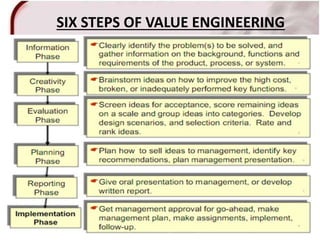
SIX STEPS OF VALUE ENGINEERING

INDUSTRIAL ENGINEERING 1st module

  • 1.
    Compiled By: Mr.Gokul O Assistant Professor Department of Mechanical Engineering Sree Buddha College of Engineering, Pattoor According to APJ Abdul Kalam Technological University Syllabus Subject- Industrial Engineering Course code- ME404 1
  • 2.
  • 3.
    Introduction to Industrial Engineering Industrialengineering is a branch of engineering that deals with the development , improvement, implementation and evaluation of integrated systems of people, wealth, knowledge, information, equipment, energy, materials and processes. 3
  • 4.
  • 5.
    Significant Events inIndustrial Engineering 5
  • 6.
    Significant Events inIndustrial Engineering 6 • Division of labor (Smith, 1776) • Standardized parts (Whitney, 1800) • Scientific management (Taylor, 1881) • Coordinated assembly line (Ford 1913) • Gantt charts (Gantt, 1916) • Motion study (the Gilbreths, 1922) • Quality control (Shewhart, 1924) • CPM/PERT (Dupont, 1957) • MRP (Orlicky, 1960) • CAD • Flexible manufacturing systems (FMS) • Computer integrated manufacturing (CIM)
  • 7.
    Application areas ofIndustrial Engineering 7
  • 8.
    Chronology of IndustrialEngineering • Charles Babbage visited factories in England and the United States in the early 1800’s and began a systematic recording of the details involved in many factory operations. He carefully measured the cost of performing each operation as well as the time per operation required to manufacture. Babbage presented this information in a table, and demonstrated that money could be saved by using women and children to perform the lower-skilled operations. The higher-skilled, higher-paid men need only perform those operations requiring the higher skill levels 8
  • 9.
    Chronology of IndustrialEngineering • Frederick W. Taylor(1859 to 1915) is done potential improvements to be gained through analyzing the work content (minimum amount of work required to accomplish the task) of a job and designing the job for maximum efficiency. • Frank B. Gilbreth (1917) extended Taylor’s work considerably. Gilbreth’s primary contribution was the identification, analysis and measurement of fundamental motions involved in performing work. • Henry L. Gantt (1913), developed the Gantt chart. The Gantt is a systematic graphical procedure for pre-planning and scheduling work activities, reviewing progress, and updating the schedule. 9
  • 10.
    Chronology of IndustrialEngineering • Hentry Ford (1913) gave to concept of mass production and organised workstations into a conveyorised assembly line. • Harrington Emersion (1913) evolved Emerson efficiency plan to emphasize labour efficiency as a basis for payment of wages. • F.W Harris (1914) developed the first economic lot size (EOQ)model which is still recognises the scientific inventory control system. • Walter Shewhart(1924) introduced the concept of Statistical Quatity Control (SQC)also the concept of control charts for monitoring the quality production process 10
  • 11.
    Chronology of IndustrialEngineering • F.H Doge,H.G Roming and W.Shewhart (1931) developed the concept of sampling inspection and published statistical sampling tables. • L.HC Trippet (1937) developed the concept of work sampling to determine machine and man power utilization and for setting performance standard for long cycle operations, operations involving team working etc. 11
  • 12.
    Functions of IndustrialEngineering » Project Management » Manufacturing, Production and Distribution » Supply Chain Management » Productivity, Methods and Process » Engineering Quality Measurement and Improvement » Program Management » Ergonomics/Human Factors » Technology Development and Transfer » Strategic Planning » Management of Changes » Financial Engineering 12
  • 13.
  • 14.
  • 15.
  • 16.
  • 17.
  • 18.
  • 19.
  • 20.
  • 21.
  • 22.
  • 23.
  • 24.
    Roles of IndustrialEngineers • Advisor/ consultant • Advocate/ activist • Analyst • Motivator • Boundary spanner • Decision maker • Designer/planner • Project manager • Data gatherer • Negotiator • Trainer/educator • Measurer • Innovator/inventor • Coordinator • Expert 24
  • 25.
    Product design • Productdesign is conceptualization of an idea about a product and transformation of the idea into a reality. • To transform the idea into reality a specification about the product is prepared. This specification is prepared by considering different constraints such as production process, customer expectation, etc. • Also final decision regarding the product is taken on the basis of the analysis. This decision can be any aspect related to the product, e.g. dimension and tolerances, type of material for every components, etc. 25
  • 26.
  • 27.
    Objectives of productdesign • To ensure growth of the organization • To utilize the surplus capacity of the organization, such as physical facility, man power, etc. • To utilize the surplus fund of the organization • To meet new requirement of the customers • To increase company’s market share and to target new market segment • To ensure complete product range in company’s portfolio 27
  • 28.
    Features of agood product design • Functionality: The product must function properly for intended purpose. • Reliability: The product must perform properly for the designated period of time. • Productivity: The product must be produced with a required quantity and quality at a defined and feasible cost. • Quality: The product must satisfy customer’s stated and unstated needs. • Standardization: The product should be designed in such a fashion so that most of the components are standardized and easily available in the market • Maintainability: The product must perform for a designated period with a minimum and defined maintenance. Adequate provision for maintenance should be kept in the product. • Cost effectiveness: The product must be cost effective. The must be manufactured in the most cost effective environment. 28
  • 29.
    Steps of productdesign 29 1. Synthesis: Try to develop different alternatives 2. Sketching: Draw sketches in exact scale for different alternatives 3. Analysis: Analysis different alternatives with respect to operability, maintainability, inspection, assembling and dismantling issues, cost parameters, production methos, etc. 4. Selection: Select the best alternative 5. Basic engineering: Prepare layout in exact scale, calculate strength of components, select proper cost effective material.
  • 30.
    Steps of productdesign 6. Detail design: Prepare detail engineering drawing for each component 7. Prototype: If option is there, then prepare prototype and test it 8. Manufacturing: If prototype is not made, then follow manufacturing steps and solve manufacturing problems and assembly problems. 9. Operation: collect feedback during actual operation of the new product. If any problem exists, try to provide design based solution. Also, implement lessons in the future design. 10. Product development: If any modification can be done, implement the same in the next generation product. 30
  • 31.
    Product Development and Research •Product is an article obtained by the transformation of raw material and is marketed/sold by the manufacturer. ie.product is a saleable item. • Consumer product and industrial product. • Development is carried out after applied research followed by pure research 31
  • 32.
    Product Development andResearch • Development concerns the most economically feasible method for applying the principles identified through research • Development involves design, redesigning, fabrication of new product, modification of product, testing for its usefulness etc. • Products can be developed by I. Imitation II. Adaptation/ modification III. Invention 32
  • 33.
    Product Development andResearch are concerned with 1. Functional efficiency 2. Quality 3. Unexplored uses 4. Investigation of materials 5. All possible substitutes 6. Utilization of waste materials 7. Standardization 8. Customer satisfaction 33
  • 34.
    Product development procedure 1.IdeaGeneration 2.Idea Evaluation 3.Strategic Analysis 4.Product development and testing 5.Market Testing 6.Commercialization 7.Product Launch 34
  • 35.
    1.Idea generation –brainstorming and coming up with innovative new ideas. 2.Idea evaluation - filtering out any ideas not worth taking forward. 3.Strategic analysis - ensuring your ideas fit into your business' strategic plans and determining the demand, the costs and the profit margin. 4.Product development and testing - creating a prototype product or pilot service. 5.Market testing - modifying the product or service according to customer, manufacturer and support organizations' feedback. This involves deciding the best timing and process for piloting your new product or service. 6.Commercialization – determining the pricing for your product or service and finalizing marketing plans. 7.Product launch – a detailed launch plan can help ensure smooth introduction to market. 35
  • 38.
    C-V-P analysis • Cost– Volume – Profit • An Industry is faced with a number of uncertainties 1.Demand (consumer behavior) 2.Nature of competition 3.Cost ( control over wages, raw materials, Indirect taxation) 4.Technology 38
  • 39.
    Unless a firmis prepared to face the uncertainties created by these risks, its profits would be left to chance. Under such circumstances, a thorough understanding of the relationship of cost, price andvolume is helpful Method of determining this relationship is Break Even Analysis. 39
  • 40.
    • The basicformula used in CVP Analysis is derived from profit equation: • In the above formula, P = price per unit V = variable cost per unit x = total number of units produced and sold FC= total fixed cost 40 Px = Vx + FC + Profit
  • 41.
    Contribution Margin (CM) •Contribution Margin (CM) is equal to the difference between total sales (S) and total variable cost or, in other words, it is the amount by which sales exceed total variable costs (VC). In order to make profit the contribution margin of a business must exceed its total fixed costs. CM = S − VC Unit Contribution Margin (Unit CM) • Contribution Margin can also be calculated per unit which is called Unit Contribution Margin. It is the excess of sales price per unit (p) over variable cost per unit (v). Thus: Unit CM = p − v
  • 42.
    Contribution Margin Ratio(CM Ratio) • Contribution Margin Ratio is calculated by dividing contribution margin by total sales or unit CM by price per unit. Margin of Safety: • The margin of safety is the excess of budgeted (or actual) sales over the break-even volume of sales. It is the amount by which sales can drop before losses begin to be incurred.
  • 43.
    Break Even Analysis •A breakeven analysis is used to determine how much sales volume your business needs to start making a profit. • The breakeven analysis is especially useful when you're developing a pricing strategy, either as part of a marketing plan or a business plan. 43
  • 44.
    Break Even Point •The break even point is the point where the gains equal the losses. • The point defines when an investment will generate a positive return. 44
  • 45.
    1.Fixed Cost: The sumof all costs required to produce a fixed unit of a product. This amount does not vary as production increases or decreases, until new capital expenditures are needed. 2.Variable Unit Cost: Costs that vary directly with the production of one additional unit. . 45 Terms used in break even analysis.
  • 46.
    3.Expected Unit Sales: Numberof units of the product projected to be sold over a specific period of time 4.Unit Price: The amount of money charged to the customer for each unit of a product or service. 5.Total Variable Cost: The product of expected unit sales and variable unit cost. (Expected Unit Sales x Variable Unit Cost ) 46
  • 47.
    6.Total Cost: The sumof the fixed cost and total variable cost for any given level of production. (Fixed Cost + Total Variable Cost ) 7.Total Revenue: The product of expected unit sales and unit price. (Expected Unit Sales * Unit Price ) 8.Profit (or Loss): The monetary gain (or loss) resulting from revenues after subtracting all associated costs. (Total Revenue - Total Costs) 47
  • 48.
    BREAK EVEN POINT Numberof units that must be sold in order to produce a profit of zero (but will recover all associated costs). 48
  • 49.
    For example, • Acompany has a fixed costs for producing 100,000 product were Rs.30,000 a year. Its variable costs per product are Rs.2.20 for materials,Rs.4.00 for labour, and Rs.0.80 for overhead. If the company choose a selling price of Rs.12.00 for each product, what will be the companies break even point? 49
  • 50.
    • Total cost= Rs.30000 • Unit cost= Rs.7.00 ( 2.20+4.00+0.80) • Selling price= Rs.12.00 BEP=30000/(12.00-7.00) = 6000 units. • So 6000 is the number of products that have to be sold at a selling price of Rs.12.00 before your business will start to make a profit. 50
  • 51.
    Prototyping Prototype is thefirst fully functional model of a design. This is not a model but a full fledged product made as per the design. However models are used in certain designs to understand the specific performance of that part or product. (Aircraft, buildings, ships, rockets etc.) 51
  • 52.
    Prototyping is doneusing the materials specified so that their performance is also taken into account. Conventionally few prototypes are made for a planned evaluation of the product from various angles. Producing a prototype is a costly procedure as the requirements are limited. Regular prototyping is done by making the design through conventional approaches. 52
  • 53.
    Currently 3D printingtechnologies have shown their worth in this. Most of the parts could be produced by this process and each may take only a few hours to produce. 3D printing was earlier known as Rapid Prototyping as they were ideally suited for this.Currently RP technologies allow metals to be used in the process 53
  • 54.
  • 55.
    Rapid Prototyping Basic Methodologyof RP • Creation of CAD model. • Conversion of CAD model to STL(Stereo Lithography )file format. • Slicing of the STL file. • Making the prototyping. • Post Processing. 55
  • 56.
    • RP isa technology in which complex 3D objects are fabricated directly from a CAD models. 56
  • 57.
    Testing and Evaluationof Design • Evaluation is done to confirm whether the design intent/criteria is satisfied. –List of important attributes to be tested –Set of experiments that test those attributes –Recording of test data –Identify major areas of concern for any redesign work. 57
  • 58.
    Reasons for Testingand Evaluation of Design. • To asses the viability of a design • To identify potential faults and to make improvements. • To identify safety issues • To scrutinize costs • Evaluating the manufacturing process to design in an efficient and cost effective production line. • For providing user instructions • Comparison of tests conducted on similar design may lead to improvement. 58
  • 59.
    Design Modifications • Anychange conducted to the product at any stage in the design process. • Clients and end users are demanding more values for their money • Small design changes are needed to have a positive influences on sales and profitability. 59
  • 60.
  • 61.
  • 62.
    THE MATERIALS SELECTION PROCESS •General Steps In Material Selection : I. Analysis of the performance requirements II. Development of alternative solutions to the problem III. Evaluation of the different solutions IV.Decision on the optimum solution 62
  • 63.
    Analysis Of MaterialPerformance Requirements • Functional requirements • Process ability requirements • Cost • Reliability requirements • Resistance to service conditions 63
  • 64.
    Product function isInterdependent. 64
  • 65.
    CreatingAlternative Solutions • Havingspecified material requirements, the rest of the selection process involves the search for the material that would best meet those requirements. • The starting point is the entire range of engineering materials. • Asteel may be the best material for one design concept while a plastic is best for a different concept, even though the two designs provide similar functions. • The importance of this phase is that it creates alternatives without much regard to their feasibility. 65
  • 66.
    Comparing And Ranking AlternativesI Weighted Properties Method I In this method each material requirement is assigned a certain weightage, depending on its importance. Aweighted property value is obtained by multiplying the scaled value of the property by the weighting factor (α). The weighted property values of each material are then summed to give a performance index (γ). The material with the highest performance index (γ) is optimum for the application. 66
  • 67.
    ComparingAnd Ranking Alternatives I WeightedProperties Method II • For cost, corrosion loss, etc., a lower value is more desirable and the lowest value is rated as 100 67
  • 68.
    Reaching Final Decision •After ranking of alternatives, candidates that have the most promising performance indices can be used to develop a detail design. • Each detail design will exploit the points of strength of the material, avoid the weak points, and reflect the requirements of the manufacturing processes needed for the material. • After completing the different designs, solutions are then compared taking the cost elements into consideration in order to arrive at the optimum design-material-process combination 68
  • 69.
    VALUE ENGINEERING • ValueEngineering (VE) is a systematic, step by step approach, intended to achieve the desired function of a product, process, system or service at an overall minimum cost without in anyway affecting quality, reliability, performance, delivery, safety or the environment.
  • 70.
    Types of values •USE Value: The properties, features and qualities which accomplish the use, the work or the service- causing the item to perform or serve an end. • ESTEEM Value: The properties, features or attractiveness which cause us to yearn to posses it- causing the item to sell. • EXCAHANGE Value: The properties or qualities which enable us to exchange an item for something else we want. • COST Value: The total of material, labor and other costs that have to be incurred to produce an item. 70
  • 71.
    • Applying formalwork plans. • A team approach • Specific definition of functions. • The simultaneous look at functions and costs. • Control of the analysis process • Quantifiable results The Key Points of VE
  • 72.
    Value Engineering is –Reliability – Maintainability – Predictability – Human Factors – Parts Availability – Cycle Time – Quality – Weight Reduction
  • 73.
    Benefits of VE •Decreasing costs • Increasing profits • Improving quality • Expanding market share • Saving time • Solving problems • Using resources more effectively
  • 74.
    SIX STEPS OFVALUE ENGINEERING