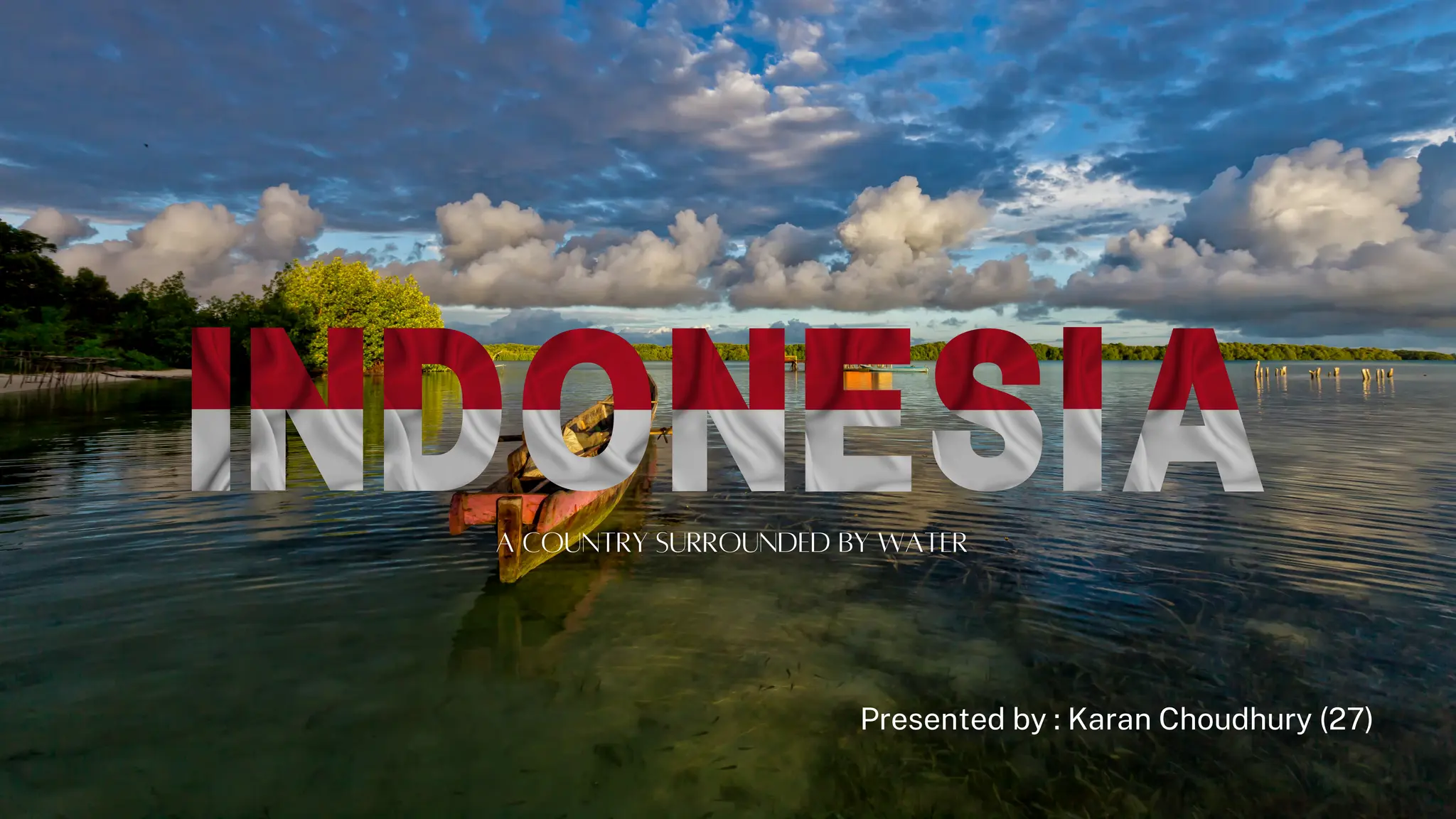
A COUNTRY SURROUNDED BY WATER
Presented by : Karan Choudhury (27)
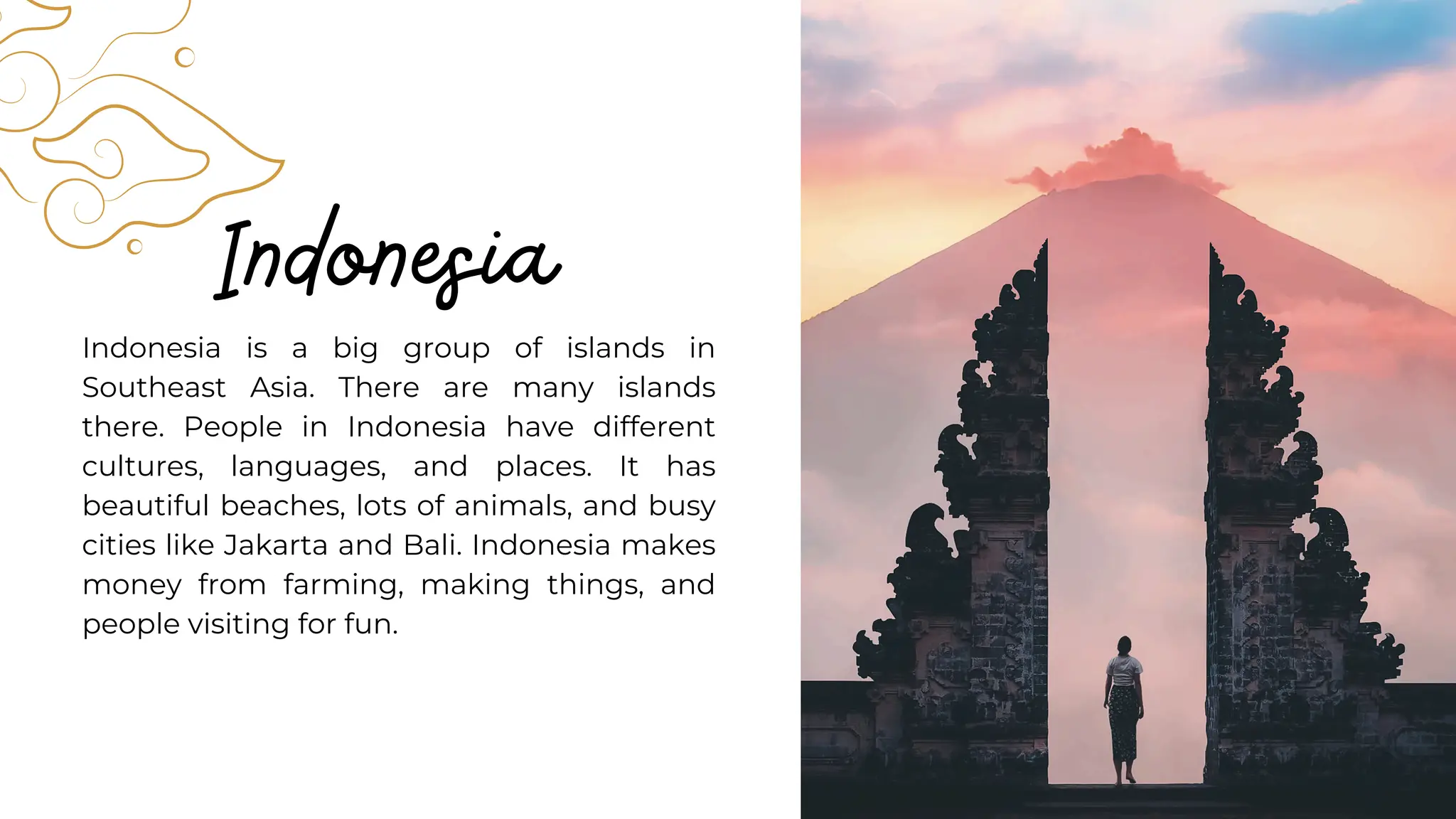
Indonesia
Indonesia is a big group of islands in
Southeast Asia. There are many islands
there. People in Indonesia have different
cultures, languages, and places. It has
beautiful beaches, lots of animals, and busy
cities like Jakarta and Bali. Indonesia makes
money from farming, making things, and
people visiting for fun.
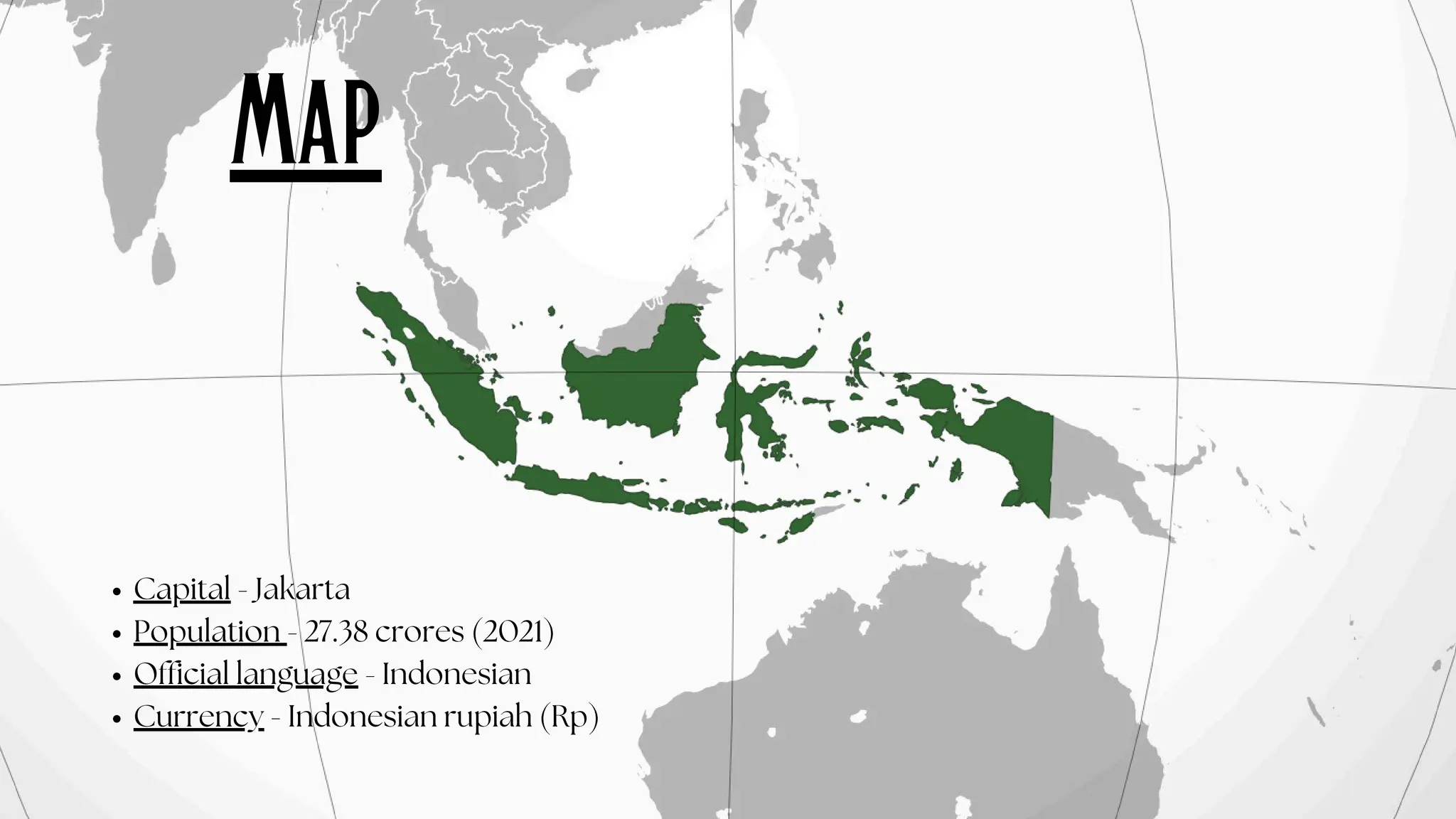
Map
Capital - Jakarta
Population - 27.38 crores (2021)
Official language - Indonesian
Currency - Indonesian rupiah (Rp)
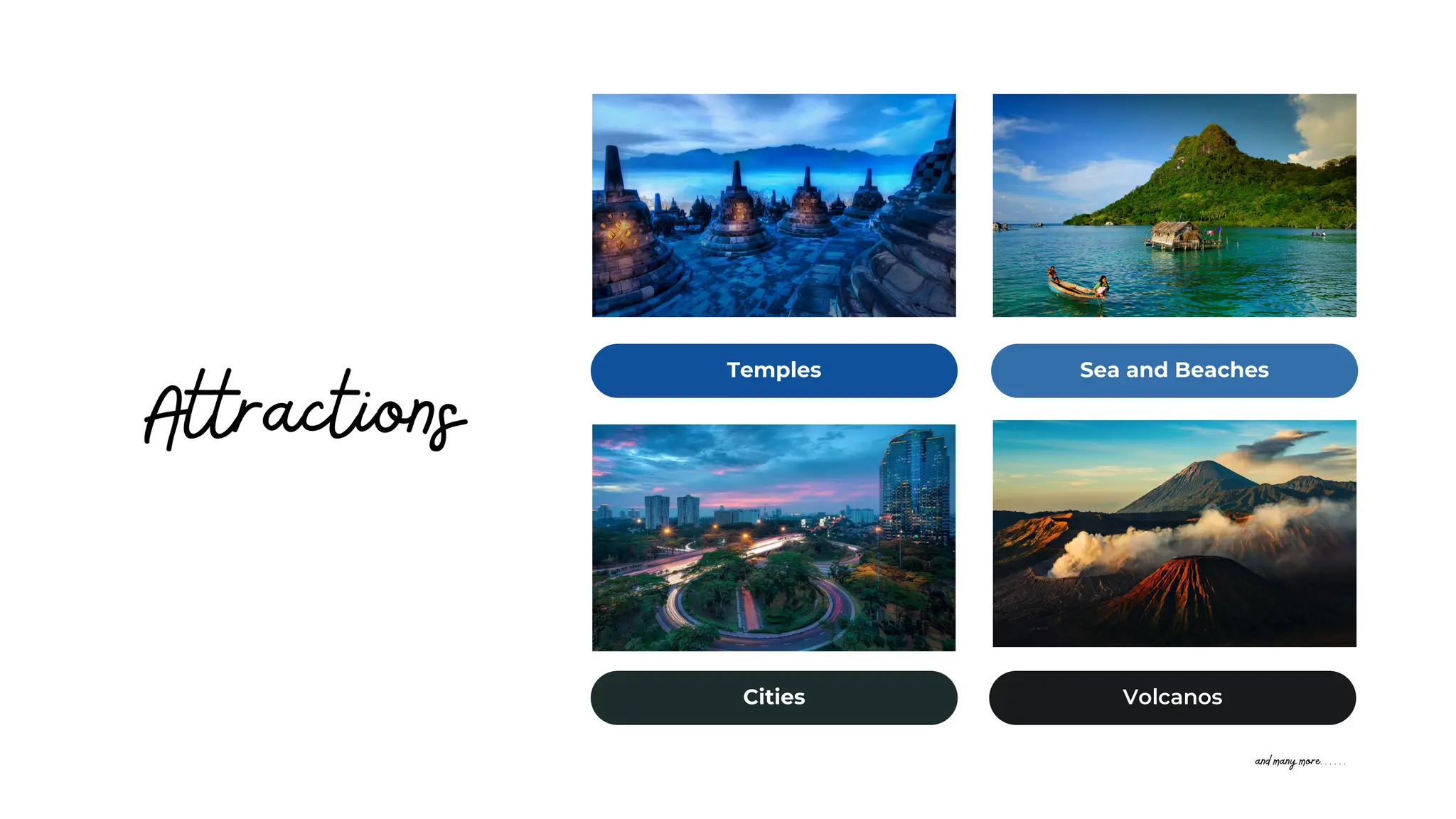
Temples Sea and Beaches
Cities Volcanos
Attractions
and many more......
Pe s te l
AnAlys i s
Political
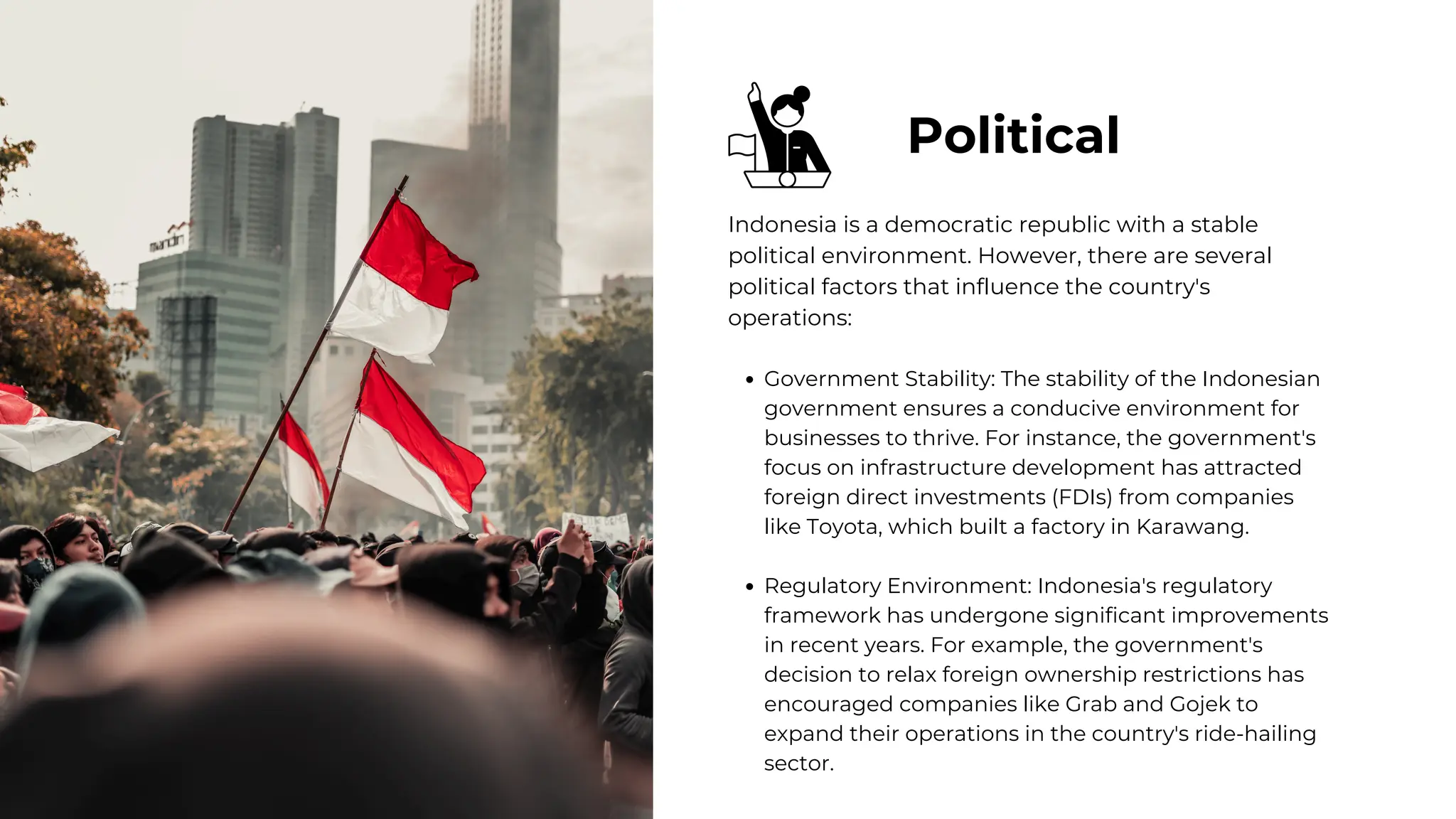
Indonesia is a democratic republic with a stable
political environment. However, there are several
political factors that influence the country's
operations:
Government Stability: The stability of the Indonesian
government ensures a conducive environment for
businesses to thrive. For instance, the government's
focus on infrastructure development has attracted
foreign direct investments (FDIs) from companies
like Toyota, which built a factory in Karawang.
Regulatory Environment: Indonesia's regulatory
framework has undergone significant improvements
in recent years. For example, the government's
decision to relax foreign ownership restrictions has
encouraged companies like Grab and Gojek to
expand their operations in the country's ride-hailing
sector.
Economic
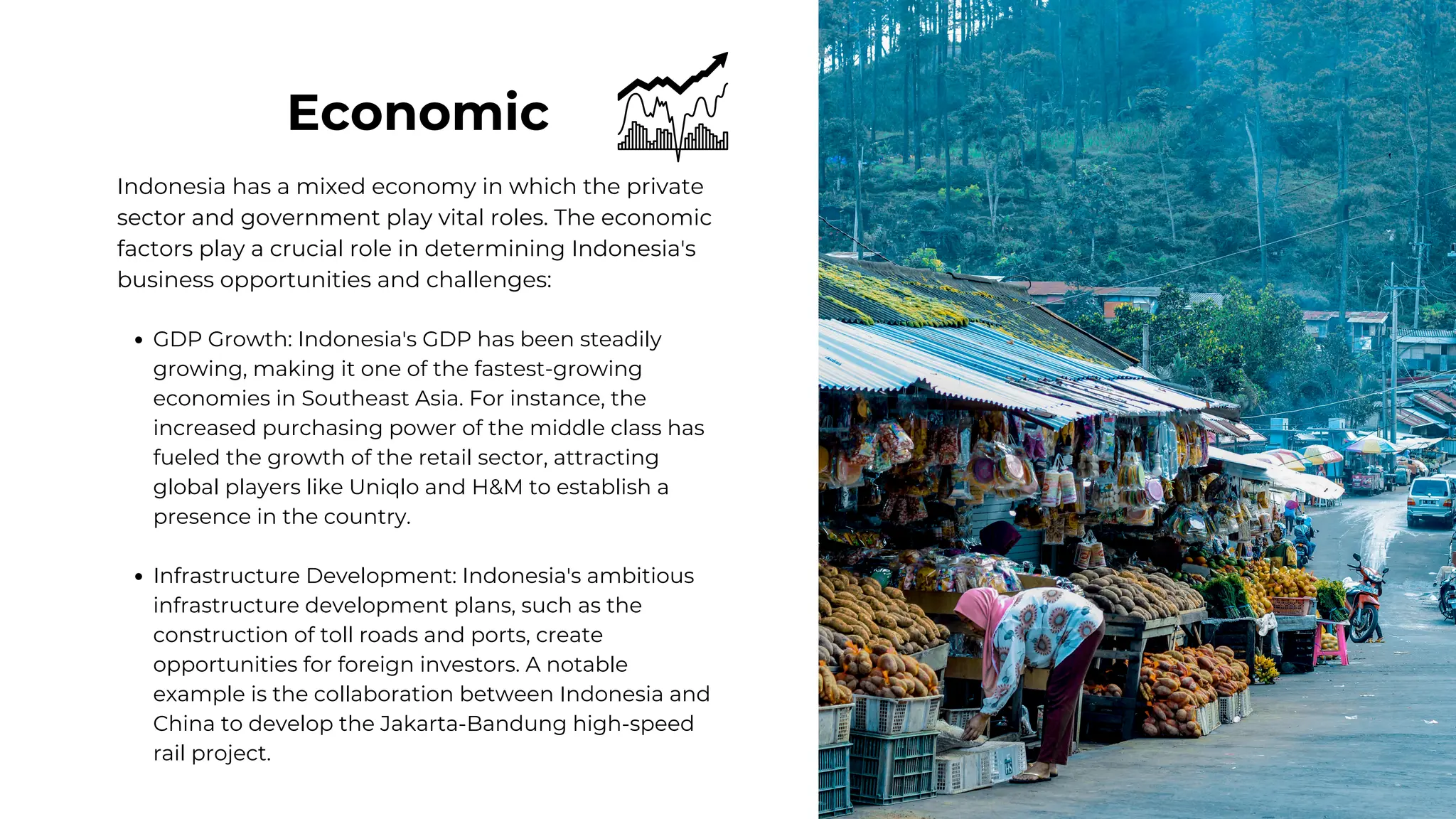
Indonesia has a mixed economy in which the private
sector and government play vital roles. The economic
factors play a crucial role in determining Indonesia's
business opportunities and challenges:
GDP Growth: Indonesia's GDP has been steadily
growing, making it one of the fastest-growing
economies in Southeast Asia. For instance, the
increased purchasing power of the middle class has
fueled the growth of the retail sector, attracting
global players like Uniqlo and H&M to establish a
presence in the country.
Infrastructure Development: Indonesia's ambitious
infrastructure development plans, such as the
construction of toll roads and ports, create
opportunities for foreign investors. A notable
example is the collaboration between Indonesia and
China to develop the Jakarta-Bandung high-speed
rail project.
Understanding the social factors is crucial for
businesses to address the needs and preferences of
the Indonesian population:
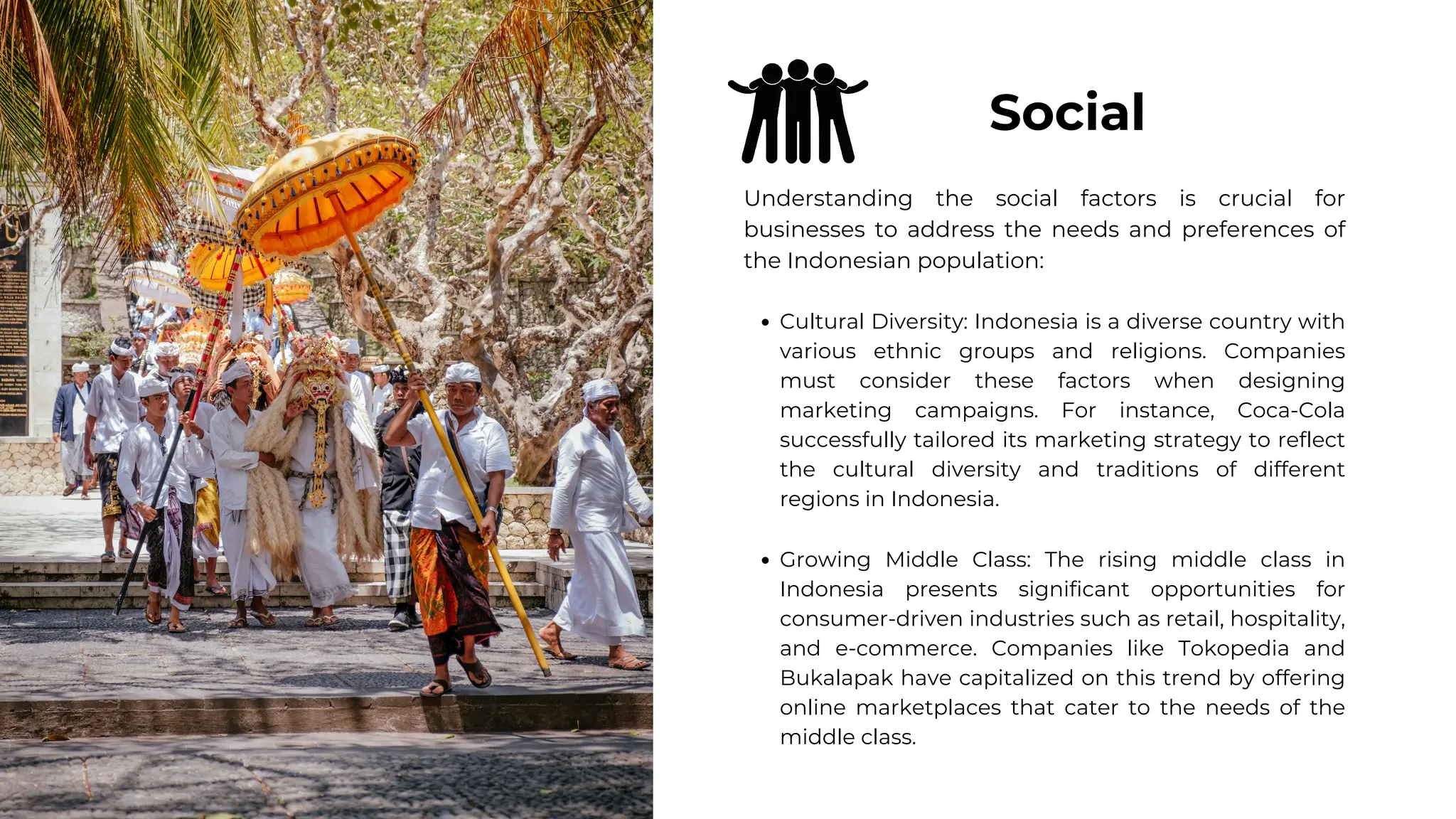
Cultural Diversity: Indonesia is a diverse country with
various ethnic groups and religions. Companies
must consider these factors when designing
marketing campaigns. For instance, Coca-Cola
successfully tailored its marketing strategy to reflect
the cultural diversity and traditions of different
regions in Indonesia.
Growing Middle Class: The rising middle class in
Indonesia presents significant opportunities for
consumer-driven industries such as retail, hospitality,
and e-commerce. Companies like Tokopedia and
Bukalapak have capitalized on this trend by offering
online marketplaces that cater to the needs of the
middle class.
Social
Technological advancements have transformed
various sectors in Indonesia:
Mobile Internet Penetration: Indonesia has a high
mobile internet penetration rate, which has
facilitated the growth of e-commerce platforms like
Shopee and Lazada. These platforms have
revolutionized the retail industry by providing
convenient and accessible online shopping
experiences.
Digital Payments: The adoption of digital payment
methods, such as GoPay and OVO, has transformed
the traditional banking landscape. These platforms
have made financial transactions more accessible,
especially for the unbanked population in rural areas.
Technological
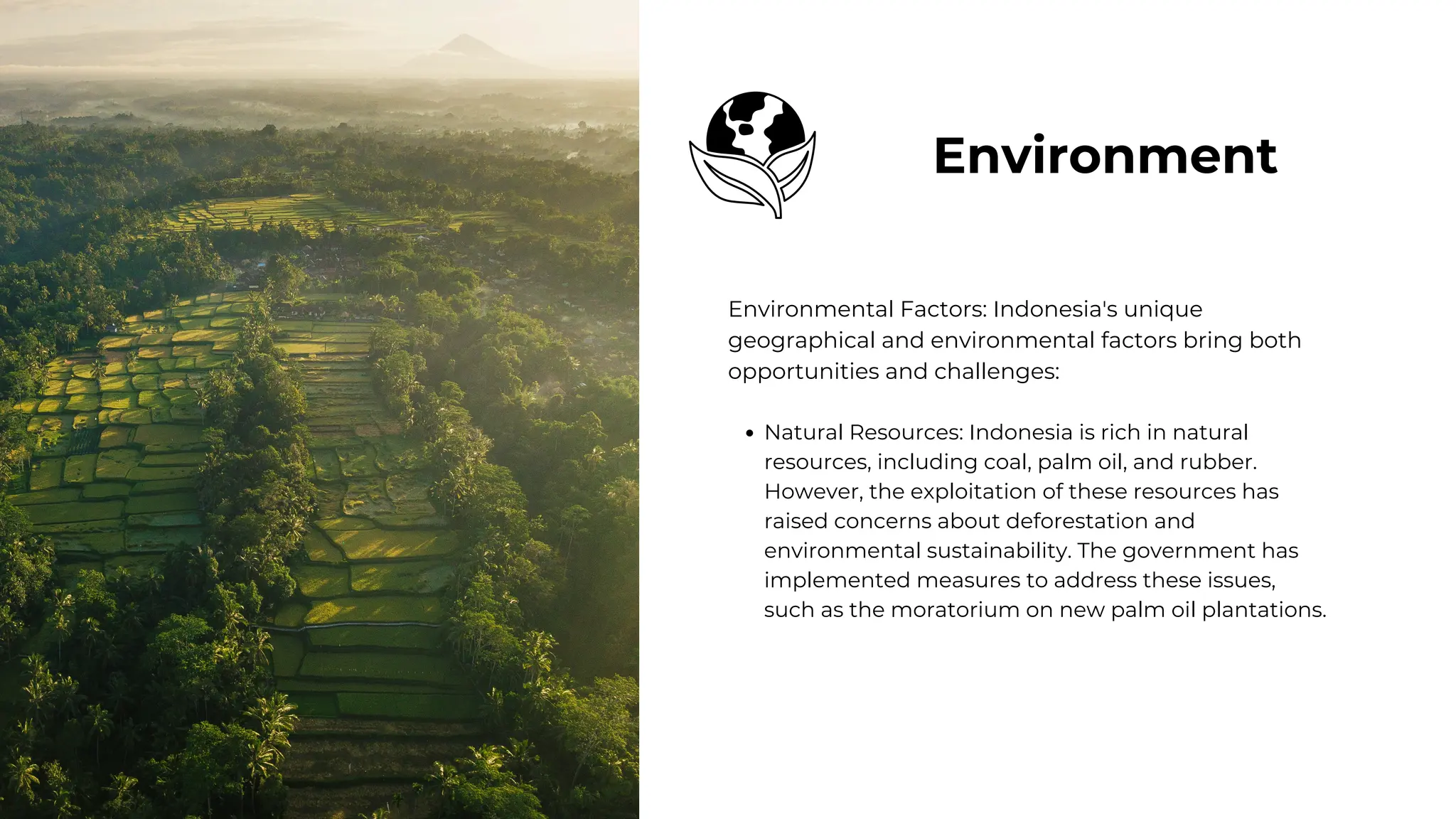
Environmental Factors: Indonesia's unique
geographical and environmental factors bring both
opportunities and challenges:
Natural Resources: Indonesia is rich in natural
resources, including coal, palm oil, and rubber.
However, the exploitation of these resources has
raised concerns about deforestation and
environmental sustainability. The government has
implemented measures to address these issues,
such as the moratorium on new palm oil plantations.
Environment
Legal factors influence businesses' operations and
compliance requirements:
Labor Laws: Indonesia's labor laws protect workers'
rights, but they can pose challenges for businesses
in terms of hiring and employment regulations.
Companies like Nike have faced scrutiny over labor
practices in their Indonesian factories.
Intellectual Property Rights: Intellectual property
protection in Indonesia is an ongoing challenge. The
government has taken steps to improve
enforcement, but piracy and counterfeiting remain
prevalent in industries such as software and fashion.
Legal
Constraints of Doing Business
in India
Doing business
In India offers numerous
advantages, such as a massive
consumer market and a growing
economy. However, there are also
several constraints and challenges
that businesses may face.
Understanding these constraints is
crucial for companies planning to
enter or expand their operations in
India.
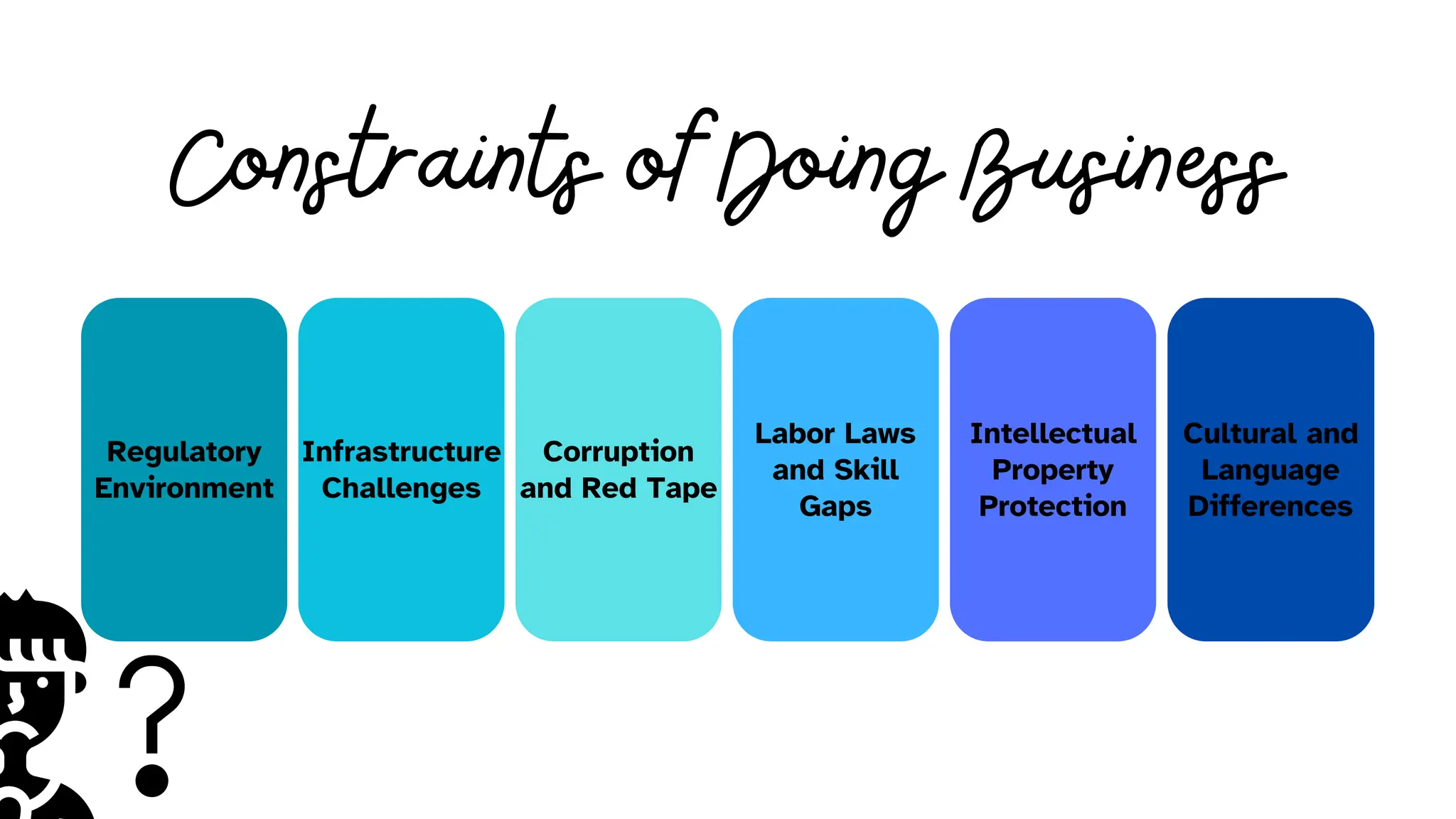
Constraints of Doing Business
Regulatory
Environment
Infrastructure
Challenges
Corruption
and Red Tape
Labor Laws
and Skill
Gaps
Intellectual
Property
Protection
Cultural and
Language
Differences
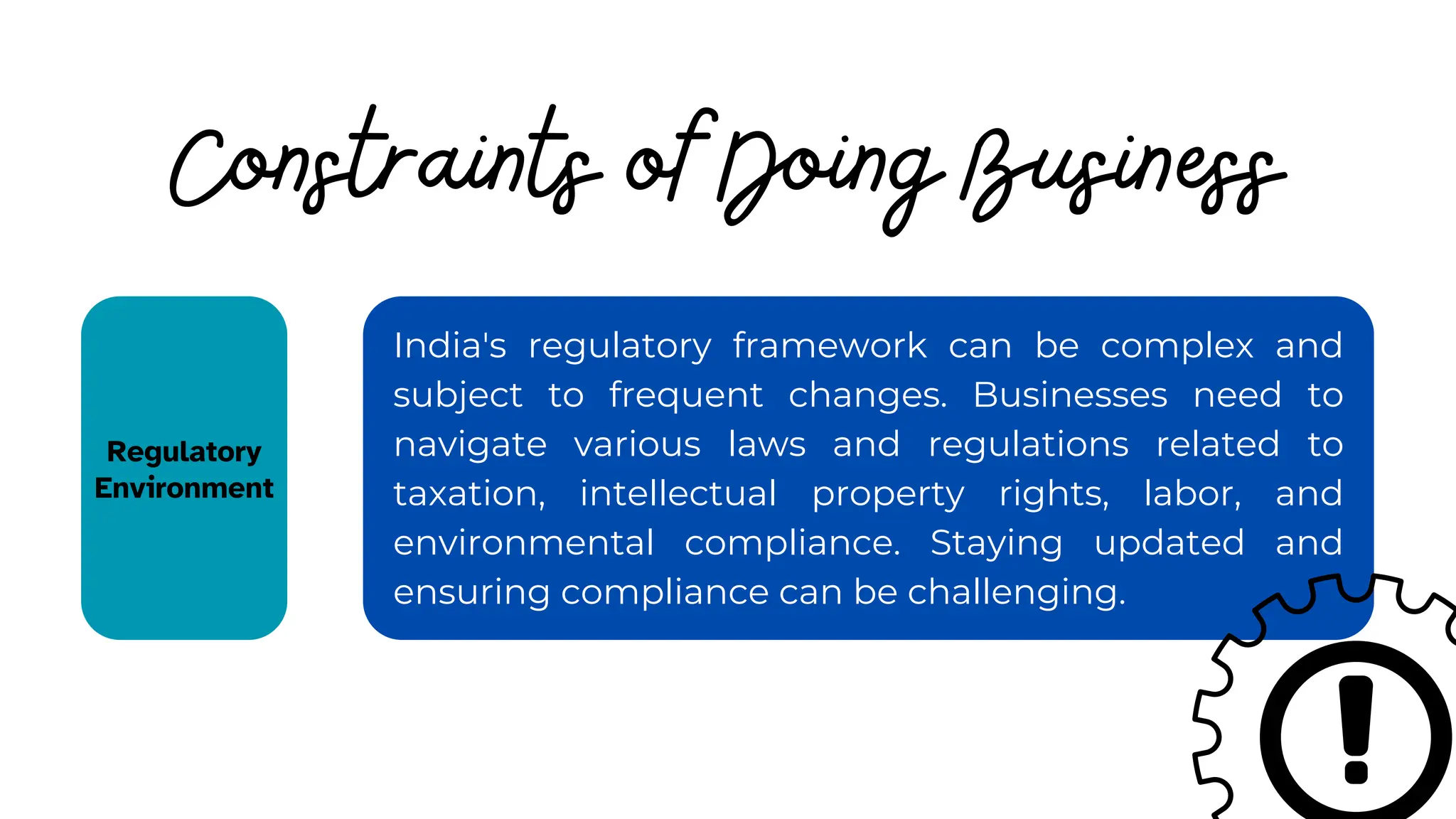
India's regulatory framework can be complex and
subject to frequent changes. Businesses need to
navigate various laws and regulations related to
taxation, intellectual property rights, labor, and
environmental compliance. Staying updated and
ensuring compliance can be challenging.
Constraints of Doing Business
Regulatory
Environment
While India has made significant progress in
infrastructure development, there are still gaps in
areas such as transportation, logistics, and power
supply. Inadequate infrastructure can impact supply
chains, increase costs, and hinder business
operations.
Constraints of Doing Business
Infrastructure
Challenges
Constraints of Doing Business
Corruption
and Red Tape
Corruption remains a challenge in India, and
businesses may encounter instances of bribery or
unethical practices. Dealing with red tape and
navigating bureaucratic procedures can be
frustrating and time-consuming.
Constraints of Doing Business
Labor Laws
and Skill
Gaps
India has a complex labor regulatory framework, and
businesses need to comply with various labor laws.
Additionally, there may be skill gaps in certain
sectors, requiring companies to invest in training and
development programs for their workforce.
Constraints of Doing Business
Intellectual
Property
Protection
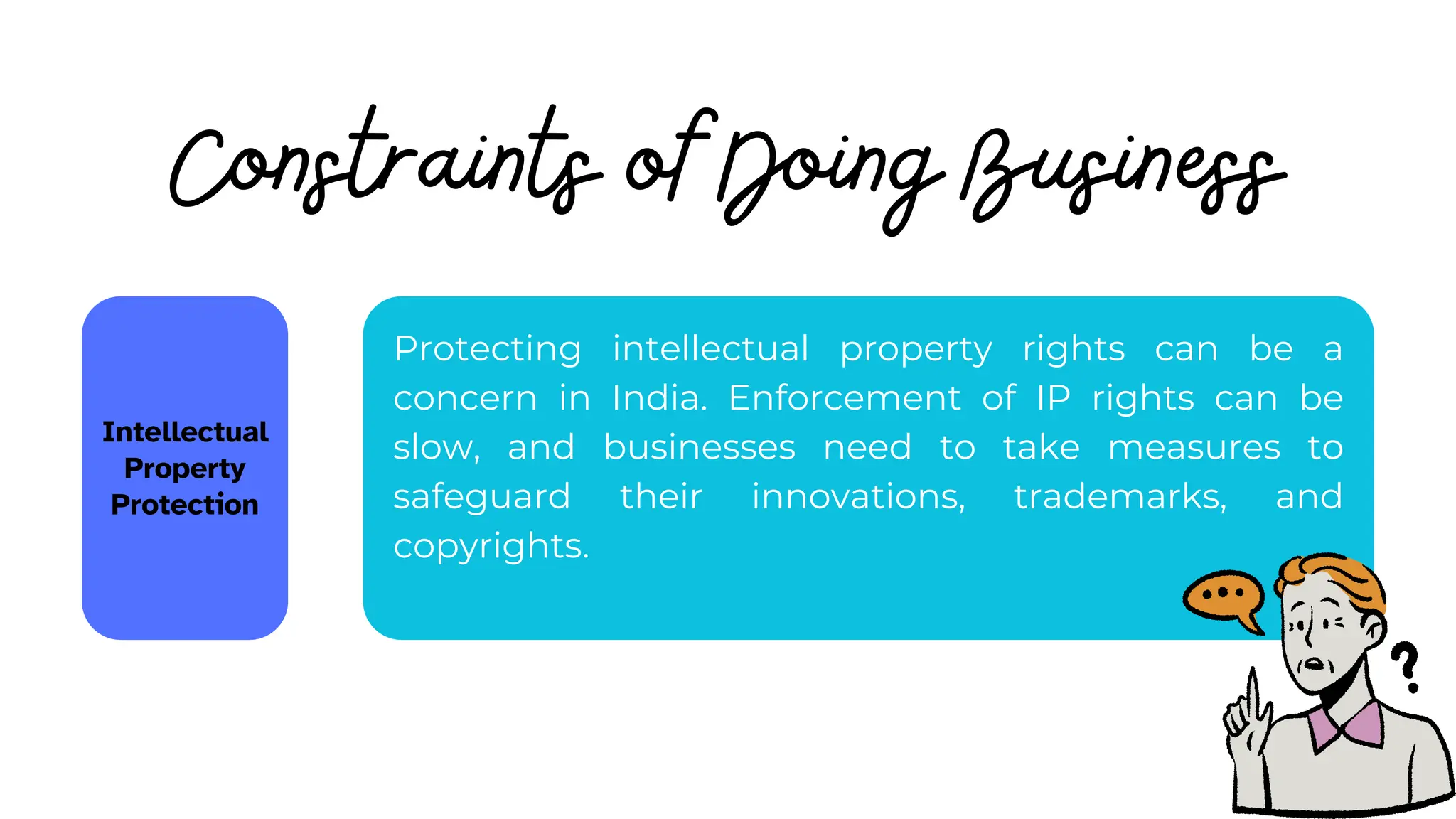
Protecting intellectual property rights can be a
concern in India. Enforcement of IP rights can be
slow, and businesses need to take measures to
safeguard their innovations, trademarks, and
copyrights.
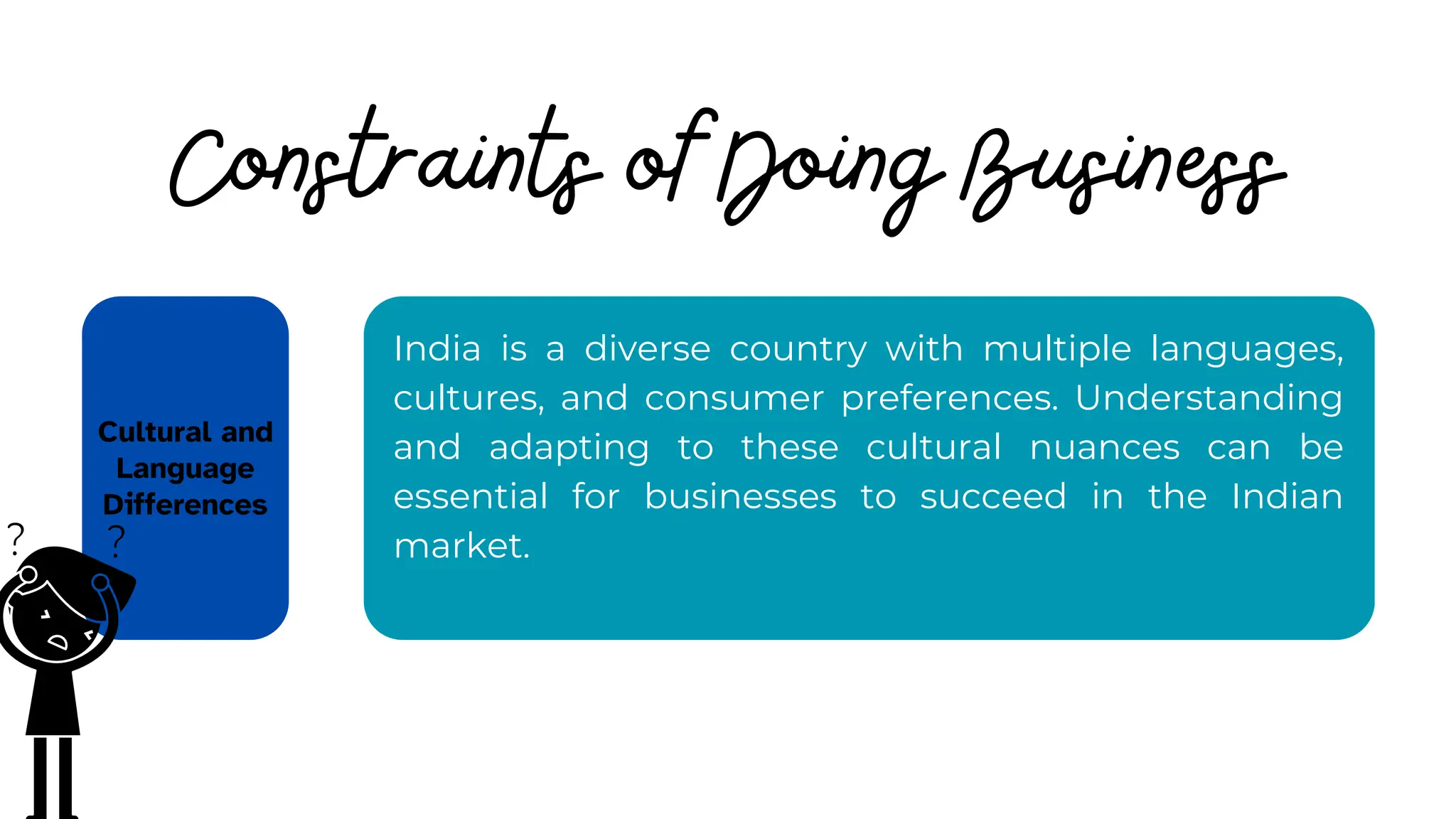
India is a diverse country with multiple languages,
cultures, and consumer preferences. Understanding
and adapting to these cultural nuances can be
essential for businesses to succeed in the Indian
market.
Constraints of Doing Business
Cultural and
Language
Differences
Thank You

Indonesia PESTEL Analysis and Constraints of doing business in India

  • 1.
    A COUNTRY SURROUNDEDBY WATER Presented by : Karan Choudhury (27)
  • 2.
    Indonesia Indonesia is abig group of islands in Southeast Asia. There are many islands there. People in Indonesia have different cultures, languages, and places. It has beautiful beaches, lots of animals, and busy cities like Jakarta and Bali. Indonesia makes money from farming, making things, and people visiting for fun.
  • 3.
    Map Capital - Jakarta Population- 27.38 crores (2021) Official language - Indonesian Currency - Indonesian rupiah (Rp)
  • 4.
    Temples Sea andBeaches Cities Volcanos Attractions and many more......
  • 5.
    Pe s tel AnAlys i s
  • 6.
    Political Indonesia is ademocratic republic with a stable political environment. However, there are several political factors that influence the country's operations: Government Stability: The stability of the Indonesian government ensures a conducive environment for businesses to thrive. For instance, the government's focus on infrastructure development has attracted foreign direct investments (FDIs) from companies like Toyota, which built a factory in Karawang. Regulatory Environment: Indonesia's regulatory framework has undergone significant improvements in recent years. For example, the government's decision to relax foreign ownership restrictions has encouraged companies like Grab and Gojek to expand their operations in the country's ride-hailing sector.
  • 7.
    Economic Indonesia has amixed economy in which the private sector and government play vital roles. The economic factors play a crucial role in determining Indonesia's business opportunities and challenges: GDP Growth: Indonesia's GDP has been steadily growing, making it one of the fastest-growing economies in Southeast Asia. For instance, the increased purchasing power of the middle class has fueled the growth of the retail sector, attracting global players like Uniqlo and H&M to establish a presence in the country. Infrastructure Development: Indonesia's ambitious infrastructure development plans, such as the construction of toll roads and ports, create opportunities for foreign investors. A notable example is the collaboration between Indonesia and China to develop the Jakarta-Bandung high-speed rail project.
  • 8.
    Understanding the socialfactors is crucial for businesses to address the needs and preferences of the Indonesian population: Cultural Diversity: Indonesia is a diverse country with various ethnic groups and religions. Companies must consider these factors when designing marketing campaigns. For instance, Coca-Cola successfully tailored its marketing strategy to reflect the cultural diversity and traditions of different regions in Indonesia. Growing Middle Class: The rising middle class in Indonesia presents significant opportunities for consumer-driven industries such as retail, hospitality, and e-commerce. Companies like Tokopedia and Bukalapak have capitalized on this trend by offering online marketplaces that cater to the needs of the middle class. Social
  • 9.
    Technological advancements havetransformed various sectors in Indonesia: Mobile Internet Penetration: Indonesia has a high mobile internet penetration rate, which has facilitated the growth of e-commerce platforms like Shopee and Lazada. These platforms have revolutionized the retail industry by providing convenient and accessible online shopping experiences. Digital Payments: The adoption of digital payment methods, such as GoPay and OVO, has transformed the traditional banking landscape. These platforms have made financial transactions more accessible, especially for the unbanked population in rural areas. Technological
  • 10.
    Environmental Factors: Indonesia'sunique geographical and environmental factors bring both opportunities and challenges: Natural Resources: Indonesia is rich in natural resources, including coal, palm oil, and rubber. However, the exploitation of these resources has raised concerns about deforestation and environmental sustainability. The government has implemented measures to address these issues, such as the moratorium on new palm oil plantations. Environment
  • 11.
    Legal factors influencebusinesses' operations and compliance requirements: Labor Laws: Indonesia's labor laws protect workers' rights, but they can pose challenges for businesses in terms of hiring and employment regulations. Companies like Nike have faced scrutiny over labor practices in their Indonesian factories. Intellectual Property Rights: Intellectual property protection in Indonesia is an ongoing challenge. The government has taken steps to improve enforcement, but piracy and counterfeiting remain prevalent in industries such as software and fashion. Legal
  • 12.
    Constraints of DoingBusiness in India
  • 13.
    Doing business In Indiaoffers numerous advantages, such as a massive consumer market and a growing economy. However, there are also several constraints and challenges that businesses may face. Understanding these constraints is crucial for companies planning to enter or expand their operations in India.
  • 14.
    Constraints of DoingBusiness Regulatory Environment Infrastructure Challenges Corruption and Red Tape Labor Laws and Skill Gaps Intellectual Property Protection Cultural and Language Differences
  • 15.
    India's regulatory frameworkcan be complex and subject to frequent changes. Businesses need to navigate various laws and regulations related to taxation, intellectual property rights, labor, and environmental compliance. Staying updated and ensuring compliance can be challenging. Constraints of Doing Business Regulatory Environment
  • 16.
    While India hasmade significant progress in infrastructure development, there are still gaps in areas such as transportation, logistics, and power supply. Inadequate infrastructure can impact supply chains, increase costs, and hinder business operations. Constraints of Doing Business Infrastructure Challenges
  • 17.
    Constraints of DoingBusiness Corruption and Red Tape Corruption remains a challenge in India, and businesses may encounter instances of bribery or unethical practices. Dealing with red tape and navigating bureaucratic procedures can be frustrating and time-consuming.
  • 18.
    Constraints of DoingBusiness Labor Laws and Skill Gaps India has a complex labor regulatory framework, and businesses need to comply with various labor laws. Additionally, there may be skill gaps in certain sectors, requiring companies to invest in training and development programs for their workforce.
  • 19.
    Constraints of DoingBusiness Intellectual Property Protection Protecting intellectual property rights can be a concern in India. Enforcement of IP rights can be slow, and businesses need to take measures to safeguard their innovations, trademarks, and copyrights.
  • 20.
    India is adiverse country with multiple languages, cultures, and consumer preferences. Understanding and adapting to these cultural nuances can be essential for businesses to succeed in the Indian market. Constraints of Doing Business Cultural and Language Differences
  • 21.