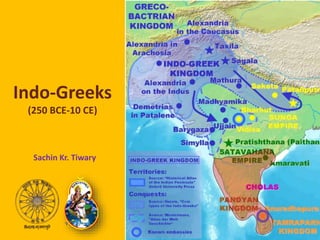
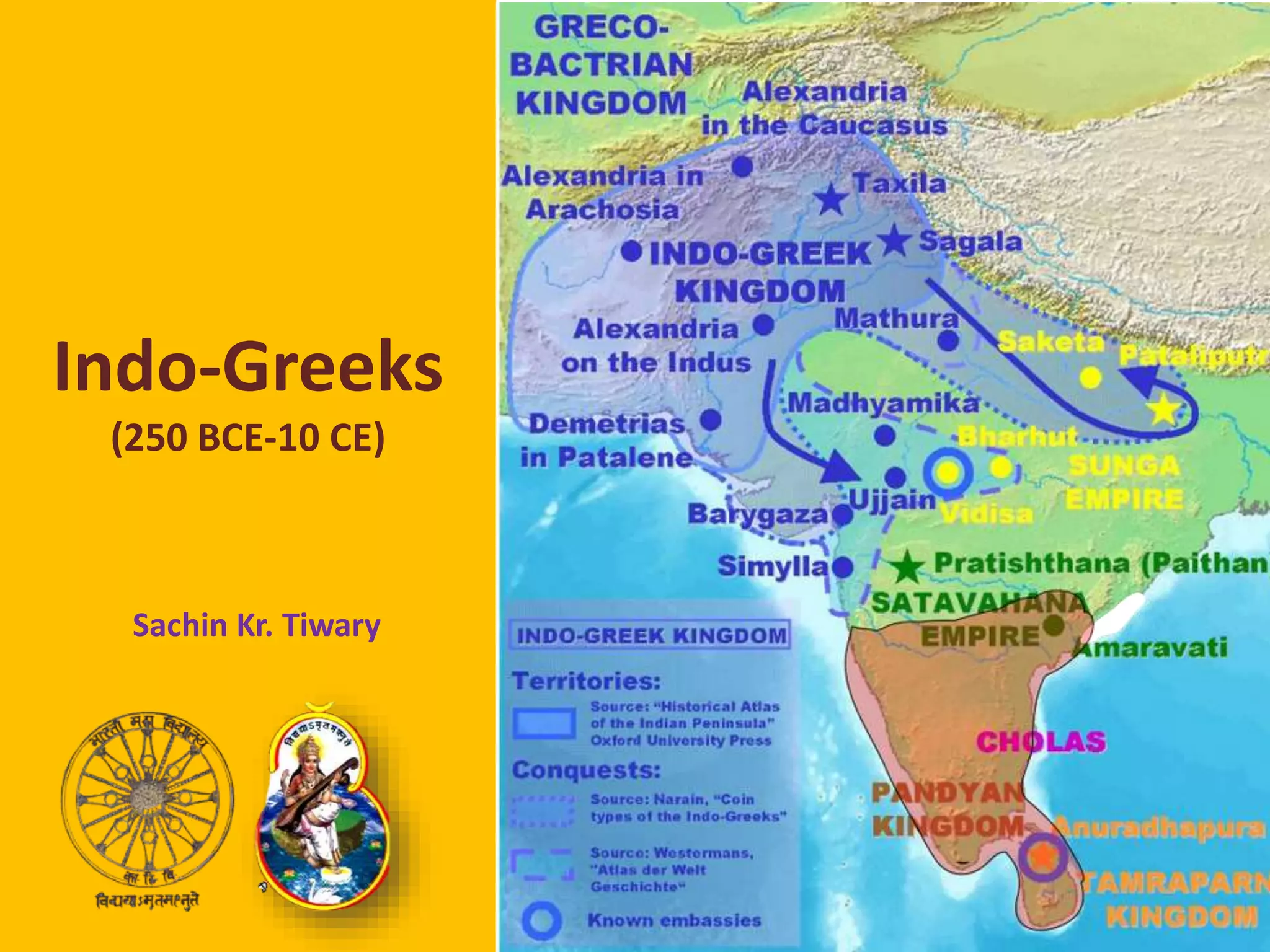
Indo-Greeks
(250 BCE-10 CE)
Sachin Kr. Tiwary
Sources:
Literature [Indian-Foreign]
– Religious- Milinda Panha (100 BCE and 200 CE)- Dialogue between the Nāgasena and Menander I,
Gargi Samhita (One of the chapter of Yug Puran- c.100 BCE-300 CE), Brihat Samhita of Varahamihira
(c. 600 CE), Mahabharat of Vyas, Bhagwat Puran.
– Secular: Mahabhashya of Pantanaji (c. 200 BCE), Avadana Kalpalata of Kshemendra (c. 990 – c. 1070
CE) based on Buddhism, Malavikaagnimitra of Kalidas (c.500 CE).
– Foreign: Greek writers Justin (c. 200 CE), ‘Parallel Lives’ and ‘Moralia’ of Lucius Mestrius Plutarchus
(c. 46-120 CE), Strabo (63 BCE- 24 CE), The Histories (event of the Roman empire in 44 Vols.) of
Polybius (c. 208 – c. 125 BCE), Geographia of Claudius Ptolemy (c. 100- 170 CE), Mythology of
Simhal Lit., History of Buddhism by Tibetan scholar Taranath (1575–1634 CE), Indica (Available in
the writings of Greek and Latin writes Diodorus Siculus, Strabo (Geographica), Pliny,
and Arrian (Indica)) of Megasthenes (Mauryan Period), Periplus of the Erythraean Sea (100 CE).
Archaeological [Epigraphs, Numismatics, Architecture- Art]:
– Epigraphs- Kharwela Inscription Hathigumpha (the eighth year of his reign he defeated greek ruler
Dimit at Rajgriha) (c.200 BCE- 100 CE), Inscriptions of Chaldean (c.705-681 BCE), Reh Inscription
(Fatehpur district, UP)- c.200 BCE and 200 CE-mentioned about Menander (?), Besnagar pillar
Inscription of Heliodorus (c. 113 BCE).
– Coins/ Numismatics- Trimit coins from Besnagar, All Indo-Greek Coins c.200 BCE to 100 CE in
Northern and North-western India (30 rulers).
– Monuments (Stupa, Monastery, Rock Cut Caves)- An image of Greek Soldiers from Sanchi,
Bharahut, Bodhgaya, Gandhara, Stupas, Monasteries from the Swat valley etc.
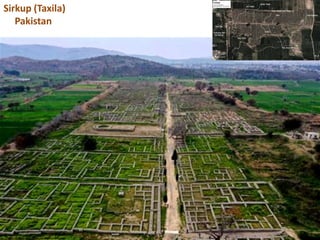
Excavations- Sirkup (Taxila), Stupas from the Swat valley and many more.
Reh Inscription (Fatehpur district, UP)
mahārājasa rājarājasa
mahāṁtasa trātārasa dhāṁmī
kasa Jayaṁtasa ca Apra
[jitasa] Minānada[de?]rasa....
• – Extrapolated Reh Inscription
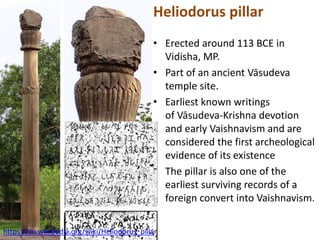
Heliodorus pillar
• Erected around 113 BCE in
Vidisha, MP.
• Part of an ancient Vāsudeva
temple site.
• Earliest known writings
of Vāsudeva-Krishna devotion
and early Vaishnavism and are
considered the first archeological
evidence of its existence
• The pillar is also one of the
earliest surviving records of a
foreign convert into Vaishnavism.
https://en.wikipedia.org/wiki/Heliodorus_pillar
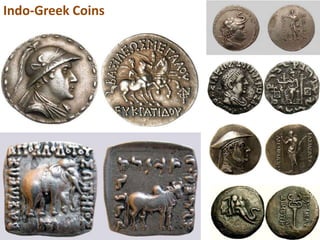
Indo-Greek Coins
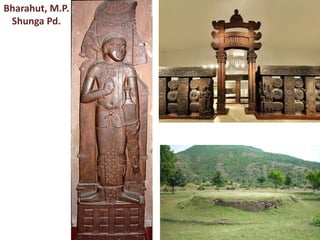
Bharahut, M.P.
Shunga Pd.
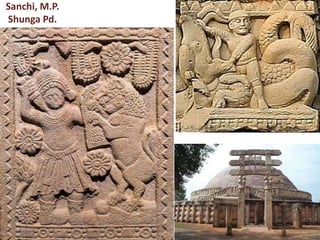
Sanchi, M.P.
Shunga Pd.
Sirkup (Taxila)
Pakistan
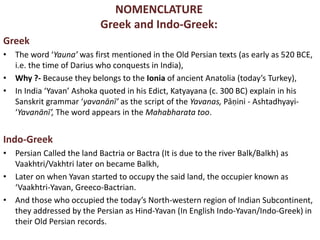
NOMENCLATURE
Greek and Indo-Greek:
Greek
• The word ‘Yauna’ was first mentioned in the Old Persian texts (as early as 520 BCE,
i.e. the time of Darius who conquests in India),
• Why ?- Because they belongs to the Ionia of ancient Anatolia (today’s Turkey),
• In India ‘Yavan’ Ashoka quoted in his Edict, Katyayana (c. 300 BC) explain in his
Sanskrit grammar ‘yavanānī’ as the script of the Yavanas, Pāṇini - Ashtadhyayi-
‘Yavanānī’, The word appears in the Mahabharata too.
Indo-Greek
• Persian Called the land Bactria or Bactra (It is due to the river Balk/Balkh) as
Vaakhtri/Vakhtri later on became Balkh,
• Later on when Yavan started to occupy the said land, the occupier known as
‘Vaakhtri-Yavan, Greeco-Bactrian.
• And those who occupied the today’s North-western region of Indian Subcontinent,
they addressed by the Persian as Hind-Yavan (In English Indo-Yavan/Indo-Greek) in
their Old Persian records.
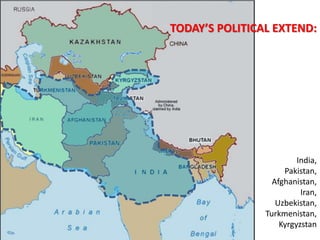
TODAY’S POLITICAL EXTEND:
India,
Pakistan,
Afghanistan,
Iran,
Uzbekistan,
Turkmenistan,
Kyrgyzstan
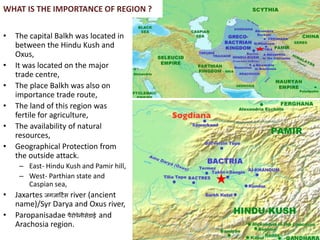
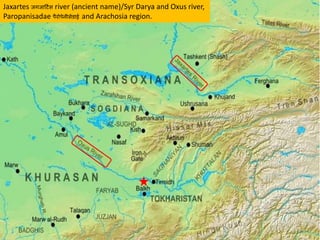
WHAT IS THE IMPORTANCE OF REGION ?
• The capital Balkh was located in
between the Hindu Kush and
Oxus,
• It was located on the major
trade centre,
• The place Balkh was also on
importance trade route,
• The land of this region was
fertile for agriculture,
• The availability of natural
resources,
• Geographical Protection from
the outside attack.
– East- Hindu Kush and Pamir hill,
– West- Parthian state and
Caspian sea,
• Jaxartes जगजार्टिस river (ancient
name)/Syr Darya and Oxus river,
• Paropanisadae पैरोपेनीसेडाई and
Arachosia region.
Jaxartes जगजार्टिस river (ancient name)/Syr Darya and Oxus river,
Paropanisadae पैरोपेनीसेडाई and Arachosia region.
RELATION BETWEEN GREEK AND INDIA
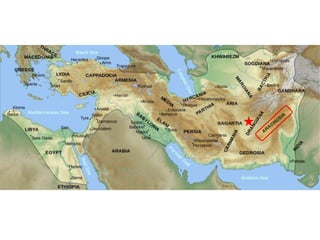
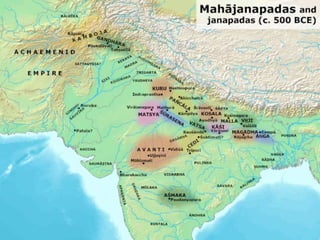
• During the Persian king Darius-I (c. 522-486 BCE), He came upto today’s
Western Pakistan- This is the time of Mahajanpadas in Indian History (Map).
The Battle of Gaugamela in 331 BCE between Alexander and Darius III was
the decline of Persian Empire from this region.
• Alexander (c. 326-323 BCE) (Argead Dynasty from Macedonia, Present
Greece) entered in to the Indian land. This is the time of Nanda dynasty in
ancient India (Map).
• According to Indian sources, Greek (“Yavana“) troops seem to have
assisted Chandragupta Maurya in toppling the Nanda Dynasty and founding
the Mauryan Empire.
• Seleucus Nicator (c. 358-281 BCE), He fought against Chandragupta Maurya
(c. 321-297 BCE) and made peace by giving him 500 war elephants which
Seleucus used in the war of Ipsus against Antigonus in 301 BCE and married
his daughter Helena, and also found Arachosia (modern Kandahar), Herat,
Kabul and Makran. Megasthenes a Greek Ambassador visited Northern
India for 04 years.
• Megasthenes talks about the older Indians who knew about the prehistoric
arrival of Dionysus and Hercules in India (as mentioned in his Indica).
• Antiochus I Soter (c. 324/23-261 BCE) from Seleucid dynasty (Greek) sent
his Ambassador Deimachos (c.320-273 BCE) to visit India during Bindusara
(c. 297-273 BCE) Time’s.
DIFFERENT OPINION ABOUT CONQUEST OVER THE LAND OF INDIA
– The 1st century BCE Greek historian Apollodorus, quoted by
Strabo, affirms that the Bactrian Greeks, led by Demetrius I and
Menander, conquered India and occupied a larger territory than
the Macedonians under Alexander the Great, going beyond the
Hyphasis (modern Beas River) towards the Himalayas. “India” only
meant the upper Indus for Alexander the Great.
– The Roman historian Justin cited the Indo-Greek conquests,
describing Demetrius as “King of the Indians”, and explaining
that Eucratides in turn “put India under his rule”.
– Since the appearance of Megasthenes, “India” meant to the
Greeks most of the northern half of the Indian subcontinent.
– Greek and Indian sources tend to indicate that the Greeks
campaigned as far as Pataliputra until they were forced to retreat
following a coup in Bactria in 170 BCE.
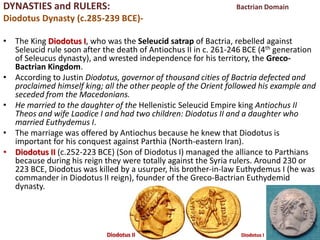
DYNASTIES and RULERS: Bactrian Domain
Diodotus Dynasty (c.285-239 BCE)-
• The King Diodotus I, who was the Seleucid satrap of Bactria, rebelled against
Seleucid rule soon after the death of Antiochus II in c. 261-246 BCE (4th generation
of Seleucus dynasty), and wrested independence for his territory, the Greco-
Bactrian Kingdom.
• According to Justin Diodotus, governor of thousand cities of Bactria defected and
proclaimed himself king; all the other people of the Orient followed his example and
seceded from the Macedonians.
• He married to the daughter of the Hellenistic Seleucid Empire king Antiochus II
Theos and wife Laodice I and had two children: Diodotus II and a daughter who
married Euthydemus I.
• The marriage was offered by Antiochus because he knew that Diodotus is
important for his conquest against Parthia (North-eastern Iran).
• Diodotus II (c.252-223 BCE) (Son of Diodotus I) managed the alliance to Parthians
because during his reign they were totally against the Syria rulers. Around 230 or
223 BCE, Diodotus was killed by a usurper, his brother-in-law Euthydemus I (he was
commander in Diodotus II reign), founder of the Greco-Bactrian Euthydemid
dynasty.
Diodotus I
Diodotus II
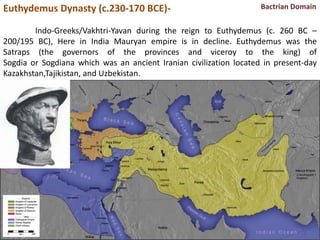
Euthydemus Dynasty (c.230-170 BCE)-
Indo-Greeks/Vakhtri-Yavan during the reign to Euthydemus (c. 260 BC –
200/195 BC), Here in India Mauryan empire is in decline. Euthydemus was the
Satraps (the governors of the provinces and viceroy to the king) of
Sogdia or Sogdiana which was an ancient Iranian civilization located in present-day
Kazakhstan,Tajikistan, and Uzbekistan.
Bactrian Domain
Indian Domain
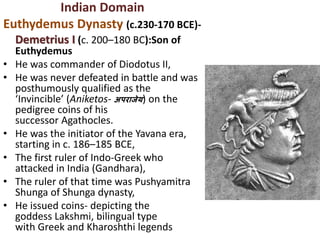
Euthydemus Dynasty (c.230-170 BCE)-
Demetrius I (c. 200–180 BC):Son of
Euthydemus
• He was commander of Diodotus II,
• He was never defeated in battle and was
posthumously qualified as the
‘Invincible’ (Aniketos- अपराजेय) on the
pedigree coins of his
successor Agathocles.
• He was the initiator of the Yavana era,
starting in c. 186–185 BCE,
• The first ruler of Indo-Greek who
attacked in India (Gandhara),
• The ruler of that time was Pushyamitra
Shunga of Shunga dynasty,
• He issued coins- depicting the
goddess Lakshmi, bilingual type
with Greek and Kharoshthi legends
Indian Domain
Euthydemus Dynasty
(c.230-170 BCE)-
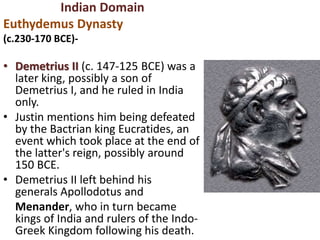
• Demetrius II (c. 147-125 BCE) was a
later king, possibly a son of
Demetrius I, and he ruled in India
only.
• Justin mentions him being defeated
by the Bactrian king Eucratides, an
event which took place at the end of
the latter's reign, possibly around
150 BCE.
• Demetrius II left behind his
generals Apollodotus and
Menander, who in turn became
kings of India and rulers of the Indo-
Greek Kingdom following his death.
Eucratides Dynasty-
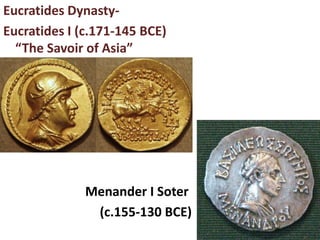
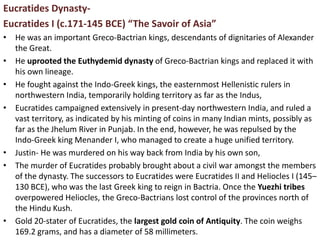
Eucratides I (c.171-145 BCE)
“The Savoir of Asia”
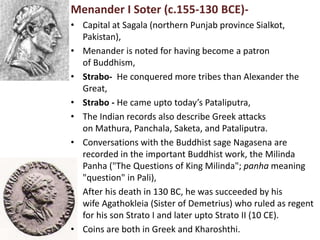
Menander I Soter
(c.155-130 BCE)
Eucratides Dynasty-
Eucratides I (c.171-145 BCE) “The Savoir of Asia”
• He was an important Greco-Bactrian kings, descendants of dignitaries of Alexander
the Great.
• He uprooted the Euthydemid dynasty of Greco-Bactrian kings and replaced it with
his own lineage.
• He fought against the Indo-Greek kings, the easternmost Hellenistic rulers in
northwestern India, temporarily holding territory as far as the Indus,
• Eucratides campaigned extensively in present-day northwestern India, and ruled a
vast territory, as indicated by his minting of coins in many Indian mints, possibly as
far as the Jhelum River in Punjab. In the end, however, he was repulsed by the
Indo-Greek king Menander I, who managed to create a huge unified territory.
• Justin- He was murdered on his way back from India by his own son,
• The murder of Eucratides probably brought about a civil war amongst the members
of the dynasty. The successors to Eucratides were Eucratides II and Heliocles I (145–
130 BCE), who was the last Greek king to reign in Bactria. Once the Yuezhi tribes
overpowered Heliocles, the Greco-Bactrians lost control of the provinces north of
the Hindu Kush.
• Gold 20-stater of Eucratides, the largest gold coin of Antiquity. The coin weighs
169.2 grams, and has a diameter of 58 millimeters.
Menander I Soter (c.155-130 BCE)-
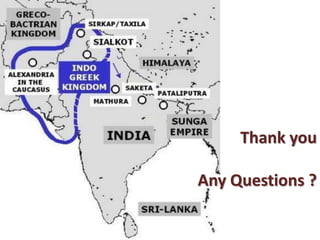
• Capital at Sagala (northern Punjab province Sialkot,
Pakistan),
• Menander is noted for having become a patron
of Buddhism,
• Strabo- He conquered more tribes than Alexander the
Great,
• Strabo - He came upto today’s Pataliputra,
• The Indian records also describe Greek attacks
on Mathura, Panchala, Saketa, and Pataliputra.
• Conversations with the Buddhist sage Nagasena are
recorded in the important Buddhist work, the Milinda
Panha ("The Questions of King Milinda"; panha meaning
"question" in Pali),
• After his death in 130 BC, he was succeeded by his
wife Agathokleia (Sister of Demetrius) who ruled as regent
for his son Strato I and later upto Strato II (10 CE).
• Coins are both in Greek and Kharoshthi.
DECLINE
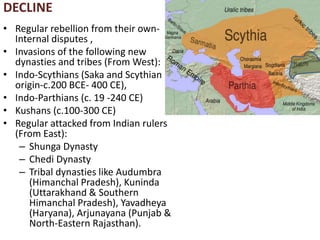
• Regular rebellion from their own-
Internal disputes ,
• Invasions of the following new
dynasties and tribes (From West):
• Indo-Scythians (Saka and Scythian
origin-c.200 BCE- 400 CE),
• Indo-Parthians (c. 19 -240 CE)
• Kushans (c.100-300 CE)
• Regular attacked from Indian rulers
(From East):
– Shunga Dynasty
– Chedi Dynasty
– Tribal dynasties like Audumbra
(Himanchal Pradesh), Kuninda
(Uttarakhand & Southern
Himanchal Pradesh), Yavadheya
(Haryana), Arjunayana (Punjab &
North-Eastern Rajasthan).
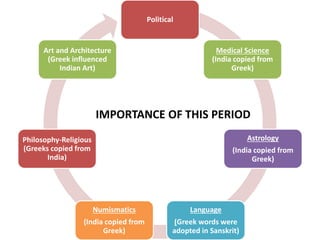
Political
Medical Science
(India copied from
Greek)
Astrology
(India copied from
Greek)
Language
(Greek words were
adopted in Sanskrit)
Numismatics
(India copied from
Greek)
Philosophy-Religious
(Greeks copied from
India)
Art and Architecture
(Greek influenced
Indian Art)
IMPORTANCE OF THIS PERIOD
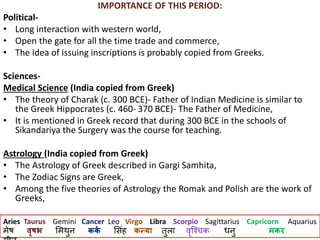
IMPORTANCE OF THIS PERIOD:
Political-
• Long interaction with western world,
• Open the gate for all the time trade and commerce,
• The idea of issuing inscriptions is probably copied from Greeks.
Sciences-
Medical Science (India copied from Greek)
• The theory of Charak (c. 300 BCE)- Father of Indian Medicine is similar to
the Greek Hippocrates (c. 460- 370 BCE)- The Father of Medicine,
• It is mentioned in Greek record that during 300 BCE in the schools of
Sikandariya the Surgery was the course for teaching.
Astrology (India copied from Greek)
• The Astrology of Greek described in Gargi Samhita,
• The Zodiac Signs are Greek,
• Among the five theories of Astrology the Romak and Polish are the work of
Greeks,
Aries Taurus Gemini Cancer Leo Virgo Libra Scorpio Sagittarius Capricorn Aquarius
मेष वृषभ ममथुन कक
क मसिंह कन्या तुला वृश्चिक धनु मकर
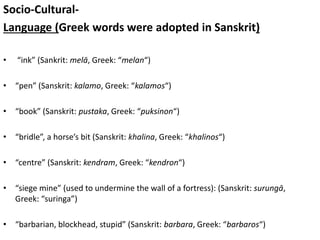
Socio-Cultural-
Language (Greek words were adopted in Sanskrit)
• “ink” (Sankrit: melā, Greek: “melan“)
• “pen” (Sanskrit: kalamo, Greek: “kalamos“)
• “book” (Sanskrit: pustaka, Greek: “puksinon“)
• “bridle”, a horse’s bit (Sanskrit: khalina, Greek: “khalinos“)
• “centre” (Sanskrit: kendram, Greek: “kendron“)
• “siege mine” (used to undermine the wall of a fortress): (Sanskrit: surungā,
Greek: “suringa”)
• “barbarian, blockhead, stupid” (Sanskrit: barbara, Greek: “barbaros“)
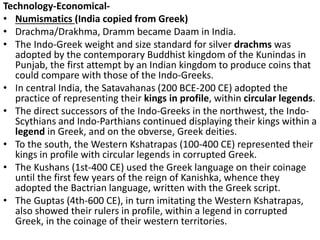
Technology-Economical-
• Numismatics (India copied from Greek)
• Drachma/Drakhma, Dramm became Daam in India.
• The Indo-Greek weight and size standard for silver drachms was
adopted by the contemporary Buddhist kingdom of the Kunindas in
Punjab, the first attempt by an Indian kingdom to produce coins that
could compare with those of the Indo-Greeks.
• In central India, the Satavahanas (200 BCE-200 CE) adopted the
practice of representing their kings in profile, within circular legends.
• The direct successors of the Indo-Greeks in the northwest, the Indo-
Scythians and Indo-Parthians continued displaying their kings within a
legend in Greek, and on the obverse, Greek deities.
• To the south, the Western Kshatrapas (100-400 CE) represented their
kings in profile with circular legends in corrupted Greek.
• The Kushans (1st-400 CE) used the Greek language on their coinage
until the first few years of the reign of Kanishka, whence they
adopted the Bactrian language, written with the Greek script.
• The Guptas (4th-600 CE), in turn imitating the Western Kshatrapas,
also showed their rulers in profile, within a legend in corrupted
Greek, in the coinage of their western territories.
Trade-Commerce
• Exchange system,
• Demand of Yavan/Greek girls for mistress in
trade.
Philosophy-Religious (Greeks copied from
India)-
• Spread of Buddhism in West,
• Following of Indian religion by the Greeks
(Menander- Buddhist; Heliodorus-
Vaishnavism),
• Creation of iconography of Indian God and
Goddesses,
Art and Architecture (Greek influenced Indian
Art) –
• An influence of Indian art and architecture,
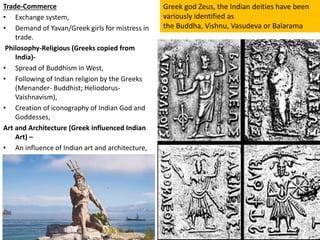
Greek god Zeus, the Indian deities have been
variously identified as
the Buddha, Vishnu, Vasudeva or Balarama
Thank you
Any Questions ?

Indo-Greeks

  • 1.
  • 3.
    Sources: Literature [Indian-Foreign] – Religious-Milinda Panha (100 BCE and 200 CE)- Dialogue between the Nāgasena and Menander I, Gargi Samhita (One of the chapter of Yug Puran- c.100 BCE-300 CE), Brihat Samhita of Varahamihira (c. 600 CE), Mahabharat of Vyas, Bhagwat Puran. – Secular: Mahabhashya of Pantanaji (c. 200 BCE), Avadana Kalpalata of Kshemendra (c. 990 – c. 1070 CE) based on Buddhism, Malavikaagnimitra of Kalidas (c.500 CE). – Foreign: Greek writers Justin (c. 200 CE), ‘Parallel Lives’ and ‘Moralia’ of Lucius Mestrius Plutarchus (c. 46-120 CE), Strabo (63 BCE- 24 CE), The Histories (event of the Roman empire in 44 Vols.) of Polybius (c. 208 – c. 125 BCE), Geographia of Claudius Ptolemy (c. 100- 170 CE), Mythology of Simhal Lit., History of Buddhism by Tibetan scholar Taranath (1575–1634 CE), Indica (Available in the writings of Greek and Latin writes Diodorus Siculus, Strabo (Geographica), Pliny, and Arrian (Indica)) of Megasthenes (Mauryan Period), Periplus of the Erythraean Sea (100 CE). Archaeological [Epigraphs, Numismatics, Architecture- Art]: – Epigraphs- Kharwela Inscription Hathigumpha (the eighth year of his reign he defeated greek ruler Dimit at Rajgriha) (c.200 BCE- 100 CE), Inscriptions of Chaldean (c.705-681 BCE), Reh Inscription (Fatehpur district, UP)- c.200 BCE and 200 CE-mentioned about Menander (?), Besnagar pillar Inscription of Heliodorus (c. 113 BCE). – Coins/ Numismatics- Trimit coins from Besnagar, All Indo-Greek Coins c.200 BCE to 100 CE in Northern and North-western India (30 rulers). – Monuments (Stupa, Monastery, Rock Cut Caves)- An image of Greek Soldiers from Sanchi, Bharahut, Bodhgaya, Gandhara, Stupas, Monasteries from the Swat valley etc. Excavations- Sirkup (Taxila), Stupas from the Swat valley and many more.
  • 4.
    Reh Inscription (Fatehpurdistrict, UP) mahārājasa rājarājasa mahāṁtasa trātārasa dhāṁmī kasa Jayaṁtasa ca Apra [jitasa] Minānada[de?]rasa.... • – Extrapolated Reh Inscription
  • 5.
    Heliodorus pillar • Erectedaround 113 BCE in Vidisha, MP. • Part of an ancient Vāsudeva temple site. • Earliest known writings of Vāsudeva-Krishna devotion and early Vaishnavism and are considered the first archeological evidence of its existence • The pillar is also one of the earliest surviving records of a foreign convert into Vaishnavism. https://en.wikipedia.org/wiki/Heliodorus_pillar
  • 6.
  • 7.
  • 8.
  • 9.
  • 10.
    NOMENCLATURE Greek and Indo-Greek: Greek •The word ‘Yauna’ was first mentioned in the Old Persian texts (as early as 520 BCE, i.e. the time of Darius who conquests in India), • Why ?- Because they belongs to the Ionia of ancient Anatolia (today’s Turkey), • In India ‘Yavan’ Ashoka quoted in his Edict, Katyayana (c. 300 BC) explain in his Sanskrit grammar ‘yavanānī’ as the script of the Yavanas, Pāṇini - Ashtadhyayi- ‘Yavanānī’, The word appears in the Mahabharata too. Indo-Greek • Persian Called the land Bactria or Bactra (It is due to the river Balk/Balkh) as Vaakhtri/Vakhtri later on became Balkh, • Later on when Yavan started to occupy the said land, the occupier known as ‘Vaakhtri-Yavan, Greeco-Bactrian. • And those who occupied the today’s North-western region of Indian Subcontinent, they addressed by the Persian as Hind-Yavan (In English Indo-Yavan/Indo-Greek) in their Old Persian records.
  • 11.
  • 12.
    WHAT IS THEIMPORTANCE OF REGION ? • The capital Balkh was located in between the Hindu Kush and Oxus, • It was located on the major trade centre, • The place Balkh was also on importance trade route, • The land of this region was fertile for agriculture, • The availability of natural resources, • Geographical Protection from the outside attack. – East- Hindu Kush and Pamir hill, – West- Parthian state and Caspian sea, • Jaxartes जगजार्टिस river (ancient name)/Syr Darya and Oxus river, • Paropanisadae पैरोपेनीसेडाई and Arachosia region.
  • 13.
    Jaxartes जगजार्टिस river(ancient name)/Syr Darya and Oxus river, Paropanisadae पैरोपेनीसेडाई and Arachosia region.
  • 15.
    RELATION BETWEEN GREEKAND INDIA • During the Persian king Darius-I (c. 522-486 BCE), He came upto today’s Western Pakistan- This is the time of Mahajanpadas in Indian History (Map). The Battle of Gaugamela in 331 BCE between Alexander and Darius III was the decline of Persian Empire from this region. • Alexander (c. 326-323 BCE) (Argead Dynasty from Macedonia, Present Greece) entered in to the Indian land. This is the time of Nanda dynasty in ancient India (Map). • According to Indian sources, Greek (“Yavana“) troops seem to have assisted Chandragupta Maurya in toppling the Nanda Dynasty and founding the Mauryan Empire. • Seleucus Nicator (c. 358-281 BCE), He fought against Chandragupta Maurya (c. 321-297 BCE) and made peace by giving him 500 war elephants which Seleucus used in the war of Ipsus against Antigonus in 301 BCE and married his daughter Helena, and also found Arachosia (modern Kandahar), Herat, Kabul and Makran. Megasthenes a Greek Ambassador visited Northern India for 04 years. • Megasthenes talks about the older Indians who knew about the prehistoric arrival of Dionysus and Hercules in India (as mentioned in his Indica). • Antiochus I Soter (c. 324/23-261 BCE) from Seleucid dynasty (Greek) sent his Ambassador Deimachos (c.320-273 BCE) to visit India during Bindusara (c. 297-273 BCE) Time’s.
  • 16.
    DIFFERENT OPINION ABOUTCONQUEST OVER THE LAND OF INDIA – The 1st century BCE Greek historian Apollodorus, quoted by Strabo, affirms that the Bactrian Greeks, led by Demetrius I and Menander, conquered India and occupied a larger territory than the Macedonians under Alexander the Great, going beyond the Hyphasis (modern Beas River) towards the Himalayas. “India” only meant the upper Indus for Alexander the Great. – The Roman historian Justin cited the Indo-Greek conquests, describing Demetrius as “King of the Indians”, and explaining that Eucratides in turn “put India under his rule”. – Since the appearance of Megasthenes, “India” meant to the Greeks most of the northern half of the Indian subcontinent. – Greek and Indian sources tend to indicate that the Greeks campaigned as far as Pataliputra until they were forced to retreat following a coup in Bactria in 170 BCE.
  • 17.
    DYNASTIES and RULERS:Bactrian Domain Diodotus Dynasty (c.285-239 BCE)- • The King Diodotus I, who was the Seleucid satrap of Bactria, rebelled against Seleucid rule soon after the death of Antiochus II in c. 261-246 BCE (4th generation of Seleucus dynasty), and wrested independence for his territory, the Greco- Bactrian Kingdom. • According to Justin Diodotus, governor of thousand cities of Bactria defected and proclaimed himself king; all the other people of the Orient followed his example and seceded from the Macedonians. • He married to the daughter of the Hellenistic Seleucid Empire king Antiochus II Theos and wife Laodice I and had two children: Diodotus II and a daughter who married Euthydemus I. • The marriage was offered by Antiochus because he knew that Diodotus is important for his conquest against Parthia (North-eastern Iran). • Diodotus II (c.252-223 BCE) (Son of Diodotus I) managed the alliance to Parthians because during his reign they were totally against the Syria rulers. Around 230 or 223 BCE, Diodotus was killed by a usurper, his brother-in-law Euthydemus I (he was commander in Diodotus II reign), founder of the Greco-Bactrian Euthydemid dynasty. Diodotus I Diodotus II
  • 18.
    Euthydemus Dynasty (c.230-170BCE)- Indo-Greeks/Vakhtri-Yavan during the reign to Euthydemus (c. 260 BC – 200/195 BC), Here in India Mauryan empire is in decline. Euthydemus was the Satraps (the governors of the provinces and viceroy to the king) of Sogdia or Sogdiana which was an ancient Iranian civilization located in present-day Kazakhstan,Tajikistan, and Uzbekistan. Bactrian Domain
  • 19.
    Indian Domain Euthydemus Dynasty(c.230-170 BCE)- Demetrius I (c. 200–180 BC):Son of Euthydemus • He was commander of Diodotus II, • He was never defeated in battle and was posthumously qualified as the ‘Invincible’ (Aniketos- अपराजेय) on the pedigree coins of his successor Agathocles. • He was the initiator of the Yavana era, starting in c. 186–185 BCE, • The first ruler of Indo-Greek who attacked in India (Gandhara), • The ruler of that time was Pushyamitra Shunga of Shunga dynasty, • He issued coins- depicting the goddess Lakshmi, bilingual type with Greek and Kharoshthi legends
  • 20.
    Indian Domain Euthydemus Dynasty (c.230-170BCE)- • Demetrius II (c. 147-125 BCE) was a later king, possibly a son of Demetrius I, and he ruled in India only. • Justin mentions him being defeated by the Bactrian king Eucratides, an event which took place at the end of the latter's reign, possibly around 150 BCE. • Demetrius II left behind his generals Apollodotus and Menander, who in turn became kings of India and rulers of the Indo- Greek Kingdom following his death.
  • 21.
    Eucratides Dynasty- Eucratides I(c.171-145 BCE) “The Savoir of Asia” Menander I Soter (c.155-130 BCE)
  • 22.
    Eucratides Dynasty- Eucratides I(c.171-145 BCE) “The Savoir of Asia” • He was an important Greco-Bactrian kings, descendants of dignitaries of Alexander the Great. • He uprooted the Euthydemid dynasty of Greco-Bactrian kings and replaced it with his own lineage. • He fought against the Indo-Greek kings, the easternmost Hellenistic rulers in northwestern India, temporarily holding territory as far as the Indus, • Eucratides campaigned extensively in present-day northwestern India, and ruled a vast territory, as indicated by his minting of coins in many Indian mints, possibly as far as the Jhelum River in Punjab. In the end, however, he was repulsed by the Indo-Greek king Menander I, who managed to create a huge unified territory. • Justin- He was murdered on his way back from India by his own son, • The murder of Eucratides probably brought about a civil war amongst the members of the dynasty. The successors to Eucratides were Eucratides II and Heliocles I (145– 130 BCE), who was the last Greek king to reign in Bactria. Once the Yuezhi tribes overpowered Heliocles, the Greco-Bactrians lost control of the provinces north of the Hindu Kush. • Gold 20-stater of Eucratides, the largest gold coin of Antiquity. The coin weighs 169.2 grams, and has a diameter of 58 millimeters.
  • 23.
    Menander I Soter(c.155-130 BCE)- • Capital at Sagala (northern Punjab province Sialkot, Pakistan), • Menander is noted for having become a patron of Buddhism, • Strabo- He conquered more tribes than Alexander the Great, • Strabo - He came upto today’s Pataliputra, • The Indian records also describe Greek attacks on Mathura, Panchala, Saketa, and Pataliputra. • Conversations with the Buddhist sage Nagasena are recorded in the important Buddhist work, the Milinda Panha ("The Questions of King Milinda"; panha meaning "question" in Pali), • After his death in 130 BC, he was succeeded by his wife Agathokleia (Sister of Demetrius) who ruled as regent for his son Strato I and later upto Strato II (10 CE). • Coins are both in Greek and Kharoshthi.
  • 24.
    DECLINE • Regular rebellionfrom their own- Internal disputes , • Invasions of the following new dynasties and tribes (From West): • Indo-Scythians (Saka and Scythian origin-c.200 BCE- 400 CE), • Indo-Parthians (c. 19 -240 CE) • Kushans (c.100-300 CE) • Regular attacked from Indian rulers (From East): – Shunga Dynasty – Chedi Dynasty – Tribal dynasties like Audumbra (Himanchal Pradesh), Kuninda (Uttarakhand & Southern Himanchal Pradesh), Yavadheya (Haryana), Arjunayana (Punjab & North-Eastern Rajasthan).
  • 25.
    Political Medical Science (India copiedfrom Greek) Astrology (India copied from Greek) Language (Greek words were adopted in Sanskrit) Numismatics (India copied from Greek) Philosophy-Religious (Greeks copied from India) Art and Architecture (Greek influenced Indian Art) IMPORTANCE OF THIS PERIOD
  • 26.
    IMPORTANCE OF THISPERIOD: Political- • Long interaction with western world, • Open the gate for all the time trade and commerce, • The idea of issuing inscriptions is probably copied from Greeks. Sciences- Medical Science (India copied from Greek) • The theory of Charak (c. 300 BCE)- Father of Indian Medicine is similar to the Greek Hippocrates (c. 460- 370 BCE)- The Father of Medicine, • It is mentioned in Greek record that during 300 BCE in the schools of Sikandariya the Surgery was the course for teaching. Astrology (India copied from Greek) • The Astrology of Greek described in Gargi Samhita, • The Zodiac Signs are Greek, • Among the five theories of Astrology the Romak and Polish are the work of Greeks, Aries Taurus Gemini Cancer Leo Virgo Libra Scorpio Sagittarius Capricorn Aquarius मेष वृषभ ममथुन कक क मसिंह कन्या तुला वृश्चिक धनु मकर
  • 27.
    Socio-Cultural- Language (Greek wordswere adopted in Sanskrit) • “ink” (Sankrit: melā, Greek: “melan“) • “pen” (Sanskrit: kalamo, Greek: “kalamos“) • “book” (Sanskrit: pustaka, Greek: “puksinon“) • “bridle”, a horse’s bit (Sanskrit: khalina, Greek: “khalinos“) • “centre” (Sanskrit: kendram, Greek: “kendron“) • “siege mine” (used to undermine the wall of a fortress): (Sanskrit: surungā, Greek: “suringa”) • “barbarian, blockhead, stupid” (Sanskrit: barbara, Greek: “barbaros“)
  • 28.
    Technology-Economical- • Numismatics (Indiacopied from Greek) • Drachma/Drakhma, Dramm became Daam in India. • The Indo-Greek weight and size standard for silver drachms was adopted by the contemporary Buddhist kingdom of the Kunindas in Punjab, the first attempt by an Indian kingdom to produce coins that could compare with those of the Indo-Greeks. • In central India, the Satavahanas (200 BCE-200 CE) adopted the practice of representing their kings in profile, within circular legends. • The direct successors of the Indo-Greeks in the northwest, the Indo- Scythians and Indo-Parthians continued displaying their kings within a legend in Greek, and on the obverse, Greek deities. • To the south, the Western Kshatrapas (100-400 CE) represented their kings in profile with circular legends in corrupted Greek. • The Kushans (1st-400 CE) used the Greek language on their coinage until the first few years of the reign of Kanishka, whence they adopted the Bactrian language, written with the Greek script. • The Guptas (4th-600 CE), in turn imitating the Western Kshatrapas, also showed their rulers in profile, within a legend in corrupted Greek, in the coinage of their western territories.
  • 29.
    Trade-Commerce • Exchange system, •Demand of Yavan/Greek girls for mistress in trade. Philosophy-Religious (Greeks copied from India)- • Spread of Buddhism in West, • Following of Indian religion by the Greeks (Menander- Buddhist; Heliodorus- Vaishnavism), • Creation of iconography of Indian God and Goddesses, Art and Architecture (Greek influenced Indian Art) – • An influence of Indian art and architecture, Greek god Zeus, the Indian deities have been variously identified as the Buddha, Vishnu, Vasudeva or Balarama
  • 30.