Download to read offline
![Signal & Image Processing: An International Journal (SIPIJ) Vol.9, No.6, December 2018
DOI : 10.5121/sipij.2018.9601 1
INDIVIDUAL EMOTION RECOGNITION AND
SUBGROUP ANALYSIS FROM
PSYCHOPHYSIOLOGICAL SIGNALS
Lin Zhang, Harald C. Traue, Dilana Hazer-Rau
Medical Psychology, University of Ulm, Ulm, Germany
ABSTRACT
This study involves intra- and inter-individual emotion classifications from psychophysiological signals
and subgroup analysis on the influence of gender and age and their interaction on the emotion recognition.
Individual classifications are conducted using a selection of feature optimization, classification and
evaluation approaches. The subgroup analysis is based on the inter-individual classification. Emotion
elicitation is conducted using standardized pictures in the Valence-Arousal-Dominance dimensions and
affective states are classified into five different category classes. Advantageous intra-individual rates are
obtained via multi-channel classification and the respiration best contributes to the recognition. High inter-
individual variances are obtained showing large variability in physiological responses between the
subjects. Classification rates are significantly higher for women than for men for the 3-category-class of
Valence. Compared to old subjects, young subjects have significantly higher rates for the 3-category-class
and 2-category-class of Dominance. Moreover, young men’s classification performed the best among the
other subgroups for the 5-category-class of Valence/Arousal.
KEYWORDS
Individual Classification, Affective Computing, Emotion Recognition, Biosignal Processing, Physiological
Response, Gender/Age Analysis.
1. INTRODUCTION AND RELATED WORK
Individual emotion recognition is increasingly gaining interdisciplinary significance in many
human-computer interaction fields including healthcare, educational and mobile applications as
well as cognitive intelligent systems such as companion, prevention or elderly support
applications. A trans situational investigation using the current dataset of this study shows for
instance a correlation between the physiological recognition rate of emotions with the dialog
success during human-computer interaction and with individual differences in brain
activation in an fMRI study [1]. Human affective states can be assessed based on the analysis of
various modalities, including facial expression, body gestures, contexts, speech and physiological
signals [2,3,4]. Among these different modalities, psychophysiological signals have various
considerable advantages in assessing human affective expressions. As honest signals, they are
considered as the most reliable for human emotion recognition as they cannot be easily triggered
by any conscious or intentional control [5].
From the perspective of applicability, there are two types of emotion recognition models: subject-
dependent and subject-independent models [6,7,8,9]. Subject-dependent models are suitable to a
given individual subject or a specific group and are difficult to apply to new samples. Subject-
independent models are convenient for more general applications as the classification is tested
with unknown data that is data collected from users different from the ones used for the initial
training of the classifier [7]. Due to the individual differences of physiological responses and](https://image.slidesharecdn.com/9618sipij01-251217115350-462b69e9/75/Individual-Emotion-Recognition-and-Subgroup-Analysis-from-Psychophysiological-Signals-1-2048.jpg)
![Signal & Image Processing: An International Journal (SIPIJ) Vol.9, No.6, December 2018
2
inter-individual variability, training a subject-independent model with high validity and accuracy
is much harder than training a subject-dependent model [8,9]. Subject-independent models need
more informative features and more intelligent classification algorithms to deliver good
performance [6]. In the application of these models, intra-individual and inter-individual testings
are conducted. In Intra-individual classifications, the data collected from a subject is used for
training and testing, while in inter-individual classifications, also commonly known as Leave-
One-Subject-Out technique, one subject’s material is left out in training and afterwards utilized
for testing only [10].
Several researchers have also studied the influence of gender and age on the physiological
responses during emotional processing. Bradley et al. found gender differences on the
motivational-related responses to pictures with various valences [11]. Hazer et al. investigated the
effect of emotion elicitation on various age groups using standardized movie clips representing
five basic emotions. The results show an influence of age on the film-clip choice, a correlation
between age and valence/arousal rating as well as differences in valence and arousal ratings in the
different age groups [12]. The studies on brain activities demonstrated that females react more to
negative pictures whereas male have greater activities when watching erotic pictures [13,14].
Further, several studies indicate that old subjects have lower physiological responses in terms of
electromyography, skin conductance, heart rate changes and finger temperature [15,16].
However, fewer investigations are conducted on the effect of gender and age on the
psychophysiological emotion classification [17,18,19]. To the best of our knowledge, studies
related to the influence of gender and age on the classification accuracies are very limited despite
their important implications in the emotion computing field.
For the psychophysiological emotion recognition, various feature extraction and selection
optimization approaches, classification algorithms, and evaluation methods are currently been
used [20,21,22]. To adapt to the fast-changing technologies and recent applications, automatic
recognition algorithms have been also applied to different biosignals in order to efficiently
compute and classify human’s affective states [23,24,25]. Thereby, various emotional models are
employed to describe the emotional space for the affect recognition based on discrete and
dimensional models. Psychophysiological emotion classification allows suitable categorization of
affective states, for instance in terms of Valence, Arousal and Dominance subspaces [26,27].
In the following, we present individual classifications and subgroup analysis for the human
emotion recognition from psychophysiological signals. The application of various feature
selection techniques, classification algorithms and evaluation methods is thereby based on our
previous performance evaluation study conducted on a larger dataset [28]. In Hazer-Rau et al., we
analyzed the combination of approaches that are most reliable for best identifying different
emotional states using intra-individual classifications. In the present study, our previous findings
are first adopted on the current dataset and the analysis is extended to include inter-individual
classifications as well as feature selection analysis. Finally, based on the inter-individual
recognition, the present study also includes a subgroup analysis in which we evaluate the
variances of individual classification accuracies to investigate the influence of gender and age
differences on the physiological responses and their related classification rates.](https://image.slidesharecdn.com/9618sipij01-251217115350-462b69e9/75/Individual-Emotion-Recognition-and-Subgroup-Analysis-from-Psychophysiological-Signals-2-2048.jpg)
![Signal & Image Processing: An International Journal (SIPIJ) Vol.9, No.6, December 2018
3
2. METHODS
2.1. Experimental Procedure
2.1.1 Subjects Description
The dataset used in this study is based on subjects previously recruited via bulletins distributed on
the campus of the University of Magdeburg. The total sample size was n= 20 subjects (9 women,
11 men) between the age of 22 and 76 years old. All subjects were right-handed, healthy and had
normal vision or corrected normal vision.
2.1.2 Emotion Elicitation
Emotion induction was conducted using standardized stimuli from the International Affective
Picture System (IAPS) and extended by the Ulm Picture Set to represent the VAD (Valence,
Arousal, Dominance) space. Both picture systems allow a dimensional induction of emotions
according to their ratings in the Valence, Arousal and Dominance dimensions [29]. The
experimental design is thereby based on a previous experiment [30], adapted to stimulate
prolonged emotion induction. Prolonged presentations consisting of 10 pictures with similar
rating à 2s each (total of 20s per presentation) are used to intensify the elicitation [31]. A total of
10 sets of these picture-presentations à 20s each were presented to induce a total of 10 different
VAD-states. Thus, the induced VAD-space for the 10 sets of picture-presentations included
combinations of positive/negative/neutral (+/-/0) Valence (V), positive/negative (+/-) Arousal
(A), and positive/negative (+/-) Dominance (D) values. In order to neutralize the user’s affective
state between two different sets of presentations, 20s of neutral fixation crosses were introduced
as baseline inbetween. In total, 100 pictures were used for the emotion induction. While the order
of pictures in each presentation-set was fixed, the display of the 10 sets was randomized.
For the classification, picture-presentation with similar ratings in terms of Arousal (+/-) and/or
Valence (+/-/0) and/or Dominance (+/-) were combined into one category. In this study, we
evaluated in total five different category classes, as presented in Table 1.
Table 1. Overview of the five different category classes used in this study.
2-category-class: 2Cat(D) Dominance D: + / -
2-category-class: 2Cat(A) Arousal A: + / -
3-category-class: 3Cat(V) Valence V: + / - / 0
5-category-class: 5Cat(VA) VA: 0- / ++ / -+ / +- / --
10-category-class: 10Cat(VAD) VAD: All picture-presentations
2.1.3. Physiological Signals
The physiological signals analyzed in this study include:
Skin Conductivity (SC): Two electrodes connected to the sensor were positioned on the index and
ring fingers. Since the sweat glands are innervated sympathetically, electrodermal activity is a
good indicator of the inner tension of a person.](https://image.slidesharecdn.com/9618sipij01-251217115350-462b69e9/75/Individual-Emotion-Recognition-and-Subgroup-Analysis-from-Psychophysiological-Signals-3-2048.jpg)
![Signal & Image Processing: An International Journal (SIPIJ) Vol.9, No.6, December 2018
4
Respiration (RSP): The respiration sensor was used to measure the abdominal breathing
frequency, as well as the relative depth of breathing. It was placed tight enough in the abdominal
area just above the navel.
Electromyography (EMG): Electrical muscle activity is related to the activity of the sympathetic
nervous system. We used two-channel electromyography EMG signals for the zygomaticus major
(Zyg.) and the corrugator supercilii, (Corr.) muscles, which are expected to be active during
different emotions.
2.2 Data Processing and Classification Analysis
The processing of the physiological signals includes the pre-processing of the raw data and the
feature analysis as well as the emotion classification. The emotion recognition analysis includes
both intra-individual and inter-individual classifications. These steps are described in the
following subsections.
2.2.1. Pre-processing and Feature Analysis
For both intra-individual and inter-individual analysis, the raw data are first pre-processed by
extracting the relevant signals and picture-sessions from the whole dataset. Then, the extracted
data are further processed and prepared to meet the AuBT (Augsburg Biosignal Toolbox) file
format requirements [32]. The Toolbox provides tools to analyze physiological signals for the
emotion recognition [33]. It is used in this study for the later signal processing and analysis
including the feature extraction and feature selection as well as the emotion classification and the
evaluation analysis. For the application of these pre-processing steps and for the optimization of
the quality of the signals, we adopte our previously developed automation scripts and filtering
techniques, composed and implemented as Matlab-based functions [28].
In the next step, the AuBT toolbox is used to extract features from the physiological signals
including skin conductivity and respiration, as well as the electromyography signals, EMG
corrugator and EMG zygomaticus. For the intra-individual analysis, all acquired signals are
examined both individually as well as in various combinations among each other. While this is
similar to the classification analysis conducted in our previous study [28], the inter-individual
analysis is conducted using all signals combined together. In both intra-individual and inter-
individual, and for each of the resulting signal configuration, the selection of the features is
optimized and the resulting selected features are used to train and evaluate a classifier. Feature
selection is thereby optimized using the Sequential Forward Selection (SFS) and the Sequential
Backward Selection (SBS) algorithms.
2.2.2. Intra-individual Emotion Classification
The intra-individual emotion classification is conducted for four different category-classes,
including the 2-category-class of Arousal, the 3-category-class of Valence, the 5-category-class of
Valence-Arousal and the 10-category-class of Valence-Arousal-Dominance (as shown in Table 1,
excluding the two-category-class of Dominance).
As classification methods, the k-Nearest-Neighbors (kNN) and the Linear Discriminant Analysis
(LDA) models are adopted. Finally, the classifiers are evaluated using three different evaluation
methods including the normal split, the random split and the one-leave-out methods.
Each of the mentioned approaches is executed using various combinations of strategies and
parameters: The SFS and SBS feature selection algorithms are tested using both “break” (stops as](https://image.slidesharecdn.com/9618sipij01-251217115350-462b69e9/75/Individual-Emotion-Recognition-and-Subgroup-Analysis-from-Psychophysiological-Signals-4-2048.jpg)
![Signal & Image Processing: An International Journal (SIPIJ) Vol.9, No.6, December 2018
5
soon as increasing SFS or decreasing SBS results in a feature set, that has a lower recognition
rate) and “best” (picks the subset consisting of the first n features – n<20 with the highest
recognition rate) strategies. The kNN classifier is applied using k closest training samples in the
feature space, with k varying between 3 and 8 nearest neighbors. On the other hand, the statistical
LDA classifier requires no parameter input and is used with no variation. In addition to the
feature selection, feature reduction based on the Fisher transformation is also applied and the
recognition rates are compared to the classification results without reduction of dimensionality
(Fisher vs. none).
As for the classifier evaluation methods, the normal split and random split methods are applied
using both x= 0.75 and x= 0.90 parameters. In the normal split, the first x(%) of the samples are
taken for training and the rest for testing, while in the random split, x(%) of the samples are taken
for training and the rest for testing but the data are divided randomly. Further, in the random split
method, the procedure is repeated iter times and the average recognition rate of all runs is
calculated. The iter parameter is set to both 10 and 20 iterations. Finally, the one leave out
method is applied with no variation, using only one sample at a time for testing and the rest to
train the classifier. This is repeated for each sample and the final result is the average of all runs.
The presented choice of signal combinations, feature extraction and selection approaches as well
as the classification techniques and evaluation methods adopted here are based on a pre-selection
from two previous studies [28,34]. In Zhang et al., we conducted a preliminary explicit analysis
of various approaches and their combinations in order to evaluate their efficiency in the emotion
recognition process [34]. In Hazer-Rau et al. the performance of those various emotion
classification approaches was explicitly further evaluated as intra-individual analysis [28]. For the
present intra-individual and inter-individual analysis, we adopt the approaches which best
performed in the first study and which were evaluated for their performance in the latter study.
An overview of the physiological signals, feature selection techniques, classification algorithms
and evaluation methods applied for the intra-individual analysis is presented in Table 2.
Table 2. Overview of the physiological signals, feature selection, classification and evaluation approaches
applied in the intra-individual analysis.
Physiological Signals
- Skin Conductivity (SC)
- Respiration (RSP)
- SC & RSP
- EMG-Corr
- EMG-Zyg
- EMG-Corr & EMG-Zyg
- ALL signals combined
Feature Selection
- Sequential Forward Selection (SFS)
- Sequential Backward Selection (SBS)
Classification Algorithms
- k-Nearest-Neighbors (kNN)
- Linear Discriminant Analysis (LDA)
Evaluation Methods
- Normal Split
- Random Split
- One-Leave-Out](https://image.slidesharecdn.com/9618sipij01-251217115350-462b69e9/75/Individual-Emotion-Recognition-and-Subgroup-Analysis-from-Psychophysiological-Signals-5-2048.jpg)
![Signal & Image Processing: An International Journal (SIPIJ) Vol.9, No.6, December 2018
6
2.2.3. Inter-individual Emotion Classification
The inter-individual emotion classification is conducted for all five category-classes shown in
Table 1, including the 2-category-class of the Dominance, the 2-category-class of Arousal, the 3-
category-class of Valence, the 5-category-class of Valence-Arousal and the 10-category-class of
Valence-Arousal-Dominance.
Inter-individual classification rates are obtained by applying the normal split evaluation method
with x= 0.95, corresponding to 19 subjects (95%) used for training the classifier and a single
remaining individual subject (5%) used as test subject for evaluating the classifier. This is
equivalent to the leave-one-subject-out method, leaving one subject’s material out during the
training and using it later for testing only [10]. In order to calculate the individual recognition rate
for each of the 20 subjects, the classification procedure is repeated 20 times to include all the
subjects.
Further, the present inter-individual analysis is conducted using all physiological signals
combined. This is based on our previous results, showing that the signals’ combination leads to
the highest recognition rates for all the different category-classes [28].
With exception of the evaluation approach (normal split; x= 0.95) and the physiological signals
used (ALL combined), the inter-individual emotion recognition processing, including the feature
selection techniques and classification algorithms, is similar to the intra-individual processing
described in subsection 2.2.2.
An overview of the physiological signals, feature selection techniques, classification algorithms,
and evaluation methods adopted in the inter-individual analysis is presented in Table 3.
Table 3. Overview of the physiological signals, feature selection, classification and evaluation approaches
applied in the inter-individual analysis.
Physiological Signals - ALL signals combined (SC, RSP, EMG-Corr, EMG-Zyg)
Feature Selection
- Sequential Forward Selection (SFS)
- Sequential Backward Selection (SBS)
Classification Algorithms
- k-Nearest-Neighbors (kNN)
- Linear Discriminant Analysis (LDA)
Evaluation Methods - Normal Split (with x= 0.95)
2.3. Subgroup Analysis
The subgroup analysis is based on the inter-individual classification analysis. It consists of three
parts. The first part is testing the gender differences of the individual classification rates. The
second part is related to the effect of age on the individual classification rates. The last third part
involves the effect of both gender and age. All three parts consider the inter-individual
classification rates obtained as described in Subsection 2.2.3 and derived from the combination of
methods presented in Table 3. The statistical analysis is performed using SPSS 22.
In the first analysis part of gender differences, the processing is carried out according to the
following steps: First, a descriptive analysis is used in order to describe the overall situation](https://image.slidesharecdn.com/9618sipij01-251217115350-462b69e9/75/Individual-Emotion-Recognition-and-Subgroup-Analysis-from-Psychophysiological-Signals-6-2048.jpg)
![Signal & Image Processing: An International Journal (SIPIJ) Vol.9, No.6, December 2018
7
including the number of subjects, the mean of recognition rates and the associated standard
deviation in the two (male and female) groups. The second step is testing the normality of the
sample. For this purpose, the Shapiro-Wilk test is used, which is an effective test of normality in
frequentist statistics. In the last step, if the samples come from a normally distributed population,
which is verified by Shapiro–Wilk test, the t-test is used to compare the means of the two
samples, the male and the female group samples. In that case, the independent-samples t-test is
used if the variances of the population from two samples are equal (in case of homogeneity of
variance); otherwise, the independent-samples t´-test is used if the population variances are not
equal (in case of non-homogeneity of variance). If the samples are not from a normally
distributed population, the Mann-Whitney U test is used for comparing the mean of the two
samples. The Mann-Whitney U test is a nonparametric test suitable for small samples as the case
in this study. Further, it does not require the assumption of normal distribution, but is nearly as
efficient as the t-test on normal distributions.
The analysis in the second part of age differences is similar to that of the first part. In the second
part, the two samples are old group and young group.
In the third part, the differences among the groups of young men, young women, old men and old
women are compared and analyzed. Also here, a simple descriptive statistical analysis is first
applied to summarize the samples. Then, the normality of the sample is tested using the Shapiro-
Wilk test and the homogeneity of variance is additionally tested using the Levene´s test. If the
population of samples is normally distributed, then the one-way analysis of variance (one-way
ANOVA) is used to analyze the differences among the group means and their associated
variations among and between the groups. When significant differences of means among the
groups resulting from ANOVA analysis are found, two post-hoc tests, consisting of both Fisher´s
least significant difference (LSD) and the Bonferroni tests are used to get deeper details on the
significant groups. If the population of samples is not normally distributed, the rank analysis and
the Chi-Square test are used to analyze the differences among the groups. An introduction to the
Shapiro-Wilk, the Mann-Whitney U, the Levene´s, the Bonferroni and the Chi-Square tests is
described in the book written by Afifi and Azen [35].
3. RESULTS
Feature analysis and classification rates of the various emotion category-classes as well as the
subgroup analysis on the different age/gender groups are presented in the following subsections.
3.1. Feature Analysis
An analysis of the amount of features selected for both the intra-individual and inter-individual
classifications is presented with regard to the used physiological signals and feature selection
methods. The type of features selected depends on the used category-class and covers the range of
the features implemented in the AuBT toolbox.
3.1.1 Intra-individual Analysis
Among all the extracted features, the amount of selected features for the intra-individual
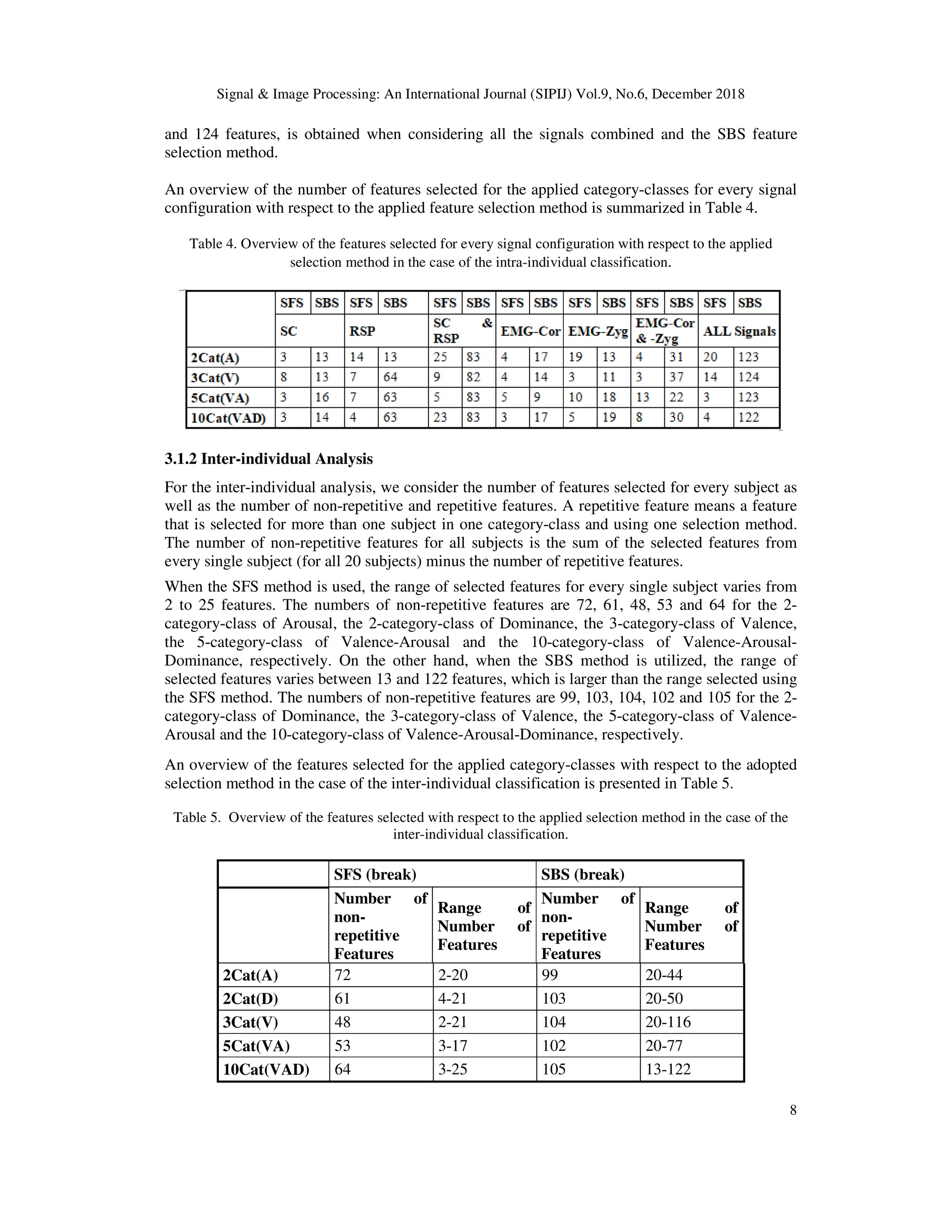
classification varies from 3 to 124 features. When the SFS selection method is applied, the
number of features selected does not exceed 25 features. This is overall less than the number of
features selected when the SBS method is used and which varies between 11 and 124 features.
Considering more than one signal, the amount of features selected is larger than considering only
one signal to classify the emotions. The largest amount of selected features, varying between 122](https://image.slidesharecdn.com/9618sipij01-251217115350-462b69e9/75/Individual-Emotion-Recognition-and-Subgroup-Analysis-from-Psychophysiological-Signals-7-2048.jpg)
![Signal & Image Processing: An International Journal (SIPIJ) Vol.9, No.6, December 2018
9
3.2. Classification Analysis
3.2.1 Intra-individual Classification
Table 6 summarizes the highest obtained recognition rates for the intra-individual classifications.
The results are illustrated for four different category-classes and for various signal configurations.
The adopted combinations of feature selection, classification algorithms and evaluation methods
are also presented in the table and are compatible with the results obtained from our previous
performance evaluation study [28].
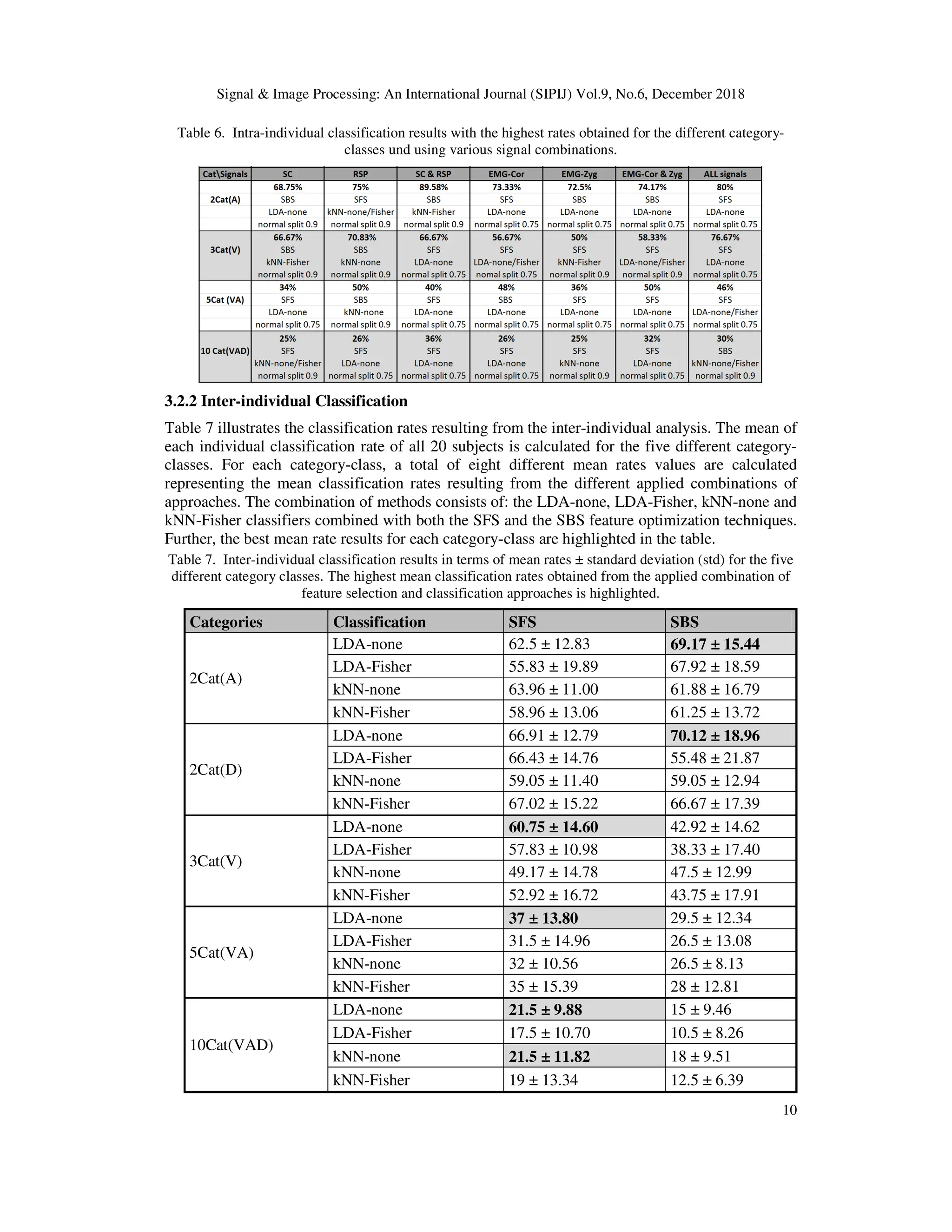
As shown in Table 6, for the 2-category-class of Arousal (A:+/-), the range of classification rates
varies from 68.75% to 89.58%. The highest recognition rate of 89.58% is obtained when
including respiration and skin conductivity signals in the analysis. This result is obtained using
the SBS feature selection, the kNN-none/Fisher classification algorithms and the normal split 0.9
evaluation method. Considering all physiological signals results in a comparable recognition rate
of 80%, using the SFS feature selection, the LDA-none classification and the normal split 0.75
evaluation method. Considering only a single physiological channel in this 2-category-class, the
respiration signal seems to best contribute to the performance, with a classification rate of 75%
obtained using the SFS feature selection, the kNN-none/Fisher classifier and the normal split 0.9
evaluation method. The least recognition rate of 68.75% is obtained when considering only skin
conductivity signal in the analysis, and using the SBS feature selection, the LDA-none classifier
and the normal split 0.9 evaluation method.
For the 3-category-class defined by the valence dimension (V: +/-/0), the classification rates
range from 50% to 76.67%. The highest recognition rate of 76.67% appears when fusing all
physiological signals together. This result is obtained using the SFS feature selection, the LDA-
none classification algorithm and the normal split 0.75 evaluation method. The second highest
recognition rate of 70.83% is obtained when only considering the respiration signal, using the
SBS feature selection, the kNN-none classification algorithm and normal split 0.9 evaluation
method. The least recognition rate of 50% is obtained when only considering the EMG-Zyg
signal channel and applying the kNN-Fisher classification algorithm combined with the SFS
feature selection and the normal split 0.9 evaluation method.
For the 5-category-class defined by the Valence and Arousal dimensions (VA: 0-/++/-+/+-/--), the
range of classification rates varies from 34% to 50%. The highest recognition rates of 50%
appears twice when considering only the respiration signal or the EMG-Corrugator combined
with EMG-Zygomaticus muscle signals together. This result is obtained when using the kNN-
none classifier combined with the SBS feature selection and the normal split 0.9 evaluation
method or using the LDA-none classification algorithm combined with the SFS feature selection
and the normal split 0.75 evaluation method, respectively. The least recognition rate of 34% is
obtained when only considering the skin conductivity signal and applying the SFS feature
selection approach combined with the LDA-none classification algorithm and the normal split
0.75 evaluation method.
For the 10-category-class of Valence-Arousal-Dominance dimensions, the range of classification
rates varies from 25% to 36%. The highest recognition rate of 36% is obtained when applying the
skin conductivity and respiration signals together. This result is obtained when using the SFS
feature selection combined with the LDA-none classification algorithm and the normal split 0.75
evaluation method. The least recognition rate of 25% appears twice when considering only skin
conductivity with kNN-none/Fisher classifier or only EMG-Zygomaticus signal with kNN-none
classification algorithm. Both least rates are obtained when using the SFS feature selection
technique and the normal split 0.9 evaluation method.](https://image.slidesharecdn.com/9618sipij01-251217115350-462b69e9/75/Individual-Emotion-Recognition-and-Subgroup-Analysis-from-Psychophysiological-Signals-9-2048.jpg)
![Signal & Image Processing: An International Journal (SIPIJ) Vol.9, No.6, December 2018
12
Table 9. Significance analysis between age differences and inter-individual classification rates obtained for
the 3-category-class of Valence and the 2-category-class of Dominance.
Category-class &
Classification
Approach
Age Nr. Mean ± Std. Test
3Cat(V) young 10 63.34 ± 9.78 Mann-Whitney U
SFS, LDA-Fisher old 10 52.33 ± 9.56 U = -2.179, p = 0.029
2Cat(D) young 10 72.85 ± 11.07 Independent-Samples t-Test
SFS, LDA-Fisher old 10 60.00 ± 15.67 F = 0.68, p = 0.048
2Cat(D) young 10 74.76 ± 15.71 Independent-Samples t-Test
SFS, kNN-Fisher old 10 59.28 ± 10.44 F = 1.5, p = 0.018
When both age and gender are considered for the subgroup analysis, the one-way ANOVA
analysis indicates significant differences among the groups of the young-men, the young-women,
the old-men and the old-women (F = 5.235, p = 0.01) for the 5-category-class of Valence-
Arousal. The classification results are obtained when using the SBS feature selection and the
kNN-none classifier. The results of this subgroup analysis are illustrated in Table 10.
Table 10. Significance analysis between age & gender differences and inter-individual classification rates
obtained for the 5-category-class of Valence-Arousal.
Category/Method Age-Gender Nr. Mean ± Std. Test
young-men 5 36.00 ± 5.48
5Cat(VA) young-women 5 22.00 ± 4.47 one-way ANOVA ; LSD
SBS, kNN-none old-men 6 23.33 ± 8.16 F = 5.235, p= 0.010
old-women 4 25.00 ± 5.77
Further, the result of the post-hoc test (LSD) presented in Table 11 reveals that the mean of inter-
individual classification rates of young men (36%) is significantly higher than that of the other
groups.
Table 11. Significance analysis for the age & gender differences from the LSD post-hoc test.
young-men young-women old-men old-women
young-men 0.003**
0.004**
0.019*
young-women 0.731 0.487
old-men 0.687
old-women
4. DISCUSSION
For the intra-individual classifications, we conducted similar analysis as in our previous studies
and obtained comparable findings [28,34]. First, the classification results for all category-classes
are above the probability for random hits due to chance (50%, 33.3%, 20% and 10%](https://image.slidesharecdn.com/9618sipij01-251217115350-462b69e9/75/Individual-Emotion-Recognition-and-Subgroup-Analysis-from-Psychophysiological-Signals-12-2048.jpg)
![Signal & Image Processing: An International Journal (SIPIJ) Vol.9, No.6, December 2018
13
respectively). Further, the best recognition rates of 89.58%, 76.67%, 50% and 36% for the 2-, 3-,
5- and 10-category-classes respectively, are obtained when considering more than one
physiological signal. This is also consistent with our previous finding stating that multi-channels
recognition improves the results compared to single channel performance. Further, when
considering only one signal, the highest recognition is always obtained with the respiration,
showing again this channel contributes the most to the classification rates. Further, except for the
2-category-class, the best results are derived from the LDA-none classifier combined with the
SFS feature selection and the 0.75 normal split evaluation method. This is also in accordance with
our previous performance evaluation study showing that the mentioned approaches together
present a relatively robust combination leading to the best results.
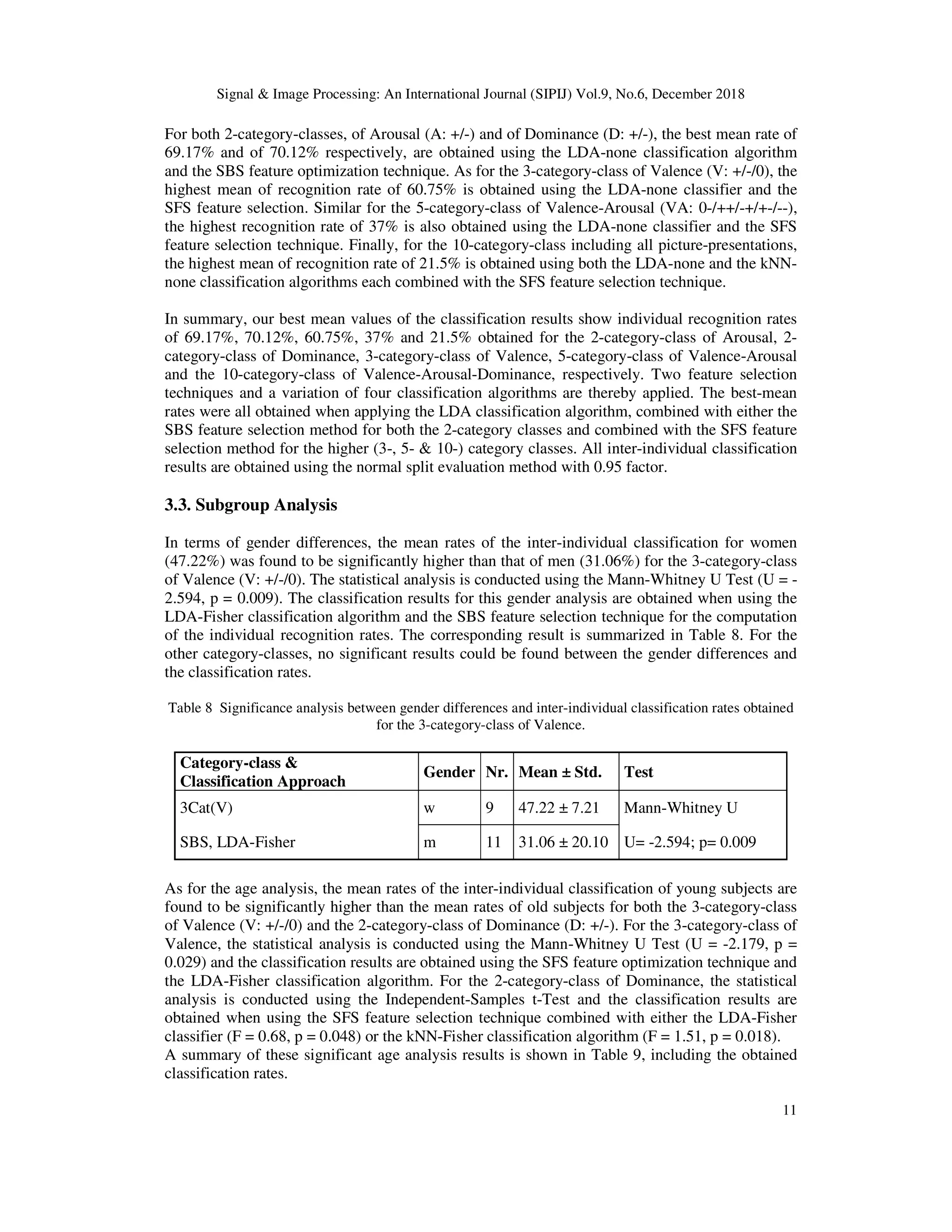
As for the extended inter-individual classification analysis, the averages of each individual
classification rate are also above the probability for random hits due to chance, but the
performance of the inter-individual classification is not as good as the intra-individual one.
Moreover, the standard deviations of the inter-individual classifications show high values, stating
that large inter-individual variability is present between the subjects. These findings are
reasonable due to the inter-individual differences in physiological responses and are consistent
with several previous studies. They explain the fact why it is harder to get high-performing inter-
individual classification compared to intra-individual classifications [8,9].
Further, feature analysis related to the amount of features selected for both the intra-individual
and inter-individual classifications is presented for all the applied category-classes and shows
large variations with respect to the adopted physiological signals and feature selection methods.
An extended analysis related to the type of features used and selected for both intra- and inter-
individual classifications and for the different combination of approaches is not explicitly
presented here as it goes beyond the frame of this paper.
Finally, the objective of the subgroup analysis was to investigate the influence of gender and age
differences on the physiological recognition rates. From the perspective of gender, women have
higher classification rates and smaller deviations than men for the 3-category-class defined by the
Valence dimension. This means that the physiological emotional reactions on the valence axis are
distinguished easier for females than for males. One possible explanation is that women are more
expressive than men. Women exhibit more positive expressions in response to a positive stimulus
and more negative expressions in response to a negative stimulus, so that the variations of the
EMG-Corrugator and EMG-Zygomaticus signals of women are greater than those of men [36].
Further, the present finding is also supported by Wilhelm et al.’ study, stating that women have
more respiratory reactivity than men in response to high arousal / negative stimulus, but smaller
respiratory reactivity than men in response to high arousal / positive stimulus [19]. From the
perspective of age, the averages of classification rates of young subjects are higher than those of
old subjects for the 3-category-class of Valence and the 2-category-class of Dominance. This
means that it is easier to recognize the physiological emotional reactions of young people than
those of older people on the axis of Valence or Dominance. This finding can be explained and
supported by several previous studies, which demonstrate that the magnitude of physiological
changes related to emotions are much smaller for elderly subjects than for young subjects [15,16].
Moreover, the present study also explores the effect of gender and age combined on the
recognition rates. The average of classification rates of young men are found to be significantly
higher than the rates of the other groups for the 5-category-class. Similar results -though only
associated to the arousal dimension- states that young men are much sensitive to arousal resulting
in large physiological changes [16].](https://image.slidesharecdn.com/9618sipij01-251217115350-462b69e9/75/Individual-Emotion-Recognition-and-Subgroup-Analysis-from-Psychophysiological-Signals-13-2048.jpg)
![Signal & Image Processing: An International Journal (SIPIJ) Vol.9, No.6, December 2018
14
5. CONCLUSION
In the present study we present intra- and inter-individual emotion classifications using
psychophysiological biosignals and investigate the effect of age and gender and their interaction
on the classification rates of emotions. The best recognition rates are obtained using similar
combination of feature selection techniques, classification algorithms and evaluation approaches
as obtained in our previous performance evaluation study. The highest intra-individual
recognition rates are obtained using multi-channel classifications fusing more than one
physiological signal. Further, the respiration signal is found to contribute the most to the intra-
individual classification. Moreover, we conduct extended inter-individual classifications to
evaluate the individual differences during the emotion recognition process. The results show large
inter-individual variability in physiological responses between the subjects as stated in various
studies. Finally, the subgroup analysis explores the effect of gender and age on the classification
rates. We found that classification rates of women are significantly higher than the rates of men
for the 3-category-class of Valence. Also, young subjects have significantly higher rates than old
subjects for the 3-category-class of Valence and the 2-category-class of Dominance. Moreover,
the emotion recognition of young men performed the best among the other subgroups for the 5-
category-class of Valence/Arousal. Based on the recognition differences related to gender and
age, subject-independent models could be improved to provide better classification results. Also,
collecting data from a larger sample of subjects is reasonable to validate the current results.
Finally, including further modalities such as facial expression, body gestures, audios and videos
with the psychophysiological signals would be beneficial to the emotion recognition in various
human computer interaction applications.
ACKNOWLEDGEMENTS
The authors´ research was supported by the Transregional Collaborative Research Center
SFB/TRR 62 Companion Technology for Cognitive Technical Systems funded by the German
Research Foundation (DFG). It is also supported by a Margarete von Wrangell (MvW)
Habilitation scholarship funded by the Ministry of Science, Research and Arts (MWK) of the
state of Baden-Württemberg for Dr. Dilana Hazer-Rau and a doctoral scholarship funded by the
China Scholarship Council (CSC) for Lin Zhang.
REFERENCES
[1] D. Rösner, D. Hazer-Rau, C. Kohrs, T. Bauer, S. Günther, H. Hoffmann, L. Zhang, & A. Brechmann,
"Is There a Biological Basis for Success in Human Companion Interaction?” In: Kurosu M. (Ed),
Human-Computer Interaction, HCI 2016, Part I, Lecture Notes in Computer Science LNCS, vol.
9731, p. 77–88, Springer, 2016.
[2] R.A. Calvo, S. D’Mello, “Affect Detection: An interdisciplinary Review of Models, Methods, and
Their Applications.” IEEE Transactions on affective computing, 1(1), 2010.
[3] P. Patel, A. Chaudhari, R. Kale, M.A.Pund, "Emotion recognition from speech with gaussian mixture
models & via boosted GMM" International Journal of Research In Science & Engineering IJRISE,
Vol. 3, Issue 2, 2017.
[4] I. Mohino-Herranz, R. Gil-Pita, S. Alonso-Diaz, M. Rosa-Zurera, “MFCC Based Enlargement of the
Training Set for Emotion Recognition in Speech.” Signal & Image Processing: An International
Journal (SIPIJ), vol.5, No.1, 2014.
[5] A. Pentland, & S. Pentland, Honest signals: how they shape our world. Bradford Books. MIT Press,
2008.](https://image.slidesharecdn.com/9618sipij01-251217115350-462b69e9/75/Individual-Emotion-Recognition-and-Subgroup-Analysis-from-Psychophysiological-Signals-14-2048.jpg)
![Signal & Image Processing: An International Journal (SIPIJ) Vol.9, No.6, December 2018
15
[6] N. Jatupaiboon, S. Pan-Ngum, & P. Israsena, “Subject-dependent and subject-independent emotion
classification using unimodal and multimodal physiological signals.” Journal of Medical Imaging and
Health Informatics, 5(5), 1020-1027, 2015.
[7] M. Ali, F. Al Machot, A.H. Mosa, & K. Kyamakya, “CNN Based Subject-Independent Driver
Emotion Recognition System Involving Physiological Signals for ADAS.” In Advanced
Microsystems for Automotive Applications, 125-138, 2016.
[8] J. Chen, B. Hu, Y. Wang, P. Moore, Y. Dai, L. Feng, & Z. Ding, “Subject-independent emotion
recognition based on physiological signals: a three-stage decision method.” BMC medical informatics
and decision making, 17(3), 167, 2017.
[9] F. Al Machot, M. Ali, S. Ranasinghe, A.H. Mosa, & K. Kyandoghere, “Improving Subject-
independent Human Emotion Recognition Using Electrodermal Activity Sensors for Active and
Assisted Living”, 2018.
[10] R. Böck, S. Glüge, A. Wendemuth, K. Limbrecht, S. Walter, D. Hrabal, & H.C. Traue,
“Intraindividual and interindividual multimodal emotion analyses in human-machine-interaction.” In
Cognitive Methods in Situation Awareness and Decision Support (CogSIMA), 2012 IEEE
International Multi-Disciplinary Conference, pp. 59-64, 2012.
[11] M.M. Bradley, M. Codispoti, D. Sabatinelli, & P.J. Lang, “Emotion and motivation II: sex differences
in picture processing.” Emotion, 1(3), 300, 2001.
[12] D. Hazer, X.Y. Ma, S. Rukavina, S. Gruss, S. Walter, & H. C. Traue, "Emotion elicitation using film
clips: Effect of age groups on movie choice and emotion rating." . In: Stephanidis C. (Ed.), Human-
Computer Interaction, HCI 2015, Part I, Communications in Computer and Information Science
CCIS, vol. 528, p. 110–116, Springer, 2015.
[13] C. Lithari, C.A. Frantzidis, C. Papadelis, A.B. Vivas, M.A. Klados, C. Kourtidou-Papadeli, C.
Pappas, A.A. loannides, & P.D. Bamidis, “Are females more responsive to emotional stimuli? A
neurophysiological study across arousal and valence dimensions.” Brain topography, 23(1), 27-40,
2010.
[14] D. Sabatinelli, T. Flaisch, M.M. Bradley, J.R. Fitzsimmons, & P.J. Lang, “Affective picture
perception: gender differences in visual cortex?” Neuroreport, 15(7), 1109-1112, 2004.
[15] R.W. Levenson, L.L. Carstensen, W.V. Friesen, & P. Ekman, “Emotion, physiology, and expression
in old age.” Psychology and aging, 6(1), 28, 1991.
[16] L. Burriss, , D.A. Powell, , & J. White, “Psychophysiological and subjective indices of emotion as a
function of age and gender.” Cognition and emotion, 21(1), 182-210, 2007.
[17] T. Vogt, & E. André, “Improving automatic emotion recognition from speech via gender
differentiation.” In Proc. Language Resources and Evaluation Conference (LREC 2006), Genoa,
2006.
[18] S. Rukavina, S. Gruss, H. Hoffmann, J.W. Tan, S. Walter, & H.C. Traue, “Affective computing and
the impact of gender and age.” PloS one 11.3, 2016.
[19] F.H. Wilhelm, J.A. Rattel, M. Wegerer, M. Liedlgruber, S. Schweighofer, S.D. Kreibig, V.
Kolodyazhniy, & J. Blechert, “Attend or defend? Sex differences in behavioral, autonomic, and
respiratory response patterns to emotion–eliciting films.” Biological psychology 130 : 30-40, 2017.
[20] S. Gupta, J. Jaafar, W.F. wan Ahmad, A. Bansal, “Feature Extraction using MFCC.” Signal & Image
Processing: An International Journal (SIPIJ), vol.4, No.4, 2013.](https://image.slidesharecdn.com/9618sipij01-251217115350-462b69e9/75/Individual-Emotion-Recognition-and-Subgroup-Analysis-from-Psychophysiological-Signals-15-2048.jpg)
![Signal & Image Processing: An International Journal (SIPIJ) Vol.9, No.6, December 2018
16
[21] R.W. Picard, “Affective computing: challenges.” International Journal of Human-Computer Studies,
59(1), 55-64, 2003.
[22] S. A. Fattah, Md. A. Iqbal, M. A. Jumana, A.B.M. S. Ud Doulah, “Identifying the Motor Neuron
Disease in EMG Signal using Time and Frequency Domain Features with Comparison.” Signal &
Image Processing: An International Journal (SIPIJ), vol.3, No.2, 2012.
[23] Y.L. Hsu, J.S. Wang, W.C. Wang, C.H. Hung, "Automatic ECG-Based Emotion Recognition in
Music Listening." IEEE Transactions on Affective Computing, 2017.
[24] J.A. Healey and R.W. Picard, “Detecting stress during realworld driving tasks using physiological
sensors,” IEEE Transactions on Intelligent Transportation Systems, Vol. 6, 156-166, 2005.
[25] W. Wei, Q. Jia, Y. Feng, G. Chen, “ Emotion Recognition Based on Weighted Fusion Strategy of
Multichannel Physiological Signals." Computational Intelligence and Neuroscience, Article ID:
5296523, 2018.
[26] J. Kim, “Bimodal emotion recognition using speech and physiological changes,” in Robust Speech
Recognition and Understanding, M. Grimm and K. Kroschel, Eds. I-Tech Education and Publishing,
Vienna, Austria, pp. 265–280, 2007.
[27] C. Frantzidis, C. Bratsas, C. Papadelis, E. Konstandinidis, C. Pappas, and P. Bamidis, “Towards
emotion aware computing: An integrated approach using multi-channel neuro-physiological
recordings and affective visual stimuli,” IEEE Trans. on Information Technology in Biomedicine,
Vol. 14, No. 3, pp. 589, 2010.
[28] D. Hazer-Rau, L. Zhang, , & H. C. Traue, “Performance evaluation of various emotion classification
approaches from physiological signals.” International Journal of Artificial Intelligence and
Applications (IJAIA), Vol.9, No 4, pp. 31-41, 2018.
[29] P. Lang, M. Bradley & B. Cuthbert, “International affective picture system (iaps): Affective ratings of
pictures and instruction manual,” University of Florida, Gainesville, FL, USA, Tech. Rep., 2008.
[30] S. Walter, J. Kim, D. Hrabal, S.C. Crawcour, H. Kessler, & H.C. Traue, “Transsituational individual-
specific biopsychological classification of emotions.” Systems, Man, and Cybernetics: Systems, IEEE
Transactions on, 43(4), 988-995, 2013.
[31] G. Valenza, A. Lanata, and E.P. Scilingo, "The Role of Nonlinear Dynamics in Affective Valence and
Arousal Recognition". IEEE Transactions on Affective Computing, ParePrints. 99, 2011.
[32] J. Wagner, Augsburg biosignal toolbox (Aubt) – User Guide. University of Augsburg, 2006.
[33] J. Wagner, J. Kim, E. André, “From Physiological Signals to Emotions: Implementing and
Comparing Selected Methods for Feature Extraction and Classification.” In IEEE International
Conference on Multimedia & Expo (ICME), 2005.
[34] L. Zhang, S. Rukavina, S. Gruss, H.C. Traue, D. Hazer, “Classification analysis for the emotion
recognition from psychobiological data.” In: International Symposium on Companion-Technology,
ISCT, IEEE, 2015.
[35] A. A. Afifi, & S. P. Azen, Statistical analysis: a computer oriented approach. Academic press, 2014.
[36] A.M. Kring, & A.H. Gordon, “Sex differences in emotion: expression, experience, and physiology.”
Journal of personality and social psychology, 74(3), 686, 1998.](https://image.slidesharecdn.com/9618sipij01-251217115350-462b69e9/75/Individual-Emotion-Recognition-and-Subgroup-Analysis-from-Psychophysiological-Signals-16-2048.jpg)

This study involves intra- and inter-individual emotion classifications from psychophysiological signals and subgroup analysis on the influence of gender and age and their interaction on the emotion recognition. Individual classifications are conducted using a selection of feature optimization, classification and evaluation approaches. The subgroup analysis is based on the inter-individual classification. Emotion elicitation is conducted using standardized pictures in the Valence-Arousal-Dominance dimensions and affective states are classified into five different category classes. Advantageous intra-individual rates are obtained via multi-channel classification and the respiration best contributes to the recognition. High interindividual variances are obtained showing large variability in physiological responses between the subjects. Classification rates are significantly higher for women than for men for the 3-category-class of Valence. Compared to old subjects, young subjects have significantly higher rates for the 3-category-class and 2-category-class of Dominance. Moreover, young men’s classification performed the best among the other subgroups for the 5-category-class of Valence/Arousal.


![[Seminar] 200910 Hyeonwook Lee](https://cdn.slidesharecdn.com/ss_thumbnails/20200910affectivestatepredictionbasedonsemi-supervisedlearningfromsmartphonetouchdata-201021044040-thumbnail.jpg?width=640&height=640&fit=bounds)


