INDIAN RETAIL SCENARIO

 As the contemporary retail sector in India is reflected in sprawling shopping centers,
 multiplex- malls and huge complexes offer shopping, entertainment and food all under
 one roof, the concept of shopping has altered in terms of format and consumer buying
 behavior, ushering in a revolution in shopping in India. This has also contributed to
 large-scale investments in the real estate sector with major national and global players
 investing in developing the infrastructure and construction of the retailing business.
 The trends that are driving the growth of the retail sector in India are

   •   Low share of organized retailing
   •   Falling real estate prices
   •   Increase in disposable income and customer aspiration
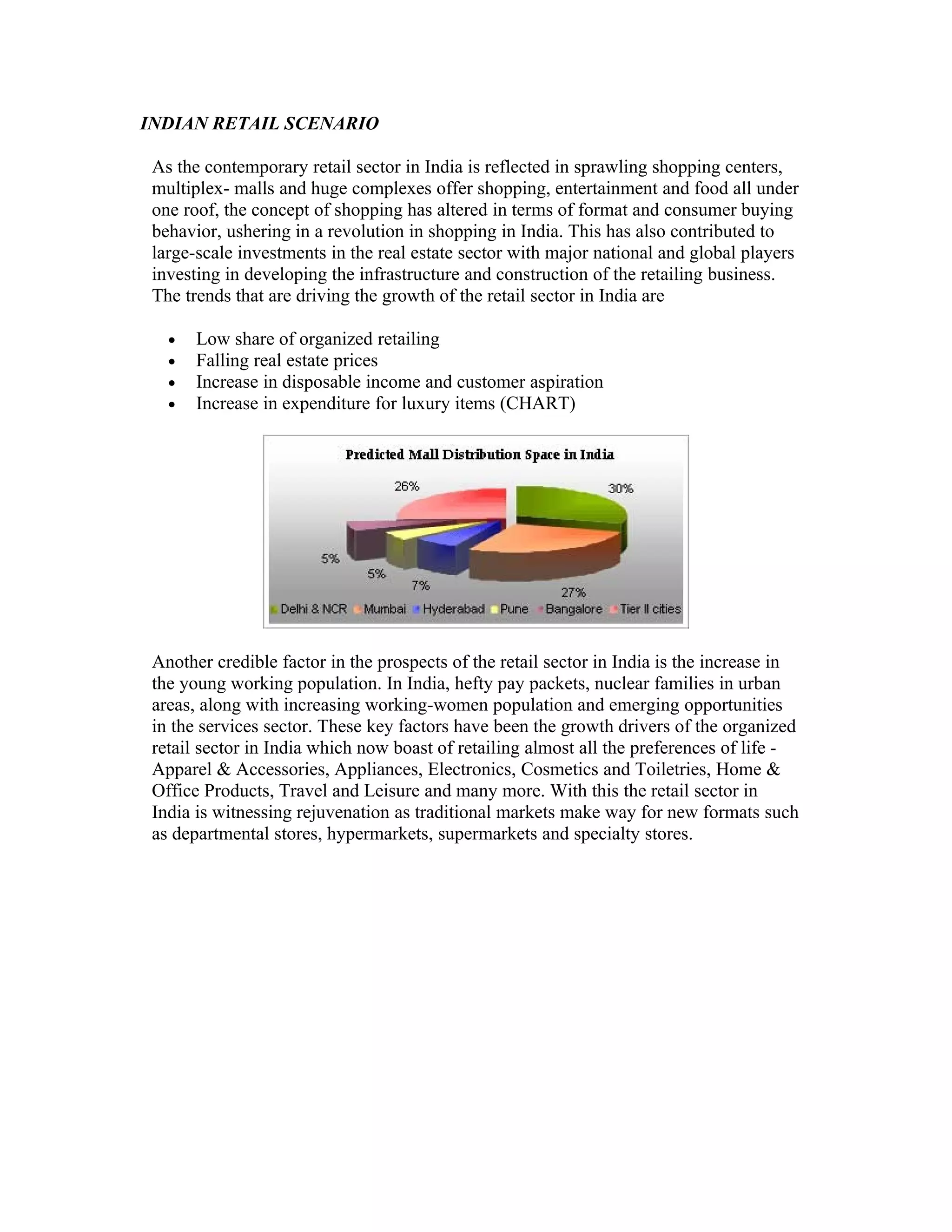
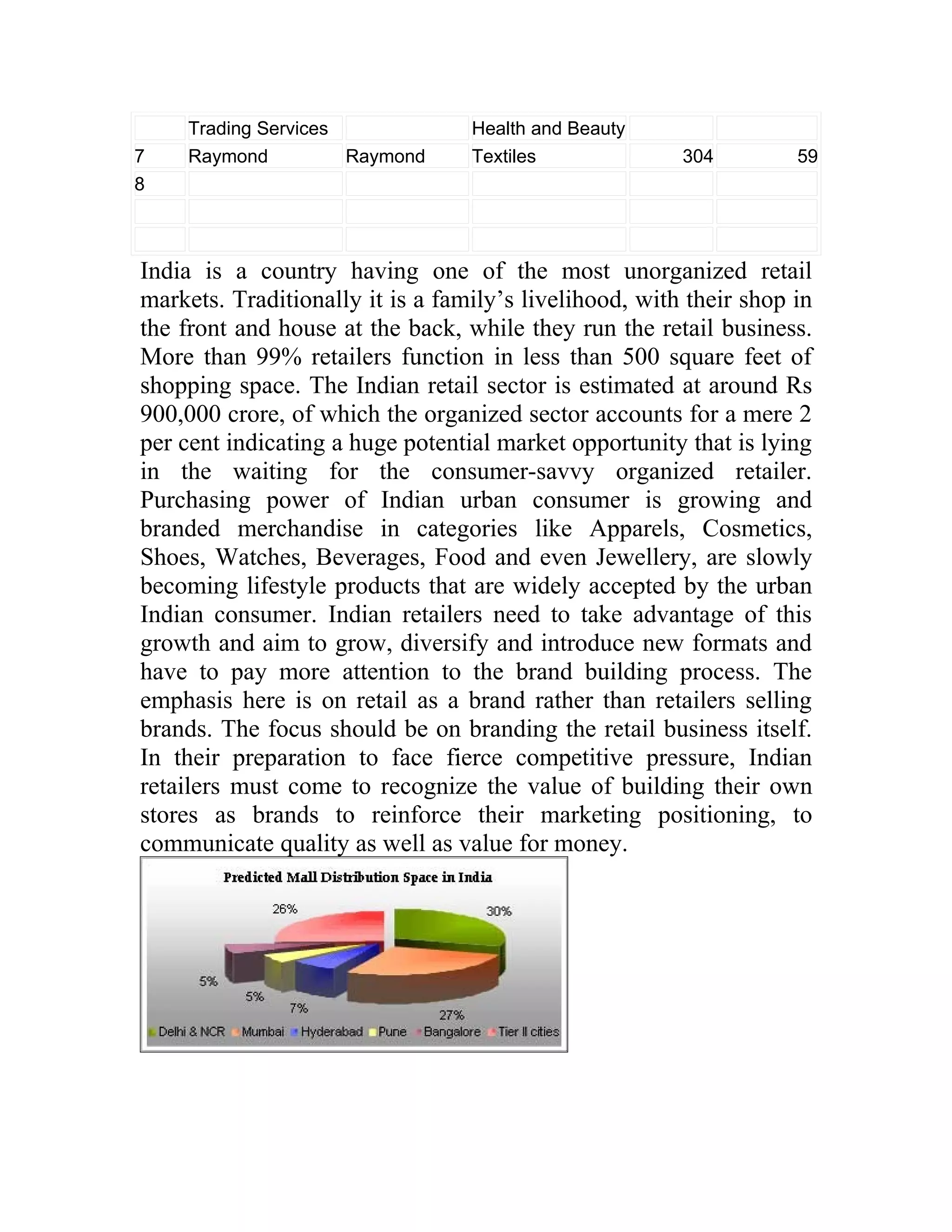
   •   Increase in expenditure for luxury items (CHART)


 Another credible factor in the prospects of the retail sector in India is the increase in
 the young working population. In India, hefty pay packets, nuclear families in urban
 areas, along with increasing working-women population and emerging opportunities
 in the services sector. These key factors have been the growth drivers of the organized
 retail sector in India which now boast of retailing almost all the preferences of life -
 Apparel & Accessories, Appliances, Electronics, Cosmetics and Toiletries, Home &
 Office Products, Travel and Leisure and many more. With this the retail sector in
 India is witnessing rejuvenation as traditional markets make way for new formats such
 as departmental stores, hypermarkets, supermarkets and specialty stores.
 The India Retail Industry is the largest among all the industries, accounting for
     over 10 per cent of the country�s GDP and around 8 per cent of the
     employment. The Retail Industry in India has come forth as one of the most
     dynamic and fast paced industries with several players entering the market. But
     all of them have not yet tasted success because of the heavy initial investments
     that are required to break even with other companies and compete with them. The
     India Retail Industry is gradually inching its way towards becoming the next
     boom industry.

         The total concept and idea of shopping has undergone an attention drawing
         change in terms of format and consumer buying behavior, ushering in a revolution
         in shopping in India. Modern retailing has entered into the Retail market in India
         as is observed in the form of bustling shopping centers, multi-storied malls and
         the huge complexes that offer shopping, entertainment and food all under one
         roof.

         A large young working population with median age of 24 years, nuclear families
         in urban areas, along with increasing workingwomen population and emerging
         opportunities in the services sector are going to be the key factors in the growth of
         the organized Retail sector in India. The growth pattern in organized retailing and
         in the consumption made by the Indian population will follow a rising graph
         helping the newer businessmen to enter the India Retail Industry.

         In India the vast middle class and its almost untapped retail industry are the key
         attractive forces for global retail giants wanting to enter into newer markets,
         which in turn will help the India Retail Industry to grow faster. Indian retail is
         expected to grow 25 per cent annually. Modern retail in India could be worth US$
         175-200 billion by 2016. The Food Retail Industry in India dominates the
         shopping basket. The Mobile phone Retail Industry in India is already a US$ 16.7
         billion business, growing at over 20 per cent per year. The future of the India
         Retail Industry looks promising with the growing of the market, with the
         government policies becoming more favorable and the emerging technologies
         facilitating operations.


global


Retail has played a major role world over in increasing
productivity across a wide range of consumer goods and
services .The impact can be best seen in countries like U.S.A.,
U.K., Mexico, Thailand and more recently China. Economies of
countries like Singapore, Malaysia, Hong Kong, Sri Lanka and
Dubai are also heavily assisted by the retail sector. Retail is the
second-largest industry in the United States both in number of
establishments and number of employees. It is also one of the
largest world-wide. The retail industry employs more than 22
million Americans and generates more than $3 trillion in retail sale
annually. Retailing is a U.S. $7 trillion sector. Wal-Mart is the
world’s largest retailer. Already the world’s largest employer with
over 1million associates, Wal-Mart displaced oil giant Exxon
Mobil             as          the           world’s          largest
Company when it posted $219 billion in sales for fiscal 2001. Wal-
Mart has become the most successful retail brand in the world due
its ability to leverage size, market clout, and efficiency to create
market dominance. Wal-Mart heads Fortune magazine list of top
500 companies in the world. Forbes Annual List of Billionaires has
the largest number (45/497) from the retail business.


                                                            Number
                                                                      Turnover,
Rank Company/Name Retail Outlets Store Types                of
                                                                      Mio $
                                                            Outlets
1    Bata               Bata            Textiles                1,600        152
                        Food Bazar,     Supermarkets,
2    Pantaloon Retail   Pantaloons,     Hypermarkets,             60        149
                        Big Bazaar      Department stores
                        Foodworld,      Supermarkets,
3    RPG Group          Spencer,        Hypermarkets,            150        123
                        Health & Glow   Health and Beauty
                        Shopper‘s
4    Shopper‘s Stop                     Department stores         17        113
                        Stop
                                        Department stores
5    Lifestyle          Lifestyle                                  7         62
                                        s
6    Subhiksha          Subhiksha       Supermarkets,            183         61
Trading Services             Health and Beauty
7    Raymond          Raymond     Textiles              304         59
8


India is a country having one of the most unorganized retail
markets. Traditionally it is a family’s livelihood, with their shop in
the front and house at the back, while they run the retail business.
More than 99% retailers function in less than 500 square feet of
shopping space. The Indian retail sector is estimated at around Rs
900,000 crore, of which the organized sector accounts for a mere 2
per cent indicating a huge potential market opportunity that is lying
in the waiting for the consumer-savvy organized retailer.
Purchasing power of Indian urban consumer is growing and
branded merchandise in categories like Apparels, Cosmetics,
Shoes, Watches, Beverages, Food and even Jewellery, are slowly
becoming lifestyle products that are widely accepted by the urban
Indian consumer. Indian retailers need to take advantage of this
growth and aim to grow, diversify and introduce new formats and
have to pay more attention to the brand building process. The
emphasis here is on retail as a brand rather than retailers selling
brands. The focus should be on branding the retail business itself.
In their preparation to face fierce competitive pressure, Indian
retailers must come to recognize the value of building their own
stores as brands to reinforce their marketing positioning, to
communicate quality as well as value for money.
Sustainable competitive advantage will be dependent on
translating core values combining products, image and reputation
into a coherent retail brand strategy. There is no doubt that the
Indian retail scene is booming. A number of large corporate houses
— Tata’s, Raheja’s, Piramals’s, Goenka’s — have already made
their foray into this arena, with beauty and health stores,
supermarkets, self-service music stores, newage book stores,
every-day-low-price stores, computers and peripherals stores,
office equipment stores and home/building construction stores.
Every retail category has been attacked, by the organized players
today. The Indian retail scene has witnessed too many players in
too short a time, crowding several categories without looking at
their core competencies, or having a well thought out branding
strategy. To illustrate, the Indianlifestyle/fashion retail scene is
already exhibiting the following characteristics, which do not
augur             well           for            its           future.

Lack of store differentiation: Leading retail stores like Shoppers
Stop, Lifestyle, Ebony, Globus, and Pyramid, offer common
brands, similar ambience, and a commitment to improved service.

Indian retail scenario

  • 1.
    INDIAN RETAIL SCENARIO As the contemporary retail sector in India is reflected in sprawling shopping centers, multiplex- malls and huge complexes offer shopping, entertainment and food all under one roof, the concept of shopping has altered in terms of format and consumer buying behavior, ushering in a revolution in shopping in India. This has also contributed to large-scale investments in the real estate sector with major national and global players investing in developing the infrastructure and construction of the retailing business. The trends that are driving the growth of the retail sector in India are • Low share of organized retailing • Falling real estate prices • Increase in disposable income and customer aspiration • Increase in expenditure for luxury items (CHART) Another credible factor in the prospects of the retail sector in India is the increase in the young working population. In India, hefty pay packets, nuclear families in urban areas, along with increasing working-women population and emerging opportunities in the services sector. These key factors have been the growth drivers of the organized retail sector in India which now boast of retailing almost all the preferences of life - Apparel & Accessories, Appliances, Electronics, Cosmetics and Toiletries, Home & Office Products, Travel and Leisure and many more. With this the retail sector in India is witnessing rejuvenation as traditional markets make way for new formats such as departmental stores, hypermarkets, supermarkets and specialty stores.
  • 2.
     The IndiaRetail Industry is the largest among all the industries, accounting for over 10 per cent of the country�s GDP and around 8 per cent of the employment. The Retail Industry in India has come forth as one of the most dynamic and fast paced industries with several players entering the market. But all of them have not yet tasted success because of the heavy initial investments that are required to break even with other companies and compete with them. The India Retail Industry is gradually inching its way towards becoming the next boom industry. The total concept and idea of shopping has undergone an attention drawing change in terms of format and consumer buying behavior, ushering in a revolution in shopping in India. Modern retailing has entered into the Retail market in India as is observed in the form of bustling shopping centers, multi-storied malls and the huge complexes that offer shopping, entertainment and food all under one roof. A large young working population with median age of 24 years, nuclear families in urban areas, along with increasing workingwomen population and emerging opportunities in the services sector are going to be the key factors in the growth of the organized Retail sector in India. The growth pattern in organized retailing and in the consumption made by the Indian population will follow a rising graph helping the newer businessmen to enter the India Retail Industry. In India the vast middle class and its almost untapped retail industry are the key attractive forces for global retail giants wanting to enter into newer markets, which in turn will help the India Retail Industry to grow faster. Indian retail is expected to grow 25 per cent annually. Modern retail in India could be worth US$ 175-200 billion by 2016. The Food Retail Industry in India dominates the shopping basket. The Mobile phone Retail Industry in India is already a US$ 16.7 billion business, growing at over 20 per cent per year. The future of the India Retail Industry looks promising with the growing of the market, with the government policies becoming more favorable and the emerging technologies facilitating operations. global Retail has played a major role world over in increasing productivity across a wide range of consumer goods and
  • 3.
    services .The impactcan be best seen in countries like U.S.A., U.K., Mexico, Thailand and more recently China. Economies of countries like Singapore, Malaysia, Hong Kong, Sri Lanka and Dubai are also heavily assisted by the retail sector. Retail is the second-largest industry in the United States both in number of establishments and number of employees. It is also one of the largest world-wide. The retail industry employs more than 22 million Americans and generates more than $3 trillion in retail sale annually. Retailing is a U.S. $7 trillion sector. Wal-Mart is the world’s largest retailer. Already the world’s largest employer with over 1million associates, Wal-Mart displaced oil giant Exxon Mobil as the world’s largest Company when it posted $219 billion in sales for fiscal 2001. Wal- Mart has become the most successful retail brand in the world due its ability to leverage size, market clout, and efficiency to create market dominance. Wal-Mart heads Fortune magazine list of top 500 companies in the world. Forbes Annual List of Billionaires has the largest number (45/497) from the retail business. Number Turnover, Rank Company/Name Retail Outlets Store Types of Mio $ Outlets 1 Bata Bata Textiles 1,600 152 Food Bazar, Supermarkets, 2 Pantaloon Retail Pantaloons, Hypermarkets, 60 149 Big Bazaar Department stores Foodworld, Supermarkets, 3 RPG Group Spencer, Hypermarkets, 150 123 Health & Glow Health and Beauty Shopper‘s 4 Shopper‘s Stop Department stores 17 113 Stop Department stores 5 Lifestyle Lifestyle 7 62 s 6 Subhiksha Subhiksha Supermarkets, 183 61
  • 4.
    Trading Services Health and Beauty 7 Raymond Raymond Textiles 304 59 8 India is a country having one of the most unorganized retail markets. Traditionally it is a family’s livelihood, with their shop in the front and house at the back, while they run the retail business. More than 99% retailers function in less than 500 square feet of shopping space. The Indian retail sector is estimated at around Rs 900,000 crore, of which the organized sector accounts for a mere 2 per cent indicating a huge potential market opportunity that is lying in the waiting for the consumer-savvy organized retailer. Purchasing power of Indian urban consumer is growing and branded merchandise in categories like Apparels, Cosmetics, Shoes, Watches, Beverages, Food and even Jewellery, are slowly becoming lifestyle products that are widely accepted by the urban Indian consumer. Indian retailers need to take advantage of this growth and aim to grow, diversify and introduce new formats and have to pay more attention to the brand building process. The emphasis here is on retail as a brand rather than retailers selling brands. The focus should be on branding the retail business itself. In their preparation to face fierce competitive pressure, Indian retailers must come to recognize the value of building their own stores as brands to reinforce their marketing positioning, to communicate quality as well as value for money.
  • 5.
    Sustainable competitive advantagewill be dependent on translating core values combining products, image and reputation into a coherent retail brand strategy. There is no doubt that the Indian retail scene is booming. A number of large corporate houses — Tata’s, Raheja’s, Piramals’s, Goenka’s — have already made their foray into this arena, with beauty and health stores, supermarkets, self-service music stores, newage book stores, every-day-low-price stores, computers and peripherals stores, office equipment stores and home/building construction stores. Every retail category has been attacked, by the organized players today. The Indian retail scene has witnessed too many players in too short a time, crowding several categories without looking at their core competencies, or having a well thought out branding strategy. To illustrate, the Indianlifestyle/fashion retail scene is already exhibiting the following characteristics, which do not augur well for its future. Lack of store differentiation: Leading retail stores like Shoppers Stop, Lifestyle, Ebony, Globus, and Pyramid, offer common brands, similar ambience, and a commitment to improved service.