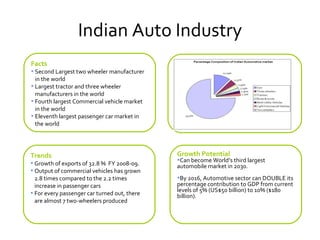
Indian Auto Industry Facts Second Largest two wheeler manufacturer in the world Largest tractor and three wheeler manufacturers in the world Fourth largest Commercial vehicle market in the world Eleventh largest passenger car market in the world Growth Potential Can become World’s third largest automobile market in 2030. By 2016, Automotive sector can DOUBLE its percentage contribution to GDP from current levels of 5% (US$50 billion) to 10% ($180 billion). Trends Growth of exports of 32.8 %  FY 2008-09.  Output of commercial vehicles has grown 2.8 times compared to the 2.2 times increase in passenger cars  For every passenger car turned out, there are almost 7 two-wheelers produced
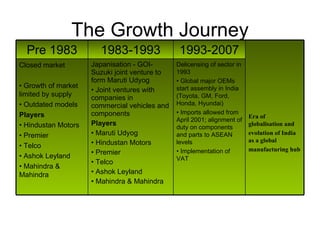
The Growth Journey Pre 1983 1983-1993 1993-2007 Era of globalisation and evolution of India as a global manufacturing hub Closed market •  Growth of market limited by supply •  Outdated models Players •  Hindustan Motors •  Premier •  Telco •  Ashok Leyland •  Mahindra & Mahindra Japanisation - GOI- Suzuki joint venture to form Maruti Udyog •  Joint ventures with companies in commercial vehicles and components Players •  Maruti Udyog •  Hindustan Motors •  Premier •  Telco •  Ashok Leyland •  Mahindra & Mahindra Delicensing of sector in 1993 •  Global major OEMs start assembly in India (Toyota, GM, Ford, Honda, Hyundai) •  Imports allowed from April 2001; alignment of duty on components and parts to ASEAN levels •  Implementation of VAT
Automotive Companies in India Major Multi-national companies Major Indian Companies
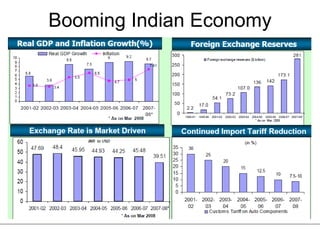
Booming Indian Economy
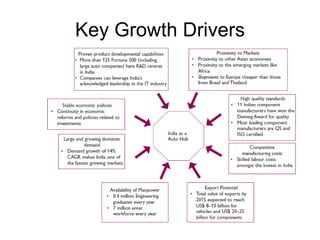
Key Growth Drivers
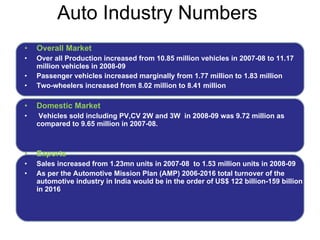
Auto Industry Numbers Overall Market Over all Production increased from 10.85 million vehicles in 2007-08 to 11.17 million vehicles in 2008-09 Passenger vehicles increased marginally from 1.77 million to 1.83 million  Two-wheelers increased from 8.02 million to 8.41 million Domestic Market    Vehicles sold including PV,CV 2W and 3W  in 2008-09 was 9.72 million as compared to 9.65 million in 2007-08. Exports Sales increased from 1.23mn units in 2007-08  to 1.53 million units in 2008-09 As per the Automotive Mission Plan (AMP) 2006-2016 total turnover of the automotive industry in India would be in the order of US$ 122 billion-159 billion in 2016
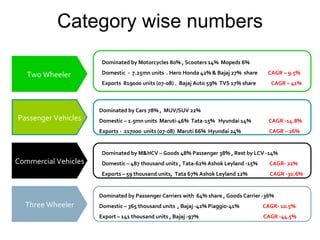
Category wise numbers Two Wheeler  Passenger Vehicles Commercial Vehicles Three Wheeler Dominated by Motorcycles 80% , Scooters 14%  Mopeds 6% Domestic  -  7.25mn units  . Hero Honda 42% & Bajaj 27%  share  CAGR – 9.5% Exports  819000 units (07-08) .  Bajaj Auto 59%  TVS 17% share  CAGR – 41% Dominated by Cars 78% ,  MUV/SUV 22% Domestic – 1.5mn units  Maruti-46%  Tata-15%  Hyundai 14%  CAGR -14.8% Exports -  217000  units (07-08)  Maruti 66%  Hyundai 24%  CAGR – 26% Dominated by M&HCV – Goods 48% Passenger 38% , Rest by LCV -14% Domestic – 487 thousand units , Tata-62% Ashok Leyland -15%  CAGR- 22% Exports – 59 thousand units,  Tata 67% Ashok Leyland 12%  CAGR -30.6% Dominated by Passenger Carriers with  64% share , Goods Carrier -36% Domestic – 365 thousand units  , Bajaj -42% Piaggio-41%  CAGR- 10.5% Export – 141 thousand units , Bajaj -97%  CAGR -44.5%
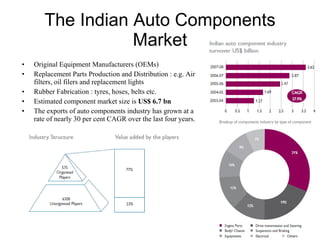
The Indian Auto Components Market Original Equipment Manufacturers (OEMs) Replacement Parts Production and Distribution : e.g. Air filters, oil filers and replacement lights  Rubber Fabrication : tyres, hoses, belts etc. Estimated component market size is  US$ 6.7 bn  The exports of auto components industry has grown at a rate of nearly 30 per cent CAGR over the last four years.
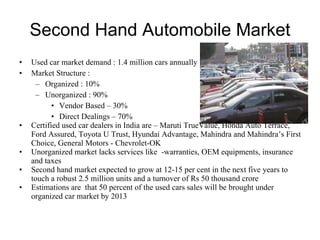
Second Hand Automobile Market Used car market demand : 1.4 million cars annually Market Structure :  Organized : 10% Unorganized : 90% Vendor Based – 30% Direct Dealings – 70% Certified used car dealers in India are – Maruti TrueValue, Honda Auto Terrace, Ford Assured, Toyota U Trust, Hyundai Advantage, Mahindra and Mahindra’s First Choice, General Motors - Chevrolet-OK  Unorganized market lacks services like  -warranties, OEM equipments, insurance and taxes Second hand market expected to grow at 12-15 per cent in the next five years to touch a robust 2.5 million units and a turnover of Rs 50 thousand crore  Estimations are  that 50 percent of the used cars sales will be brought under organized car market by 2013
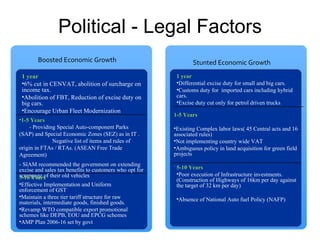
Political - Legal Factors Boosted Economic Growth 1 year  6% cut in CENVAT, abolition of surcharge on income tax. Abolition of FBT, Reduction of excise duty on big cars. Encourage Urban Fleet Modernization 1-5 Years  -  Providing Special Auto-component Parks (SAP) and Special Economic Zones (SEZ) as in IT .  Negative list of items and rules of origin in FTAs / RTAs. (ASEAN Free Trade Agreement) - SIAM recommended the government on extending  excise and sales tax benefits to customers who opt for scrappage of their old vehicles 5-10 Years Effective Implementation and Uniform enforcement of GST  Maintain a three tier tariff structure for raw materials, intermediate goods, finished goods. Revamp WTO compatible export promotional schemes like DEPB, EOU and EPCG schemes  AMP Plan 2006-16 set by govt Stunted Economic Growth 1 year  Differential excise duty for small and big cars. Customs duty for  imported cars including hybrid cars. Excise duty cut only for petrol driven trucks 1-5 Years  Existing Complex labor laws( 45 Central acts and 16 associated rules) Not implementing country wide VAT Ambiguous policy in land acquisition for green field projects . 5-10 Years Poor execution of Infrastructure investments. (Construction of Highways of 16km per day against the target of 32 km per day) Absence of National Auto fuel Policy (NAFP)
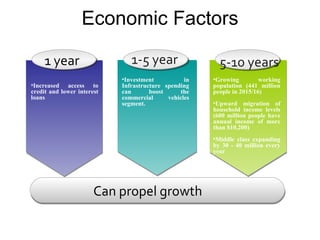
Economic Factors 1 year 1-5 year 5-10 years Increased access to credit and lower interest loans Investment in Infrastructure spending can boost the commercial vehicles segment. Growing working population (441 million people in 2015/16) Upward migration of household income levels (600 million people have annual income of more than $10,200) Middle class expanding by 30 - 40 million every year Can propel growth
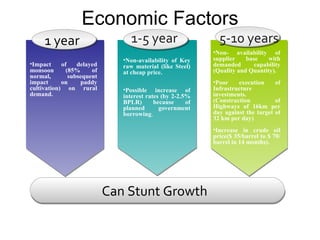
Economic Factors 1 year 1-5 year 5-10 years Impact of delayed monsoon (85% of normal, subsequent impact on paddy cultivation) on rural demand. Non-availability of Key raw material (like Steel) at cheap price. Possible increase of interest rates (by 2-2.5% BPLR) because of planned government borrowing . Non- availability of supplier base with demanded capability (Quality and Quantity). Poor execution of Infrastructure investments. (Construction of Highways of 16km per day against the target of 32 km per day) Increase in crude oil price($ 35/barrel to $ 70/ barrel in 14 months). Can Stunt Growth
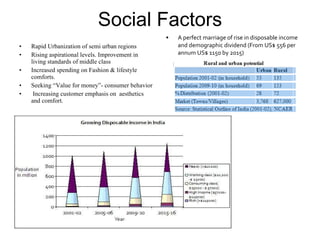
Social Factors Rapid Urbanization of semi urban regions   Rising aspirational levels. Improvement in living standards of middle class Increased spending on Fashion & lifestyle comforts. Seeking “Value for money”- consumer behavior Increasing customer emphasis on  aesthetics and comfort. A perfect marriage of rise in disposable income and demographic dividend (From US$ 556 per annum US$ 1150 by 2015)
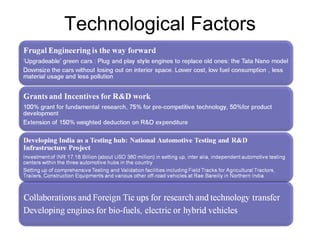
Technological Factors
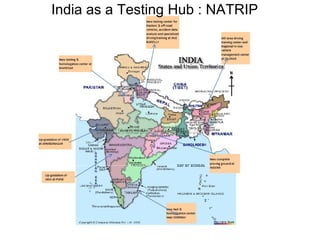
India as a Testing Hub : NATRIP
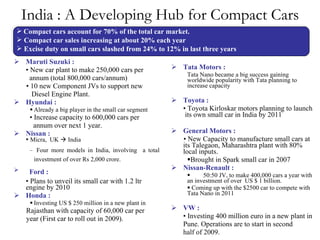
India : A Developing Hub for Compact Cars Maruti Suzuki : •  New car plant to make 250,000 cars per   annum (total 800,000 cars/annum) •  10 new Component JVs to support new Diesel Engine Plant. Hyundai : Already a big player in the small car segment •  Increase capacity to 600,000 cars per annum over next 1 year. Nissan : •  Micra,  UK    India Four more models in India, involving  a total investment of over Rs 2,000 crore.   Ford : •  Plans to unveil its small car with 1.2 ltr engine by 2010 Honda : Investing US $ 250 million in a new plant in Rajasthan with capacity of 60,000 car per year (First car to roll out in 2009). Tata Motors : Tata Nano became a big success gaining worldwide popularity with Tata planning to increase capacity Toyota : •  Toyota Kirloskar motors planning to launch  its own small car in India by 2011  General Motors : •  New Capacity to manufacture small cars at its Talegaon, Maharashtra plant with 80% local inputs. Brought in Spark small car in 2007 Nissan-Renault : 50:50 JV, to make 400,000 cars a year with an investment of over  US $ 1 billion. Coming up with the $2500 car to compete with Tata Nano in 2011 VW : •  Investing 400 million euro in a new plant in Pune. Operations are to start in second half of 2009. Compact cars account for 70% of the total car market. Compact car sales increasing at about 20% each year Excise duty on small cars slashed from 24% to 12% in last three years
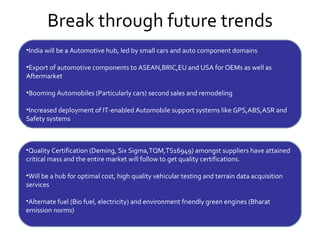
Break through future trends India will be a Automotive hub, led by small cars and auto component domains Export of automotive components to ASEAN,BRIC,EU and USA for OEMs as well as Aftermarket Booming Automobiles (Particularly cars) second sales and remodeling  Increased deployment of IT-enabled Automobile support systems like GPS,ABS,ASR and Safety systems . Quality Certification (Deming, Six Sigma,TQM,TS16949) amongst suppliers have attained critical mass and the entire market will follow to get quality certifications. Will be a hub for optimal cost, high quality vehicular testing and terrain data acquisition services Alternate fuel (Bio fuel, electricity) and environment friendly green engines (Bharat emission norms)
References www.acmainfo.com www.wikipedia.org www.siamindia.com www.ibef.org Ernst & Young Auto Track www.economywatch.com www.business-standard.com The Economic Times Hindu Business Line www.automobileindia.com automobiles.mapsofindia.com
 

Indian Auto Industry Analysis

  • 1.
  • 2.
    Indian Auto IndustryFacts Second Largest two wheeler manufacturer in the world Largest tractor and three wheeler manufacturers in the world Fourth largest Commercial vehicle market in the world Eleventh largest passenger car market in the world Growth Potential Can become World’s third largest automobile market in 2030. By 2016, Automotive sector can DOUBLE its percentage contribution to GDP from current levels of 5% (US$50 billion) to 10% ($180 billion). Trends Growth of exports of 32.8 % FY 2008-09. Output of commercial vehicles has grown 2.8 times compared to the 2.2 times increase in passenger cars For every passenger car turned out, there are almost 7 two-wheelers produced
  • 3.
    The Growth JourneyPre 1983 1983-1993 1993-2007 Era of globalisation and evolution of India as a global manufacturing hub Closed market • Growth of market limited by supply • Outdated models Players • Hindustan Motors • Premier • Telco • Ashok Leyland • Mahindra & Mahindra Japanisation - GOI- Suzuki joint venture to form Maruti Udyog • Joint ventures with companies in commercial vehicles and components Players • Maruti Udyog • Hindustan Motors • Premier • Telco • Ashok Leyland • Mahindra & Mahindra Delicensing of sector in 1993 • Global major OEMs start assembly in India (Toyota, GM, Ford, Honda, Hyundai) • Imports allowed from April 2001; alignment of duty on components and parts to ASEAN levels • Implementation of VAT
  • 4.
    Automotive Companies inIndia Major Multi-national companies Major Indian Companies
  • 5.
  • 6.
  • 7.
    Auto Industry NumbersOverall Market Over all Production increased from 10.85 million vehicles in 2007-08 to 11.17 million vehicles in 2008-09 Passenger vehicles increased marginally from 1.77 million to 1.83 million Two-wheelers increased from 8.02 million to 8.41 million Domestic Market   Vehicles sold including PV,CV 2W and 3W in 2008-09 was 9.72 million as compared to 9.65 million in 2007-08. Exports Sales increased from 1.23mn units in 2007-08 to 1.53 million units in 2008-09 As per the Automotive Mission Plan (AMP) 2006-2016 total turnover of the automotive industry in India would be in the order of US$ 122 billion-159 billion in 2016
  • 8.
    Category wise numbersTwo Wheeler Passenger Vehicles Commercial Vehicles Three Wheeler Dominated by Motorcycles 80% , Scooters 14% Mopeds 6% Domestic - 7.25mn units . Hero Honda 42% & Bajaj 27% share CAGR – 9.5% Exports 819000 units (07-08) . Bajaj Auto 59% TVS 17% share CAGR – 41% Dominated by Cars 78% , MUV/SUV 22% Domestic – 1.5mn units Maruti-46% Tata-15% Hyundai 14% CAGR -14.8% Exports - 217000 units (07-08) Maruti 66% Hyundai 24% CAGR – 26% Dominated by M&HCV – Goods 48% Passenger 38% , Rest by LCV -14% Domestic – 487 thousand units , Tata-62% Ashok Leyland -15% CAGR- 22% Exports – 59 thousand units, Tata 67% Ashok Leyland 12% CAGR -30.6% Dominated by Passenger Carriers with 64% share , Goods Carrier -36% Domestic – 365 thousand units , Bajaj -42% Piaggio-41% CAGR- 10.5% Export – 141 thousand units , Bajaj -97% CAGR -44.5%
  • 9.
    The Indian AutoComponents Market Original Equipment Manufacturers (OEMs) Replacement Parts Production and Distribution : e.g. Air filters, oil filers and replacement lights Rubber Fabrication : tyres, hoses, belts etc. Estimated component market size is US$ 6.7 bn The exports of auto components industry has grown at a rate of nearly 30 per cent CAGR over the last four years.
  • 10.
    Second Hand AutomobileMarket Used car market demand : 1.4 million cars annually Market Structure : Organized : 10% Unorganized : 90% Vendor Based – 30% Direct Dealings – 70% Certified used car dealers in India are – Maruti TrueValue, Honda Auto Terrace, Ford Assured, Toyota U Trust, Hyundai Advantage, Mahindra and Mahindra’s First Choice, General Motors - Chevrolet-OK Unorganized market lacks services like  -warranties, OEM equipments, insurance and taxes Second hand market expected to grow at 12-15 per cent in the next five years to touch a robust 2.5 million units and a turnover of Rs 50 thousand crore Estimations are that 50 percent of the used cars sales will be brought under organized car market by 2013
  • 11.
    Political - LegalFactors Boosted Economic Growth 1 year 6% cut in CENVAT, abolition of surcharge on income tax. Abolition of FBT, Reduction of excise duty on big cars. Encourage Urban Fleet Modernization 1-5 Years - Providing Special Auto-component Parks (SAP) and Special Economic Zones (SEZ) as in IT . Negative list of items and rules of origin in FTAs / RTAs. (ASEAN Free Trade Agreement) - SIAM recommended the government on extending excise and sales tax benefits to customers who opt for scrappage of their old vehicles 5-10 Years Effective Implementation and Uniform enforcement of GST Maintain a three tier tariff structure for raw materials, intermediate goods, finished goods. Revamp WTO compatible export promotional schemes like DEPB, EOU and EPCG schemes AMP Plan 2006-16 set by govt Stunted Economic Growth 1 year Differential excise duty for small and big cars. Customs duty for imported cars including hybrid cars. Excise duty cut only for petrol driven trucks 1-5 Years Existing Complex labor laws( 45 Central acts and 16 associated rules) Not implementing country wide VAT Ambiguous policy in land acquisition for green field projects . 5-10 Years Poor execution of Infrastructure investments. (Construction of Highways of 16km per day against the target of 32 km per day) Absence of National Auto fuel Policy (NAFP)
  • 12.
    Economic Factors 1year 1-5 year 5-10 years Increased access to credit and lower interest loans Investment in Infrastructure spending can boost the commercial vehicles segment. Growing working population (441 million people in 2015/16) Upward migration of household income levels (600 million people have annual income of more than $10,200) Middle class expanding by 30 - 40 million every year Can propel growth
  • 13.
    Economic Factors 1year 1-5 year 5-10 years Impact of delayed monsoon (85% of normal, subsequent impact on paddy cultivation) on rural demand. Non-availability of Key raw material (like Steel) at cheap price. Possible increase of interest rates (by 2-2.5% BPLR) because of planned government borrowing . Non- availability of supplier base with demanded capability (Quality and Quantity). Poor execution of Infrastructure investments. (Construction of Highways of 16km per day against the target of 32 km per day) Increase in crude oil price($ 35/barrel to $ 70/ barrel in 14 months). Can Stunt Growth
  • 14.
    Social Factors RapidUrbanization of semi urban regions Rising aspirational levels. Improvement in living standards of middle class Increased spending on Fashion & lifestyle comforts. Seeking “Value for money”- consumer behavior Increasing customer emphasis on aesthetics and comfort. A perfect marriage of rise in disposable income and demographic dividend (From US$ 556 per annum US$ 1150 by 2015)
  • 15.
  • 16.
    India as aTesting Hub : NATRIP
  • 17.
    India : ADeveloping Hub for Compact Cars Maruti Suzuki : • New car plant to make 250,000 cars per annum (total 800,000 cars/annum) • 10 new Component JVs to support new Diesel Engine Plant. Hyundai : Already a big player in the small car segment • Increase capacity to 600,000 cars per annum over next 1 year. Nissan : • Micra, UK  India Four more models in India, involving a total investment of over Rs 2,000 crore.   Ford : • Plans to unveil its small car with 1.2 ltr engine by 2010 Honda : Investing US $ 250 million in a new plant in Rajasthan with capacity of 60,000 car per year (First car to roll out in 2009). Tata Motors : Tata Nano became a big success gaining worldwide popularity with Tata planning to increase capacity Toyota : • Toyota Kirloskar motors planning to launch its own small car in India by 2011 General Motors : • New Capacity to manufacture small cars at its Talegaon, Maharashtra plant with 80% local inputs. Brought in Spark small car in 2007 Nissan-Renault : 50:50 JV, to make 400,000 cars a year with an investment of over US $ 1 billion. Coming up with the $2500 car to compete with Tata Nano in 2011 VW : • Investing 400 million euro in a new plant in Pune. Operations are to start in second half of 2009. Compact cars account for 70% of the total car market. Compact car sales increasing at about 20% each year Excise duty on small cars slashed from 24% to 12% in last three years
  • 18.
    Break through futuretrends India will be a Automotive hub, led by small cars and auto component domains Export of automotive components to ASEAN,BRIC,EU and USA for OEMs as well as Aftermarket Booming Automobiles (Particularly cars) second sales and remodeling Increased deployment of IT-enabled Automobile support systems like GPS,ABS,ASR and Safety systems . Quality Certification (Deming, Six Sigma,TQM,TS16949) amongst suppliers have attained critical mass and the entire market will follow to get quality certifications. Will be a hub for optimal cost, high quality vehicular testing and terrain data acquisition services Alternate fuel (Bio fuel, electricity) and environment friendly green engines (Bharat emission norms)
  • 19.
    References www.acmainfo.com www.wikipedia.orgwww.siamindia.com www.ibef.org Ernst & Young Auto Track www.economywatch.com www.business-standard.com The Economic Times Hindu Business Line www.automobileindia.com automobiles.mapsofindia.com
  • 20.