INCOME UNDER THE HEAD
“ INCOME FROM HOUSE
PROPERTY”
TOTAL INCOME
 "Total income” u/s 2(45) means the total amount of
income referred to in Chapter 5 computed in the manner
laid down under this Act i.e. HEADS:
 Salaries
 Income from house property
 Profits and gains of business or
profession.
 Capital gains
 Income from other sources.
CONDITIONS TO BE
SATISFIED
1. The property must consist of buildings or lands
appurtenant thereto.
2. The assessee must be the OWNER of such
house property.
3. The property should not be used by the owner
thereof for the purpose of any business or
profession carried on by him, the profits of
which are chargeable to tax.
BASIS OF CHARGE
Chargeability [ Section 22 ]
The basis of charge is Annual Value of the
property
However, if let out, then vacancy allowance
for the vacant period which means rent
received or receivable less local taxes paid
actually.
4
PROPERTY CONSISTING OF ANY
BUILDING OR LAND APPURTENANAT
THERETO
 The term “ property” is very wide; but here only
House Property is concerned;
 Rental income of a vacant plot;
 It can be charged under the head “ Profits and
gains of business or profession” or under the
head” Income from other sources” as the case
may be.
BUILDING
 Word “ building” is wide enough to include
residential house; OR
 building let out for office use or for storage
or for use as factory, music halls, dance
halls, lecture halls, and other public
auditorium used for cinema and stage
shows.
LAND APPURTENANT THERETO
 Approach roads to and from public streets,
compounds, courtyards, backyards, playgrounds,
kitchen garden etc. attached to and forming part
of building.
 Non-residential building: car-parking spaces,
roads, connecting one department with another
department, playgrounds for the benefit of
employees, etc.
“OWNER”
 The word “owner” means a legal owner but in
his own right;
 Income from subletting is either ‘business
income’ under section 28 or it is from ‘other
sources’ under section 56.
DEEMED OWNERSHIP [Section 27]
 The following persons though not the legal
owners of a property, are deemed to be the
owners, for the purposes of sections 22 to 26.
 (i) Transfer of property by an individual to
his/her spouse, without adequate consideration;
but not transferred in connection with an
agreement to live apart.
Cont….
 Transfer of property by an individual to his or
her minor child otherwise than for adequate
consideration; but not to a minor married
daughter;
 The transferor shall remain ‘owner’ for the
purposes of rental income.
 (iii) The holder of an impartible estate shall
be deemed to be the individual owner of all
properties comprised in the estate.
The impartible estate is a property which is
not legally divisible.
 (iv) A member of a co-operative society, to
whom a building is allotted or leased as per the
scheme.
 (v) A person who is allowed to take or retain
the possession of any building or part thereof
in part performance under section 53A of the
Transfer of Property Act;
 (vi) A person who acquires any right for not
less than 12 years.
DETERMINATION OF GROSS ANNUAL
VALUE
 The annual value of any property shall be the
sum for which the property might reasonably be
expected to be let.
 It is neither actual rent nor the municipal
valuation of the property. It is something
notional rent which could have been derived,
had the property been let.
REASONABLE EXPECTED RENT
 (a) Municipal valuation of the property
How ascertained?
 (b) Fair rent of the property.
(fetched by a similar property in the
same or similar locality);
 (c) Standard Rent of the property
The higher of (a) and (b) is generally taken as
expected reasonable rent.
STANDARD RENT UNDER THE RENT
CONTROL ACTS
 A landlord cannot reasonably expect to receive from
a hypothetical tenant anything more than the
standard rent under the Rent Control Act [ Shiela
Kaushish Vs.CIT – 7 Taxman 1 and Amolak Ram
Khosla Vs. CIT[1981] 7 Taxman 51(SC) ]
 the annual value of the house belonging to the
assessee must be taken to be the standard rent of the
house determinable under the provisions of the Rent
Act. The revenue will pay the costs of the appeals to
the assessee.
Therefore reasonable expected rent will be
computed on the basis of three factors,
namely:-
 (a) Municipal Valuation,
 (b) Fair rent of the property; and
 (c) Standard rent of the property.
The higher of (a) and (b), subject to
maximum of (c) is reasonable expected rent.
COMPUTATION IF COMPOSITE RENT
IS PAID OR PAYABLE
 In case of composite rent of a property as well
as certain benefits provided by the landlord;
 How to work out the rent attributable to the
house property only.
DETERMINATION OF GROSS ANNUAL
VALUE
 Step 1 – Reasonable expected rent is taken as
gross annual value if step 2 and step 3 are not
applicable.
 Step 2- If rent receivable is more than
reasonable expected rent, then rent received or
receivable is taken as gross annual value.
Cont.
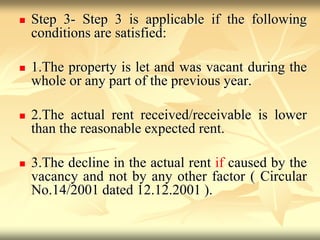
 Step 3- Step 3 is applicable if the following
conditions are satisfied:
 1.The property is let and was vacant during the
whole or any part of the previous year.
 2.The actual rent received/receivable is lower
than the reasonable expected rent.
 3.The decline in the actual rent if caused by the
vacancy and not by any other factor ( Circular
No.14/2001 dated 12.12.2001 ).
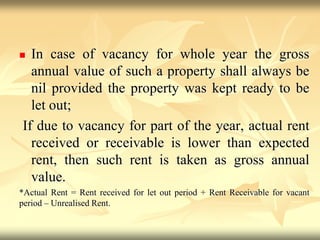
 In case of vacancy for whole year the gross
annual value of such a property shall always be
nil provided the property was kept ready to be
let out;
If due to vacancy for part of the year, actual rent
received or receivable is lower than expected
rent, then such rent is taken as gross annual
value.
*Actual Rent = Rent received for let out period + Rent Receivable for vacant
period – Unrealised Rent.
DEDUCT MUNICIPAL TAXES FROM
GROSS ANNUAL VALUE
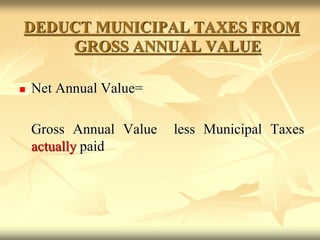
 Net Annual Value=
Gross Annual Value less Municipal Taxes
actually paid
DEDUCTIONS UNDER SECTION 24
FROM THE NET ANNUAL VALUE
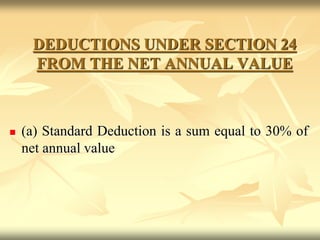
 (a) Standard Deduction is a sum equal to 30% of
net annual value
 (b) Where the property has been acquired,
constructed, repaired, renewed or reconstructed
with borrowed capital, the amount of any interest
payable on such capital (in case of SOP, it is
limited).
INTEREST ON BORROWED
CAPITAL [ SECTION 24(b) ]
 (1) Deductible on “accrual” basis. It can be
claimed on yearly basis, even if the interest is not
actually paid during the year.
 (2) No deduction is allowed for any brokerage or
commission for arranging the loan.
 (3) Interest on a fresh loan, taken to repay the
original loan, is also allowable as deduction. [
Circular No. 28,dated august 20,1989 ].
Contd.
 It is on the balance outstanding on the last
day of each month [Clarification by CBDT
vide Circular No.363, dated June 24,1983 ]
ARRANGEMENT TO PAY SALE
PRICE IN INSTALLMENTS
 If the house property is purchased on installments,
comprising of principal and interest thereon;
 The unpaid purchase price is treated [deemed] as
loan from the seller and the interest paid thereon
shall be deducted from rent received u/s 24(b);
 In the case of a let out property interest on
borrowed capital is deductible without any
ceiling.
(8) Interest paid on borrowed capital for
acquisition of plot is also allowable as the word
property is used in Section 24(b) and not the word
house property. It was held so in the case-- [ CIT
Vs. Amrit Lal Adlakha [ 2007] [105 TTJ 271]
INTEREST OF PRE-CONSTRUCTION
PERIOD
 Interest relating to preconstruction period or
before acquisition of property is deductible in
five equal annual installments. The year in
which house is acquired or constructed shall be
the first year.
INTEREST WHEN NOT DEDUCTIBLE
[SECTION 25 ]
 Interest payable outside India shall not
be allowed as deduction
 However it is allowable:-
a) If the tax is paid or deducted at source; And
b) there is a person in India, who may be treated
as agent of the recipient.
SELF-OCCUPIED PROPERTY
 Annual Value shall be Nil [ Section 23(2)(a) and
(b) If:-
 (a) it is self occupied; or
 (b) it is kept vacant
i. due to owner’s employment, business at any
other place; where
ii. he has to reside in a building not belonging to
him and
iii. no other benefit is derived by the owner from
such house.
WHERE ASSESSEE HAS MORE
THAN ONE HOUSE FOR SELF
OCCUPATION [ SECTION 23(4) ]
 The other house(s) will be deemed to be let out
and only one at the option of the assessee shall
be treated as self occupied.
DEDUCTIONS ALLOWABLE FOR ONE
SELF OCCUPIED HOUSE
 Not entitled to the standard deduction of 30%.
 Deduction on account of interest
(including 1/5th of the accumulated interest of pre-
construction period) as follows :-
Cont.
 (a) Capital borrowed on or after 01-04-1999 and
acquisition or construction of property is
completed within 3 years of the end of the
financial year in which the capital was borrowed;
 Actual interest payable subject to maximum
Rs. 2,00,000/- subject to furnishing of certificate
, if loan is borrowed before 01.04.1999 than
interest allowed for deduction is maximum to Rs.
30,000/-;
 Even under new Tax Code passed by Lok Sabha
on 27th of August 2010, it has been retained.
TREATMENT OF UNREALISED
RENT [EXPLANATION TO
SECTION 23(1)]
 The unrealized rent shall not be included
in the rental income, but subject to the
rules made in this behalf to check the
misuse of this concession.
Cont.
RULE 4 FOR UNREALIZED RENT
 (a) The tenancy is bonafide.
 (b) The defaulting tenant has vacated, or steps
have been taken to compel him to vacate the
property.
 (c) The defaulting tenant is not in occupation of
any other property of the assessee.
 (d) The assessee has taken all reasonable steps
to institute legal proceedings for the recovery of
the unpaid rent or satisfies the Assessing Officer
that legal proceedings would be useless.
UNREALIZED RENT RECEIVED
SUBSEQUENTLY TO BE CHARGED
TO INCOME TAX [ SECTION 25A ]
 The amount realised subsequently, if not included
in rent earlier, shall be the deemed income in the
year of receipt.
 In the year of realisation, the assessee may or
may not be the owner of the property.
SPECIAL PROVISIONS FOR ARREARS
OF RENT RECEIVED
 Deduction of 30% shall be allowed;
 The assessee may or may not be the owner
in the year of receipt.
PROPERTY OWNED BY CO-OWNERS
[SECTION 26]
 The co-owners having definite and
ascertainable share shall be assessed
accordingly and not as an AOP.
 If property is self occupied by the co-
owners the ALV for each shall be nil.
Cont.
 However entitled to deduction of interest upto
2 lakhs on borrowed capital.
 However if co-owners have let it out,
computation shall be made as if it were one
person; [no deduction to each] and there after
the income shall be apportioned according to
their definite share.
Cont.
APPLICABILITY OF SECTION 22 IN
CERTAIN TYPICAL SITUATIONS
House property in a foreign country
 (a) Rent from a property in foreign country
received by resident assessee is taxable.
 (b) However in the case of Non-resident it
shall be taxable only if it is received in
India.
DISPUTED OWNERSHIP
 If ownership is under dispute in a court of law,
the decision rests with the Income-tax
Department;
 The department has prima facie the power to
decide whether the assessee is the owner and is
chargeable to tax under section 22, without
waiting for judicial judgment of any suit filed in
respect of the property – Keshardeo Chamaria
(1937) 5 ITR 246 ( Cal.).
HIRING OF COMPLEX:
PROPERTY+SERVICES
 Property and other facilities e.g., a furnished
paying guest accommodation, a well equipped
theatre, a safe deposit vault.
 Income in such cases may be assessed as income
from business.
THANK YOU

INCOME_FROM_HOUSE_PROPERTY-1.pptx

  • 1.
    INCOME UNDER THEHEAD “ INCOME FROM HOUSE PROPERTY”
  • 2.
    TOTAL INCOME  "Totalincome” u/s 2(45) means the total amount of income referred to in Chapter 5 computed in the manner laid down under this Act i.e. HEADS:  Salaries  Income from house property  Profits and gains of business or profession.  Capital gains  Income from other sources.
  • 3.
    CONDITIONS TO BE SATISFIED 1.The property must consist of buildings or lands appurtenant thereto. 2. The assessee must be the OWNER of such house property. 3. The property should not be used by the owner thereof for the purpose of any business or profession carried on by him, the profits of which are chargeable to tax.
  • 4.
    BASIS OF CHARGE Chargeability[ Section 22 ] The basis of charge is Annual Value of the property However, if let out, then vacancy allowance for the vacant period which means rent received or receivable less local taxes paid actually. 4
  • 5.
    PROPERTY CONSISTING OFANY BUILDING OR LAND APPURTENANAT THERETO  The term “ property” is very wide; but here only House Property is concerned;  Rental income of a vacant plot;  It can be charged under the head “ Profits and gains of business or profession” or under the head” Income from other sources” as the case may be.
  • 6.
    BUILDING  Word “building” is wide enough to include residential house; OR  building let out for office use or for storage or for use as factory, music halls, dance halls, lecture halls, and other public auditorium used for cinema and stage shows.
  • 7.
    LAND APPURTENANT THERETO Approach roads to and from public streets, compounds, courtyards, backyards, playgrounds, kitchen garden etc. attached to and forming part of building.  Non-residential building: car-parking spaces, roads, connecting one department with another department, playgrounds for the benefit of employees, etc.
  • 8.
    “OWNER”  The word“owner” means a legal owner but in his own right;  Income from subletting is either ‘business income’ under section 28 or it is from ‘other sources’ under section 56.
  • 9.
    DEEMED OWNERSHIP [Section27]  The following persons though not the legal owners of a property, are deemed to be the owners, for the purposes of sections 22 to 26.  (i) Transfer of property by an individual to his/her spouse, without adequate consideration; but not transferred in connection with an agreement to live apart. Cont….
  • 10.
     Transfer ofproperty by an individual to his or her minor child otherwise than for adequate consideration; but not to a minor married daughter;  The transferor shall remain ‘owner’ for the purposes of rental income.
  • 11.
     (iii) Theholder of an impartible estate shall be deemed to be the individual owner of all properties comprised in the estate. The impartible estate is a property which is not legally divisible.  (iv) A member of a co-operative society, to whom a building is allotted or leased as per the scheme.
  • 12.
     (v) Aperson who is allowed to take or retain the possession of any building or part thereof in part performance under section 53A of the Transfer of Property Act;  (vi) A person who acquires any right for not less than 12 years.
  • 13.
    DETERMINATION OF GROSSANNUAL VALUE  The annual value of any property shall be the sum for which the property might reasonably be expected to be let.  It is neither actual rent nor the municipal valuation of the property. It is something notional rent which could have been derived, had the property been let.
  • 14.
    REASONABLE EXPECTED RENT (a) Municipal valuation of the property How ascertained?  (b) Fair rent of the property. (fetched by a similar property in the same or similar locality);  (c) Standard Rent of the property The higher of (a) and (b) is generally taken as expected reasonable rent.
  • 15.
    STANDARD RENT UNDERTHE RENT CONTROL ACTS  A landlord cannot reasonably expect to receive from a hypothetical tenant anything more than the standard rent under the Rent Control Act [ Shiela Kaushish Vs.CIT – 7 Taxman 1 and Amolak Ram Khosla Vs. CIT[1981] 7 Taxman 51(SC) ]  the annual value of the house belonging to the assessee must be taken to be the standard rent of the house determinable under the provisions of the Rent Act. The revenue will pay the costs of the appeals to the assessee.
  • 16.
    Therefore reasonable expectedrent will be computed on the basis of three factors, namely:-  (a) Municipal Valuation,  (b) Fair rent of the property; and  (c) Standard rent of the property. The higher of (a) and (b), subject to maximum of (c) is reasonable expected rent.
  • 17.
    COMPUTATION IF COMPOSITERENT IS PAID OR PAYABLE  In case of composite rent of a property as well as certain benefits provided by the landlord;  How to work out the rent attributable to the house property only.
  • 18.
    DETERMINATION OF GROSSANNUAL VALUE  Step 1 – Reasonable expected rent is taken as gross annual value if step 2 and step 3 are not applicable.  Step 2- If rent receivable is more than reasonable expected rent, then rent received or receivable is taken as gross annual value. Cont.
  • 19.
     Step 3-Step 3 is applicable if the following conditions are satisfied:  1.The property is let and was vacant during the whole or any part of the previous year.  2.The actual rent received/receivable is lower than the reasonable expected rent.  3.The decline in the actual rent if caused by the vacancy and not by any other factor ( Circular No.14/2001 dated 12.12.2001 ).
  • 20.
     In caseof vacancy for whole year the gross annual value of such a property shall always be nil provided the property was kept ready to be let out; If due to vacancy for part of the year, actual rent received or receivable is lower than expected rent, then such rent is taken as gross annual value. *Actual Rent = Rent received for let out period + Rent Receivable for vacant period – Unrealised Rent.
  • 21.
    DEDUCT MUNICIPAL TAXESFROM GROSS ANNUAL VALUE  Net Annual Value= Gross Annual Value less Municipal Taxes actually paid
  • 22.
    DEDUCTIONS UNDER SECTION24 FROM THE NET ANNUAL VALUE  (a) Standard Deduction is a sum equal to 30% of net annual value
  • 23.
     (b) Wherethe property has been acquired, constructed, repaired, renewed or reconstructed with borrowed capital, the amount of any interest payable on such capital (in case of SOP, it is limited).
  • 24.
    INTEREST ON BORROWED CAPITAL[ SECTION 24(b) ]  (1) Deductible on “accrual” basis. It can be claimed on yearly basis, even if the interest is not actually paid during the year.  (2) No deduction is allowed for any brokerage or commission for arranging the loan.  (3) Interest on a fresh loan, taken to repay the original loan, is also allowable as deduction. [ Circular No. 28,dated august 20,1989 ]. Contd.
  • 25.
     It ison the balance outstanding on the last day of each month [Clarification by CBDT vide Circular No.363, dated June 24,1983 ]
  • 26.
    ARRANGEMENT TO PAYSALE PRICE IN INSTALLMENTS  If the house property is purchased on installments, comprising of principal and interest thereon;  The unpaid purchase price is treated [deemed] as loan from the seller and the interest paid thereon shall be deducted from rent received u/s 24(b);
  • 27.
     In thecase of a let out property interest on borrowed capital is deductible without any ceiling.
  • 28.
    (8) Interest paidon borrowed capital for acquisition of plot is also allowable as the word property is used in Section 24(b) and not the word house property. It was held so in the case-- [ CIT Vs. Amrit Lal Adlakha [ 2007] [105 TTJ 271]
  • 29.
    INTEREST OF PRE-CONSTRUCTION PERIOD Interest relating to preconstruction period or before acquisition of property is deductible in five equal annual installments. The year in which house is acquired or constructed shall be the first year.
  • 30.
    INTEREST WHEN NOTDEDUCTIBLE [SECTION 25 ]  Interest payable outside India shall not be allowed as deduction  However it is allowable:- a) If the tax is paid or deducted at source; And b) there is a person in India, who may be treated as agent of the recipient.
  • 31.
    SELF-OCCUPIED PROPERTY  AnnualValue shall be Nil [ Section 23(2)(a) and (b) If:-  (a) it is self occupied; or  (b) it is kept vacant i. due to owner’s employment, business at any other place; where ii. he has to reside in a building not belonging to him and iii. no other benefit is derived by the owner from such house.
  • 32.
    WHERE ASSESSEE HASMORE THAN ONE HOUSE FOR SELF OCCUPATION [ SECTION 23(4) ]  The other house(s) will be deemed to be let out and only one at the option of the assessee shall be treated as self occupied.
  • 33.
    DEDUCTIONS ALLOWABLE FORONE SELF OCCUPIED HOUSE  Not entitled to the standard deduction of 30%.  Deduction on account of interest (including 1/5th of the accumulated interest of pre- construction period) as follows :- Cont.
  • 34.
     (a) Capitalborrowed on or after 01-04-1999 and acquisition or construction of property is completed within 3 years of the end of the financial year in which the capital was borrowed;  Actual interest payable subject to maximum Rs. 2,00,000/- subject to furnishing of certificate , if loan is borrowed before 01.04.1999 than interest allowed for deduction is maximum to Rs. 30,000/-;  Even under new Tax Code passed by Lok Sabha on 27th of August 2010, it has been retained.
  • 35.
    TREATMENT OF UNREALISED RENT[EXPLANATION TO SECTION 23(1)]  The unrealized rent shall not be included in the rental income, but subject to the rules made in this behalf to check the misuse of this concession. Cont.
  • 36.
    RULE 4 FORUNREALIZED RENT  (a) The tenancy is bonafide.  (b) The defaulting tenant has vacated, or steps have been taken to compel him to vacate the property.  (c) The defaulting tenant is not in occupation of any other property of the assessee.  (d) The assessee has taken all reasonable steps to institute legal proceedings for the recovery of the unpaid rent or satisfies the Assessing Officer that legal proceedings would be useless.
  • 37.
    UNREALIZED RENT RECEIVED SUBSEQUENTLYTO BE CHARGED TO INCOME TAX [ SECTION 25A ]  The amount realised subsequently, if not included in rent earlier, shall be the deemed income in the year of receipt.  In the year of realisation, the assessee may or may not be the owner of the property.
  • 38.
    SPECIAL PROVISIONS FORARREARS OF RENT RECEIVED  Deduction of 30% shall be allowed;  The assessee may or may not be the owner in the year of receipt.
  • 39.
    PROPERTY OWNED BYCO-OWNERS [SECTION 26]  The co-owners having definite and ascertainable share shall be assessed accordingly and not as an AOP.  If property is self occupied by the co- owners the ALV for each shall be nil. Cont.
  • 40.
     However entitledto deduction of interest upto 2 lakhs on borrowed capital.  However if co-owners have let it out, computation shall be made as if it were one person; [no deduction to each] and there after the income shall be apportioned according to their definite share. Cont.
  • 41.
    APPLICABILITY OF SECTION22 IN CERTAIN TYPICAL SITUATIONS House property in a foreign country  (a) Rent from a property in foreign country received by resident assessee is taxable.  (b) However in the case of Non-resident it shall be taxable only if it is received in India.
  • 42.
    DISPUTED OWNERSHIP  Ifownership is under dispute in a court of law, the decision rests with the Income-tax Department;  The department has prima facie the power to decide whether the assessee is the owner and is chargeable to tax under section 22, without waiting for judicial judgment of any suit filed in respect of the property – Keshardeo Chamaria (1937) 5 ITR 246 ( Cal.).
  • 43.
    HIRING OF COMPLEX: PROPERTY+SERVICES Property and other facilities e.g., a furnished paying guest accommodation, a well equipped theatre, a safe deposit vault.  Income in such cases may be assessed as income from business.
  • 44.